 Write to the booksellers
8827 books for « hans a »Edit
-
Type
Autograph (2)
Book (8812)
Engraving (5)
Magazine (1)
Music sheets (67)
New book (4)
-
Latest
Last 24h (1)
Last 3 days (8)
Last month (148)
Last week (4)
-
Language
Dutch (37)
English (26)
French (8631)
German (56)
Japanese (1)
Russian (139)
Swedish (1)
-
Century
16th (9)
17th (22)
18th (61)
19th (152)
20th (4035)
21st (389)
-
Countries
Belgium (1097)
Canada (38)
China (2)
Côte d'Ivoire (31)
Denmark (256)
France (5331)
Germany (5)
Greece (9)
Switzerland (1967)
United Kingdom (16)
United States of America (139)
-
Syndicate
ALAC (36)
CLAM (78)
CLAQ (12)
CNE (9)
ILAB (4264)
NVVA (640)
SLACES (640)
SLAM (2739)
SNCAO (4)
Topics
- Adam (20)
- Alps (64)
- Alsace (106)
- Andersen hans christian (570)
- Animals (24)
- Antwerp (21)
- Archaeology (103)
- Architecture (331)
- Army (76)
- Asia - orient (22)
- Austria (45)
- Autographs (24)
- Basel (39)
- Baumann hans (25)
- Belgium (82)
- Bellmer (154)
- Bible (22)
- Bibliography (32)
- Bibliophilism (27)
- Biography (55)
- Carossa hans (26)
- Children’s books (140)
- Christianity (24)
- Churches (19)
- Comic strip (28)
- Curiosa (31)
- Drawings (38)
- Economics (63)
- Egypt (23)
- Engraving (books about) (21)
- Engravings (45)
- Erni hans (30)
- Ethnology (32)
- Europe (23)
- Fallada hans (54)
- Fine arts (184)
- First edition (84)
- Genealogy (25)
- Geography (76)
- Geology (49)
- German literature (38)
- Germanic languages (671)
- Germany (183)
- Graphic art (49)
- Guide books (29)
- Habe hans (24)
- Haug hans (33)
- Helvética (518)
- Herlin hans (26)
- History (509)
- Holbein (54)
- Illustrated books (36)
- Industrial arts & crafts - fine arts (69)
- Ink (30)
- Jacob (28)
- Kirst hans hellmut (89)
- Kluber hans (31)
- Küng hans (65)
- Law (50)
- Legends (28)
- Linguistics (31)
- Literature (394)
- Medicine (80)
- Military arts (34)
- Mountaineering climbing (19)
- Music (54)
- Navy (43)
- Painters (33)
- Painting (38)
- Painting (120)
- Philology (38)
- Philosophy (136)
- Photography (120)
- Poetry (65)
- Policy (30)
- Psychology (27)
- Regionalism (20)
- Religions (98)
- Review (84)
- Scandinavian (22)
- Sciences (135)
- Scores (93)
- Sculpture (38)
- Sociology (29)
- Songs (62)
- Surrealism (60)
- Switzerland (494)
- Tales (96)
- Tea (33)
- Theatre (36)
- Theology (86)
- Travel (32)
- Travels & tourism (20)
- Various (41)
- War (150)
- Youth (56)
- Zoology (19)
- Zurich (77)
Hans Haug, Paul Vitry, Pierre Francastel, Hans Reinhardt, Paul Ahnne, Pierre Scize -
Reference : 42495
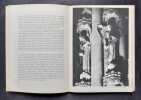
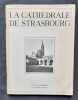
La Cathédrale de Strasbourg 1439-1939 - Le Point, numéro spécial, n°XIX, février 1939 -
textes de Hans Haug, Paul Vitry, Pierre Francastel, Hans Reinhardt, Paul Ahnne, Pierre Scize - Lanzac, par Souillac (Lot) : Le Point (Revue Artistique et Littéraire), février 1939 - in-8 agrafé (19,5x26 cm) sous couverture rempliée, 56 pages - illustré de 32 photographies en héliogravure de la cathédrale - bon état -
Tous nos livres sont visibles sur notre site : https://www.livrepoesie.com/
Hans Arp, Hugo Ball, Gabrielle Buffet-Picabia, Serge Charchoune, Raoul Hausmann, Richard Huelsenbeck, Marcel Janco, Man Ray, Georges Ribemont-Dessaignes, Hans Richter, Tristan Tzara - DORIVAL (Bernard) - HOOG (Michel) - WEHRLI (René) - BAUMANN (Felix-Andreas) - BEHAR (Henri) - LIEUSSOU (Yves) - SANOUILLET (Michel) -
Reference : 45381
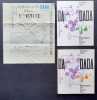
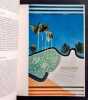
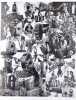
Dada. Ausstellung Zum 50-Jährigen Jubiläum / Exposition Commémorative Du Cinquantenaire -
Catalogues de l'exposition organisée par le Kunsthaus de Zurich et le Musée National d'Art Moderne de Paris, en collaboration avec l'Association pour l'Etude du Mouvement Dada, du 30 novembre 1966 au 30 janvier 1967 - 2 volumes 19x23,2cm brochés sous couvertures illustrées, 112 et 24 pages illustrées de 28 planches hors texte dont 8 en couleurs - Bon état - Textes en allemand et français - Complet de la réimpression du tract, Excursions et visites Dada, un feuillet 31 x 26,5 cm, recto seul. Le placard est plié.
Tous nos livres sont visibles sur notre site : https://www.livrepoesie.com/
Henri DELUY, Hans LEYBOLD, Hugo BALL, Hans ARP, Tristan TZARA, Raoul HAUSMANN, Lionel RICHARD, Francis PICANIA, Walter MEHRING.
Reference : 43904
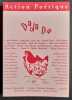
Action poétique n°181, septembre 2005.
Revue trimestrielle. Ivry-sur-Seine, rédacteur en chef : Henri Deluy. Comité de rédaction : Jean-Jacques Viton, Claude Adelen, Jean-Pierre Balpe, Bernard Vargaftig, Florence Pazzottu, etc. Un volume 13x21cm broché de 146 pages. Bon état. Numéro consacré au mouvement Dada.
Fondée au début des années 1950 à Marseille par Gérald Neveu, Action poétique est une des revues de poésie de la seconde moitié du XXème siècle en France qui connut la plus grande longévité. Animée par Henri Deluy, de 1958 jusqu'à sa dernière livraison en 2012 (210 numéros), Action poétique inscrit la poésie dans le champ théorique de la création française : désir de changer le monde, de s’ouvrir à lui, à travers des traductions défricheuses, et d’interroger la langue qui permet de lui donner forme. "Une des plus vastes encyclopédies de la poésie, couvrant tous les âges, tous les pays, de Gilgamesh à la poésie multimédia." (Jean-Yves Lacroix, Catalogue Revues, janvier 2019, p.4). Tous nos livres sont visibles sur notre site : https://www.livrepoesie.com/
ARP (Hans). BRETON (André). LINHARTOVA (Véra). NASSIF (Jacques). PRASSINOS (Gisèle). PIERRE (José). ROCHE (Gérard). SOULAGES (Pierre). SZENTKKUTHY (Miklos). TROTSKY. TSOCLIS (Costas). VILLEGLE (Jacques).
Reference : 47788
Pleine marge. Cahiers de littérature , d'arts plastiques & de critique. N°3, mai 1986.
Cognac : Editions Le Temps qu'il fait, mai 1985. Directrice : Jacqueline Chénieux. Un volume broché (23,8x16,4 cm), 104 pages. Photographies des sculptures et peintures en noir et en couleurs. . Contient 2 poèmes inédits de Hans Arp écrits peu de temps après la mort accidentelle de Sophie-Taeuber-Arp en 1943. Bon état.
Revue semestrielle qui compte 50 numéros de 1985 à 2009. Le titre "Pleine Marge" fait référence au poème d'André Breton et la revue se propose d'interroger l'ensemble de la mouvance surréaliste et des modernités. Elle contient des textes originaux français et étrangers, des contributions critiques sur des écrivains et des artistes et des dossiers plastiques illustrés de documents. Tous nos livres sont visibles sur notre site : https://www.livrepoesie.com/
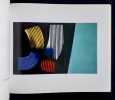
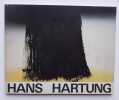
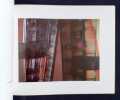
Hans Hartung. Musée Picasso - Antibes. Du 5 juillet au 16 septembre 1979.
Catalogue d'exposition 24x30cm broché de 108 pages illustrées de 48 planches hors texte en couleurs et de photographie de l'artiste. Belle impression des reproductions. Bon état. Texte de Daniel Abadie.
Tous nos livres sont visibles sur notre site : https://www.livrepoesie.com/
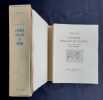
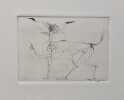
L'Homme déguisé en homme.
Lausanne : Editions André & Pierre Gonin, 1959. Un volume in-4 (33x26,5 cm) en feuilles sous couverture rempliée, emboîtage et étui, 154 pages. Edition originale tirée à 215 exemplaires : un des 200 exemplaires sur Vélin d'Arches pur chiffon avec 16 eaux-fortes de Hans Fischer en hors texte. Bon état.
Tous nos livres sont visibles sur notre site : https://www.livrepoesie.com/
FASSBINDER (Rainer Werner) - IDEN (Peter) - KARSUNKE (Yaak) - PRINZLER (Hans-Helmut) - ROTH (Wilhelm) - WIEGAND (Wilfried) -
Reference : 42595
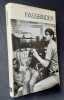
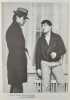
Rainer Werner Fassbinder -
Textes traduits de l'allemand par Esther Tanon - Nantes : L'Atalante, 1982. Un volume broché (13x20 cm) sous jaquette illustrée, 233 pages. Illustré de photographies en noir. textes de Peter Iden, Yaak Karsunke, Hans-Helmut Prinzler, Wilhelm Roth et Wilfried Wiegand. Filmographie in-fine. Bon état.
Tous nos livres sont visibles sur notre site : https://www.livrepoesie.com/
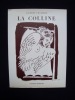
La Colline -
Paris : Pierre Seghers, 1955 - un volume 16,4x22,2cm broché sous couverture illustrée par Hans Erni, 36 pages - très bon état - Envoi autographe signé de l'auteur adressé à Loys Masson -
Tous nos livres sont visibles sur notre site : https://www.livrepoesie.com/
A truly splendid and unique collection of 23 Hans Christian Andersen-items that together tell the true story of Andersen's life and sheds light on all aspects of his life and work. The collection is divided into the following (full descriptions belo... - [MAGNIFICENT HANS CHRISTIAN ANDERSEN-COLLECTION]
(1822) - 1872.
With the present Hans Christian Andersen-collection, we have aimed not at an exhaustive collection of ALL of his many writings nor at a LARGE collection, but at an exquisite, chosen collection that tells us the true story of Andersen's life. A collection that enlightens us about both the author and the man Hans Christian Andersen and that sheds light on all aspects of his life and work. A collection that epitomizes quality, scope, and importance, not merely numbers of items nor works that are not particularly important in his life's work. Every one of the 23 items in the present collection has been carefully chosen to represent a certain Aspect of Hans Christian Andersen at a certain time of his life, in an attempt to get as close to the great fairy tale author as possible. The items basically span his entire career - from his first book, published at the age of 17 (and only known in about 10 copies) to an original manuscript poem by the ageing author at the age of 67. The 23 carefully chosen and unique items cover his earliest publications that are of extreme scarcity, his three seminal fairy tale cycles that catapulted him into fame and created the genre of the fairy tale, for which he is now famous world-wide, five magnificent presentation-copies (among them an absolutely magnificent copy of his very first fairy tale, one of the best presentation-copies known) that each give us an insight into the poet Andersen and into his circle of friends, six splendid original letters that are all different in style and content and written from all over the world (among them one of the extremely rare letters known by him written in English, in Latin hand), an original manuscript, which is an extreme scarcity on private hands and something one may never come by again, two books from Andersen's own library, which is extremely rare to find, as only 75 such books are known and almost all of them are in institutional holdings, and finally the three main translations that ensured his fame in the rest of the world: the most important translations into German, English, and French respectively. The collection is divided into the following seven categories, and below follows a short preview and introduction to each. Upon request, a document with full, elaborate descriptions of each item will be provided. 1. Debuts/earliest publications (see also 3.1.)2. The three fairy tale collections/cycles3. Presentation-copies (see also: 2.3.)4. Letters5. Manuscript6. Books from Andersen's library7. The three main translations1. Debuts/earliest publications1.1. Ungdoms-Forsøg / Gjenfærdet ved Palnatokes Grav, en Original Fortælling" og Alfsol, en original Tragoedie. Ungdoms=Forsøg. Kjöbenhavn, [1822]. The extremely rare first printing of Hans Christian Andersen's first book - with facsimiles of the title-page, the contents-leaf and a further four leaves. The book is exceedingly rare. A title-issue appeared in 1827. No more than about ten copies in all of both the first issue and the title-issue are known to exist - only a couple of them are known in private collections, and less than a handful of copies are known outside of Denmark. The present publication, his first book, is of immense importance to Andersen's life and work and is arguably THE most important piece of Anderseniana. 1.2. Ved min Velgører Provst Gutfelds Død. Slagelse, 1823.The extremely rare first printing of the 1823-issues of this slightly obscure newspaper, which contains Hans Christian Andersen's third publication. This exceedingly rare piece of Anderseniana was published when the master of the fairy tale genre was merely 17 years old, namely in February 1823. The present publication constitutes one of the two pieces of publication that are at the epicentre of the coming-to-be of the greatest poet and author to emerge from Danish soil. This little piece is a heartfelt, almost perfectly stylized poem that constitutes an obituary of Hans Christian Andersen's early benefactor, Gutfeld, who was responsible for Collin accepting to be Andersen's benefactor. It was due to Gutfeld and his belief in Andersen that he made it on into the world and was taken seriously enough - at the mere age of 17 - to later be allowed to follow his heart and his life dream - that of writing.1.3. Fodreise fra Holmens Canal til Østpynten af Amager i Aarene 1828 og 1829. Kjöbenhavn, 1829. The rare first edition of Hans Christian Andersen's debut novel, ""Journey on Foot"", here in the extremely scarce original printed wrappers. Andersen himself considered this book his debut and refers to it as ""my first publication"". It came to play a tremendous role in the development of his writing and constitutes one of his most important works. It is the first piece of Andersen that yields any success and the first work for which he gained any recognition. ""It is a well-known fact that Hans Christian Andersen made his début as a writer three times during his youth. The first time he published a book was in 1822, when ""Youthful Attempts"" came out... He was 17 years old, penniless and in need for help, but the main part of the circulation ended up in the paper mill... The second time he made his début was in 1829, when he published ""Journey on Foot from Holmen's Canal to the Eastern Point of Amager"", a book which can hardly be classified as a travel book.. it seems a subtle and humorous arabesque and a literary satire. This book was published in the year after he had left grammar-school and was qualifying for the entrance examination to academic studies at the university. It can rightly be regarded as a key, which enables us to understand the entire development of his later production...2. The three fairy tale-collections2.1. Eventyr fortalte for Børn. (1.-3. Hefte) + Eventyr fortalte for Børn. Ny Samling (1.-3. Hefte). 2 Bind. Kjöbenhavn, 1835-1847. A lovely set of this exceedingly rare collection of Andersen's earliest fairy tales. This legendary fairy tale-collection that created the fairy tale-genre and brought Andersen international fame, consists in six parts that together make up two volumes. As with most of the other few existing copies, the present set is a mixture of issues and likewise has certain wants concerning title-pages, half-titles and tables of contents. ""During Andersen's lifetime 162 of his Fairy Tales were published, but the scarcest and most difficult to obtain are these six little pamphlets. We do not know exactly how many, or how few, copies were printed, but we do know that no copy with all the title pages and tables of contents has ever been offered for sale.""2.2. Nye Eventyr. 2 Bind (5 samlinger). Kjøbenhavn, 1844 - 48.First edition of Hans Christian Andersen's seminal second collection of fairy tales - the publication that made him internationally famous - with all five collections in first issue, also the first, which is of the utmost rarity. It is in this legendary first collection that we find the first printing of ""The Ugly Duckling""(not as is indicated in PMM in his first). The rarity of the first issue of volume 1, collection 1 is legendary. It was published on November 11th 1843 (dated 1844 on the title-page) in a very small number, probably due to the poor sales of Andersen's first fairy tale collection. Against all belief, this first collection sold out within a few days, catapulting Andersen into worldwide fame, and a second issue was published already on December 21st 1843. Thus, only very few copies of the first issue exist, and almost all collections of the ""New fairy Tales"" are bound with the second issue or the third of 1847, meaning that they do not contain the actual first printing of ""The Ugly Duckling"", ""The Nightingale"", ""The Angel"", and ""The Sweethearts"". 2.3. Nye Eventyr og Historier. 3 Series, 10 collections. Kjøbenhavn, 1858-1872.A splendid fully complete copy of Andersen's third fairy tale collection, WITH ALL 10 ISSUES IN FIRST EDITIONS, FIRST ISSUES, ALL IN THE ORIGINAL PRINTED WRAPPERS, AND ONE OF THEM WITH A SIGNED PRESENTATION-INSCRIPTION BY ANDERSEN - WITH 39 FAIRY TALES IN THEIR FIRST PRINTINGS. It is highly uncommon to find all ten issues of the series together, let alone in the original printed wrappers, each of which is a scarcity on their own. To our knowledge, only one other such set exists in a private collection, and that is in far from as fine condition as the present, where all but one of the issues (which does not have the back wrapper) are fully complete with the spines, exactly as issued. 3. Presentation-copies3.1. Digte. Kjöbenhavn, 1830.THE RARE FIRST EDITION - PRESENTATION-COPY, IN THE EXCEEDINGLY SCARCE ORIGINAL PRINTED WRAPPERS - OF ANDERSEN'S THIRD BOOK, CONTAINING HIS FIRST FAIRY TALE. The magnificent presentation-inscription - hitherto unknown and unregistered - is arguably one of the most important Andersen-presentations known to exist. It is inscribed to Henriette Collin, the then fiancée, later wife, of his closest and most important friend, who was more like a brother to him, Edvard Collin. It is one of the very early Andersen-presentations known. This first published collection of Andersen's poetry constitutes Andersen's third published book (at the age of 24) and contains, at the end, the first printing of any of his fairy tales, being also his very first fairy tale ""The Ghost"" (or ""The Spectre""). This is the first time that Andersen uses the term ""Eventyr"" (fairy tale), the term which came to denote the genre for which he received world-wide fame as one of the most important writers of all time. 3.2. Nye Eventyr. Tredie Samling. Kjøbenhavn, 1845.An excellent presentation-copy of the first edition of the third ""collection"" of Andersen's second fairy tale-collection, containing five of his best fairy tales in the first printing - among them the cherished tales ""The Red Shoes"" and ""The Shepherdess and the Chimney-Sweep "". Inscribed copies of Andersen's fairy tales are very rare and extremely sought-after. But the present presentation-copy is even more interesting, as it is inscribed to a fellow author of tales for children - ""The poet Kaalund/ in kind remembrance/ of our first meeting/ the 29th of April 1845/ from the [NEW FAIRY TALES] (the printed half title) 's author."" -in the collection of Andersen's fairy tales that appeared almost simultaneously with Kaalund's renowned ""Tales for Children"" (""Fabler for Børn""). 3.3. Historier. Anden Samling. Kjøbenhavn, 1853.First edition, in splendid condition, with the original printed wrappers, of the second part of Andersen's ""Story""-collection, containing first printings of four of his famous fairy-tales. With a lovely, poetical presentation-inscription to Frederikke Larcher, signed ""H.C. Andersen"", translated as thus: ""I put my bouquet on the board of the stage/ you yourself make the impression of a fresh bouquet"". Frederikke Larcher was a stage actress, and Andersen might have given the little book as a gift upon her last performance.3.4. Nye Eventyr og Historier. Anden Række (første samling). Kjøbenhavn, 1861.An excellent copy, in the original printed, illustrated wrappers, of the separately published first part of the second series of ""Nye Eventyr og Historier"", with a lovely presentation-inscription to the title-page, translating thus ""The splendid, the spirited,/ Mrs. Agentinde Renck/ send this bouquet of stories/ from my garden of poetry this spring/ Most heartfelt and respectfully/ H.C. Andersen."" This splendid volume contains first printings of one of Andersen's most famous, most beloved and most frequently recounted fairy-tales/stories: ""What the Old Man does is Always Right"". Apart from that masterpiece of moral story-telling, the present publication contains five other of Andersen's great stories in first printings.3.5. Da Spanierne var her. Originalt romantisk Lystspil i tre Acter. Kjøbenhavn (Copenhagen), 1865. An excellent copy of the first edition of Andersen's famed play, in the scarce original binding and with a magnificent presentation-inscription to Rudolph Kranold, who at the time was director of the Royal Theatre in Copenhagen. His short reign here (until 1866) coincides exactly with the work on and premiere of one of the plays that was very closest to Andersen's heart, namely ""When the Spanish were Here"", which premiered at the Royal Theatre on April 6, 1865. Reading Andersen's diaries allows us to actually follow the play the entire way through to the stage. It is evident, both from his diaries and from the present presentation-inscription, that the play meant a lot to Andersen. As the inscription indicates, he's anxious that the play not be taken down again and he clearly asks Kranold to take good care of this play that is close to his heart. 4. Letters4.1. Autographed letter, signed in full (""Hans Christian Andersen""), in English, for the Scottish author William Hurton. Dated ""Copenhagen 2 October 1851"".The present letter is of the utmost interest, as it is written in English (in Andersen's own hand!) and also in Latin letters, as opposed the gothic handwriting that Andersen usually uses. Letters and inscriptions in Andersen's Latin hand are of the utmost scarcity. Out of the few known letters in Andersen's hand, we have even fewer letters by him written in English. He made an exception for William Hurton, to whom a few letters have been preserved, demonstrating his reverence for this Scottishman so fascinated by Andersen himself. Almost all of these letters are in institutional holdings, and the present one on private hands is a true scarcity. 4.2. Autographed letter, signed ""H. C. Andersen"", for Frederik Bøgh. Dated ""Basnæs ved Skjelskjør/ den 3 Juli 1862"". 4 pages.This very lengthy letter from Andersen to Frederik Bøgh is interesting in several respects. First of all, Andersen here mentions several of his works: new songs for the revised version of his opera ""The Raven"", proofreading and numerous comments for the ""new edition of Fairy Tales and Stories"", and a brand new fairy tale: ""Finally, I have written a new fairy tale: ""Snowdrop""."" Furthermore, Andersen talks about his health and problems he has with his eye as well as the weather and his impending travel plans. It is clear from the letter that he is very close to his young student friend Bøgh. 4.3. Autographed letter, signed ""H. C. Andersen"", for Frederik Bøgh. Dated ""Tanger I Marokko/ den 8 Nov: 1862."".An absolutely splendid letter with rare observations about Moroccan culture, the people, how they dress and behave, the food, the landscape, etc. It is clear that Tanger, with its ""wild, romantic nature"", its palm trees, its wilderness, the wild boars and hyenas, is very far from the coldness of the North. Andersen's fascination with the ""half naked men"" and women in horrible dress, with the bare headed Moorish Jews in kaftans, ""the naked brown kids that screamed and roared"", and the slaves that carry goods, leaps from the pages of the letter and paint a picture of a place that to a Dane in 1862 must seem oddly fascinating and so different. There is no doubt that this rich culture served as direct inspiration for Andersen's story-writing. 4.4. Autographed letter, signed ""H. C. Andersen"", for Frederik Bøgh. Dated ""Toledo den 6 December 1862"".A splendid letter from Toledo, which Andersen paints so clearly as only he can. ""Toledo is a dead city, but with the life of poetry"", he writes, after having described in detail, to his dear friend back home, the ruins and the melancholy that is Toledo. 4.5. Autographed letter, signed ""H. C. Andersen"", for ""Kjære William"" (i.e. William Melchior). Dated "" Frijsenborg den 27 August/ 1868. "". A lovely, cheerful birthday letter for the young birthday boy William Melchior, who was turning 7 years old. The letter is utterly charming and describes the journey of the birthday letter itself, flying over land and sea, from Jutland to Copenhagen. The letter not only portrays the ease with which Andersen communicates with children, it also constitutes a miniature version of beloved Andersen-stories such as ""Little Tuk"" and ""A Piece of Pearl String"". 4.6. Autographed letter, signed ""H. C. Andersen"", for Frederik Bøgh. Dated "" den 9 Maj 1873"".This Beautiful little letter for Nicolai Bøgh bears witness to the heartfelt bond that Andersen felt towards his young friend. This little gem of a letter is very poetical - most of it is almost like a poem, describing the sun coming through the clouds and liking the clouds to snow and the heaven to Paradise. Furthermore, Andersen mentions his friends' illness, liking him to a bird that needs to be free. Bøgh had fallen ill the previous year, from an illness that would eventually kill him 9 years later, at the mere age of 45. 5. Manuscript5.1. Original handwritten and signed manuscript for a poem entitled ""Stormfloden"" (i.e. The Storm or The Storm Surge). November (22nd), 1872. 1 1/2 handwritten pp.Original manuscripts by Andersen are of the utmost scarcity, and only very few are known on private hands. The present is the manuscript for a poem that Andersen wrote just a couple of years before he died and which was published as the preface to a ""Christmas Present"" by Vilhelm Gregersen in December 1872, just a few weeks after Andersen wrote it. The poem is very dramatic and doomsday-like, but has an uplifting an upbuilding ending. It is inspired by the dramatic storm or storm surge that hit Copenhagen on November 13th, 1872.6. Books from Andersen's Library6.1. F. ANDERSEN, C.J. HANSEN, J.P.E. HARTMANN, P. HEISE and A. WINDING. Ni Fleerstemmige Mandssange. Udgivne af Foreningen ""Fremtiden"". Kjöbenhavn, 1866.Hans Christian Andersen's own copy, with his ownership signature to the bottom of the front wrapper, of this pamphlet of ""Nine Polyphonic Male Songs"". The pamphlet contains nine lovely songs written by the greatest Danish authors of the period, set to music by the most famous Danish musicians of the period. Andersen's contribution is the song ""Hun har mig glemt"" (She Has me Forgotten), which he had printed for the first time in 1854, but in a different version, with different wording. Here, it is set to music by F. Andersen. 6.2. G.h. [GEORG EMIL BETZONICH]. En Kjærligheds-Historie. Fortælling. Kjøbenhavn, 1862.A truly rare example of a book that has belonged to Andersen, with a long presentation-inscription from the author to Hans Christian Andersen to front free end-paper, dated on Andersen's 58th birthday. The author of the novel Georg Emil Betzonich (1829 - 1901) is not a famous author today, nor was he very famous at the time. It is interesting, however, that Andersen kept his book in his library. The book passed to Edvard Collin, who inherited Andersen's entire estate, when Andersen died in 1875, and also Collin kept it. It was sold at the auction of his belongings in 1886.7. The three main Translations7.1. Jugendleben und Träume eines Italienischen Dichters. Nacch H.C. Andersens Dänischen Original: Improvisatoren. Ins Deutsche übertragen von L. Kruse. 2 Theile. Hamburg, August Campe, 1835.The very rare first edition of the first German translation of Andersen's first novel, ""Improvisatoren"", being the first of Andersen's books to be translated into any foreign language. It is fair to say that no other translation before or after was as important to Andersen as the present. Before the work even appeared, Andersen had a list of recipients for the German translation. Among these was Adalbert Chamisso, to whom he wrote in April 1835: ""Here I send you my Italian son" he speaks the German language, so your family can also understand him. I wish that in the great Germany people will be aware of my book and that I may deserve that awareness. That Kruse is introducing me as an author of novels should be somewhat of a recommendation"… For making such an effort of being known outside of little Denmark, I think, I cannot be blamed."" 7.2. Danish Fairy Legends and Tales. (Translated by Caroline Peachey). London, William Pickering (Chiswick), 1846.The very rare first edition - ANDERSEN'S CLOSE FRIEND HENRIETTE SCAVENIUS' (BORN MOLTKE) COPY - of this highly important Andersen-translation, which contains the very first appearance in English of some of Andersen's most famous and beloved fairy tales: ""The Emperor's New Clothes, ""The Nightingale"", ""The Wild Swans"", ""The Buck-Wheat"" and ""The Dustman"", and for the first time we here find the titles ""The Ugly Duckling"" (previously called ""The Ugly Duck"") and ""The Real Princess"" (previously called ""The Princess and the Peas"").7.3. Contes pour les enfants. Traduit du Danois par V. Caralp. Illustrations à deux teintes par Derancourt. Paris, Morizot, (1848).Extremely scarce first edition of the first translations of any of Hans Christian Andersen's fairy tales to appear in French. This first French Andersen-collection constitutes the introduction of Hans Christian Andersen's works in French literature, the introduction of the fairy-tale-genre in France, and a cornerstone in the history French children's literature.

Dance in Close-Up. Erwin Olaf / Hans van Manen.
BE - , Hannibal Books, 2022 Hardcover, 120 pages, 32x31cm. English edition. Magnifiques illustrations en couleurs FINE!. ISBN 9789464366273.
Een unieke kijk op dans en choreografie door fotograaf Erwin Olaf en choreograaf Hans van Manen Ballet inspireert mij. De mens heeft de capaciteit om zich uit te drukken in vele kunstvormen, maar bij dans en zeker bij klassiek modern ballet verbaas ik me altijd weer over die ongelooflijk hoge vorm van expressie. Het is zo precies en zo ontzettend ambachtelijk, dat bewonder ik enorm. Fotograaf en filmmaker Erwin Olaf Dat de fotograaf kijkt via de camera is anders dan het direct aankijken van de figuur. Dat is voyeuristisch. De camera kan iets wat je als toeschouwer niet kan: een close-up maken. Choreograaf Hans van Manen Dit jaar viert de grootmeester van de Nederlandse dans, choreograaf Hans van Manen, zijn negentigste verjaardag. Dat wordt internationaal gevierd door vooraanstaande balletgezelschappen met het omvangrijke Hans van Manen-festival van 8 tot 29 juni 2022, de exclusieve publicatie Dance in Close-Up en de gelijknamige expo in Galerie Ron Mandos in Amsterdam van 19 juni tot 17 juli 2022. Vanaf de jaren zeventig tot de jaren negentig was Hans van Manen niet alleen een van ?s werelds vooraanstaandste choreografen maar eveneens een internationaal gevierde fotograaf. Het was in die tijd dat de toen piepjonge fotograaf Erwin Olaf de vermaarde kunstenaar ontmoette, die hem onmiddellijk bij de hand nam en hem met de wereld van de beeldende kunst en studiofotografie liet kennismaken. In dit boek wordt hun veertigjarige vriendschap gevierd met een fotoserie waarin Van Manen momenten uit zijn choreografieën regisseert, uiterst precies vastgelegd door Erwin Olaf. Met tekstbijdragen van auteurs Nina Siegal en Michael James Gardner.The grand master of Dutch dance, Hans van Manen, celebrates his ninetieth birthday this year. That has given rise to international celebrations by leading ballet companies with the Hans van Manen festival from 8 to 29 June 2022, the exclusive publication Dance in Close-Up and the exhibition of the same name in Galerie Ron Mandos in Amsterdam from 19 June to 17 July 2022. From the 1970s to the 1990s, Hans van Manen was not only one of the world?s leading choreographers, but also an internationally acclaimed photographer. It was during this period that the then very young photographer Erwin Olaf met the famed artist, who immediately took him under his wing and introduced him to the world of the visual arts and studio photography. This book celebrates their forty years of friendship, with a photo series in which Van Manen directs moments from his choreographic career, recorded with the utmost precision by Erwin Olaf. With text contributions from the authors Nina Siegal and Michael James Gardner.
JULES CÉSAR. Avec 5 gravures de Hans Bellmer (1955)
Pierre Seghers, Paris 1955. Un volume in-8 (21,3 x 11,3) broché sous cartonnage de papier marbré de l’éditeur, 70 pages, étiquette de papier bleu, portant le titre, contrecollée au dos, étui éditeur. Édition originale. 1/99 ex. num. sur vélin de Rives, le n° 5. - 5 SUPERBES GRAVURES SUR CUIVRE DE HANS BELLMER à la pointe-sèche et au burin. - Tirage total à 106 : 1 ex. unique, 6 Japon, 99 vélin de Rives + 7 H.C. L'exemplaire porte UN TRÈS BEL ENVOI À L'ENCRE DE JOYCE MANSOUR sur un feuillet liminaire. Référence : Mandiargues, Hans Bellmer, Œuvre gravé, 31-33, reproduit. -- ENGLISH DESCRIPTION: Hans BELLMER - MANSOUR, Joyce : JULES CÉSAR. With 5 etchings by Hans Bellmer (1955). Pierre Seghers, Paris 1955. A volume 8° (21.3 x 11.3) in the publisher's marbled paperboard cover, 70 pages, blue paper label, bearing the title, laminated on the back, in the publisher's slipcase. First edition, first printing. 5 SUPERB ORIGINAL ETCHINGS BY HANS BELLMER with drypoint and chisel. Edition: 1/99 ex. number on Rives vellum (n°5) (total print run of 106: 1 unique, 6 Japan, 99 Rives vellum + 7 H.C.). L'un des ouvrages illustrés par Hans Bellmer parmi mes préférés ! Cet exemplaire avec une belle dédicace manuscrite de Joyce Mansour. One of my favorites… and more and more, so since meeting him is rare… With a dedicace in ink by Joyce Mansour. Reference: Mandiargues, Hans Bellmer, engraved works, 31-33, reproduced.
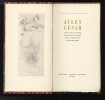
Un de mes préférés… d'autant plus que sa rencontre se fait de plus en plus rare… Référence : Mandiargues, Hans Bellmer, Œuvre gravé, 31-33, reproduit. Exemplaire en très bel état, légers frottements à l'étui comme pour la majorité des exemplaires.
Variationen über ein Thema. Hrsg. vom Hans Orlowski-Kreis. (Mit einer Einführung von Hans-Werner Schober) HANS ORLOWSKI. Schober, Hans-Werner
Berlin, , Hans von Hans-Orlowski-Kreis, 1969., Series of 10 sheet-sized Orig woodcuts by Hans Orlowski. 2 unn. Bll., 10 unn. Boards. Folio. Loose as published in Orig.-Pp.-Folder with light linen spine. One of 100 numbered copies n°. 21. .
commemorating the artist's 75th birthday. Typographic design by Hans-Werner Schwarzenberger.
Walther Oschilewski (texte) - Hans Orlowski (graveur sur bois)
Reference : 25791
(1948)
HANS ORLOWSKI. HOLZSCHNITTE. (Hans Orlowski. Gravures sur bois)
Dietmannsried et Heidelberg Walter Rau 1948 in-folio en feuilles sous chemise un volume, 10 gravures sur bois en noir par Hans Orlowski en feuilles libres dans une chemise rempliée grand in-folio éditeur, couverture illustrée d'un bois d'Hans Orlowski en noir et imprimée en rouge et noir, 2 pages de présentation par Walther Oschilewski + 10 feuilles de gravures sur bois par Hans Orlowski, 1948 Dietmannsried et Heidelberg Walter Rau Editeur,
Hans Otto Orlowski (né le 1er mars 1894 à Insterburg, en Prusse orientale ; le 3 mai 1967 à Berlin) était un peintre et bûcheron allemand. De 1911 à 1915, Orlowski étudie avec Harold Bengen à l'École des Arts et Métiers de Charlottenburg, se spécialisant dans les linogravures. Après avoir participé à la Première Guerre mondiale et avoir été blessé, la première participation à une exposition a eu lieu. En 1918, il participe à la Sécession berlinoise. De 1918 à 1919, il fréquente lÉcole nationale des beaux-arts de Berlin et y étudie avec Philipp Franck. De 1922 à 1945, il travaille à l'école des arts et métiers. En 1931, il y fut nommé professeur. Orlowski est l'auteur de nombreuses gravures sur bois et séries d'illustrations. En 1924, il fait un voyage à Paris et se détourne de l'expressionnisme. Il détruit lui-même ses premières uvres. La première exposition personnelle a lieu à la galerie Gurlitt de Berlin en 1934. En 1945, il devient directeur d'une classe de peinture murale et de vitrail à l'Université des Beaux-Arts de Berlin. En 1953, il expose à Munich, Linz et Würzburg. En 1954, il fonde la « Jubiläumsstiftung 1848/1948 Bildende Kunst ». 1964 fut sa dernière exposition à Berlin ...... RARE .... en trés bon état (very good condition). en trés bon état
Die Quadrat-Bücher. In Ergänzung der Illustrierten Zweimonatsschrift für neue Dichtung "hortulus" herausgegeben.
43 Bände in 38 Bänden (ohne Band 42). St. Gallen (ab Band 25: St. Gallen und Stuttgart), Tschudy Verlag, 1959-1964. 18,5x18,3 cm. Originalpappbände.
1. Sylvanus, Erwin: Korczak und die Kinder. Ein Stück. Mit einem Bildnis von Doktor Janusz Korczak und vier Bünhenfotos. - 2. Marti, Kurt: Republikanische Gedichte. Mit sechs Original-Linolschnitten von Max Sulzer. - 3. Zürich zum Beispiel. Signatur einer Stadt in lyrischen Texten von heute. Mit vier Original-Lithographien von Max Truniger. (Titelblatt mit winzigem Randausriss). - 4. Erklär mir, Liebe. Liebesgedichte deutscher Sprache seit 1945. Mit vier Farbzeichnungen von Hans Erni. - 5. Hoboken, Eva van: Die Brücke bewegt sich. Gedichte. Mit Bewegungsübungen aus einer japanischen Schreibschule und einem Nachwort von Eugen Gomringer. - 6. Hilty, Hans Rudolf: Jeanne d'Arc bei Schiller und Anouilh. Skizzen einer Geistesgeschichte des modernen Dramas. Mit neuen Abbildungen. - 7. Frisch, Max: Schinz. Skizze. Mit fünf Zeichnungen von Varlin. - 8. Vadian, Joachim: Hahnenkampf oder Hennen im Laufgitter (Gallus Pugnans). Eine Renaissance-Posse. Neu für di Bühne bearbeitet von Hans Rudolf Hilty. Mit Beiträgen von Josef Nadler und Werner Näf und acht Bildtafeln. - 9. Arnet, Edwin: Die Möwen von Zürich. Skizze zu einem Filmbuch. Mit vier dreifarbigen Original-Handätzungen von Max Hunzkier. - 10. Elytis, Odysseus: Körper des Sommers. Ausgewählte Gedichte neugriechisch und deutsch. Mit einer Zeichnung von Ghika. - 11. Gomringer, Eugen: 33 konstellationen mit 6 konstellationen von Max Bill. - 12. Andersch, Alfred: Der Tod des James Dean. Eine Funkmontage. Texte von John Dos Passos, Robert Lowry, E.E. Cummings, Allen Ginsberg, Robinson Jeffers, Kenneth Patchen, Kenneth Rexroth, Delmore Schwartz, beigleitet von der Trompete von Miles Davis. Mit neun Fotos. - 13. Turel, Adrien: Weltsaite Mensch. Ausgewählte Gedichte. Mit zwei Fotos. - 14. Der schwermütige Ladekran. Japanische Lyrik unserer Tage. Mit drei Zeichnungen von Shinzaburo Ishii. - 15/16. Die dritte Generation. 42 junge Schweizer Künstler. Plastik, Malerei, Zeichnung. Mit 42 Werkabbildungen und 42 Porträtfotos. - 17. Ramuz, C.F. / Strawinskij, I.: L'histoire du soldat. Die Geschichte vom Soldaten. Mit Dokumenten zur Entstehung des Werkes und sechs Abbildungen. - 18. Vogel, Wladimir: Wagadus Untergang durch die Eitelkeit. Spielmannsgeschichten der alten Berber aufgezeichnet von Leo Frobenius. Oratorium für Soli, gemischten Chor, fünf Saxophone und Klarinette von Wladimir Vogel. Mit dreizehn Abbildungen. - 19. Fornaro, Arturo: Angebot des Frühlichts. Gedichte. Offerta dell'alba. Poesie. - 20. Tschubak, Sadegh: Der Aristokrat und das Tier. Novelle aus dem heutigen Persien. Mit acht Zeichnungen von Li Gelpke. - 21. Levertov, Denise: Mit Augen an unserm Hinterkopf. Gedichte englisch und deutsch. Mit vier Zeichnungen von Marco Richterich. - 22. Burckhardt, Carl J.: Die Episode Randa. Novelle. Mit vier Original-Lithographien von Hermann Alfred Sigg. - 23. Valangin, Aline: Raum ohne Kehrreim. Ausgewählte Gedichte. Espace sans refrain. Poèmes choisis. Mit drei Scherenschnitten von Hans Arp. - 24. Hilpert, Heinz: Das Theater ein Leben. Erfahrungen und Erinnerungen. Mit 27 Fotos. - 25. Read, Herbert: Vocal avowals. Worte sagen aus. Gedichte englisch und deutsch mit fünf Zeichnungen von Ben Nicholson. - 26. Weder, Heinz: Kuhlmann. Prosa. Mit zwölf Zeichnungen von Max von Mühlenen. - 27. Oswald von Wolkenstein: Biographische Gedichte des Herrn Oswald von Wolkenstein. I, Original und in neuer Übertragung. Mit sechs Bildern nach Radierungen von Ambrosius Humm. - 28/29. József, Attila: Am Rande der Stadt. A város permén. Ausgewählte Gedichte ungarisch und deutsch. Mit fünf Farbzeichnungen von Imre Reiner und zwei Fotos. - 30. Lindtberg, Leopold: Regiearbeit. Texte von Leopold Lindtberg,.Kurt Hirschfeld, Ernst Ginsberg, Rolf Liebermann, Martin Schlappner, Hans Wings. Mit 40 Fotos. - 31. Bremer, Claus: Theater ohne Vorhang. Drei dramaturgische Essays mit einem Vorwort von Gustav Rudolf Sellner und sieben Fotos. - 32. Hans Arp und die Worte der Dichter. Mit fünf Abbildungen. Gedichte von und für Arp. - 33. Jaeckle, Erwin: Im Gitter der Stunden. Nachrichten aus dem Hotel Demut. Ein Gedichtzyklus mit zwei Abbildungen nach Werken von Josef Albers. - 34. Hohl, Ludwig: Wirklichkeiten. Prosa. Mit sechs Farbzeichnungen von Hans Aeschbacher und einer Foto. - 35. Otto, Teo: Skizzen eines Bühnenbildners. 35 Zeichnungen. Mit Texten von Max Frisch, Kurt Hirschfeld und Oskar Wälterlin. - 36/37. Wohnort Halen. Eine Architekturreportage. 95 Fotos von Leonardo Bezzola. Texte von Esther Thormann-Wirz und Fritz Thormann. - 38. Lehner, Peter: Fase Kran. Gedichte mit sechs Zeichnungen von Paul Lehmann. - 39. Matzig, Richard B.: Notturno. Eine neuzeitliche Harlekinade für die Marionetten von Ascona. Mit neun Zeichnungen von Harriet L. Klaiber. - 40/41. Zwischen Augen und Atem. Tussen ogen en adem Niederländische Lyrik seit 1945. Niederländisch und deutsch mit vier Original-Holzschnitten und einer Zeichnung von Gerrd Bruning. - 43. Carmi, T. Le serpent d'airain. Poèmes. Die Kupferschlange. Gedichte. Im hebräischen Original und in französischer und deutscher Übertragung mit drei Zeichnungen von Schoschana Heimann. - 44. Dank an Kurt Hirschfeld. Samuel Bächli, Harry Buckwitz, Friedrich Dürrenmatt, Max Frisch, Peter Löffler, Erwin Parker, Jean Rodolphe von Salis, Richard Schweizer, Gody Suter, Jakob Teichmann, Anna Katharina Wyler-Salten. Mit elf Fotos. - Es fehlt Band 42. Büchner, Georg: Woyzeck. Ein Stück, mit Zeichnungen von Werner Gölz. - Einige Rückenkanten etwas bestossen.
[Hans Hofmann] - Morris, Catherine; Sandler, Irving; Hofmann, Hans; Rush, Michael [Editor]
Reference : 010386
(2009)
Hans Hofmann: Circa 1950
The Rose art Museum 2009 In-4 Cartonnage illustré éditeur
Published in conjunction with exhibition, January 14 - April 5, 2009, at the Rose Art Museum of Brandeis University, with catalogue of 40 Abstract Expressionist paintings and drawings exhibited. Foreword and introductory essay, "Hans Hofmann, circa 1950: Painter & Writer" by Michael Rush; "The Artist and His Time" by Catherine Morris; "Hans Hofmann, I Hate to Repeat Myself" by Irving Sandler. Hardcover. >Neuf, sous film. Neuf 0
Marcel Marceau présente : Pantomimes de style et Pantomimes de Bip. Avec Pierre Verry. [Envoi autographe signé à Hans Richter]
Paris S.N. Mercure 1969 in-4 plaquette agrafée Paris, S.N. Mercure, sd [1969]. 31 x 24 cm, in-4, (20) pp. y compris les couvertures, abondamment illustré en noir, plaquette agrafée sous couverture illustrée.
![Marcel Marceau présente : Pantomimes de style et Pantomimes de Bip. Avec Pierre Verry. [Envoi autographe signé à Hans Richter]. [Richter, Hans] - ...](https://static.livre-rare-book.com/pictures/AJM/4821_1_thumb.jpg)
![Marcel Marceau présente : Pantomimes de style et Pantomimes de Bip. Avec Pierre Verry. [Envoi autographe signé à Hans Richter]. [Richter, Hans] - ...](https://static.livre-rare-book.com/pictures/AJM/4821_2_thumb.jpg)
Programme enrichi d'un bel ENVOI autographe signé au peintre et réalisateur d'avant-garde Hans Richter : "A Hans Richter, avec ma franche admiration et mon coeur, Marcel Marceau 69 / Bip [fleur]". Comporte au revers de la couverture le cachet de la succession Hans Richter (Estate Hans Richter) et le numéro d'inventaire PM 10. Large mouillure angulaire. Assez bon
GEORGOUDIS (Vangelis). GARRIGUES (Martine). FLEER (Fritz). BUTOW (Hans). HEARN (Lafcadio). MONJO (Armand).
Reference : 48750
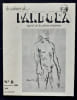
Les cahiers de Pandora, n°6, décembre 1982.
Neuilly. Directeur: Vangelis Georgoudis. Un volume 27x21,2cm, de 36 pages illustrées. Bon état.
Tous nos livres sont visibles sur notre site : https://www.livrepoesie.com/
DEGUY (Michel). PONGE (Francis). ROBINSON-VALERY (Judith). ZELLER (Hans). OSTER (Pierre). BONNEFOY (Yves). JARRY (André). NARDIS (Luigi de). BOIE (Bernhild). COLLOT (Michel).
Reference : 48751
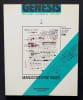
Genesis. N°2, 1992: Manuscrits poétiques.
Paris: Jean-Michel Place. Directeur: Jean-Louis Lebrave. Un volume 27,2x21,8cm broché de 200 pages illustrées. Bon état.
Tous nos livres sont visibles sur notre site : https://www.livrepoesie.com/
NICHOLS (James). SULLIVAN (Patrick). TZARA (Tristan). HUELSENBECK (Richard). BRETON (André). ARP (Hans). CENDRARS (Blaise). SUKOL (George). HART (Lawrence). ZINNES (Harriet). BLAND (Robert). PADGETT (Ron). KALECHOFSKY (Roberta). KORG (Jacob). COLLINS (Douglas). CLARK (Tom).
Reference : 48760
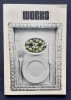
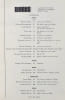
Works, a quarterly of writing, n°3, spring 1968.
New York. Directeurs: John Hopper et Robert Brotherson. Un volume 25,4x17,8cm broché de 124 pages illustrées de collages par James Nichols. Couverture en couleurspar Patrick Sullivan. Revue poétique d'avant-garde.
Tous nos livres sont visibles sur notre site : https://www.livrepoesie.com/
POUND (Ezra). MONTAGUE (John). BERGE (Hans C. ten). ROUBAUD (Jacques). MOUSSARON (Jean-Pierre). PERALDI (Jacques). PORTUGAL (Anne). SORRENTE (Dominique). DUBOURG (Bernard). POULAIN (Jacques).
Reference : 48656
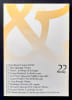
Po&sie. N°22, troisième trimestre 1982.
Paris, directeur: Michel Deguy. Editions Belin. Un volume 24x17cm broché de 128 pages. Bon état. Excellente revue de poésie et d’essais animée pendant 25 ans par Michel Deguy.
Tous nos livres sont visibles sur notre site : https://www.livrepoesie.com/
SANKARA. FOSCOLO (Ugo). MELVILLE (Herman). BERNHARD (Thomas). HILL (Geoffrey). PAZ (Octavio). PARRAU (Alain). RAPOPORT (Armand). REYBAUD (Antoine). REDA (Jacques). GUEZ RICORD (Christian Gabrielle). ROSSI (Paul Louis). GADAMER (Hans-Georg). PINCHARD (Bruno).
Reference : 48664
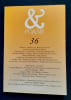
Po&sie. N°36, mars 1986.
Paris, directeur: Michel Deguy. Editions Belin. Un volume 24x17cm broché de 126 pages. Bon état. Excellente revue de poésie et d’essais animée pendant 45 ans par Michel Deguy.
Tous nos livres sont visibles sur notre site : https://www.livrepoesie.com/
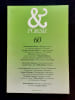
MARINO (Giovan Battista). BELLI (Giuseppe Gioachino). LOY (Mina). ESHLEMAN (Clayton). NOSSACK (Hans Erich). MOUCHARD (Claude). BOHRINGER (Hannes). SECKEL (Hélène). MARTEAU (Robert). CARRAUD (Christophe).
Reference : 48681
Po&sie. N°60, deuxième trimestre 1992.
Paris, directeur: Michel Deguy. Editions Belin. Un volume 24x17cm broché de 128 pages. Bon état. Excellente revue de poésie et d’essais animée pendant 45 ans par Michel Deguy.
Tous nos livres sont visibles sur notre site : https://www.livrepoesie.com/
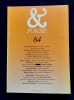
NOSSACK (Hans Erich). LOPEZ BECERRA (Salvador). KRAL (Petr). SOMLYO (Gyorgy). CHAILLOU (Michel). MUS (David). DARRAS (Jacques). BICHET (Yves). MAINARDI (Cécile). SETRE (Jean-Paul). TENGOUR (Habib). BADIOU (Alain). NANCY (Jean-Luc). FINAS (Lucette).
Reference : 48684
Po&sie. N°64, deuxième trimestre 1993.
Paris, directeur: Michel Deguy. Editions Belin. Un volume 24x17cm broché de 128 pages. Petite tache en couverture sinon bon état. Excellente revue de poésie et d’essais animée pendant 45 ans par Michel Deguy.
Tous nos livres sont visibles sur notre site : https://www.livrepoesie.com/
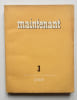
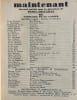
DELANNOY (Aristide). MASEREEL (Franz). SINCLAIR (Upton). FERREIRA DE CASTRO. SACHS (Hans). CHABRIER (Agnès). LITTRE (Florence). JACOB (Max). CARLEGLE. AUGSBOURG (Geo). MATVEEV (Michel). FAURE (Elie). MOUGIN (Jules).
Reference : 48603
Maintenant. Cahier 3, juillet 1946.
Paris: Grasset (directeur: Henry Poulaille). Un volume 23,5x18,5cm broché de 256 pages illustrées en noir dans et hors texte. Papier uniformément jauni sinon bon état. Excellente revue fondée et animée par Henry Poulaille, le chef de file de la littérature prolétarienne en France au XXème siècle.
Tous nos livres sont visibles sur notre site : https://www.livrepoesie.com/
DEBRAY (Régis). NEGRI (Toni). JEUDY (Henri-Pierre). HAVEL (Vaclav). CURNIER (Jean-Paul). RISSET (Jacqueline). SURYA (Michel). DOBBELS (Daniel). BALIBAR (Etienne). MARMANDE (Francis). WEIL (Eric). HOGGART (Richard). HAACKE (Hans).
Reference : 48503
Lignes n°8, décembre 1989. La capitulation?
Paris. Directeur: Michel Surya. Un volume 21x15cm broché de 176 pages. Bon état.

Tous nos livres sont visibles sur notre site : https://www.livrepoesie.com/

