 Write to the booksellers
11 books for « gleichen »Edit
-
Language
English (1)
French (10)
-
Century
18th (2)
19th (1)
20th (3)
-
Topics
Biology (1)
First edition (1)
Freemasonry (1)
Germanic languages (1)
Hermeticism (1)
History (1)
Literature (1)
Sciences (1)
Symbolism (1)
Travel stories (1)
-
Countries
Belgium (1)
Denmark (1)
France (7)
Germany (1)
Switzerland (1)
-
Syndicate
ILAB (5)
SLAM (3)
GLEICHEN, WILHELM FRIEDRICH von [RUSSWORM / GLEICHEN-RUSSWORM / RUSSWURM].
Reference : 48272
(1764)
Das Neueste aus dem Reiche der Pflanzen, oder Mikroskopische Untersuchungen und Beobachtungen der geheimen Zeugungstheile der Pflanzen in ihren Blüten, und der in denselben befindlichen Insekten" nebst einigen Versuchen von dem Keim, und einen Anhang ... - [GLEICHEN'S MICROSCOPE]
[Nuremberg], Christian de Launoy seel. Erben, 1764 [recte: 1763-66]. Folio. Contemporary half calf with gilt lines to spine. Corners a bit bumped. In magnificent, completely clean and fresh condition. (6), 8, (4), 72, 40, (8), 26 ff. + 51 magnificent engraved plates - all plates in astonishing, contemporary hand-colouring. Plates numbered as thus: 1-5 + 2b (i.e. 6 plates - depiting the microscope), I-XXX + A-E (i.e. 35 - details of floral structure and pollens), Anhang 1-10 (i.e. 10 - mainly insects). The plates are engraved by (and coloured by/under the auspices of) Christoph Keller after drawings by Gleichen-Russworm. With several beautiful, large engraved vignettes (by Johann Michael Stock, efter Keller).
The scarce first edition of this splendid work, in which the outstanding microscopist Baron Gleichen-Russworm recorded his observations of plants and insects. The 51 astonishingly beautiful hand-coloured copperplates show the morphology of plants and insects in great detail as well as his magnificent specially constructed microscope and its different parts, making it of the utmost importance to the history of the microscope as well as the fertilization processes in plants. With his thorough study of the pollen, stamens, and pistils as well as the process connected with them, magnificently presented in great detail on beautifully produced plates, the work became a great source of inspiration for many biologists and microscopists of the 18th century. The microscope described and depicted here was frequently reproduced from the detailed plates and Gleichen-Russworm's experiments widely repeated in order to investigate the true nature of the plant. The plates depicting the microscope are among the most frequently reproduced depictions of microscopes. The work appeared in three fascicles, between 1763 and 1766 and were issued with a title-page stating 1764. Wilhelm Friedrich von Gleichen, known as Russworm (1717 - 1783) belongs to the outstanding microscopists of the eighteenth century. He was the elder son of Heinrich von Gleichen and Caroline von Russworm. ""He received little formal education and in 1734, after some years as a page at the court of Prince Thurn und Taxis in Frankfurt, he decided to make his career in the forces of the margrave of Bayreuth. [...]. Gleichen-Russworm remained in the army until 1756, when he resigned his commission in order to devote himself to the management of the Greifenstein estates, inherited from his mother in 1748. His first published writings appeared after his departure from Bayreuth, in the periodical ""Fränkische Sammlung aus der Naturlehre, Arzneigelahrtheit, Ökonomie und der damit verbundenen Wissenschaften"""" they deal, inter alia, with natural history, physics, and chemistry but are, for the most part, quite fanciful.[...] In the summer of 1760 Gleichen-Russworm made the acquaintance of Martin Ledermüller, who had already begun publication of his ""Mikroskopische Gemüths- und Augenergötzungen"" (1759-1762)"" it was this work which led Gleichen-Russworm to concentrate on microscopy. Ledermüller visited Schloss Greifenstein in 1762, and Gleichen-Russworm continued to benefit from his advice until the former took offense at certain criticisms of his work which appeared in ""Geschichte der gemeinen Stubenfliege"" (1764).Gleichen-Russworm was particularly interested in the processes of fertilization in plants and animals, and in 1763 he published the first fascicle of Das neueste aus dem Reiche der Pflanzen. This work contains fifty-one colored plates illustrating numerous details of floral structure and various pollens"" in addition, his interest in the construction of the microscope is reflected in the six plates devoted to the different modifications and accessories which he designed for the instrument. His account of the pollen of Asclepias syriaca L. in Auserlesene mikroskopische Entdeckungen (1777-1781) contains what appears to be the first observation of a pollen tube, although he remained unaware of its significance."" (D.S.B.). Nissen BBI: 716. Pritzel: 3367 (merely stating 46 plates). Honeyman: 1515. Wellcome: III:125 (merely having an incomplete copy of the French translation).

Dissertation sur la Génération, Les Animalcules spermatiques, et ceux d'Infusions, avec des Observations microscopiques sur le Sperme, et sur Différentes Infusions. Par le Baron de GLEICHEN, Ouvrage traduit de l'Allemand, orné de trente-quatre planches, dont plusieurs enluminées.
A Paris, de l'Imprimerie de Digeon, An VII (1798-99), 1 volume in-4 de 310x235 mm environ, 1 feuillet blanc, titre, faux-titre, 238 pages, suivies de 34 planches (dont 9 planches dépliantes, une planche bis (pl. 23), et 1 planche non numérotée p. 41), 1 feuillet blanc, demi reliure moderne en basane brune mouchetée, dos à nerfs portant titres dorés, sur 2 pièces de titre, une verte et une rouge, orné de petits fers dorés aux entrenerfs, gardes marbrées. Les planches de notre exemplaire ne sont pas en couleurs (annoncé dans le titre), les coins des premières pages et dernières sont brunis ainsi que les tranches, les feuillets non rognés sont fendillés par endroits, sinon bon état.
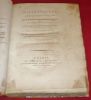
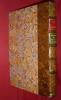
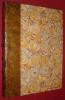
Wilhelm Friedrich von Gleichen (1717-1783). Merci de nous contacter à l'avance si vous souhaitez consulter une référence au sein de notre librairie.
Souvenirs suivis de la Science maçonnique selon le baron de Gleichen et d'extraits de sa correspondance.
Arché, Coll. Acacia, 2004, 272 p., petit in-8, broché, bon état.
Merci de nous contacter à l'avance si vous souhaitez consulter une référence au sein de notre librairie.
Dissertation sur la génération, les animalcules spermatiques, et ceux d'infusions, avec des observations microscopiques sur le sperme et sur différentes infusions. Ouvrage traduit de l'allemand [par J.-C.-T. de Laveaux], orné de trente-quatre planches, dont plusieurs enluminées
Imprimerie de Digeon | Paris 1799 (An VII) | 23.8 x 31.5 cm | Relié
Edition originale de la traduction française illustrée de 34 planches dont une en couleurs. Cf. Garrison & Morton, 2465 (pour l'originale allemande). Reliure en plein cartonnage de l'époque de papier crème marbré, dos lisse comportant des frottements et des manques, motif de trois glands poussé au centre des plats, ex-libris moderne encollé au verso du premier plat de reliure. Quelques petites rousseurs. Première traduction française de la Abhandlung über die Saamen - und Infusionsthierchen, und über die Erzeugung, nebst mikroskopischen Beobachtungen des Saamens der Thiere in verschiedenen Infusionen (1778). Le biologiste Wilhelm Friedich von Gleichen-Russwurm (1717-1783) fut le premier à développer la teinture des bactéries (carmin, indigo) pour en faciliter l'observation au microscope. - Photographies et détails sur www.Edition-Originale.com -

Souvenirs de Charles-Henri, BARON DE GLEICHEN précédés d'une notice par M. Paul Grimblot.
Léon Techener Fils, Librairie Paris 1878 In-12 ( 190 X 120 mm ) de 227 pages, broché sous couverture imprimée, dos recollé. Bel exemplaire.
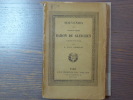
Dissertation sur la génération, les animalcules spermatiques, et ceux d'infusions, avec des observations microscopiques sur le sperme, et sur les différentes infusions
Paris, Digeon, an VII [1799], in-4, [4]-238 pp, 34 pl, basane marbrée, dos à nerfs orné, tranches rouges, 34 planches dont 4 coloriées, représentant les observations faites par l'auteur au microscope. Dans cet ouvrage, traduit de l'allemand par Lavaux, Gleichen (1717-83) attribue aux animalcules des passions, telles que l'amour et la colère, puisqu'ils s'accouplent et s'entredévorent. Il remarque aussi, dans les animalcules de la semence, des cristaux salins qui paraissaient être du phosphate de chaux. Reliure usagée, traces de restauration au niveau des coiffes ; coiffe supérieure arasée. Une petite galerie de vers marginale, sans atteinte au texte. Blake p. 177. Wellcome III-125. Couverture rigide
Bon [4]-238 pp., 34 pl.
Die Siegfriedsage, fûr die reifer Jugend bearbeitet
1910 Stuttgart, Levy & Müller, sans date, (vers 1910), in-8 carré de 240-(4) pp., reliure de l'éditeur de pleine percline bordeaux, illustrée sur le 1er plat représentant Siegfried et le dragon à ses pieds, titre en lettres dorées, bon exemplaire.
Ouvrage illustré de bois gravés hors-texte et dans le texte par Franz STASSEN.
GLEICHEN - RUSSWORM , Wilhelm Friedrich von - Jakob Friedrich ISENFLAMM ( translator ) :
Reference : 40356
Découvertes les plus nouvelles dans le regne végétal ou observations microscopiques sur les parties de la génération des plantes renfermées dans leurs fleurs, & sur les insectes qui s'y trouvent, avec quelques essais sur le germe, un supplement d'observations melées...
Nürnberg, Imprimé chés (sic) la Veuve de Chretien de Launoy , 1770, in-folio, 38 x 25 cm, (8)nn pp (includes title page) + 76 pp + 48 pp + (8)nn pp includes the supplement half title ) + 24 pp + 51 engraved plates in contemporary handcolouring. The plates are labelled [1] I , IIa, IIb , III , IV , V, [2] A, B, C, D, E, [3] I - XXX , [4] 1 - > 10. ( complete). Bound in later red half morocco with marbled covers. Title page very slightly soiled with some faint stains. Some copies have two title pages dated 1763 and 1770 (e.g. British Museum copy), one presumes that the 1763 title was cancelled. Fine copy of the French translation. Only edition of this beautiful botanical work illustrated with finely coloured plates based on microscopic observations. (Nissen n° 717, de Belder 133). The plates have been engraved by J.C. Keller. The original German edition '' Das Neueste aus dem Reiche der Pflanzen...'' (Nissen 716) appeared in 1764-1766. This French translation is very rare. The last copy we could trace on the market was sold in 1991. The author Gleichen-Rußworm had met Ledermüller who helped him with microscopic investigations. In this publication he turns his attention to pollen and fertilisation of plants. This very study, by an amateur, who himself perfected the tools for his research, greatly advanced microscopy in Germany in the second half of the 18th century. A very attractive copy..
Die gotische welt - Sitten und gebräuche im späten mittelalter (Erstes tausend)
Verlag von Julius Hoffmann. 1919. In-8. Relié. Etat d'usage, Couv. légèrement passée, Dos satisfaisant, Intérieur acceptable. XVI + 429 pages. Livre en allemand. Coins frottés.. . . . Classification Dewey : 430-Langues germaniques. Allemand
Classification Dewey : 430-Langues germaniques. Allemand
Eva mit dem Apfel. Frauenraub, Frauenkauf, Frauenrecht.
Munich-Berlin, Drei Masken, 1928. 8°. (8), 416 p. With 25 plates. Orig. cloth, gilt front cover.
[CHAPMAN & HALL] - GLEICHEN COUNT ALBERT EDWARD WILFRIED
Reference : PHO-462
(1888)
WITH THE CAMEL CORPS UP THE NILE
SECONDE EDITION
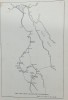
In 8° (23 x 14 cm) Pleine toile éditeur, dos insole avec 2 décirures Seconde édition XI 320 pp, 38 pp catalogue éditeur, nombreux dessins et cartes.

