 Write to the booksellers
11901 books for « gilbert h f »Edit
-
Type
Any type (1)
Autograph (13)
Book (11365)
Disk (1)
Engraving (2)
Magazine (25)
Manuscript (1)
Maps (1)
Music sheets (488)
New book (4)
Photographs (3)
Postcards (1)
Posters (1)
-
Latest
Last 24h (2)
Last 3 days (6)
Last month (415)
Last week (8)
-
Language
Dutch (4)
English (45)
French (11807)
German (4)
Russian (43)
Spanish (3)
-
Century
16th (2)
17th (20)
18th (39)
19th (1211)
20th (5779)
21st (829)
-
Countries
Belgium (523)
Brazil (1)
Canada (85)
China (14)
Côte d'Ivoire (29)
Denmark (33)
France (10548)
Germany (13)
Greece (2)
Netherlands (5)
Switzerland (599)
United Kingdom (8)
United States of America (46)
-
Syndicate
ALAC (74)
CLAM (18)
CLAQ (39)
CNE (2)
ILAB (5288)
NVVA (80)
SLACES (80)
SLAM (5034)
SNCAO (11)
Topics
- 1900 (35)
- Alsace (36)
- Aquitaine (32)
- Archaeology (60)
- Architecture (50)
- Autographs (81)
- Aviation (34)
- Badia gilbert (32)
- Belgium (41)
- Bibliophilism (33)
- Biography (94)
- Bordes gilbert (230)
- Brittany (29)
- Cesbron gilbert (878)
- Children’s books (151)
- China (31)
- Christianity (27)
- Cinema (43)
- Colette (30)
- Comic strip (137)
- Cooking (74)
- Dauphiné (34)
- Dedication (107)
- Detective novels (90)
- Dictionaries (30)
- Drawings (39)
- Early printed books (48)
- Economics (60)
- Education (53)
- Education - morals (30)
- Egypt (42)
- Fine arts (74)
- First edition (169)
- Fishing (26)
- French literature (31)
- Ganne gilbert (57)
- Genealogy (33)
- Geography (70)
- Germany (38)
- Gilbert guy (119)
- Guide books (32)
- Guilleminault gilbert (144)
- Helvética (130)
- History (395)
- Industrial arts & crafts - fine arts (50)
- Law (63)
- Lemonnier henry (90)
- Literature (1196)
- Magazine (51)
- Marlier marcel (66)
- Martineau gilbert (31)
- Mathematics (52)
- Maurin gilbert (26)
- Medicine (98)
- Mountain (35)
- Music (27)
- Napoleon i (35)
- Navy (34)
- Newspapers press (1038)
- Painting (51)
- Paris (57)
- Periodicals (52)
- Philosophy (125)
- Photography (79)
- Poetry (226)
- Policy (55)
- Prouteau gilbert (64)
- Psychology (61)
- Quebec (35)
- Regionalism (75)
- Religions (94)
- Reliure (30)
- Resistance (26)
- Review (106)
- Reviews (74)
- Robin (41)
- Sade a. f. marquess de (36)
- Sciences (48)
- Scores (511)
- Sculpture (26)
- Sexuality (34)
- Sigaux gilbert (47)
- Sociology (45)
- Songs (446)
- Switzerland (146)
- Theatre (50)
- Theology (41)
- Tibet pc (25)
- Tournier gilbert (30)
- Travel (34)
- United states (25)
- Various (139)
- Viticulture (29)
- Voisins gilbert de (28)
- War (116)
- Wine (49)
- Youth (29)
English Vernacular Furniture 1750-1900
Gilbert, Christopher: English Vernacular Furniture 1750-1900. Yale University Press, 1991. 304pp with 45 colour plates and 372 monochrome illustrations. Hardback. 28 x 25cms. First comprehensive scholarly analysis, based on a wealth of documentation, investigating over 20 types, including school, workhouse and prison furniture.
First comprehensive scholarly analysis, based on a wealth of documentation, investigating over 20 types, including school, workhouse and prison furniture.

Furniture at Temple Newsam House and Lotherton Hall. A catalogue of the Leeds collection. 2 vols
Gilbert, Christopher: Furniture at Temple Newsam House and Lotherton Hall. A catalogue of the Leeds collection. 2 vols. Leeds: Leeds Art Collection, 1978. Together 522pp with 2 tipped-in colour and 662 monochrome plates. Cloth. 30x25cms. Carefully researched study, and fully illustrated catalogue of some 700 examples of fine English, Continental, Colonial and Oriental furniture. With documentation.
Carefully researched study, and fully illustrated catalogue of some 700 examples of fine English, Continental, Colonial and Oriental furniture. With documentation. Text in English
Furniture at Temple Newsam House. Vol 3
Gilbert, Christopher: Furniture at Temple Newsam House. Vol 3. Leeds: W S Maney & Son Ltd, 1998. 744pp with 11 colour plates, 11 colour and 309 monochrome illustrations. Cloth, 30x25cms. Completing the 1978 2-volume catalogue of the renowned furniture at Temple Newsam House and Lotherton Hall, Leeds, this volume documents 240 subsequent acquisitions. In addition updated information on about a third of the pieces in vols I & II is recordeed. Among the predominantly English furniture is a cabinet by John Channon and pieces by Seddon & Co. and Gillows, together with examples of British regional furniture.
Completing the 1978 2-volume catalogue of the renowned furniture at Temple Newsam House and Lotherton Hall, Leeds, this volume documents 240 subsequent acquisitions. In addition updated information on about a third of the pieces in vols I & II is recordeed. Among the predominantly English furniture is a cabinet by John Channon and pieces by Seddon & Co. and Gillows, together with examples of British regional furniture. Text in English
Derby Porcelain 1750-1798
Bradley, Gilbert; Judith Anderson et al:: Derby Porcelain 1750-1798. London: 1991. 180pp illustrated throughout in colour. Cloth. 28x21.5cms. Well illustrated, important study of the history and products of this major manufacturer. With catalogue of 122 examples, arranged by type, and a chapter on the Duesbury Papers. With bibliography, periodicals list, index.
Well illustrated, important study of the history and products of this major manufacturer. With catalogue of 122 examples, arranged by type, and a chapter on the Duesbury Papers. With bibliography, periodicals list, index. Text in English
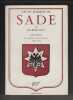
VIE DU MARQUIS DE SADE écrite sur des données nouvelles et accompagnée de nombreux documents, le plus souvent inédits. Tome I. De la naissance à l'évasion de Miolans 1740 - 1773
Éditions Gallimard, Paris, 1952, (14,5 x 21 cm), 538 pages. Édition originale, fort volume en très bon état.
Tous nos envois se font avec suivi. I ship worldwide, have no hesitation to contact me for any question.
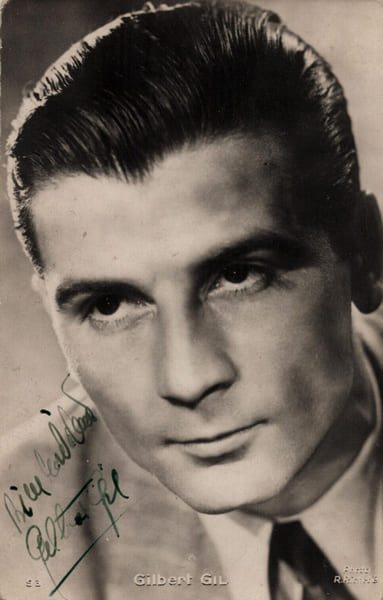
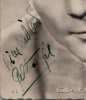
Gilbert GIL autographe - PHOTOGRAPHIE DÉDICACÉE ET SIGNÉE de sa main
Gilbert GIL autographe -PHOTOGRAPHIE DÉDICACÉE ET SIGNÉE de sa main Acteur Photographie dédicacée et signée par Gilbert GIL au feutre noir. "Bien cordialement Gilbert Gil." Provenance : issu de la collection d'autographes de Claude ARMAND, collectionneur suisse. Dimensions : 13,5 x 8,5 cm État : Voir photos pour plus de détails. Nombre de pages : 1 page Gilbert GIL Gilbert Gil, nom de scène de Gilbert Jean Alphonse Moreau, né le 7 septembre 1913 à Goussainville et mort le 25 août 1988 à Maisons-Laffitte, est un acteur français. Wikipédia Contactez-nous Lettres autographes, vieux papiers, livres anciens, photographies, gravures, timbres... Nous expertisons et/ou rachetons dans toute la France vos lettres, collections de lettres et livres anciens. Paiement Sont acceptés les paiements par eBay, par PayPal, par virement ou par chèque. Envoi Envoi soigné dans un emballage rigide et étanche sous trois jours. Prévoir les délais postaux habituels en plus. Retour Satisfait ou remboursé. Si vous n'êtes pas entièrement satisfait, retour à la charge du vendeur pour l'Europe. À la charge de l'acheteur pour le reste du monde.


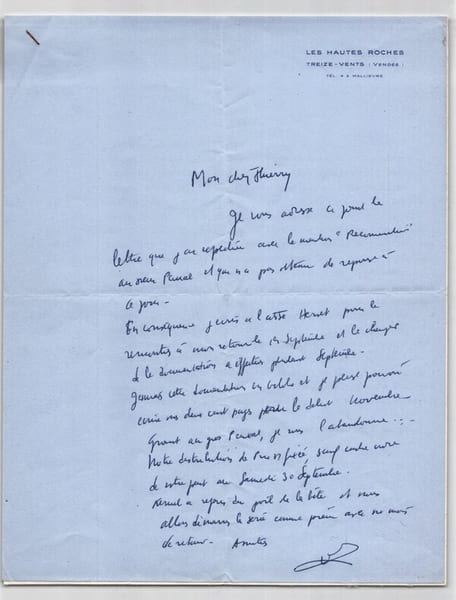
Gilbert Prouteau Lettre autographe signée Thierry Maulnier et une dactylographié
Gilbert Prouteau. Lettre autographe signée Thierry Maulnier et une dactylographié Poète Gilbert PROUTEAU (1917–2012) – Lettre autographe signée à Thierry Maulnier copie dactylographiée d’une lettre adressée à Pascal sur le projet “Notre ennemi héréditaire : l’Amérique” Ensemble cohérent de deux documents relatifs à un projet d’ouvrage conçu par Gilbert Prouteau et Thierry Maulnier (de l’Académie française), intitulé Notre ennemi héréditaire : l’Amérique, destiné aux éditions Plon. La lettre autographe signée, rédigée sur papier bleu à en-tête des Hautes Roches, Treize-Vents (Vendée), est adressée à Thierry Maulnier. Prouteau y évoque la préparation du manuscrit, la coordination documentaire avec [l’abbé Herest], la remise des 200 pages prévues pour novembre, ainsi que l’organisation de leur rendez-vous. Il précise joindre une copie dactylographiée d’une lettre recommandée récemment envoyée à un certain Pascal, restée sans réponse. 1 page in-4, encre bleue, très bon état. Cette copie dactylographiée, conservée par Maulnier, reproduit une lettre formelle adressée à Pascal, dans laquelle Prouteau réclame avec fermeté la restitution de travaux de documentation relatifs aux relations France–États-Unis, base du projet commun. 1 page in-4 dactylographiée, non signée, très bon état. État : Voir photos et description pour plus de détails. Nombre de pages : 1 page Dimension : 27 x 21 cm Gilbert Prouteau Gilbert Prouteau était un poète et réalisateur français. Né à Nesmy, en Vendée, il remporta en 1948 une médaille de bronze aux concours artistiques des Jeux olympiques pour son œuvre « Rythme du Stade ».

Essais de critique militaire, par G. G. de La Nouvelle Revue (Capitaine Gilbert). I. Etude sur Clausewitz – II. Septembre et octobre 1806 – Juillet et août 1870.
P., Librairie de La Nouvelle Revue, 1897, gr. in-8°, viii-375 pp, nouvelle édition, suppléments et pièces justificatives, 13 tableaux de marche, reliure demi-toile chocolat, pièce de titre basane noire, bon état
Georges Gilbert fait partie de l’école de la manœuvre napoléonienne, qui considère qu’il n’y a pas de modification significative à apporter à la doctrine française suite à la guerre ; le système napoléonien est indépassable. Georges Gilbert, né le 18 janvier 1851, est entré à l’Ecole polytechnique en 1869. Capitaine d’artillerie (1876), major de la première promotion de l’Ecole supérieure de guerre (1876-77), il a été rapidement attaché à l’état-major du général Miribel, puis à celui de la fameuse 11e division d’infanterie (“division de Nancy” ou “division de fer”). Gravement malade, il a quitté l’armée en 1884 pour se consacrer à l’étude et à l’écriture. Ses principaux ouvrages sont : Essais de critique militaire, Paris, Librairie de la Nouvelle Revue, 1887 ; Sept études militaires, Paris, Librairie de la Nouvelle Revue, 1892 ; Lois et Institutions militaires, Paris, 1895 ; La guerre sud-africaine, Paris, Nancy, Berger-Levrault, 1902. Très lié avec les milieux militaires français officiels et très apprécié par ces derniers, le général Bonnal a pu dire de lui au moment de son hommage funèbre : “Avec Gilbert disparaît le plus grand penseur et le plus illustre écrivain de l’armée française contemporaine”. — "Ce n'est pas en revenant à la tradition militaire napoléonienne, comme l'y invitent beaucoup d'officiers distingués, que la France échappera à cette servile émulation du militarisme allemand qui paralyse ses facultés propres de defense et d'action. Depuis quinze ou vingt ans, il y a eu, dans notre jeune armée, même républicaine, comme un réveil napoléonien, un retour aux idées tactiques et stratégiques du grand manieur d'hommes, du grand manœuvrier. C'est, je crois, le capitaine Gilbert qui a été un des initiateurs de ce mouvement ; c'est lui du moins qui lui a donné la forme la plus nette et la plus forte. Ses études, qui parurent d'abord dans la Nouvelle Revue, de Mme Adam, et qui furent publiées en deux volumes, en 1890 et 1892, sous le titre : Essais de critique militaire, et Sept études militaires, ont eu sur l'esprit de l'armée une grande influence ; et presque tous les officiers qui pensent ou qui écrivent s'en inspirent à quelque degré. Notre enseignement de l'École supérieure de guerre en procède dans une large mesure. Nombreux sont dans l'armée ceux qui considèrent l'œuvre du capitaine Gilbert comme géniale et qui lui empruntent toute leur philosophie militaire. Et il est vrai qu'elle est remarquable par la netteté de ses formules, par la précision des vues, par la vigueur de l'esprit de synthèse..." (Jean Jaurès, L'Armée nouvelle, chap. 4) Désormais les frais d'envoi sont de 6 € seulement pour les livres jusqu'à 1 kg (colissimo suivi), pour la France métropolitaine.
Gilbert Peyrefin de chantier
Halle Saint-Pierre, Paris, 2001. In-8, broché, 32 pp. Le cosmos et les électromécaniques de Gilbert Peyre, par Gilbert Lascault - Planches.
Avec 16 planches en noir et en couleurs.Envoi de Gilbert Peyre en page de titre. --- Plus d'informations sur le site archivesdunord.com
La Defance de la religion réformée par passages de l'Escriture Saincte opposée A un livre intitulé La defance de la Verité Catholique, faict soubs le nom de M. Francois Blouin Advocat au Parlement de Bordeaus.
A Bergerac, par Gilbert Vernoy, 1615. In-12 de (38) pp., 1 feuillet blanc, 740 pp. [sig. *12, ()8 (f. ()8 blanc), A-Hh12, sans les deux derniers feuillets blancs], vélin souple (reliure de l'époque).
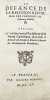
Édition originale anonyme. Le nom de l'auteur n'apparaîtra qu'à la deuxième édition datée 1618.Très rare impression de Bergerac, place forte des protestants dans le Bordelais, sortie des presses de Gilbert Vernoy d'abord installé à Bordeaux. Gilbert Vernoy ouvre un atelier d'imprimerie à Bergerac en 1608 à la demande du corps municipal. Plusieurs livres d'inspiration protestante sortent de ses presses jusqu'en 1615, date à laquelle il revient à Bordeaux. Il y exerce jusqu'en 1621, où il est le seul imprimeur protestant de la ville. Il revient ensuite à Bergerac à la demande des protestants de la ville, et y est actif, avec son fils Antoine, jusqu'en 1640.Gilbert Primrose (v. 1580–1642), fils du chirurgien royal Gilbert Primrose, fut un important pasteur calviniste écossais actif principalement en France et en Angleterre. Formé à St Andrews, il exerça longtemps à Bordeaux, où il joua un rôle notable dans la vie intellectuelle et ecclésiastique réformée.Impliqué dans des affaires politiques et religieuses sensibles, il suscita la méfiance du pouvoir royal français. En 1623, une mesure excluant les pasteurs étrangers l’obligea à quitter la France. Installé à Londres, il devint pasteur de l’Église française, aumônier du roi Jacques Ier, docteur en théologie d’Oxford et chanoine de Windsor. Auteur prolifique de traités et de sermons, il incarne la circulation européenne des élites réformées au début du XVII siècle.Très bon exemplaire ; traces de mouillure claire sur la moitié des pages ; infime galerie marginale de ver sur une vingtaine de feuillets.Seuls trois exemplaires recensés : Toulouse, Bordeaux et La Rochelle.Desgraves, Répertoire des ouvrages de controverse, n°1784.

Amanitaceae
Milan, Mediolani, 1940-1941, in-8, 3 parties en deux volumes de I. VIII, 427, (1bl.)pp, et un frontispice , II. 73 planches, plein maroquin rouge de Levitzky, dos à 4 nerfs, tranches dorées, gardes jaspées, sous emboitage, Unique édition de cette oeuvre majeure du mycologue français sur l'espèce des amanites. Cette importante monographie d'histoire naturelle forme le supplément, et le volume XXVII, de "l'Iconographia Mycologica" de Bresadola. E.J. Gilbert divise son oeuvre en 3 fascicules. Dans le premier, la "partie générale", il définit sa méthode scientifique de naturaliste et donne de nombreux conseils sur la manière de compiler, décrire et déterminer les objets observés ; puis il propose une longue liste de synonymes et une classification de la famille des amanitacées ; enfin, il illustre son propos de 49 planches représentant des spores. Dans le second fascicule, "la partie spéciale", l'auteur décrit chaque espèce en latin, ajoute des observations en français et termine par une bibliographie. Le dernier fascicule forme un atlas de 73 planches qui se composent de 59 illustrations en couleurs dont 11 furent dessinées par Gilbert lui-même et de 14 reproductions photographiques en noir. Sur les gardes des deux volumes, ex-libris de 1965 "à Rémy", "petit-fils premier né" de Gilbert. On joint : "La vie d'un mycologue. Mon maitre, Edouard-Jean Gilbert" par Louis Imler portant un envoi autographe signé de l'auteur à ces "chers amis, Monsieur et Madame Poulain-Gilbert". Superbe exemplaire ayant appartenu à la famille de l'auteur et habillé d'un fin maroquin rouge. Étuis défraichis. Couverture rigide
Bon 3 parties en deux volumes de
Carte postale photographique dédicacée par Gilbert Bécaud
s. n. | Paris 1970 | 10 x 15 cm | Une carte postale
Carte postale photographique en noir et blanc représentant Gilbert Bécaud. Discographie de Gilbert Bécaud au verso de la carte qui comporte de petits manques de papier. Envoi autographe signé de Gilbert Bécaud au grand collectionneur d'autographes Claude Armand : "A Claude Gilbert" enrichi d'un petit chat dessiné au stylo bille bleu. - Photographies et détails sur www.Edition-Originale.com -
Partition de la chanson : Album Gilbert Laffaille 12 titres : - Trucs et ficelles - La femme image - Neuilly blues - Chocolat et cerises - Deux minutes fugitives - Le p'tit Léon - Interrogations écrites - Sac à dos pataugas - Le grand glouton - Le gros chat du marché - Le président et l'éléphant - Les beaux débuts
Pascal Claude 1981

Bon état Grand format Guitare,Piano
Les Poësies diverses de Monsieur Gilbert, Secrétaire des Commandemens de la Reyne de Suede, & son Resident en France.
Paris, Guillaume de Luyne, 1661. In-12 de (14)-173-(1) pp., maroquin rouge à grains longs, dos orné à nerfs, tranches dorées (reliure du début XIXe siècle).
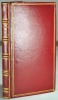
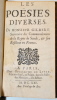
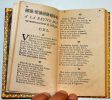
Édition originale rare, dont le privilège datait de 1654, de cet unique recueil poétique de Gabriel Gilbert (Paris, ca 1620 – ca 1680), « poète pauvre et pauvre poète » (Annales poétiques), dramaturge aujourd'hui oublié dont l'oeuvre compte seize pièces de théâtre, publié au moment où ses pièces rencontraient leur plus grand succès.Secrétaire de la duchesse de Rohan, Gilbert devint en 1656 secrétaire des commandements de la reine Christine de Suède, dont il accompagna le séjour parisien (1656-1660), l'utilisant encore comme titre sur sa page de titre en 1663, avant d'y renoncer vers 1664 lorsqu'il perdit vraisemblablement ses fonctions. Chapelain, dans une lettre à Huet du 8 décembre 1661, le qualifie d'« affamé de servitude » et rapporte qu'il avait conseillé à un poète de se méfier des « appointemens plus propres à estre promis qu'à estre tenus » de Christine. Sonet dans le Dictionnaire des Précieuses de l'abbé de Pure le désigne sous le pseudonyme de Gallus. Gilbert mourut dans la misère vers 1680.Le recueil rassemble sept odes adressées au roi, à la reine-mère, à la reine de Suède, au cardinal Mazarin et à d'autres grands personnages, dix-neuf élégies, un grand nombre de madrigaux et quelques poésies chrétiennes.Bel exemplaire en maroquin rouge relié vers 1810 ; premier feuillet rogné un peu court en tête.Brunet, II, 1592 ; Eleanor J. Pellet, A Forgotten French Dramatist, Gabriel Gilbert ; Viollet-le-Duc, Bibliothèque poétique, p. 572.
Demain n'est qu'une chimère
Editions du Masque in12. Sans date. Broché.
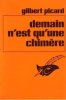
Etat Correct trace étiquette bas 4e plat qq taches rousseurs début et fin livre
Picard Gilbert Picard Gilbert Picard Gilbert
Reference : 184315
(1976)
ISBN : 9782702405376
René Char. Conférence prononcée le 3 juillet 1946 à Paris par Gilbert Lély
Sur René Char, pour Char Paris, Variété, (14 novembre) 1947. 1 vol. (145 x 195 mm) de 29 p., [1] et 1 f. Broché. Édition originale. Tirage unique à 550 exemplaires sur B.F.K. de Rives. Un des 50 premiers exemplaires hors commerce réservés à l’auteur (n° 19). Carte postale de Lely (120 x 75 mm) et photo de Greta Garbo (90 x 140 mm) jointes. Précieux exemplaire de René Char qui, comme souvent, a porté la mention « mon exemplaire » sur le papier cristal, en première de couverture. Envoi signé : « René, l’herbe où nous étions couchés, le 17 novembre 1942, face au vallon de la Valmasque, aurait voulu nous apaiser : muette, elle avait la confidence du destin… Ami, que le bonheur soit toujours à portée de ta main. Ton frère Gilbert ».
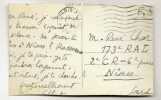
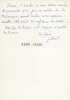
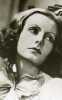
Le texte de cette conférence donnée à Paris le 2 juillet 1946 (carton à parution conservé) constitue la première manifestation d'un intérêt public pour René Char, en même temps que la condamnation sans appel d'une certaine « poésie de résistance » et « le misérable retour à l'alexandrin observé au lendemain de la défaite ». Lely s'en prend ainsi à Aragon, sacré « poète national », se plaisant à rappeler que c'est Char qui trouva en 1932 le titre du tract surréaliste l'excommuniant : « Paillasse ! ». Char a conservé dans l'exemplaire une carte postale que Lely lui avait envoyée au début de la guerre : « [Ch]er René, je commence [à m]e trouver inquiet de [ton] silence. Ne serais-tu [p]lus à Nîmes ? Rassure-[mo]i, je te prie. Je te [ré]pondrai longuement. [Po]ur l'instant, je te cherche. Fraternellement, Gilbert ». La carte, oblitérée le 15 septembre 1939, est adressée à « Monsieur René Char, 173e RAL, 2e CR-6e pièce, Nîmes » ; elle a été retaillée par le poète, sans doute pour pouvoir la garder dans ses papiers, vraisemblablement moins pour garder intact le souvenir écrit de l'ami que conserver la photographie du visage de Greta Garbo ! Le cliché est une photographie de la M.G.M., que nous joignons à l'ensemble, extraite d'un film que nous n'avons pas pu identifier. Il est assez émouvant de penser que Char ne s'est pas séparé de cette photo au début de la guerre voire au long de ces années de Résistance, avant de la joindre au livre de Lely. Rappelons que Gilbert Lély fut celui à qui René Char annonça, le premier, l'existence et la parution à venir des Feuillets d'Hpynos. Le volume est illustré de 4 planches hors-texte, parmi lesquelles figure la photographie de Char entouré des Ginoux mère et fils : un cliché que Char fera monter dans son propre exemplaire des Feuillets d'Hpynos, et dont il offrira au moins deux épreuves originales : l'une à Adrienne Monnier, l'autre à Max-Pol Fouchet.
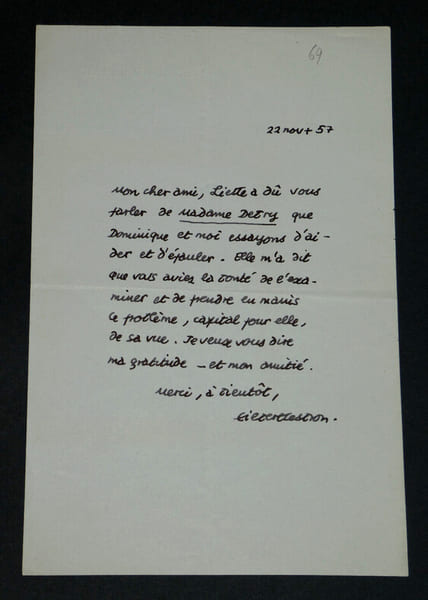
Gilbert CESBRON - Lettre autographe signée de remerciements - 1957
Gilbert CESBRON. Lettre autographe signée, 1957 Écrivain français Lettre autographe signée de Gilbert CESBRON, adressée à "Mon cher ami", datée du 22 novembre 1957. Écrite à l'encre noire sur un feuillet simple avec tampon sec de son nom en entête. Dimensions : 13,5 x 21 cm Nombre de pages : 1 page Gilbert Cesbron est un écrivain français d’inspiration catholique, né le 13 janvier 1913 à Paris, où il est mort le 12 août 1979.
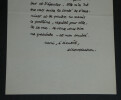
Gilbert CESBRON - LETTRE AUTOGRAPHE SIGNÉE - 1973
Gilbert CESBRON. Lettre autographe signée, 1973 Écrivain français Lettre autographe signée de Gilbert CESBRON, adressée à "Chère Liette", datée du 23 novembre 1973. Écrite à l'encre noire sur un feuillet simple avec tampon sec de son nom en entête. "Chère Liette, Voici les livres dédicacés. Dédicaces-standard" car je suis encore assez fatigué. Il faut me le pardonner. Fidèlement et affectueusement à vous deux. Il manquait 2 "Imposteurs"..." * Dimensions : 13,5 x 21 cm * État : Voir photos pour plus de détails. * Nombre de pages : 1 page Gilbert Cesbron Gilbert Cesbron est un écrivain français d'inspiration catholique, né le 13 janvier 1913 à Paris, où il est mort le 12 août 1979. Wikipédia
La Montagne Héroïque [Paperback] Gilbert - Charles Gilbert
Le Cercle D'or BROCHE
Merci de nous contacter à l'avance si vous souhaitez consulter une référence dans notre boutique à Authon-du-Perche.
Publié à l'occasion de l'exposition Gilbert Portanier. Le chemin du rêve au musée Magnelli, musée de la céramique à Vallauris du 19 octobre 2024 au 27 janvier 2025.
Reference : 33875
ISBN : 9788836659081
Gilbert Portanier. Le chemin du rêve.
<p><em>Je vois courir mon pinceau sur la surface,<br>il se prend en charge, mon seul travail est de le laisser faire.<br>Je ressens l’étroit contact entre la main conductrice et le chemin du rêve.<br>Maintenant, je sais que je ne m’arrêterai plus.<br></em>— Gilbert Portanier</p><p>Gilbert Portanier (1926-2023), alchimiste de la terre et des couleurs, a donné un souffle nouveau à la céramique française des années 1950 à nos jours. Ce catalogue présente un ensemble de pièces emblématiques, permettant de découvrir ou redécouvrir son œuvre où les possibilités infinies du matériau sont explorées.<br>Installé à Vallauris, Gilbert Portanier a abordé la céramique en peintre tout en faisant preuve d’une grande maîtrise technique tant dans le façonnage que dans le travail des émaux, dévoilant une œuvre délicate. Au début, de sa carrière, il s’approprie des objets utilitaires, qu’il aborde comme des supports picturaux. Par la suite, il continue ses recherches, notamment sur les émaux, ce qui lui permet de diversifier les textures et les effets de surface, et il expérimente différentes techniques de réalisation. Il évolue vers une approche plus sculpturale et plus libre formellement, jouant pleinement des relations entre le volume et le décor dans des pièces à la taille de plus en plus imposante.<br>Ce catalogue vous invite à parcourir son univers créatif unique où se mêlent savoir-faire technique et élégance raffinée.</p> Milan, 2024 Silvana Editoriale 96 p., 56 ill. couleur, broché à rabat 23 x 29
Neuf
Gilbert and George
Paris Musée d'Art Moderne 1997 En feuilles
Publication édité par Agnès B pour l'exposition des deux artistes britanniques organisée du 4 octobre 1997 au 4 janvier 1998. Texte en rouge et noir en première et dernière page. 5 grandes illustrations en couleurs, l'une de double page centrale. 8 pp. 43 x 30,7 cm. Très bel exemplaire sans pliures. Très bon 0
Atala N 12/2009 : La distance objet gographique
Atala Broch D'occasion bon tat 01/03/2009 150 pages
Sous l'Equateur du Pacifique - Les Iles Gilbert et la Mission Catholique 1888-1938
Issoudun, Archiconfrérie, Paris, 1939. Editions Dillen 1 volume in-8, 292 pp., broché, couverture souple imprimée, ouvrage agrémenté de nombreuses photographieset d'une grande carte dépliante in fine du vicariat apostolique des Iles Gilbert et Elice, très bon état. Introduction par Henri Pourrat.
Panorama complet des Iles Gilbert. Sommaire: Vie végétale et animale - Mythologies, Légendes et Récits - Croyances, Religions et Superstitions - La vie sociale - Travaux - Navigation, Pirogues, Pêches - Les guerres gilbertines - Les Trafiquants - Les Fondateurs - Les premières findations - A travers les Iles - Occupation des Iles du nord - La Lute dans le Sud - Les Iles du Centre - Les Ecoles - l'Episcopat de Mgr Leray - Les Missionnaires et leurs travaux - Derniers Evénements
Bécaud Gilbert,Diamond Neil - Bécaud Gilbert,Diamond Neil - Diamond Neil,Bécaud Gilbert
Reference : 106325
(1981)
Partition de la chanson : Chansons de ta vie (Les)
Rideau Rouge 1981
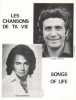
Très bon état Format Coquille Piano

