 Write to the booksellers
4 books for « gehrcke e »Edit
-
Topics
Germanic languages (1)
Physics (2)
Sciences (1)
-
Countries
Denmark (1)
France (2)
Switzerland (1)
-
Syndicate
ILAB (3)
NVVA (1)
SLACES (1)
SLAM (1)
Über die Anwendung der Interferenzen an planparallelen Platten zur Analyse feinster Spektrallinien. - [THE LUMMER-GEHRCKE INTERFEROMETER]
(Leipzig, Johann Ambrosius Barth, 1903). 8vo. No wrappers. Extracted from ""Annalen der Physik"" Vierte Folge. Bd. 10. Entire issue no. 3 offered. Pp. 457-477. [Entire issue: Pp.
First appearance of this important paper in which the ""Lummer-Gehrcke interferometer"" was presented for the first time. ""Since Lummer fringes are the result of differences in path length of many wavelengths, Lummer arrived at the idea, in 1901, of developing the plane parallel plates into a spectroscope of the highest resolution. This device had the advantage of possessing greater resolving power than the interferometer produced in 1897 by Fabry and Perot. The considerable drawback of low luminous intensity, caused by the glancing incidence of the light, was eliminated in 1902 by Gehrcke, who cemented a prism to the plate with Canada balsam. The new apparatus, for which Lummerproposed the name Lummer-Gehrcke interference spectroscope, proved to be an excellent tool for spectroscopy and superior to the simple line grating."" (DSB)Lummer-Gehrcke interferometer is a multiple-beam interferometer similar to the Fabry-Perot etalon, but using light at a steep angle of incidence. The interferometer consists of a long plate of glass or quartz, with faces that are polished accurately flat and parallel. Light bounces back and forth inside the plate, striking the faces at an angle just below the critical angle as it propagates along. Because of the steep angle of incidence, nearly all of the light is reflected, but a tiny fraction leaks out on each bounce.
Die Strahlen der positiven Elektrizität.
Leipzig, S. Hirzel, 1909, in-8°, XII + 124 S., mit 43 Figuren + 2 (1 farb.) Tafeln, Bibl.-Stempel, Original-Leinenband.
Das Buch behandelt die positive Strahlen: 1) erzeugt durch elektrische Entladungen. / 2) erzeugt durch radioaktive Körper. Mit 7 Nachträgen und alphabet. Register.Prof. Dr. E. Gehrcke war Privatdozent an der Universität Berlin, ständiger Mitarbeiter an der Physikalisch-Technischen Reichsanstalt.

(SLACES, NVVA)
Phone number : 41 (0)26 3223808
Die Massensuggestion der Relativitätstheorie. Kulturhistorisch-psychologische Dokumente
Berlin, Hermann Meusser, 1924, in-8, de VIII et 108 pages, exemplaire broché, Première édition. Dans ce texte, Ernst Gehrcke s'oppose à la théorie de la relativité générale d'Einstein. Très rare texte polémique, qui émane du mouvement antisémite "German Physics". Celui-ci s'opposait, autour des années 1920-1930, aux deux grandes révolutions de la physique moderne : la théorie de la relativité et le développement de la physique quantique. Bon exemplaire, portant l'ex-libris de Marcel Bekus de VIII et 108 pages
Handbuch der physikalischen optik - Band I.
Leipzig verlag von Johann Ambrosius Barth. 1927. In-8. Relié. Etat passable, Tâchée, Coiffe en pied abîmée, Mouillures. X + 957 pages - nombreuses figures en noir et blanc dans le texte - ouvrage en allemand - quelques traces de mouillures en pied de page à l'intérieur de l'ouvrage sans conséquence sur la lecture - coins frottés - étiquette collée sur le dos - coiffes abîmées - mors abîmés.. . . . Classification Dewey : 430-Langues germaniques. Allemand
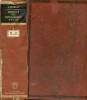
Ouvrage en allemand. Classification Dewey : 430-Langues germaniques. Allemand


