 Write to the booksellers
83 books for « francois arago »Edit
-
Century
19th (50)
20th (3)
-
Countries
Belgium (2)
Brazil (1)
Denmark (13)
France (59)
Germany (1)
Switzerland (7)
-
Syndicate
CLAM (1)
ILAB (42)
NVVA (1)
SLACES (1)
SLAM (25)
SNCAO (3)
Topics
- Agriculture (1)
- Ampere andré - marie (1)
- Anonymous (1)
- Arago françois (17)
- Architecture (1)
- Astronomy (12)
- Biography (3)
- Botany (1)
- Chemistry (7)
- Clock-making (1)
- Comet (1)
- Commune the (1)
- Condorcet (3)
- Constellations (1)
- Discovery (1)
- Early printed books (4)
- Electricity (1)
- Engraving (books about) (2)
- Fine arts (2)
- First edition (2)
- History (6)
- Lamp (1)
- Limited editions (1)
- Literature (1)
- Locomotion (1)
- Meteorology (2)
- Opera (1)
- Opera ballet (1)
- Phone directory (1)
- Photography (1)
- Physics (3)
- Policy (1)
- Political economy (1)
- Portraits (2)
- Repertory post office directory (1)
- Sciences (10)
- Sciences & technique (1)
- Star (2)
- Sun (1)
- Tardieu andré (1)
- Tea (6)
- Theatre (1)
- Travel (2)
- Various (1)
Alfred Arago (1815 ou 1816-1892), peintre, inspecteur des Beaux-Arts, fils de François Arago.
Reference : 011183
Lettre autographe signée
Alfred Arago (1815 ou 1816-1892), peintre, inspecteur des Beaux-Arts, fils de François Arago. L.A.S., sd, 1p in-8. A un ami. « Je suis en ce moment dans une crise terrible et en proie aux plus douloureuses inquiétudes » et ne mérite pas ses reproches. Il est question de rendez-vous donnés par Arago auquel le correspondant ne s'est pas rendu. Cachet de la collection Etienne Déville (1873-1944), historien, conservateur à Lisieux. [157]
Alfred Arago (1815 ou 1816-1892), peintre, inspecteur des Beaux-Arts, fils de François Arago.
Reference : 011182
Lettre autographe signée
Alfred Arago (1815 ou 1816-1892), peintre, inspecteur des Beaux-Arts, fils de François Arago. L.A.S., sd [1853], 2p in-8. Au comte (futur duc) de Morny. Etant un « débutant dans la spécialité financière », il souhaite que Morny lui obtienne 25 actions « dans la répartition du capital du chemin Grand Central » dont Morny est le fondateur. Cette société de chemin de fer n'exista que 4 ans. Cachet de la collection Etienne Déville (1873-1944), historien, conservateur à Lisieux. [157]
Marie-Jean-Antoine Nicolas de Caritat, marquis de Condorcet ; Arthur Condorcet O'Connor ; François Arago
Reference : 0496
(1847)
Œuvres de Condorcet publiées par A. Condorcet O'Connor, lieutenant-général, et M. F. Arago, secrétaire perpétuel de l'Académie des Sciences
Paris, Firmin-Didot, 1847-49. Édition originale des œuvres complètes du philosophe par son gendre et le savant François Arago. Quasi complet, seul le volume X manque. Onze forts volumes (sur les 12) de 154 x 231 mm reliés demi-chagrin grainé tabac, dos à 5 nerfs, mention "ŒUVRES DE CONDORCET" et tomaison en caractères d'imprimerie dorés. Gardes colorées, portrait de Condorcet en frontispice sous papier de soie. Plus de 5500 pages en tout : tome I, Biographie de Condorcet par Arago et œuvres diverses, CLXXXVI et 652 pp. ; tome II, Éloges I, VIII et 672 pp. ; tome III, Éloges II, 664 pp. ; tome IV, Mélanges de littérature et de philosophie I, 644 pp. ; tome V, Mélanges de littérature et de philosophie II, 575 pp. ; tome VI, Mélanges de littérature et de philosophie III, 662 pp. ; tome VII, Économie politique et politique I, 575 pp. ; tome VIII, Économie politique et politique II, 662 pp. ; tome IX, Économie politique et politique III, 547 pp. ; tome X manquant ; tome XI, Politique I, 676 p. ; tome XII, Politique II, 690 pp. Marie-Jean-Antoine Nicolas de Caritat, marquis de Condorcet (1743-1794), fut l'une des grandes figures intellectuelles du mouvement des Lumières. "Célèbre pour ses travaux pionniers en statistique et en probabilités, pour son analyse des modes de scrutin, le vote Condorcet, « théorème du jury » et le paradoxe de Condorcet, ainsi que pour ses écrits philosophiques et son action politique, notamment contre l'esclavage et pour l'égalité des sexes, tant avant la Révolution que sous celle-ci. Siégeant parmi les girondins, il propose la refondation du système éducatif ainsi que celle du droit pénal." (Wikipédia) Grand ami de d'Alembert, puis de Voltaire, il finit par se mettre la Convention révolutionnaire à dos et mourut dans des circonstances mal connues sous la Terreur alors qu'il était au cachot. Quelques rousseurs à travers les volumes, très petits trous de ver à certains sans perte au texte, frontispice bien présent, petits manques au cuir en coiffe et queue de certains volumes, cuir du dos du vol. XII en bonne partie manquant. Bon état général. Complet hors le volume X manquant.
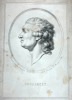
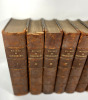
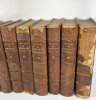
Considérée comme la "meilleure édition collective des œuvres de Condorcet", cette publication a été revue sur les manuscrits du philosophie. Renferme plusieurs écrits inédits de Condorcet ainsi que nombre de lettres de Voltaire (Bengesco, III, 2058) et de Turgot. Rarissime et quasi introuvable. Cité par Brunet (II, 216) et par l'INED (1173). IMPORTANT : les frais de port sont inclus dans le prix !
[Gravure d'Ambroise Tardieu] - Portrait de Dominique François ARAGO
Reference : GF29168
Portrait gravé (en buste) de Dominique François ARAGO - Astronome et Physicien - Né à Estagel en 1786 -
Authentique Gravure du XIXeme siècle - Format médaillon de 29 x 20 cm sur un feuillet de 27 x 18 cm - Bon état -
D'après le buste du Musée du Vatican -
François Arago. Avec un portrait et un autographe. 3e édition.
P., Havard (Collection "Les Contemporains" N°30), 1855, petit in 12 broché, 96 pages.
...................... Photos sur demande ...................


Phone number : 04 77 32 63 69
Oeuvres de François Arago, 2e édition, complétée par J.A. Barral
1865 Librairie des sciences naturelles Théodore Morgand Broché. Bon état, non coupé, des rousseurs, quelques traces de mouillures claires, brochage solide.
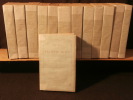
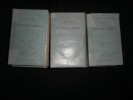
13 volumes : notices biographiques: 3 tomes - notices scientifiques : 5 tomes - voyages scientifiques : 1 tome - mémoires scientifiques : 2 tomes - mélanges : 1 tome - table : 1 tome. Avec 11 figures dans le texte.
Phone number : 04 76 97 79 28
François Arago et MM. Le Verrier, Babinet, Ch. Delaunay, etc
Reference : 46140
(1865)
La Lune et son influence supposée sur le Temps, dialogue entre un propriétaire et un cultivateur, où l'auteur démontre l'erreur dans laquelle tombent ceux qui croient à la lune rousse, la Saint-Médard et autres préjugés populaires ; avec l'opinion de François Arago et de MM. Le Verrier, Babinet, Ch. Delaunay, etc..sur ce sujet
1865 PARIS, Ch. Pougeois - 1865 - E.O. - in-8 - Broché - 32 pages - traces de mouillures sèches - envoi rapide et soigné
Cnformément à nos conditions générales de vente :Les frais de port sont affichés à titre indicatif. Il se peut que nous devions vous contacter pour vous informer du coût de laffranchissement supplémentaire en fonction du poids et du nombre de livres, surtout pour les envois internationaux Cependant vu l'augmentation des tarifs postaux à l'internationale, nous pouvons expédier les ouvrages en point relais MONDIAL RELAY pour les pays suivants : Allemagne, Autriche, Belgique, Espagne, Italie, Luxembourg, Pays-Bas, Pologne, et Portugal. Merci de nous indiquer en retour le point relais choisi ainsi que votre numéro de téléphone mobile & adresse Courriel pour assurer le suivi du colis.N'hésitez pas à nous interroger.In accordance with our general terms and conditions of sale:Shipping costs are displayed for informational purposes only. We may need to contact you to inform you of the additional postage costs depending on the weight and number of books, especially for international shipments.However, given the increase in international postal rates, we can ship books via Mondial Relay to the following countries: Germany, Austria, Belgium, Spain, Italy, Luxembourg, Netherlands, Poland, and Portugal. Please provide us with your chosen Mondial Relay point, as well as your mobile phone number and email address to ensure package tracking.Please feel free to contact us with any questions
Portrait lithographié representant l'Astronome François ARAGO, né à Estagel (Pyrénées-Orientales) en 1786 et mort à Paris en 1853 -
Lithographie format 37,5 x 25,5 cm marges comprises - Paris - Imprimerie Lemercier - vers 1880 -
Avec une notice biographique et un fac-similé d'autographe - ensemble extrait du Panthéon des Illustrations françaises au XIXéme siècle -
Le Daguerreotype
Echoppe
Livre à l'état de neuf, très frais sans annotations ni défauts dissmulés.
Le daguerréotype
Editions Allia
Livre à l'état de neuf, très frais sans annotations ni défauts dissmulés.
27, 28 et 29 Juillet, tableau épisodique des trois journées
J.N. Barba | Paris 1830 | 14 x 21.50 cm | broché
Edition originale de l'adaptation théâtrale de cet évènement majeur du XIXème siècle. Légers manques marginaux sans atteinte au texte sur certaines pages, deux petites taches sur la dernière garde. Rare. - Photographies et détails sur www.Edition-Originale.com -
Leçons Nouvelles d'Astronomie Recueillies aux Cours Publics par un Ancien Elève de l'Ecole Polytechnique
Paris, 1826, in-8, 208pp, broché, Quelques défauts mineurs (cachets de bibliothèque, rousseurs, couverture légèrement salie) sinon très bel exemplaire de l'édition originale de ce texte, publié ici anonymement. (cf. Avant-propos, Leçons d'Astronomie 4ème édition) Bien complet des cinq planches! 208pp
François ARAGO. Son génie et son influence. Caractères de la science au XIXe siècle – EDITION ORIGINALE – BEL EXEMPLAIRE
P., Garnier, 1857, un volume in 8 relié en demi-basane bleue marine, dos orné de filets dorés (reliure de l'époque), 104pp., (1)
---- EDITION ORIGINALE ---- BEL EXEMPLAIRE ---- Idée générale de la vie et des travaux de François Arago - Sur les ouvrages de François ARAGO concernant l'application des sciences à l'industrie - Sur les ouvrages de François ARAGO concernant les sciences spéculatives - Génie de François ARAGO ; ses principales découvertes - Influence de François ARAGO ; sa méthode - Liste des ouvrages d'ARAGO**9111/K3
OEUVRES COMPLETES DE FRANCOIS ARAGO publiées d'après son ordre sous la direction de M. J.A. Barral (avec une introduction par A. De HUMBOLDT) -- EDITION ORIGINALE -- 17 VOLUMES (COMPLETE SET) -- COLLECTION COMPLETE DES OEUVRES D'ARAGO
P., Gide & Baudry, 1854/162, 17 VOLUMES in 8 reliés en plein veau glacé rouge, dos ornés de fers et caissons dorés, filets et fers dorés sur les plats, toutes tranches dorées (reliures de l'époque), (2 coiffes légèrement émoussées, quelques épidermures et plats frottés), collection illustrée d'UN PORTRAIT, DE NOMBREUSES FIGURES DANS LE TEXTE ET PLANCHES HORS TEXTE
----EDITION ORIGINALE ---- BON EXEMPLAIRE ---- COLLECTION BIEN COMPLETE (17 VOLUMES) DES OEUVRES D'ARAGO : Notices biographiques. P., Gide & Baudry, 1854/1859 (3 volumes) - Notices scientifiques. P., Gide & Baudry, 1854/1858 (5 volumes) - Voyages scientifiques. P., Gide, 1857 (1 volume) - Mémoires scientifiques. P., Gide, 1858/1859 (2 volumes) - Mélanges. P., Gide, 1859 (1 volume) - Astronomie populaire. P., Gide, 1860/1861 (4 volumes) - Tables : Discours de M. FLOURENS prononcé aux funérailles de F. ARAGO, Notice chronologique sur les oeuvres de F. ARAGO, tables des auteurs et des personnages cités dans les oeuvres de F. ARAGO, Table cosmique, Table analytique et alphabétique des matières). P., Gide, 1862 (1 volume) - SOIT 17 VOLUMES ---- "ARAGO made important discoveries in electro-magnetism (especially the phenomenon of rotatory magnetics), in optics, in astronomy and physics. He may be said to have proved the relation between the aurora borealis and magnetic variations. He greatly promoted the acceptance of the undulatory theory of light and made important advances in the doctrine of the polarisation of light. Other minor achivements were made in the department of photometric measurements of the brightness of the stars, the elastic force of steam and other gases". (Sotheran N° 131) ---- "ARAGO published no single scientific treatise of major significance during his life time. After the June days of 1848, he began arranging his papers in preparation for a complete edition. It was published posthumously as Oeuvres de François Arago, J. A. Barral ed., 17 vols (Paris, 1854/1862), with an introduction by Humboldt. It contains most of his published articles (somewhat edited) and reports, the revised portions of his lectures (Astronomie populaire), and many previously unpublished notes". (DSB I) ** (P7.141.14100)
Mémoire Sur l'Action que les rayons de lumière polarisés exercent les uns sur les autres. - [THE DISCOVERY THAT LIGHT VIBRATES TRANSVERSELY]
Paris, Crochard, 1819. 8vo. Contemporary half calf with raised bands and gilt spine. Very light wear along edges. Small stamps on verso of title-page and on verso of plates. In ""Annales de Chimie et de Physique"", Tome X, 2. Series. 448 pp. a. 2 folded engraved plates. (Entire volume offered). Arago and Fresnel's paper: pp. 288-306.
First appearance of this seminal paper in which Arago and Fresnel described the experiments which demonstrated that light vibrates transversely to its direction of forward movement.""In a further letter to Arago, dated 29 April 1818 Young recurred to the subject of transverse vibrations, comparing light to the undulations of a cord agitated by one of its extremities. This letter was shown by Arago to Fresnel, who at once saw that it presented the true explanation of the non-interference of beams polarised in perpendicular planes, and that the latter effect could even be made the basis of a proof of the correctness of Young's hypothesis" for if the vibration of each beam be supposed resolved into three components, one along the ray and the other two at right angles to it, it is obvious from the Arago-Fresnel experiment that the components in the direction of the ray must vanish" in other words THAT THE VIBRATIONS WHICH CONSTITUTE LIGHT ARE EXECUTED IN THE WAVE-FRONT."" (Edmund Whittaker in ""A History of the Theories of Aether and Electricity I"", p. 115). - Parkinson, Breakthroughs 1819 P. - Magie ""A Source Book in Physics, p. 325 ff.The volume contains another groundbreaking paper, in which THE CONNECTION BETWEEN ATOMIC WEIGHT AND ATOMIC HEAT WAS ESTABLISHED - THE ""LAW OF DULONG AND PETIT"".DULONG, (PIERRE) & (ALEXIS) PETIT. Recherches sur quelques points importans de la théorie de la chaleur. Vol. X, pp. 395-413. (In the volume offered).""They (Dulang and Petit) were concerned with the specific heats of elements"" but if these elements really existed as atoms, it seemed possible that there might be a connection between the weight of the atom and the amount of heat acquired to raise the temperature of a given weight of that element by a certain amount."" (DSB). - ""One of his (Dulong) most important researches was made in collaboration with Alexis Thérese Petit (1791-1820), with whom he announced the law that the product of atomic weight and specific heat is constant (1819). It rendered a distinct service in fixing atomic weights, especially when these were in question, and enabled Berzelius and later Cannizzaro to arrive at correct atomic weights and the correct number of atoms in molecules."" (Leicester & Klickstein, A source Book in Chemistry 1400-1900, p. 273). Magie ""A Source Book in Physics"", p. 178 ff. - Parkinson, Breakthroughs (1819).
"(ARAGO, DOMINIQUE- FRANCOIS). - THE DISCOVERY OF MAGNETIZATION BY WAY OF THE VOLTAIC CURRENT.
Reference : 44807
(1820)
Expériences relatives à l'aimantation du fer et de l'acier par l'action du courant voltaïque.
(Paris, Crochard, 1820). No wrappers as extracted fron 'Annales de Chimie et de Physique', Volume 15 (2e Series). Pp. 93-102.
First appearance of this importent paper in which Arago gives an account of his discovery of how iron and steel could be magnetized by the action of the voltaic current, THE FIRST STEP TOWARDS THE ELECTRIC TELEGRAPH. ""Arago .... made several important contributions to electromagnetism on his own. On 20 September 1820 he announced the discovery of the temporary magnetization of soft iron by an electric current, which suggested to Ampère a theory about the nature of magnetic ""currents"" and provided the technological key to the electric telegraph. Ampère calculated that the magnetic power could be multiplied by twisting the current-carrying wire into a helix, and with Arago he carried out the first experiments on primitive solenoids. In his historical articles Arago was always careful to credit Ampère with the major share of this discovery, which ultimately depended upon Ampère’s mathematical theory.""(DSB).Arago formed a close freinship with Fresnel,whose views on the nature of light he ardently supported. He assisted Fresnel in some of his most importent work and made original discoveries in the same field.Magie ""A Source Book in Physics"", p. 443 ff.
"ARAGO, DOMINIQUE- FRANCOIS et AUGUSTIN FRESNEL. - ESTABLISHING THAT LIGHT VIBRATES TRANSVERSELY.
Reference : 47357
(1819)
Mémoire Sur l'Action que les rayons de lumière polarisés exercent les uns sur les autres.
Paris, Crochard, 1819. 8vo. No wrappers. In ""Annales de Chimie et de Physique"", Tome X, 2. Series, Cahier 3. Titlepage to vol. X. Pp. 241-336 (entire issue offered, Cahier 3). Arago and Fresnel's paper: pp. 288-306.
First appearance of this seminal paper in which Arago and Fresnel described the experiments which demonstrated that light vibrates transversely to its direction of forward movement.""In a further letter to Arago, dated 29 April 1818 Young recurred to the subject of transverse vibrations, comparing light to the undulations of a cord agitated by one of its extremities. This letter was shown by Arago to Fresnel, who at once saw that it presented the true explanation of the non-interference of beams polarised in perpendicular planes, and that the latter effect could even be made the basis of a proof of the correctness of Young's hypothesis" for if the vibration of each beam be supposed resolved into three components, one along the ray and the other two at right angles to it, it is obvious from the Arago-Fresnel experiment that the components in the direction of the ray must vanish" in other words THAT THE VIBRATIONS WHICH CONSTITUTE LIGHT ARE EXECUTED IN THE WAVE-FRONT."" (Edmund Whittaker in ""A History of the Theories of Aether and Electricity I"", p. 115). - Parkinson, Breakthroughs 1819 P. - Magie ""A Source Book in Physics, p. 325 ff.
"(ARAGO, DOMINIQUE- FRANCOIS & AMPERE, ANDRE-MARIE AMPÈRE) + FRESNEL, AUGUSTIN
Reference : 48806
(1821)
Rapport fait à l'Academie des Sciences, le lundi 4 juin 1821, sur un Mémoire de M. Fresnel relatif aux couleurs des lames cristallisées douées de la double réfraction. (Arago and Ampère). (+) Note sur le Calcul des teintes que la polarisation dévelop...
Paris, Crochard, 1821. 8vo. Uncut and unopened in orig. printed wrappers. In: ""Annales de Chimie et de Physique, Redigées par MM. Gay-Lussac et Arago"", Tome XVII - Mai Issue. Pp. 1-112 including titlepage to vol. 17. - The rapport: pp. 80-102. Fresnel's paper: pp. 102-111. Clean and fine.
First appearance of the joint report. This investigation of Fresnel's paper by Arago (mainly written by Arago as a polemic directed at Biot) and Ampère is a central document in the rather bitter confrontation between Arago and Biot on the wave theory of light put forward by Fresnel.Fresnel's paper is the first part of three of his ""Calcul des teintes"".
"ARAGO, FRANCOIS - LOUIS DAGUERRE. - THE INVENTION OF THE DAGUERREOTYPE.
Reference : 46845
(1839)
Fixation des images qui se forment au foyer d'une chambre obscure. (Seance du Lundi 7 Janvier 1839). (+) Le Daguerréotype. (Seance du Lundi 19 Aout 1839).
Paris, Bachelier, 1839. 4to. No wrappers. In: ""Comptes Rendus Hebdomadaires des Séances de L'Academie des Sciences"", Tome VIII (No.1)+ IX, (No. 8) Entire issues offered with htitles and titlepages to both volumes. Pp. 1-36 + Pp. 249-282 and 1 lithographed plate. The papers: pp. 4-7 and pp. 250-267. A faint stamp to top of titlepages. A few brownspots to titlepages.
First Edition of the official and complete report of the invention of the ""daguerreotype"", the photographic process invented by Louis Daguerre. Together with the preliminary report of the invention (OF JANUARY 7). The presentation by Arago preceeded Daguerre's own publication ""Historique de description des procédés du daguerreotype et du diorama"", (1839). ""When the attempt to exploit the process of daguerreotype was unsuccessfull, Daguerre and Nièpce decided to offer their method to the government. Daguerre approached Francois Jean Arago, to whom he imparted, under the seal of secrecy his processes and those of Nicéphore Niépce. It was fortunate that Arago possessed such a great insight into the invention, which he received enthusiastically. He reported the invention of the daguerretype to the Academy of Sciences on January 7, 1839. The secrecy, however, was not observed very carefully, for the ""Gazette de France"" published a note abouit it on January 6, 1839, although without printing any details.""(Eder ""History of Photography"").
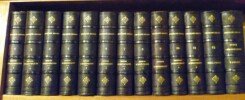
Oeuvres complètes de François Arago publiées d'après son ordre sous la direction de M. J.A. Barral (avec une introduction par A. de Humboldt).
Paris, Gide & Baudry, Leipzig, T. O. Weigel, 1854/1862.Dix-sept volumes reliés in-8 (13 x 22 cm) de 1 portrait d'Arago en frontispice, (8)-xxxii-638 pages / (8)-703 pages / (8)-628 pages / (8)-iv-715 pages / (8)-676 pages / (8)-705 pages / (8)-610 pages / (8)-658 pages / (8)-644 pages / (8)-602 pages / (8)-756 pages / (8)-740 pages / (4)-cclxiii-646-(2) pages / (4)-xii-559 pages et 8 planches hors texte / (4)-554 pages et 9 planches hors texte / (4)-635 pages et 4 planches hors texte / (4)-854-(2) pages et 3 planches hors texte. Au total, un frontispice et 24 planches.Première édition des oeuvres complètes d'Arago. Notices biographiques 3 vol. - Notices scientifiques 5 vol. - Voyages scientifiques 1 vol. - Mémoires scientifiques 2 vol. - Mélanges 1 vol. - Astronomie populaire 4 vol. - Tables 1 vol.Reliure demi-chagrin violine, dos à nerfs, titrage doré. Coins du volume de Tables émoussés et manque de papier sur le deuxième plat. Sinon bel exemplaire en reliure uniforme.
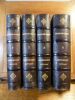
Oeuvres complètes de François Arago,... publiées d'après son ordre sous la direction de M. J.-A. Barral,... 2e édition
Paris, Théodore Morgand, impr. J. Claye, à Paris 1865 17 volumes. In-8 22,5 x 14 cm. Reliure de l’époque demi-chagrin rouge à coins, dos à nerfs, têtes dorées, environ 600 pp. par volume, tables des matières.
Bon état d’occasion
"DAGUERRE, LOUIS J.M. - (ARAGO, FRANCOIS). - THE FIRST DESCRIPTION OF THE PRODUCTION OF DAGUERREOTYPES.
Reference : 44903
(1839)
Le Daguerréotype.(Analyse de la communication faite à l'Academie par M. Arago).
Paris, Crochard et Comp., 1839. Orig. printed yellow wrappers (no backstrip). In 'Annales de Chimie et de Physique', 2e series, Volume 71, Juillet- issue, pp. 225-352 (entire July-issue offered with orig. wrappers and titlepage to vol. 71). Arago's paper: pp. 313-340.
First printing of probably the first (the Juillet issue of Annales) official announcement of Daguerre's invention of the photographic process. The paper offered here preceeded the official report in Comptes Rendues which was published at the end of 1839 (in the July-December issue). The first report of on the discovery was presented to the Royal Academy on January 7, 1839 and delivered in full on August 19, 1839 (and printed in the July-Dec. issue of Comptes Rendues). The paper also preceeded Daguerre's own publication of 1839 ""Historique et description du daguerréotypie...""In 1839 Arago took a personal interest in announcing and popularizing the inventions of Niepce and Daguerre, who were awarded government pensions as a result of Arago’s recognition of their inventions’ potential significance.""In 1829 Daguerre went into partnership with Niepce, who had managed to produce images by the action of light some three years earlier but had failed to make the process really practical. Daguerre carried on and began to use copper plates on which silver salts were deposited. ight was made to focus upon that and an image was formed. The light portions of the image darkened the salts, while the shadowy portions left them unaffected. The unchanged salt was dissolved away by sodium thiosulfate (a process that had been suggested by John Herschel and a permanent image of sorts was left behind.""(Asimov).Together with JEAN CHARLES PELTIER ""Mémoire sur la Formation des Tables des Rapports qu'il y entre la Force d'un Courant électrique et la Déviation des aiguilles des multiplicateurs"" suivi de Recherches sur la Causes de Pertubation des couples thermo-électriques..."", pp. 225-313.
"DAGUERRE, LOUIS J.M. - (ARAGO, FRANCOIS). - THE FIRST DESCRIPTION OF THE PRODUCTION OF DAGUERREOTYPES.
Reference : 49078
(1839)
Le Daguerréotype.(Analyse de la communication faite à l'Academie par M. Arago).
Paris, Crochard et Comp., 1839. Contemp. hcloth. Gilt lettering to spine. In 'Annales de Chimie et de Physique', 2e series, Volume 71. (4),445,(3) pp. (Entire volume offered). Arago's paper: pp. 313-340. The first and last leaves with some browning. A few scattered brownspots.
First printing of probably the first (in the Juillet issue of Annales) official announcement of Daguerre's invention of the photographic process. The paper offered here preceeded the official report in Comptes Rendues which was published at the end of 1839 (in the July-December issue). The first report of on the discovery was presented to the Royal Academy on January 7, 1839 and delivered in full on August 19, 1839 (and printed in the July-Dec. issue of Comptes Rendues). The paper also preceeded Daguerre's own publication of 1839 ""Historique et description du daguerréotypie...""In 1839 Arago took a personal interest in announcing and popularizing the inventions of Niepce and Daguerre, who were awarded government pensions as a result of Arago’s recognition of their inventions’ potential significance.""In 1829 Daguerre went into partnership with Niepce, who had managed to produce images by the action of light some three years earlier but had failed to make the process really practical. Daguerre carried on and began to use copper plates on which silver salts were deposited. ight was made to focus upon that and an image was formed. The light portions of the image darkened the salts, while the shadowy portions left them unaffected. The unchanged salt was dissolved away by sodium thiosulfate (a process that had been suggested by John Herschel and a permanent image of sorts was left behind.""(Asimov).
Le Daguerréotype. (Seance du Lundi 19 Aout 1839). (+ Daguerre:) Des procédés photogéniques comme moyens de gravure - Lettre de M. Daguerre à M. Arago. (Séance du Lundi 20 Septembre 1839).
(Paris, Bachelier), 1839. 4to. No wrappers. In: ""Comptes Rendus Hebdomadaires des Séances de L'Academie des Sciences"", Tome IX, No. 8 a. 14. Pp. (249-) 282 a. pp. (417-) 436. Arago's rapport: Pp. 250-267 - Daguerre's letter: pp. 423-429. Both issues clean and fine.
First printing of the first official and complete report of the invention of the ""daguerreotype"", the photographic process invented by Louis Daguerre. The presentation by Arago preceeded Daguerre's own publication ""Historique de description des procédés du daguerreotype et du diorama"", (1839). Together with Daguerre's letter to Arago in which he relates the process of heliography and describes his contract with Niépce to exploit the heliogrphis process. The Heliogravure was invented by Niépce
"ARAGO, FRANCOIS - LOUIS DAGUERRE. - FIRST ANNOUNCEMENT OF THE PRODUCTION OF DAGUERROTYPES.
Reference : 49478
(1839)
Fixation des images qui se forment au foyer d'une chambre obscure. (Seance du Lundi 7 Janvier 1839).
Paris, Bachelier, 1839. 4to. No wrappers. In: ""Comptes Rendus Hebdomadaires des Séances de L'Academie des Sciences"", Tome VIII No. 1. Pp. 1-36. (Entire issue offered with htitles and titlepages to volume 8). Arago's paper: Pp. 4-7. Light toning to halftitle. Stamps to title-page (one punched in lower margin). Fine and clan.
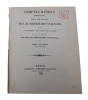
First printing of the first announcement and description of the production of Daguerreotypes made by Arago to the French Academy on January 7, 1839. The first complete report was printed on August 19, 1839. The presentation by Arago preceeded Daguerre's own publication ""Historique de description des procédés du daguerreotype et du diorama"", (1839).""Arago, himself a chemist and a member of the Chamber of Deputies, made a brief pronouncement on Daguerre's proces in the Chamber on 7 January 1839 (the paper offered). and in the following August printed the full text of his report thereon made to a joint sesion of the Chambers of Deputies and the Academy of Sciences.""(PMM: 318 (Note to).

