 Write to the booksellers
54 books for « eusebius »Edit
-
Language
French (53)
Latin (1)
-
Century
16th (2)
17th (1)
18th (2)
19th (11)
20th (22)
-
Countries
Belgium (32)
Denmark (3)
France (12)
Netherlands (7)
-
Syndicate
ILAB (8)
SLAM (2)
Topics
- Alexandria (1)
- Architecture (1)
- Asia - orient (1)
- Belgium (1)
- Byzantium, (2)
- Christianity (1)
- Churches (1)
- Exegesis (2)
- Germanic languages (1)
- Greek (16)
- Hagiography (1)
- History (3)
- Illustrated books (1)
- Isaac (2)
- Latin (19)
- Liturgy (1)
- Patrology (12)
- Regionalism (1)
- Religions (4)
- Religions & spirituality (1)
- Reliure (1)
- Saint jerome (2)
- Sciences (1)
- Tea (1)
- Theology (10)
- Zoology (1)
Pseudo-Eusebius of Alexandria, Rémi Gounelle, Aidan Conti, Zbigniew Izydorczyk
Reference : 70484
Late Antique Harrowing of Hell and Its Medieval Reception. Eusebius of Alexandria's Sermons 15 and 17 (CPG 5524 and 5526) and their Latin Rewritings
, Brepols, 2026 Hardback, Pages: 551, Size:156 x 234 mm, Illustrations:4 tables b/w., Languages: English, Latin, Greek. ISBN 9782503614465.
Summary In 1904, Edward Kennard Rand published a Latin sermon by an unknown author from a single manuscript of the ninth century that recounts the amazement of the devil at the crucifixion of Jesus and the devil's defeat at the coming of Christ into the underworld, or the Harrowing of Hell. This Sermo de confusione diaboli et inferni added a new dimension to the already complex body of research on the sermons attributed to pseudo-Eusebius of Alexandria and the Gospel of Nicodemus. A century later, new witnesses of the text edited by Rand and an unedited Latin translation of pseudo-Eusebius' Sermo 17 have begun to shed new light on the interconnectedness of all these materials. The present book critically edits the newly identified Latin documents and discusses them in relation to their Greek source(s) and to one another. It retraces the paths from the protean forms of pseudo-Eusebius' Greek sermons 15 and 17 to their Latin translations, to the Sermo de confusione diaboli et inferni, and to the Gospel of Nicodemus. In the process, it highlights the creativity of the copyists and translators of Late Antiquity and the Middle Ages, and demonstrates their profound interest and investment in the story of Christ's Descent into Hell. TABLE OF CONTENTS Sigla To the Reader Introduction (R. Gounelle) Chapter 1. State of research and new perspectives on Eusebius of Alexandria and the corpus of homilies ascribed to him 1.Did Eusebius of Alexandria really exist? (D. Niquin) 2. The collection of homilies by Pseudo-Eusebius of Alexandria (R. Gounelle) 3. History of research on the Greek manuscript tradition of Sermons 15 and 17 (R. Gounelle) 4. The Greek tradition of the Sermones 15 & 17 (R. Gounelle) Appendix to chapter 1. Edition of Greek texts of sermons 15 and 17 of Pseudo-Eusebius of Alexandria (R. Gounelle) Chapter 2. The Latin witnesses 1. The De passione (A. Conti) 2. The Sermo de confusione diaboli (Z. Izydorczyk) Appendix to chapter 2. Synoptic presentation of the Latin texts of sermo 17 Chapter 3. Relations of the De passione and the Sermo de confusione diaboli with their presumed Greek sources 1. A single translation of Sermo 17 (A. Conti - R. Gounelle - Z. Izydorczyk) 2. The Latin translation of Sermo 15 A. Conti - R. Gounelle - Z. Izydorczyk) 3. The origins of the Latin De confusione text (Z. Izydorczyk - R. Gounelle) Chapter 4 Relationship between De Passione / De Confusione and the Gospel of Nicodemus (R. Gounelle - Z. Izydorczyk) 1. Parallel yet different narratives 2. The relationship between the two versions General conclusion (R. Gounelle - A. Conti - Z. Izydorczyk) General stemma Bibliography Index of biblical citations Index of the Latin words discussed in the notes or in the philological commentary
Eusebii Pamphili, Ruffini, Socratis, Theodoreti, Sozomeni, Theodori, Euagrij, & Dorothei Ecclesiastica Historia. Sex prope seculorum res gestas complectens; Latine olim a doctissimis viris partim scripta, partim e Graeco a clarissimis viris, Vuolfgango Musculo, Ioachimo Camerario & Iohanne Christophersono Britanno, eleganter conversa; et nunc ex fide Graecorum codicum, sic ut novum opus videri possit, per Ioan. Iacobum Grynaeum locis obscuris innumeris illustrata, dubijs explicata, mutilis restituta; Chronographia insuper Abrahami Bucholceri, ad Annum Epochae Christianae 1598. & lectionis sacrae historiae luculenta Methodo exornata. Cum continuatione in praesentem annum 1611. Et indicibus rerum verborumque locupletiss.
Basel (Basileae), Per Sebastianum Henricpetri, n.d. (1611)
Folio. (LXXX),807,(1 blank),(23 index),(1) p. Overlapping vellum 34 cm (Ref: VD17 23:297069D; Hoffmann 2,107) (Details: Latin translation only. Woodcut printer's mark on the title; 'From 1496 until the seventeenth century, the Petris printed in Basel, and for three generations--Adam Petri, Heinrich Petri, and Sebastian Henripetri--the printers mark alluded to the family name: a stone being smashed by a godlike hammer over which fire is blown by a heavenly face. The symbolism is explained by the biblical motto (Hieremias Propheta, 23,29) printed in Greek, Latin, and Hebrew in some books, 'numquid non verba mea sunt quasi ignis ait Dominus, et quasi malleus conterens petram', 'Is not my Word like fire, like a hammer that shatters stone?' (Source: University Library Illinois, webpage 'Windows Printers' Marks') The printer's mark is repeated on the last page. One woodcut headpiece. Some woodcut initials) (Condition: Vellum soiled, some small brown stains on the upper board. Paper somewhat yellowing. Bookplate on front flyleaf. Short title in ink on the back) (Note: The church father Eusebius Caesariensis, ca. 260-339, was elected to the see of Caesarea in Asia Minor, nowadays Kayseri, in 313 A.D. He had an impressive ecclesiastial career, but his literary achievements made him immortal. His important 'Historia Ecclesiastica' (History of the Church) runs up to 324; The object of this work was to present the apostolic 'succession' of the 4 great episcopal thrones, Rome, Alexandria, Antioch and Jerusalem, and to describe the intellectual, spiritual and institutional life of the Church, the persecutions and the heresies. 'It cannot be too strongly emphasised that Eusebius, like all early church historians, can be understood only if it be recognized that whereas modern writers try to trace the development, growth and change of doctrines and institutions, their predecessors were trying to prove that nothing of the kind ever happened. According to them the Church had had one and only one teaching from the beginning. It had been preserved by the 'succession', and heresy was the attempt of the devil to change it'. (Eusebius, the Ecclesiastical History, With an English transl. by K. Lake, Cambr. Mass., 2001, vol.1, p.XXXIV) The Latin West came to know this Greek work through the translation of 403 by Rufinus of Aquileia. The 'Historia Ecclesiastica' was first published, together with the works of the later church historians Socrates Scholasticus, Sozomenus and Theodoretus in Paris in 1544 by Robertus Stephanus. The editor of our Latin edition of 1611 is the Swiss theologian and classical scholar Joannes Jacobus Grynaeus, 1540-1617, professor at the University of Basel. He was more a theologian than a philologist. In 1570 he had already published for Henricpetri a Latin translation of the 'Opera Omnia' of Eusebius. (GG 421) In the same year, 1570, a separate edition of Grynaeus' Latin translation of the 'Historia Ecclesiastica' was published by the Basler printer Episcopius. (GG 416) Hoffmann says that our 1611 edition is a repetition of the 'Historia Ecclesiastica' edition of 1570. This cannot be correct. The titles are different, and the edition of 1611 has a preface dated 1587. We found in VD16 an edition (not mentioned by Hoffmann), with exact the same title as the one of 1611, and published in 1587 in Basel by Episcopius ( VD16 ZV 5530, also BL shelfmark 3627.ff.4). The only difference being that the 'Chronographia' at the end of the book has been continued till 1611). So this edition of 1611 is a reissue of the Basel edition of 1587, which was brought on the market by Eusebius Episcopius. This title contains Eusebius' 'Historiae Ecclesiasticae libri X', and 'De vita Constantini Magni', translated by Johannes Christophorsonus (John Christopherson), and the 'Oratio Constantini Imperatoris', and Rufinus' 'Historiae Ecclesiasticae libri II', and a Latin translation of Socrates Scholasticus' 'Ecclesiasticae Historiae libri VII', and Theodoretus' 'Historiae Ecclesiasticae libri V', translated by Joachim Camerarius, and a Latin translation of Sozomenus' 'Ecclesiasticae Historiae libri IX', and Euagrius Scholasticus' 'Historiae Sacrae libri VI', and Dorotheus Lector's 'Quomodo apostoli et prophetae vixerint ac mortui sint', translated by Wolfgang Musculus. At the end (p. 625/807) has been added the 'Chronologia' or 'Index Chronologicus' of the German historian and theologian Abraham Buch(h)olzer up to 1611) (Provenance: A modern bookplate with the text: 'Ex libris Henn Wolfram Riedesel Freiherr zu Eisenbach'. At the top a part of the coat of arms of the Riedesel family, the head of a donkey, with 3 reed leaves in its mouth. The Riedesel Freiherren zu Eisenbach family belongs to the ancient nobility in Hesse, Germany) (Collation: alpha8, alpha6, beta6, gamma6, delta6, epsilon8; a-z6 A-Z6 Aa-Vv6 Xx8, Yy-Zz6) (Photographs on request) (Heavy book, may require extra shipping costs)
Kerkelyke geschiedenissen, zedert den dood van onzen Zaligmaker tot aan den volkomen bloeistand van 't Kristendom. Waar in van de prediking der Apostelen; de Heilige Schrift des N. Verbonds; de opvolgeren der Apostelen; de uitmuntende mannen in de vornaamste kerken, en hunne schriften; de vervolgingen; martelaren; scheuringen; ketteryen, en andere zaken, de eerste Kristen Kerk betreffende, berigt wordt gegeven: In het Grieksch beschreven door Eusebius Pamfilus, (...). Nu vertaald en met vele aantekeningen opgehelderd door Abraham Arent Vander Meersch; (...).
Amsterdam (Te Amsteldam), By F. Houttuyn, 1749.
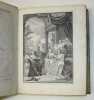
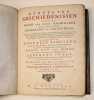
4to. Frontispiece, (XLVI),584,L,116,(36) p., 2 folding maps. Vellum. 26.5 cm (Ref: STCN ppn 82986403, STCN does not mention the cancel of leaf 2Y4, p. 359/360, which our copy has; OiN p. 180) (Details: Title printed in red & black. The frontispiece by J.C. Philips depicts an allegorical scene of the battle between False and True Religion. 15 engravings in the text, 2 folding maps, 43x30 cm, of the Roman empire under Constantine the Great, and of Asia Minor) (Condition: Vellum wrinkled & soiled. Back worn. The vellum seems ill-fitting, it looks as if the binder has tried to make the vellum of an other book fit to this binding. The interior is ok. New endpapers. The maps are slightly waterstained) (Note: Eusebius Caesariensis, ca. 263-339, became bishop of Caesarea in 313, shortly after the Great Persecution of christians, which lasted from 303 till 313. Eusebius was not an original thinker or historian. Nevertheless, he has 'mit Gelehrsamkeit und gründlicher Quellenkenntnis zu vielen Gebieten Beachtliches in einer grossen Anzahl von Schriften beigetragen'. (N.P. 4,310) The most important of his works is his 'Historia Ecclesiastica', the History of the Church. The first 7 books run up to 280 A.D., books 8 & 9 describe the Great Persecution, and book 10 offers the events from 313 till 324; Eusebius developped the idea that a christian emperor has, as a successor of Christ, divine power. This is the first Dutch translation of this work. The book contains also a translation of the appendix to book 8, 'De martyribus Palestinae'. Then follows a translation of 50 p. of Hieronymus' Latin version of the 'Chronicon' of Eusebius, and of its continuation by Hieronymus. At the end 116 p. of annotations by Vander Meersch. Abraham Arent vander Meersch, 1720-1792, was professor of Theology and Church history at Amsterdam. He lectured also on philosophy. He was succeeded by Daniel Wyttenbach in 1771. (See for a vita NNBW vol. 10; and 'Gedenkboek van het Athenaeum en de Universiteit van Amsterdam 1632-1932', p. 684) (Collation: *-6*4 (frontispiece after leaf *1, minus blank leaf 6*4), A-2X4, 2Y4 (cancel leaf 2Y4), 2Z-3A4, 3B4 (leaf chi 1 after 3B3), 3C-4D4; a-f4, g2 (minus blank leaf g2); A-T4 (2 maps after leaf P2)) (Photographs on request) (Heavy book, may require extra shipping costs)
EUSEBIUS GALLICANUS (pseudo-Eusebius Emisenus) & GLORIE F., ed.
Reference : R118718
(1970)
Eusebius 'Gallicanus' Collectio homiliarum & Sermones extravagantes (3 volumes) [in: Corpus Christianorum Series Latina CI-CIA-CIB, CCSL 101-101A-101B]
Turnhout, Brepols 1970-1971 Complete in 3 volumes: liv + 1316 pp. (continuous pagination), with 2 plates out-of-text, 26cm., in the series "Corpus Christianorum Series Latina" volumes 101-101A-101B, publisher's hardcover bindings in orange cloth with gilt lettering, small ex-libris stamp on blanco endpaper and at verso of title page, text and interior are clean and bright (looks unread), introduction and text in Latin, good condition, weight: 2.9kg., R118718
EUSEBIUS GALLICANUS (pseudo-Eusebius Emisenus) & GLORIE F., ed.
Reference : R102868
(1970)
Eusebius 'Gallicanus' Collectio homiliarum & Sermones extravagantes (3 volumes) [in: Corpus Christianorum Series Latina CI-CIA-CIB, CCSL 101-101A-101B]
Turnhout, Brepols 1970-1971 Complete in 3 volumes: liv + 1316 pp. (continuous pagination), with 2 plates out-of-text, 26cm., in the series "Corpus Christianorum Series Latina" vol.101-101A-101B, original softcovers, pages still uncut, Very good, introduction and text in Latin, weight: 2.6kg., R102868
EUSEBIUS Caesariensis - SIGEBERTUS de Gembloux - Collection of two MEDIAEVAL CHRONICLES :
Reference : 16000
EUSEBIUS. Chronicon. quod Hieronymus presbyter divino eius ingenio Latinum facere curavit...(bound with) SIGIBERTUS of GEMBLOUX. Chronicon. Two books in one binding.
" Paris, Henricus Stephan(us), 1518, in-4°, 22 x 16 cm, woodcut title + (1)(bl) + (38) + 346 pp (numbered fol. 1-175, some errors e.g. 77 for 87, 175 for 173, complete except for the last blank, printed in red & black). Moreau; 2, 1816 ; Machiels E756. USTC 144859. BOUND WITH . Sigisberti Gemblacensis coenobitae Chronicon ab anno 381 ad 1113...Paris, venale habetur in officina Henrici Stephani...in officina Ioannis Petit, 1513, title printed in red & black with woodcut printer's mark + (1)(privilege) + (42) + 327 pp + (1)(bl) (some errors; 70 for 71, 159-160 for 161-162). Adams S1091. USTC 144079. Bound in old vellum, extraordinary fine crisp copies. With the manuscript ex-libris of Alexandre Cyprien Marjoli (Luxembourg 1805), together with some manuscript notes on a fly-leaf. Interesting and very fine convolute of two pre-renaissance chronicles. The first text by Eusebius was written in Greek before 303 A.C. but did not survive. (see Catalogus Jan de Hondt). It was augmented by e.g. Matteo Palmieri de Florence , Prosper Aquitanus a.o. On page 155b you find the printed record of the invention of printing in the Western world by ''Ioane Guntenberg'' in the year 1457. The Sigisbert chronicle is here present in the first printed edition with the continuation up to 1210. Sigisbertus of Gembloux is characterised by Max Manitius (Geschichte der Lateinische Literatur) as one of the most versatile and important writers of the 11th century. His fame rests mainly on this book in which he set out to continue the Eusebius-Hieronymus chronicle."
EUSEBE D'EMESE [EUSEBIUS OF EMESA, EUSEBIUS EMESENUS] & BUYTAERT E.M.
Reference : R73960
(1949)
L'héritage littéraire d'Eusèbe d'Emèse. Etude critique et historique. Textes
Louvain, Bureaux du Muséon 1949 xiii + 192 + 217pp., 27cm., dans la série "Bibliothèque du Muséon" volume 24, brochure originale, pages non coupées, bon état, rare, [étude en français, textes en grec, latin, syriaque et arménien], R73960
EUSEBIUS ALEXANDRINUS, EUSEBIUS EMESENUS, LEONTIUS BYZANTINUS, EVAGRIUS Scholasticus, e.a. (MIGNE J.-P., ed.)
Reference : R77762
(1860)
Saecula V-VII, Anni 458-610. Eusebii Alexandrini episcopi, Eusebii Emeseni, Leontii Byzantini, Basilii Seleucensis Opera quae reperiri potuerunt omnia ... [in: Patrologia Graeca, 44 A-B]
Petit-Montrouge, J.-P. Migne 1860-1861 Complete in 2 volumes: 1376 + 1216 columns, text printed in 2 numbered columns, 28cm., hardback (bound in cart.cover, marbled plates, spine in cloth with gilt lettering), original 1860/61-edition, in the series "Patrologiae Cursus Completus Series Graeca. Patrologiae Graecae, latine tantum editae" Tomi XLIV-XLIV bis (44 A-B), some occasional foxing & few spots (text always well readable), stamp on titlepage, Text in Latin, Good condition, [continuation of title: "intermiscentur Gennadii patriarchae Cp., S.Gregentii Tapharensis, Aeneae Gazensis, Zachariae Mitylenes, Antipatri Bostrensis, Theodori Scythopolitani, Epiphanii Cp., Andreae Samosatensis, S.Isaaci Ninivitani, Timothei Hierosolymitani, Theodosii Alexandrini, Episcoporum; Ammonii presbyteri, Euthalii, Agapeti Cp., Diaconorum; Theodori lectoris, S.Barsanuphii, Eusthatii, Joannis Carpathii, monachrum, Epistolae, Tractatus, Opuscula, accedunt Justiniani, Eudociae, impp.augg., Scripta dogmatica. Volume 2 (44B): Leontii Byzantini Opera omnia, accedit Evagrii Scholastici Historia Ecclesiastica, intermiscentur S.Sophronii, etc... ], R77762
EUSEBIUS Alexandrinus, EUSEBIUS Emesenus, LEONTIUS Byzantinus, e.a. (& MIGNE J.-P., ed.)
Reference : R104412
(1976)
Eusebii Alexandrini episcopi, Eusebii Emeseni, Leontii byzantini, Opera quae reperiri potuerunt omnia, etc. [in: Patrologiae cursus completus, patrologia graeco-latina LXXXVI-1 (PG 86-1)]
Turnhout, Brepols 1976 [892] pp., text printed in 1782 numbered columns, bilingual: Greek-Latin, 29cm., softcover, reprint of the 1869-edition, copy from the collection of the belgian byzantinist prof. Justin Mossay (with stamp and ex-libris), text clean and bright, good condition, weight: 1.7kg., R104412
HIERONYMI, D Saint-Jérôme, Eusebius Sophronius Hieronymus Stridonensis.
Reference : 110071
D. Hieronymi Stridoniensis Epistolae Selectae, & in libros tres distributae opera D. Petri Canisij (Pierre Canisius) Theologi : Nunc primum ad exemplar Mariani Victorÿ Restini, Episcopi Amerini, emendate, argumentisque illustrate. Cum Rerum & verborum Indice Locupletissimo.
Apud Sebastianum Nivellium (Sébastien Nivelle), 1582, Cum Privilegio Regis, 1 volume in-18 de 125x75x45 mm environ, 1f. blanc, 16 ff. (titre avec vignette, praefatio), 418 feuillets (1 numéro pour 2 pages), 49 ff. (index), 1f.blanc, reliure plein veau havane, dos à 4 nerfs, avec petits motifs aux entre-nerfs, encadrement des plats d'un filet doré, médaillon oval doré au centre des plats. Coiffe inférieure endommagée avec manque de cuir, début de fente sur un mors, petites mouillures dans les marges, 2 coins émoussés, ex-libris sur la garde blanche et sur la page de titre, quelques erreurs de pagination : p. 79-80, p. 250 (numérotée 198), et 2 cahiers inversés (cahiers O et P). Texte en latin enrichi de lettrines, bandeau et une gravure représentant Saint-Jérôme au dos de la page de titre.
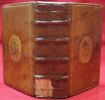
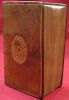
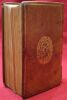
Jérôme de Stridon ou Saint Jérôme Eusebius Sophronius Hieronymus Stridonensis, né vers 347 à Stridon, à la frontière entre la Pannonie et la Dalmatie (en actuelle Slovénie ou Croatie), et mort le 30 septembre 420 à Bethléem, est un moine, traducteur de la Bible, Docteur de l'Église et l'un des quatre Pères de l'Église latine, avec Ambroise de Milan, Augustin d'Hippone et Grégoire Ier. L'ordre des hiéronymites (ou « ermites de saint Jérôme ») se réfère à lui. Merci de nous contacter à l'avance si vous souhaitez consulter une référence au sein de notre librairie.
SAINT JEROME, Jérôme de Stridon (en latin Eusebius Sophronius Hieronymus Stridonensis).
Reference : 101930
SANCTI EUSEBII HIERONYMI STRIDONENSIS PRESBYTERI OPERUM divina bibliotheca, antehac inedita. Complectens translationes latinas Veteris ac Novi Testamenti, cum ex Hebraeis, tum è Graecis fontibus derivatas ; innumera quoque scholia marginalia antiquissimi Hebraei cujusdam Scriptoris Anonymi, Hebraeas voces pressius experimentis. Prodit è vetustissimis Manuscriptis Codicibus Gallicanis, Vaticanis, &tc. Studio et Labore Monachorum ordinis S. Benedicti è Congregatione S. Mauri (5 volumes).
Parisiis (Paris), Urbanum COUSTELIER, 1693-1706, 5 volumes in-folio de 428x280 mm environ, Tome I : 1 f. blanc, faux-titre, frontispice, titre en rouge et noir avec vignette, 29 feuillets (epistola, prolegomena, Laus , veterum testimonia, capitulationes), 1710 colonnes (2 colonnes par page), 2 ff. ( variantes lectiones, addenda, privilège), 2 cartes dépliantes, 1 feuillet blanc - Tome II : 1 f. blanc, 18 ff. (faux-titre, titre en rouge et noir avec vignette, prolegomena, supplementum), 886 colonnes (2 colonnes par page), 12 ff. (index), 550 colonnes avec le privilège sur le dernier feuillet, 1 f. blanc - Tome III : colonnes 1834 colonnes, 5 ff. (epistola, index, privilège), 1 f. blanc - Tome IV : 1 f.blanc, faux-titre, titre en rouge et noir avec vignette, 10 ff. (prologomena), 532 colonnes, 3 ff. (index), 830 colonnes, 31 ff. (index ; (8) - Tome V : 1 f. blanc, faux-titre, titre en rouge et noir avec vignette, 4 ff. (praefatio, table), 70-1200 colonnes, 1 f. blanc, reliures plein cuir granité brun de l'époque, dos à 6 nerfs portant titres et tomaisons dorés sur pièces de titre bordeaux, ornés de caissons à riches motifs dorés. Avec 3 cartes dépliantes, des lettrines et bandeaux. Des coins émoussés, 4 coiffes supérieures et une inférieures manquantes, des frottements et épidermures avec petites restaurations, des rousseurs et pages brunies, quelques mouillures dans les marges, des notes et ex-libris manuscrits dans les marges et sur les pages de titre, quelques erreurs de numérotation (feuillets inversés), sans manque.
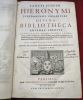
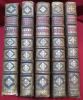
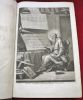
Jérôme de Stridon, saint Jérôme ou, en latin, « Eusebius Sophronius Hieronymus Stridonensis », né vers 347 à Stridon, à la frontière entre la Pannonie et la Dalmatie (actuelle Croatie) et mort le 30 septembre 420 à Bethléem, est un moine, traducteur de la Bible, docteur de l'Église et l'un des quatre Pères de l'Église latine, avec Ambroise de Milan, Augustin d'Hippone et Grégoire Ier. L'ordre des hiéronymites (ou « ermites de saint Jérôme ») se réfère à lui. Merci de nous contacter à l'avance si vous souhaitez consulter une référence au sein de notre librairie.
Eusebius - Das Onomastikon der biblischen Ortsnamen
Georg olms hildesheim 1966 in8. 1966. Cartonné.
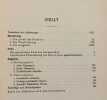

Bon état cependant accroc sur le dos intérieur propre
A Syrian in Greek dress. The use of Greek, Hebrew, and Syriac Biblical texts in Eusebius of Emesa's commentary on Genesis.
Louvain, Peeters, 1997.
XII,492 p. Stiff wrs. 24 cm (Diss. Leiden)(Saec. IV)
Kerkgeschiedenis van Eusebius Pamphyli. Bewerkt door H.U. Meyboom.
Leiden, A.W. Sijthoff, 1908.
3 volumes: XIII,526;XLI p. Wrappers. 22 cm (OiN 180; Oud-christelijke geschriften in Nederlandsche vertaling, 2, 3 & 4; covers plasticized and partly faded)
The library of Eusebius of Caesarea.
Leiden, Boston, Brill, 2003.
XV,358 p. Hardbound 24 cm (Vigiliae Christianae Suppl. 67)
Die Textbezeugung der Vita Constantini des Eusebius von Caesarea.
Bln., Akad. Verlag, 1962.
XIII,182 p. Wrs. 24 cm (Cover worn; lower corner of first leaves with a fold)
The Orthodox Journal, and Catholic Monthly Intelligencer. Voll III. No 28. For September 1815.
London: W. E. Andrews, Red Lion Square, 1815
First edition. Sewn journal, a single issue. No covers. Articles on "The Catholic Question - Conduct of the Whigs", "Dublin aggregate meeting - a lay deputation to Rome", "Irish Gratitude to Dr. Milner.", "Observations on the advantages of a Conventual education", "On the causes of multitudinous Religion Sects in Britain", "On the State of feeling amongst Catholics." and several other smaller articles. This was a time of much agitation for Catholic emancipation, and this is reflected in these pages. A clean and tidy copy, without any significant flaws. Slight edge wear only. The register would suggest that this copy of the journal has come from a larger work. 325 - 364pp. 220 x 140 mm (8Ÿ x 5œ inches). William Eusebius Andrews (1773-1837) was a Roman Catholic journalist, and editor of several Catholic journals. This work ran from 1813 to 1820, when he was forced to suspend publication, despite support from Bishop Milner. He revived the journal in 1834, and it was continued after his death. Andrews was also the founder of several other (mainly short lived) Catholic journals, and "The Friends of Civil and Religious Liberty", a tract society.

The Orthodox Journal, and Catholic Monthly Intelligencer. Voll III. No 20. For January 1815.
London: W. E. Andrews, Red Lion Square, 1815
First edition. Disbound journal, a single issue. No covers. Articles on "The State of Morals in answer to Cobbett's Register", "The continuation of an address to the Laity", "An English Catholic on Petitioning", "Rev. Mr. Martyn on the Nun-baiting order", "Rev. Mr Gandolphy on the Catholic Petition", and several other smaller articles. This was a time of much agitation for Catholic emancipation, and this is reflected in these pages. A clean and tidy copy, without any significant flaws (other than being disbound). Slight edgewear only. The register would suggest that this copy of the journal has come from a larger work. 1 - 40pp. 220 x 140 mm (8Ÿ x 5œ inches). William Eusebius Andrews (1773-1837) was a Roman Catholic journalist, and editor of several Catholic journals. This work ran from 1813 to 1820, when he was forced to suspend publication, despite support from Bishop Milner. He revived the journal in 1834, and it was continued after his death. Andrews was also the founder of several other (mainly short lived) Catholic journals, and "The Friends of Civil and Religious Liberty", a tract society.
The Orthodox Journal, and Catholic Monthly Intelligencer. Voll III. No 25. For June 1815.
London: W. E. Andrews, Red Lion Square, 1815
First edition. Disbound journal, sewn, a single issue. No covers. Articles on "The Catholic Question", "Infant Baptism", and several other smaller articles. This was a time of much agitation for Catholic emancipation, and this is reflected in these pages, with the bulk of the articles, initially rejected by Parliament in 1815, the Catholics Emancipation act was finally passed in 1829. A clean and tidy copy, without any significant flaws. Slight edgewear only. The register would suggest that this copy of the journal has come from a larger work. 205 - 244pp. 220 x 140 mm (8Ÿ x 5œ inches). William Eusebius Andrews (1773-1837) was a Roman Catholic journalist, and editor of several Catholic journals. This work ran from 1813 to 1820, when he was forced to suspend publication, despite support from Bishop Milner. He revived the journal in 1834, and it was continued after his death. Andrews was also the founder of several other (mainly short lived) Catholic journals, and "The Friends of Civil and Religious Liberty", a tract society.
Eusebius 'Gallicanus' Sermones extravagantes [Corpus Christianorum. Series latina, 101b]
Turnhout, Brepols 1971 x + pp.815-1316, 25cm., in the series "Corpus Christianorum. Series latina" vol.101b, editor's cloth with gilt lettering, VG, ISBN 2-503-01015-1, [introduction and text in Latin]
Eusebii Pamphili, Caesareae Palestinae episcopi, Opera Omnia quae existant, curis variorum, nempe: Henrici Valesii, Francisci Vigeri, etc. [6 volumes, complete, Greek-Latin]
Paris, Migne 1857- Complete works of Eusebius in 6 volumes (complete), bilingual: Greek-Latin, 29cm., text printed in 2 columns, together ca. 4400 pages, in the series "Patrologiae Cursus Completus. Series Graeca" volumes 19 to 24 (edited by Migne), uniform 19th cy. hardcover bindings with spines in vellum and with some traces of use, text clean and bright with only few occasional foxing, good condition, total weight is more than 10kg., rare, R95476
Bibliotheke Ellenon Pateron Kai Ekklesiastikon Suggrapheon. Volume 20 : Eusebios Kaisereias (meros 2)
Athenai [Athens], Ekdosis tes apostoloikes diakonias tes ekklesias tes Ellados 1959 415pp., containing critical text editions (2nd part) of Eusebius of Caesarea (c. 260-339 A.D.), 22cm., text in classical Greek, publishers full cloth binding, copy from the collection of the Belgian Byzantinist J. Mossay (with stamp and ex-libris), text is clean and bright, good condition, R113670
Bibliotheke Ellenon Pateron Kai Ekklesiastikon Suggrapheon. Volume 21 : Eusebios Kaisereias (meros 3)
Athenai [Athens], Ekdosis tes apostoloikes diakonias tes ekklesias tes Ellados 1959 432pp., containing critical text editions (3rd part) of Eusebius of Caesarea (c. 260-339 A.D.), 22cm., text in classical Greek, publishers full cloth binding, copy from the collection of the Belgian Byzantinist J. Mossay (with stamp and ex-libris), text is clean and bright, good condition, R113671
Bibliotheke Ellenon Pateron Kai Ekklesiastikon Suggrapheon. Volume 22 : Eusebios Kaisereias (meros 4)
Athenai [Athens], Ekdosis tes apostoloikes diakonias tes ekklesias tes Ellados 1959 436pp., containing critical text editions (4th part) of Eusebius of Caesarea (c. 260-339 A.D.), 22cm., text in classical Greek, publishers full cloth binding, copy from the collection of the Belgian Byzantinist J. Mossay (with stamp and ex-libris), text is clean and bright, good condition, R113672
Bibliotheke Ellenon Pateron Kai Ekklesiastikon Suggrapheon. Volume 23 : Eusebios Kaisereias (meros 5)
Athenai [Athens], Ekdosis tes apostoloikes diakonias tes ekklesias tes Ellados 1960 412pp., containing critical text editions (5th part) of Eusebius of Caesarea (c. 260-339 A.D.), 22cm., text in classical Greek, publishers full cloth binding (small defect at front cover), text is clean and bright, good condition, R113673

