 Write to the booksellers
217 books for « erasmus s p »Edit
-
Language
English (1)
French (216)
-
Century
16th (6)
17th (8)
18th (16)
19th (17)
20th (33)
21st (3)
-
Countries
Belgium (42)
Denmark (23)
France (60)
Greece (1)
Netherlands (74)
Switzerland (17)
-
Syndicate
ILAB (54)
NVVA (2)
SLACES (2)
SLAM (20)
Topics
- Archaeology (1)
- Army (1)
- Autographs (1)
- Badius conrad (1)
- Basel (1)
- Belgium (8)
- Bible (2)
- Christianity (1)
- Colette (1)
- Cosyns (1)
- Drawings (1)
- Earth (1)
- Elzevier (1)
- Engravings (1)
- Erasmus (198)
- Ethic (1)
- Exegesis (2)
- Fin de siècle (1)
- Fine arts (1)
- Flora (1)
- History (16)
- Holbein (4)
- Horticulture (1)
- Humanism (29)
- Iceland (1)
- Illustrated books (1)
- Linnean society of lyons (1)
- Luther (3)
- Lyons and area (1)
- Lyons college (1)
- Lyons college pc (1)
- Lyons revue (1)
- Musicology (1)
- Newspapers press (1)
- Nuclear (1)
- Philosophy (1)
- Photography (1)
- Portraits (1)
- Professions guilds (1)
- Religions (6)
- Scores (1)
- Songs (1)
- Sorbonne (1)
- Tea (2)
- Theology (8)
- Turkey - ottoman empire (1)
- Vellum (1)
- Wairy louis-constant alias constant (1)
- War (1)
- Zweig stefan (1)
MÔRIAS EGKÔMION. Id est Stultitiae laus. Erasmi Roterodami declamatio. Ad fidem editionis antiquae Frobenii figuris Holbenianis ornata. Cum duabus Erasmi epistolis ad Martinum Dorpium et ad Thomam Morum. Accessit dialogus Epicureus.
Leiden (Lugduni Batavorum), Apud D. Noothoven van Goor, 1851.
XL,233 p.; illustrations in the text, 2 portraits. Half calf. 24 cm (Details: Rebound in antique style. Back with 5 raised bands. Portrait of Erasmus lithographed by H.J. Backer after H. Holbein bound before the title, and a lithographed portrait of Hans Holbein at the end of the preliminary pages) (Note: This edition of 1851 is a reissue of an edition which was published earlier in the Dutch town of Hoorn in 1839. The sale of that edition apparantly fell short of expectation. The remainder was sold and was republished in Leiden in 1851. Only the title was renewed. The edition was produced by the Dutch schoolmaster Cornelis Alard Abbing, 1800-1872, who was from 1826 Rector of the 'Schola Latina' of Hoorn. (NNBW 4, col. 5/6) It contains Erasmus' satirical attack on superstitions 'Laus Stultitiae' (Praise of Folly), which follows Erasmus' own copy of the Basel edition of 1515, that was illustrated for him with pen and ink drawings by Hans Holbein Junior. Abbing also added a letter that Erasmus wrote to his friend the Louvain theologian Martinus Dorpius (Maarten van Dorp), who, instigated by enemies of Erasmus, had attacked his 'Laus Stultitiae'. Erasmus' letter was so convincing that Dorpius admitted his mistake. Added is also the text of a letter that Erasmus wrote in 1520 to his friend the English scholar Thomas Morus, to whom he had dedicated his 'Laus Stultitiae'. At the end we find one of Erasmus' Colloquia Familiaria' called 'Epicureus', which is on 'voluptas')
Hyperaspistes diatribae adversus Servum arbitrium Martini Lutheri. [avec :] Hyperaspistae liber secundus.
Bâle, J. Froben, 1526 - 1527.
![Hyperaspistes diatribae adversus Servum arbitrium Martini Lutheri. [avec :] Hyperaspistae liber secundus.. ERASMUS, Desiderius, ERASME](https://static.livre-rare-book.com/pictures/HUG/17078_1_thumb.jpg)
![Hyperaspistes diatribae adversus Servum arbitrium Martini Lutheri. [avec :] Hyperaspistae liber secundus.. ERASMUS, Desiderius, ERASME](https://static.livre-rare-book.com/pictures/HUG/17078_2_thumb.jpg)
![Hyperaspistes diatribae adversus Servum arbitrium Martini Lutheri. [avec :] Hyperaspistae liber secundus.. ERASMUS, Desiderius, ERASME](https://static.livre-rare-book.com/pictures/HUG/17078_3_thumb.jpg)
Premières éditions. Erasme avait publié le 'De libero arbitrio' en 1524 auquel Luther répondit par: 'De servo arbitrio' en 1525. Au début de 1526, Erasmus répondit à celui-ci par la première partie de son 'Hyperaspistes'. La deuxième partie a été publiée en septembre 1527. Poursuivant la controverse exégétique avec Luther, Erasme y attaque la position exagérée de Luther - dérivée de Paul - selon laquelle la loi n'apporte que la connaissance du péché et n'est donc pas vraiment destinée à être accomplie. La confrontation entre Erasme et Luther est un duel dune importance majeure pour lEurope de la première moitié du XVIe siècle, car ce sont deux visions de lhomme, de lhistoire et de la foi qui saffrontent. Cette oeuvre de controverse d'Erasme n'a pas connu le succès populaire de celle de Luther; elle est rare aujourd'hui. Très belle typographie des Froben. Très bon exemplaire. USTC 664563 et 635401. /// In-8 de (312) pp. / 575, (1) pp. Vélin à rabats, lacets d'attache. (Reliure du XVIIe.) //// First editions. The controversy between Erasmus and Luther. Erasmus had published a tract 'De libero arbitrio' (On Free Will) in 1524 and Luther published his riposte 'De Servo Arbitrio' (On the bondage of the Will) in 1525. In early 1526, Erasmus replied to this work with the first part of his two-volume 'Hyperaspistes' (The Shield-bearer). In September 1527 the second part of 'Hyperaspistes' appeared, continuing the exegetical controversy with Luther. Erasmus "'now deliberately buttressed his position even more strongly with references to the church fathers. He particularly attacked Luther's allegedly exaggerated position - derived from Paul - that the law brings only the knowledge of sin and thus is not really intended to be fulfilled. While Luther had decided in favor of the Pauline position, Erasmus had smoothed out the controversial points in the biblical tradition with his combination of grace and free will." Brecht, Martin Luther. Shaping and Defining the Reformation. The confrontation between Erasmus and Luther is a duel of major importance for Europe in the first half of the 16th century, because they are two visions of man, of history and of faith which confront each other. This work of the controversy by Erasmus did not had the popular success of that of Luther; it is rare today. Very nice typography of Froben. Very good copy.


Des. Erasmi Roterod. Colloquia, nunc emendatiora.
Amsterdam (Amstelodami), Ex officina Elzeviriana, 1662.
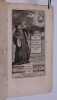
12mo. (XX),672 p. Overlapping vellum. 14 cm (Ref: Willems 1285: 'Réimpression ligne pour ligne de l'édition donnée par les Elzevier en 1655'; Berghman 1350; Rahir 1324; Brunet 2,1040) (Details: 5 thongs laced through the joints. Title engraved by Corn. Cl. Duysend, it depicts a standing Erasmus, who looks through a telescope into a clouded sky; from a cloud comes the hand of God, that bears the 'globus cruciger' (corss-bearing orb, in German Reichsapfel); the globe represents the earth, and he who holds the globe, owns the world. The motto on the title suits Erasmus: 'Vidit, pervidit, risit'. This engraved title was already used by Elsevier for the edition of the Colloquia of 1636. On the last of the preliminary pages a woodcut illustration, depicting both sides of a medal of Erasmus, on the recto his portrait, on the verso his motto: 'Concedo nulli'; around it the legend with Erasmus' interpretation of his motto: 'Mors ultima linea rerum') (Condition: Vellum age-tanned and somewhat soiled) (Note: 'The Colloquia, like the Adagia, were written over a period of years and constantly enlarged as edition succeeded edition. From their earliest form of short models of Latin conversation and formulae of etiquette (composed at Paris in 1497 for the use of some pupils and first printed in 1518) they grew into 'a rich and motley collection of dialogues, each a master piece of literary form, well-knit, spontaneous, convincing, unsurpassed in lightness, vivacity and fluent Latin, each one a finished one-act play' (Huizinga). The Colloquia, full of witty and penetrating observations on ordinary day-to-day happenings as well as on the basic weakness of Church and society, are an invaluable mine of information about 16th century customs, institutions and social problems. Besides, their success as a schoolbook was unrivaled and the stream of editions and translations flowed almost uninterruptedly down to modern times'. (Gilhofer & Ranschburg GmbH, Catalogue 50, Erasmus, published on the 500th anniversary of his birth', Luzern, ca. 1967, p. 34) The Colloquia are preceded by a short biography of Erasmus (last sentence: 'Discerptus est ab utraque, dum utrique studet consulere'), and a table of content) (Collation: *10, A-2E12) (Photographs on request)
Zoonomie, ou Lois de la vie organique, par Erasme Darwin, Docteur en Médecine, Membre de la Société royale de Londres, Auteur du Jardin botanique, etc. Traduit de l'anglais sur la troisième Édition, et augmenté d'Observations et de Notes, par Joseph-François Kluyskens, Professeur de Chirurgie à l'École élémentaire de Médecine, et Chirurgien en chef des Hôpitaux civils de Gand, Membre correspondant de la Société de l'École de Médecine de Paris, et de plusieurs Sociétés savantes.
A Gand, chez P. F. de Goesin-Verhaeghe; rue Haute-porte, n°229, 1810-1811. 1810 4 vol. in-8° (212 x 138 mm.) de: I. [3] ff. (faux-titre, titre, épigraphe); 20 pp. (préface du traducteur); [1] f. (titre de la première partie); 23 pp. (reprise de la pagination à 19, préface de l'auteur); [1] p. (table); 614 pp.; [1] p. (errata); 3 planches aquarellées ; II. [2] ff. (titre, table); 659 pp.; [2] pp. (errata, avis au relieur); 4 planches (3 aquarellées, 1 gravée); III. XIV pp. (titre, titre de la deuxième partie, préface de l'auteur); 586 pp.; 3 planches gravées; IV. [1] f. (titre); 570 pp. (dont table); 1 planche dépliante gravée. Un total de 11 planches (dont 1 dépliante et 6 à l'aquarelle). (Corps douvrage très frais). Demi-basane d'époque, plats recouverts de papier marbré, dos lisses ornés, titre et tomaison de maroquin noir, tranches jaspées. (Quelques petites rousseurs).
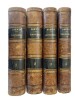
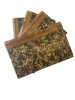
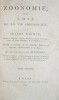
Première édition en français, traduite de l'anglais par Joseph-François Kluyskens et due à Erasmus Darwin (E.O. : 1795 et 1799). Le présent ouvrage est considéré comme son uvre principale pour ce qui touche aux sciences naturelles et à la médecine. Erasmus Darwin (1731-1802) est un poète, médecin, botaniste et inventeur britannique. 70 ans avant les travaux de son célèbre petit-fils et face au créationnisme alors dominant, il amorce de façon significative les réflexions sur l'origine de la vie et son évolution. Médecin, il exerce son art avec un grand succès à Lichfield. On a de lui un poème célèbre, le Jardin botanique (1781), divisé en deux parties, intitulées : l'Économie de la végétation et les Amours des plantes, et un ouvrage fort original, la Zoonomie ou Lois de la vie organique (1794) : il y classe les maladies de l'homme d'après une méthode analogue à celle adoptée par Carl von Linné (1707-1778, naturaliste suédois) pour les plantes, et les explique toutes par l'excitabilité, comme Thomas Brown (1785-1862, naturaliste et un malacologiste britannique). Dans cet ouvrage, de même que dans le poème posthume The Temple of Nature, il expose des idées évolutionnistes. Sa curiosité le conduit à s'interroger sur les raisons de la présence de coquillages fossilisés présents au fond des mines ainsi que sur le développement des bactéries qu'il observe au microscope. Il mène également des recherches sur les nuages. Dans ses travaux et sa réflexion, il en vient à remettre en cause la doctrine alors dominante du créationnisme. Il fait jouer un rôle à la sélection sexuelle dans l'évolution des espèces, idée que son petit-fils soutiendra lui aussi et qui intitulera Zoonomia le premier manuscrit de l'Origine des espèces. Également inventeur dans divers domaines, Erasmus Darwin laisse cependant d'autres s'attribuer certaines de ses inventions, craignant pour sa réputation en tant que médecin. On lui attribue ainsi :le moulin à vent horizontal de Josiah Wedgwood (grand-père d'Emma Wedgwood, épouse de Charles Darwin) ; un type de chariot qui ne se renverse pas (1766) ; une machine parlante (1771) ; l'ascenseur à caisson du canal à charbon du Somersetshire ; un dispositif géométrique de liaison dans la direction d'un véhicule (1758), préfigurant la géométrie directionnelle d'Ackermann ; un puits artésien ainsi que divers appareils de météorologie. Le traducteur, Joseph-François Kluyskens, décrit cette oeuvre de Darwin comme telle: Faire connaître les lois qui gouvernent tous les corps organisés ; réduire toutes ces lois qui ont rapport à la vie organique en classes, ordres, genres et espèces, et les faire servir enfin à l'explication des causes des maladies ; tel fut le but que se proposa le Docteur Darwin lorsqu'il composa la Zoonomie, ouvrage sublime qui lui a coûté plus de vingt années de travail, et les plus profondes méditations (Préface du traducteur, vol. 1). Louvrage est illustré de 11 planches, dont plusieurs rehaussées à laquarelle, représentant la rétine et le spectre oculaire. A noter l'impressionnante gravure du fauteuil pour corriger la distorsion de la colonne vertébrale. Rare exemplaire dont ne dénombre que 2 exemplaires passés en vente ces 50 dernières années. Bel exemplaire conservé dans sa reliure dépoque. 4 vol. 8vo (212 x 138 mm.) of : I. [3] ff. (faux-title, title, epigraph); 20 pp. (preface by the translator); [1] f. (title of the first part); 23 pp. (resumption of pagination at 19, preface by the author); [1] pp. (table) ; 614 pp. ; [1] p. (errata); 3 watercolor plates; II. [2] ff. (title, table) ; 659 pp. ; [2] pp. (errata, notice to the binder); 4 plates (3 watercolors, 1 engraved); III. XIV pp. (title, title of the second part, preface by the author) ; 586 pp. ; 3 engraved plates ; IV. [1] f. (title) ; 570 pp. (including table) ; 1 engraved folding plate. A total of 11 plates (including 1 folding and 6 in watercolor). (Body of the book very fresh). Contemporary half-basane, boards covered with marbled paper, spines decorated with smooth edges, title in black morocco, edges speckled. (A few small freckles). First edition in French, translated from English by Joseph-François Kluyskens and due to Erasmus Darwin (E.O.: 1795 and 1799). The present work is considered to be his main work on natural sciences and medicine. Erasmus Darwin (1731-1802) was a British poet, physician, botanist and inventor. Seventy years before the work of his famous grandson and in the face of the then dominant creationism, he significantly initiated reflections on the origin of life and its evolution. As a physician, he practiced his art with great success in Lichfield. He wrote a famous poem, the "Jardin botanique" (1781), divided into two parts, entitled "l'Économie de la végétation" and "Amours des plantes", and a very original work, the "Zoonomie ou Lois de la vie organique" (1794): he classifies the diseases of man according to a method similar to the one adopted by Carl von Linné (1707-1778, Swedish naturalist) for plants, and explains them all by excitability, like Thomas Brown (1785-1862, British naturalist and malacologist). In this work, as well as in the posthumous poem "The Temple of Nature", he exposes evolutionary ideas. His curiosity led him to question the reasons for the presence of fossilized shells at the bottom of mines as well as the development of bacteria, which he observed under a microscope. He also conducted research on clouds. In his work and his reflection, he came to question the then dominant doctrine of creationism. He gave a role to sexual selection in the evolution of species, an idea that his grandson would also support and even entitled "Zoonomia" the first manuscript of the Origin of Species. Also an inventor in various fields, Erasmus Darwin allowed others to take credit for some of his inventions, fearing for his reputation as a doctor. He is credited with: Josiah Wedgwood's horizontal windmill (grandfather of Charles Darwin's wife Emma Wedgwood); a type of carriage that does not tip over (1766); a talking machine (1771); the Somersetshire Coal Canal box elevator; a geometric device for linking the direction of a vehicle (1758), prefiguring Ackermann's directional geometry; an artesian well; and various meteorological devices. The translator, Joseph-François Kluyskens, describes Darwin's work as follows: "To make known the laws which govern all organized bodies; to reduce all these laws which relate to organic life into classes, orders, genera, and species, and finally to make them serve as an explanation of the causes of disease; such was the aim which Doctor Darwin proposed to himself when he composed Zoonomy, a sublime work which cost him more than twenty years of work, and the deepest meditations (translated from french). The work is illustrated with 11 plates, several of them enhanced with watercolors, representing the retina and the ocular spectrum. Note the impressive engraving of the chair "to correct the distortion of the spine" (translated from french). Rare and beautiful copy, preserved in its original binding, of which only 2 copies have been sold in the last 50 years.
Magni Des. Erasmi Roterodami vita; partim ab ipsomet Erasmo, partim ab amicis aequalibus fideliter descripta. Accedunt Epistolae illustres plus quam septuaginta, quas aetate provectiore scripsit, nec inter vulgatas in magno volumine comparent, P. Scriverii, & fautorum auspiciis.
Leiden (Lugduni Batavorum), Ex officina Ioannis Maire, 1642.
12mo. (XXXIV),394,(2 blank) p. Overlapping vellum 13 cm (Ref: Breugelmans p. 494, 1642:7) (Details: Boards with blind double fillet borders. Woodcut printer's mark on the title, depicting a farmer stamping a shovel into the ground, above the head of the farmer the motto 'fac et spera'. Woodcut portrait of Erasmus in the introduction. Pages 1-160 contain the biography of Erasmus, p. 161-394 the more than 70 letters of him) (Condition: Lacking the frontispiece. Vellum age-toned, stained and soiled. Manuscript title on the back. Front hinge cracking. Title slightly thumbed and soiled. Old ownership entry on the title. Almost invisible wormhole in the blank lower margin of 50 pages at the beginning. Occasionally small and old ink notes in the margins of 19 pages. Some pencil stripes. (See the provenance for the maker of these notes)) (Note: Joannes Maire, publisher, printer and bookseller in Leiden, 1603-1657, produced during his career a number Erasmus of editions. The project 'that can be seen as a series, and which ensured Maire's reputation through the ages, is undoubtedly his edition of Erasmus's 'opera omnia' in 12mo. 23 different volumes appeared between 1641 and 1652. The first half of this book contains the introduction and the biographic sketches, the rest is filled with the letters of Erasmus) (Provenance: Inscription in small type on the title: 'Liber Guilhelmi Griffithii Anglo-Brittani Artium Magistri Cantebrigensis; emtus 1.6. 1664'. Ink annotations of William Griffith in the margins of 19 p. We couldnot find this William Griffith in J. Venn & J.A. Venn's 'Alumni Cantabrigienses: A Biographical List of All Known Students, Graduates and Holders of Office at the University of Cambridge, from the earliest times to 1900', Cambridge 1947) (Collation: *12 (minus leaf *1, the frontispiece); 2*6, A-Q12, R6) (Without the 2 conjugate leaves with the portrait and coat of arms of Thomas Neale, which according to Breugelmans only some copies have)) (Photographs on request)
Desiderii Erasmi Roterodami Liber utilissimus de conscribendis epistolis, continens artificium & praecepta in earum compositione observanda. Editio nova, diligenter ab erratis expurgata.
Amsterdam, Apud Henricum & Theodorum Boom, 1670.
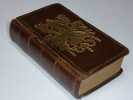
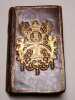
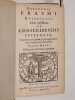
12mo. 470,(33),(1 blank) p., frontispiece. Calf 13 cm The definitive work on the subject (Ref: Spoelder p. 644: Middelburg 5;) (Details: Prize copy, but without the prize. Back ruled gilt, with a red morocco letterpiece. The boards have gilt borders. In the center of both boards the gilt coat of arms of Middelburg. The frontispiece depicts Erasmus in his study, writing a letter. On the title a woodcut printer's mark, depicting Hercules, club at hand, and the Nemean lion under a tree, the motto reads: 'Virtus nescia vinci', 'Virtue doesnot know defeat') (Condition: Some wear to the extremes. Front flyleaf removed. The blank upper margin of the frontispiece slightly cut short) (Note: The genesis of the treatise 'De conscribendis epistolis' of the Dutch humanist and scholar Desiderius Eramus, 1566/69-1536, is rather complicated. The genuine edition, authorized by Erasmus, was first published in Basel by Froben in 1522. In the short preface to this work, repeated also in this edition of 1670, Erasmus explains that he feels obliged to publish this work, because a kind of pirate edition had been published in England recently (i.e. 'Libellus de conscribendis epistolis', published in 1521 by John Siberch, in Cambridge) without his knowledge and consent. It was pirated from a copy of an old manuscript work of him on the art of writing letters, which he wrote, he continues, about 30 years ago (annis abhinc ferme triginta, ca. 1492) in Paris at the request of a friend. Erasmus is very unhappy with this English edition, because it is 'non solum rude, sed & truncum et mutilum'. And now he offers the reader a completely revised and expanded treatment. The emphasis in the treatment remains clearly pedagogical. Erasmus gives an elaborate lesson on the presentation of the subject matter, illustrating how the teacher should give an outline of the subject to be treated, define it in some detail, provide material from the classical authors, and his own work) (Collation: A-X12 (leaf X12 verso blank)) (Photographs on request)
Zoonomie ou lois de la vie organique (...) Traduit de l'anglais sur la troisième édition, et augmenté d'observations et de notes, par par Joseph-François Kluyskens
Gand, P. F. de Goesin-Verhaeghe, 1810-1811, in-8, 4 vol. : [6]-20 pp, [1] ff, pp. 19 à 23-[1], 614 pp, 3 pl. ? [4]-659-[1] pp, 4 pl. ? XIV-586 pp, 3 pl. ? [2]-570 pp, 1 pl. dépl, Demi-veau glacé postérieur, dos lisses et fleuronnés, pièces de titre et de tomaison havane, tranches marbrées, Première édition française de cet ouvrage majeur par le grand père de Charles Darwin, Erasmus Darwin (1731-1802). Cette somme, où se mêlent médecine, biologie et philosophie naturelle, avec certaines intuitions évolutionnistes, a été publiée à l'origine en 1794-1796 (Zoonomia; or the laws of organic life. 2 vols. London, J. Johnson). Le texte est illustré de onze planches, dont cinq en couleurs, qui représentent des expériences de persistence rétinienne et des inventions - ou appareil améliorés - de l'auteur : une machine thérapeutique à décharge électrostatique, consistant en une planchette et deux tubes de verre; un fauteuil orthopédique; une boîte à brosse circulaire pour pulvérisation de quinquina et de céruse dans le traitement de la phtisie; et un "lit de repos mobile à roues", envisagé pour faire tourner les malades afin de les endormir. Erasmus Darwin, inventeur, poète et pionnier en médecine, s'est préoccupé de philosophie naturelle et s'est intéressé aux recherches et inventions contemporaines. Il conçut un moulin à vent horizontal, une charrue améliorée, une pompe rotative ou encore une machine parlante. Il travailla aussi sur la turbine à vapeur, les toilettes, les élévateurs de canal et les télescopes. Il explora encore la formation des nuages, décrivit la photosynthèse et défendit un traitement humain des maladies mentales (Heirs of Hippocrates n° 998). On le considère comme un théoricien précoce de l'évolution : il postulait que la reproduction sexuelle est au coeur des changements et des progrès de l'évolution, tant chez les humains que chez les plantes. Son célèbre descendant déclara toutefois que la théorie d'Erasmus n'avait pas eu d'effet sur L'Origine des espèces (Laniel-Musitelli) : toutefois, Charles Darwin reconnaissait l'intérêt des travaux de son aïeul, en admettant notamment qu'il était "curieux de voir combien le docteur Erasme Darwin, [son] grand-père, dans sa Zoonomia (...), a devancé Lamarck dans ses idées et ses erreurs"*. Garrison & Morton n° 105 pour l'édition originale; Heirs of Hippocrates n° 999 pour la 2e édition anglaise. Sophie Laniel-Musitelli, "Erasmus Darwin : naissance du transformisme dans le texte poétique". In Bulletin d'histoire et d'épistémologie des sciences de la vie, 2011/1 (Volume 18), p. 25-40. Cachet ex-libris du psychiatre J[ules] Falret. Charnières fendillées et fragiles, manque en tête d'un dos. Bon état intérieur. * Charles Darwin, L'origine des espèces au moyen de la sélection naturelle (...) traduit sur la 6e édition anglaise, par Ed. Barbier. Paris, Reinwald, 1876, p. X. Couverture rigide
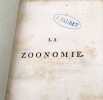
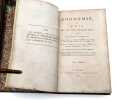
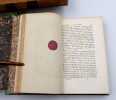
Bon 4 vol. : [6]-20 pp, [1] ff.,
The Botanic Garden; A Poem in two Parts
London, printed for J. Johnson, 1791, in-4, Front, XII-214-126-[2] pp, 9 pl. dont 1 depl.; front, [2]-IX-197 pp, 9 pl, Reliure ancienne, dos lisse, plats de veau brun rapportés, Célèbre poème scientifique du grand père de Charles Darwin, Erasmus Darwin (1731-1802). Cet exemplaire comprend la première édition de la première partie (The Economy of Vegetation) et la troisième édition de la deuxième partie (The Loves of the Plants), enrichie de deux planches supplémentaires par rapport à la première édition de 1789. Le Jardin botanique fut publié de manière inversée, selon le souhait de l'auteur, qui fit d'abord paraître la seconde partie de l'ouvrage (1789 et 1790), la jugeant plus apte à divertir et charmer. Comme dans les autres oeuvres d'Erasmus Darwin, ce poème contient un grand nombre d'informations scientifiques souvent avancées. La première partie, plus scientifique, couvre la philosophie naturelle et fait état de nombreuses recherches et inventions contemporaines, telle que l'histoire du cosmos. En seconde partie, l'auteur explique le système de la reproduction sexuée de Linné avec les propriétés remarquables de certaines plantes en particulier. L'aïeul de Charles postule que la reproduction sexuelle est au coeur des changements et des progrès de l'évolution, tant chez les humains que chez les plantes. Cette conception d'une transformation progressive des espèces appartient aux sciences de la reproduction et rejoint les théories pré-évolutionnistes qui sont apparues à l'aube du XIXe siècle (Laniel-Musitelli). Néanmoins, son petit-fils, Charles, déclara que la théorie d'Erasmus n'avait pas eu d'effet sur L'origine des espèces. Le Jardin botanique est également précieux pour son illustration, qui comporte deux frontispices, 18 planches et une vignette dans le texte : 5 des planches du volume I ont été gravées par William Blake, soit 4 gravures du vase de Portland et la planche de la Fertilisation de l'Égypte, d'après un dessin de Johann Heinrich Füssli (Henry Fuseli), célèbre peintre du Cauchemar. Ex-libris gravé de Marcus Jacobson. Coins et dos anciennement refaits. Épidemures sur les plats. Légères rousseurs et salissures sur les premiers feuillets. Garrison & Morton n° 8921. Sophie Laniel-Musitelli, "Erasmus Darwin : naissance du transformisme dans le texte poétique". In Bulletin d'histoire et d'épistémologie des sciences de la vie, 2011/1 (Volume 18), p. 25-40. Couverture rigide
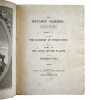
Bon Front., XII-214-126-[2] pp.,
VERBOD VLEES TE ETEN,
Antwerpen , De Vries - Brouwers, Paperback. ISBN 9789061005933.
In dit traktaat aan de bisschop van Bazel verzet Erasmus zich tegen de uitgebreide regelgeving van de katholieke kerk - in het bijzonder het verbod om gedurende 150 dagen van het kerkelijk jaar vlees te eten. De essentie van het vertoog van Erasmus is het conflict tussen menslievendheid en wettische regeltjes. Erasmus pleit voor een milde, menselijke benadering van het probleem. Nieuw.
Erasmus von Rotterdam und seine Zeit. Werke und Porträts des Erasmus, Drucke des 16. Jahrh., Literatur über Renaissance, Reformation und Humanismus. Katalog 452, hrsg. zum 400. Todestag des Erasmus ... Braus-Riggenbach.
Basel, Braus-Riggenbach, (1936).
104 p., ills. Wrs. (Sale Catalogue, 758 items) (Cover sl. worn)
The Colloquies of Erasmus
Chicago, 1965 xxxiv + 662pp., 25cm., publisher's hardcover, dustwrapper, good condition, [Erasmus' Colloquies in a new English translation by Craig Thompson], weight: 1.5kg., T120151
ERASME [ERASMUS] (traduite et annotée d'après "l'Opus epistolarum" de P.S.Allen-H.M.Allen-H.W.Garrod par Marie Delcourt & Hendrik Vannerom, dir. A.Gerlo & Paul Foriers) [ERASMUS, Desiderius]
Reference : F31772
La correspondance d'Erasme - Volumen XI. 1534-1536
, Bruxelles, University Press (Institut pour l'étude de la Renaissance et de l'humanisme) 1982, 493pp., brochure originale, non coupé, bel état, F31772
MATON-SONON Colette & GERLO Aloïs (ERASME - ERASMUS, traduite et annotée d'après "l'Opus epistolarum" de P.S.Allen-H.M.Allen-H.W.Garrod, dir. A.Gerlo) [ERASMUS, Desiderius]
Reference : F31774
(1984)
La correspondance d'Erasme - Volumen 12. Tables Générales
Bruxelles, University Press (Institut pour l'étude de la Renaissance et de l'humanisme) 1984 183pp., brochure originale, pages toujours non coupées, bel état (état de neuf), F31774
ERASMUS (NOORDENBOS O. & VAN LEEUWEN Truus, eds., HUIZINGA J., voorwoord)
Reference : G73530
(1936)
Erasmus in den spiegel van zijn brieven. Een keuze uit de brieven van Erasmus, vertaald en toegelicht
Rotterdam, Brusse 1936 xii + 183pp.geïll., enkele stempeltjes, goede staat, [Nederlandse vertaling met toelichting], G73530
ERASMUS IN DIEN SPIEGEL VAN ZIJN BRIEVEN.
, Rotterdam, W.L. & J. Brusse, 1936., Originele uitgeversomslag , 145 + 225mm, 183pp.
Een keuze uit de brieven van Erasmus, vertaald en toegelicht door Dr. O. Noordenbos en Truus van Leeuwen. Met een woord vooraf van Prof. Dr. J. Huizinga.
Ost- und West-Indischer wie auch Sinesischer Lust- und Stats-Garten.
Nuremberg, Johann A. Endters and Wolfgang Sel, 1668. 1668 3 parties reliées en 2 vol. in-folio (318 x 202 mm. de: [20] ff. (frontispice gravé, titre en rouge et noir, armes de Leopold I gravées par C.N. Schurtz, dédicace, liste des auteur), 1762 pp. ; [18] ff. (tables) ; 65 gravures à pleine page numérotées de 1 à 63, avec les planches 45 et 47 doublées (titre et feuillet de dédicace rognés courts, petite découpe comblée dans la marge du titre). Reliure à paneaux mosaïqués d'époque, dos à nerfs orné, titres de maroquin rouge, tranches marbrées ( dos restauré avec dos ancien conservé).
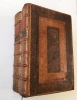
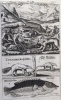
Edition originale de cet ouvrage du à Erasmus Francisci (Lübeck 1627, Nuremberg 1694). Polymath, il est surtout connu pour sa collection infatigable de toutes sortes de folklore, d'histoire naturelle et d'ethnographie; ses études massives, souvent publiées sous des pseudonymes de société, ont été des best-sellers dans l'Europe du XVIIe siècle. Il est considéré comme lune des personnalités les plus influentes de la période baroque allemande. Dans son présent ouvrage, les descriptions d'histoire naturelle sont entrecoupées de réflexions ethnographiques, de conseils homéopathiques sur les médecines traditionnelles et d'histoire de l'exploration et de l'expansion européennes, à la fois réelles et fabuleuses. Les trois livres de ce vaste ouvrage traitent de l'histoire naturelle, des coutumes et des curiosités des Indes orientales et occidentales et les Amériques, avec beaucoup de détails très curieux, dont une spéculation sur un combat entre un tigre et un dragon, l'anatomie des sirènes et les tortues volantes de Chine. Liconographie de louvrage présente des sujets multiples, beaucoup sont consacrées à la botanique. Avec une somptueuse série de planches détaillées, dont deux vues de Batavia (fondée en 1623), montrant le port rempli de jonques et divers navires. Bel exemplaire. 3 parts bound in 2 vol. in-folio of: [20] ff. ; 1762 pp., [18] ff. ; 65 full-page engravings numbered from 1 to 63, with plates 45 and 47 line. 17th-century paneled calf gilt. First edition of this work by Erasmus Francisci (Lübeck 1627, Nuremberg 1694). Polymath, he is best known for his indefatigable collection of all kinds of folklore, natural history and ethnography. His massive studies, often published under pseudonyms of society, were best-sellers in the seventeenth century Europe. He is considered one of the most influential personalities of the German Baroque period. In his present work, descriptions of natural history are interspersed with ethnographic reflections, homeopathic advice on traditional medicine and history of European exploration and expansion, both real and fabulous. The three books of this vast work deal with the natural history, customs and curiosities of the East and West Indies and the Americas, with many very curious details, including a speculation about a fight between a tiger and a dragon, the Anatomy of the sirens and flying turtles from China. The iconography presents multiple subjects, many devoted to botany. With a sumptuous series of detailed planks, including two views of Batavia (founded in 1623), showing the harbor filled with junks and various ships. Fine copy.
Erasmus in den spiegel van zijn brieven. Een keuze uit de brieven van Erasmus, vertaald en toegelicht door dr O. Noordenbos en Truus van Leeuwen. Met een woord vooraf van prof.dr. J. Huizinga.
Rotterdam, W.L. & J. Brusse's uitgeversmaatschappij, 1936.
XII,183 p. Half cloth. 22 cm (Cover worn, especially at the extremes. Back faded)
Erasmus, de actualiteit van zijn denken. Redactie G.Th. Jensma, W.P. Blockmans, J. Sperna Weiland, S. Dresden, J. Nuchelmans, A.M. Koldeweij, W.Th.. Frijhoff.
Zutphen, Walburg Pers, (1986).
4to. 184 p.; illustrations. Cloth. 29 cm (Including dustjacket (6 articles, in which Erasmian topics are discussed, his biography, his politcal theories, his view on education, music, and an article on Erasmus in art)
Erasmus. Reformer zwischen den Fronten.
Göttingen, Vandenhoeck & Ruprecht, (1969).
301 p.; 66 ills. Cl. (Or. title: Erasmus of Christendom)

