 Write to the booksellers
17 books for « epictetus »Edit
-
Century
18th (4)
19th (1)
20th (2)
-
Topics
Belgium (1)
Emblems (1)
Ethic (2)
Greek (5)
Humanism (1)
Latin (3)
Philosophy (4)
-
Countries
Belgium (3)
Denmark (3)
France (2)
Netherlands (5)
Switzerland (4)
-
Syndicate
ILAB (4)
SLAM (1)
EPIKTÊTOY Egcheiridion, KEBÊTOS thêbaiou Pinaks; kai THEOPHRASTOY Êthikoi Charaktêres. Epicteti Enchiridion, Cebetis Thebani Tabula; et Theophrasti Characteres Ethici. Cum versione latina. Denuo recognita & notis illustrata.
Oxford (Oxonii), E Theatro Sheldoniano, 1670.
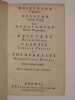
8vo. (XV)(1),143(1);95(1),8 p. Calf 15.5 cm (Ref: Oldfather 175, see also 114; Ebert 6771; not in Hoffmann; only 2 copies in the British Libraries; cf. Brunet 2,1012, who mentions an edition of 1707) (Details: Back ruled gilt, and with 4 raised bands. Black morocco shield in second compartment. Boards ruled with double fillet borders. Greek text with facing Latin translation) (Condition: Cover scuffed and worn at the extremes. Head of the spine gone for 1 cm. Front joint beginning to split. Corners bumped) (Note: This book is the first publication for the market, i.e. 'real book', printed in the famous Sheldonian Theatre, which was named after the Chancellor of the University, and archbishop of Canterbury, Gilbert Sheldon. The building, a work of Christopher Wren, was completed in 1668. The Vice-Chancellor of the University John Fell 'the most powerful man on the University' in those days 'persuaded Sheldon that, when not in use, the building might be used for printing. Composing frames and presses, (no less than five, a large number then) all built locally, were moved in before the builders were out, late in 1668 or early 1669'. (N. Barker, 'The Oxford University Press and the spread of Learning, 1478-1978, Oxf., 1978, p. 15) In F. Madan's 'Oxford books, a bibliography of printed works relating to the University and City of Oxford, or printed or published there' (Oxford, 1895-1931) we found for 1670 only a few small occasional publications, e.g. some epicedia (funeral songs), or more or less internal University documents, such as the 'Parecbolae sive excerpta e corpore statutorum Universitatis Oxon. in usum juventutis academicae'. The only real book 'e Theatro Sheldoniano' in 1670 is this Epictetus/Cebes/Theophrastus edition. (Madan, vol. 3 (1931), no. 2853) For the previous year of 1669 Madan mentions only the imprint 'e theatro Sheldoniano' for the occasional poem of Corbet Owen, 'Carmen Pindaricum', a bad poem by the way, which was recited at the opening of the Theatre on the 9th of July 1669. In order to understand the following search for the identity of the editor of this anonymous 1670 edition, one should know that an expanded edition 'e Theatro Sheldoniano' was printed in 1680 (also anonymously), and another one in 1707. The 1707 edition mentions on its title an editor, 'C. Aldrich' (Carolus, Charles Aldrich), student of 'Christ Church'. Later bibliographers assumed that this same Aldrich must also have been responsible for the anonymous 1670 & 1680 editions. Now Aldrich's dates are 1681-1737. (See for Charles Aldrich 'A directory of the parochial libraries of the Church of England and the Church of Wales' by N.R. Ker & M. Perkins, London 2004, p. 235, s.v. Henley-On-Thames, where the story of his library is told) So, Charles Aldrich cannot have produced the edition of 1670, nor that one of 1680. He however gives us a clue to the identity of the editor of the 1680 edition. The real editor of the 1680 edition, we must conclude, is most probably the classical scholar, Dean of Christ Church, bishop of Oxford, John Fell, because Aldrich tells us on page a4-recto of his 'Ad Lectorem' that he 'minime deflexisse' from 'illa Felli editione' of 1680. This could mean of course 'from the edition of the University Press, led by John Fell', but this seems far fetched. More probable is that Aldrich refers to an Epictetus edition of 1680, which was produced by Fell himself. The name on the title of the 1707 edition caused later bibliographers (Fabricius/Harles, Bibliotheca Graeca, Hamburg, 1796, volume V, p. 80, but also Oldfather in his 'Bibliography of Epictetus', no's 114 and 117) to ascribe the 1670 and 1680 edition erroneously to Aldrich. As shown above, the almost certain editor of the 1680 edition is John Fell. On the title of the 1680 edition even the phrase on the title of 1670 'denuo recognita & notis illustrata' was copied. That it is a reprint (with the addition of passages from Prodicus and Cicero, not yet found in the first edition) of 1670 is proved by the reproduction in 1680 of the 1670 misprint of 'viderà' for 'videre' on page A4-verso of the preface. In the preface of 1670 it is admitted that the edition is based on earlier ones, especially those of Meric Casaubon and Salmasius, but the editor claims to have filled some 'lacunae' and to have corrected the Greek text and Latin translation (by Meric Casaubon, first published in 1659), not only with the help of the printed sources, but also by collating manuscripts from the Bodleian Library and the Library of the New College. (A3-verso) From the abundant notes of others he offers only an anthology (sylva), to elucidate some matters. These notes can be found at the end of the book, and they number only 8 pages. The notes are brief, for the editor says that he does not approve of voluminous books, stuffed with unnecessary knowledge. To underline his loathing he tells the reader that he left the job of compiling this 'sylva' of notes to a 'juvenis studiosus' who had plenty of time for that (cui otium magis suppetebat). (A3-verso & A4-recto) The tone of the writer of the preface is mature and very confident, he surely is a proud and advanced scholar. This leaves us in Oxford ca. 1670 with only one person, John Fell, 1625-1686, a great classical scholar, Dean of Christ Church, bishop of Oxford, and Architypographus of the University Press from 1672. He had a high reputation as a Grecian and a philologist, and published editions of Cyprian, Aratus, Theocritus, Athenagoras and other classical authors. (N. Barker, 'The Oxford University Press and the Spread of Learning', Oxf., 1978, p. 14-26; see also the 11th edition of the Encyclopaedia Britannica, s.v. John Fell) It is more than appropriate to assume that Fell produced the first 'real' book, be it for students, for the press of his University. For the founding of the revived Press of the University of Oxford was his work alone. Epictetus and the 2 other works in this volume have been repeatedly republished by the University Press, in 1680 and 1707 (already mentioned), but also in 1702, 1715, 1723, 1739 and 1804 (Madan, no. 2853) Madan tells about the misprint 'viderà' for 'videre' in the preface that it 'is perhaps in all copies corrected by hand'. Our copy apparantly escaped the attention of the corrector, for the misprint has not been corrected. This book seems to be extremely rare. We found only 5 copies in British Libraries, one in the British Library, 2 in the Bodleian, one in Cambridge University Library, and one in Sheffield. All British university libraries hold an electronic or microfilm copy of the book. They all ascribe this edition to Aldrich, except the British Library and the Bodleian. They mention John Fell. We searched in KVK for other copies, and we found only 2 other copies, one in the University Library Gent, and one in the Royal Library of Denmark. The copy of the 'Staatsbibliothek zu Berlin' is lost owing to 'Kriegsverlust'. We found not one copy auctioned in 'Americana Exchange') (Provenance: The front pastedown has once been renewed. Through the paper is vaguely visible a big bookplate) (Collation: A-Q8, R4) (Photographs on request)
Epicteti Manuale et Sententiae. Quibus accedunt Tabula Cebetis, & alia affinis argumenti, in linguam Latinam conversa a Marco Meibomio. Subjiciuntur eiusdem notae, emendationes Claudii Salmasii in Epictetum, notae illorum & alius viri docti in Dissertationes Epicteti ab Arriano digestas, & varians scriptura codicum manu exaratorum, cura Hadriani Relandi.
Utrecht (Trajecti Batavorum), Ex officina Gulielmi Broedelet, bibliopolae, 1711.
4to. 3 parts in 1: (XX),151,(1);124; 152,(59 index),(1 blank) p. Calf. 21 cm (Ref: STCN ppn 185671004; Oldfather no. 287; Hoffmann 2,15; Didbin 2,515/6: 'The edition is a valuable and critical one'; Ebert 6775; Brunet 2,1012/13; Graesse 2,484; P.A. Hansen, 'A bibliography of Danish contributions to classical scholarship from the 16th century to 1970', Copenhagen 1977, no. 363) (Details: Back gilt and with 5 raised bands. Title printed in red and black. Woodcut printer's mark on the title, depicting Athena and Hermes, motto: 'Suum cuique tribue'. Woodcut initials. Greek text with facing Latin translation. Last 152 pages are filled with the notes of Meiboom (1-32), the notes and emendations of the Enchiridium by Salmasius (33-48), notes and emendations by Meiboom and Salmasius 'in Arriani Epictetum' (49-98), variae lectiones (99-136), and an 'Accessio ad emendationes Meibomianas in Dissertationes Epicteteas Arriani' (137-152). The last 4 pages of the preliminary leaves are, owing to a binder's error, to be found in the last gathering of the book. 'Alius' in the title is an old genitive form, with a long i) (Condition: Cover scuffed; back rubbed; corners bumped; front joint starting to split; head & tail of the spine chafed; bookplate on front pastedown) (Note: There is something odd about this title. Half of the book is printed carefully with the use of beautiful Greek and Roman type, and is presented in a balanced layout. The woodcut initials are sharp and elegant. The other half of the book is printed on paper of somewhat lesser quality, with the use of dull and conventional Greek and Roman type. The woodcut initials are quite common and worn. This difference has its story, and reflects the life and character of its main contributor, Marcus Meibom. The 'fine' half was printed in Copenhagen, about 40 years earlier than the other half, which was printed in Utrecht in 1711. The Danish philologist Marcus Meibom, or Marcus Meibomius, was born in 1630 in Tönning in Schleswig-Holstein. He was a scholar with a bad temper and a lot of ennemies. After a turbulent life he died poor in Utrecht in 1710 or 1711. He was 'one of those colourful people who, despite numerous initiatives, was unable to ascend in the Republic of Letters. He had achieved some fame with an edition of seven classical authors on music, which he dedicated to Queen Christina of Sweden, and for which he received an invitation to her court in return. He himself had reconstructed instruments from antiquity, with which he tried to put on a concert (for the court of the Queen); unfortunately, the performance generated only hilarity and ended in turmoil. Frustrated Meiboom then attacked a friend of the Queen, which forced him to leave'. (D. van Miert, 'Humanism in an age of science: the Amsterdam Athenaeum in the Golden Age, 1632-1704', Leiden 2009, p. 88) Meibom treated everyone crudely and could never restrain his arrogance. The Dutch gentleman/scholar Nicolaas Heinsius called him a 'hungry rogue' and an 'ungrateful person'. (D. van Miert p. 89) In 1653 Meibom left Sweden, and entered into the service of king Frederic III of Denmark. He was made royal librarian and professor at Uppsala the next year. (Michaud, 'Biographie Universelle', Vol. 28, Lpz., 1843, p. 520/1) In 1668 he accepted a position at the Athenaeum Illustre at Amsterdam, to give public lectures and private tuition, with a salary of 1200 guilders a year. One year later, in 1670, he was fired. The reason was that, as Burmannus reports in a letter, 'Meiboom had turned up his nose at the obligation to give private tuition to the sons of the bourgomasters'. (D. van Miert, p. 90) 'Meiboom next dedicated himself to the military shipping trade. He reviewed a book on this subject by Johan Scheffer, and wrote a book himself on antique triremes, with which he left for England to convince Charles II that these antique vessels would give him supremacy at sea'. (D. van Miert, p. 91) Of course this untertaking was not successful. He also tried to sell his project to the French, but found no one interested. His next great project in England in 1674 was the publishing of the Old Testament with his remarks on the Hebrew text, of which he wanted to correct numerous passages. He shocked the English and had to return to Holland poorer than ever. Nevertheless he possessed some very valubable ancient manuscripts, which he did not want to sell. He died in Utrecht, where his heirs found the unfinished edition of Epictetus, printed ca. 40 years before, which they sold to the publisher Broedelet. He asked Hadrianus Relandus to finish it. The part of Meibom opens with the Greek text with facing Latin translation of the Enchiridion, then follow the 'Epicteti Sententiae ex Joanne Stobaeo, Graece & Latine', the 'Cebetis Thebani Tabula, Graece & Latine', and 'Prodicus de Hercule, ex Xenophontis Memorabilium libro IIdo (secundo) Joa. Leunclavio interprete', a allegoric story about Hercules on the crossroads, where he has to choose between Virtue and Vice. Meibom finished with 'Hippocratis Epistola' to Damagetus, a long letter concerning the madness of the 'laughing philosopher' Democritus. This letter is a founding text in the history of melancholy. Relandus tells the reader in the preface that while he was working on this edition he stumbled upon a traesure (thesaurum), an Epictetus edition dated 1595 (Oldfather 15) from the library of Meibom, in the margins of which the French scholar Claude de Saumaise, or Claudius Salmasius, 1588-1653, had jotted down corrections and emendations to the Enchiridion. (General preface leaf *2, and preface to the notes of Salmasius, p. 37/38) Salmasius was in Leyden the successor of Scaliger, and a prolific author and textual critic. He had produced once an Enchiridium edition himself. (Amsterdam, 1640) Michaud tells about Meibom's part of this Enchiridion edition that the 'roi de Danemarck fit imprimer cet ouvrage à ses frais, et fit présent de la totalité de l'édition à Meibom, qui la garda plus de quarante ans dans son cabinet'. (Michaud, vol. 28 p. 521) The quality of the printing of Meibom's part of the book seems to affirm the story of Michaud, still the question remains why Meibom had transported heavy barrels full of quality printing to Amsterdam in 1668/69, and forgot about it for the next 40 years? Boter follows the suggestion of Schweighaeuser in his edition of 1798, (Schweighaeuser, Lpz. 1798, p. LIXV) and argues that Meibom did not think his own work worthy of publication. (G. Boter, 'The Encheiridion of Epictetus and its three christian adaptations', Leiden 1999, p. 78) This seems hard to believe with regard to such an arrogant and headstrong character. He was very much convinced of his own genius. Graevius wrote in a letter to N. Heinsius that Meibom considered himself a better philologist than Isaac Casaubon, Carlo Sigonio, Gronovius and Salmasius. (D. van Miert, p. 91) Modesty and humility were not his strongest points. The flaws in the character of this (manic?) man, who led a tumultuous life, might be the cause of the abandonment of the project. Moreover, when Meibon arrived in Amsterdam, and would have asked around in 1669 if someone was interested in publishing his Epictetus' Enchiridium, he would have heard that in Amsterdam the publishers Boom and Ravestein were already busy producing an edition for 1670, as did the Van Gaasbeek brothers. Anyway, Meibom's heirs sold part of his possessions, including the barrels filled with plano sheats of a book which had never been published. The first page of the collection simply said 'Epicteti Manuale, Graece & Latine'. The load of paper was bought by the publisher Broedelet, who asked the Dutch scholar Hadrianus Relandus, for whom he had published several titles, to write an introduction and to produce some commentary, and an index. 'Relandus did his best, he wrote introductions to the different parts, added the notes of Meibom and Salmasius, which he had found among Meibom's papers and in the margins of some of his books. He added also collations of two manuscripts, the 'codex Hafniensis' (p. 101-119 of the second part), and the 'codex Gerdesianus' (p. 120-136 of the second part). That Meibom did a good job was already noted in 1711 in the periodical 'Acta Eruditorum. 'Haec editio est accurata, & a mendis typographicis pura, literis elegantibus & majoribus impressa'. (Acta Eruditorum, 1711, p. 374) Furthermore, Schweighaeuser dedicates almost seven of his preliminary pages of his famous 1798 edition of the Enchiridium to this work of Meibomius/Relandus. And G. Boter deems Meibomius/Relandus worthy of incorporating them in the short list of 'Studiosi in apparatu critico laudati' of his edition of the Enchiridium, published in the normative 'Bibliotheca Teubneriana' series, Berlin 2007. Adrianus Reland, or Hadrianus Relandus, 1676-1718, was a child prodigy. At 13 he enrolled as a student at the University of Utrecht, where he studied philosophy, classics and oriental languages. In 1700 he was appointed professor of Oriental languages and Holy Antiquities. This 'jewel' of the university remained in Utrecht till his untimely death at the age of 41. He didnot publish much on Oriental languages, but wrote some influential works on Hebrew antiquities, the 'Antiquitates sacrae veterum Hebraeorum' (1708 & 1712, publisher Broedelet), and 'Palestina ex monumentis veteribus illustrata', (1714, publisher Broedelet). His best known work seems to be 'De religione mohammedica' (1705, publisher Broedelet), which was reissued several times, and was translated into several languages. In this work he broke new ground with an honest and correct approach of this religion. As a consequence the Vatican placed it on the Index of forbidden books) (Provenance: On the front pastedown the remains of a woodcut bookplate. The lower part with the name of the owner has been removed. It shows the Royal arms of the United Kingdom, as used by the Hanover dynasty between 1714 and 1800, during the reign of King George I, II & III. (See Wikipedia, s.v. 'Royal coat of arms of the United Kingdom') The shield is oval, and rests on a pedestal. Around the oval a belt with the motto of the Order of the Garter 'Honi soit qui mal y pense'. The oval is surmounted with a royal crown. Before the pedestal a banner with the motto of the English monarchs 'Dieu et mon droit'. Right of the shield the Unicorn, and left a crowned lion. (There is no royal helm beneath the crown) The bookplate is probably of a royal or of a library of a public institution, and dates from before 1800) (Collation: *-2*4, A-T4, 2A-2P4, 2Q2. A-R4, *S4-*T4, S-2A4, 2B4 (leaf 2B2 verso blank, the second and third leaf of the last gathering 2B are signed 3*1 and 3*2; these 2 leaves ought to have been cut out and bound after leaf 2*4; we once sold another copy of this book, and it showed the same binder's error)) (Photographs on request)
THE TEACHING OF EPICTETUS: BEING THE 'ENCHEIRIDION OF EPICTETUS', WITH SELECTIONS FROM THE 'DISSERTATIONS' AND 'FRAGMENTS'
Walter Scott. Non daté. In-12. Relié. Bon état, Couv. convenable, Dos satisfaisant, Intérieur acceptable. 222 pages. Texte en anglais (English). Tranche en tête dorée. Annotations en page de garde. Jaquette manquante.. . . . Classification Dewey : 420-Langue anglaise. Anglo-saxon
The Scott Library. Trans. from the Greek with Intro. and Notes by T.W. Rolleston. Classification Dewey : 420-Langue anglaise. Anglo-saxon


Entretiens, livre II
Paris, Les Belles Lettres 1949 [236] pp., 21cm., brochure originale, pages toujours non coupées, bon état, F105689
Entretiens, livre I
Paris, Les Belles Lettres 1948 lxxxvi + [231] pp., 21cm., brochure originale, pages toujours non coupées, bon état, F105690
Epictetus en deux volumes (texte en anglais deuxième volume non coupé)
Humphreys 1897 in8. 1897. Broché. du chapitre I au XXX texte en anglais
Etat Correct couvertures fortement défraîchies ternies bords frottés intérieur frais pages du deuxième volume non coupées)
Of Human Freedom
Penguin Books UK
LIVRE A L’ETAT DE NEUF. EXPEDIE SOUS 3 JOURS OUVRES. NUMERO DE SUIVI COMMUNIQUE AVANT ENVOI, EMBALLAGE RENFORCE. EAN:9780141192352
Whatever Is Rational Is Tolerable
Penguin Books UK
LIVRE A L’ETAT DE NEUF. EXPEDIE SOUS 3 JOURS OUVRES. NUMERO DE SUIVI COMMUNIQUE AVANT ENVOI, EMBALLAGE RENFORCE. EAN:9780241752333
How To Be a Stoic
Penguin Books UK
LIVRE A L’ETAT DE NEUF. EXPEDIE SOUS 3 JOURS OUVRES. NUMERO DE SUIVI COMMUNIQUE AVANT ENVOI, EMBALLAGE RENFORCE. EAN:9780241475263
Discourses and Selected Writings
Penguin Books UK
LIVRE A L’ETAT DE NEUF. EXPEDIE SOUS 3 JOURS OUVRES. NUMERO DE SUIVI COMMUNIQUE AVANT ENVOI, EMBALLAGE RENFORCE. EAN:9780241764060
Handbüchlein der Moral, nebst einer Auswahl seiner Unterredungen. Mit einer Einleitung von H. SCHMIDT.
Lpz., Kröner, n.d.
123 p. Cloth 18 cm (Gothic script)
Entretiens. Livre I. Texte établi et traduit par J. SOUILHÉ.
Paris, Les Belles Lettres, 1948.
Wrs. 20 cm (Budé)
Entretiens. Livre I. Texte établi et traduit par J. SOUILHÉ.
Paris, Les Belles Lettres, 1948.
Wrs. 20 cm (Budé)(Cover slightly worn)
VAN VEEN Otto [VENIUS VAENIUS Octavius] & EPICTETUS & CEBES Thebanus
Reference : Y91273
(1733)
Theatro moral de la vida humana, en cien emblemas ; con el Enchiridion de Epicteto, y la Tabla de Cebes, philosofo platonico
Amberes [Antwerp], Widow of Hendrik Verdussen 1733 3 parts in 1 volume (with the addenda "Enchiridion de Epicteto and "Tabla de Cebes", [18] 207 [1] & 27 [1bl] & [8] 50 [1] pp., illustrated with engraved printer's mark at title page and 103 large emblems and a double-page engraving with the "Tabula Cebetis", the engraved portrait of Venius is missing, title in red and black, some spots and stains mainly at the last 80 pages text always readible very well), modern binding in fine condition (marbled plates, spine in leather with title in gilt), 39cm., Spanish translation of the French edition "Le theatre moral de la vie humaine" (cfr. PRAZ, Studies in seventeenth-century imagery I pp.523-524 & Peeters Fontainas Bibliographie des impr. espagn. des Pays-Bas mérid. 1275), good copy, Y91273
Epiktets Haandbog. Af det græske oversat og med Anmærkninger oplyst af Engelbert Boye.
Kiøbenhavn, Gyldendal, 1781. Lille8vo. Samtidigt beskedent hldrbd. Øverste kapitæl slidt. (10),94 pp. Lettere brunplettet.
Den første danske udgave, som er oversat efter originalsproget. Birgitte Thotts oversættelse fra 1661 var oversat fra Latin. Boye følger her Kalls græske tekst i ""Epicteti Enchiridion Græce"". - Bibl. Danica IV:95.
Epiktets Haandbog. Af det græske oversat og med Anmærkninger oplyst af Engelbert Boye.
Kiøbenhavn, Gyldendal, 1781. Lille 8vo. Samtidigt stift marmoreret omslag. (10),94 pp. Lettere brunplettet og med brugsspor. Gl. ejernavne på titelbladet.
Første danske udgave, som er oversat efter originalsproget. Birgitte Thotts oversættelse fra 1661 var oversat fra Latin. Boye følger her Kalls græske tekst i ""Epicteti Enchiridion Græce"". - Bibl. Danica IV:95.
Enchiridion, et Cebetis tabula, Graece et Latine, prioribus editionibus emendatiora et auctiora.
Guelferbyti (Wolfenbüttel), Meisneri, 1740. 12mo. Contemp. full calf with ""mirror"" (Cambridge binding-style). Ricly gilt spine with gilt lettering. Wear to top of spine. (4),378 pp.

