 Write to the booksellers
371 books for « einstein »Edit
-
Latest
Last 24h (1)
Last month (6)
Last week (2)
-
Language
English (1)
French (368)
Russian (2)
-
Century
19th (1)
20th (222)
21st (6)
-
Countries
Belgium (20)
Brazil (1)
Canada (3)
Côte d'Ivoire (2)
Denmark (118)
France (184)
Germany (1)
Switzerland (40)
United States of America (2)
-
Syndicate
ALAC (3)
ILAB (224)
NVVA (15)
SLACES (15)
SLAM (84)
SNCAO (1)
Topics
- Abraham (1)
- Africa (1)
- Army (1)
- Artists (2)
- Astrology (1)
- Astronomy (2)
- Astrophysics (1)
- Avant-garde (1)
- Bachelard gaston (1)
- Biography (13)
- Boulez pierre (1)
- Braque georges (1)
- Ceramic (1)
- Clark ronald (1)
- Cosmology (1)
- Dedication (1)
- Desnos (2)
- Dukas paul (1)
- Economics (1)
- Einstein (327)
- Einstein alfred (14)
- Epistemology (3)
- Essays (1)
- Exile (1)
- Fine arts (1)
- First edition (7)
- Flammarion camille (1)
- Geometry (3)
- German history (1)
- German literature (1)
- Germanic languages (6)
- Germany (2)
- Germany pc (1)
- Hackney (1)
- Hebraic literature (2)
- Helvética (2)
- History (7)
- History of art (1)
- Hoffmann (4)
- Humanism (1)
- Illustrated books (1)
- Joliot-curie frédéric (1)
- Law (1)
- Lincoln (1)
- Literary review (1)
- Literature (5)
- Medicine (3)
- Moreux abbot (1)
- Music (6)
- Nigger (1)
- Ollier (1)
- Paz octavio (1)
- Periodicals (2)
- Philosophy (14)
- Physics (2)
- Printing (1)
- Psychoanalysis (2)
- Psychoanalysis pc (1)
- Psychology (4)
- Religions (1)
- Reviews (2)
- River (4)
- Romanticism (1)
- Sciences (4)
- Shapes & colours (1)
- Siro (1)
- Sociology (1)
- Sportsmen (2)
- Switzerland (2)
- Tea (13)
- Technology (1)
- Theatre (1)
- Theory (1)
- Translation (1)
- War (1)
- Zoology (1)
Über die Interferenzeigenschaften des durch Kanalstrahlen emittierten Lichtes [Einstein] (+) Über die Interferenzeigenschaften des Kanalstrahllichtes [Rupp]. Offprint from ""Sitzungsberichte der Preussischen Akademie der Wissenschaften"", XXV, 1926. - [THE GREATEST SCANDAL IN PHYSICS - AUTHOR'S PRESENTATION OFFPRINT ISSUE]
1926. Royal8vo. Author's presentation offprint with the printed presentation statement on top of frontwrapper ""Überreicht von den Verfassern"" [i.e. ""Given by the authors""]. Original printed wrappers. Front wrapper loose, but fully intact. ""Chilpp 202"" and ""Recdese 160"" written in hand to top of front wrapper. A very fine and clean copy. Pp. 334-351.
First edition, in the scarce author's presentation offprint issue, of this important paper, which contains Einstein's theories on wave-particle duality and German physicist Rupp's work on the same subject, seemingly to corroborating Einstein's theories. Rupp's experimental results later turned out to have been falsifications, and today he is mainly known as the protagonist in one of the biggest scandals in physics in the 20th century.Rupp published a number of papers on the interference properties of light emitted by canal ray sources. These articles, particularly the present that came into being in close collaboration with Albert Einstein, attracted quite a lot of attention, as they probed the wave versus particle nature of light. They also significantly propelled Rupp's career, even though they were considered highly controversial to begin with.In April 1926, Albert Einstein proposed to Emil Rupp to carry out two experiments that were to prove the wave nature of light versus the particle nature of light: the so-called 'Wire Grid Experiment' and the 'Rotated Mirror Experiment', experiments that Einstein had worked on theoretically and now would like to gain confirmation of through experiments. Rupp, at the time regarded as one of the most important and most competent experimental physicists, gladly took up the challenge. Rupp's observations - though highly controversial - confirmed Einstein's theory. Due to the surprising outcome of the experiments, Einstein was interested in exactly how it they were conducted, as Rupp's initial descriptions did not convince him that the results were feasible.""Rupp stood by his observations and suggested yet other circumstances that might explain them. Did Einstein now realize that there was something rather dubious about Rupp's work? He had seen him change his data repeatedly-and each time in better accordance with his own criticism, and on one occasion in no less than two days. He had had to accept that Rupp claimed to earlier have ""unknowingly"" or ""unconsciously"" rotated a mirror, and he will likely have seen that Rupp's work was highly controversial amongst experimentalists, leading to very public criticism in Die Naturwissenschaften. He himself was now also convinced that, in fact, Rupp's results were incomprehensible. So, did Einstein choose to suspend the publication of Rupp's piece, so that an additional round of checks and balances could take place? The answer is no: Rupp's paper was presented by Einstein to the Prussian Academy in a session on 21 October 1926, and it appeared in print in the Academy's proceedings in November of 1926-the articles by Einstein and Rupp came out back to back, and reprints circulated with both papers bound together, with a joint cover page that displayed both titles. Einstein referred in his article to Rupp's claims and he had even written the abstract of Rupp's paper"" (Dongen: ""Emil Rupp, Albert Einstein and the Canal Ray Experiments on Wave-Particle"").The first clear indication that Rupp's work was impossible to recreate came in 1930 in a paper published by Staub - nothing was wrong with Einstein's theory but Rupp's work was simply impossible: ""Rupp immediately set out to respond to Straub's publication. On 12 July 1930 he sent a first draft to Einstein, to whom he also announced his intention of redoing his canal ray experiments-Straub was dismissed as a clumsy graduate student with a lousy apparatus. Einstein suggested inviting Straub once Rupp had his experiment up and running again, but cautioned him not to engage the polemic in too sharp a tone"". Rupp managed to convince the physics society and continued to publish the new few years. In 1934 various different physicians pointed out that Rupp's work was impossible to recreate, and in 1935 the final blow to Rupp's career came about, when the German Physical Society's decided not to allow any citations of Rupp's work. This seems to have had very severe consequences, as today it is almost impossible to find any quotations - or even mentioning of Rupp in general, let alone his fraud - in any historical studies of either quantum theory or of Einstein.Despite the unquestionable fraud by Rupp, his experiments and collaboration with Einstein might have had a positive influence on the further progression to quantum mechanics. The two present papers became of seminal importance in the discussions between Bohr and Heisenberg, which eventually in 1927 resulted in Heisenberg publishing his landmark thesis on the uncertainty principle. When Max Born received the Nobel Prize in physics he stated that: ""An idea of Einstein gave me the lead [From the present paper]. He had tried to make the duality of particles-light quanta or photons-and waves comprehensible by interpreting the square of the optical wave amplitudes as probability density for the occurrence of photons.""Boni 160" Weil 153.
"EINSTEIN, ALBERT. - THE FIRST EXPLICIT STATEMENT OF THE ENERGY-MASS EQUATION !!
Reference : 47457
(1907)
Über die vom Relativitätsprincip geforderte Trägheit der Energie. (On the Inertia of Energy Required by the Relativity Principle).
Leibzig, Johann Ambrosius Barth, 1907. 8vo. Contemp. hcalf. Spine gilt. Title-and tomelabels with gilt lettering. Slightly rubbed. In ""Annalen der Physik"", Vierte Folge, Band 23. VIII,1000 pp. a. 4 plates. (The entire volume offered). Einstein's paper: pp.371-384. A small stamp on titlepage (Gmelin.Institut.). Internally clean and fine.
First edition of the first explicit statement of Einstein's energy-mass equation E=mc2.Nearly all descriptions of Einstein's scientific work state that the mass-energy equivalence E=mc2 was first formulated in Einstein's 1907 review paper 'Über das Relativitätsprinzip und die aus demselben gezogenen.' published in 'Jahrbuch der Radioaktivität und Elektronik' (see Weil no. 21 and Dictionary of Scientific Biography, vol. 4 pp.323 for examples). However, in his paper 'Über die von Relativitätsprincip geforderte Trägheit der Energie' [the offered paper] which predates the former mentioned by six months, Einstein gave a clear statement of the mass-energy equivalence E=mc2. See Lanczos: The Einstein Decade, pp.149-150 and 153 as well as Volume 2 of 'The Collected Papers of Albert Einstein' pp. 428.Einstein's first paper regarding the relation E=mc2 is his fourth 1905 paper, 'Ist die Trägheit eines Körpers von seinem Energieinhalt abhängig?'. In this short paper Einstein showed that a body releasing the energy E in the form of radiation will have its mass decreased by E/c2, and concluded that the mass of a body is a measure of its energy content, e.g., that all energy has mass. The next time Einstein returns to the subject is in his 1906 paper 'Das Prinzip von der Erhaltung der Schwerpunkts Bewegung und die Trägheit der Energie.'. Here Einstein concluded that one must either ascribe the inertial mass E/c2 to any form of energy E or else give up the fundamental law mechanics regarding conservation of the motion of the center of gravity. Then finally in the 1907 paper 'Über die von Relativitätsprincip geforderte Trägheit der Energie.' [the offered paper] Einstein makes the decisive step of assuming that all mass has energy. On page 382 Einstein considers the total energy of a moving mass point as the sum of its kinetic energy and its rest energy. In classical mechanics it is most convenient to set the second term to zero but in relativistic mechanics one obtains the simplest expression by setting the rest energy equal to mc2. Einstein then continues to show that this stipulation cannot lead to a contradiction in any relativistic argument. In a footnote on page 382 Einstein states for the first time the equation E=mc2 and mentions that this equation is the expression of the principle of the equivalence of mass and energy - see Volume 2 of 'The Collected Papers of Albert Einstein' pp. 428.The volume contains another paper by Einstein ""Bemerkungen zu der Notiz von Hrn. Paul Ehrenfest: ""Die Translation deformierbarer Elektronen und der Flächensatz"""", pp.206-208. - Weil No. 18.Collected Works, Doc. 45. Weil 19. Boni 19.
"EINSTEIN, ALBERT. - THE FIRST EXPLICIT STATEMENT OF THE ENERGY-MASS EQUATION !!
Reference : 53408
(1907)
Über die vom Relativitätsprincip geforderte Trägheit der Energie. (On the Inertia of Energy Required by the Relativity Principle).
Leibzig, Johann Ambrosius Barth, 1907. 8vo. Contemp. hcalf. Spine gilt and with gilt lettering. Slightly rubbed and light wear to spineends. In ""Annalen der Physik"", Vierte Folge, Band 23. VIII,1000 pp. a. 4 plates. (The entire volume offered). Einstein's paper: pp.371-384. Stamps on titlepage (Allgemeine Electricitäts-Gesellschaft a. AEG Forschungsinstitut). Internally clean.
First edition of the first explicit statement of Einstein's energy-mass equation E=mc2.Nearly all descriptions of Einstein's scientific work state that the mass-energy equivalence E=mc2 was first formulated in Einstein's 1907 review paper 'Über das Relativitätsprinzip und die aus demselben gezogenen.' published in 'Jahrbuch der Radioaktivität und Elektronik' (see Weil no. 21 and Dictionary of Scientific Biography, vol. 4 pp.323 for examples). However, in his paper 'Über die von Relativitätsprincip geforderte Trägheit der Energie' [the offered paper] which predates the former mentioned by six months, Einstein gave a clear statement of the mass-energy equivalence E=mc2. See Lanczos: The Einstein Decade, pp.149-150 and 153 as well as Volume 2 of 'The Collected Papers of Albert Einstein' pp. 428.Einstein's first paper regarding the relation E=mc2 is his fourth 1905 paper, 'Ist die Trägheit eines Körpers von seinem Energieinhalt abhängig?'. In this short paper Einstein showed that a body releasing the energy E in the form of radiation will have its mass decreased by E/c2, and concluded that the mass of a body is a measure of its energy content, e.g., that all energy has mass. The next time Einstein returns to the subject is in his 1906 paper 'Das Prinzip von der Erhaltung der Schwerpunkts Bewegung und die Trägheit der Energie.'. Here Einstein concluded that one must either ascribe the inertial mass E/c2 to any form of energy E or else give up the fundamental law mechanics regarding conservation of the motion of the center of gravity. Then finally in the 1907 paper 'Über die von Relativitätsprincip geforderte Trägheit der Energie.' [the offered paper] Einstein makes the decisive step of assuming that all mass has energy. On page 382 Einstein considers the total energy of a moving mass point as the sum of its kinetic energy and its rest energy. In classical mechanics it is most convenient to set the second term to zero but in relativistic mechanics one obtains the simplest expression by setting the rest energy equal to mc2. Einstein then continues to show that this stipulation cannot lead to a contradiction in any relativistic argument. In a footnote on page 382 Einstein states for the first time the equation E=mc2 and mentions that this equation is the expression of the principle of the equivalence of mass and energy - see Volume 2 of 'The Collected Papers of Albert Einstein' pp. 428.The volume contains another paper by Einstein ""Bemerkungen zu der Notiz von Hrn. Paul Ehrenfest: ""Die Translation deformierbarer Elektronen und der Flächensatz"""", pp.206-208. - Weil No. 18. Further with 2 importent papers by Max v. Laue.Collected Works, Doc. 45. Weil 19. Boni 19.
Carte postale autographe signée adressée au Professeur Ludwig Hopf
Zurich 21 juin 1910 | 9 x 14 cm | une carte postale
Carte postale autographe signée d'Albert Einstein adressée à Ludwig Hopf, 18 lignes écrites au verso et recto, adresse également de la main d'Einstein. Tampon postal indiquant la date du 21 juin 1910. Publiée dans The Collected Papers of Albert Einstein, Volume 5: The Swiss Years: Correspondence, 1902-1914, Princeton University Press, 1993, n°218, p. 242. *** Exceptionnelle et très esthétique carte d'Albert Einstein à «l'ami des plus grands génies de son temps» -selon Schrödinger -le mathématicien et physicien Ludwig Hopf, qui permit la rencontre d'Einstein avec un autre génie du XXe siècle : Carl Jung. Le maître invite ici son élève à un dîner comptant au nombre des invités le scientifique Max Abraham, futur grand rival des années zurichoises et fervent opposant à la théorie de la relativité d'Einstein. Le destinataire de cette carte, Ludwig Hopf, rejoint Einstein en 1910 en tant qu'assistant et élève à ses séminaires de physique et de théorie cinétique à l'Université de Zürich. Ils signent deux articles fondamentaux sur les aspects statistiques de la radiation et donnent leurs noms à la force de résistance «Einstein-Hopf». Leurs échanges épistolaires retracent le complexe cheminement des travaux d'Einstein sur la relativité et la gravitation, témoignant de leur grande complicité et du précieux apport de Hopf dans les recherches du maître. Quelques mois après l'écriture de cette missive, Hopf trouvera même une erreur dans les calculs d'Einstein sur les dérivées de certaines composantes de la vitesse que ce dernier corrigera dans un article l'année suivante.Ils forment également un duo musical et interprètent les grands génies de la musique, Hopf accompagnant au piano le violon du maître sur des morceaux de Bach et Mozart. Einstein invite par cette carte son élève et ami Hopf à un dîner avec Max Abraham, à l'aube d'une controverse scientifique majeure qui les opposera à partir de 1911. La théorie de la relativité restreinte selon Abraham ne convaincra pas Einstein qui soulignera le peu de moyens de vérification par l'observation et son manque de prédiction de la courbure gravitationnelle de la lumière. En 1912, leur différend deviendra public par publications interposées. Abraham ne reconnaîtra jamais la validité de la théorie einsteinienne. Au cours de leurs brillants échanges artistiques et intellectuels, Hopf a sans doute réussi là où Freud avait échoué comme il lui avouera dans une lettre:«Je romprai avec vous si vous vous glorifiez d'avoir converti Einstein à la psychanalyse. Une longue conversation que j'ai eue avec lui il ya quelques années m'a montré que l'analyse lui était tout aussi hermétique que peut m'être la théorie de la relativité.»(Vienne, 27 septembre 1931).Fervent adepte de la psychanalyse, Hopfest en effet connu pour avoir présentéle célèbre psychanalyste Carl Jung à Einstein. Hopf et son maître partiront tous deux pour l'Université Karl-Ferdinand de Prague en 1911, où ils fréquenteront l'écrivain Franz Kafka et son fidèle ami Max Brod dans le salon de Mme Fanta. Avec l'avènement du régime nazi, les destins de cesdeux théoriciens de la mécanique du mondeseront marqués par les persécutions et l'exil, Einstein se réfugiant tout d'abord en Belgique, Hopf en Grande-Bretagne après sa mise à pied en 1934 de l'université d'Aix-la-Chapelle à cause de ses origines juives. Les deux savants continueront àentretenir une prolifique correspondance au cur de la tourmente, Einstein suggérant à Hopf l'ouverture d'une université à l'étranger pour les étudiants allemands exilés. Hopf s'éteindra peu de temps après avoir prisla chaire de mathématiques duTrinity College deDublin en juillet 1939. Précieuse invitation du grand physicien à l'ultime dîner réunissant la "vieille école" scientifique symbolisée parMax Abraham, à l'aube de la publication de la théorie de la relativité générale, qui bouleversera les conceptions classiques de l'espace et du temps et propulsera la Science dans le XXe siècle. "L

Über die vom Relativitätsprincip geforderte Trägheit der Energie. - [THE FIRST EXPLICIT STATEMENT OF THE ENERGY-MASS EQUATION]
Leibzig, Johann Ambrosius Barth, 1907. 8vo. In contemporary full cloth with gilt lettering to spine. In ""Annalen der Physik"", Vierte Folge, Band 23. Entire volume offered. Ex-libris pasted on to top right corner of pasted down front free end-paper. Light rubbing to extremities, a very fine and clean copy (not an ex-library copy). Pp.371-384. [Entire volume: VIII, 1000 pp. + 4 plates].
![Über die vom Relativitätsprincip geforderte Trägheit der Energie. - [THE FIRST EXPLICIT STATEMENT OF THE ENERGY-MASS EQUATION]. "EINSTEIN, ALBERT.](https://static.livre-rare-book.com/pictures/LLX/50595_1_thumb.jpg)
![Über die vom Relativitätsprincip geforderte Trägheit der Energie. - [THE FIRST EXPLICIT STATEMENT OF THE ENERGY-MASS EQUATION]. "EINSTEIN, ALBERT.](https://static.livre-rare-book.com/pictures/LLX/50595_2_thumb.jpg)
![Über die vom Relativitätsprincip geforderte Trägheit der Energie. - [THE FIRST EXPLICIT STATEMENT OF THE ENERGY-MASS EQUATION]. "EINSTEIN, ALBERT.](https://static.livre-rare-book.com/pictures/LLX/50595_3_thumb.jpg)
First edition of the first explicit statement of Einstein's landmark energy-mass equation E=mc2.Nearly all descriptions of Einstein's scientific work state that the mass-energy equivalence E=mc2 was first formulated in Einstein's 1907 review paper 'Über das Relativitätsprinzip und die aus demselben gezogenen.' published in 'Jahrbuch der Radioaktivität und Elektronik' (see Weil no. 21 and Dictionary of Scientific Biography, vol. 4 pp.323 for examples). However, in his paper 'Über die von Relativitätsprincip geforderte Trägheit der Energie' [the offered paper] which predates the former mentioned by six months, Einstein gave a clear statement of the mass-energy equivalence E=mc2. See Lanczos: The Einstein Decade, pp.149-150 and 153 as well as Volume 2 of 'The Collected Papers of Albert Einstein' pp. 428.Einstein's first paper regarding the relation E=mc2 is his fourth 1905 paper, 'Ist die Trägheit eines Körpers von seinem Energieinhalt abhängig?'. In this short paper Einstein showed that a body releasing the energy E in the form of radiation will have its mass decreased by E/c2, and concluded that the mass of a body is a measure of its energy content, e.g., that all energy has mass. The next time Einstein returns to the subject is in his 1906 paper 'Das Prinzip von der Erhaltung der Schwerpunkts Bewegung und die Trägheit der Energie.'. Here Einstein concluded that one must either ascribe the inertial mass E/c2 to any form of energy E or else give up the fundamental law mechanics regarding conservation of the motion of the center of gravity. Then finally in the 1907 paper 'Über die von Relativitätsprincip geforderte Trägheit der Energie.' [the offered paper] Einstein makes the decisive step of assuming that all mass has energy. On page 382 Einstein considers the total energy of a moving mass point as the sum of its kinetic energy and its rest energy. In classical mechanics it is most convenient to set the second term to zero but in relativistic mechanics one obtains the simplest expression by setting the rest energy equal to mc2. Einstein then continues to show that this stipulation cannot lead to a contradiction in any relativistic argument. In a footnote on page 382 Einstein states for the first time the equation E=mc2 and mentions that this equation is the expression of the principle of the equivalence of mass and energy - see Volume 2 of 'The Collected Papers of Albert Einstein' pp. 428.The volume contains another paper by Einstein ""Bemerkungen zu der Notiz von Hrn. Paul Ehrenfest: ""Die Translation deformierbarer Elektronen und der Flächensatz"""", pp.206-208. - Weil No. 18.Collected Works, Doc. 45. Weil 19. Boni 19.
Über die Krümmung des Raumes + Über die Möglichkeit einer Welt mit konstanter negativer Krümmung des Raumes [Friedman] (+) Bemerkung zu der Arbeit von A. Friedmann ""Über die Krümmung des Raumes"" (+) Notiz zu der Arbeit von A. Friedmann ""Über die Krümm... - [THE CURVATURE OF SPACE]
Berlin, Julius Springer, 1922-24. 8vo. 4 contemporary half cloth binding: two in uniform half green cloth and two en uniform grey/blue half cloth. In ""Zeitschrift für Physik"", Bd. 10, 11, 16 & 21. Entire volumes offered. All volumes with stamp to title page and front free end paper, otherwise a fine and clean set. [Friedmann:] Bd. 10: Pp. 377-386" Bd. 21: P.p. 326-332. [Einstein:] Bd. 11:P. 326" Bd. 16: P. 228.
![Über die Krümmung des Raumes + Über die Möglichkeit einer Welt mit konstanter negativer Krümmung des Raumes [Friedman] (+) Bemerkung zu der Arbeit von ...](https://static.livre-rare-book.com/pictures/LLX/49429_1_thumb.jpg)
First printing of these four landmark paper in which Friedman ""introduced into cosmology two concepts of revolutionary importance, the age og the world and the creation of the world"" (Kragh, Cosmology and Controversy). ""In his paper of 1922, Friedmann offered a complete analysis of the solutions of Einstein's cosmological field equations that went beyond the earlier solutions of Einstein and de Sitter as it also included nonstatic solutions. Friedmann did so clearly and explicitly: ""The purpose of this note,"" he wrote, ""is firstly to show that the cylindrical [Einstein]and spherical [de Sitter] worlds are special cases of more general assumptions, and secondly to demonstrate the possibility of a world in which the curvature of space is independent of the three spatial coordinates but does on time"".(Ibid.).In 'Über die Krümmung des Raumes' Friedman derived the non-stationary solutions to Einstein's field equations. Einstein quickly responded in a short comment ('Bemerkung'), in which he expressed his suspicion of such a model of the Universe and apparently pointed out an error in Friedman's calculations. However, Friedman now wrote a letter to Einstein, in which he enclosed his full calculations. Shortly after this, Einstein submitted a short notice (Notiz), in which he admitted that he himself had performed a calculation error and that Friedman's solutions, which shed new light on the matter, were valid. Friedman's expanding universe model was corroborated by Edwin Hubble's red-shift observations in 1929. In 'Über die Möglichkeit einer Welt mit konstanter negativer Krümmung des Raumes' Friedman derived the Friedman-equations and demonstrated that he had command of all three Friedman-models describing positive, zero and negative curvature respectively, nearly a decade before the independent discoveries of the same models by Lemaître, Robertson, and Walker. ""Friedmann made a valuable contribution to Einstein's general theory of relativity. As always, his interest was not limited simply to familiarizing himself with this new field of science but led to his own remarkable investigations. Friedmann's work on the theory of relativity dealt with one of its most difficult questions, the cosmological problem. In his paper ""Über die Krümmung des Raumes"" (1922), he outlined the fundamental ideas of his cosmology: the supposition concerning the homogeneity of the distribution of matter in space and the consequent homogence of ""world"" time for which, at any moment in time, the metrics of space will be identical at all points and in all directions. This theory is especially important because it leads to a sufficiently correct explanation of the fundamental phenomenon known as the ""red shift."" This solution of the Einstein field equations, obtained from the above propositions, is the model for any homogeneous and isotropic cosmological theory. It is interesting to note that Einstein thought that the cosmological solution to the equations of a field had to be static and had to lead to a closed model of the universe. Friedmann discarded both conditions and arrived at an independent solution. Einstein welcomed Friedmann's results because they showed the dispensability of the ad hoc cosmological term Einstein had been forced to introduce into the basic field equation of general relativity"". (DSB). Weil 122 & 130.
APPENDIX FOR THE SECOND EDITION [of The Meaning of Relativity] + APPENDIX II. GENERALIZED THEORY OF GRAVITATION. - [ORIGINAL PROOF-COPY]
[1950]. 8vo. Original proof-copy (of the latest stage, presumably final proof, in the same format as the printed version and with no corrections), printed on rectos and versos. Stapled twice in left margin. A few marginal creases. A (proof-) number to upper left corner in red ink (297). Pp. 109-148 + tipped-in errata slip at p. 147.
Very rare original proof-copy of the two highly important appendices for Einstein's ""The Meaning of Relativity"", third edition, 1950, the second appendix being one of the most important pieces Einstein ever wrote, namely the appendix ""in which he described his most recent work on unification"" (Pais), and the work which was hailed by The New York Times under the heading ""New Einstein theory gives a master key to the universe"". The first appendix, which appeared for the second edition of the work, remained unchanged throughout the history of ""the Meaning of Relativity"" and was written because ""Since the first edition of this little book some advances have been made in the theory of relativity. [...] The first step forward is the conclusive demonstration of the existence of the red shift of the spectral lines by the (negative) gravitational potential of the place of origin"" [...] A second step forward, which will be mentioned briefly, concerns the law of motion of a gravitating body."" [...] A third step forward, concerning the so-called ""cosmologic problem,"" wiil be considered here in detail..."" (pp. 109-10). The present 40 pages constitute the final proof-copy of the entire appendices I and II to the Generalized Theory of Gravitation, exactly as they appeared in the third edition (Princeton in 1950). Einstein's ""The Meaning of Relativity"" was originally published in 1922, on the basis of his ""Vier Vorlesungen ueber Relativitetstheorie"" given at Princeton in 1921. A second edition, with an appendix (appendix I) appeared in 1945 (several issues and editions of this appeared also), and in 1949 the third edition, with the seminal Appendix II printed for the first time, appears (also appeared in 1950, in Princeton). In 1950 a revised edition of the third edition appears, having Appendix II slightly revised, and in 1953 the heavily revised fourth edition appears. THIS IS THE PROOF-COPY OF APPENDICES I AND II FOR THE ""THIRD EDITION, INCLUDING THE GENERALIZED THEORY OF GRAVITATION"" (PRINCETON, 1950). The main focus of the work throughout all these editions of the work since 1949 is Appendix II, which deals with Einstein's main interest, the generalization of the Gravitation Theory, which was to unite the general theory of relativity with electromagnetism, recovering an approximation for quantum theory, and presenting us with a theory to explain the universe as a unified entity, the ultimate goal for the greatest physicist that ever lived. ""This was Einstein's ultimate response to the mechanical-electromagnetic crisis in physical theory he had first talked about in the opening of his 1905 light quantum-paper."" (Nandor, in D.S.B., p. 330). It was indeed Einstein's aim to provide an explanation of the universe through his unified field theory, although he was well aware that his sort of field theory might not exist. However, even the establishing of the non-existence of it could bring us closer to an explanation than we had ever been before. There is no topic of greater importance to Einstein than his theory of unification. ""In 1949 Einstein wrote a new appendix for the third edition of his ""The Meaning of Relativity"" in which he described his most recent work on unification. It was none of his doing that a page of his manuscript appeared on the front page of ""The New York Times"" under the heading ""New Einstein theory gives a master key to the universe"". He refused to see reporters and asked Helen Dukas to relay this message to them: ""Come back and see me in twenty years""."" (Pais, p. 350).
Entwurf einer verallgemeinerten Relativitatstheorie - Uber die spezielle…
Éditions originales de ces deux ouvrages essentiels d’Einstein, étapes décisives dans l'élaboration de la théorie de la relativité générale. Petit in-8 de 38 pp. Brochure verte de l'éditeur. In-8 de IV et 70 pp. Brochure de l'éditeur, chemise, étui. I/ Einstein, Albert. Entwurf einer verallgemeinerten Relativitatstheorie und einer Theorie der Gravitation. Leipzig und Berlin, B. G. Teubner, 1913.II/ Einstein, Albert. Uber die spezielle und die allgemeine Relativitatstheorie. Braunschweig, Vieweg, 1917.Éditions originales de ces deux ouvrages essentiels d’Einstein, étapes décisives dans l'élaboration de la théorie de la relativité générale. Norman, 693 ; Weil, N. 58a (premier ouvrage).Le premier ouvrage est un tiré à part de la revue Zeitschrift fur Mathematik und Physik (volume n°62, 1913).Albert Einstein y a rédigé la partie physique du traité et Marcel Grossmann la partie mathématique.“One of the turning points in the development of relativity theory" (Norman).Albert Einstein, dont les travaux sur la relativité entrepris en 1904 n'aboutiraient définitivement qu'en 1916, cherchait à proposer une refonte globale des conceptions de l'espace et du temps, et, pour cela, s'orientait depuis 1907 vers une généralisation de la théorie de la relativité.Pour approfondir ses recherches, il s'adjoignit la collaboration du grand mathématicien Marcel Grossmann, grâce auquel il mit à profit le calcul différentiel absolu de Levi-Civita et les variétés de Riemann pour adapter les équations de Minkowski et élargir les théories de Newton.Le présent ouvrage en livre les résultats.“After Einstein published his theory of special relativity in 1905 he realized that it was incomplete, and spent the next seven years trying to find a solution that would incorporate gravity and accelerated motion. "Until then Einstein's scientific success had been based on his special talent for sniffing out the underlying physical principles of nature. He had left to others the task, which to him seemed less exalting, of finding the best mathematical expressions of those principles. But by 1912 Einstein had come to appreciate that math could be a tool for discovering–and not merely describing–nature's laws"(Isaacson, Einstein : His Life and Universe, p. 193).Provenance : Marcel Bekus (estampilles ex-libris au verso de la couverture supérieure et du titre).Marcel Bekus (1888-1939) prend fait et cause pour la Révolution en 1905 en Russie, et est déporté en Sibérie. Libéré, il s’intéresse à la Révolution française ainsi qu’à celle de 1917 en Russie. En 1919, il arrive à Paris où il continue à fréquenter les milieux révolutionnaires. Il constitue une importante collection d’ouvrages politiques et scientifiques.
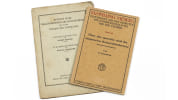
édition_originale
Eine Theorie der Grundlagen der Thermodynamik"
Leipzig, Johann Ambrosius Barth, 1903. Contemp. hcloth. Handwritten paperlabel on spine. In: ""Annalen der Physik. Vierte Folge. Band 11. Herausgegeben von Paul Drude."". VIII,1144pp. and 6 plates. (Entire volume offered). The Einstein paper: pp. 170-187. Faint signs of dampstains in outer margins on a few leaves.
First edition of Einsteins fourth paper. In his paper from 1902, Einstein ""says in his introduction that nobody has yet succeeded in deriving the conditions of thermal equilibrium and of the second law of thermodynamics from probability considerations, although Maxwell and Boltzmann came near to it. Willard Gibbs is not mentioned. In fact, Einstein's paper was written in ignorance of Gibbs paper published 1901. In the present paper, Einstein builds the theory on another basis not used by Gibbs, namely on the consideration of a single system in course of time (later called ""Zeit-Gesamtheit"", time assembly), and proves that this is equivalent to a certain virtual assembly of many systems, Gibb's micro-canonical assembly...Einstein at once proceeded to apply his theorems to a case of utmost importance, namely to systems of a size suited for demonstrating the reality of molecules and the correctness of the kinetic theory of matter.""(Walter Alicke). First edition of Einsteins fourth paper. In his paper from 1902, Einstein ""says in his introduction that nobody has yet succeeded in deriving the conditions of thermal equilibrium and of the second law of thermodynamics from probability considerations, although Maxwell and Boltzmann came near to it. Willard Gibbs is not mentioned. In fact, Einstein's paper was written in ignorance of Gibbs paper published 1901. In the present paper, Einstein builds the theory on another basis not used by Gibbs, namely on the consideration of a single system in course of time (later called ""Zeit-Gesamtheit"", time assembly), and proves that this is equivalent to a certain virtual assembly of many systems, Gibb's micro-canonical assembly...Einstein at once proceeded to apply his theorems to a case of utmost importance, namely to systems of a size suited for demonstrating the reality of molecules and the correctness of the kinetic theory of matter.""(Walter Alicke). - Weil No. 4 - Boni No 4.
Entwurf einer Landschaft. Illustré de lithographies par C.-L. Roux.
Paris, Éditions de la Galerie Simon, 1930. Grand in-4 broché, couverture imprimée. Chemise en demi-box noir, étui (Honegger).
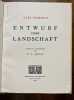
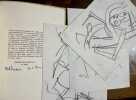
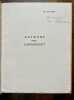
Illustré de 5 lithographies de Gaston-Louis Roux, dont une en frontispice. Édition originale. Tirage à 112 exemplaires, un des X exemplaires de chapelle sur Hollande van Gelder, signé par l’auteur et l’illustrateur. Enrichi d’un envoi autographe de l’auteur à Erna Reber, la dédicataire du livre, ainsi que des cinq dessins originaux ayant servis aux illustrations de ce livre, tous signés. Amis de la première heure, Carl Einstein rencontre Kahnweiler dès son arrivée à Paris vers 1904. Amateur de peinture cubiste, il écrit également des romans et de la poésie, que Kahnweiler apprécie particulièrement. Intellectuel engagé, Einstein devient un fin critique et un grand théoricien de l'art primitif. En 1915 son livre Negerplastik fait date, tout comme la somme sur l’art de son temps, Die Kunst des 20e Jahrhunderts. Pour rédiger ses travaux, il entre en contact avec de nombreux artistes et collectionneurs à travers l’Europe. C’est ainsi qu’il rencontre Gottlieb Friedrich Reber, immense collectionneur des peintres cubistes de la première heure. D’origine allemande, Reber s’installe en Suisse après la Première Guerre mondiale. Dans son histoire de l’art, Einstein illustrera le chapitre sur le cubisme avec les œuvres de la collection Reber. Et ils collaboreront tous les deux à la revue surréaliste Documents. C’est dire si la présence d’un envoi autographe d’Einstein à Erna Reber, est précieuse: l’ouvrage lui étant déjà dédié, il lui est personnellement dédicacé ! Entwurf einer Landschaft (Esquisse d’un paysage) est le premier livre publié par Einstein en France. Recueil de poèmes au ton hermétique, il ne connait pas un grand succès, et pour cause, ni l’éditeur ni son auteur n’ont cru utile d’en donner une traduction en français. Gaston-Louis Roux a intégré la Galerie Simon en 1927, à l'âge de vingt-trois ans, mais n’avait pas encore réalisé d’illustrations pour Kahnweiler. Il avait déjà une expérience en ce domaine, puisqu’il avait travaillé pour Pascal Pia, spécialisé dans la littérature érotique clandestine. Ainsi Roux et Einstein se connaissent, ils collaborent à la revue Documents, et Einstein lui consacre même une partie d’un chapitre dans son histoire de l’art. Toutefois, l’illustration qui naîtra de cette collaboration est des plus déroutantes. Entwurf - esquisse - ainsi semblent les dessins réalisés par Roux. On peut aisément penser que ce rare exemplaire de chapelle, enrichi des dessins originaux, a été offert par le poète et le peintre à l’épouse du collectionneur lorsque le couple visitait la Galerie Simon. Et il est amusant de noter que sur la page de titre se trouvent non pas deux, mais trois coquilles ! Skira 320; Hugues 26; Pompidou p. 187; Chapon p. 285; Galland p. 952.
Zur Quantentheorie der Strahlung. - [FOUNDING LASER PHYSICS.]
Leipzig, S. Hirzel, 1917. Royal8vo. Bound in contemporary half calf with gilt lettering to spine and 5 raised bands with ornaments in gilt. In ""Physikalische Zeitschrift"", Bd. 18, 1917. Spine and hinges with wear, otherwise a fine and clean copy. Pp. 121-128. [Entire volume: XI, (1), 604 pp. + 14 plates.
The paper was first published in 1916 in Mitteilungen der Physikalischen Gesellschaft in Zürich, but here for the first time in Physikalische Zeitschrift. All subsequent research on absorption and emission of radiation and the entire discovery of the maser, later the laser, was based on the research presented in the present paper. The paper is also notable for introducing the concept (but not the name) of the photon"" Einstein argues that in the interaction of matter and radiation there must be, in addition to the processes of absorption and spontaneous emission, a third process of stimulated emission. If stimulated emission exists then he can derive the Planck distribution for blackbody radiation and without it the same argument implies the invalid Wien-distribution theory.""In this paper he derived Planck's original quantum law from a different starting point, he suggested that as well as spontaneous emission and absorption, there could also take place the process of stimulated emission. In 1917 this seemed mainly of theoretical interest"" forty years later it was utilized to provide the maser and laser of modern technology. In 1916, ""Einstein came back once more to blackbody radiation and made further progress. In November 1916 he wrote to Besso: 'A splendid light has fallen on me about the absorption and emission of radiation'. His reasoning is divided into three papers, two of which appeared in 1916 and the third one early in 1917 [the two papers above - note that these are the two papers of Einstein on radiation theory cited by Weil as ""principal works"""" a third paper from 1916 is not.] In these papers, Einstein proposed a statistical theory of the interaction between atoms and photons, gave a new demonstration of Planck's radiation theory and introduced the concept of 'stimulated emission', providing the basis for the discovery of masers and lasers "" (Bertolotti, The History of the Laser).""When Einstein returned to the radiation problem in 1916, the quantum theory had undergone a major change. Niels Bohr's papers had opened a new and fertile domain for the application of quantum concepts-the explanation of atomic structure and atomic spectra. In addition Bohr's work and its generalizations by Arnold Sommerfeld and others constituted a fresh approach to the foundations of the quantum theory of matter. Einstein's new work showed the influence of these ideas . He had found still another derivation of Planck's black-body radiation law, an ""astonishingly simple and general"" one which, he thought, mightproperly be called ""the derivation"" 12 of this important law. It was based on statistical assumptions about the processes of absorption and emission of radiation and on Bohr's basic quantum hypothesis that atomic systems have a discrete set of possible stationary states. The proof turned on the requirement that absorption and emission of radiation, both spontaneous and stimulated, suffice to keep a gas of atoms in thermodynamic equilibrium. (This paper introduced the concept of stimulated emission into the quantum theory and is therefore often described as the basis of laser physics.) Einstein himself considered the most important contribution of this work to be not the new derivation of the distribution law but rather the arguments he presented for the directional character of energy quanta. (DSB) Weil No 91 (with an asterix denoting major paper).
Zur Theorie der Lichterzeugung und Lichtsabsorption (withbound:) Das princip von der Erhaltung der Schwerpunktsbewegung und die Trägheit der Energie" (2 papers).
Leipzig, Johann Ambrosius Barth, 1906. Bound together in one contemp. hcloth. Small tears to spine ends. (=) ""Annalen der Physik. Vierte Folge. Band 20. Herausgegeben von Paul Drude."" , Portrait (Paul Drude), VIII,1048 pp. and 6 plates. Einstein papers: pp. 199-206 and 627-33. Internally fine and clean. The whole volume offered.
Both papers first edition. It was for the papers ""Ueber einen die Erzeugung und Verwandlung des Lichtes betreffenden heuristischen Gesichtspunkt"" of 1905 and ""Zur Theorie der Lichterzeugung...( Theory of light emission and absorption), the offered item), that Einstein was awarded the Nobel Prize in 1921.""The quantum theory has affected virtually every branch of physics. Its earliest and one of its most significant developments was Einstein's application of the theory to what is known as the 'photo-electrical effect'....Einstein explained this effext by suggesting that the classical view that light is emitted in the form of continous waves must be abandoned. The photo-electrical effect could be explained only as an example of quantum action where the waves of light or X-rays are emitted in minute particles or bullets. It is he size of the bullet (the wave-lenght of the radiation) which determines the number of electrons ejected. It was for this, and not for the theory of relativity, that Einstein was awarded the Nobel Prize in 1921. Einstein's two fundamental papers on this subject are ""Ueber einem Erzeugung...."" 1905 and Zur Theorie der Lichterzeugung (the paper offered here)"" (PMM the note to 391). In the second paper (Principle of the conservation of the centre of mass motion and the inertia of energy) he shows that the conservation of mass is a special application of his energy principle (E= Mc2) - Weil: 12 & 13.Among the many papers in this volume we have Max von Laue: Zur Thermodynamik der Inteferenzerscheinungen. pp. 365-378.
Zur Theorie der Lichterzeugung und Lichtsabsorption" (Eingegangen 13. März 1906). (On the Theory of Light Production and Light Absorption).
(Leipzig, Johann Ambrosius Barth, 1906). No wrappers. Extracted from ""Annalen der Physik"" Vierte Folge. Bd. 20. Pp. 199-206. Clean and fine.
First printing of one of the papers for which Einstein was awarded the Nobel Prize in 1921. It was for the papers ""Ueber einen die Erzeugung und Verwandlung des Lichtes betreffenden heuristischen Gesichtspunkt"" of 1905 and ""Zur Theorie der Lichterzeugung...( Theory of light emission and absorption), the offered item, that Einstein received the prize: ""for his services to theoretical physics and especially for his discoveryof the law of the photoelectrical effect"" - his reward was not based on relativity.""The quantum theory has affected virtually every branch of physics. Its earliest and one of its most significant developments was Einstein's application of the theory to what is known as the 'photo-electrical effect'....Einstein explained this effext by suggesting that the classical view that light is emitted in the form of continous waves must be abandoned. The photo-electrical effect could be explained only as an example of quantum action where the waves of light or X-rays are emitted in minute particles or bullets. It is he size of the bullet (the wave-lenght of the radiation) which determines the number of electrons ejected. It was for this, and not for the theory of relativity, that Einstein was awarded the Nobel Prize in 1921. Einstein's two fundamental papers on this subject are ""Ueber einem Erzeugung...."" 1905 and Zur Theorie der Lichterzeugung (the paper offered here)"" (PMM the note to 391).Weil: 12 (with an asterix, denoting a major paper) - Boni:12.
Zur Theorie der Lichterzeugung und Lichtsabsorption (withbound:) Das princip von der Erhaltung der Schwerpunktsbewegung und die Trägheit der Energie" (2 papers).
Leipzig, Johann Ambrosius Barth, 1906. Bound together in one contemp. halfcalf. Spine gilt. Minor scratches to spine. A stamp to titlepage and htitle. ""Annalen der Physik. Vierte Folge. Band 20. Herausgegeben von Paul Drude."" , Portrait (Paul Drude), VIII,1048 pp. and 6 plates. Einstein papers: pp. 199-206 and 627-33. The entire volume offered.
Both papers first edition. It was for the papers ""Ueber einen die Erzeugung und Verwandlung des Lichtes betreffenden heuristischen Gesichtspunkt"" of 1905 and ""Zur Theorie der Lichterzeugung...( Theory of light emission and absorption), the offered item), that Einstein was awarded the Nobel Prize in 1921.""The quantum theory has affected virtually every branch of physics. Its earliest and one of its most significant developments was Einstein's application of the theory to what is known as the 'photo-electrical effect'....Einstein explained this effext by suggesting that the classical view that light is emitted in the form of continous waves must be abandoned. The photo-electrical effect could be explained only as an example of quantum action where the waves of light or X-rays are emitted in minute particles or bullets. It is he size of the bullet (the wave-lenght of the radiation) which determines the number of electrons ejected. It was for this, and not for the theory of relativity, that Einstein was awarded the Nobel Prize in 1921. Einstein's two fundamental papers on this subject are ""Ueber einem Erzeugung...."" 1905 and Zur Theorie der Lichterzeugung (the paper offered here)"" (PMM the note to 391). In the second paper (Principle of the conservation of the centre of mass motion and the inertia of energy) he shows that the conservation of mass is a special application of his energy principle (E= Mc2) - Weil: 12 & 13.Among the many papers in this volume we have Max von Laue: Zur Thermodynamik der Inteferenzerscheinungen. pp. 365-378.
EINSTEIN, ALBERT. - THE PHOTOELECTRIC EQUATION - THE NOBEL PRIZE PAPERS.
Reference : 59121
(1906)
Zur Theorie der Lichterzeugung und Lichtsabsorption (withbound:) Das princip von der Erhaltung der Schwerpunktsbewegung und die Trägheit der Energie" (2 papers).
Leipzig, Johann Ambrosius Barth, 1906. Full cloth. Spine with gilt lettering. In: ""Annalen der Physik. Vierte Folge. Band 20. Herausgegeben von Paul Drude."" , Portrait (Paul Drude), VIII,1048 pp. and 6 plates. Einstein papers: pp. 199-206 and 627-33. Internally fine and clean. The entire volume offered. Broad margins.
Both papers first edition. It was for the papers ""Ueber einen die Erzeugung und Verwandlung des Lichtes betreffenden heuristischen Gesichtspunkt"" of 1905 and ""Zur Theorie der Lichterzeugung...( Theory of light emission and absorption), the offered item), that Einstein was awarded the Nobel Prize in 1921. ""The quantum theory has affected virtually every branch of physics. Its earliest and one of its most significant developments was Einstein's application of the theory to what is known as the 'photo-electrical effect'....Einstein explained this effext by suggesting that the classical view that light is emitted in the form of continous waves must be abandoned. The photo-electrical effect could be explained only as an example of quantum action where the waves of light or X-rays are emitted in minute particles or bullets. It is he size of the bullet (the wave-lenght of the radiation) which determines the number of electrons ejected. It was for this, and not for the theory of relativity, that Einstein was awarded the Nobel Prize in 1921. Einstein's two fundamental papers on this subject are ""Ueber einem Erzeugung...."" 1905 and Zur Theorie der Lichterzeugung (the paper offered here)"" (PMM the note to 391). In the second paper (Principle of the conservation of the centre of mass motion and the inertia of energy) he shows that the conservation of mass is a special application of his energy principle (E= Mc2) - Weil: 12 & 13.Among the many papers in this volume we have Max von Laue: Zur Thermodynamik der Inteferenzerscheinungen. pp. 365-378.
EINSTEIN, sa vie et son temps -- EDITION ORIGINALE
P., A.Michel, 1950, un volume in 8, broché, couverture imprimée, 435pp.
---- EDTION ORIGINALE ---- Jeunesse et formation - Conception du monde physique avant Einstein - Naissance d'une ère nouvelle en physique (vie à Berne, influences philosophiques, les hypothèses fondamentales de la théorie de la relativité, relativité du temps...) - Einstein à Prague, à Berlin - La relativité généralisée - Einstein, figure publique - Voyages à travers l'Europe, l'Amérique et l'Asie - Développement de la physique atomique - Agitation politique en Allemagne - Utilisation politique des théories d'Einstein - Einstein au Etats-Unis**5925/CAV.E6
"EINSTEIN, A. & N. ROSEN. - THE SILBERSTEIN-EINSTEIN CONTROVERSY.
Reference : 47073
(1936)
Two-Body Problem in General Relativity Theory.
Lancaster, American Physical Society, 1936. 4to. In: ""The Physical Review"", Vol. 49, Second Series. X,971 pp. (Entire volume offered). Einstein & Rosen's paper: pp. 404-405.
First printing of Einstein and Rosen's answer to Silberstein's critique of Einstein's Theory of Relativity ..""Ludwik Silberstein, who initially was a supporter of the special theory, objected at different occasions against general relativity. In 1920 he argued that the deflection of light by the sun, as observed by Arthur Eddington et al. (1919), is not necessarily a confirmation of general relativity, but may also be explained by the Stokes-Planck theory of complete aether drag. However, such models are in contradiction with the aberration of light and other experiments (see ""Alternative theories""). And in 1935, Silberstein claimed to have found a contradiction in the Two-body problem in general relativity. However, also this claim was refuted by Einstein and Rosen (1935) (in the paper offered).""(Wikipedia).
DE BROGLIE (L.) - RUSSO (F.) - LE LIONNAIS - NATAF - KAHAN - ARMAND - etc -- EINSTEIN (A.)
Reference : 5922
EINSTEIN
P., Hachette, 1966, un volume in 8 reliure souple de l'éditeur, 248pp., nombreuses gravures dans le texte
---- EDITION ORIGINALE ---- BEL EXEMPLAIRE ---- DE BROGLIE (L.). La physique contemporaine et l'oeuvre d'EINSTEIN - KAHAN (T.). Avant EINSTEIN - LE LIONNAIS (F.). La révolution relativiste - NATAF (R.). Après EINSTEIN, une science toujours en devenir - RUSSO (F.). Le philosophe-savant - ARMAND (L.). La grandeur d'EINSTEIN - etc**5922/P5DE-cav.G3-cav.G6(5)
Sammlung von 7 postkartengrösse Abbildungen und Sprüche von Albert Einstein + 1 Blatt: ‘Zeittafel unter besoderer Berücksichtigung der Berner Jahre (von 1879 bis 1955) / Verso: Stammbaum von Albert Einstein, / Albert Einstein in Bern
o.J., um 1970, kl. in-8vo, 219 S., ill., + 1 dépl. Albert Einstein Museum (2007) zus. im O.-Couvert v. ‘Einstein-Haus’, / Leinengebunden.

(SLACES, NVVA)
Phone number : 41 (0)26 3223808
Über die Krümmung des Raumes. + Über die Möglichkeit einer Welt mit konstanter negativer Krümmung des Raumes. + (Einstein's two remarks to the first paper): Bemerkung ... + Notiz ... - [THE CURVATURE OF SPACE]
(Berlin, Julius Springer, 1922-24). 8vo. In: ""Zeitschrift für Physik"", Vol. 10 (pp. 377 ff.),Vol.11 (pp.326), vol.16 (pp.228), vol.21 (pp.326-332). The entire four volumes offered here. Contemporary half cloth bindings.

Two landmark papers in the history of cosmology: All first editions. In 'Über die Krümmung des Raumes' Friedman derived the non-stationary solutions to Einstein's field equations. Einstein quickly responded in a short comment ('Bemerkung'), in which he expressed his suspicion of such a model of the Universe and apparently pointed out an error in Friedman's calculations. However, Friedman now wrote a letter to Einstein, in which he enclosed his full calculations. Shortly after this, Einstein submitted a short notice (Notiz), in which he admitted that he himself had performed a calculation error and that Friedman's solutions, which shed new light on the matter, were valid. Friedman's expanding universe model was corroborated by Edwin Hubble's red-shift observations in 1929. In 'Über die Möglichkeit einer Welt mit konstanter negativer Krümmung des Raumes' Friedman derived the Friedman-equations and demonstrated that he had command of all three Friedman-models describing positive, zero and negative curvature respectively, nearly a decade before the independent discoveries of the same models by Lemaître, Robertson, and Walker.
Zur allgemeinen molekularen Theorie der Wärme"
Leipzig, J.A. Barth, 1904. Contemp. hcloth, tears to hinges at upper part of spine. ""Annalen der Physik. Vierte Folge. Band 14. Herausgegeben von Paul Drude"". VIII,1040 pp. and 3 plates. The Einstein paper: pp. 354-362. Internally clean and fine. The whole volume offered.
First edition of Einstein's fifth work. ""It was in this last of his early series of papers, before the announcement of the theory of relativity in 1905, that Einstein introduced a new theme. Einstein asked for the physical significance of the constant now known as Boltzmann's konstant 'k'.It was already well known from the theory of the ideal gas that 'k' was simply related to the gas constant 'R' and to Avogardo's number, the number of molecules in a gram-molecular weight of any substance. Einstein showed that 'k' entered into still another basic equation of the statistical theory, the expression for the mean square fluctuation of the energy about its average value. This meant that 'k' determines the thermal stability of a system...the paper contains the seeds of much of his later work...(Walter Alicke). - Weil No 5.
Zum hundertjährigen Gedenktag von Lord Kelvins Geburt.
Berlin, Julius Springer, 1924. Royal8vo. Bound in contemporary half cloth with gilt lettering to spine. In ""Die Naturwissenschaften"", 12. Jahrg, 1924. The whole year offered. ""12"" written in hand to spine, otherwise a very fine and clean copy. Pp. 601-602. [Entire volume: XXV, (1), 1412, 60 pp.].
First printing of Einstein's paper on Lord Kelvin and his scientific work. The occasion was the Centenary Year of Thomson's birth and Einstein wrote 'Zum hundertjährigen Gedenktag von Lord Kelvins Geburt (26. Juni 1824)'. In the mid-nineteenth century Thomson's ideas on thermodynamics established the base line for future generations of scientists. Likewise in 1905, Einstein changed the world of physics forever with the publication of his radical new ideas on special relativity.""We may learn from Einstein the philosopher, of his interest in the founding scientists of the nineteenth century such as Kelvin and Maxwell, of science being not only about instrumentation, mathematics and formulae but also about sharing in the aspirations and achievements of other scientists, past or present."" (Trainer, Einstein's Centenary Tribute) The volume contain several other papers by influential contemporary phycisians. Weil 140.
"CARTAN, ÉLIE. - THE EINSTEIN-CARTAN THEORY (ECT) OF GRAVITATION.
Reference : 48912
(1922)
Sur une définition géométrique du tenseur d'énergie d'Einstein. (+) Sur une généralisation de la notion de courbure de Riemann et les espaces à torsion. (+) Sur les espaces généralisés et la théorie de la Relativité. (+) Sur les espaces conformes...
Paris, Gauthier-Villars, 1922. 4to. Bound in 2 uniform full cloth, but of slightly different sizes. Paperlabels pasted to lower part of spines. A faint stamp to titlepage and some of the issues. In ""Comptes Rendus Hebdomadaires des Séances de L'Academie des Sciences"", Tome 174. 1815,(1) pp. (Entire volume offered). Cartan's papers: pp.437-439, 593-595, 734-737, 857-60, 1104-1107.
First edition of these papers, in which Cartan intruced the concept of ""Torsion"", the main inspiration for Einstein in his searce for a unified field theory. The ECT of gravity is a modification of the General relativity Theory""The Einstein-Cartan theory, also known as the Einstein-Cartan-Sciama-Kibble theory, is a classical theory of gravitation similar to general relativity but relaxing the assumption that the affine connection has vanishing antisymmetric part (torsion tensor), so that the torsion can be coupled to the intrinsic angular momentum (spin) of matter, much in the same way in which the curvature is coupled to the energy and momentum of matter. In fact, the spin of matter in curved spacetime requires that torsion is not constrained to be zero but is a variable in the principle of stationary action. Regarding the metric and torsion tensors as independent variables gives the correct generalization of the conservation law for the total (orbital plus intrinsic) angular momentum to the presence of the gravitational field. The theory was first proposed by Élie Cartan in 1922 and expounded in the following few years. Dennis Sciama and Tom Kibble independently revisited the theory in the 1960s, and an important review was published in 1976. Albert Einstein became affiliated with the theory in 1928 during his unsuccessful attempt to match torsion to the electromagnetic field tensor as part of a unified field theory. This line of thought led him to the related but different theory of teleparallelism."" (Wikipedia).
EINSTEIN. - BARNETT, Lincoln: - MARIANOFF, D. WAYNE, P.: - Clark(Ronald):
Reference : 45118aaf
(SLACES, NVVA)
Phone number : 41 (0)26 3223808
Eine Theorie der Grundlagen der Thermodynamik;
Leipzig, Johann Ambrosius Barth, 1903. Contemp. hcloth. Some small nicks to spine. (=) Annalen der Physik. Vierte Folge. Band 11. Herausgegeben von Paul Drude."". VIII,1144pp. and 6 plates. The Einstein paper: pp. 170-187. Internally fine and clean.
First edition of Einsteins fourth paper. In his paper from 1902, Einstein ""says in his introduction that nobody has yet succeeded in deriving the conditions of thermal equilibrium and of the second law of thermodynamics from probability considerations, although Maxwell and Boltzmann came near to it. Willard Gibbs is not mentioned. In fact, Einstein's paper was written in ignorance of Gibbs paper published 1901. In the present paper, Einstein builds the theory on another basis not used by Gibbs, namely on the consideration of a single system in course of time (later called ""Zeit-Gesamtheit"", time assembly), and proves that this is equivalent to a certain virtual assembly of many systems, Gibb's micro-canonical assembly...Einstein at once proceeded to apply his theorems to a case of utmost importance, namely to systems of a size suited for demonstrating the reality of molecules and the correctness of the kinetic theory of matter.""(Walter Alicke). - Weil No. 4.

