Write to the booksellers
119 books for « edmund husserl »Edit
-
Latest
Last month (4)
Last week (1)
-
Language
French (111)
Russian (8)
-
Century
20th (61)
21st (4)
-
Topics
Bachelard gaston (1)
Early printed books (1)
Epistemology (1)
Essays (1)
Literature (1)
Logic (4)
Mathematics (3)
Paris (1)
Philosophy (69)
Psychology (7)
Sciences (1)
-
Countries
Belgium (10)
Canada (2)
Denmark (13)
France (79)
Switzerland (6)
United States of America (9)
-
Syndicate
ALAC (2)
ILAB (34)
NVVA (2)
SLACES (2)
SLAM (17)
Texte zur Phänomenologie des inneren Zeitbewusstseins (1893 - 1917). Husserl, Edmund
BROCHE
Merci de nous contacter à l'avance si vous souhaitez consulter une référence dans notre boutique à Authon-du-Perche.
Logische Untersuchungen [Paperback] Husserl, Edmund
BROCHE TOME 1
Merci de nous contacter à l'avance si vous souhaitez consulter une référence dans notre boutique à Authon-du-Perche.
Husserl E. The Crisis of European Sciences and Transcendental Phenomenology. In
Husserl E. The Crisis of European Sciences and Transcendental Phenomenology. In Russian /Gusserl E. Krizis evropeyskikh nauk i transtsendentalnaya fenomenologiya. Translation from German by D.V.Sklyadneva. St. Petersburg, Vladimir Dal, 2004, 400 p.We have thousands of titles and often several copies of each title may be available. Please feel free to contact us for a detailed description of the copies available.SKUalb05594f7078030444.
Idées directrices pour une phénoménologie
Gallimard 1950 568 pages collection bibliotheque de philosophie. in8. 1950. broché. 568 pages.
Bon état
Leçons pour une phénoménologie de la conscience intime du temps
Presses universitaires de France 1964 collection Épiméthée Essais Philosophiques. 1964.


Bon état
Logique Formelle et Logique Transcendantale
Presses universitaires de France 1965 collection Épiméthée Essais Philosophiques. 1965.


Bon état
Zur Phänomenologie Der Intersubjektivität
Kluwer Academic Publishers Relié très bon état sous jaquette Jaquette abîmée . 741 pages . 1973.Zur Phenomenologie Der Intersubjektivitit, Texte Aus Dem Nachla?. Dritter Teil. 1929-1935
Merci de nous contacter à l'avance si vous souhaitez consulter une référence dans notre boutique à Authon-du-Perche.
Formale Und Transzendentale Logik
Kluwer Academic Publishers Relié comme neuf sous jaquette . 1974. 510 pages . Formale Und Transzendentale Logik: Versuch Einer Kritik Der Logischen Vernunft. Mit Erganzenden Texten.
Merci de nous contacter à l'avance si vous souhaitez consulter une référence dans notre boutique à Authon-du-Perche.
Analysen Zur Passiven Synthesis
Relié sous jaquette bon état. Passages soulignés et annotations au crayon de papier . Jaquette abîmée . 1966. 531 pages. Analysen Zur Passiven Synthesis: Aus Vorlesungs- Und Forschungsmanuskripten 1918-1926
Merci de nous contacter à l'avance si vous souhaitez consulter une référence dans notre boutique à Authon-du-Perche.
Ideen Zu Einer Reinen Phänomenologie Und Phänomenologischen Philosophie
Kluwer Academic Publishers Relié très bon état sans jaquette . Contenu propre. 165 pages. 1971. Ideen Zu Einer Reinen Phanomenologie Und Phanomenologischen Philosophie: Drittes Buch: Die Phanomenologie Und Die Fundamente Der Wissenschaften
Merci de nous contacter à l'avance si vous souhaitez consulter une référence dans notre boutique à Authon-du-Perche.
Philosophie Der Arithmetik
Kluwer Academic Publishers Relié très bon état sans jaquette . Ex libris intérieur 1 er plat . 1970. 585 pages . Philosophie Der Arithmetik
Merci de nous contacter à l'avance si vous souhaitez consulter une référence dans notre boutique à Authon-du-Perche.
Goosserl E. Collection of Works. Vol. III (1). In Russian /Gusserl E. Sobranie
Goosserl E. Collection of Works. Vol. III (1). In Russian /Gusserl E. Sobranie sochineniy. T.III (1). M. Intellectual Book House 2001. 584s. We have thousands of titles and often several copies of each title may be available. Please feel free to contact us for a detailed description of the copies available. SKUalbe60c75249b4070b2.
Goosserl E. Ideas for pure phenomenology and phenological philosophy. Book one
Goosserl E. Ideas for pure phenomenology and phenological philosophy. Book one. In Russian /Gusserl E. Idei k chistoy fenomenologii i fenomenologicheskoy filosofii. Kniga pervaya. Series: Philosophical Technologies. Translated with him by A.V. Mikhailov, Entry by V.A. Kurennoy. M. Academic Project, 2009. 489s. We have thousands of titles and often several copies of each title may be available. Please feel free to contact us for a detailed description of the copies available. SKUalb9be8775bbb24a5a4.
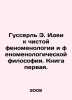
Goosserl E. Ideas for Pure Phenomenology and Phenomenological Philosophy. Book
Goosserl E. Ideas for Pure Phenomenology and Phenomenological Philosophy. Book 3. Phenomenology and Foundations of Sciences. In Russian /Gusserl E. Idei k chistoy fenomenologii i fenomenologicheskoy filosofii. Kniga 3. Fenomenologiya i osnovy nauk. Nervous with it. Kaliningrad BFU named after I. Kant 2024. 231s.We have thousands of titles and often several copies of each title may be available. Please feel free to contact us for a detailed description of the copies available.SKUalb1a6cf57a1664e5f8.
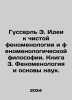
D.N. Razeev, E. Gusserl in the networks of phenology. The main problems of phen
D.N. Razeev, E. Gusserl in the networks of phenology. The main problems of phenology. In Russian /Razeev D.N., Gusserl E. V setyakh fenomenologii. Osnovnye problemy fenomenologii. Translation from German. St. Petersburg University Publishing House 2004. 363 pp.We have thousands of titles and often several copies of each title may be available. Please feel free to contact us for a detailed description of the copies available.SKUalb0a52725dda1333c5.
D.N. Razeev, E. Gusserl in the networks of phenology. The main problems of phen
D.N. Razeev, E. Gusserl in the networks of phenology. The main problems of phenology. In Russian /Razeev D.N., Gusserl E. V setyakh fenomenologii. Osnovnye problemy fenomenologii. St. Petersburg University Publishing House. 2004. 368s. We have thousands of titles and often several copies of each title may be available. Please feel free to contact us for a detailed description of the copies available. SKUalb8df7dd9ec516922b.
Goosserl E. The Beginning of Geometry./Gusserl E. Nachalo geometrii.
Goosserl E. The Beginning of Geometry./Gusserl E. Nachalo geometrii.. E6

La Terre ne se meut pas
Paris, Ed. de Minuit, 2001, in-8, broché, 93p. Très bon état.

NB. La librairie est fermée jusqu'à fin septembre. Les questions et commandes seront traitées début octobre.
Goosserl E. The Idea of Phenomenology: Five Lectures. In Russian /Gusserl E. Id
Goosserl E. The Idea of Phenomenology: Five Lectures. In Russian /Gusserl E. Ideya fenomenologii: pyat lektsiy. Introduction of the article by M.A. Belousov: translation with him by N.A. Artemenko S.Pb.IC Humanities Academy 2023 320 Contact us for details or to request photos of available books. Delivery of this book could take longer than normal due to additional handling time before shipping, and no rush delivery options are available. Please let us know if you have a specific date by which you need to receive your order. SKUalba4c94c79fd2dfabe

Goosserl E. Collection of Works. Volume 3 (1). Logical Research. Research on Ph
Goosserl E. Collection of Works. Volume 3 (1). Logical Research. Research on Phenomenology and Theory of Cognition. In Russian /Gusserl E. Sobranie sochineniy. Tom 3 (1). Logicheskie issledovaniya. Issledovaniya po fenomenologii i teorii poznaniya. M. House of Intellectual Book. 2001.Contact us for details or to request photos of available books. Delivery of this book could take longer than normal due to additional handling time before shipping, and no rush delivery options are available. Please let us know if you have a specific date by which you need to receive your order.SKUalba1a8eace9a00c110