 Write to the booksellers
3 books for « e p gratianus »Edit
-
Language
Dutch (1)
French (2)
-
Century
16th (1)
20th (1)
-
Topics
Antwerp (1)
Law (1)
-
Countries
Belgium (2)
Denmark (1)
-
Syndicate
CLAM (1)
ILAB (2)
De Bevrijdster van Antwerpen, De gelukzalige Anna van den Heiligen Bartholomeus
Kortrijk 1940 Carmelitana Soft cover Fine
Langue: néerlandais. La Libératrice d'Anvers, La bienheureuse Anna de Saint-Barthélemy 175 x 135 mm, 48 pages, en bon état, petite tache d'humidité au dos avec de nombreuses illustrations couverture souple

Decreti huius plenissimum argumentum (Decretum aureum). (3 Parts, Ministeria, Negotia, Sacramenta).
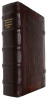
Paris, B. Rembolt, 1511. Large folio. (40x30 cm.). Contemp. full brown calf over wood, richly blindtooled covers. Later rebacking. 5 raised bands. Brass clasps and catches. Leather on clasps renewed. Brass edges on covers. Fol. 459,(27),46,(1). Lacking Folios in Index (Fol. 41-43). Title-page printed in red/black within woodcut border and with printers woodcut device. Text throughout printed in red/black. Large woodcut on Fol. 1 verso (biblical figures, church fathers and Gratian in the middle). Numerous figurative woodcut initials throughout. Internally very fine and clean, a few leaves with a faint dampstain to margins. On fine thick paper. On the renewed spine is with letters in gold printed 1507 (it should be 1511).
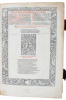
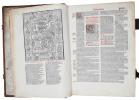
Scarce early edition of the famous collection of Canon Law. The Decretum Gratiani, also known as the Concordia discordantium canonum or Concordantia discordantium canonum, is a collection of Canon law compiled and written in the 12th century as a legal textbook by the jurist known as Gratian. It forms the first part of the collection of six legal texts, which together became known as the Corpus Juris Canonici. It was used by canonists of the Roman Catholic Church until Pentecost (May 19) 1918, when a revised Code of Canon Law (Codex Iuris Canonici) promulgated by Pope Benedict XV on 27 May 1917 obtained legal force. (Wikipedia).Adams
GRATIANUS - Johannes TEUTONICUS - Bartolomeo da BRESCIA ( commentators ) :
Reference : 53699
Decretum.
" Nuremberg ( Nürnberg ) , Anton Koberger, 30.XI.1493, in-folio, 34,5 x 23,5 cm, 410 leaves, coll. a-r10 s12 t-z4 A-D10 E6 F8 G10 H8 I-M10 N8 O10 P8 Q-S10 (complete, and includes the final blank leaf. ). Contemporary German binding: blind-stamped pigskin over wooden boards, (a few tiny wormholes), bevelled edges, spine with 3 raised bands, central and corner brass pieces ( front cover complete with the original pieces, back cover retains only 1 corner piece); brass clasps in working order. metal clasps and catches, a few fore-edge tabs and manuscript title on fore-edge. Inside with some very unobtrusive dampstaining in some blank margins, occ. light local browning. A complete and very good copy in a nicely preserved contemporary binding. Provenance: Manuscript ex-libris ''Monasterium Neustatt ad Moenam'' ( Kloster Neustatt in Mainz) on page aii (recto), with a small oval stamp of ''Fürstliche Löwenstein-Rosenbergische Canzlei-Bibliothek, also on page aii (recto). Second Koberger edition (1st 1483) of this compilation of canons by the 12th-c. Bolognese laywer Gratian, which the author himself called ""Concordantia discordantium canonum"". This text is one of the foundation texts of canon law and as such a milestone in the development of Western law. The text is printed in Gothic type, in 2 col., with commentary surrounding the text. Headlines, chapter headings and 2-line initials printed in red. Capital spaces with blue (and some red) rubricated initials. On the last three (blank) pages an extensive and neatly written commentary. Ref. USTC 745343 - GW 11379. - Goff G386. - Polain 1685. - BMC II:437. Fine and monumental example of the high quality attained, barely 40 years after the invention of printing with moveble types, by one of the major printers of the incunable era : Anton Koberger (1440 - 1513) . He was the first printer in Nuremberg. This title is published in the same year (1493) as his Nuremberg Chronicle - considered to be the finest publication of the incunable period. The book is entirely printed in red & black; a difficult printing method whereby each leaf had to pass 4 times under the press."

