 Write to the booksellers
9 books for « davisson c j »Edit
Diffraction of Electrons by a Crystal of Nickel.
Minneapolis, The Collegiate Press, 1927. 4to. As extracted from ""The Physical Review, Volume 30, Second Series, July-December, 1927"". Title-page detached, with vague library stamp to top right corner. A fine and clean copy. (2), 704-740 pp.
First printing of Davisson and Germer's paper in which they present some additional discoveries not published in their groundbreaking paper ""The Scattering of Electrons by a Single Crystal of Nickel"" published the same year. This led directly to Davisson receiving the Nobel Prize in physics in 1937. It advanced understanding of physics at the quantum level and led to inventions such as the electron microscope.""Davisson and Germer submitted their results to Nature in early March and their paper was published on 16 April. It contains a detailed comparison between their replcted beams and those that would be produced by illuminationg the crystal with X-rays. There were thirteen reflected beams in all, of which ten corresponded to those seen in X-ray diffraction"". (Gerwin, A Century of Nature, 28 p.) They could not account for the last three wave and this was not published in their first paper. ""The remaining three peaks for which Davisson and Germer could not find any correspondence with X-ray data were later identified as being due to diffraction from atoms absorb ed on the surfaces of the target crystal."" (Ibid.). This information was published in the present paper. ""Davisson's investigations on the scattering of electrons entered a new phase when, in April 1925, his taget was heavily oxidized by an accidental explosion of a liquid-air bottle. He cleaned the target by prolonged heating and then found the distribution-inangle of the secondary electrons completely changed, new showing a strong dependence on crystal direction. Prior to the accident the target had consisted of many tiny crystals, but heating converted it to several large crystals. Davisson and L. H. Germer, who had replaced Kunsman before the accident, at once began bombarding targets of single crystals. [...] When Davisson returned from England, he and Germer began a systematic research for some sort of interference phenomenon, and in January 1927 they observed electron beams resulting from diffraction by a single crystal of nickle. The results were in good agreement with de Broglie's prediction. For his confirmation of electron waves Davisson shared the Nobel Prize in physics in 1937 with G. P. Thomson."" (DSB, III, 597b-598a).Davisson and Germer's confirmation of the de Broglie hypothesis if today known as the Davisson-Germer experiment.

The Scattering of Electrons by a Single Crystal of Nickel. - [ELECTRON DIFFRACTION - NOBEL PRIZE IN PHYSICS 1937.]
London, Macmillian and Co, 1927. Royal8vo. Bound in contemporary half cloth with whilte title paper-label to spine. In ""Nature"", vol. 119, 1927, entire volume offered. Stamp to front free end-paper and title-pages of each issue.Light wear to extremieies, otherwise fine. Pp. 558-560. [Entire volume: LIX, (1), 948, 100].
![The Scattering of Electrons by a Single Crystal of Nickel. - [ELECTRON DIFFRACTION - NOBEL PRIZE IN PHYSICS 1937.]. "DAVISSON, C. [CLINTON] & L. H. ...](https://static.livre-rare-book.com/pictures/LLX/59913_1_thumb.jpg)
![The Scattering of Electrons by a Single Crystal of Nickel. - [ELECTRON DIFFRACTION - NOBEL PRIZE IN PHYSICS 1937.]. "DAVISSON, C. [CLINTON] & L. H. ...](https://static.livre-rare-book.com/pictures/LLX/59913_2_thumb.jpg)
First edition of this seminal and highly influential paper on electron diffraction. Today the paper is regarded as one of the most important in the entire journal of Nature, and it led directly to Davisson receiving the Nobel Prize in physics in 1937. It advanced understanding of physics at the quantum level and led to inventions such as the electron microscope. Davisson and Germer's confirmation of the de Broglie hypothesis if today known as the Davisson-Germer experiment.""Davisson's investigations on the scattering of electrons entered a new phase when, in April 1925, his taget was heavily oxidized by an accidental explosion of a liquid-air bottle. He cleaned the target by prolonged heating and then found the distribution-inangle of the secondary electrons completely changed, new showing a strong dependence on crystal direction. Prior to the accident the target had consisted of many tiny crystals, but heating converted it to several large crystals. Davisson and L. H. Germer, who had replaced Kunsman before the accident, at once began bombarding targets of single crystals. [...] When Davisson returned from England, he and Germer began a systematic research for some sort of interference phenomenon, and in January 1927 they observed electron beams resulting from diffraction by a single crystal of nickle. The results were in good agreement with de Broglie's prediction. For his confirmation of electron waves Davisson shared the Nobel Prize in physics in 1937 with G. P. Thomson."" (DSB, III, 597b-598a).
The Scattering of Electrons by a Single Crystal of Nickel. - [ELECTRON DIFFRACTION - NOBEL PRIZE IN PHYSICS 1937.]
London, Macmillian and Co, 1927. Royal8vo. Bound in a nice black full cloth with title, year and exlibris (Grosvenor Library) in gilt on spine. The entire volume 119, 1927, of ""Nature"" offered. Pasted library stamp to pasted down free front end-paper. Binding tight, clean and externally as well as internally. Pp. 558-560. [Entire volume: LIX, (1), 948, 100].
First edition of this seminal and highly influential paper on electron diffraction. Today the paper is regarded as one of the most important in the entire journal of Nature, and it led directly to Davisson receiving the Nobel Prize in physics in 1937. It advanced understanding of physics at the quantum level and led to inventions such as the electron microscope. Davisson and Germer's confirmation of the de Broglie hypothesis if today known as the Davisson-Germer experiment.""Davisson's investigations on the scattering of electrons entered a new phase when, in April 1925, his taget was heavily oxidized by an accidental explosion of a liquid-air bottle. He cleaned the target by prolonged heating and then found the distribution-inangle of the secondary electrons completely changed, new showing a strong dependence on crystal direction. Prior to the accident the target had consisted of many tiny crystals, but heating converted it to several large crystals. Davisson and L. H. Germer, who had replaced Kunsman before the accident, at once began bombarding targets of single crystals. [...] When Davisson returned from England, he and Germer began a systematic research for some sort of interference phenomenon, and in January 1927 they observed electron beams resulting from diffraction by a single crystal of nickle. The results were in good agreement with de Broglie's prediction. For his confirmation of electron waves Davisson shared the Nobel Prize in physics in 1937 with G. P. Thomson."" (DSB, III, 597b-598a).
Electrons and Quanta. - [PHYSICS NOBEL PRIZE 1937.]
New York, American Telephone and Telegraph Company, 1929. 8vo. Original full green cloth. Volume VIII, 1929 of The Bell System Technical Journal. Library stamp to front free end-paper and title page. Minor bumping to extremities. A nice and clean copy. Pp. 217-224. [Entire volume: (8), 861 pp.].
First edition of Davisson's paper on electrons and quanta. Together with George Paget Thomson he won the Nobel Prize in Physics in 1937 for his discovery of electron diffraction.""The experiments by the author and L. H. Germer, by G. P. Thomson and by others from which the wave properties of electrons are adduced are briefly described. The agreement between the results of these experiments and the prediction of L. de Broglie is pointed out. The wave and corpuscular properties of electrons are compared with the similar properties of light quanta.""(From the introduction to the present paper).Other papers of interest is contained in the present volume:1. Osborne, H.S. The Principles of Electric Circuits Applied to Communication. Pp. 3-20.2. Frederick, Halsey A. Recent Advances in Wax Recording. Pp. 159-172.3. Elmen, G.W. Magnetic Alloys of Iron, Nickel, and Cobalt. Pp. 435-465.4. Davisson, C.J." Germer, L.H. A Test for Polarization of Electron Waves by Reflection. Pp. 466-481. 5. Martin, W.H. Gray, C.H.G. Master Reference System for Telephone Transmission. Pp. 536-5596. Germer, L.H. An Application of Electron Diffraction to the Study of Gas Adsorption. Pp. 591-6047. Darrow, Karl K. Statistical Theories of Matter, Radiation and Electricity. Pp. 672-748. 8. Fletcher, H. Steinberg, J.C. Articulation Testing Methods. Pp. 806-854.
Electrons and Quanta. - [THE DISCVERY OF ELECTRON DIFFRACTION]
New York, American Telephone and Telegraph Company, 1929. Lex8vo. Volume VIII, April, No. 1, 1929 of ""The Bell System Technical Journal"". In the original printed blue wrappers. Even soiling to spine and back wrapper. Internally fine and clean. Pp. 217-224. [Entire issue: Pp. 217-434].
First edition of Davisson's paper on electrons and quanta. Together with George Paget Thomson he won the Nobel Prize in Physics in 1937 for his discovery of electron diffraction.""The experiments by the author and L. H. Germer, by G. P. Thomson and by others from which the wave properties of electrons are adduced are briefly described. The agreement between the results of these experiments and the prediction of L. de Broglie is pointed out. The wave and corpuscular properties of electrons are compared with the similar properties of light quanta."" (From the introduction to the present paper).Other papers contained in the present issue:1. Williams, R.R." Murphy, E.J.The Predominating Influence of Moisture and Electrolytic Material Upon Textiles as Insulators. Pp. 225-242.2. Glenn, H.H. Wood, E.B. Purified Textile Insulation for Telephone Central Office Wiring. Pp. 243-256.3. Townsend, J.R.Telephone Apparatus Springs: A Review of the Principal Types and the Properties Desired of These Springs. Pp. 257-266.4. Herman, J.Effect of Signal Distortion on Morse Telegraph Transmission Quality. Pp. 267-285.5. Johnson, J.B.A Braun Tube Hysteresigraph. Pp. 286-308.6. Bailey, Austin Dean, S.W. Wintringham, W.T.The Receiving System for Long-Wave Transatlantic Radio Telephony. Pp. 309-367.7. Marrison, W.A.Oscillographs for Recording Transient Phenomena. Pp. 368-390.8. Darrow, Karl K.Contemporary Advances in Physics, XVIII, The Diffraction of Waves by Crystals. Pp. 391-428.
Collectif: Ellery Queen, L. A. G. Strong, Thomas Walsh, Davisson Post, Thomas Kyd, Jean Dereims, Pietro di Donato, Pierre Larroque, Charlotte Armstrong, Igor B. Maslowski :
Reference : 3357
(1955)
25 nouvelles policières reprises de Mystère-magazine.
25 nouvelles policières reprises de Mystère-magazine, série 28 - Opta, 1955. Fort volume in-12 broché, couverture illustrée. Couverture légèrement tachée, petit accroc au dos.
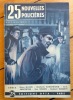
Nouvelles classées par genre: des histoires de détectives, des histoires criminelles, une histoire de suspense et des chroniques. Suite à un accident immobilisant votre libraire pour quelques semaines, le traitement des commandes est bien assuré, mais momentanément ralenti. Merci de votre patience et de votre compréhension.
The world of sport aviation
Hearst Books 1982 In-4 relié 28,2 cm sur 21,8. Bon état d’occasion.
Bon état d’occasion
Mystere Magazine N°220 - mai 1966- L'allumette de sûreté- Le couteau de chasse- Du sang sur la neige- Trois fils de justice- persécution- Hildegarde, Oscar et Sylvia- Le caillou- La plantation du testament- La lampe magique- Une odeur de brûlé- verdict...
Opta Collection Mystère Magazine. 1966. In-12. Broché. Etat d'usage, 1er plat abîmé, Coiffe en pied abîmée, Quelques rousseurs. 127 pages, couverture couleurs. Texte sur deux colonnes. Dos frotté. Une planche illustrée d'un dessin en noir et blanc.. . . . Classification Dewey : 70.49-Presse illustrée, magazines, revues
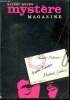
Ellery queen , mystere magazine, La revue littéraire de tous ceux qui s'interressent au policier et au mystère. SOMMAIRE: L'allumette de sûreté- Le couteau de chasse- Du sang sur la neige- Trois fils de justice- persécution- Hildegarde, Oscar et Sylvia- Le caillou- La plantation du testament- La lampe magique- Une odeur de brûlé- verdict... Classification Dewey : 70.49-Presse illustrée, magazines, revues

24 CAPRICEN IN FORM VON ETÜDEN FÜR VIOLINE SOLO.
C.F.PETERS.LEIPZIG.. Non daté. In-4. Broché. A relier, Couv. convenable, Dos frotté, Intérieur frais. 36 pages de partitions. Inscriptions au crayon à papier sur quelques pages.. . . . Classification Dewey : 780.26-Partitions
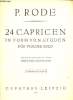
10646. Classification Dewey : 780.26-Partitions

