 Write to the booksellers
934 books for « da mathilde »Edit
-
Type
Autograph (2)
Book (915)
Drawings (3)
Magazine (4)
Music sheets (5)
Photographs (5)
-
Latest
Last month (182)
Last week (5)
-
Century
18th (1)
19th (52)
20th (240)
21st (227)
-
Countries
Belgium (28)
Denmark (4)
France (800)
Switzerland (102)
-
Syndicate
CNE (1)
ILAB (402)
NVVA (3)
SLACES (3)
SLAM (394)
SNCAO (3)
Topics
- Africa (3)
- Age (3)
- Alanic mathilde (117)
- Alsace (10)
- Ampelography - wines (4)
- Anjou (3)
- Architecture (11)
- Autographs (9)
- Bach j. s. (4)
- Biography (8)
- Bonaparte (21)
- Brittany (11)
- Bumble-bee (19)
- Children’s books (21)
- Cinema (3)
- Clubs (3)
- Collections (2)
- Comic strip (12)
- Cooking (9)
- Couple (4)
- Culinary art (3)
- Decoration (4)
- Dedication (7)
- Drawings (7)
- Dressmaking (3)
- Early printed books (4)
- Education (5)
- Education - morals (3)
- English (4)
- Exhibition (3)
- Family (2)
- Fine arts (4)
- First edition (3)
- Florence (5)
- Gastronomy (3)
- Genealogy (6)
- Guide books (3)
- Helvética (3)
- History (23)
- Hulot mathilde (5)
- Humour anecdotes (11)
- Illustrated books (3)
- Italy (6)
- Jacquet maité (4)
- Journalism (5)
- Languedoc (6)
- Lebedeff (3)
- Legends (3)
- Literature (152)
- Magazine (13)
- Marriage (2)
- Marx karl (6)
- Mauclair camille (11)
- Medicine (4)
- Morin edgar (15)
- Morocco (5)
- Mosaic (2)
- Museums (3)
- Newspapers press (28)
- Niel mathilde (7)
- Nobecourt mathilde (3)
- Painting (6)
- Paris (15)
- Philately (4)
- Photography (14)
- Poetry (25)
- Popular literature (15)
- Psychology (6)
- Reading vocabulary (3)
- Regionalism (5)
- Religions (6)
- Resistance (2)
- Reviews (13)
- Russia (4)
- Sciences (3)
- Scores (8)
- Sculpture (4)
- Sociology (3)
- Songs (4)
- Spain (3)
- Sports (3)
- Success (5)
- Switzerland (3)
- Tea (3)
- Telephone - telegraph (2)
- Theatre (7)
- Translation (7)
- Various (8)
- Viticulture (6)
- Wagner richard (4)
- Walewska (3)
- Wine (8)
- Women (the) (6)
- Youth (9)
Rabat et Salé.
Paris, Henri Laurens, 1934. Grand in-8 broché sous couv. rempliée illustrée, 1ff., 171pp., ill. de 30 pl. avec vignettes contrecollées en coul. d'après les tableaux de Mathilde Arbey et ornementations en noir dans le texte, édition originale n° 22 sur les 50 ex. de luxe sur papier d'arches, à grandes marges, seul grand papier.
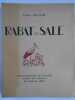
Des rousseurs en marge sur certaines pages, couv. en partie insolée, bonne cond. par ailleurs. - Frais de port : -France 7,15 € -U.E. 9 € -Monde (z B : 14 €) (z C : 24 €)


Les vingt-cinq récits du mauvais génie. Traduits de l’hindi par…
P., Geuthner, 1912. In-12 br., (4)ff., 236 pp.
Couv. lég. passée, ex. en belle condition. - Frais de port : -France 5,7 € -U.E. 8 € -Monde (z B : 12 €) (z C : 22 €)
Etre et savoir. Une ambition de femme au siècle des Lumières.
Rennes, PUR, 2016. In-8 broché, couv. ill. en coul., 300 pp., 2 cartes, qq. fig. et tableaux in t., sources et bibliographie, index.
De la Collection " Histoire " dirigée par Frédéric Chauvaud, Florian Mazel, Cédric Michon et Jacqueline Sainclivier. Comme neuf. - Frais de port : -France 5,7 € -U.E. 8 € -Monde (z B : 12 €) (z C : 22 €)
La Comtesse de Maura.
Paris Dentu 1879 1 Un volume de format petit in 8° de 396 pp.; reliure de l'époque en demi basane cerise; dos à 4 nerfs; titre et décor doré.
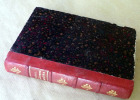
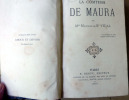
Volume manié mais bien relié ; rousseurs éparses. Texte peu fréquent. Voir photos.
"(FIBIGER, MATHILDE) + (JULIUS CHRISTIAN GERSON) (+) (PETER VANDAL)
Reference : 63447
(1851)
Clara Raphael. Tolv Breve, udgivne af Johan Ludvig Heiberg. Andet Oplag (+) Fem Breve til Clara Raphael fra en Ung Hustru (+) Blik paa det verdenshistoriske Værk ""Clara Raphael"" og den derved fremkaldte Damelitteratur.
Kjøbenhavn, 1851. 8vo. In recent blue paper covered boards with white paper title-label to front board. Annotations in pencil to pasted down front end-paper. Internally with light occassional brownspotting. X, 110, 35, (1), 71 pp.

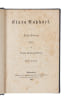
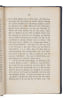
A most interesting sammelband containing the scarce second edition, published the same year as the first, of the first feminist novel in Denmark, the highly controversial and influential ""Clara Raphael"", which is the work that sparked the battle for women's rights in Denmark. Bound together is one of the most important responses to it from the same year (“Fem Breve til Clara Raphael”) as well as Drejer’s (under the pseudonym Vandal) critical commentary. Fibiger’s novel caused enormous controversy. The intellectual elite was in uproar. Within the first year of its publication, ca 25 responses to it were published in newspapers and periodicals and ca 10 brochures and pamphlets pertaining to it. The novel caused vexation in all political camps. The demands for equality between the sexes were scrutinized in all regards, and many politicians began singing the praises of “the woman of the home”. It is in this strain of thought that the famous author of children’s books, Julius Christian Gerson, wrote his significant contribution to the feud, “Five Letters to Clara Raphael from a Young Wife”, also published in 1851. Using the pseudonym “A Young Wife”, he claims, in the voice of this fictitious woman, that Fibiger’s novel had violated the female gender and that the emotions and the striving that are presented as those most pertinent for the woman, are completely foreign to the true woman. He lets his fictitious female author praise herself for being “a young mother who wishes for nothing and wishes to be nothing outside of her circle.” The debate that arose following the publication of ""Clara Raphael"" was very harsh indeed, and the whole public debate was hard on Mathilde Fibiger. Her views were lost on almost all notable men of the period, but she clearly needed to defend herself. ""Clara Raphael"" is the main work of feminism in Denmark and the first Danish governess novel. It founded an entirely new genre of women's novels hitherto unknown in Denmark. The work, which constitutes the break-through of feminism in Denmark, was greatly controversial and immediately caused great furore. It resulted in the so-called Clara Raphael Dispute, in which for instance N.F.S. Grundtvig defended Mathilde Fibiger. Due to the controversial contents of the work, Mathilde Fibiger published it anonymously, and only J.L. Heiberg (1791-1860, perhaps the most famous cultural persona during the Danish Golden Age. He played a more significant role than any other author or thinker during this period) is mentioned on the title-page, as the editor. No publisher had wanted to touch this highly controversial work, and it was only after the appearance of ""Jane Eyre"" that a publishing house dared take it on. As Mary Wollstonecraft had pioneered feminist philosophy with ""A Vindication of the Rights of Women"" from 1792 and argued for education as the means to liberate women, so Mathilde Fibiger surprised her Danish contemporaries with her groundbreaking novel ""Clara Raphael. Twelve Letters"", from 1851, in which she made the connection between the national-democratic movement and the liberation of women. With this book, which deals with the inequality of the sexes and the lack of possibility for women to develop themselves, Mathilde Fibiger became the first notable advocate of the emancipation of women in Denmark. It was not only the political controversy caused by the request of equality that made the book so extremely controversial, it was also the ability of the merely 20 year old author to clearly and precisely state and substantiate the essential problems. When reading the book, it is not difficult to see why it came to have the effect that it did, and why it caused the furor that it did. For instance, Clara Raphael, when despairing at the position of women in society, writes: ""Our position in society is tragic, and why? What right does man have to suppress us? For subjugated we are, despite the chains being gilded."" She understands that casting off these chains will be no easy matter, and that it will not only be a matter of politics, but also of consciousness and mindset: ""When the peasants were granted their freedom, some of them wept, begging for permission to keep things as they had been."" One of the beaming sentences of the novel is Clara's response to her friend when asked what she is actually fighting for: ""I will fight and live for what I understand by the emancipation of women."" Her hope of breaking with the existing patriarchal system of society required national and democratic self-awareness, which for her constituted a promise of freedom. In 1871, Frederik Bajer (1837-1922) and Matilde Bajer (1840-1934) founded the Danish Women's Society, the first women's organisation in Denmark. Mathilde Fibiger was one of the earliest members of the Society. When the Danish Women's Society was established, it did not demand female suffrage. It was not until 1906 that a majority of the members were in favour of making that demand the official policy of the Society. In Denmark, women were not allowed to vote in parochial church council elections until 10+3" not until 1908 were they allowed to vote in parish council and local council elections, and not until 1915 in the Folketing and the Landsting elections. It was not until then that women became fully-fledged citizens in a political sense.
Mathilde Bonaparte (1820-1904), épouse du comte Demidoff, la princesse Mathilde.
Reference : 021891
Lettre autographe signée
Mathilde Bonaparte (1820-1904), épouse du comte Demidoff, la princesse Mathilde. L.A.S. « Mathilde Bonaparte », 7 décembre, 1p in-8. « Monsieur, je trouve ce vilain morceau de plâtre, comme vous le dîtes vous-même, très [mot illisible]. Je lui ai donné une bonne place dans mon atelier et j'espère que vous viendrez l'y voir. Recevez, je vous prie, tous mes sincères remerciements ainsi que l'expression de tous mes sentiments les plus distingués. Mathilde Bonaparte ». [532]

Mathilde Bonaparte (1820-1904), épouse du comte Demidoff, la princesse Mathilde.
Reference : 021899
Lettre autographe signée
Mathilde Bonaparte (1820-1904), épouse du comte Demidoff, la princesse Mathilde. L.A.S. « Mathilde Bonaparte Demidoff », 20 mai, 1p in-8. « Monsieur, Je ne puis que vous confirmer ma dernière lettre par laquelle je renonçais à la location d'Auteuil. Veuillez, Monsieur, agréer l'expression de tous mes sentiments. Mathilde Bonaparte Demidoff ». [532]

Mathilde Bonaparte (1820-1904), épouse du comte Demidoff, la princesse Mathilde.
Reference : 021937
Lettre autographe signée
Mathilde Bonaparte (1820-1904), épouse du comte Demidoff, la princesse Mathilde. L.A.S. « Mathilde Bonaparte Demidoff », mardi 19 mars, 2p in-8. « Monsieur, Je suis très fâchée de n'avoir pas été chez moi quand vous avez pris la peine de passer à ma porte et vous prie de venir me voir jeudi prochain vers 1 heure après midi si cela ne vous dérange pas. Agréez je vous prie Monsieur l'expression de tous mes sentiments les plus distingués. Mathilde Bonaparte Demidoff ». [533]


Mathilde Bonaparte (1820-1904), épouse du comte Demidoff, la princesse Mathilde.
Reference : 021938
Lettre autographe signée
Mathilde Bonaparte (1820-1904), épouse du comte Demidoff, la princesse Mathilde. L.A.S. « Mathilde Bonaparte Demidoff », Pavillon de Breteuil, 10 juin, 1p in-8. « Monsieur, Je suis à la campagne et ne sais quand je pourrai aller en ville pour voir [mots illisibles]. Recevez, je vous prie, tous mes regrets ainsi que l'expression de tous mes sentiments les plus distingués. Mathilde Bonaparte Demidoff ». [533]

Mathilde Bonaparte (1820-1904), épouse du comte Demidoff, la princesse Mathilde.
Reference : 021890
Lettre autographe signée
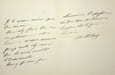
Mathilde Bonaparte (1820-1904), épouse du comte Demidoff, la princesse Mathilde. L.A.S., sd [jeudi], 2p 1/2 in-12. « J'ai beaucoup regretté d'avoir manqué votre aimable visite. J'eusse été charmée d'embrasser la jeune femme et de lui offrir tous mes voeux. Mais ce qui est retardé n'est pas perdu et j'espère que dans quelques semaines je la verrai ainsi que son mari. Veuillez faire tous mes compliments à Mme L. et vous souvenir que je rentre chez moi tous les soirs surtout le dimanche. Recevez, je vous prie Monsieur, l'expression de tous mes sentiments les plus distingués et dévoués. Mathilde ». [532]

Mathilde Bonaparte (1820-1904), épouse du comte Demidoff, la princesse Mathilde.
Reference : 021892
Lettre autographe signée
Mathilde Bonaparte (1820-1904), épouse du comte Demidoff, la princesse Mathilde. L.S., 8 mars 1853, 1p in-8. Belle lettre après le suicide de Charles Camerata (1826-1853) le 4 mars 1853, petit-fils d'Elisa Bonaparte, soeur de Napoléon : « Monsieur, Je suis bien touchée de la part que vous prenez à la perte douloureuse qui vient de frapper au coeur toute notre famille, et je vous remercie sincèrement des détails que vous me donnez sur les sentiments de ce pauvre garçon à mon égard, je n'ai jamais douté de son affection pour moi, comme il aurait dû compter sur mon amitié pour lui. Recevez, Monsieur, l'expression de mes sentiments distingués. Mathilde ». [532]

Mathilde Bonaparte (1820-1904), épouse du comte Demidoff, la princesse Mathilde.
Reference : 021901
Lettre signée
Mathilde Bonaparte (1820-1904), épouse du comte Demidoff, la princesse Mathilde. L.S., Paris, 1er juin 1855, 1p in-4. Au peintre Adolphe Yvon (1817-1893). « Monsieur, Bien que je n'accepte jamais rien, je recevrai avec plaisir les épreuves photographiques de vos dessins du Musée du Havre, que vous avez eu la pensée de m'offrir. C'est une attention dont je vous remercie sincèrement. Recevez, Monsieur, l'assurance de mes sentiments distingués. Mathilde ». [532]

Mathilde Bonaparte (1820-1904), épouse du comte Demidoff, la princesse Mathilde.
Reference : 021902
Lettre autographe signée à Joachim Murat
Mathilde Bonaparte (1820-1904), épouse du comte Demidoff, la princesse Mathilde. L.A.S., 9 mai [1884], 2p in-8. Au général Joachim Murat (1834-1901) au moment du mariage de son fils Joachim Napoléon Murat (1856-1932). « Mon cher Joachim, J'étais avec l'intention d'assister au mariage de ton cher fils. Mais le Nonce ne vient pas chez moi. Je pense que je ne dois pas aller chez lui, même pour un mariage de famille. Je le regrette beaucoup. Je n'en ferai pas moins tous les voeux pieux pour le bonheur de ton fils et de sa femme et te prie de [mots illisibles] le motif de mon [mot illisible]. Je t'embrasse de tout mon coeur, Je suis ta très affectionnée tante Mathilde. Le Nonce est le seul des ambassadeurs qui ne soit jamais venu chez moi sciemment ». [532]


Mathilde Bonaparte (1820-1904), épouse du comte Demidoff, la princesse Mathilde.
Reference : 021903
Lettre autographe signée
Mathilde Bonaparte (1820-1904), épouse du comte Demidoff, la princesse Mathilde. L.A.S., sd [lundi matin], 1p 1/2 in-8. « Chère Madame, Je vous remercie pour le joli [mots illisibles]. Si vous ne savez que faire demain, vous seriez bien aimable, ainsi que le Ministre, de venir diner chez moi tout à fait seuls. Mille amitiés. Mathilde. Nous dinerons à 7 heures ». [532]


Mathilde Bonaparte (1820-1904), épouse du comte Demidoff, la princesse Mathilde.
Reference : 021918
Lettre autographe signée
Mathilde Bonaparte (1820-1904), épouse du comte Demidoff, la princesse Mathilde. L.A.S., mardi 28, 1p in-8. « Mon cher général, Faites le nécessaire pour obtenir cette prolongation de congé. Demandez la au Maréchal de ma part. J'y tiens beaucoup. Votre bien dévouée. Mathilde ». [533]

Mathilde Bonaparte (1820-1904), épouse du comte Demidoff, la princesse Mathilde.
Reference : 021885
Carte autographe signée
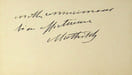
Mathilde Bonaparte (1820-1904), épouse du comte Demidoff, la princesse Mathilde. C.A.S., sd, 2 lignes. « Mille remerciements bien affectueux. Mathilde ». [531]
Mathilde Bonaparte (1820-1904), épouse du comte Demidoff, la princesse Mathilde.
Reference : 021887
Lettre autographe signée au prince Joachim Murat
Mathilde Bonaparte (1820-1904), épouse du comte Demidoff, la princesse Mathilde. L.A.S., 1er octobre [1894], 1p in-8. Au général Joachim Murat (1834-1901) peu avant son mariage avec Lydia Hervey. « Mon cher Joachim, Je te souhaite tout le bonheur possible et cela de grand coeur. Je me souviens de Mademoiselle Hervé [sic] comme d'une charmante personne que je serais charmée de revoir. Ta très affectionnée tante Mathilde ». [531]

Mathilde Bonaparte (1820-1904), épouse du comte Demidoff, la princesse Mathilde.
Reference : 021888
Lettre autographe signée à la comtesse Vandal
Mathilde Bonaparte (1820-1904), épouse du comte Demidoff, la princesse Mathilde. L.A.S., 5 juillet, 1p in-8. A la comtesse Vandal, Berthe Heeckeren d'Anthès (1839-1908), fille du fameux baron d'Anthès qui tua Pouchkine, au moment de la mort de sa soeur, Léonie Charlotte (1840-1888), mort le 30 juin 1888. « Chère Madame, J'avais lu dans le journal la mort de votre pauvre soeur et je pensais à vous dire toute la part que je prends à votre chagrin, malgré l'état si triste où elle était depuis si longtemps. Veuillez parler de moi à votre père et croire à mon sincère attachement. Mathilde ». [531]
Clara Raphael. Tolv Breve, udgivne af Johan Ludvig Heiberg. - [FOUNDING FEMINISM IN DENMARK]
Kjøbenhavn [Copenhagen], 1851. Bound in a lovely, elegant later (ca 1920) brown half calf with gilt spine and blindtamped borders to boards. Some brownspotting throughout. Numerous pencil-annotations. Fly-leaf with old owner's name. Last leaf repaired at inner hinge, no loss.
![Clara Raphael. Tolv Breve, udgivne af Johan Ludvig Heiberg. - [FOUNDING FEMINISM IN DENMARK]. "[FIBIGER, MATHILDE].](https://static.livre-rare-book.com/pictures/LLX/60744_1_thumb.jpg)
![Clara Raphael. Tolv Breve, udgivne af Johan Ludvig Heiberg. - [FOUNDING FEMINISM IN DENMARK]. "[FIBIGER, MATHILDE].](https://static.livre-rare-book.com/pictures/LLX/60744_2_thumb.jpg)
![Clara Raphael. Tolv Breve, udgivne af Johan Ludvig Heiberg. - [FOUNDING FEMINISM IN DENMARK]. "[FIBIGER, MATHILDE].](https://static.livre-rare-book.com/pictures/LLX/60744_3_thumb.jpg)
Scarce first edition of the first feminist novel in Denmark, the highly controversial and influential ""Clara Raphael"", which is the work that sparked the battle for women's rights in Denmark. The work is is main work of feminism in Denmark and the first Danish governess novel. It founded an entirely new genre of women's novels hitherto unknown in Denmark. The work, which constitutes the break-through of feminism in Denmark, was greatly controversial and immediately caused great furore. It resulted in the so-called Clara Raphael Dispute, in which for instance N.F.S. Grundtvig defended Mathilde Fibiger. Due to the controversial contents of the work, Mathilde Fibiger published it anonymously, and only J.L. Heiberg (1791-1860, perhaps the most famous cultural persona during the Danish Golden Age. He played a more significant role than any other author or thinker during this period) is mentioned on the title-page, as the editor. No publisher had wanted to touch this highly controversial work, and it was only after the appearance of ""Jane Eyre"" that a publishing house dared take it on. As Mary Wollstonecraft had pioneered feminist philosophy with ""A Vindication of the Rights of Women"" from 1792 and argued for education as the means to liberate women, so Mathilde Fibiger surprised her Danish contemporaries with her groundbreaking novel ""Clara Raphael. Twelve Letters"", from 1851, in which she made the connection between the national-democratic movement and the liberation of women. With this book, which deals with the inequality of the sexes and the lack of possibility for women to develop themselves, Mathilde Fibiger became the first notable advocate of the emancipation of women in Denmark. It was not only the political controversy caused by the request of equality that made the book so extremely controversial, it was also the ability of the merely 20 year old author to clearly and precisely state and substantiate the essential problems. When reading the book, it is not difficult to see why it came to have the effect that it did, and why it caused the furor that it did. For instance, Clara Raphael, when despairing at the position of women in society, writes: ""Our position in society is tragic, and why? What right does man have to suppress us? For subjugated we are, despite the chains being gilded."" She understands that casting off these chains will be no easy matter, and that it will not only be a matter of politics, but also of consciousness and mindset: ""When the peasants were granted their freedom, some of them wept, begging for permission to keep things as they had been."" One of the beaming sentences of the novel is Clara's response to her friend when asked what she is actually fighting for: ""I will fight and live for what I understand by the emancipation of women.""Her hope of breaking with the existing patriarchal system of society required national and democratic self-awareness, which for her constituted a promise of freedom. In 1871, Frederik Bajer (1837-1922) and Matilde Bajer (1840-1934) founded the Danish Women's Society, the first women's organisation in Denmark. Mathilde Fibiger was one of the earliest members of the Society. When the Danish Women's Society was established, it did not demand female suffrage. It was not until 1906 that a majority of the members were in favour of making that demand the official policy of the Society. In Denmark, women were not allowed to vote in parochial church council elections until 10+3" not until 1908 were they allowed to vote in parish council and local council elections, and not until 1915 in the Folketing and the Landsting elections. It was not until then that women became fully-fledged citizens in a political sense.
Mathilde Bonaparte (1820-1904), épouse du comte Demidoff, la princesse Mathilde.
Reference : 021893
Lettre signée
Mathilde Bonaparte (1820-1904), épouse du comte Demidoff, la princesse Mathilde. L.S., Paris, 20 août 1864, 1p in-4. Elle se réjouit du mariage de mademoiselle de Corneillan. Il s'agit de Clémence de Vernède de Corneillan qui épouse, ce 20 août 1864, Charles Pagès de Pourcarès. Clémence était une spécialiste de la sériciculture - l'élevage des vers à soie - et avait même déposé en 1861 un brevet dans ce domaine. [532]

Mathilde Bonaparte (1820-1904), épouse du comte Demidoff, la princesse Mathilde.
Reference : 021900
Lettre autographe
Mathilde Bonaparte (1820-1904), épouse du comte Demidoff, la princesse Mathilde. L.A., sd, 1p in-8. A l'explorateur Eugène Duflot de Mofras (1810-1884). Invitation imprimée à trous, remplis par la princesse, pour une invitation à dîner. Petit cachet de cire avec un M. [532]

Mathilde Bonaparte (1820-1904), épouse du comte Demidoff, la princesse Mathilde.
Reference : 021886
Lettre autographe signée à Ninette Vimercati
Mathilde Bonaparte (1820-1904), épouse du comte Demidoff, la princesse Mathilde. L.A.S., sd, 1p in-12. A son amie Emilie Vimercati dite Ninette (1855-1920) : « Ma chère Ninette, Donne-moi l'adresse du lieutenant [passage illisible] ? J'espère que tu es mieux et je t'embrasse. M ». [531]

Mathilde Bonaparte (1820-1904), épouse du comte Demidoff, la princesse Mathilde.
Reference : 021889
Carte autographe
Mathilde Bonaparte (1820-1904), épouse du comte Demidoff, la princesse Mathilde. C.A., sd, 3 lignes. « Mille et mille remerciements avec l'expression de mon sincère attachement ». [531]
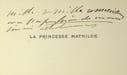
Mathilde Bonaparte (1820-1904), épouse du comte Demidoff, la princesse Mathilde.
Reference : 021904
Carte autographe
Mathilde Bonaparte (1820-1904), épouse du comte Demidoff, la princesse Mathilde. C.A., sd, 3 lignes. « Mille remerciements. Venez me voir le soir si vous le pouvez ». [532]
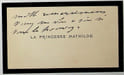
Mathilde Bonaparte (1820-1904), épouse du comte Demidoff, la princesse Mathilde.
Reference : 021905
Carte autographe
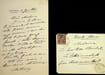
Mathilde Bonaparte (1820-1904), épouse du comte Demidoff, la princesse Mathilde. C.A., sd, 2 lignes. « Tous mes plus sincères remerciements ». On joint une enveloppe autographe, datée du 22 mars 1869, adressée à Charles-Edmond Chojecki (1822-1899), provenant peut-être d'un autre courrier. [532]


