 Write to the booksellers
35 books for « claudianus »Edit
-
Century
17th (7)
18th (5)
19th (2)
-
Topics
Aesop (1)
Antwerp (1)
Architecture (1)
Books from the xviiith (1)
Colbert (1)
Elzevier (1)
Greek (6)
History (3)
Latin (10)
Literature (4)
Mythology (1)
Poetry (4)
Roman empire (1)
Rome (2)
Sciences (2)
-
Countries
Belgium (4)
Denmark (1)
France (19)
Netherlands (9)
Switzerland (2)
-
Syndicate
ILAB (13)
NVVA (1)
SLACES (1)
SLAM (9)
Claudianus' Verzamelde gedichten
, Athenaeum-Polak & Van Gennep, 2008 Linnen band met stofomslag, 339 pagina's, 22 x 15 cm, Nederlandstalige tekst. *mooie staat . ISBN 9789025363741.
Het jaar 400. Itali wordt verscheurd door invasies van de Goten en politiek krakeel. Maar Claudius Claudianus schrijft glorieuze gedichten waarin Rome en de keizers worden bezongen als onoverwinnelijke grootheden. M. d Hane-Scheltema, bekend van onder meer de Metamorphosen van Ovidius, vertaalde vrijwel al zijn po zie voor het eerst in het Nederlands, waarmee een groot dichter aan onze taal is toegevoegd. De barbaren lijken in de gedichten voorgoed te zijn verdreven, terwijl wij weten dat ze binnen enkele jaren onder leiding van Alarik midden op het Romeinse Forum zullen staan. De keizers waren christenen, maar hofdichter Claudianus bezingt hen (en vooral hun generaal Stilicho) in een heidens decor van Olympische goden. Kortom: Claudianus werk geeft een wereld van tegenstellingen te zien, die historisch gezien misschien wat eenzijdig is, maar juist daarom ook zeer interessant. Bovendien is hij een echt goede, klassieke dichter. We lezen, in vele mooie verzen, een schitterend epos over de mythische roof van Proserpina en een even felle als geestige reactie op allerlei wantoestanden, corrupte bestuurders en opstandige bondgenoten. Claudianus geldt terecht als de laatste dichter-van-klasse in het klassieke Latijn. Hijzelf is onsterfelijk geworden in Hella S. Haasses Een nieuwer testament. Zijn werk is dat nu ook, in deze nieuwe, hoogstaande vertaling.
Claudii Claudiani Opera, Quae Exstant, Omnia Ad Membranarum Veterum Fidem Castigata.
Amstelaedami / Amsterdam Ex Officina Schouteniana / [Petrus, Schouten] 1760 Eerste editie. De werken van Claudianus, met syllogismen en aantekeningen. Hedendaags blind gestempeld wit leer met titels in zwarte inkt op de rug. Het leer is wat donkerder geworden, met een gerepareerde scheur in de bovenrand van de rug. Inwendig schoon en netjes, met een beetje markering / donkerder geworden, vooral aan de randen. Al met al een heel mooi exemplaar. 27cm x 21.5cm. [14], xxxii, [2], 1112 pagina's. Claudius Claudianus, beter bekend als Claudianus, was een Latijnse dichter die leefde van ongeveer 370 tot 404 AD. Hij werd geboren in Alexandrië, Egypte, en sprak Grieks met een sterke kennis van de Latijnse literatuur. Hij staat bekend als een van de laatste grote dichters van het heidense Rome en diende als hofdichter tijdens het bewind van keizer Honorius in Milaan, nauw verbonden met de generaal Stilicho.
First edition. The works of Claudian, with syllogisms and notes. Contemporary blind stamped white leather with titles in black ink to the spine. Some darkening / marking to the leather, with a repaired split to the top edge of the spine. Internally clean and tidy, with a little marking / darkening, particularly to the edges. Overall a very nice copy. 27cm x 21.5cm. [14], xxxii, [2], 1112 pages. Claudius Claudianus, commonly known as Claudian, was a Latin poet who lived approximately from 370 to 404 AD. Born in Alexandria, Egypt, he was a Greek speaker with a strong knowledge of Latin literature. He is renowned as one of the last major poets of pagan Rome and served as a court poet during the reign of Emperor Honorius in Milan, closely associated with the general Stilicho. .
Cl. Claudiani Principum, Heroumque Poetae praegloriosissimi, Quae exstant. Caspar Barthius ope XVII manuscriptorum exemplarium restituit; commentario multo locupletiore, grammatico, critico, philologo, historico, philosophico, politicoque, ita illustravit, ut Auctor pretiosissimus omni aetati, scholasticae, academicae, aulicae, politicaeque, esse debeat ex commendato commendatissimus.
Frankfurt (Francofurti), Apud Joannem Naumannum, Bibliop. Hamburgensem, 1650.
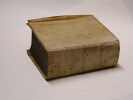
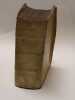
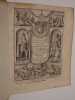
4to. (LXXVI, including title & frontispiece),111,(1 blank),1371,(1 blank),(31 corrigenda),(1 blank) p. Vellum 21 cm (Ref: VD17 3:006469N; Schweiger 2,283; Dibdin 1,470: 'Barthius commentary is not only superior to every work which preceded it, but has never been surpassed by any similar production'; Moss 1,376/7: 'rare, and held in considerable estimation'; Brunet 2,88; Ebert 4756; Graesse 2,194; Fabricius/Ernesti 3,201) (Details: 5 thongs laced through both joints. Frontispiece by A. Aubry, depicting the Roman emperor Theodosius the Great and his 'Magister Militum' Stilicho, who guards 2 little boys, Honorius and Arcadius. Title in red and black. Woodcut printer's mark on the title, motto: 'Superata tellus sidera domat'. Woodcut initials and headpieces) (Condition: Vellum soiled, and loosening from fore edge of both boards. Upper board slightly curved. Front endpapers worn. Old inscription and name on the front flyleaf. Name below the frontispiece. Name and small stamp on the title. Stain in the upper margin of frontispiece and title leaf) (Note: 1650 was a lucky year for the last important Roman poet Claudius Claudianus (ca. 400). In the same year as Barthius the Dutch scholar Nicolaas Heinsius published an edition of the works of Claudian. Claudianus 'war ein sehr fruchtbarer, temperamentvoller Dichter und bietet reichen historischen Stoff in rhetorischem Stil'. (Buchwald, Tusculum-Lexikon, 3rd ed. p. 171/2) As 'tribunus et notarius' he acted as court poet for the emperor Theodosius, his general Stilicho, and the emperor's sons Honorius and Arcadius. In 400 he was honoured with a bronze statue on the Forum Trajanum in Rome. His work was widely read in the Middle Ages. The humanists also placed him on the center stage. In the beginning of the 20th century philologist lost interest, but since the rise of interest in late antiquity in the sixties, he is again recognized as one of the great Roman poets. (NP., s.v. Claudianus). Caspar von Barth, or Barthius, 1587-1658, was a child prodigy. He read a lot during his lifetime, but seems to have known little. His specialty seems to have been hoarding material. In his youth, in 1612, he published his first edition of Claudian. He republished it, with many corrections and additions in 1650. The commentary is, says Schweiger, 'überladen'. The very weight of this book, almost 2 kilo's, proves that he is right. For some Barthius was a charlatan, for others a 'divinum ingenium'. Barthius 'war gelehrt, hatte viel gelesen und so auch in seinen Schriften ausgespeichert, aber Ordnung, Klarheit und Schärfe lässt sich vermissen', is the final judgment in ADB. (Allgemeine Deutsche Biographie 2, p. 101/2) This edition shows however enough glimpses of genius to deserve the praise most bibliographers assigned to him) (Provenance: On the front flyleaf the name of Lennart Håkanson, professor of Latin Literature at the Univ. of Uppsala, 1980-1987. 2 other names seem to point to Denmark. Under the frontispiece in old ink: 'Axelii Julii Iv. F. Nobilis Dani Dno de Wolstorp etc. Anno 1657'. We found on the internet the following provenance, dated 1662, of one 'Axelius Julius Ivari Filius Dus de Wolstorp [?] hujus Libri possessor [?]', in an edition of 'De anulis antiquis' of 1654. This makes: 'Axelii Julii Ivari Filii Nobilis Dani Domino de Wolstorp'. The 'Domino' is awkward. In faint ink in the right margin of the frontispiece and on the title: 'J. Mundelstrup'. We found the following title, a poem in Latin and Danish, on the internet of one J. Mundelstrup: 'a Augustiss. Friderico Qvarto, Daniæ ... regi, gloriosissimam pacem regnis Ao. 1720 vindicatam gratulabatur'. A small round stamp on in left lower corner of the title: 'A.St.B.') (Collation: a4 (a2 plus (2)a4; meaning that between leaf a2 and a3 has been inserted a second gathering of 4 leaves signed a, containing an afterwards composed dedication), b-e4 (minus the blank leaf e4), f-h4, i2; A-O4 (leaf O4 verso blank); A-8K4, 8L2; 8M-8P4 (leaf 8P4 verso blank)) (Photographs on request) (Heavy book, may require extra shipping costs)
Cl. Claudiani Quae exstant. Varietate lectionis et perpetua adnotatione illustrata a Io. Matthia Gesnero. Accedit index uberrimus.
Leipzig (Lipsiae), In officina Fritschia, 1759.
8vo. 2 volumes: (XIV) p., p. 1-400; (2),401-720; 222 (index),(2 blank). Vellum. 20 cm (Ref: Neue Pauly, Suppl. 2, p. 178: 'enthält (...) nützlichen lat. Komm.'; Schweiger 2,184: 'Im wesentlichen ist der Text der Ausg. von Heinsius (1650) wiederhohlt, aber auch dessen spätere Emendationen u. ältere Ausgg. zu Rathe gezogen. Die kurzen Anmerkgg. erläutern trefflich den Sinn, die Sprache u. die Sachen'; Dibdin 1,471/72: 'A work so recommended (...) will not make the student hesitate long about the necessity of procuring it.'; Moss 1,377: 'undoubtedly a very excellent and valuable edition'.; Ebert 4759; Brunet 2,88; Graesse 2,194; Not yet in VD18; Fabricius/Ernesti 3,202) (Details: 2 thongs laced through the joints. Back ruled gilt, and with a black shield in the 'second' and 'fourth compartment'. Endpapers and edges marbled) (Condition: Vellum age-tanned and slightly soiled. The edges of the shields on the back damaged. The boards of volume 1 are slightly outstanding, volume 2 more so. Foxed, paper somewhat browning) (Note: The Roman poet Claudius Claudianus, ca. 400 AD, 'war ein sehr fruchtbarer, temperamentvoller Dichter und bietet reichen historischen Stoff in rhetorischem Stil'. (Buchwald, Tusculum-Lexikon, 3rd ed. p. 171/172) As 'tribunus et notarius' he acted as court poet, eulogizing the emperor Theodosius, his general Stilicho, and the emperor's sons Honorius and Arcadius. In 400 he was honoured with a bronze statue on the Forum Trajanum in Rome, and a rich bride selected for him by Stilicho's wife. He is the last representative of the classical tradition of Latin poetry. 'In diction and technique he bears comparison with the best Silver Age work, but his considerable gifts of invective, description and epigram are offsett by a deplorable tendency of over-elaboration. His writings are a useful (...) historical source for his period'. (OCD 2nd ed. p. 245) Claudianus died ca. 404. His work was widely read in the Middle Ages. The humanists also placed him on the center stage. In the beginning of the 20th century philologist lost interest, but since the rise of interest in late antiquity in the sixties, he is again recognized as one of the great Roman poets. This edition of Claudian of the German classical scholar Johann Matthias Gesner, 1691-1761, gives evidence of sound scholarship, but, just like his many other editions of ancient authors of Gesner, the edition does never break new ground. It just is a testimony of solid current knowledge. Textual critiscism was not Gesner's strongest point. His notes are excellent and learned, well calculated to illustrate the poet. The edition contains erudite prolegomena, a literary history of Claudianus, 'variae lectiones', and a useful account of editions. Gesner earned lasting fame with his epoch-making lexicographic work, especially with his revised edition of the 'Dictionarum, seu Latinae linguae thesaurus' of Robertus Stephanus (London 1734). Wilamowitz calls Gesner the 'Praeceptor Germaniae', 'denn er hat die Leipziger Thomasschule zu einer Musteranstalt gemacht, (...) und ihm bleibt der Ruhm, das erste philologisches Seminar gegrundet zu haben'. (U. von Wilamowitz-Moellendorff, 'Geschichte der klassichen Philologie', Leipzig/Berlin 1921, p. 42) (Collation: a-c8 (chi1 'addenda emendanda' after leaf a1); A-Z8, Aa-Bb8, chi1 (title second volume), Cc-Zz8, Aaa-Nnn8 (leaf Nnn8 blank)) (Photographs on request)
CL : CLAUDIANUS. De Raptu Proserpinae. - In Rufinum - In Eutropium - De Bello Gildonico - De Bello Getico - De Tertio Consultatu Honorii Augusti Panegyris - De Consultatu Mallii Theodori Panegyris - De Laudibus Stiliconis - De Nuptiis Honorii et Mariae - Gigantomachia - Epigrammata.
Amstelodami, Apud Joann Jansonium, 1628, 1 volume in-18 de 105x55x10 mm environ, 2ff. blancs, 240 pages, (1) f.blanc, plein veau cognac, dos à nerfs portan titre doré, orné de caissons à fleurons dorés, encadrement des plats d'un double filet doré, gardes marbrées de couleurs, tranches finement mouchetées de rouge. Manque la partie mobile des gardes de couleurs, restauration discrète sur le cuir, sinon bon état. Texte en latin
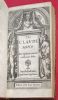
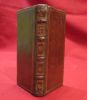
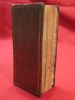
Claudien, poète de cour et mondain, a écrit en latin et parfois en grec. Avec Prudence, il l'un des derniers grands poètes latins de l'Empire romain. Il est l'auteur de poèmes de circonstances, destinés à glorifier Stilicon et l'Empereur Honorius : panégyriques, poèmes nuptiaux (épithalames), célébrations de victoires militaires, invectives et aussi Epopées mythologiques : Le Rapt de Proserpine, la Gigantomachie (Combats de Géants). Merci de nous contacter à l'avance si vous souhaitez consulter une référence au sein de notre librairie.
Claudius Claudianus. Verzamelde gedichten. Vertaald en toegelicht door M. d'Hane-Scheltema.
Amsterdam, Athenaeum-Polak & Van Gennep, 2008.
339 p. Cloth 22 cm (Including a very slightly worn dustjacket with 'buikbandje')
The use of images by Claudius Claudianus.
The Hague, Paris, Mouton, 1969.
140 p. Wrappers. 21 cm
Cl. Claudiani Quae exstant. Nic. Heinsius Dan. Fil. recensuit ac notas addidit, post primam editionem altera fere parte nunc auctiores. Accedunt selecta Variorum commentaria, accurante C.S.M.D.
Amsterdam (Amstelodami), Ex Officina Elzeviriana, 1665.
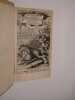
8vo. (XXVIII),917,(15 index) p. Vellum 20 cm (Ref: Schweiger 2,283/84; Dibdin 1,471: 'in fact the best Variorum edition'; Moss 1,377: 'a very correct and valuable edition' and 'This is one of the very scarcest of the Variorum editions'; Graesse 2,194; Ebert 4757; Brunet 2,88; Ernesti, Bibl. Lat. 1774, 3,201: 'sed optima est ed. a. 1665'; Willems 1350: 'fort bien imprimé'; Rahir 1400; Berghman 2036; Spoelder, Enkhuizen 1, p. 554) (Details: Prize copy, prize gone. 6 thongs laced through both joints. Gilt coat of arms of Enkhuizen within blind ruled borders on both boards. Engraved title depicting the rape of Proserpina, and the battle of the Giants against the gods. The notes are printed on the lower half of the pages, below the text) (Condition: Vellum varnished, the bad result is a gleaming binding with a few brownish strokes. Gilt fading. 4 thongs on the front joint broken. All 4 ties gone. Small bookplate on the front pastedown. Name on front flyleaf) (Note: This is the second edition of the works of the Roman poet Claudius Claudianus produced by Nicolaas Heinsius, 1620-1681, who was the only son of Daniel Heinsius. It was first published in 1650. Nicolaas never held any academic post. Let us see what Sandys tells about this genius: 'His practice in versification, his wide reading in classical and post-classical Latin, and his knowledge of Greek literature made him an accomplished scholar. As a textual critic he had acquired an extensive knowledge of various readings by his study of MSS'. And: 'In making his selection from the vast mass of variants, he was guided by a fine taste and a sound judgement acquired by long experience'. And: 'His editions of the Latin poets laid the foundation of the textual criticism of those authors, and he has thus obtained the title of 'sopitator poetarum Latinorum.' (Sandys 2,323/327). Heinsius consulted, he says in the praefatio, for his first edition some 28 manuscripts, 'viginti enim & octo fere ad manum fuerunt, ut vides'. Among these were 2 from the University Library of Leiden, and 2 from the Bodleian. Also 2 that were in the possession of the successor of Plantin, the publisher Balthasar Moretus, manuscripts that were originally used for the Plantin edition of Claudian by Pulman. (Antwerp, 1571) Heinsius rebukes Pulman for having neglected one of these, which he calls 'insignis' and 'probus'. Pulman used it sluggishly, 'oscitanter'. Heinsius consulted also 3 manuscripts which the French librarian and collector of manuscripts Alexander Petavius (Petau) had send him, one of the Royal Library, one of his own, and one owned by J.A. de Thou (Thuanus). After his edition of 1650 Heinsius continued to consult during his diplomatic travels through Europe 10 'bis quini' other excellent manuscripts containing texts of Claudian. Heinsius gives in the new praefatio to this second edition, written 14 years after the first edition, 'ante annos hosce plus minus quatuordenos' a dazzling account of the books and manuscripts he consulted for the new edition. We also get a glimpse of the huge network of scholarly friends of which Heisius was a member. This second edition was published, so the title says, by Cornelis Schrevelius, who took his doctoral degree in Paris as a Doctor of Medicine in 1627. Hence C.S.M.D., that is Cornelis Schrevelius Medicus Doctor. He taught classics at the Schola Latina at Leiden, where he had been raised himself. In 1642 he succeeded his father, Theodorus Schrevelius, as the rector (Moderator) of the school. He died in 1664, a few days after having completed this edition of Claudian. He raised at least 11 kids, and fell victim to the plague. (A.M. Coebergh van den Braak, Meer dan zes eeuwen Leids Gymnasium, Leiden, 1988, p. 47/55); includes also his portrait). The involvement of Schrevelius in publishing a new edition of Claudian was limited to the necessary, but ungrateful task of the beast of burden. He did, so the 'typographus' (who must be Daniel Elzevier) tells us in his short address to the reader, all that is necessary for a better understanding of Claudian, producing excerpts from the commentaries and editions of the best scholars) (Provenance: An engraved armorial bookplate on upper pastedown of one 'Joshua Ruddock': a crown, with 3 strawberry leaves on it, and a 'pearl' in the center of the leaves, on top, an eagle with spread wings. On the front flyleaf the name of Lennart Håkanson, professor of Latin Literature at the Univ. of Uppsala, 1980-1987) (Collation: *8, 2*6, A-3M8 3N2) (Photographs on request)
CL. CLAUDIANUS EX OPTIMORUM CODICUM FIDE
Bassani Ex typographia Jo. Antonii Remondini 1722 1 vol. in-12 ( 14 x 8 cm ) ( poids = 150 g ) 264 pp. ( dont t. ) . En latin . Contient : C. Claudiani vita ex Petro Crinito , Ex Volaterrano ; De Claudiano ejusque scriptis testimonia ; Cl. Claudiani operum index ; De raptu Proserpinae ; In Rufinum ; In Eutropium ; De bello Gildonico ; De bello Getico vel Pollentiaco vel De victoria Stiliconis contra Alaricum ; De tertio consulatu Honorii Augusti Panegyris ; De quarto consulatu Honorii Augusti Panegyris ; De sexto consulatu Honorii Augusti Panegyris ; De consulatu Mallii Theodori Panegyris ; De Probini et Olybrii fratrum consulatu ; De laudibus Stiliconis ; Laus Serenae reginae ; De nuptiis Honorii et Mariae ; In nuptias Honorii Augusti et Mariae ; Epithalamium Palladii & Celerinae ; Gigantomachia ; Epigrammata ; Anonymi Poetae laudes Herculis . Au titre , marque typographique de Giovanni Antonio Remondini ; une lettrine , culs-de-lampe . Plein vélin de l' époque . Dos lisse , nom de l' auteur à l' encre . Bon état . Petit travail de vers à la reliure . ( Collat. complet )
L' oeuvre du poète latin CLAUDIEN ( 370 - 404 ) , l' un des derniers représentants de la littérature païenne , protégé par l' empereur Honorius et le régent Stilicon , imprimée par Giovanni Antonio Remondini ( 1700 -1769 ) , de la célèbre dynastie de libraires-imprimeurs de Bassano del Grappa très actifs en Vénétie pendant deux siècles .
Cl. Claudianus, Theod. Pulmanni Craneburgii Diligentia, & side summa, è vetustis codicibus restitutus [relié à la suite :]Aviani Aesopicarum fabularum [relié à la suite :] Ad Cl. Claudiani V. C. Opera
Antverpiae [Anvers / Antwerpen], ex Officina plantiniana / apud Joannem Moretum, 1607 - Antverpiae, ex Officina plantiniana / apud Joannem Moretum, 1607 - Antverpiae, ex Officina plantiniana / apud Joannem Moretum, 1607. 3 ouvrages reliés en un volume au format in-16 (133 x 92 mm) de 351 pp. ; 29 pp. et 1 f. n.fol. ; 90 pp. et 1 f. n.fol. Reliure de l'époque de plein veau glacé blond, double filet doré encadrant les plats, dos à nerfs orné de filets gras à froid, roulette dorée sur les nerfs, doubles caissons d'encadrement dorés, fleurons dorés, filet en pointillés dorés en tête et queue, titre doré, tranches rouges.
![Cl. Claudianus, Theod. Pulmanni Craneburgii Diligentia, & side summa, è vetustis codicibus restitutus [relié à la suite :]Aviani Aesopicarum ...](https://static.livre-rare-book.com/pictures/BLS/27184_1_thumb.jpg)
Réunion - en un volume - de trois ouvrages rares sortis des presses de Christophe Plantin et Jean Moretus. L'Officina Plantiniana est considérée comme l'entreprise d'édition et d'imprimerie la plus importante qui ait jamais été établie en Belgique. Vignette au ''Compas d'or'' en page de titre, troisième et dernière marque qu'utilisa l'imprimeur. Lequel - à l’instar de Robert Estienne - exposait devant sa porte ses épreuves en promettant une récompense à ceux qui y découvriraient quelque faute... ''En raison de ses origines alexandrines, Claudien assimile le goût pour le « baroque » de son temps, représenté, par exemple, par le poète Nonnos de Panopolis. Poète de cour et mondain, c'était aussi un païen convaincu. Avec Prudence, il est l'un des derniers grands poètes latins de l'Empire romain. Les deux ouvrages de Claudien sont ici accompagnés des notes estimées de Martin Antonio Del Rio. Graesse II, Trésor de livres rares et précieux, p. 193 - Brunet II, Manuel du libraire et de l'amateur de livres, 88 (pour une édition de 1602). Angles émoussés. Petites altérations superficielles éparses affectant par ailleurs la reliure. Papier oxydé présentant en outre de claires rousseurs. Infime manque en marge inférieure d'un feuillet. Nonobstant, ensemble en belle condition.

Proserpine, poème de Claudian, traduit en vers héroïques & achevé dédié à Monseigneur le Comte de Servien, Ministre d'Estat, & sur-Intendant des Finances par Monsieur le Président Nicole.
1658 Charles de Sercy, Paris, 1658. Un volume in-12 relié plein vélin ivoire, dos lisse, titre manuscrit, [1f.] blanc, [10ff.] dont page de titre, 86 pages dont 4 planches de Chauveau à pleine page, [1f.], [1f.] blanc. Manque frontispice, bel exemplaire néanmoins.
La librairie est ouverte du mardi au samedi de 9h30 à 12h30 et de 13h30 à 19h00. Commandes par courriel ou téléphone. Envoi rapide, emballage soigné.
Cl. Claudianus Theod. Pulmanni Craneburgii diligentia, & fide summa, è vetustis codicibus restitutus.
rouen Beauvais 1611 in-16 plein-VELIN un volume, reliure janséniste d'époque en plein vélin ivoire parcheminé à fermeture à cordonnet (sans les cordonnets) (jansenist's binding full vellum) in-16 (8,5 x 12,4 cm), dos long (spine without raised band), titre manuscrit à l'encre brune en haut du dos (handwritten title on the spine), plats muets (cover without text), tranches lisses (smooth edges), Texte en Latin, sans illustration (no illustration) excepté la marque de l'imprimeur gravée sur bois (engraving wood) en noir sur la page de titre + bandeaux et lettrines gravées suir bois en noir, 384 pages, 1611 Rothomagi apud Romanum de Beauvais Editeur,
RARE...... en bon état ( good condition). bon état
Opera. Quorum catalogum, post eius vitam ex Petro Crinito ac Voterrano, reperies.
Lyon, Thibault Payen, 1551. 1 vol. petit in-8°, basane brune marbrée. Reliure du début du XIXe siècle, dos accidenté, coins émoussés, coiffe sup. arrachée. Ex-libris manuscrit de François Barbier (1651) sur le titre. Impression en caractères italiques, lettrines ornées, 344 pp. Signatures : [a-x]8 y4. Plusieurs passages soulignés et quelques annotations marginales anciennes à l'encre brune, larges mouillures sur quelques feuillets.
Edition scolaire des oeuvres complètes de Claudien, précédée de sa vie par Pietro Crinito. Baudrier IV, 248.
Opera. Serio emendata, neque non aucter, ex fide vet[ustissimi] codicum qui olim in Bibliotheca Cuiaciana. Cum annotationibus perpetuis ST Claveii. Paris, Robert Fouet, 1602. [A la suite] : CLAVIERE (Etienne de) : Coronis Miscella ad Claudianum.
Paris, veuve de Guillaume Chaudière, 1602. 2 parties en 1 vol. in-4°, parchemin souple à rabats, titre écrit à la plume au dos (encre très pâle). Reliure de l'époque, traces de lacets. Bon exemplaire. cachets de la bibliothèque d'Orléans, avec cachet d'annulation ("double vendu"). (6) ff., 270 ff.; 75 ff., (1) f. blanc, (8) ff. d'index. Signatures : at4 et2 [A-Z]4 [Aa-Zz]4 [Aaa-Xxx]4 Yyy2; [AAAa-XXXx]4.|D41]
Première édition des oeuvres du poète latin Claudien avec le commentaire estimé d'Etienne de Clavière (Bourges 1550 - Paris 1622). "Rare édition" (Graesse). Brunet I, 88; Graesse II, 193.
Opera quae exant, interpretatione et annotationibus illustravit Gulielmus pyrrho, in Academi Cadomensi Doctor Eloquentiae, Consiliariusque & Professor Regius: Jussu christanissimi Regis, in usum serenissimi Delphini.
Parisiis apud Fredericum Leon 1677 In-4, maroquin rouge, grandes armes pousses or au centre des plats orns d'un double encadrement de trois filets dors avec fleurons aux angles, dos nerfs orn petits fers pousss or, roulette or sur les coupes; doublures et gardes de papier marbr, tranches dores (reliure ancienne).Ce volume de la collection Ad usum Delphini n'est pas commun. Il est orn d'un beau frontispice grav sur acier par Edelinck, d'une vignette de titre et de nombreux fleurons in texte galement gravs sur acier. Exemplaire aux armes de Jean-Baptiste Colbert, marquis de Seignelay, de Chteauneuf-sur-Cher et de Blainville, baron de Seaux, de Linires et autres lieux, surintendant des finances de 1661 1664, prsident de la compagnie des Indes en 1665, commandeur et grand trsorier des ordres de Louis XIV de 1665 1675. Ardent bibliophile, Colbert avait form, avec l'aide du savant Carcavi, une bibliothque clbre dans toute l'Europe. Prcieux exemplaire cit par Brunet (Manuel du libraire, tome II, col.88) et par Olivier (Manuel de l'amateur de reliures armories franaises, pl. 1296, fer n4 de grandes dimensions). Olivier prcise que cet exemplaire a fait partie de la vente des 20-23 avril 1925 (Ch. Bosse et F. Lefranois experts, n125). Exemplaire en parfait tat de conservation, avec une signature autographe de Seignelai, 1692 appose discrtement sur la page de titre.
Oeuvres complètes, traduites en françois pour la première fois, avec des notes mythologiques, historiques et le texte latin. [Trad. Guillaume Souquet de La Tour]
Dugour et Durand, an VI 1798 2 volumes in-8, pleine basane marbrée, dos lisse, caissons et fers dorés, pièces de titre et de tomaison rouge et verte, XXXII- 533- 401- 70 pp. Petits frottements, une coiffe usée, coins émoussés, néanmoins bon exemplaire.
Bon état d’occasion Livres anciens
De Raptu Proserpinae. Edited with an introduction and commentary by J.B. Hall.
Cambridge, CUP, 1969.
IX,252 p. Cloth 22 cm (Cambridge Classical Texts and Commentaries) (Blind stamp in front flyleaf, without dustjacket)
Poetry and propaganda at the court of Honorius.
Oxford, Clarendon Press, 1970.
XVI,508 p. Cloth 23 cm
Die Göttergestalten in Claudians De raptu Proserpinae. Polarität und Koinzidenz als anthropozentische Dialektik mythologisch formulierter Weltvergewisserung.
Stuttgart, Lpz., Tbn., 1997.
341 p. Cl. 24 cm (Beitr. zur Altertumskunde 106)
Lectiones Claudianeae. Studien zu Poetik und Funktion der politisch-zeitgeschichtlichen Dichtungen Claudians.
Heidelberg, Winter, 2011.
495 p. Hardb. 24 cm
Cl. Claudiani Quae exstant Nic. Hensius. Dan. F. Recensuit Ac Notas Addidit.
Amstelodami ( Amsterdam ) Ex Officina Elzeviriana 1665 in 8 (20x11,5) 1 fort volume reliure plein velin à rabats de l'époque,, belle page de titre gravée illustrée (Engraved title page), 13 feuillets non chiffrés, 917 pages, et 7 feuillets non chiffrés d'index, très fine galerie de vers dans le centre de la marge inférieure des premiers cahiers (sans aucune atteinte au texe). Texte en latin. Bon exemplaire, exempt de rousseurs ( Photographies sur demande / We can send pictures of this book on simple request )
Bon Reliure
Omnia Opera ex optimis codicibus et editionibus cum varietate lectionum selectis omnium notis et indice rerum ac verborum universo [3 volumes]
Paris, Lemaire 1824 Complete in 3 volumes; xx,708 + 416 + 360pp., 22cm., bound in modern hardcover in very good condition (spines in black cloth with gilt title), in the series "Bibliotheca classica latina sive collectio auctorum classicorum latinorum cum notis et indicibus", text in Latin, some occasional foxing, good condition, [volume 3 contains the "Index universus vocabulorum latinorum et graecorum, rerum, nominum, locorum, editionum ac versionem, auctior caeteris atque emendatior"], K86819
CLAUDIUS CLAUDIANUS - ( CLAUDIAN ) - Theodorus PULMANNUS ( editor ) :
Reference : 48543
Cl. Claudianus, Theod. Pulmanni Craneburgii diligentia, et fide summa, e vetustis codicibus restitutus. & Martini Antonij Del-Rio notis illustratis.
"6. Geneve, excudebat Petrus de la Rouiere , 1606, in-8°, 14,5 x 8,5 cm, 346 pp, bound in contemporary supple vellum, paste down leaves are unstuck revealing pieces of rubricated gothic print. Small marginal hole in the title page ( without loss of text ). A few clear old waterstains, some sparse and tiny annotations in ink. Nice copy printed in a very small type. The printing place on the title page ''Aurelia Allobrogum'' is made illegible with a printed repetition of a bold blackletter. Added is a new printing place ''Genevae''. With the manuscript ex-dono '' Donné par M. Prévost, curé de V.... au Recollets de Chaudun ''. Apparently a very rare edition of this Claudian text entirely based upon the Plantin Press edition of 1571 ( Voet 993 ). The Plantin edition has a dedication letter to Cornelio Pruenen dated 27 december 1570. Our Geneva edition reprinted also the dedication letter but unscrupulously changed the letter's date to April 6th 1604; a fraudulent update with 34 years. When in 1607 Johannes Moretus , son-in-law of Christopher Plantin , issued a new edition of this text, he did not change the letter's date. It remained 27 december 1570. ( see STVC 6830309). USTC 6703215 lists 2 copies of this text but in a different edition: without a publisher's name."
Oeuvres complètes de Claudien traduites en français pour la première fois, avec des notes mythologiques, historiques et le texte latin.
A Paris, chez A. J. Dugour et Durand, Libraires, rue et hôtel Serpente Relié 1798 Deux volumes in-8 relié demi veau taupe à coins, dos à 4 nerfs, décors à froid et doré, (12,5 * 20 cm), pièces de titre et de tomaison noire, tranches marbrées, volumes I : faux titre, titre, xxxii et 533 pages, volume II : faux titre, titre, 403 pages puis 70 pages pour les notes sur l'enlèvement de Prosperine, une jolie gravure décore la page de titre (différente) ; petite épidermure sur les pièces de tomaison, coins usées, très bel exemplaire dans une belle reliure d'époque de cette rare première édition en français des Oeuvres de Claudien. Barbier page 496 N° 13123. Livraison a domicile (La Poste) ou en Mondial Relay sur simple demande.
Ex optimorum codicum fide.
Bassani, ex typographia Jo. Antonii Remondini, 1722, pt. in-8vo, 264 p., titre avec marque (chiffre entrelacé), tache d'eau sur la partie infér. des feuilles, ex libris ‘Bibliothèque du Clergé’ (Fribourg), et nom ms. ‘Yenni’ sur garde, reliure en parchemin, qq peu frotté, tranches rouges pâlies, titre ms. en haut du dos.
Claude Claudien, poète latin né à Alexandrie et proche de l'Empereur romain d'Occident Honorius, a laissé des oeuvres encore empreintes d'un certain purisme latin, et qui ont gardé tout leur intérêt pour l'étude de l'Antiquité tardive. Auteur panégyriste de la Cour, Claudien a célébré Stilichus et couvert d'infamie Rufinus et Eutrope, l'historien. Image disp.

(SLACES, NVVA)
Phone number : 41 (0)26 3223808

