Write to the booksellers
312 books for « champollion a »Edit
-
Type
Book (328)
Magazine (2)
-
Latest
Last 24h (1)
Last month (2)
-
Century
17th (1)
19th (42)
20th (96)
21st (56)
-
Countries
Belgium (13)
Denmark (3)
France (299)
Switzerland (15)
-
Syndicate
CLAM (1)
ILAB (115)
NVVA (5)
SLACES (5)
SLAM (105)
Topics
- Africa (2)
- Akhenaten (1)
- Alps (2)
- Alsace (1)
- Aquitaine (2)
- Archaeology (32)
- Architecture (10)
- Arles (1)
- Asia - orient (1)
- Bibliophilism (2)
- Botany (1)
- Brittany (2)
- Burgundy (6)
- Castles (4)
- Cathedrals (1)
- Celine louis ferdinand (2)
- Champollion hervé (28)
- Champollion jean-françois (20)
- Chapels (1)
- Christianity (1)
- Churches (1)
- Civilisation (1)
- Collin raphaël (2)
- Dauphiné (17)
- Dialectal (1)
- Discovery (2)
- Drawings (1)
- Early printed books (1)
- Egypt (77)
- Egyptology (23)
- Essays (1)
- Expeditions explorations (1)
- Expeditions explorations pc (1)
- Explorations (1)
- Fine arts (4)
- First edition (2)
- Flammarion camille (2)
- Gallo-roman (1)
- Gard (1)
- Geography (8)
- Gothic (1)
- Grammar (3)
- Guide books (8)
- Hermeticism (2)
- History (25)
- Hygienics (1)
- Ile de france (1)
- Illustrated books (1)
- La tour du pin (1)
- Lacroix paul jacob (3)
- Lambert jean (1)
- Literature (30)
- Longus (3)
- Marseilles (1)
- Memories (2)
- Middle ages (6)
- Molière j. b. poquelin (2)
- Mythology (2)
- Navy (1)
- Normandy (2)
- North africa (2)
- Orientalism (4)
- Pantheon (2)
- Philology (3)
- Photography (11)
- Portugal (2)
- Pyramids (1)
- Raphael (3)
- Regionalism (10)
- Religions (4)
- Revolution 1789 (4)
- Romanic art (3)
- Savoy (2)
- Schefer jean-louis (1)
- Sciences (4)
- Sudan (17)
- Terrain (2)
- Tort patrick (1)
- Travel (2)
- Travels & tourism (5)
- Various (5)
- Vercors (2)
- Watteau (2)
- Writing - calligraphy (5)
- Xvth century (1)
Champollion - Hervé Champollion Et Jacqueline Wilmes
Reference : 300004516
(2004)
ISBN : 9782874390050

Promenade en Normandie
Editions Ouest-France Sans date. Guide illustré présentant les paysages le patrimoine et les sites remarquables de la Normandie conçu pour les visiteurs souhaitant découvrir la région

Bon état
Lettre a M. Dacier, relative a l'alpabet des hiéroglyphes phonétiques, employés par les égyptiens pour inscrire sur leurs monuments les titres, les noms et les surnoms des souveraines grecs et romains. - [""I'VE GOT IT"" - CRACKING THE CODE OF THE HIEROGLYPHS]
Paris, Firmin Didot, 1822. 8vo. Uncut in the original printed wrappers. Front wrapper slightly soiled and a bit of light dampstaining throughout. Upper corner worn. Six leaves with contemporary neat annotations, scholarly notes and drawings have been inserted at the front and the back - one double-leaf in front of the title-page (with one page of annotations with references to other works by Champollion), two leaves between plates III and IV (with two and a half pages of Greek-ancient Greek-Latin correspondence alphabet) and three leaves at the end, before the final blank (with five pages of an alphabet of the first Egyptian letters - very neatly drawn - and an alphabet-correspondence at the end). A very charming and interesting copy in the exceedingly rare original wrappers. Housed in a half morocco slipcase with gilt lettering to spine. (4), 52 pp. + 4 folded plates + 1 blank leaf.
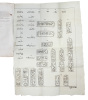
The scarce first edition, in the even scarcer original printed wrappers, of Champollion's milestone work, which announced for the first time the deciphering of the Rosetta Stone, provided the key to reading Egyptian hieroglyphs, and gave birth to the entire field of modern Egyptology. This seminal work arguably constitutes the single most important philological work ever written. ""[...] in the actual state of Egyptian studies, when the monuments stream out from all sides and are collected by the rulers as by amateurs, and when also the scientists of all countries are eager to engage in serious research of their subject matter and are eager to penetrate deeply into the knowledge of these written monuments which must be used to explain all the others, I do not think I should wait till another time to bring to the scientists' attention and under your honourable auspices a short but important series of new developments, which naturally belong to my Memory on HIEROGLYPHIC writing, and which will doubtlessly save you the trouble that I have taken to establish what may be very serious errors about the different periods in the history of Egyptian art and the general administration of Egypt: for this is about the series of hieroglyphs that, making an exception to the general nature of the signs of this writing, have been equipped with the ability to EXPRESS THE SOUNDS of the words, and which are used in the inscriptions of the public monuments of Egypt, the TITLES, the NAMES, and the EPONYMS OF THE GREEK OR ROMAN SOVEREIGNS, who rule Egypt one after the other. Many certainties in the history of this celebrated piece of land must arise from this new result of my research, to which I have been led quite naturally."" (pp. 2-3) (*) says Champollion on the opening pages of the present letter to Mr. Dacier. And thus was laid the foundation of modern Egyptology. Jean Francois Champollion (1790-1832), known as the father of Egyptology, was by no means exaggerating when he stated the above - his letter to Mr. Dacier upon his new discoveries and the decipherment of the Egyptian hieroglyphs did change the study of Egypt and Egyptology more profoundly than any work before or after. Ever since the publication of the present work, Champollion has been credited with being the first to correctly and fully decipher the inscription on the famous Rosetta Stone, translating it, and breaking the mystery of the ancient hieroglyphic script"" it is in the present work that this milestone event in the history of modern man is announced first time, and it is due to this discovery that he is accepted as the founder of Scientific Egyptology. The Rosetta Stone, which dates back to 196 B.C was found in 1799 by French Troops and was immediately brought to England, where it has been ever since. The stone was (and is) of the utmost importance to the understanding of the Egyptian language, the principles of which were totally unknown up until this point. Because the hieroglyphic inscription on the stone is accompanied by a Greek and a Demotic one with the same contents (the commemoration of Ptolemy V's accession to the Egyptian throne), Champollion was able to crack the code of the hieroglyphs and to read a language that had not been read for far more than a millennium. Other very skilled linguists had worked on the decipherment of the hieroglyphic inscription simultaneously with Champollion, but they had all given up by the time that Champollion finally had his first true breakthrough. It came in 1822, when he successfully deciphered two Egyptian names, Ramses and Thutmos, written in hieroglyphic characters in temple cartouches. Champollion's discovery pointed to the fact that the Egyptian hieroglyphs functioned as an alphabet, a phonetic language and a system of symbols that could stand for words or concepts. ""And if the resembling signs of the two names render THE SAME SOUNDS on both cartouches, it is due to their ENTIRELY PHONETIC character."" (p. 7). (**) He succeeded in showing that the Egyptian hieroglyphic writing system was a combination of phonetic and ideographic signs, and using his new discovery as a foundation, Champollion next turned his attention to common nouns, and deciphered the phrase ""birthday celebrations"" from the Rosetta Stone.""It is a complex system, writing figurative, symbolic, and phonetic all at once, in the same text, the same phrase, I would almost say in the same word"" says Champollion about the hieroglyphs, in the present work, after having established their meaning. He had finally cracked the code and was sure of it. He was so excited by this monumental discovery that he immediately ran to his brother's house, into his office, shouting the famous words ""Je tiens l'affaire!"", i.e. ""I've got it!"". It is said that he then fainted and spent the next five days in bed recovering. Shortly after his recovery, he began writing the letter for Mr. Dacier, outlining the discovery that laid the foundation for deciphering hieroglyphs, which was published later the same year, and a condensed version of which he presented as a speech at the Academie des Inscriptions. When he presented the speech, Thomas Young, who had given up breaking the code four years earlier, was also in the audience.In 1824, Champollion published a more comprehensive explanation of the hieroglyphic system, his famous ""Précis du Système Hieroglyphiques des Anciens Egyptiens"".Champollion was an extraordinary philologist, who, by the age of sixteen, besides Greek and Latin, mastered six ancient Middle Eastern languages, among these Coptic, the knowledge of which, unlike that of Egyptian, was never lost. As the first, Champollion realized the connection between the Coptic and the Egyptian language, and was able to identify many of the Egyptian words on the Rosetta Stone, as he could read them with their Coptic equivalents. He was the first to believe that both Demotic and Hieratic represented symbols, and not sounds as earlier presumed. After that he quickly realized that each single hieroglyph could represent a sign, and he began compiling a hieroglyphic alphabet. When publishing his letter to Mr. Dacier, he presented the fact that the hieroglyphs represented sounds as well as concepts, according to context. Champollion is thus the constructor of our present code of the hieroglyphic alphabet. ""Further study enabled him to discover the values of a number of syllabic hieroglyphic signs, and to recognize the use of hieroglyphs as determinatives. In cases where the Greek text supplied him with the meaning of hieroglyphs of which he did not know the phonetic values, his knowledge of Coptic enabled him to suggest values which he found subsequently to be substantially correct. Further reference to determinatives and the importance of parallel passages and texts will be made later on in his work. Between 1822-24 CHAMPOLLION worked incessantly, and was enabled to modify much of his earlier views, and to develop his Alphabet, -and he evolved some rudimentary principles of Egyptian Grammar..."" (Wallis Budge, The Rosetta Stone in the British Museum, pp. 224-25). ""We have only been able to locate 4 auction records of the work within the last 40 years (ABPC & JAP), none of them in original wrappers.________________________________________________________________________________ORIGINAL FRENCH TEXT OF THE QUOTATIONS ABOVE (WHICH ARE IN OWN TRANSLATION):(*) ""[...] dans l'etat actual des études égyptiennes, lors-que de toutes parts les monuments affluent et sont recueilles par les souverains comme par les amateurs, lorsqu'aussi, et a leur sujet, les savants de tous les pays s'empressent de se livrer à de laborieuses recherches, et s'efforcent de pénétrer intimement dans la connaissance de ces monuments écrits qui doivent servir à expliquer tous les autres, je ne crois pas devoir remettre à un autre temps d'offrir à ces savants et sous vos honorables auspices, une courte mais importante série de faits nouveaux, qui appartient naturellement à mon Mémoire sur l'écriture HIÉROGLYPHIQUE, et qui leur épargnera sans doute la peine que j'ai prise pour l'établir, peut-être aussi de graves erreurs sur les époques diverses de l'histoire des arts et de l'administration générale de l'Égypte: car il s'agit de la série ges HIÉROGLYPHES qui, faisant exception à la nature générale des signes de cette écriture, étaient doués de la faculté d'EXPRIMER LES SONS des mots, et ont servi à inscrire sur les monuments publics de l'Égypte, les TITRES, les NOMS, et les SURNOMS DES SOUVERAINES GRECS OU ROMAINS qui la gouvernèrent successivement. Bien des certitudes pour l'histoire de cette contrée célèbre doivent naître de ce nouveau résultat des mes recherches, auquel j'ai été conduit très-naturellement."" (pp. 2-3).(**) ""et si les signes semblables dans ces deaux noms exprimaient dans l'un et l'autre cartouche LES MÊMES SONS, ils devaient constater leur nature ENTIÈREMENT PHONÉTIQUE."" (p.7).

Notice de Deux Papyrus Égyptiens en Ecriture Demotique, et du règne de Ptolémée-Èpiphane-Euchariste (i.e. Notice of Two Egyptian Papyri in Demotic Script, and of the reign of Ptolemy Epiphanes Eucharist). [Extrait du Journal Asiatique redigé par de Ch...
Paris, Dondey-Dupré, 1823. 8vo. Uncut in contemporary blank wrappers with contemporary handwritten name to front wrapper. A bit of brownspotting. Pp. (2), 32 pp. + two folded engraved plates.
Scarce first edition, offprint from ""Journal Asiatique"", of Champollion-Figeac's study of two highly important Egyptian contracts written in Demotic script, dating to the reign of Ptolemy Epiphanes: one from year 4 (200 BC) and one from year 8 (196 BC) of his reign – preceding the Rosetta Stone inscription, from year 9 of the same reign. All three documents contain the names of the same priests and priestesses. These two inscriptions not only provide further highly valuable historical information about the period, they also shed new light on important passages on the Rosetta Stone. The French translation of the two protocols – that is, the standardized opening formula that identified the legal document, the date, and the reigning monarch – and an analogous passage in the Rosetta Stone is found on pages 6-7. Champollion-Figeac explains the following: “[…] the custom adopted in drafting public acts in Egypt during the Ptolemaic period: to mention in their protocol not only the year of the reign and the surname of the reigning sovereign, but also several priests or priestesses, foremost among them the priest of Alexander the Great […] whose name is followed in these contracts by the names of all the Ptolemaic kings who had died since Alexander and were associated with his honors, up to the reigning king. Thus, the protocol in public acts of some importance, and therefore more carefully written, provides the genealogical and chronological series of the Ptolemaic kings, and these documents are very valuable for their history” (p. 3) Champollion-Figeac examines whether this can shed light on “the reign of Ptolemy Epiphanes in particular, and, in general, about the status, in Egypt, of priests in charge of the posthumous cult of the kings and queens who were his ancestors” (pp. 4-5"" p. 31). The examined passages help shed light on the two surnames of Ptolemy V – Epiphanes and Eucharist – and the order in which he acquired them: “the comparison of the contracts with the Rosetta Stone inscription proves that he only took that of Epiphanes (illustrious or manifest) upon his accession” (pp. 29-30). Furthermore, his study helps explain, in a new way, two important passages of the Rosetta Stone inscription. Jacques-Joseph Champollion-Figeac (1778-1867), elder brother of Jean-Francois Champollion (decipherer of the Rosetta Stone) was a French librarian and paleographer. He was professor of Greek and a librarian at the University of Grenoble but lost the position for supporting Napoleon during the Hundred Days. He later became the curator of manuscripts at the Bibliothèque Nationale and professor at the École des Chartes (school of paleography), Paris. In 1849, Champollion-Figeac became librarian of the palace at Fontainebleau. (britannica.com) Ptolemy Epiphanes Eucharist, or Ptolemy V Epiphanes, (born c. 210—died 180 BCE) was a Macedonian king of Egypt from 205 BCE. In 196 he promulgated the decree inscribed on the Rosetta Stone, which was deciphered largely by Thomas Young and Jean-François Champollion, the younger brother of Champollion-Figeac. Demotic script is an ancient Egyptian cursive script used in 7th-5th century BCE. By the 5th century it was used throughout Egypt for business and literary purposes but began to be displaced by Greek during the Ptolemaic period (304-30 BCE). See also: Britannica Editors. ""Rosetta Stone"". Encyclopedia Britannica, 14 Feb. 2026, https://www.britannica.com/topic/Rosetta-Stone. Accessed 26 May 2026.
Précis du système hiéroglyphique des anciens Égyptiens ou recherches sur les élémens premiers de cette écriture sacrée, sur leurs diverses combinaisons, et sur les rapports de ce système avec les autres méthodes graphiques égyptiennes. Avec un volume ... - [THE FINDING OF A LOST LANGUAGE]
Paris, Chez Treuttel et Würtz, 1824. Lex 8vo. Both volumes bound completely uncut in one near contemporary brown half calf with ornametal spine. A bit of wear to capitals, corners, and hinges. Occasional brownspotting. Overall a very nice copy. (Text-vol.:) (4), XVI, 410, (4, - 1 blank leaf + 1 leaf of book binder instructions) pp. + 16 plates, some folded" (2), 45 pp. + 32 plates (numbered 1-21 and A-K). Complete in two vols. w. all 38 lithographed plates.
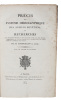
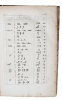
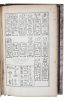
Very rare first edition of the work in which the deciphering of the hieroglyphs was fully presented for the first time. In 1822 Champollion had read his ""Lettre a M. Dacier"" before the Academie des Inscriptions, and for the first time presented the key to reading hieroglyphs. His monumental work ""Précis du système hiéroglyphique"" appeared two years later, and in this richly illustrated work he presents his definitive, expanded analysis, and finally corrects the misleading mistakes of the other Egyptologists, counting also Thomas Young. Jean Francois Champollion (1790-1832), the father of Egyptology, is credited with actually deciphering the inscription on the famous Rosetta Stone, translating it, and breaking the mystery of the ancient hieroglyphic script"" he is therefore accepted as the founder of Scientific Egyptology, -a title primarily justified with the publication of this work.The Rosetta Stone was found in 1799 by French Troops and was immediately brought to England, where it has been ever since. The stone was (and is) of the utmost importance to the understanding of the Egyptian language, the principles of which were totally unknown up to this point. Because the hieroglyphic inscription on the stone is accompanied by a Greek and a Demotic one with the same contents, Champollion was able to crack the code of the hieroglyphs and to read a language that had not been read for far more than a millennium. Champollion was an extraordinary philologist, who, by the age of sixteen, besides Greek and Latin, mastered six ancient Middle Eastern languages, among these Coptic, the knowledge of which, unlike that of Egyptian, was never lost. As the first, Champollion realized the connection between the Coptic and the Egyptian language, and was able to identify many of the Egyptian words on the Rosetta Stone, as he could read them with their Coptic equivalents. He was the first to believe that both Demotic and hieroglyphs represented symbols, and not sounds as earlier presumed. After that he quickly realized that each single hieroglyph could represent a sign, and he began compiling a hieroglyphic alphabet. In his ""Précis du système hiéroglyphique"" he could finally, in 1824, prove that the glyphs represented sounds as well as concepts, according to context. Champollion is the constructor of our present code of the hieroglyphic alphabet. ""Further study enabled him to discover the values of a number of syllabic hieroglyphic signs, and to recognize the use of hieroglyphs as determinatives. In cases where the Greek text supplied him with the meaning of hieroglyphs of which he did not know the phonetic values, his knowledge of Coptic enabled him to suggest values which he found subsequently to be substantially correct. Further reference to determinatives and the importance of parallel passages and texts will be made later on in his work. Between 1822-24 CHAMPOLLION worked incessantly, and was enabled to modify much of his earlier views, and to develop his Alphabet, -and he evolved some rudimentary principles of Egyptian Grammar. The results of his studies at this period he published in his ""Précis du Système Hiéroglyphique"", Paris, 1824, wherein he took special pains to inform his readers that his system had nothing whatever to do with that of Dr. YOUNG."" (Wallis Budge, The Rosetta Stone in the British Museum, pp. 224-25). ""... Ces mémoires réunis formèrent le grand ouvrage publié aux frais de l'Etat en 1824 sous le titre ""Précis du système hiéroglyphique des anciens Égyptiens"", didié au roi."" (N.B.G. Vol. 9, p. 650).
[Imprimerie Royale] - CHAMPOLLION LE JEUNE ; [CHAMPOLLION, Jean-François ] ; LENORMANT, Ch.
Reference : 58251
(1841)
Mémoire sur les Signes employés par les Anciens Egyptiens à la notation des divisions du Temps dans leurs trois systèmes d'écriture par M. Champollion Le Jeune [ Edition originale ] [ Avec : ] Eclaircissements sur le Cercueil du Roi Memphite Mycérinus traduits de l'anglais et accompagnés de notes par Ch. Lenormant, suivis d'une lettre sur les Inscriptions de la Grande Pyramide de Gizeh, par M. le Docteur Lepsius [ Edition originale ]
1 vol. reliure de l'époque demi-basane verte, Imprimerie Royale, Paris, 1841, 2 ff., 64 pp. et 6 planches dépliantes, Chez Leleu, Paris, 1839, 50 pp. avec 2 planches (dont un dépliante). . Rappel du titre complet : Mémoire sur les Signes employés par les Anciens Egyptiens à la notation des divisions du Temps dans leurs trois systèmes d'écriture par M. Champollion Le Jeune [ Edition originale ] [ Avec : ] Eclaircissements sur le Cercueil du Roi Memphite Mycérinus traduits de l'anglais et accompagnés de notes par Ch. Lenormant, suivis d'une lettre sur les Inscriptions de la Grande Pyramide de Gizeh, par M. le Docteur Lepsius [ Edition originale ]

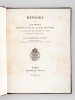
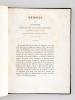
Edition originale de la plus extrême rareté du tiré-à-part, daté de 1841, avec un titre propre et une pagination spécifique du "Mémoire sur les Signes" de Champollion. Ce "Mémoire sur les Signes employés par les Anciens Egyptiens" de Jean-François Champollion (1790-1832) fut publié de manière posthume et intégré dans les Mémoires de l'Institut Royal de France (Tome XV, 1842). On trouve, relié à la suite, un rare texte de l'égyptologue Charles Lenormant, qui sera nommé en 1849 professeur de langue égyptienne au Collège de France, dans la chaire d'archéologie créée par Champollion. Bon état (dos un peu frotté, qq. annotations légères au crayon, petit choc à un plat, bon exemplaire par ailleurs). Scarce copy of the separate edition, dated 1841 with its own pagination.
Lettres écrites d'Egypte et de Nubie en 1828 et 1829. Par Champollion Le Jeune.
Paris, Librairie Académique Didier et Cie, Libraires-Editeurs, 1868, 1 volume in-8 de 225x150 mm environ, 3ff. (faux-titre, titre, avertissement), 397 pages, reliure demi chagrin noir, dos à 5 nerfs portant titres dorés, tranche de tête dorée, gardes de couleurs. Complet des 4 planches hors texte. Fortes rousseurs par endroits, manque la partie mobile des gardes de couleurs, coins et coupes émoussés, cuir frotté avec petites épidermures.
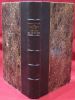
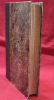
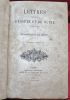
Jean-François Champollion dit Champollion le Jeune, né le 23 décembre 1790 à Figeac (Lot) et mort le 4 mars 1832 à Paris, est un égyptologue français.Premier à déchiffrer les hiéroglyphes, Champollion est considéré comme le père de l'égyptologie. Il disait de lui-même : « Je suis tout à l'Égypte, elle est tout pour moi ». Merci de nous contacter à l'avance si vous souhaitez consulter une référence au sein de notre librairie.
Antiquités de GRENOBLE, ou Histoire ancienne de cette ville, d'après ses Monumens (monuments). Par J. J. CHAMPOLLION-FIGEAC, Secrétaire de la Société des Sciences et des Arts de Grenoble, Membre non - résidant de l'Académie Celtique de Paris, Correspondant de l'Athénée de la Langue Française, etc.
Grenoble, de l'Imprimerie de J.H. Peyronard, 1807, 1 volume in-4 de 310x230 mm environ, xij-151 pages, demi chagrin noir, dos à 5 nerfs portant titres dorés. Avec une planche hors-texte, sans les 2 planches dépliantes. Petits frottements sur les nerfs, manque de papier sur un coin de page de titre, sinon bon état.
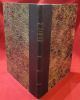
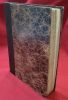
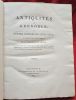
Jacques-Joseph Champollion, dit Champollion-Figeac (né le 5 octobre 1778 à Figeac dans le Lot et mort le 9 mai 1867 à Fontainebleau), est un archéologue français. Il est le frère aîné de Jean-François Champollion. Merci de nous contacter à l'avance si vous souhaitez consulter une référence au sein de notre librairie.
Lettres à M. LE DUC DE BLACAS D'AULPS, Premier Gentilhomme de la Chambre, Pair de France, etc. Relatives AU MUSEE ROYAL EGYPTIEN de Turin ; par M. CHAMPOLLION Le Jeune. Seconde Lettre - Suite des Monuments historiques.
Paris, chez Firmin Didot Père et Fils, et chez Treutfel et Wurtz, 1826, 1 volume in-8 de 225x150 mm environ, 167 pages, demi-reliure postérieure en toile vert sauge, avec dos muet. Sans les planches in-fine. Quelques rousseurs, frottements sur le cartonnage.
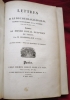

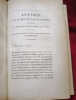
Jean-François Champollion dit Champollion le Jeune, né le 23 décembre 1790 à Figeac (Lot) et mort le 4 mars 1832 à Paris, est un égyptologue français.Premier à déchiffrer les hiéroglyphes, Champollion est considéré comme le père de l'égyptologie. Il disait de lui-même : « Je suis tout à l'Égypte, elle est tout pour moi ». Merci de nous contacter à l'avance si vous souhaitez consulter une référence au sein de notre librairie.
LETTRES DE M. CHAMPOLLION LE JEUNE, écrites pendant son voyage en Égypte, en 1828 et 1829.
1829 Paris, Firmin Didot, 1829. In-8 (134 X 215 mm) demi-basane aubergine, dos lisse cloisonné de guirlandes et filets dorés, auteur et titre dorés (reliure de l'époque) ; (2) ff. de faux-titre et titre, 184 pages, 24 pages. Rousseurs éparses, plus marquées aux premiers feuillets.
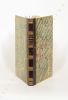
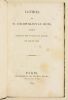
ÉDITION ORIGINALE RARISSIME de cet ouvrage qui publie pour la première fois les VINGT PREMIÈRES LETTRES écrites par Jean-François CHAMPOLLION (1790-1832) durant la mission scientifique qu'il mena de 1828 à 1830 en Égypte, avec son collaborateur et ami Ippolito Rosellini. Une édition de ces "Lettres", posthume, paraîtra en 1833 chez le même éditeur : elle contient 31 lettres, mais les lettres XXV à XXXI, qui concernent le voyage du retour de Toulon à Bordeaux, sont d'un intérêt moindre. Dans la préface de l'édition de 1833, l'éditeur écrit : «Les dix-neuf premières "Lettres" écrites d'Égypte ont été imprimées en tout ou par fragments dans divers recueils littéraires, et dans le "Moniteur" ; quelques exemplaires d'épreuves tirées à part ont été conservés par des mains bienveillantes : on reproduit ici ces mêmes lettres avec quelques corrections dans les noms propres ; la vingtième lettre et les suivantes n'avaient pas encore été publiées. » Il s'agit donc ici de l'un de ces RARES EXEMPLAIRES «tirés à part » : à noter que contrairement à ce qu'affirme l'éditeur, la vingtième lettre, écrite de Thèbes, palais de Kourna, le 6 juillet 1829, est en partie reproduite dans notre exemplaire. Une note liminaire du "Moniteur" du 11 août 1828 occupe les deux premières pages. On a RELIÉ À LA SUITE un extrait de la Revue Française (n°XII), rédigé par Charles Lenormant et intitulé "Esquisse de la Basse-Nubie" (24 pages). Charles LENORMANT (1802-1859), archéologue, égyptologue et numismate français, accompagna Champollion durant son voyage en Égypte. (Hage-Chahine, 890, qui ne cite que la troisième édition de 1868 - Gay, 1975, qui ne cite que les éditions de 1833 et 1868.) BEL EXEMPLAIRE, conservé dans son élégante reliure de l'époque. NICE COPY. PICTURES AND MORE DETAILS ON REQUEST.

Champollion Hervé Hervet Jean-Pierre
Reference : 500030462
(2001)
ISBN : 9782737325472
Les Alpes françaises
Ouest-France 2001 127 pages 19x1x25cm. 2001. Broché. 127 pages.
Très bon état - légères marques de lecture et/ou de stockage mais du reste en très bon état- expédié soigneusement depuis la France
Aimer les châteaux de la Loire - Espagnol
Ouest france 2018 144 pages 18x1x24cm. 2018. Broché. 144 pages.

Bon état
Aimer les châteaux de la Loire - Espagnol
Ouest france 2018 144 pages 18x1x24cm. 2018. Broché. 144 pages.

Très bon état
Champollion Hervé Aubarbier Jean-Luc Binet Michel
Reference : 500098863
(2001)
ISBN : 9782737327704
AED PAYS CATHARE (LE)/IT.DECOUV
Ouest france 2001 160 pages 19x1 4x25cm. 2001. Broché. 160 pages.
Bon état - . légères marques de stockage sur couverture et coins mais du reste en bon état - envoi rapide et soigné dans enveloppe à bulles depuis france
Aimer les châteaux de la Loire - Espagnol
Ouest france 2018 144 pages 18x1x24cm. 2018. Broché. 144 pages.

Comme neuf - livre issu de destockage - pouvant présenter d'infimes traces de stockage - Expédié soigneusement dans emballage adapté
Aimer les châteaux de la Loire - Espagnol
Ouest france 2018 144 pages 18x1x24cm. 2018. Broché. 144 pages.

Très bon état


La Côte d'Azur
Ouest-France 2010 92 pages 18x19x1cm. 2010. Broché. 92 pages.

French édition - Livre issu de déstockage JAMAIS LU présentant des marques de manipulation sur la couverture et/ou les pourtours mais demeurant en très bon état d'ensemble.Expédition sous blister dans une enveloppe matelassée depuis la France
Bourgogne : Edition français-anglais
Ouest-France 2010 92 pages 18x19x1cm. 2010. Broché. 92 pages.
Bourgogne : Edition français-anglais
Ouest-France 2010 92 pages 18x19x1cm. 2010. Broché. 92 pages.
La Provence
Ouest-France 2016 120 pages 15 6x21 4x0 8cm. 2016. Broché. 120 pages.
Comme neuf - L'ouvrage qui n'a jamais été lu pourrait présenter de légères traces de stockage - remis sous blister et expédié soigneusement dans emballage adapté -