 Write to the booksellers
35 books for « cassius j f »Edit
-
Type
Book (34)
New book (1)
-
Language
French (32)
Italian (1)
Latin (1)
Russian (1)
-
Century
16th (1)
17th (1)
18th (1)
19th (1)
20th (7)
21st (1)
-
Countries
Belgium (2)
Denmark (1)
France (17)
Greece (1)
Netherlands (7)
Switzerland (5)
United Kingdom (1)
United States of America (1)
-
Syndicate
ILAB (12)
SLAM (9)
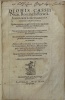
Historiae romanae, quae supersunt, Volumen I quod complectitur Fragmenta Librorum I - XXXV cum Annotationibus Maxime Henrici Valesii - Libros XXXVI - LIV, Integros cum Annotationibus Ioannis Alberti Fabricii ac Paucis Aliorum, Graeca ex Codicibus Mss. et Fragmentis supplevit emendavit Latinam Versionem Xylandro-Leunclavianam Limavit, Varis Lectiones Notas Doctorum suas cum apparatu et indicibus adiecit Hermannus Samuel Reimarus. Tome II : Quod complectitur Libros Dionis LV - LX. Passim Mutilos et breviatos cum Annotationibus Ioannis Alberti Fabricii et nonnullis aliorum, Libros item Dionis LXI - LXXX. Ex compendio IO. Xiphilini, cum annotationibus Hermanni Samuelis Reimari, qui et ubivis Fragmenta reperta suis logis inservit varias lectiones et annotationes subiecit versionem castigavit, Apparatum Annationum et emendationum cum indice Graeco et Latino adiunxit.
Hamburgi, Christian HEROLD, 1750, 2 volumes grand in-folio de 265x405 mm environ, tome I : (2) ff., faux-titre, titre, xxix (dedicatio, praefatio), 1 portrait pleine page du traducteur Johannes Albertus Fabricius, 767 pages, (2) ff., tome II : (1) f., faux-titre, titre (2) ff. (ad lectorem), 1 portrait pleine page de Hermanus Samuel Reimarus, pagination de 770 à 1708 (pagination continue), impression sur 2 colonnes par pages du texte grec avec traduction latine en regard, plein velin crème d'époque avec décor à froid sur les plats, titres manuscrits sur le dos, tranches finement mouchetées de rouge et brun. Mors abimés, erreur de pagination dans le tome II (1619 à 1626, répétition des chiffres mais texte cohérent et complet)un tampon ancien sur les pages de titre, rousseurs légères et pages brunies. Texte en grec et en latin.
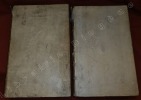
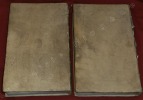
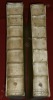
Dion Cassius, en latin Lucius (ou Claudius) Cassius Dio (Cocceianus ?) (Nicée, Bithynie, v. 150-id., après 235) est un historien romain d'expression grecque.Dion Cassius est surtout connu pour son Histoire romaine, ouvrage de 80 livres qui retracent les 973 ans de la vie de Rome, de sa fondation à Alexandre Sévère en 229. Ne sont conservés intégralement que les livres 37 à 60, soit de 68 av. J.-C. à 47 apr. J.-C., les autres ne sont connus que par des abréviateurs comme les byzantins Xiphilin et Zonaras. Merci de nous contacter à l'avance si vous souhaitez consulter une référence au sein de notre librairie.
Cassii Dionis Cocceiani Historiae Romanae quae supersunt. (...) Cum annotationibus maxime Henrici Valesii, (...) Ioannis Alberti Fabricii ac paucis aliorum. Graeca ex codicibus MSS. et fragmentis supplevit, emendavit, Latinam versionem Xylandro-Leunclavianam limavit, varias lectiones, notas doctorum et suas cum apparatu et indicibus adjecit Hermannus Samuel Reimarus. (...)
Hamburg (Hamburgi), Sumtibus Christiani Heroldi, 1750 - 1752. (Colophon at the end of vol. 1: Hamburgi, Typis Joannis Georgii Piscatoris & Filii, 1749)
Folio. 2 volumes: (IV including portrait), XXIX,(1),768,(1 blank) p.; (VIII including portrait), p. 769-1708 (recte 1716 ); 2 portraits, of Fabricius & Reimarus; 1 plate. Contemporary gilt calf. 42 cm (Ref: Hoffmann 1,549; Brunet 2,712: 'Édit. la plus belle, la plus complète et la meilleure'; Moss 1,405/06: 'One of the most correct and valuable Greek works ever printed. The notes contain a treasure of erudition'; Dibdin 1,506/07; Ebert 6143; Graesse 2,393; Not yet in VD18) (Details: Back elaborately gilt, and with 7 raised bands. Red morocco shield in the second compartment. Boards with gilt borders and 2 gilt rectangles. Title printed in red and black. Beautiful full-page portrait of Fabricius after the first half title, engraved by Gustav Andreas Wolfgang, 1749. Big headpiece of 1/2 a page at the beginning of the dedication, designed and engraved by Christ. Fritzsch, showing a portrait of the dedicatee Cardinal Angelo Maria Quirini. Full-page portrait of Reimarus at the beginning of volume 2, also designed and engraved by Christ Fritzsch, 1751. Facsimile of a leaf from a Vatican Codex after leaf 5E4) (Condition: Bindings slightly scuffed. Head of the first volume somewhat chafed. Corners slightly bumped. The leather enclosed by the sides of the inner rectangle on the boards is affected by a colouring agent) (Note: Dio Cassius Cocceianus of Nicaea in Asia Minor was born ca. 164 A.D. He held several high state offices (twice consul). He wrote in Greek a Roman history (Rhômaikê Historia) in 80 books, from the founding of the city of Rome till 229 A.D, the year of his own second consulate. His work 'appears to be based on republican annalistic tradition, Livy, or Livy's sources (...), imperial annalistic tradition, and for contemporary events', the time of Marcus Aurelius and the Severian dynasty, 'his own high authority. Unreliably about republican institutions and conditions, from Caesar onwards he used his constitutional experience, at first colouring events with his ideas of imperial absolutism, (...) but later handling his material with full knowledge. Annalistic in arrangement (...) his narration concentrated on political aspects, in the manner of Thucydides, giving a rhetorical narrative in Atticist style'. (OCD 2nd ed. p. 345) The 'editio princeps' of Cassius Dio was published in 1548 by Robertus Stephanus. The first Latin translation appeared ten years later in Basel, and was made by the German scholar Xylander, in German Wilhelm Holzman, professor of Greek at the University of Heidelberg. His gifted pupil Johannes Leunclavius, or Hans Loewenclau revised and augmented Xylander's translation, and had it published in 1592. Leunclavius added also a collection of critical notes of his own. This edition of 1750/1752 is the next important edition. It was begun by the German bibliographer and classical scholar Johannes Albertus Fabricius, 1668- 1736, whose notes cover the books 35/60. On his death his son-in-law Hermann Samuel Reimar, 1694-1768, professor of philosophy at Hamburg, completed the edition. Reimar carefully inspected all earlier editions, and consulted and collated some excellent manuscripts, and he incorporated the entire notes of the earlier commentators in it. The fragments of Dio Cassius were adopted from the 'Excerpta Peiresciana', collected and published by the French scholar Henri de Valois (1634). The first volume also contains the surviving fragments of the epitome of Dio that was compiled by the 11th century byzantine scholar Joannes Xiphilinus. The second volume contains the prefaces and observations of Robertus and Henricus Stephanus, Xylander, Sylburg and Leunclavius. Here we find also the critical and explanatory notes of Dutch professors Lambertus Bos, Tiberius Hemsterhuis and Peter Wesseling, and of other leading scholars) (Provenance: Bookplate of A. Pitlo on the verso of the half title, with a riddle. On the foreground an opened book, and in the background a fuming volcano, in between the motto 'Del pasat la remembransa e la fe de l'an que ven'. The Dutch jurist Adriaan Pitlo, 1901-1987, was for 30 years professor of private and notarial law. At the beginning of the thirties of the 20th century he spent 3 years with his wife in Naples. Of this time the said later: 'Ik geef het U ook te doen, om met uitzicht op de Vesuvius het Juristenblad te raadplegen!' (It is tough job, to consult the Jurist Journal, while enjoying the view of the Vesuvius') The bookplate obviously illustrates this anecdote full of melancholy. In the background we see the ever-fuming Vesuvius, and in front the opened Journal. The motto seems to reflect this mood) (See the site "Resources Huygens ING") (Collation: Volume 1: a-d4 (portrait after a1; leaf a4 signed a3); A-5D4 (leaf 5D4 verso blank). Volume 2: pi4 (portrait after leaf pi1; minus blank leaf p4); A-4F4, 4G4 (between leaf 4G2 and 4G3 an extra leaf, also signed 4G3, on which leaf the 'Apparatus ad Cassium Dionem' begins), 4H4-5E4 (Extra leaf, not signed, not paginated, with a specimen of a Vatican Codex after 5E4), 5F-5P4, (5P)4, 5Q-6B4, 6C2 (leaf 6C2 blank)) (Heavy set, may require extra shipping costs) (Photograph on request)
[Librairie de Firmin-Didot Frères] - DION CASSIUS ; (GROS, Etienne ; BOISSEE, V.)
Reference : 63384
(1848)
Histoire Romaine de Dion Cassius (Tomes 2, 3, 4 et 5).
Traduite en français avec des notes critiques, historiques etc., et le texte en regard, par E. Gros, 4 vol. in-8 reliure postérieure pleine toile verte, couvertures conservées, Librairie de Firmin-Didot Frères, Paris, 1848, 1850, 1855, 1861, XV-441 pp. ; IV-519 pp. ; 467 pp. ; VIII-454 pp.
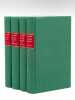
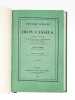
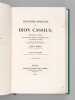
Rare ensemble réunissant 4 des 10 tomes de cette édition de référence des oeuvres de l'historien grec Dion Cassius. Proche des empereurs Septime Sévère et Sévère Alexandre, Dion Cassius est connu pour son "Histoire romaine" en 80 livres, dont beaucoup ne nous sont parvenus que sous forme de fragments. A la mort d'Etienne Gros en 1850, c'est Boissée qui poursuivra la publication. Bon ensemble (qq. mouill., très bon état par ailleurs).
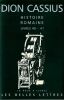
Histoire romaine, livre 40-41, César et Pompée.
<p>Collection "La roue à livres".</p><p>Les sept années (54 à 48 av. J.-C.) que couvrent les livres 40 et 41 de l'Histoire romaine de Dion Cassius sont cruciales: l'éclatement du triumvirat qui s'est partagé le pouvoir et l’empire, la puissance grandissante de César auréolé par ses conquêtes gauloises et son affrontement avec l’autre général dévoré d’ambition, Pompée, marquent virtuellement la fin de la République.</p><p>Avec un recul de trois siècles et demi, Dion Cassius, sénateur romain et historien grec, montre, sans prendre parti pour l’un ou pour l’autre des deux adversaires, l’impuissance du Sénat, la faillite des institutions républicaines et la tyrannie naissante des dynastes. Il le fait dans un récit qui privilégie les scènes et dramatise les fureurs et les déchirements qui traversent les citoyens des deux camps emportés dans la même guerre sans merci.</p><p>La présente traduction est la première en français depuis près de cent cinquante ans.</p> Paris, 1996 Les Belles Lettres. 160 p., broché avec rabats. 13,5 x 21
Neuf
Histoire Romaine Livre 40-41
Les Belles Lettres - La roue à livres -1996. In-8, broché, couverture souple glacée vert tabac rempliée ornée du logotype "La roue à livre", très bel exemplaire, 156 page.
Bon Etat Mise à jour du Samedi 27 Juin 2026. Paiement PayPal immédiat, Mondial Relay pour : France, Allemagne, Autriche, Belgique, Espagne, Italie, Portugal, Luxembourg, Pays-Bas, Pologne (Communiquer votre point ou locker si connu). Une participation supplémentaire peut être demandée pour les colis lourds hors France où les envois compris entre 5 et 25 kg sont dégressifs : 2 à 4 kilogrammes - 7.99 / 5 à 10 kg - 15.99 / 15 -25 kg - 25.99. Certaines de nos collections ( Vian, Céline, Camus (...) peuvent être expédiées en Franco de port. Pour linternational hors Europe (Suisse, Canada, Japon, Etats-Unis, les frais dexpéditions peuvent varier selon le poids (mise à jour : 1 juin 2026).
O vysokom, Tvorenie Dionisiya Longina. In Russian /On the high, the Creation of
Short description: In Russian. Longinus, Dionysius Cassius. On the high, the Creation of Dionysius Longin. type I. Ioannesov. You are welcome to reach out to us for a detailed description of the copies currently available. Delivery of this book may take longer than usual including extended processing and pre-shipping time, no expedited shipping is available. Please advise us if you have a set date or a deadline to receive your order.SKU5208050
Solinas, Francesco, Marie Laure Cassius-Duranton, and Giullaume Glorieux
Reference : 125470
(2025)
ISBN : 9788865576069
L'Ornament Precieux 2
Solinas, Francesco, Marie Laure Cassius-Duranton, and Giullaume Glorieux: L'Ornament Precieux 2. 2025. 197 pages, 183 colour illustrations. Paperback. 29 x 21cms. A study of the sumptuary arts in Europe since the late Middle Ages, looking at oriental fabric and carpets, glasswork, enamels, and jewelry. 12 essays explore the jewels of the House of Burgundy and Habsburg, the contents of the Tudor treasury, perfume at the European courts, Catherine de Medici's Valois tapestry, precious ornaments for Jewish merchants in Venice, jewelry in sixteenth century Florence, commissions for Eleonora and Margherita Gonzaga, and Cardinal Mazarin's gem collection. Text in French.
A study of the sumptuary arts in Europe since the late Middle Ages, looking at oriental fabric and carpets, glasswork, enamels, and jewelry. 12 essays explore the jewels of the House of Burgundy and Habsburg, the contents of the Tudor treasury, perfume at the European courts, Catherine de Medici's Valois tapestry, precious ornaments for Jewish merchants in Venice, jewelry in sixteenth century Florence, commissions for Eleonora and Margherita Gonzaga, and Cardinal Mazarin's gem collection. Text in French

La vérité sur l’Affaire Pétain
Du Milieu du Monde, coll. « Documents d’aujourd’hui » 1945 In-12 broché 18 cm sur 12. jamais lu, pages non coupées. 217 pages. Très bon état d’occasion.
Cassius (pseudonyme d’Henri Guillemin) est un des premiers à analyser la politique de Pétain, la démission des élites de l’époque, de l’antisémitisme programmé par ce gouvernent. l’auteur a une assez vision marxiste de cette période de notre histoire. Très bon état d’occasion
Romaikon Istorion ta Sozomena (Greek) Historiae Romanae qvae supersunt. 2 vols. (I. Fragmenta librorum I-XXXV cum Annotationibus Henrici Valesii. Libros XXXVI-LIV Integros cum Annotationibus Ioannis Albert Fabricii - II. Libros Dionis LV-LX...Cum Anno...
Hamburg, Christian Heroldus, 1750-52. Fol. (40x26,5 cm.). Bound in 2 fine contemp. full calf. Richly gilt backs divided in 7 compartments by raised bands. Title-and tomelabels in leather. A few scratches to covers, one corner a bit bumped. A small stamp on titles. 2 fine engraved portraits (A. Fabricius and Reimar), one half-page engraved vignette. (2),XXX,767,(1)"(4),(769-)1709 pp. Printed on good paper, clean and fine. Greek-Latin text in double-columns.
Dio Cassius' Roman History from the beginnings to 229 A.D., took ten years to prepare and 12 years to write. It is annalistic in arrangement, although modified to meet requirements of subject-matter, concentrating on political aspects (he was himself praetor and consul suffectus), in the manner of Thucydides, giving a rhetorical narrative in Attic style. (Based on Oxford Classical Dict.).A beautifully printed work, ""One of the most splendid and truly critical editions (the offered item) which were ever published in Germany. It was begun by the famous Fabricius, whose notes extend from the 35th to the 60th book. On the death of that great man, Reimar, his son-in-law, completed the edition" and in respect to editorial care, diligence, and correctness, and the acquisition of valuable materials for the compilation of it, nothing can exceed the present most admirable performance. All the former publications on Dion Cassious were carefully inspected some excellent MSS. and fragments were procured and collected".. Harwood calls this admirable work ""one of the most correct and valuable Greek books ever published: the notes contain a treasure of erudition""."" (Dibdin I:506). - Graesse II: p. 393. - Brunet II: p. 712: ""Edit. la plus belle, la plus complète et le meilleure que l'on ait dans ce format.""
Dion Cassius, Histoire romaine, livres 40-41 : César et Pompée. Collection : La roue à Livres.
Paris, Les Belles Lettres, 1996. 13 x 21, 157 pp., broché, couverture à rabats, très bon état.
HISTOIRE de DION CASSIUS DE NICEE, abrégée par XIPHILIN. Contenant ce qui s'est passé de plus considérable sous les empereurs romains, à commencer depuis le grand POMPEE, jusques à ALEXANDRE, fils de MAMMEE. Traduite de grec en françois par M. de B. G.**.
Chez Claude Barbin Paris 1674 2 tomes reliés en 1 volume in-12 ( 160 X 90 mm ) de ( [6]-319-[3] et [1]-279-[16] pages, demi cuir-de-russie vert sapin, dos lisse orné de filets dorés, plats de papier maroquiné vert émeraude ( Reliure du XIXe siècle ). EDITION ORIGINALE TRES RARE. Bel exemplaire.
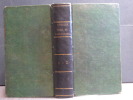
Dione Historico delle Guerre & Fatti de Romani. Tradotto di Greco in lingua vulgare per M. Nicolo Leoniceno. DION CASSIUS
Venise, Nicolo d'Aristotile di Ferrara 1533. in-8o, VI+CCLVII feuilles, page de titre et 22 images gravees sur bois, quelques brunissures eparses, reliure plein velin XVIIe, dos lisse, p. de titre maroquin, ecriture ancienne rayee a la marge inf. du titre, bon etat. Elle est la deuxieme edition du Dion apres celle de 1526 a Venise aussi. De son oeuvre de 80 livres il nous reste qu'une partie augmentee grace aux ecrits du moine Xiphilin et de Zonaras. L'historien grec fut senateur, preteur et consul 'ordinarius', etant partisan et ami des empereurs Septime et Alexandre Severe et hostile aux republicains tels que Ciceron. ''Ouvrage precieux... il constitue une source irremplacable pour l'histoire de son epoque" Laffont-Bompiani II, 632, Brunet II, 713
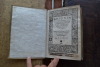
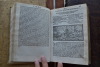
Histoire romaine, livres 50 et 51.
P., Belles Lettres, 1991. In-8, cartonnage de l'éditeur, XCVIII-176 pp., index, bibliographie, cartes. (Collection des Universités de France - Budé).
Très légèrement insolé, très bonne condition néanmoins. - Frais de port : -France 6,8 € -U.E. 9 € -Monde (z B : 14 €) (z C : 24 €)

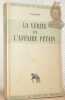
La vérité sur l'affaire Pétain. Collection Documents d’aujourd’hui.
Genève, Editions du Milieu du Monde 1945, 187x120mm, 217pages, broché. Bel exemplaire.
Pour un paiement via PayPal, veuillez nous en faire la demande et nous vous enverrons une facture PayPal
De Cassii Dionis vocabulis quae ad ius publicum pertinent.
Den Haag, Mensing, 1923.
VIII,173 p. Wrs. 24 cm (Diss.) (Used; cover worn; sl. waterstained)
Historia Romana. Editionem primam curavit Ludovicus Dindorf, recognovit Ioannes Melber. Volumen I.
Leipzig, B.G. Teubner, 1890.
XLIII,604 p. Modern boards. 17.5 cm (BT) (Greek text. Fragmenta, books 36/40) (Rebound)
Historia Romana. Cum annotationibus Ludovici Dindorfii. Vol. IV: Ioannis Xiphilini epitome, 61-80.
Leipzig, B.G. Teubner, 1864.
363 p. Modern boards. 17.5 cm (BT)
Dionis Cassii Nicaei, Romanae historiae libri (tot enim hodie extant) XXV. nimirum a XXXVI ad LXI : Quibus exponuntur res gestae a bello Cretico usque ad mortem Claudii Caesaris, quae est historia annorum circiter CII : Nunc primum summa fide diligentiaque de Graecis Latini facti / Guilielmo Xylandro Augustano interprete : His accesserunt eiusdem Annotationes, in quib. autoris huius quamplurima aut restituuntur corrupta, aut explicantur obscura loca. Additum est Ioannis Xiphilini e Dione Compendium / Guil. Blanco Albiensi interprete: quae versio ab eodem Xylandro diligenter est, ubi oportuit, castigata : Iidem libri Dionis ac Xiphilini seorsim Graece quoque eduntur, accurate ab eodem emendati.
Basileae : apud Ioannem Oporinum, [1558]. olio (302 x 210 mm) [10] Bl., 676 S., [25] Bl., 1 folding plate (genealogiae Cesarum), printer mark on the title, decorated initials, text ruled in red. contemporary brown calf, medallion at the centre, spine on raised bands somewhat restored, split joins, dampstains on first leaves; paper somewhat yellowed.
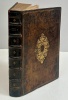
Cassius Dio's Roman History remains a critical source for understanding Roman political and military history from the Republic through the early Empire. Spanning 80 booksof which portions survive. Dedicatory epistle by Guilielmus Xylander to Johannes Henricus Herwartus. Exlibris manuscript on the title. VD16 D 1793
De la médecine. Texte établi, traduit et annoté par Anne Fraisse. Deuxième tirage. Collection des Universités de France, publiée sous le patronage de l’Association Guillaume Budé.
Paris, Les Belles Lettres 2002, 195x125mm, LXXXI - 260pages, broché. Petit accros sur le haut du dos, autrement très bel exemplaire, intérieur impeccable.
édition bilingue: français - latin, Pour un paiement via PayPal, veuillez nous en faire la demande et nous vous enverrons une facture PayPal
Histoire Romaine Livres 57-59 (Tibère-Caligula)
Les Belles Lettres "La Roue à livres" 1995, in-8 broché, couverture illustrée à rabats, XXVI-177 p. (bel état) Bibliographie et index. Nouvelle traduction française de ce point de vue original d'un sénateur romain et écrivain de talent (164-234) qui travailla dans l'entourage immédiat de six empereurs.
La vérité sur l'affaire Pétain
Paris, Editions du Milieu de Monde, 25 oct. 1945, in-12, broché, 217p. Bon état.
Dionysii Longini philosophi et rhetoris - [Peri Hipsous] - Libellus [De Sublimitate], Cum Notis, Emendationibus, & Praefatione Tanaquilli Fabri [Tanneguy Le Febvre]. (CARACTÈRES LATINS ET GRECS)
Petit in-8, demi-chagrin, dos lisse orné d'un décor de caissons et de semis de petits fers à l'étoile dorés (rel. XIXe), (1) f., de titre, (39) p., 375 p. [i.e. 391]. Salmurii, Apud Joannem Lenerium [Saumur, Jean Lesnier], 1663.
Bonne édition bilingue contenant le texte grec suivi de sa traduction latine par Gabriel de Petra, accompagnée des préface, commentaires et notes de Tannegui Lefevre. Marque et devise de l'imprimeur au titre."Le premier texte complet dont nous disposions sur la question du sublime. Lauteur est vraisemblablement un juif hellénisé, platonisant et stoïcien, qui vivait sous le règne de Claude ou de Néron. Malgré plusieurs allusions à la sculpture, la peinture, larchitecture et la musique, louvrage concerne 'le sublime dans le discours', mais déborde le champ de la rhétorique pour couvrir la critique littéraire dans son ensemble, jusquà former une véritable anthologie de la littérature ancienne. Lanalyse littéraire se marie cependant à la philosophie, et lanonyme insiste sur le caractère pratique dune recherche qui est destinée à trouver "par quels moyens nous pourrions amener nos dons naturels à un certain degré délévation" et dont lobjet spécifique est léducation politique (I, 2). Grâce au pseudo-Longin, toute une "hodologie" du sublime se fait jour" (Blandine Saint-Girons).(Brunet, III, 1151).Bon exemplaire.

