 Write to the booksellers
917 books for « c g jung »Edit
-
Type
Autograph (1)
Book (912)
Music sheets (4)
-
Latest
Last 24h (2)
Last 3 days (2)
Last month (30)
Last week (4)
-
Language
English (2)
French (808)
German (4)
Italian (1)
Russian (102)
-
Century
18th (1)
19th (21)
20th (280)
21st (102)
-
Countries
Belgium (45)
Canada (3)
China (2)
Côte d'Ivoire (1)
Denmark (5)
France (592)
Greece (2)
Switzerland (165)
United States of America (102)
-
Syndicate
ALAC (3)
CLAM (4)
ILAB (287)
NVVA (15)
SLACES (15)
SLAM (246)
Topics
- Adam (2)
- Alchemy (6)
- Alsace (16)
- Archaeology (5)
- Architecture (2)
- Army (3)
- Autographs (6)
- Cazenave (3)
- Children’s books (3)
- China (7)
- Clock-making (2)
- Comic strip (18)
- Cooking (7)
- Death (2)
- Earth (4)
- Economics (3)
- Education (2)
- Encyclopaedia (2)
- England (3)
- Epigraphy (2)
- Erotic (7)
- Esotericism (7)
- Essays (2)
- Ethic (2)
- First edition (8)
- Fleury (2)
- Genealogy (2)
- German literature (2)
- Germanic languages (3)
- Germany (11)
- History (23)
- Hitler (2)
- Industrial arts & crafts - fine arts (2)
- Jaffé aniela (2)
- Journalism (3)
- Jung (806)
- Korea (2)
- Laid (4)
- Law (2)
- Lay (9)
- Literature (12)
- Magazine (4)
- Malacology (3)
- Marie louise (4)
- Mathematics (3)
- Mathieu mireille (3)
- Metaphysics (9)
- Moon (12)
- Mythology (6)
- Napoleon i (2)
- Nazism (2)
- Newspapers press (5)
- Oriental philosophy (2)
- Parapsychology (3)
- Pharmacopoeia (2)
- Photography (6)
- Physics (2)
- Protestantism (2)
- Psyche (3)
- Psychiatry neurology (35)
- Psychoanalysis (2)
- Psychology (6)
- Regionalism (8)
- Religions (12)
- Review (7)
- Reviews (4)
- Romance (7)
- Sciences (2)
- Subconscious (2)
- Switzerland (11)
- Symbolism (3)
- Teaching (2)
- Theology (4)
- Unconscious (10)
- United kingdom (3)
- War (7)
- Wisdom (2)
- Yoga (3)
- Youth (4)
C. G. Jung. Psychologie et religion : . Traduction de Marthe Bernson,... et Gilbert Cahen [Unknown Binding] Jung, Carl Gustav; Bernson, Marthe and Cahen, Gilbert
Buchet-Chastel-Corrèa Mesnil, impr. Firmin-Didot e ATTENTION EDITION 1958. BROCHE BON ETAT. SCOTCH SUR DOS . COUVERTURE LEGEREMENT TACHEE EN PIED. DESSINS SUR DERNIERE GARDE AU CRAYON DE BOIS. 220 PAGES . 240 GR. PHOTOS SUR DEMANDE. Psychologie et Religion. Traduction de Marthe Bernson, Psychologue et Gilbert Cahen, ~ Jung, Carl Gustav. Buchet-Chastel-Corrèa . Broché, 1958
Merci de nous contacter à l'avance si vous souhaitez consulter une référence dans notre boutique à Authon-du-Perche.
Zur Psychologie westlicher und östlicher Religion (Gesammelte Werke) [Unknown Binding] Jung, Carl Gustav; Niehus Jung, Marianne; Hurwitz Eisner, Lena and Riklin, Franz
Bel exemplaire relié toile de l'éditeur sous jaquette papier. Très bon état.
Merci de nous contacter à l'avance si vous souhaitez consulter une référence dans notre boutique à Authon-du-Perche.
Problèmes de lâme moderne C.G. Jung -1961 - 465 pages [Album] Jung
BROCHE, ETAT CORRECT. DEFRAICHI. DOS DE LA COUVERTURE JAUNI, PETITES SALISSURES ET DECHIRURES MARGINALES. CONTENU PROPRE. BUCHET CHASTEL, 1961. 465 PAGES. PHOTOS SUR DEMANDE
Merci de nous contacter à l'avance si vous souhaitez consulter une référence dans notre boutique à Authon-du-Perche.
Erinnerungen, Träume, Gedanken. [Hardcover]
Erinnerungen, Träume, Gedanken von C. G. Jung. Sonderausgabe. , Carl Gustav Jung RELIE NEUF SOUS BLISTER
Merci de nous contacter à l'avance si vous souhaitez consulter une référence dans notre boutique à Authon-du-Perche.
L'homme à la découverte de son âme (Exemplaire numéroté) - Préface et traduction de Roland Cahen-Salabelle - Table analytique - Collection Action et pensée [Paperback] Carl Gustav Jung
Broche, Exemplaire numerote, edition de 1944. Bon etat. Couverture legerement defraichie presentant plis et frottements d usage. Photos sur demande.
Merci de nous contacter à l'avance si vous souhaitez consulter une référence dans notre boutique à Authon-du-Perche.
Géo Art: La Terre est une artiste Jung-Hüttl, Angelika and Edmaier, Bernhard
relie sous jaquette papier
Merci de nous contacter à l'avance si vous souhaitez consulter une référence dans notre boutique à Authon-du-Perche.
Wild Swans: Three Daughters of China Chang, Jung and Massey, Anna
PHOTOS SUR DEMANDE
Merci de nous contacter à l'avance si vous souhaitez consulter une référence dans notre boutique à Authon-du-Perche.
Livre du cretin (le) [Paperback] Jung, Franz; Gallissaires, Pierre and Ivernel, Philippe
Ludd PHOTOS SUR DEMANDE
Merci de nous contacter à l'avance si vous souhaitez consulter une référence dans notre boutique à Authon-du-Perche.
Alsace. [Paperback] Mathias Jung and Heinz Finke
PHOTOS SUR DEMANDE
Merci de nous contacter à l'avance si vous souhaitez consulter une référence dans notre boutique à Authon-du-Perche.
Gesammelte Werke 13. Studien über alchemistische Vorstellungen. Jung, Carl Gustav
RELIE SOUS JAQUETTE PAPIER.
Merci de nous contacter à l'avance si vous souhaitez consulter une référence dans notre boutique à Authon-du-Perche.
Géo Art: La Terre est une artiste Jung-Hüttl, Angelika and Edmaier, Bernhard
RELIE SOUS JAQUETTE PAPIER.
Merci de nous contacter à l'avance si vous souhaitez consulter une référence dans notre boutique à Authon-du-Perche.
Venezuela [Paperback] Jung, Jochen
Anne-Marie Métailié BROCHE
Merci de nous contacter à l'avance si vous souhaitez consulter une référence dans notre boutique à Authon-du-Perche.
la cuisine alsacienne [Paperback] emile jung
PHOTOS SUR DEMANDE
Merci de nous contacter à l'avance si vous souhaitez consulter une référence dans notre boutique à Authon-du-Perche.


Introduction à l' essence de la mythologie. l' Enfant Divin - La Jeune Fille divine. Traduction De H. E. Del Medico, d' après la quatrième édition revue. [Paperback] JUNG (C. G.) et KERENYI (Ch.)
Bonne conservation.
Merci de nous contacter à l'avance si vous souhaitez consulter une référence dans notre boutique à Authon-du-Perche.
Les Sept Sermons Aux Morts - Le Problème Du Quatrième
POCHE EN BON ETAT. PLIS DE LECTURE AU DOS, LEGEREMENT DEFORME, PETITES ROUSSEURS AUX TRANCHES. INTERIEUR TRES PROPRE. CARL G. JUNG, LES SEPT SERMONS AUX MORTS ET AUTRES TEXTES : LE PROBLEME DU QUATRIEME, LA PSYCHOLOGIE ANALYTIQUE EST ELLE UNE RELIGION ? EDITIONS DE L HERNE, COLLECTION CONFIDENCES, 1996. 148 PAGES. PHOTOS SUR DEMANDE
Merci de nous contacter à l'avance si vous souhaitez consulter une référence dans notre boutique à Authon-du-Perche.
MEMORIES, DREAMS, REFLECTIONS [Paperback] JUNG C.G.
LIVRE EN ANGLAIS. POCHE EN BON ETAT. COUVERTURE TRES LEGEREMENT DEFRAICHIE, INTERIEUR PROPRE. COLLINS, FOUNT, 1982. 448 PAGES. PHOTOS SUR DEMANDE
Merci de nous contacter à l'avance si vous souhaitez consulter une référence dans notre boutique à Authon-du-Perche.
Versuch einer Darstellung der psychoanalytischen Theorie. Neun Vorlesungen, gehalten in New-York im September 1912. Sonderabdruck aus dem Jahrbuch für psychoanalytische und psychopathologische Forschungen, V. Band. - [THE BREAK WITH FREUD - PRESENTATION-COPY]
Leipzig und Wien, Franz Deuticke, 1913. 8vo. Uncut in the original printed yellow wrappers. Upper corners of back wrapper restored. Remains of adhesive tape to spine, mostly to wrappers towards hinges. Most of the printing on spine preserved. Wear to extremities. A few leaves with notes and underlinings in pencil, otherwise nice and clean. V, (3 - blank), 135 pp. Inscribed to front wrapper: ""Herrn Dr. A. Maeder/ mit besten Grüssen / überreichtvonVerf""
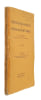
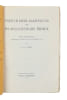
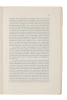
First edition, off-print, presentation-copy for Maeder, of the seminal ""Fordham Lectures"", in which Jung breaks decisively with Freud. Jung gave his ""Fordham lectures"" in New York in 1912 (EN: ""An attempt to present psychoanalytic theory. Nine Lectures Delivered in New York in September 1912""). They were then printed in German for the first time, in 1913, and subsequently published in English, under the title The Theory of Psychoanalysis, in consecutive issues of The Psychoanalytic Review between 1913 and 1915. The ""Fordham Lectures"" marked a crucial point in Jung's work, not least because they constitute a decisive break from Freud's theories, but also because he here fully develops his own understandings of sexuality, the origins of neuroses, dream interpretation, and the unconscious. Furthermore, Jung was the first to argue that analysts should themselves be analyzed. ""At the center of these lectures, the reader finds not one theory, but the exposition of a new way of doing science, a method of investigation that was unique in 1912 and remained deeply shared by Jung and Freud, notwithstanding the break that took place between the two pioneers"" (Wertz 2015, p. 4). ""The message from Jung in the Fordham lectures is clear: 'Psychoanalysis is a general method of psychological research and heuristic principle of the first rank in the domain of the human sciences.' Above all else, the Fordham lectures highlight the scientific character of the psychoanalysis shared by Jung and Freud in anticipation of the entire movement of psychoanalysis through the twentieth century and into the current century."" (Wertz 2015, p. 19) Alphonse Maeder (1882-1971) worked under Jung in the Burghölzli hospital and became a close cooperator and friend of Jung" and he broke with Sigmund Freud in 1913.See: Wertz, F.J. (2015). Jung’s break with Freud revisited: Research method and the character of theory in psychoanalysis. In M. Mattson, F. Wertz, H. Fogerty & B. Zibriskie, B. (Eds.), Carl Jung in the academy and beyond: The Fordham Lectures of 1912. New York: The Spring Press.Jung, C. G. (2011). Jung contra Freud: The 1912 New York Lectures on the Theory of Psychoanalysis. Princeton University Press.
La structure de l'inconscient. [Extrait des Archives de Psychologie, T. XVI, N. 62 (décembre 1916)]. - [FIRST APPEARANCE OF ""COLLECTIVE UNCONSCIOUS"" - PRESENTATION-COPY]
(Genève, Kundig), 1916. 8vo. Original printed orange wrappers. Spine restored, with new paper and new edges. Parts of blank paper towards hinge of back wrapper missing (but with new paper spine in matching paper underneath). A damp stain to front wrapper, towards hinge, some smaller spts, and some small nicks and creases to extremities. A very mild damp stain to inner blank margin of first quire. Pp. (152)-179. Inscribed by Jung to upper front wrapper: ""Herrn Dr. A Maeder / mit besten / Gruss vom / Verf.""
![La structure de l'inconscient. [Extrait des Archives de Psychologie, T. XVI, N. 62 (décembre 1916)]. - [FIRST APPEARANCE OF ""COLLECTIVE UNCONSCIOUS"" ...](https://static.livre-rare-book.com/pictures/LLX/63295_1_thumb.jpg)
![La structure de l'inconscient. [Extrait des Archives de Psychologie, T. XVI, N. 62 (décembre 1916)]. - [FIRST APPEARANCE OF ""COLLECTIVE UNCONSCIOUS"" ...](https://static.livre-rare-book.com/pictures/LLX/63295_2_thumb.jpg)
![La structure de l'inconscient. [Extrait des Archives de Psychologie, T. XVI, N. 62 (décembre 1916)]. - [FIRST APPEARANCE OF ""COLLECTIVE UNCONSCIOUS"" ...](https://static.livre-rare-book.com/pictures/LLX/63295_3_thumb.jpg)
Scarce first printing, off-print, presentation-copy from Jung to Maeder, of this seminal paper, which contains the very first written appearance of the term ""collective unconscious"", a concept which is “one of the pillars of the Jungian model of the psyche” (Boechat). This paper is the core of what would later become Die Beziehungen zwischen dem Ich und dem Unbewussten (EN: ""The Relations between the Ego and the Unconscious"", 1928). The renowned psychiatrist and psychoanalyst Carl Jung (1875-1961) first introduced the term ""collective unconscious"" in 1916 in a talk to the Zurich School for Analytical Psychology, with the title ""Uber das Unbewesste und seine Inhalte"". The earliest written appearance of the term was found in the present work, a French translation of the Zurich talk, published in 1916 in the Archives de Psychologies (Tresan 2005: 313). The main chapters of this early work are: I. Distinction de l'inconscient personnel et de l'inconscient impersonnel (""Distinction between the personal unconscious and the impersonal unconscious"")"" II. Les phénomènes subséquents à l'assimilation d l'inconscient (""Phenomena subsequent to the assimilation of the unconscious"")"" III. La personne considérée comme segment de la psyché collective (""The person considered as a segment of the collective psyche"")"" IV. Comment l'individualité essaye de se libérer de la psyché collective (""How individuality tries to free itself from the collective psyche""). Jung's notion of the collective unconscious “ranges from a passive repository that records the history of all human reactions to the world to an active substratum that is the ground out of which all reality emerges. The components of the collective unconscious were first said by Jung to be primordial ancestral images and later archetypes that manifest in consciousness through images, strong affects, and behavioral patterns. When the energies of the collective unconscious break through into consciousness, consciousness itself is altered, and reactions vary from insanity to a significant reordering of major attitudes"" (Tresan 2005: 313) The notion first came to Jung “from a dream he had in 1909 on board a ship returning from the United States with Freud. The dream depicted a house that had a cellar bellow the normal cellar and below that a repository of prehistoric pottery, bones, and skulls."" (Tresan 20025). The first cellar represented the personal unconscious, and Jung expected Freud to accept the ""cellars below this cellar"" (Tresan 2005). However, ""Freud acknowledged primordial ancestral patterns but regarded them as simply inheritable traits (Lamarckianism) posited in each individual (the biogenetic law). For Freud such experiences were phylogenetic recapitulations unrelated to a transcendent structure such as the collective unconscious, but for Jung they arise anew from the collective unconscious in each person in each instance just as they did in one's ancestors"" (Tresan 2005). Jung's formulation of the theory of the collective unconscious went through various phases. According to Boechat, its beginnings can be traced back to “the first moments of Jung’s creative journey during the period he was working as a psychiatrist at the Burghölzli Hospital"" (see Boechat), i.e. between 1900 and 1909. Alphonse Maeder (1882-1971) worked under Jung in the Burghölzli hospital and became a close cooperator and friend of Jung" and he broke with Sigmund Freud in 1913. Sources: Boechat, Walter. The Collective Unconscious. https://iaap.org/jung-analytical-psychology/short-articles-on-analytical-psychology/the-collective-unconscious-2/ (Accessed 15.06.26) Tresan, David. (2005). Collective Unconscious. In Alain de Mijolla (ed.), The International Dictionary of Psychoanalysis (pp. 312-314). New York: Thomson Gale.
Jung C. G. - Arthus André - Fordham Frieda - Tissot Franck - Perrot Etienne - Clausse Simone - Solié Pierre - Loupiac André - Rogé Emile - Humbert - Montangerant Paul - Gaillard Christian
Reference : 19269
Sacrifice et Castration - Cahiers de psychologie Jungienne (N°10). Le Sacrifice - Cahiers de psychologie Jungienne (N°25).
Paris, Cahiers de psychologie Jungienne. N°10. Été 1976. Brochure in-8 brochée, 71 pages. Très bon état.
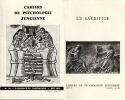
Jung Face au Nazisme - Le sacrifice d'après Jung - Castration Rituelle - L'axe vertical dans l'espace créatif - Castration et Individuation - De la biologie à la mystique du Sacrifice - La dette due au père - Le prix du Symbole - Castration et Sacrifice - C.G Jung " Commentaires sur le mystère de la fleur d'or "- Charles Baudouin, sa pensée et son enseignement - Introduction à la psychologie de C.G Jung. Mise à jour du Samedi 27 Juin 2026. Paiement PayPal immédiat, Mondial Relay pour : France, Allemagne, Autriche, Belgique, Espagne, Italie, Portugal, Luxembourg, Pays-Bas, Pologne (Communiquer votre point ou locker si connu). Une participation supplémentaire peut être demandée pour les colis lourds hors France où les envois compris entre 5 et 25 kg sont dégressifs : 2 à 4 kilogrammes - 7.99 / 5 à 10 kg - 15.99 / 15 -25 kg - 25.99. Certaines de nos collections ( Vian, Céline, Camus (...) peuvent être expédiées en Franco de port. Pour linternational hors Europe (Suisse, Canada, Japon, Etats-Unis, les frais dexpéditions peuvent varier selon le poids (mise à jour : 1 juin 2026).
Psychogenèse des maladies mentales
Albin Michel, 2001, in-8 br. (14 x 22,5), 383 p., traduit de l'allemand par Josette Rigal, très bon état.
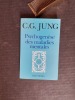
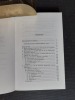
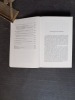
Avant de rencontrer Freud et la psychanalyse, Carl Gustav Jung travaillait déjà sur la schizophrénie aux côtés d'Eugen Bleuler et Auguste Forel. La qualité, le niveau et l'originalité de ses recherches lui valurent une notoriété certaine et la réputation d'un psychiatre prometteur. Son essai sur "La psychologie de la démence précoce" attira l'attention de Freud au moment où Jung lui-même découvrait son "interprétation des rêves". A la psychanalyse naissante, Jung associait le terrain de la psychose alors mal connu, suscitant ainsi réexamens et réévaluations de certains points fondamentaux. En 1959, dans ses Considérations actuelles sur la schizophrénie, Jung constatait avec regret que, depuis ses premières publications, les connaissances sur la nature profonde de cette maladie mentale restaient très fragmentaires. Il ferait sans doute encore le même constat aujourd'hui malgré les avancées neurobiologiques ou cognitives qui ont été effectuées. Ce volume présente un intérêt d'autant plus grand que c'est très certainement par sa formation de psychiatre et par sa connaissance de la psychose - singulièrement de la schizophrénie - que s'explique la rupture ultérieure de Jung avec Freud et la théorie nouvelle qu'il sera amené à bâtir : "Le fréquent recours à des formes et à des productions associatives archaïques qui sont observées dans la schizophrénie, écrit-il dans son essai sur la schizophrénie, m'a donné pour la première fois l'idée d'un inconscient non seulement constitué de contenus de conscience originelle perdus, mais d'une strate plus profonde, avec un caractère tout aussi universel que les motifs mythiques qui caractérisaient l'imagination humaine en général". Voir le sommaire sur photos jointes.
Jung Karl G. - Pallud Pierre - Solié Pierre - Heymes Marjolaine - Jung Emma - Hillman James Salzmann Monique - Perrot Maryvonne - Humbert Elie G. Reeves Hubert Cazenave Michel - Kugler Paul Gordon-Montagnon Rosemary - Leterrier Monique et Français - Humbert Elie G.
Reference : 19274
Synchronicité - Cahiers de Psychologie Jungienne (N°28 et 29 ). Correspondance du psychique et du Physique. Un Ordre Acausal.
Paris, Cahiers de psychologie Jungienne. N°28, 29. Hiver 1981. Brochure in-8 brochée. Très bon état. 144 PAGES.
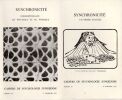
L'idée de synchronicité dans l'oeuvre de J - Unité psycho-physique du monde - Nombre et temps / Nombre et synchronicité / La synchronicité comme émergence de l'archétype du nombre - En 1938, des amis et des disciples de Jung veulent aider Freud à quitter Vienne - Anima et Animus - Le symbolisme de la roue - // - Incursion dans le monde acausal Mise à jour du Samedi 27 Juin 2026. Paiement PayPal immédiat, Mondial Relay pour : France, Allemagne, Autriche, Belgique, Espagne, Italie, Portugal, Luxembourg, Pays-Bas, Pologne (Communiquer votre point ou locker si connu). Une participation supplémentaire peut être demandée pour les colis lourds hors France où les envois compris entre 5 et 25 kg sont dégressifs : 2 à 4 kilogrammes - 7.99 / 5 à 10 kg - 15.99 / 15 -25 kg - 25.99. Certaines de nos collections ( Vian, Céline, Camus (...) peuvent être expédiées en Franco de port. Pour linternational hors Europe (Suisse, Canada, Japon, Etats-Unis, les frais dexpéditions peuvent varier selon le poids (mise à jour : 1 juin 2026).
Hommage à C.G. Jung.
Revue SYNTHESES. N° 115, décembre 1955. In-8 br. Numéro spécial consacré à C.G. Jung. Contributions : H. Corbin, René de Solier, F. Hellens, M. Lecmte, J. Masui, etc. Texte inédit de Jung.
manga FEVER 3
Editions Paquet 2006 livre manga 21*14,5 191 pages
bon brochÃ, rousseurs sur page de garde 305 g ----------> Pour bÃnÃficier du tarif de livraison le plus avantageux, pour la France et certains pays d'Europe, les livres seront expÃdiÃs par Mondial Relay. Merci de m'indiquer un point relais Mondial Relay lors de votre commande
manga FEVER 2
Editions Paquet 2006 livre manga 21*14,5 sp pages
bon brochÃ, rousseurs sur page de garde 241 g ----------> Pour bÃnÃficier du tarif de livraison le plus avantageux, pour la France et certains pays d'Europe, les livres seront expÃdiÃs par Mondial Relay. Merci de m'indiquer un point relais Mondial Relay lors de votre commande

