 Write to the booksellers
5 books for « burmannus petrus »Edit
-
Topics
Belgium (1)
Flanders (1)
History (1)
-
Countries
Belgium (3)
Netherlands (2)
Catalogus rarissimorum & praestantissimorum librorum qui in thesauris romano, graeco, italico & siculo continentur, secundum nomina auctorum per alphabeti ordinem digestus.
Leiden (Leidae), Apud Petrum vander Aa, Typographum Academiae, 1725.
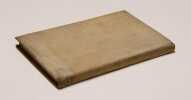
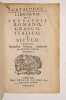
8vo. (VIII),88 p. Vellum 20.5 cm (Details: Woodcut printer's mark on the title, it depicts Athena and Hermes, the motto is: 'Hac itur ad astra', borrowed from Seneca's 73th letter. The words that complete this saying are often forgotten: 'hac secundum frugalitatem, hac secundum temperantiam, hac secundum fortitudinem') (Condition: Vellum age-tanned. Some small wormholes in the gutter of the blank upper corner, sometimes nibbling at a letter. Pinpoint wormhole in the blank right margin) (Note: The Dutch classical scholar Pieter Burman, latinized as Petrus Burmannus, 1668-1741, was professor of History and Eloquence (Latin) at the University of Utrecht from 1696, and was transferred to Leiden in 1715. As an editor he confined himself to the Latin classics, such as Phaedrus, Horace, Ovid and Lucan. 'His numerous editorial and critical works spread his fame as a scholar throughout Europe, and engaged him in many of the stormy disputes which were then so common among men of letters. Burman was rather a compiler of editions than a critic; his commentaries show immense learning and accuracy, but are wanting in taste and judgement.' (Wikipedia 'Pieter Burman the Elder') The great powers of endurance of this manufacturer of 'Variorum editions' of classical authors, and his laborious patience have led to his being described as the 'beast of burden' of classical learning. (Sandys, vol. 2, p. 445) This catalogue of 1725 is a proof of Burmannus' great powers of endurance and laborious patience. It is a bibliography, offering a list of the authors and works that are mentioned in Jacobus Gronovius' (1645-1716) huge thirteen volume 'Thesaurus Antiquitatum Graecarum' (1697-1702), and Johannes Georgius Graevius' (1632-1703) equally huge twelve volume 'Thesaurus Antiquitatum Romanarum' (1694/99), and Graevius' huge 45 volume 'Thesaurus Antiquitatum et Historiarum Italiae, Neapolis, Siciliae, Sardiniae, Corsicae etc.', (1704-1725) which was continued by Burmannus after the death of Graevius. Burmannus produced the catalogue, he tells in the preface (Lectoribus s.d. Petrus Burmannus), because he felt the need, having completed the last volume of this third series to which he contributed, to produce a supplementary volume, which was to create order in the multitude of names and the farrago of titles, and to make these huge enterprises accessible. (p. *2 recto) At the end of the preface has been printed a small advertisement of the printer/bookseller P. van der Aa, offering a complete set of the third Thesaurus for 580 guilders. The pages 84/88 are filled with another advertisement of Van der Aa: 'Catalogue de quelques livres nouveaux & autres, que Pierre Vander Aa à Leide a imprimé ou reçu de divers endroits, & qui se trouvent dans sa boutique') (Collation: *4, A-E-8, F4) (Photographs on request)
Unum epistolium epistoliorum dulcissimorum dulcissimum, unius fidelissimi discipuli & olim scholaris ad suum magistrum.
Copenhagen (Coppenhagae), 1706.
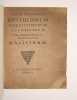
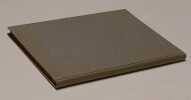
4to. (II),70 p. Modern boards. 22 cm 'Written cum maxima fractura capitis & labore' (Ref: STCN ppn 183625013; Knuttel 15549) (Condition: Paper browning. Edges of the title and second leaf chipped) (Note: The Roman author, orator and politician Cicero enjoyed his greatest glory during the Renaissance, 'when he became not only a historical figure and a writer but also the object of the literary cult known as Ciceronianism'. (The Classical Tradition, Cambr. Mass., 2010, p. 195) Petrach established Cicero as a uniquely powerful stylistic source and intellectual resource. 'In the later 15th century Humanists like Angelo Poliziano and Filippo Beroaldo began to widen the range of Latinity: they commented on and sometimes imitated Quintilian, Statius, Apuleius, and others.' (Op. cit., p. 196) Thanks to humanistically inclined popes Ciceronianism, the endeavour to imitate, or even ape the pure Latinity of Cicero, won the debate. In 1528 Desiderius Erasmus published his 'Ciceronianus', a treatise that attacked the Ciceronian pedantic Latin written by many scholars during the early 16th century. But, 'over time a moderate Ciceronianism , generally classical, but not extremist, became the norm, in Protestant 'Gymnasien' in North Germany (and the Netherlands), Jesuit schools from Paris to Prague, and English grammar schools alike. Despite the late 16th century vogue for Tacitus, Cicero retained his central position as a school author and a model for good writing of many kinds'. (Op. cit., p. 197) In the late 17th and the 18th centuries Cicero's works continued to be committed to memory in schools, as an example of good taste. Now, having acquired the principal rules, and a competent knowledge of the language, the student was adviced for his grammatical studies to peruse constantly and carefully the works of Cicero, and authors like Terentius and Caesar, in order to absorb the structure and idiom of pure Latinity. The Dutch scholar Pieter Burman, or Petrus Burmannus, 1668-1741, appointed in 1696 professor of History and of Latin at Utrecht, was one of the advocates of an elegant Latin style. In 1706 Burmannus published this satyrical letter, supposedly written by one Stephanus Spinaeus, to denounce the horrible dog-Latin of some of his colleagues, for instance the Dutch scholar Melchior Leidecker, 1642-1721, who was professor of Theology since 1678 at the university of Utrecht. Leydecker wrote a kind of barbaric Latin which no one could understand, unless he spoke Dutch. (Chr. Sepp, 'Het godgeleerd onderwijs in Nederland gedurende de 16e en 17e eeuw', Leiden 1873, p. 353) In this letter Burmannus sins against every rule of good taste and style, it teems with mistakes, barbarisms, solecisms, and idiomatic constructions in vernacular, but translated into Latin. Poking fun at Leydecker, Burmannus writes, that he wrote the letter 'cum maxima fractura capitis & labore'. This satyrical letter was published anonymously, and supposedly in Copenhagen. This is of course a mystification. It was printed in the Netherlands, probably Utrecht) (Collation: pi1, A-I4 (minus leaf I4. Leaf I4 was probably used for pi1, the title)) (Photographs on request)
SCHETS Gaspar, SCHELIUS Radbodus Hermannus, HOGERSIUS Theophilus, GRAEVIUS N., VAN KINSCHOT Caspar (& BURMANNUS Petrus, ed.)
Reference : B50014
(1772)
Analectorum Belgicorum - Pars prima continens Casparis Scheti, Corvini, Commentarius ineditus de rebus quae inter Joannem Austriacum, accedit Dialogus de Pace Pars altera continens viri illustris Rabodi Hermanni Schelii, Opuscula politica
Lugduni Batavarum[Leiden], apud Corn. Van Hoogeveen 1772 2 volumes: [2] bl. [20] CXLIII, 327 + LX,551 pp., with engraved vignette on titlepages by P.C.La Fargue, full leather binding with gilt decorations on plates and on spine, 21cm., text in latin, nice copy, [full title; Casparis Scheti, corvini, Wesemaliae baronis, Grobbendoncki toparchae, equitis aurati, quaestoris regii, etc. Commentarius ineditus de rebus quae inter Joannem Austriacum, ab eo tempore quo D.XXIV. Julii an.MDLXXVII arcem namurci intercepit, et Belgii ordines actae fuerunt. Accedit ejusdem Dialogus de pace inter Philippum II. Hispaniae regem et belgas ineunda: et alia opuscula his adjecta & Rabodi Hermanni Schelii, venebruggae et Welbergii toparchae, Iselmudani Salaniae agri praesidis, Opuscula Politica. Quibus conprehenduntur Libertas publica; protrepticus de pace, et de caussis belli anglici primi, ad principes christianos; et de iure imperii, insertis tribus Theoph. Hogersii orationibus. Quibus accedunt Joannis Georgii Graevii oratio]
BURMAN Pieter - ( Petrus Burmannus Secundus ) - Charles van HULTHEM ( provenance ) :
Reference : 32072
Petri Bvrmanni Secvndi Poëmatvm Libri Qvatvor.
Lugduni Batavorum ( Leiden ), Corn. van Hoogeveen, 1774, in-4°, title with engraved vignette (N. v.d. Meer J.) + (24)nn pp (dedications) + 502 pp, contemporary half leather with marbled boards, headcap damaged, corners bumped and worn, boards a bit soiled and worn, ex-library copy with small stamp on title. On the first paste down a nice engraved ex-libris of '' Charles van Hulthem '', with an inventory date or number in ink underneath (1819). On title and verso title small cancellation stamp of the Bibliothèque Royale de Belgique (dated 1861). Interesting provenance. Van Hulthem's library of over 30.000 volumes was bought en bloc by the young Belgian Royal Library. This book was sold in 1861as a double.
ALTMANN Johann Georg ( author ) - Pieter Burman Junior ( Petrus Burmannus Secundus ) - Daniel Albert Wyttenbach ( provenance ) :
Reference : 37789
Meletemata Philologico-Critica, quibus difficilioribus Novi Testamenti Locis ex antiquitate lux assunditur , & verus eorundem sensus indagatur. Accedit Oratio de illustri inscriptione Crucis Christi, ejusque mysterio. 3 parts in one volume.
"10. Trajecti ad Rhenum ( Utrecht ), apud Nicolaum Muntendam, 1753, small in-4°, 19,5 x 15 cm, title printed in red and black with engraved vignette + (9)nn pp + 296 pp ; (2) nn pp (subtitle part II) + 294 pp ; (2) nn pp (subtitle part III) + 168 pp + 1 folding plate + (22) nn pp (index). Bound with ; ( same author ), Exercitio Historica-Critica De Tesseris Badae Helvetiorum Erutis. Bern, Ex Typogr. Ill. Reipubl. Bernensis, 1750, in-4°, 59 pp. Contemporary full vellum, fine copy nothwithstanding some faint waterstains at a few pages. Very interesting provenance ; With a nice authograph ex-dono of the author to Pieter Burman '' Eloq. & ling. Graeco in Atheneo Amsteld. Proff. ...''. ( on the frontispiece page). This copy was then bought by Daniel Wyttenbach in 1779 at the auction of the library of P. Burman, Leiden, 27th sept. 1779 . He writes on the first fly leaf ; '' D. Wyttenb. 1779. / Ex Bibl. Burm. 16 st. ( price 16 st.). Further with the engraved ex-libris of W.H. Mill (English, 19th century).."

