 Write to the booksellers
672 books for « broglie a de »Edit
-
Type
Autograph (2)
Book (668)
Photographs (2)
-
Latest
Last 3 days (1)
Last month (2)
-
Language
Arabic (1)
French (670)
Latin (1)
-
Century
18th (4)
19th (151)
20th (254)
21st (18)
-
Countries
Belgium (41)
Brazil (1)
Canada (2)
Denmark (12)
France (595)
Germany (1)
Greece (1)
Switzerland (19)
-
Syndicate
ALAC (2)
ILAB (340)
NVVA (2)
SLACES (2)
SLAM (322)
SNCAO (5)
Topics
- Almanac (4)
- Ancien régime (20)
- Architecture (6)
- Army (3)
- Astronomy (2)
- Atomic bombs (2)
- Austria (7)
- Autographs (10)
- Bible (2)
- Biography (20)
- Broglie duke de (8)
- Broglie emmanuel de (15)
- Broglie gabriel de (13)
- Broglie louis de (15)
- Catholicism (10)
- Christianity (10)
- Churches (3)
- Daniel-rops (5)
- Decoration (2)
- Dedication (3)
- Diplomacy (6)
- Discovery (3)
- Einstein (2)
- Electronics (3)
- Engraving (books about) (3)
- Essays (2)
- Ethic (4)
- Faith (2)
- Fenelon (3)
- Fine arts (4)
- First edition (6)
- Genealogy (3)
- Geography (16)
- Germany (4)
- Hagiography (4)
- History (73)
- Inventions (2)
- Italy (2)
- Journalism (2)
- July monarchy (6)
- Languedoc (3)
- Law (2)
- Literature (28)
- Louis xv of france (6)
- Magazine (2)
- Manuscripts (5)
- Mathematics (4)
- Mechanics (3)
- Medicine (6)
- Memories (4)
- Modern times (3)
- Montalembert (3)
- Napoleon i (2)
- Navy (3)
- Newspapers press (8)
- Nuclear (3)
- Paris (2)
- Philosophy (24)
- Photography (5)
- Physics (71)
- Picardie (3)
- Poetry (2)
- Policy (9)
- Prussia (2)
- Religions (25)
- Review (2)
- Reviews (2)
- Rops félicien (2)
- Rousseau jean jacques (3)
- Sciences (59)
- Sociology (2)
- Songs (2)
- Tea (4)
- Telephone - telegraph (2)
- Theology (15)
- Various (7)
- Vatican city (2)
Malherbe
Paris Librairie Hachette et Cie (Coll. "Les grands écrivains français") 1897 190 pages in-12. 1897. cartonné. 190 pages. In-12 (184x119 mm) 190 pages. Livre relié Cartonnage toilé avec pièce de titre au dos. Frontispice en noir. Cartonnage en bon état un peu sali. Des rousseurs claires aux contre-plats et pages de garde sinon intérieur propre. Poids : 340 gr
Le secret du Roi. Tome I : Correspondance secrète de Louis XV avec ses agents diplomatiques 1752-1774
Calmann Lévy 1879 VIII-464 pages collection Bibliothèque contemporaine. in-8. 1879. broché. VIII-464 pages.
Etat correct. Couverture un peu salie et frottée. Intérieur avec rousseurs peu nombreuses
"BROGLIE (DE BROGLIE), LOUIS DE . - DISCOVERY OF THE WAVE THEORY OF MATTER AND CREATION OF WAVE-MECHANICS
Reference : 49718
(1923)
Ondes et quanta. Note de M. Louis de Broglie, présentée par M. Jean Perrin. (Séance du 10 Septembre 1923). (+) Quanta de lumière, diffraction et interférences. Note de M. Louis de Broglie, transmise par M. Jean Perrin. (Séance du 24 Septembre 1923). (...
Paris, Gauthier-Villars et Cie, 1923. 4to. Bound in one contemp. full buckram. Spines gilt and with gilt lettering. In: ""Comptes Rendus Hebdomadaires des Séances de L'Academie des Sciences"", Tome 177. Bound with orig. printed front-wrapper to No. 1, half-title and title-page to vol. 177. 1513 pp. (Entire volume offered). De Broglie's papers: pp. 507-510, pp. 548-551 a. pp. 630-32. Clean and fine. A punched stamp on foot of title-page.
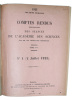
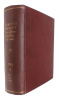
First edition of these papers which ESTABLISHED A NEW ERA IN PHYSICS by introducing the epochal new principle that particle-wave duality should apply not only to radiation but also to matter and thus CREATING QUANTUM MECHANICS. These 3 papers were extended to form his doctoral thesis of 1924 ""Recherches sur la Théorie des Quanta.""De Broglie relates ""After long reflection in solitude and meditation, I suddenly had the idea, during the year 1923, that the discovery made by Einstein in 1905 should be generalized by extending it to all material particles and notably to electrons"" (Preface to his PhD thesis 1924).""He made the leap in his September 10, 1923, paper: E=hv should hold not only for photons but also for electrons, to which he assigns a 'fictitious associated wave'. In his September 24 paper, he indicated the direction in which one 'should seek experimental confirmations of our ideas': a stream of electrons traversing an aperture whose dimensions are small compared with the wavelenght of the electron waves 'should show diffraction phenomena' .""(Pais ""Subtle is the Lord"", pp. 425-436).In the third paper (October 8) he discusses ""The interplay between the propagation of the particle and of the waves could be expressed in more formal terms as an identity between the fundamental variational principles of Pierre de Fermat (rays), and Pierre Louis Maupertuis (particles) as de Broglie discussed it further in his last communication . Therein he also considered some thermodynamic consequences of his generalized wave-particle duality. He showed in particular how one could, using Lord Rayleigh’s 1900 formula for the number of stationary modes for phase waves, obtain Planck’s division of the mechanical phase space into quantum cells.Louis de Broglie achieved a worldwide reputation for his discovery of the wave theory of matter, for which he received the Nobel Prize for physics in 1929. His work was extended into a full-fledged wave mechanics by Erwin Schrödinger and thus contributed to the creation of quantum mechanics. After an early attempt to propose a deterministic interpretation of his theory, de Broglie joined the Copenhagen school’s mainstream noncausal interpretation of the quantum theory.""(DSB).""This idea [i.e. de Broglie's that matter might behave as waves] was tested and confirmed by Davisson and Germer in 1927... Thus the duality of both light and matter had been established, and physicists had to come to terms with fundamental particles which defied simple theories and demanded two sets of 'complementary' descriptions, each applicable under certain circumstances, but incompatible with one another."" (Printing and the Mind of Man, 417).

"BROGLIE (DEBROGLIE), LOUIS de. - DISCOVERY OF THE WAVE THEORY OF MATTER AND CREATION OF WAVE-MECHANICS.
Reference : 46949
(1923)
Ondes et quanta. Note de M. Louis de Broglie, présentée par M. Jean Perrin. (Séance du 10 Septembre 1923). (+) Quanta de lumière, diffraction et interférences. Note de M. Louis de Broglie, transmise par M. Jean Perrin. (Séance du 24 Septembre 1923). (...
Paris, Gauthier-Villars et Cie, 1923. 4to. Bound in 2 contemp. full cloth. Spines gilt and with gilt lettering. In: ""Comptes Rendus Hebdomadaires des Séances de L'Academie des Sciences"", Tome 177. With htitle a. titlepage. 1513 pp. (Entire volume offered). De Broglie's papers: pp. 507-510, pp. 548-551 a. pp. 630-32. Clean and fine. A stamp to verso of titlepage.
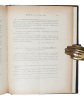
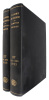
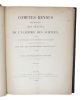
First edition of these papers which ESTABLISHED A NEW ERA IN PHYSICS by introducing the epochal new principle that particle-wave duality should apply not only to radiation but also to matter and thus CREATING QUANTUM MECHANICS. These 3 papers were extended to form his doctoral thesis of 1924 ""Recherches sur la Théorie des Quanta.""De Broglie relates ""After long reflection in solitude and meditation, I suddenly had the idea, during the year 1923, that the discovery made by Einstein in 1905 should be generalized by extending it to all material particles and notably to electrons"" (Preface to his PhD thesis 1924).""He made the leap in his September 10, 1923, paper: E=hv should hold not only for photons but also for electrons, to which he assigns a 'fictitious associated wave'. In his September 24 paper, he indicated the direction in which one 'should seek experimental confirmations of our ideas': a stream of electrons traversing an aperture whose dimensions are small compared with the wavelenght of the electron waves 'should show diffraction phenomena' .""(Pais ""Subtle is the Lord"", pp. 425-436).In the third paper (October 8) he discusses ""The interplay between the propagation of the particle and of the waves could be expressed in more formal terms as an identity between the fundamental variational principles of Pierre de Fermat (rays), and Pierre Louis Maupertuis (particles) as de Broglie discussed it further in his last communication . Therein he also considered some thermodynamic consequences of his generalized wave-particle duality. He showed in particular how one could, using Lord Rayleigh’s 1900 formula for the number of stationary modes for phase waves, obtain Planck’s division of the mechanical phase space into quantum cells.Louis de Broglie achieved a worldwide reputation for his discovery of the wave theory of matter, for which he received the Nobel Prize for physics in 1929. His work was extended into a full-fledged wave mechanics by Erwin Schrödinger and thus contributed to the creation of quantum mechanics. After an early attempt to propose a deterministic interpretation of his theory, de Broglie joined the Copenhagen school’s mainstream noncausal interpretation of the quantum theory.""(DSB).""This idea [i.e. de Broglie's that matter might behave as waves] was tested and confirmed by Davisson and Germer in 1927... Thus the duality of both light and matter had been established, and physicists had to come to terms with fundamental particles which defied simple theories and demanded two sets of 'complementary' descriptions, each applicable under certain circumstances, but incompatible with one another."" (Printing and the Mind of Man, 417).
Waves and Quanta. - [CREATING QUANTUM MECHANICS]
London, Macmillan & Co., 1923. Royal8vo. Bound with the original wrappers (in the back) in publisher's pictorial cloth. Gilt lettering and Nature's logo to spines and front board. In ""Nature"", July - December, 1923, Vol. CXII [12]. Entire volumes offered. ""Emmanuel College"" in gilt lettering to spines. Two library stamps to title-page and first index page. A small tear to top of spine and signs after removal of label to spine. Very slight wear to extremities, otherwise a fine and clean copy. Rare in the publisher's binding. P. 540. [Entire volume: LIV, 960 pp. + advertisements and wrappers].
The important Nature-printing - a summary of his three papers published in ""Comptes rendus"" the same year - of De Broglie's landmark discovery of the wave nature of matter. ""In order to reach an audience wider than the limited readership of the Comptes rendus, de Broglie arranged the publication of a summary of his results in Nature(October 1923)."" (DSB).His discovery established a new era in physics by introducing the epochal new principle that particle-wave duality should apply not only to radiation but also to matter and thus creating quantum mechanics. It was extended to form his doctoral thesis of 1924 ""Recherches sur la Théorie des Quanta.""De Broglie relates ""After long reflection in solitude and meditation, I suddenly had the idea, during the year 1923, that the discovery made by Einstein in 1905 should be generalized by extending it to all material particles and notably to electrons"" (Preface to his PhD thesis 1924).""He made the leap in his September 10, 1923, paper: E=hv should hold not only for photons but also for electrons, to which he assigns a 'fictitious associated wave'. In his September 24 paper, he indicated the direction in which one 'should seek experimental confirmations of our ideas': a stream of electrons traversing an aperture whose dimensions are small compared with the wavelenght of the electron waves 'should show diffraction phenomena' .""(Pais ""Subtle is the Lord"", pp. 425-436).In the third paper (October 8) he discusses ""The interplay between the propagation of the particle and of the waves could be expressed in more formal terms as an identity between the fundamental variational principles of Pierre de Fermat (rays), and Pierre Louis Maupertuis (particles) as de Broglie discussed it further in his last communication . Therein he also considered some thermodynamic consequences of his generalized wave-particle duality. He showed in particular how one could, using Lord Rayleigh's 1900 formula for the number of stationary modes for phase waves, obtain Planck's division of the mechanical phase space into quantum cells.Louis de Broglie achieved a worldwide reputation for his discovery of the wave theory of matter, for which he received the Nobel Prize for physics in 1929. His work was extended into a full-fledged wave mechanics by Erwin Schrödinger and thus contributed to the creation of quantum mechanics. After an early attempt to propose a deterministic interpretation of his theory, de Broglie joined the Copenhagen school's mainstream noncausal interpretation of the quantum theory.""(DSB).""This idea [i.e. de Broglie's that matter might behave as waves] was tested and confirmed by Davisson and Germer in 1927... Thus the duality of both light and matter had been established, and physicists had to come to terms with fundamental particles which defied simple theories and demanded two sets of 'complementary' descriptions, each applicable under certain circumstances, but incompatible with one another."" (Printing and the Mind of Man, 417).
Discours prononcé dans la séance publique tenue par l'Académie Française pour la réception de Monsieur Le Prince Louis De Broglie le Jeudi 31 Mai 1945 - Réponse de M. Le Duc De Broglie, directeur de l'Académie au discours de M. Le Prince Louis De Broglie -- EDITION ORIGINALE
P., Firmin-Didot, 1945, un volume in 4 broché, couverture imprimée, UN PORTRAIT, 45pp.
---- EDITION ORIGINALE de ce discours prononcé par Louis De Broglie lors de sa réception à l'Académie Française à la place laissée vacante par la mort de Emile PICARD. Le discours de Louis De Broglie occupe les pages 1 à 23. Dans ce discours Louis De Broglie fait l'éloge de Emile Picard. Ce discours est suivi par celui du Directeur de l'Académie entièrement consacré à l'éloge de Louis De Broglie**7207/M7DE
souvenirs 1785 - 1870 du feu duc de broglie
Calmann Levy 1886
Bon état Demi reliure , dos lisse orné dune pièce de titre et dune autre de tomaison ( les indications ne sont plus très lisibles ) . quelques discrets tampons de bibliothèque , texte en parfait état , reliure solide . achille-charles-léon-victor de broglie, 3e duc de broglie (1785-1870), fils du prince victor de broglie et petit-fils du 2e duc de broglie , homme détat et diplomate, membre de l'académie française (1855). ( wikipédia ) histoire politique française xixe autobiographie duc de broglie - largeur/hauteur : 14x22 cm - poids : 880 g - nombre de pages : 493 p. - langue : Français
souvenirs 1785 - 1870 du feu duc de broglie
Calmann Levy 1886
Bon état Demi reliure , dos lisse orné dune pièce de titre et dune autre de tomaison ( les indications ne sont plus très lisibles ) . quelques discrets tampons de bibliothèque , texte en parfait état , reliure solide . achille-charles-léon-victor de broglie, 3e duc de broglie (1785-1870), fils du prince victor de broglie et petit-fils du 2e duc de broglie , homme détat et diplomate, membre de l'académie française (1855). ( wikipédia ) histoire politique française xixe autobiographie duc de broglie - largeur/hauteur : 14x22 cm - poids : 900 g - nombre de pages : 426 p. - langue : Français
souvenirs 1785 - 1870 du feu duc de broglie
Calmann Levy 1886
Bon état Demi reliure , dos lisse orné dune pièce de titre et dune autre de tomaison ( les indications ne sont plus très lisibles ) . quelques discrets tampons de bibliothèque , texte en parfait état , reliure solide . achille-charles-léon-victor de broglie, 3e duc de broglie (1785-1870), fils du prince victor de broglie et petit-fils du 2e duc de broglie , homme détat et diplomate, membre de l'académie française (1855). ( wikipédia ) histoire politique française xixe autobiographie duc de broglie - largeur/hauteur : 14x22 cm - poids : 800 g - nombre de pages : 367 p. - langue : Français
GEORGES (A.) - TONNELAT (A.) - DESTOUCHES (J.L.) - COSTA DE BEAUREGARD (O.) - LOCHAK (G.) - etc -- DE BROGLIE (Louis)
Reference : 1617
LOUIS DE BROGLIE. Sa conception du monde physique -- EDITION ORIGINALE
P., Gauthier-Villars, 1973, un volume in 8 relié en pleine toile éditeur, 28pp., 387pp., nombreuses figures dans le texte et hors texte
---- EDITION ORIGNALE ---- Articles de A. GEORGES, F. KUBLI, A. TONNELAT, J.L. DESTOUCHES, J.J. TRILLAT, R. DAUDEL, O. COSTA DE BEAUREGARD, etc... ---- Oeuvres de LOUIS DE BROGLIE - Vue d'ensemble sur la carrière de LOUIS DE BROGLIE - La thèse de 1924 - Influence de la relativité sur LOUIS DE BROGLIE - Les recherches de LOUIS DE BROGLIE sur l'électrotecnique, les guides d'ondes, le principe de Huygens et la diffraction - La description des particules fondamentales dans l'oeuvre de LOUIS DE BROGLIE - etc**1617/M4
François Louis de Helmstatt, (1752-1841), page de Marie-Antoinette, militaire, gendre de Victor-François de Broglie (2e duc de Broglie).
Reference : 022188
Lettre autographe signée
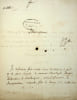
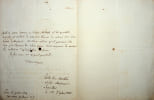
François Louis de Helmstatt, (1752-1841), page de Marie-Antoinette, militaire, gendre de Victor-François de Broglie (2e duc de Broglie). L.A.S., Paris, 6 juillet 1824, 2p in-4. Lettre à un monseigneur pour obtenir une place à un jeune, Christophe Jaeger, originaire de Sarreguemines en Moselle, d'où sa famille est originaire. [538]

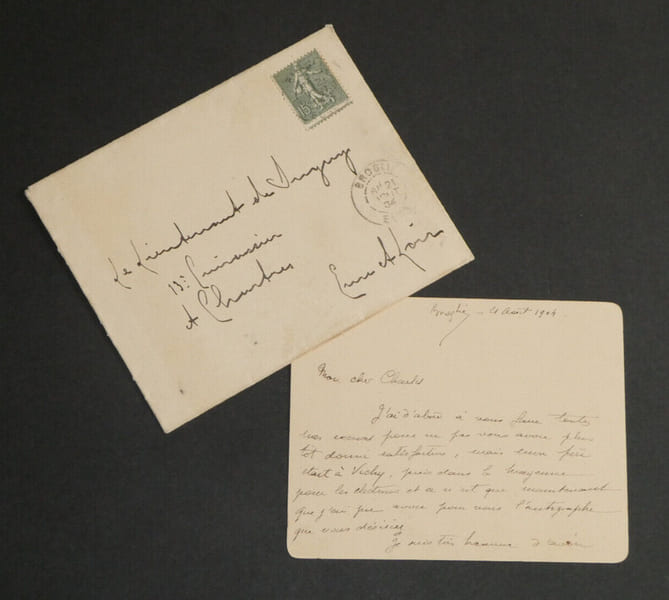
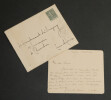
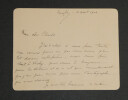
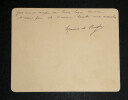
Maurice de BROGLIE - CARTE LETTRE AUTOGRAPHE SIGNÉE, 1904
Maurice de BROGLIE. Carte lettre autographe signée datée du 21 août 1904 Physicien Carte lettre autographe signée à un certain lieutenant à Chartres, datée du 21 août 1904. Dimensions : 8,9 x 11,5 cm Nombre de pages : 2 pages Maurice de BROGLIE Louis-César-Victor-Maurice, duc de Broglie, né le 27 avril 1875 dans le 8ᵉ arrondissement de Paris et mort le 14 juillet 1960 à Neuilly-sur-Seine, est un physicien français spécialiste des rayons X et des rayonnements issus des éléments radioactifs.
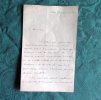
BROGLIE (Hedvig Gustava Albertina dite Albertine Stal Broglie, duchesse de).
Reference : 418
Ne Paris. 1797-1838. Fille de Mme de Stal et Erik Magnus Stal Von Holstein. Mre de Albert de Broglie, membre de l Acadmie Franaise. L.A.S. de a. Stal de Broglie Monsieur. [Paris], s.d. 1 page in-8. (Reste de montage sur onglet au verso).
La fille de Mme de Stal se voit contrainte de repousser une fois de plus le plaisir de recevoir son correspondant dner : & ma mre a les nerfs si agits& explique-t-elle ...je vous assure quelle en a bien du regret& Quand elle sera plus forte, on le lui fera savoir.A cette poque, Mme de Stal est enfin de retour Paris ; pas pour longtemps, puisquelle va mourir en juillet 1817, dans lhtel de son amie Sophie Gay (1776-1852).
Lettre Autographe Signée de Albert de Broglie.
Lettre Autographe Signée de Albert de Broglie datée de 1889.3 pages format in-8°(21x13) sous couverture plastique.Jacques Victor Albert, duc de Broglie, (1821-1901), fils d'Achille Victor, duc de Broglie, est un historien, diplomate et homme d'État français, monarchiste et orléaniste. Chef du gouvernement de l'ordre moral en 1873-1874, puis en 1877, il s'efforce vainement de préserver les droits dynastiques des Orléans. Il défend une conception aristocratique du bicaméralisme, proposant le 15 mai 1874 un Grand Conseil des Notables, qui mêlait membres nommés à vie par le président de la République, membres de droit éminents, et membres élus par les capacités.
Une tentative d'interprétation causale et non linéaire de la mécanique ondulatoire. (la théorie de la double solution).
Paris, Gauthier-Villars, 1956. Royal8vo. Uncut in the original printed wrappers. Fine and clean. VII, (1), 297, (2) pp.
First printing of de Broglie's important work on nonlinear wave mechanics. ""The early 1950s again witnessed a major change in de Broglie’s views. Impressed by the nonlocal theory put forth by David Bohm in 1951, which reintroduced pilot-waves, de Broglie turned back to his first theoretical convictions. Surrounded by some faithful followers, de Broglie resumed his quest for a causal interpretation, this time supplementing his initial views with the idea of nonlinear dynamics for the singular wave. This was, however, increasingly perceived as a marginal research program, even in his own country, where quantum theoreticians preferred to stick to more mainstream physics, less fundamental and closer to the wealth of new experimental data emerging in the 1950s."" (DSB).
Correspondance secrète du comte de Broglie avec Louis XV (1756-1774). Publiée pour la Société de l’Histoire de France par Didier Ozanam et Michel Antoine.
P., Klincksieck, 1956-1961, 2 vol. gr. in-8°, cxiv-392 et xii-536 pp, 2 portraits en frontispices, un tableau dépliant et une planche hors texte, index, brochés, bon état
Le comte de Broglie était le chef du "Ministère secret" de Louis XV. Tome 1 : 1756-1766. Tome 2 : 1767-1774. — "La publication en deux volumes de la Correspondance secrète du comte de Broglie avec Louis XV par Didier Ozanam et Michel Antoine constitue un événement : c'est un modèle de publication de texte, reconstituant une série continue avec des bribes jadis dispersées aux quatre coins des archives publiques et privées. Une mine de notes double le texte et met au service du lecteur quantité de renseignements tirés, pour la plupart, d'archives inédites et souvent inutilisées ; à tel point que le lecteur le moins versé dans les dédales de la grande politique européenne du XVIIIe siècle suit, sans aucune peine, une correspondance secrète, dont la clarté n'est pas, a priori, l'apanage. Seule, la familiarité des auteurs avec ce monde infiniment complexe, avec cette société intelligente jusqu'à l'infirmité, des agents du Secret a permis ce tour de force. Le Secret a, désormais, son classique. La France a eu, pendant trente ans, de 1743 à 1774, deux diplomaties : une officielle dotée de grands moyens, une secrète plus effacée, mais pas nécessairement moins efficace. Didier Ozanam et Michel Antoine retrouvent les origines de cette situation, nullement paradoxale, dans les ambitions polonaises de Conti et le caractère de Louis XV. Secret de Conti, jusqu'en 1756, de la mort de Fleury au renversement des alliances ; secret de Broglie, de 1756 au partage de la Pologne et à l'orientation de Louis XV vers des réformes de structure qu'une mort prématurée ne lui a pas permis de poursuivre jusqu'à leur terme. (...) On le voit, le livre de Didier Ozanam et de Michel Antoine est, à son point de départ, un ouvrage d'histoire classique ; les exigences intellectuelles de ses auteurs lui ont conféré l'étonnante richesse d'une évocation, en profondeur, du XVIIIe siècle. L'histoire diplomatique ainsi renouvelée, coulée dans une langue digne de Voltaire, a sa large place au cœur de l'histoire générale : n'est-ce pas le plus bel éloge qui puisse être fait de cette Correspondance secrète, et surtout de la très belle étude qui la précède et la domine ?" (Pierre Chaunu, Annales ESC) Désormais les frais d'envoi sont de 6 € seulement pour les livres jusqu'à 1 kg (colissimo suivi), pour la France métropolitaine.
Le Général de Valence, ou l'insouciance et la gloire. D'après les papiers inédits de Mme de Montesson, de Mme de Genlis, du général et de la comtesse de Valence.
Perrin, 1972, in-8°, 449 pp, 16 pl. de gravures et fac-similés hors texte, annexe sur les archives Valence, biblio, cart. éditeur, jaquette illustrée, bon état
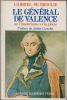
En marge du manuscrit du général de Gaulle, “La France et son armée”, on peut lire, de la main du maréchal Pétain: "Qui est Valence ?" En effet cet homme, qui toute sa vie a occupé le devant de la scène, est pourtant resté dans les coulisses de l'histoire. Cyrus, vicomte puis comte de Valence, amant de Mme de Montesson, gendre de Mme de Genlis, homme à la mode sous Louis XVI, général de la Révolution, contraint à l'exil en 1793 en compagnie du futur roi Louis-Philippe, sénateur, général de Napoléon, fut employé en Espagne, en Russie, combattit les Alliés en mars 1814 à Besançon, commanda la défense de Paris pendant les Cent-Jours et négocia l'armistice avec Wellington au lendemain de Waterloo. Il acheva sa riche carrière comme pair de France de Louis XVIII. Disposant d'archives familiales complètes, l'auteur a su restituer une époque et faire revivre un homme attirant, séduisant, présent dans tous les salons comme sur tous les champs de bataille. — "Gabriel de Broglie examine le destin du général de Valence. Fils d'un général, il est lui-même général au début de la Révolution et participe à la campagne de 1792. Mais il suit Dumouriez lorsque celui-ci rejoint le camp autrichien. Dès lors, c'est l'exil jusqu'en 1800, mais Valence ne retrouvera un commandement, secondaire d'ailleurs, qu'en 1807 ; il fera les campagnes d'Espagne et de Russie. En réalité, ce qui donne de l'intérêt à la biographie de Valence, c'est sa femme Pulchérie, fille de la célèbre Mme de Genlis. Elle le trompa d'ailleurs sans vergogne. Mais, par les Genlis, Valence a gravité dans l'entourage de la famille d'Orléans et Gabriel de Broglie, en utilisant les papiers Valence-Genlis (propriétés de la famille du maréchal Gérard qui avait épousé une fille de Valence et de Pulchérie), a, dans une certaine mesure, renouvelé le sujet." (Jacques Godechot, Revue Historique, 1975) — Bien né et reçu partout, jeune courtisan à la mode, franc-maçon orléaniste, le comte de Valence a attiré l'attention de Gabriel de Broglie. Sa biographie dévoile les secrets de ce modèle de succès mondain. Celui qui a servi Louis XVI, puis les jacobins régicides, puis Napoléon, avant d'entrer à la Chambre des pairs sous la Restauration, est aussi le parangon des girouettes. Grâce à d'exceptionnelles archives familiales, Gabriel de Broglie suit, pas à pas, le jeune noble ambitieux d'une femme à une autre, puis le vieil aristocrate impotent d'un régime au suivant, toujours occupé à régner sur les salons et les cercles. Une certaine idée de la gloire. (Yves Bruley, Historia) Désormais les frais d'envoi sont de 6 € seulement pour les livres jusqu'à 1 kg (colissimo suivi), pour la France métropolitaine.
N Paris. 1821-1901. Historien, diplomate et homme d tat franais. Chevalier de la Lgion d honneur en 1845. Membre de l Acadmie franaise. L.A.S. de Broglie mon cher collgue . S.n.l.d. 4 pages in-8.
Le duc de Broglie rdige cette lettre afin & dintercder auprs& dun collgue & en faveur dun ancien camarade [& ], homme tout fait excellent et distingu ; actuellement proviseur& En effet, celui-ci ne peut plus monter en grade car il tait souponn & davoir fait dans le Correspondant des articles dans lequels il combattait quelques unes des rformes de M. Duruy& cest--dire pour des raisons politiques.Le duc de Broglie fait appel l& esprit si clair et si impartial& de son confrre pour ne pas croire en cette culpabilit et lui confier un provisorat dans un grand Lyce, afin quil finisse & ses jours dans un rectorat&
N Paris. 1821-1901. Historien, diplomate et home d Etat franais. Chevalier de la Lgion d honneur en 1845. Membre de l Acadmie franaise. L.A.S. Broglie Monsieur et cher collgue . S.l.n.d. 3 pages in-12.
Lettre de recommandation de du Duc de Broglie pour lAbb de Contus son confrre, pour & la vacance de lvch de Prigueux, dont le titulaire vient den tre promu lvch de Tours& Selon le Duc, labb tait & ce grand vicaire prfr de Mgr Jacquemet dernier vque de Nantes et aprs M. lvque dOrlans, je ne connaissais pas de plus prlat plus courageux la fois et plus sage que Mgr Jacquemet& Plus quune recommandation, Monsieur de Broglie se permet dinsister un peu & dans lintrt des bons rapports de lEglise et de lEtat&
Trillat (Jean-Jacques) - Maurice de Broglie et Louis de Broglie (préface)
Reference : Z47700GLW
ISBN : B0046HNOW4
Découverte de la matière - Préface de Maurice et Louis de Broglie (Microscope électronique) [Paperback]
Broché bon état .Contenu propre . 1er et 4ème plats légèrement déchirés du haut .1956.358 pages. Découverte de la matière. PHOTOS SUR DEMANDE
Merci de nous contacter à l'avance si vous souhaitez consulter une référence dans notre boutique à Authon-du-Perche.
Laissez- passer du 1. 10. 1759 pour le capitaine Lardenoir signé par le duc de Broglie et Desforges. Une feuille composée - l'en-tête est contrecollé au laissez-passer - de 38 x 25,5 cm.
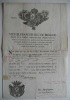
Victor François Duc de Broglie (1718 - 1804), maréchal de France (1759), gouverneur des Trois-Evêchés (1770), puis d'Alsace. Desforges (1710 - 1768), littérateur français. Il fit 3 années de cage au Mont-Saint-Michel avant de devenir secrétaire du Duc de Broglie qui, plus tard, le nomma commissaire des guerres (voire la notice dans LAROUSSE). Au verso du document se trouvent 2 annotations contemporaines signées, sur la marge du document deux notices à l'encre rouge d'un marchand de documents. Pliures et quelques petites restaurations.
Discours prononcé par M. Le duc de Broglie à la réunion électorale tenue à Evreux le 15 septembre 1885.
[Normandie, Eure, Evreux] Albert de Broglie, Discours prononcé par M. Le duc de Broglie à la réunion électorale tenue à Evreux le 15 septembre 1885. Paris, Société anonyme de publication périodiques, 1885. In-12, 32p. Petite plaquette agrafée, un des derniers actes politiques du duc qui avait échoué a être réélu sénateur en janvier 1885. [299-3]
![Discours prononcé par M. Le duc de Broglie à la réunion électorale tenue à Evreux le 15 septembre 1885.. [Normandie, Eure, Evreux] Albert de Broglie,](https://static.livre-rare-book.com/pictures/JNL/013127_thumb.jpg)
Correspondance Secrète Du Comte de Broglie Avec Louis XV (1756-1774)
Librairie C. Klincksieck 16 x 24 Paris 1956 Deux forts volumes in-8 brochés, 1956 et 1961, CXIV-392 et XII-536 p. Tableau généalogique de la famille de Broglie depuis le XVe siècle, index des noms de personnes et de lieux. Deux portraits en frontispice, un fac-similé.Tome 1 ( 1756/1766) et Tome 2 ( 1767/1774). Publiée pour la Société de l'Histoire de France. Edition de la correspondance du comte de Broglie (1719-1781), diplomate de Louis XV, précédée d'une importante introduction. Source essentielle, entre le renversement des alliances (1756) et la mort de Louis XV (1774), qui constitue "un commentaire suivi et une critique incisive de la gestion des ducs de Choiseul et d'Aiguillon, en même temps qu'un effort pour tirer Louis XV de son pacifisme et l'amener à redresser la situation diplomatique de la France, terriblement compromise par la paix de 1763 et le partage de la Pologne (1772). Dos en parfait état, exemplaire non coupé. Très bonne condition.(C144) PHOTOS NUMERIQUES DISPONIBLES PAR EMAIL SUR SIMPLE DEMANDE-DIGITAL PHOTOGRAPS MAY BE AVAILABLE ON REQUEST
"BROGLIE (DEBROGLIE), LOUIS de. - COINING THE TERMS 'ANTIPARTICLE' AND 'ANTINEUTRINO'.
Reference : 48952
(1934)
Sur la nature de photon.
(Paris, Gauthier-Villars), 1934. 4to. No wrappers. In: ""Comptes Rendus hebdomadaires des Séances de L'Academie des Sciences"", tome 198, No 2. Pp. (129-) 212. (Entire issue offered). De Broglie's paper: pp. 135-138. A stamp to the first page. Disbound.
First apperance of de Broglie's importent paper on antiparticles and the Neutrino of light. The antiparticle having the same mass as another but opposite values for its other properties.""In a communication dated January 8, 1934 (the paper offered)... de broglie stated that this new particle is an 'antiparticle which is related to (the neutrino) like the positive electron to the negative electron in the whole theory of Dirac'. In this note the terms 'antiparticle' and 'antineutrino' enter physics for the first time.""(Pais in ""Inward Bound"", p. 418).
Souvenirs français dans le Tyrol.
Innsbruck, chez l'Auteur, 1948, gr. in-8°, 177 pp, préface de Pierre Voizard, 45 portraits, gravures et photos, notes, reliure demi-toile illustrée de l'éditeur, rare fragile jaquette illustrée conservée (très lég. abîmée), bon état. Peu courant
Prisonniers politiques dans la forteresse de Kufstein : Théroigne de Méricourt, Maret de Bassano – L'émigration et les princes de Bourbon – Souvenirs militaires : 1703, 1797, 1799, 1805, 1809 – Ecrivains et voyageurs : Montaigne, Montesquieu, Dolomieu, Mme de Staël, Michelet – Internés au château d'Itter d'Albert Lebrun, Daladier, Paul Reynaud, Weygand, Gamelin, Léon Jouhaux, François-Poncet, le colonel de La Rocque – Les alpinistes... — "Il nous apparaît important de parler d’un ouvrage visant à rappeler l’origine de l’amitié franco-autrichienne. Grâce à ce livre, les troupes d’occupation françaises voulaient s’assurer que les Autrichiens ne les perçoivent pas comme de méchants occupants, mais plutôt comme des amis. C’est Raoul de Broglie qui a rédigé ce livre intitulé “Souvenirs français dans le Tyrol”, dont 2000 exemplaires ont été imprimés, grâce aux fonds destinés à la propagande française en Autriche, ouvrage commandé en juillet 1945 par Pierre Voizard, le chef de la Mission de contrôle pour les provinces du Tyrol et du Vorarlberg. (...) La description de Raoul de Broglie des rapports entre le Tyrol et la France relevait davantage du fantasme que de la réalité. Les Français étaient beaucoup plus méfiants envers les Autrichiens que ne le laisse croire l’auteur et les Autrichiens n’ont jamais accepté la présence de l’occupant français sur leur territoire. Raoul de Broglie avait toutefois l’honnêteté de parler clairement des avantages que procurait à la France l’occupation de l’Autriche..." (Éric Dussault, “La politique culturelle de la France dans sa zone d’occupation en Autriche (Tyrol et VorarÏberg) et à Vienne entre 1945 et 1955”, 2005) Désormais les frais d'envoi sont de 6 € seulement pour les livres jusqu'à 1 kg (colissimo suivi), pour la France métropolitaine.

