 Write to the booksellers
6 books for « bernoulli jacob »Edit
-
Century
17th (3)
18th (3)
-
Topics
Discovery (1)
Isaac (1)
Jacob (6)
Leibniz (2)
Mathematics (2)
Mechanics (1)
Newton (1)
Tea (3)
-
Countries
Denmark (5)
Switzerland (1)
"LEIBNIZ (LEIBNITZ), G.F. - CHRISTIAAN HUYGENS - JOHANN BERNOULLI - JACOB BERNOULLI ET AL. - THE DISCOVERY OF THE ""CATENARY CURVE"" , THE ""LOGARITHMIC CURVE"" AND THE ""POLAR COORDINATES"".
Reference : 41859
(1691)
1. De Linea in quam Flexile se pondere proprio curvat, ejeuque usu insignia adinveniendi quotcunque medias proportionales & Logarithmos. - 2. De Solutionibus Problematis Catenarii vel Funicularis in Actis A. 1691, aliisque a Dn. I.B. propositis. (1-2:...
Leipzig, Grosse & Gleditsch, 1691. 4to. Contemp. full vellum. Faint handwritten title on spine. a small stamp on titlepage. In: ""Acta Eruditorum Anno MDCLXXXXI"". (8),590,(6) pp. and 13 (of 15) folded engraved plates. The 2 first plates lacks, but they do not belong to the papers listed.Leibniz' papers: pp.277-281 a. 1 plate, pp. 435-439. Johann Bernoulli: pp. 274-276 a. 1 plate. Huygens: pp. 281-282. - Jacob Bernoulli: pp. 282-290 a. 1 plate.
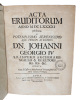
All papers first apperance. All 5 of extreme importence in the development of the Calculus. Leibniz' 2 papers on the catenary curve (paper 1-2 offered here) was written at the instigation of Jacques Bernoulli. Following the example of Blaise Pascal, who had initiated, in 1658, a contest for the construction of the cycloid, Leibniz also provoked the geometers of his time, by challenging them to submit, at the fixed date of mid-1691, their geometric method for the construction of the catenary curve. Leibniz later provided the answer, followed by Johann Bernoulli and Huygens.'These two papers are a historical account of the origin of the study of this transcendental curve, and, at the same time, the first physical-geometric construction showing the species-relationship between the catenary and the logarithmic curves, as two companion curves" one arithmetic, the other geometric. All of the differentials of the catenary curve, are arithmetic means of corresponding differentials of the logarithmic curve" and, all of the differentials of the logarithmic curve, are geometric means of the catenary.'""The Catenary is the form of a hanging fully flexible rope or chain (the name comes from ""catena"", which means 'chain'), suspended on two points. The interest in this curve originated with Galileo, who thought that is was a parabola. Young Christiaan Huygens proved in 1646 that this cannot be the case. What the actual form was remained an open question till 1691, when Leibniz, Johann Bernoulli and the then much older Huygens sent solutions to the problem to the ""Acta"" (Jakob Bernoulli, 1690, Johann Bernoulli 1691, Huygens 1691 and Leibniz 1691), - these 4 1691-papers offered here - in which the previous year Jakob Bernoulli had challenged mathematicians to solve it. As published, the solutions did not reveal the methods, but through later publications of manuscripts these methods have been known. Huygens applied with great ( paper 4) virtuosity the by then classical methods of 17th century infinitesimal mathematics, and he needed all his ingenuity to reach a satisfactory solution. Leibniz ( the papers 1-2) and Bernoulli (paper 3), applying the new Calculus, found the solutions in a much direct way. In fact, the catenary was a test-case between the old and the new style in the study of curves, and only because the champion of the old style was a giant like Huygens, the test-case can formally be considered as ending in a draw."" (Grattan-Guiness in ""From the Calculus to Set Theory, 1630-1910."").The paper by JACOB BERNOULLI ( no. 5 offered here) is a milestone papers as it marks the invention of the ""SYSTEM OF POLAR COORDINATES"" with points located by reference to a fixed point and a line through that point. Although newton had earlier also devised such a coordinate system (in 1671), his work was not known, so that the credit for the discovery generally goes to Bernoulli. (Parkinson, Breakthroughs (1691).Further papers contained in this volume of Acta Eruditorum:DENYS PAPIN: Mecanicorum de Viribus Motricibus sententia, asserta a D. Papino adversius C.G.G. L. (Leibniz) objectiones. pp. 6-13. The plate lacks. - and Dion. Papini Observationes quaedam circa materias ad Hydraulicam spectantes. Pp. 208-213 a. 1 plate. This importent paper is part of the LEIBNIZ-PAPIN-CONTROVERSY.JACOB BERNOULLI: Specimen Calculi Differentialis in dimensione Parabolæ helicoidis, ubi de flexuris curvarum in genere, carundem evolutionibus. Pp. 13-22. The plate lacks. - and J.B. Demonstratio Centri Oscillationis ex Natura Vectis, reperta occassione eorum, quæ super hac materia in Historia Literaria Roterodamensi recensentur, articulo...Pp.317-321.LEIBNIZ: O.V.E. Additio ad Schediasma de Medii Resistentia publicatum in Actis mensis Febr. 1889. Pp. 177-178. and O.V.E. Quadratura Arithmetica Communis Sectionum Conicarum quæ centrum babent,...Pp. 178-182 a. 1 plate.TSCHIRNHAUS: Singularia Effecta Vitri Caustici bipedalis, quod omnia magno sumtu hactenus constructa specula ustoria virtute superat, per D.T. Pp. 517-520

"LEIBNITZ, GOTTFRIED WILHELM., JOHANN BERNOULLI, JACOB BERNOULLI & ISAAC NEWTON - SOLVING THE BRACHISTOCHRONE PROBLEM.
Reference : 45644
(1697)
Communicatio suae pariter, duarumque alienarum ad edendum sibi a Dn. Jo. Bernoulli, deinde a Dn Marchione Hospitalio communicatarum solutionum problematici curvae..descensus a Dn. Jo. Bernpulli....propositi solutione... (Leibniz). + Curvatura Radii in...
Leipzig, Grosse & Gleditsch, 1697. 4to. No wrappers. In: ""Acta Eruditorum Anno MDCXCVII"", No V, May-issue. Pp. 193-240 (entire issue offered). With titlepage to the volume 1697. Leibniz: pp. 201-205. Johann Bernoulli: pp. 206-211. Jacob Bernoulli: pp. 211-214. Newton: pp. 223-224. As usual, some leaves with browning.
First appearance of the famous issue of Acta Eruditorum in which the 4 solutions by the 4 most eminent mathematicians at the time, were printed together. There were in all 5 solutions to the posed problem, and Newton's solution was first printed in the Philosophical Transactions (January 1697) and reprinted here. The solution proposed by L'Hopital, not printed here, was not published until 1988.The brachistochrone problem was posed by Johann Bernoulli in Acta Eruditorum in June 1696. He introduced the problem as follows: ""I, Johann Bernoulli, address the most brilliant mathematicians in the world. Nothing is more attractive to intelligent people than an honest, challenging problem, whose possible solution will bestow fame and remain as a lasting monument. Following the example set by Pascal, Fermat, etc., I hope to gain the gratitude of the whole scientific community by placing before the finest mathematicians of our time a problem which will test their methods and the strength of their intellect. If someone communicates to me the solution of the proposed problem, I shall publicly declare him worthy of praise."" Johann Bernoulli and Leibniz deliberately tempted Newton with this problem. It is not surprising, given the dispute over the calculus, that Johann Bernoulli had included these words in his challenge:- ....""there are fewer who are likely to solve our excellent problems, aye, fewer even among the very mathematicians who boast that [they]... have wonderfully extended its bounds by means of the golden theorems which (they thought) were known to no one, but which in fact had long previously been published by others.""According to Newton's biographer Conduitt, he solved the problem in an evening after returning home from the Royal Mint. Newton: ... ""in the midst of the hurry of the great recoinage, did not come home till four (in the afternoon) from the Tower very much tired, but did not sleep till he had solved it, which was by four in the morning.""Newton send his solution to his friend Charles Montague and Montague published anonymously in the Transactions. Newton's solution, presented here in the Acta, is also anonymous. The episode did not please Newton, as he later wrote: ""I do not love to be dunned [pestered] and teased by foreigners about mathematical things ..."" After the competition Johann Bernoulli said "".... my elder brother made up the fourth of these (after Leibniz, himself and Newton), that the three great nations, Germany, England and France, each one of their own to unite with myself in such a beautiful search, all finding the same truth.""Struik (Edt.) ""A Source Book in Mathematics, 1200-1800, pp. 391 ff.
"BERNOULLI, (JACOB). - A NEW ERA IN THE MECHANICS OF ELASTICAL BODIES.
Reference : 44383
(1706)
Veritable Hypothêse de la Résistance des Solides, Avec la Démonstration de la Coubure des corps qui sont Ressort. Lettre du 12. Mars 1705.
Paris, Jean Boudot, 1706. 4to. Without wrappers. Extracted from ""Mémoires de l'Academie des Sciences. Année 1705"". Pp. 176-186 and 1 folded engraved plate.
First appearance of a founding paper in the theory of elastic curves. ""Importent also is his last work, on the resistance of elastic bodies (1705)."" (DSB II, p.49 s).""During the last quarter of the seventeenth century and the beginning of the eighteenth centuries a rapid development of the infinitesimal calculus took place. Started on the Continent by Leibnitz...it progresssed principally by the work of Jacob and John Bernoulli. In trying to expand the field of application of this new mathematical tool, they discussed several examples from mechanics and physics. One such example treated by Jacob Bernouilli..concerned the shape of the deflection curve of an elastic bar and in this way he began an importent chapter inthe mechanics of elastic bodies.""(Timoshenko ""History of Strenght of Materials"" p. 25-26).
Ars conjectandi, opus posthumum. Accedit tractatus de seriebus infinitis, Et Epistola Gallicè scripta de ludo pilae reticularis.
Basilea, Impensis Thurnisiorum Fratum, 1713. Petit in-4 de [4]-306-35-[1] pages, plein veau moucheté brun, dos à nerfs, pièce de titre en maroquin beige, filet doré sur les coupes, tranches rouges.
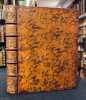
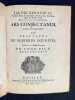
Édition originale de «l'ouvrage de référence sur la théorie des probabilités» qui « a énoncé les principes fondamentaux du calcul des probabilités et a été le premier à suggérer que cette théorie pouvait s'étendre au-delà des frontières des mathématiques pour s'appliquer aux affaires civiques, morales et économiques » (Norman). Cet ouvrage « a constitué la première tentative systématique visant à établir la théorie des probabilités sur des bases solides, et il reste encore aujourd'hui le fondement de nombreuses applications pratiques reposant sur les probabilités : les assurances, les statistiques et les tables mathématiques de fécondité » (PMM). L’Appendice, rédigée en français, explique les différentes stratégies du jeu de paume et les probabilités de victoire dans différentes situations. Bernoulli aborde les joueurs de force inégale, les parties à deux contre un et d’autres permutations du jeu. Bien complet des tableaux dépliants aux pages 172, 306 et 24 de la seconde partie. Très bel exemplaire. Norman 216; PMM 179. HORAIRE ESTIVAL : DU LUNDI 27 JUILLET AU SAMEDI 21 AOUT NOUS SERONS OUVERTs UNIQUEMENT SUR RENDEZ-VOUS.
"LEIBNITII, GODOFREDI GUILIELMI. (GOTTFRIED WILHELM LEIBNIZ) & BERNOULLII (IACOBI). (JACOB BERNOULLI) & BERNOULLII (IOHANNIS). (JOHANN BERNOULLI).
Reference : 42860
(1695)
Specimen Dynamicum (+) Notatiuncula Constructiones Lineae in qua Sacoma aequilibrium cum pondere moto faciens incedere debet. Et quaedam de Quadraturis (+) Resposio ad nonnullas Difficultates a Bern. Nieuwentüt circa Methodum differentialem motas (+) ... - [FIRST PUBLICATION OF THE ""BERNOULLI EQUATION"".]
Leipzig, Grosse & Gleditsch, 1695. 4to. Contemp. full vellum. Faint handwritten title on spine. A small stamp on titlepage and pasted library label to pasted down front free end-paper. In: ""Acta Eruditorum Anno MDCXCV"". (2), 560, (52) pp. + 10 plates. As usual with various browning to leaves and plates. The entire volume offered. Leibniz's papers: pp. 145-57" 184-185 310-316 369-372 493-495. Jacob Bernoulli's paper: pp. 537-553 + one folding table 65-66. Johann Bernoulli's: pp. 59-65" 374-376.
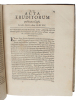
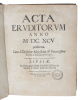

First printing of a series of influential papers by Leibniz, Jacob Bernoulli and Johann Bernoulli.First publication of Jakob Bernoulli's famous and influential ""Bernoulli Equation"". In ""Notatiuncula Constructiones Lineae"" Bernoulli proposed a solution to non linear equations which today is one of the most common used solutions of the general fluid. Bernoulli equations are significant because they are nonlinear differential equations with known exact solutions. In the ""Specimen dynamicum"" Leibniz presents a conception of body and force which distinct between primitive and derivative forces and between active and passive forces. This article is regarded as being the clearest exposition of Leibniz' dynamics. (DSB VII, 151b).""The first attempt at a detailed account of the dynamics was a long dialogue, the ""Phoranomus seu de potentia et legibus naturae,"" written in July 1689 while Leibniz was in Rome. This was quickly followed be the composition of the massive Dynamica de potential et legibus naturae corporeae (1689-90) [...]. Though it was written with the intention of publication, and though Leibniz work at publishing it, he never considered it entirely finished and it remained unpublished during his lifetime.The later [...] he finally revealed some of the metaphysical foundations of the project in an essay [the present paper]."" (Garber, Daniel. Leibniz: body, substance, monad. 2009. 132 p.)""Its title suggests a summary of or a selection from the earlier work [...]. However, it actually contains something in a way rather more interesting: a careful exposition of the metaphysical foundations of the new science, something that is hard to find in the old Dynamica or any of the more Technical pieces."" (Garber, Daniel. Leibniz: Body, Substance, Monad. 2009. 133 p.)
Analysis magni problematis Isoperimetrici. - [BERNOULLI'S SOLUTION TO THE ISOPERIMETRIC PROBLEM]
Leipzig, Gross & Fritsch, 1701. 4to. Contemporary full vellum. Handwritten title on spine. A small stamp to title page and page . Pasted library label to pasted down front free end-paper. In: ""Nova Actorum Eruditorum Anno MDCCI"". Pp 213-228 + 1 engraved plate. [Entire volume: (2), 581 pp. + 8 engraved plates].
First publication of Jacob Bernoulli influential dissertation in which he published the first correct solution to the isoperimetric problem both Johann Bernoulli and Leibniz had been seeking without success. The paper influenced both Leonhard Euler in writing his first research paper and British mathematician Brook Taylor to begin a dispute which has later been referred to as Taylor versus Continental mathematicians. ""It [the dissertation] was considered as a prodigy of sagacity and invention: and indeed, if the time be considered, it will not be too much to assert, that a more difficult problem never was solved."" (Bossut. A general history of mathematics. 341 p.).The isoperimetric problem is an ancient problem which dates back to antiquity and can be described as which curve, if any, maximizes or minimizes the area of its enclosed region?Euler, who had been taught by Johann Bernoulli, published his first paper in 1726 which was a note on the construction of isochronous curves in a resistant medium.DSB II, 48b.The following papers by Johann Bernoulli are also contained in the present volume:1. Disquisitio Catoptrico-Dioptrica exhibens Reflexionis et Refractionis naturam ex aequilibrii fundamento deductam. Pp 19-26.2. Novaratio construendi radios osculi seu curvanturae in Curvis quibusvis etc. Pp. 136-40.3. Multisectio Anguli vel Arcus, duplici aequatione universali exhibita. Pp. 170-75.

