 Write to the booksellers
5 books for « astronomy »Edit
-
Century
18th (1)
19th (2)
20th (1)
-
Topics
Astronomy (5)
Maps (1)
Tea (2)
-
Countries
Denmark (3)
France (1)
Switzerland (1)
"HERSCHEL, WILLIAM. - THE BASIS OF INTERFEROMETRIC IMAGING IN ASTRONOMY.
Reference : 42389
(1805)
Experiments for ascertaining how far Telescopes will enable us to determine very small Angles, and to distinguish the real from the spurious Diameters of celestial and terrestrial Objects: with an Application of the Result ofthese Experiments to a ser...
(London, W. Bulmer and Co., 1805). 4to. No wrappers as extracted from ""Philosophical Transactions"" 1805 - Part I. Pp. 31-64 and 1 engraved plate. Clean and fine.
First appearance of an importent paper, founding the metric of interstellar space.It was the contemporous discoveries of the first minor planets, ceres in 1801, Pallas in 1802 and Juno in 1803, that prompted Herschel to investigate the origin of the spurious diameters of stars. ""Were their apparent diameters as real as those of planets or spurious as for stars? To address this question Herschel conducted an extensive series of experiments in his garden in Slough, examining through his telescope small globules of differing sizes and materials placed in a tree some 800 ft (ca. 244 m) away (Herschel 1805). His observations showed that for the smallest globules the diameters were all spurious and all of the same size. Furthermore, he found that, if just the inner part of the aperture of the telescope were used, the spurious diameters, whether of globules or of stars, were larger. If the whole aperture was employed, the diameters were smaller, and if only an outer annular aperture was used the diameters were smaller still. This experimental discovery that unfilled apertures can be used to obtain high angular resolution remains today the essential basis for interferometric imaging in astronomy (in particular Aperture Masking Interferometry). The theoretical justification of this result came with Airy's analysis of the diffraction pattern of a circular aperture 30 years later (Airy 1835), and it took a further 30 years before the idea of using multiple apertures was developed. In an early study the Reverend W. R. Dawes noted that he had frequently found great advantage from the use of a perforated whole aperture' and that when observing Venus this produced a central image of the planet perfectly colourless, and very sharply dened' (Dawes 1866). But it was left to Fizeau, in his submission to the Commission for the Prix Bordin the following year, to remark on une relation remarquable et n´ecessaire entre la dimension des franges et celle de la source lumineuse' and suggest that by using an interferometric combination of light from two separated slits il deviendra possible d'obtenir quelques donn´ees nouvelles sur les diametres angulaires de ces astres' (Fizeau 1868).""

Recherches sur la Précession des Équinoxes, et sur la Nutation de L'Axe de la Terre (and) De la Parallaxe de la Lune tant par Rapport a sa Hauteur qu'a son Azimuth dans L'Hypothese de la Terre Spheroidique.
(Berlin, Haude et Spener, 1751). 4to. No wrappers, as issued in ""Mémoires de l'Academie Royale des Sciences et Belles-Lettres"", Tome V, pp. 289-325 and 1 folded engraved plate - pp. 326-338 and 1 folded engraved plate.
Both first edition.These memoirs ""Research concerning the precession of the eqinoxes and of the nutation of the earth's axis"" and ""On the parallaxe of the Moon, with respect to its elevation and azimuth, under the hypothesis of a spherical earth"" played an importent role in the confirmation of Newton's theory of gravitation by using analytical methods instead of geometrical. - Eneström, Euler Bibliography E 171 a. E 172.
"HERSCHEL, WILLIAM. - THE BASIS OF INTERFEROMETRIC IMAGING IN ASTRONOMY.
Reference : 45883
(1805)
Experiments for ascertaining how far Telescopes will enable us to determine very small Angles, and to distinguish the real from the spurious Diameters of celestial and terrestrial Objects: with an Application of the Result ofthese Experiments to a ser...
(London, W. Bulmer and Co., 1805). 4to. No wrappers as extracted from ""Philosophical Transactions"" 1805 - Part I. Pp. 31-64 and 1 engraved plate. Clean and fine.
First appearance of an importent paper, founding the metric of interstellar space.It was the contemporous discoveries of the first minor planets, ceres in 1801, Pallas in 1802 and Juno in 1803, that prompted Herschel to investigate the origin of the spurious diameters of stars. ""Were their apparent diameters as real as those of planets or spurious as for stars? To address this question Herschel conducted an extensive series of experiments in his garden in Slough, examining through his telescope small globules of differing sizes and materials placed in a tree some 800 ft (ca. 244 m) away (Herschel 1805). His observations showed that for the smallest globules the diameters were all spurious and all of the same size. Furthermore, he found that, if just the inner part of the aperture of the telescope were used, the spurious diameters, whether of globules or of stars, were larger. If the whole aperture was employed, the diameters were smaller, and if only an outer annular aperture was used the diameters were smaller still. This experimental discovery that unfilled apertures can be used to obtain high angular resolution remains today the essential basis for interferometric imaging in astronomy (in particular Aperture Masking Interferometry). The theoretical justification of this result came with Airy's analysis of the diffraction pattern of a circular aperture 30 years later (Airy 1835), and it took a further 30 years before the idea of using multiple apertures was developed. In an early study the Reverend W. R. Dawes noted that he had frequently found great advantage from the use of a perforated whole aperture' and that when observing Venus this produced a central image of the planet perfectly colourless, and very sharply dened' (Dawes 1866). But it was left to Fizeau, in his submission to the Commission for the Prix Bordin the following year, to remark on une relation remarquable et n´ecessaire entre la dimension des franges et celle de la source lumineuse' and suggest that by using an interferometric combination of light from two separated slits il deviendra possible d'obtenir quelques donn´ees nouvelles sur les diametres angulaires de ces astres' (Fizeau 1868).""
The Moon or Selenology in its Various Aspects.
Geneva, Nagel Publishers, 1970. 12 mo, 176 pages, full red percaline, gilt title, orange headband, dust jacket printed in red.
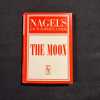
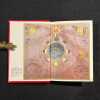
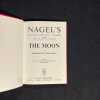
96 black-and-white illustrations, 7 colour illustrations and 4 folded maps. "Handbooks for more than 40 earthbound locations have so far been published in the popular range ofNAGEL'S ENCYCLOPEDIA-GUIDES. Now we have this illustrated special edition dedicated for the first time to an extra-terrestrial area.After the epoch-making success of space flight and especially following man's first landing on the MOON, people on our planet have become interested in tourist space travel. For a long time they have been talking about plans for hotels on the moon, and Pan American World Airways have a waiting list of about 80,000 who want to fly there.To match the flow of swiftly moving ideas, the thought of a travel guide for the moon does not seem so far fetched. However, the realisation of such an idea might only increase the flood of recent ephemeral publications on man's advance into the universe.Instead we have endeavoured to make this book a more lasting contribution to the illustrated history of lunar science, thus adding a new volume- in this case, of purely encyclopedic character - to the above mentioned range.The task of editing the explanatory text and compiling the illustrations has been entrusted to Dr. Peter Baumgarten. Our special acknowledgement goes to the various learned bodies mentioned in the legends to the illustrations, who have generously made available material from their records." NAGEL PUBLISHERS. Du 26 septembre au 5 octobre, le libraire est absent il prendra connaissance de vos commandes dès le 6 octobre au matin. Et durant cette période, l'horaire de fermeture sera 17h30 du lundi au vendredi. – From September 26 to October 5, the bookseller is absent; he will take note of your orders as early as the morning of October 6. And during this period, the closing time will be 5:30 p.m. from Monday to Friday.
THE NEW ASTRONOMY
N.Y., Schuster, 1955, un volume in 8, broché, 10pp., 246pp.
---- EDITION ORIGINALE -- Articles originaux de : Gamow (G.). Modern cosmology ; Turbulence in space - Gray (G.W.). A larger and order universe - Gérard de Vaucouleurs (M.). The supergalaxy ; Mars - Struve (O.). The evolution of stars et de MM. Le Corbeiller, Hannes Alfvén, Bart J. Bok, W.W. Morgan, Cecilia H. Payne-Gaposchkin, R. Marshak, Fred Hoyle, L. Whipple, A.J; Deutsch, Fletcher G. Watson, J. Stebbins, A.C.B. Lovell, H.I. Ewen**4712/L5DEP

