 Write to the booksellers
8 books for « arrianus »Edit
-
Century
17th (1)
18th (1)
19th (2)
20th (1)
-
Topics
Greek (4)
Latin (1)
Military arts (1)
Philosophy (1)
-
Countries
Denmark (1)
France (4)
Netherlands (3)
-
Syndicate
ILAB (5)
SLAM (4)
Arriani Nicomedensis Expeditionis Alexandri libri septem, et Historia Indica graec. et lat. cum annotationibus et indice graeco locupletissimo Georgii Raphelii. Accedunt Eclogae Photii ad Arrianum pertinentes cum lectionibus variantibus Dav. Hoeschelii, summaria librorum distincta & emendata, index rerum accuratissimus, nec non tabula geographica Expeditionis Alexandri.
Amsterdam (Amstelaedami), Apud Wetstenium, 1757.
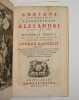
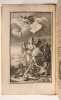
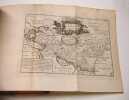
8vo. XLVIII,637,(211) p., frontispiece, folding map of Europe and the Orient. Vellum 21 cm (Ref: STCN ppn 212310364; Hoffmann 1,377; Brunet 1,497; Dibdin 1,329: 'An excellent and commodious edition'; Moss 1,188; Graesse 1,227; Ebert 1236) (Details: 6 thongs laced through the joints. Frontispiece by I.K. Philips (in Greek letters), depicting an armed and winged Nike crushing 3 ennemies, a black African, an Asian and a European; in the air flies Fama with her trumpet. Title in red & black. Printer's mark on the title, depicting a hand sharpening a chisel on a whetstone, the motto is: 'Terar dum prosim'. The map is executed by N. Frankendaal. The text is printed in 2 columns, Greek and Latin side by side) (Condition: Vellum slightly soiled and wrinkled at the top of the spine. Paper clipping on Nicomedia from 'The Gentleman's Magazine' (Vol. 98, 1828, Supplement part 1, p. 627) tipped in on front pastedown. Old & legible ink annotations on the front flyleaf. Rear endpapers stained, and its pastedown is detached. Paper yellowing) (Note: This edition of Arrianus is more or less a 'parergon' of the German Lutheran theologian Georg Raphel, latinized as Georgius Raphelius, 1673 - 1740. He was 'Pfarrer' and Superintendent of the St. Nicolai church, and Inspector of the 'Scholae Johannaeae' at Luneburg. His interest in pagan antiquity and in the New Testament generated a series of works in which he compared the language and style of the New Testament with works of ancient historians. In 1709 he published in Hamburg, 'Annotationes Philologicae in N.T. ex Xenophonte collectae'. In 1715 appeared, also in Hamburg, 'Annotationes Philologicae in N.T. ex Polybio & Arriano collectae'. He published in Lüneburg in 1731 'Annotationes in S. Scripturam ex Herodoto collectae'. In 1710 Raphel had published a German translation of the Indica of Arrian, 'Arriani Indica, d.i. Indianische Geschichte oder Reisebeschreibung der Flotte Alexanders des Grossen, aus dem Griechischen ins Deutsche Übersetzt'. The three 'Annotationes Philologicae' were reprinted together in Leiden in 1747. This edition contains an extensive biography of Raphel, with at the end a list of his published works, and a short list of not yet published work: 'Scripta Rapheliana in MSC. adhuc latentia'. One of these 'scripta latentia' is 'Annotationes in Arrianum'. In the preface (Lectori) to our edition of Arrianus of 1757 the publisher Wetstein tells us that this manuscript with notes on Arrianus had lain tucked away ever since 1709 in a drawer ('in privatis scriniis'). (p. X) It had been offered in the meantime to German publishers, who however feared that they would not make a penny from it. Wetstein tells us that finally the son-in-law of Raphel, one Conr. Arn. Schmid (whom Ebert erroneously considers to be the editor), asked him to publish this work of his beloved and admired father-in-law. Raphel not only produced the annotations, but had made also a careful recension of the Greek text, especially with the help the new edition of the Leiden professor of Greek Jacobus Gronovius, who had discovered a new important manuscript of Arrian. ('textum quam potuit accuratissime castigavit, adjutus praesertim libris MSS a Jac. Gronovio consultis'. Preface p. VIII). The manuscript of Raphel contained also a corrected Latin translation. ('versionemque permultis locis pravam elegantissime correxit'. (Idem, ibidem) Wetstein probably here refers to the Latin translation of Bonventura Vulcanius which was printed in the 1704 edition of Gronovius. Wetstein ends with the assurance that all lovers of literature will thank the son-in-law for his troubles. Raphel is also known for this pioneering work on deaf-muteness. Three of his children were deaf and dumb. 'Paternal affection had inspired him with zeal and skill in their instruction, and in 1718 he published, for the benefit of others, the result of his labours', 'Die Kunst Taube und Stumme reden zu lehren, am Exempel seiner eigenen Tochter'. It is said that his eldest daughter spoke so well that her deficiency was hardly noticed. The girl died however 20 years old) (Provenance: On the front flyleaf at the head of the manuscript notes the name 'Mitford', and 'White') (Collation: *-3*8; A-2S8, 2T-3Q4, 3R8, 3S4) (Photographs on request)
Stoa en litteratuur in het licht der Schrift.
Goes, Oosterbaan & Le Cointre, 1949.
XIV,242 p. Cl. 22 cm (OiN p. 99; including an ample anthology of the Epicteti Dissertationes of Arrianus)
Werke. Übersetzt und erläutert von C. CLESS. (Vol. 1 & 2: Anabasis).
Stuttgart, Krais & Hoffmann, 1862 - 1865.
279;201 p. H.calf 17 cm (Lacking vol. 3, which contains the minor works of Arrian)(Cover scuffed, corners bumped; head & tail of spine chafed; foxed; Gothic script)
Arriani Ars Tactica, Acies Contra Alanos, Periplus Ponti Euxini, Periplus Maris Erythraei, Liber De Venatione, Epicteti Enchiridion, Ejusdem Apopthegmata et Fragmenta, Quae in Joannis Stobaei Florilegio, et in Agellii Noctibus Atticis Supersunt, Appianoy
Apud Janssonio - Waesbergios, Amstelodami Relié 1683 In-8 relié plein vélin (20 * 13 cm), 7 feuillets non-chiffrés, (14 pages) incluant le faux titre illustré d'une jolie gravure à vignettes, le titre, la dédicace à Henrico Casimiro gouverneur général de la Frise, puis deux pages de sommaire et trois pages de nomenclature, une grande carte de l'océan indien avec 3 cartouches d'après Abraham Ortelius, le texte 450 page, pour finir 2 feuillets (4 pages) d'arrata. Texte en deux colonnes latin et grec. On trouve également un carte dépliante du Pont Euxin et une planche dépliante de tactique, et quelques croquis gravés de tactiques dans le texte. 'the best edition' (Dibdin I, page 331 (4th ed.) Sans doute une des meilleurs éditions des écrits d'Arrien commentée par établie par Blancardi et reprenant de nombreux commentaires de Meric Casaubon, Jusus Lipsius, Angelo Politan, Lucas Holstein etc., bel exemplaire en reliure d'époque. Livraison a domicile (La Poste) ou en Mondial Relay sur simple demande.


Expeditionis Alexandri libri septem et Historia Indica. Ex Bonav. Vulcanii interpretatione Latina post variam aliorum industriam...Opera Jacobi Gronovii. Lugd. Batavorum (Leiden), Petrus van der Aa, 1704.
Folio. Probably publishers full blindtooled vellum. Rebacked with most of the orig. vellumback preserved. Title in greek a. latin, red and black letters with a woodcut. Engraved portr., 2 textengravings. (10),376,(6) pp. Ocassionally light browning to leaves. Greek and latin paralelltext.
Brunet I,497.
FLAVII ARRIANI ANABASIS ALEXANDRI
B. G. Teubner. 1910. In-12. Broché. Etat d'usage, Couv. légèrement passée, Dos abîmé, Intérieur acceptable. 333 pages. Texte en grec ancien. Scotch jauni sur le dos. Plats et quelques cahiers détachés.. . . . Classification Dewey : 480-Langues helléniques. Grec
'Bibliotheca Scriptorum Graecorum et Romanorum Teubneriana'. Edidit A.G. Roos. Edition Stereotypa Minor. Classification Dewey : 480-Langues helléniques. Grec
ARRIANI ANABASIS ALEXANDRI
Weidmannos, Berlin. 1867. In-8. Broché. Etat d'usage, Tâchée, Dos fané, Non coupé. 304 pages. Texte en grec ancien. Illustré d'une carte dépliable en noir et blanc en fin d'ouvrage. Papier muet encollé sur le dos, le consolidant. Etiquette de code sur la couverture. Quelques tampons de bibliothèque. Traces de colle sur la couverture.. . . . Classification Dewey : 480-Langues helléniques. Grec
Edidit Carolus Sintenis. Cum Tabula Geographica Aeri Incisa. Classification Dewey : 480-Langues helléniques. Grec
ARRIAN'S ANABASIS, 2 HEFTE
B. G. Teubner, Leipzig. 1871-1875. In-8. Broché. Etat d'usage, 2ème plat abîmé, Dos fané, Non coupé. 205 pages pour le tome I et 228 pages pour le tome II. Tome I illustré d'une carte dépliable en frontispice. Texte en grec ancien et Notes en allemand (sur 2 colonnes). Papiers muets encollés sur les dos, les consolidant. Etiquettes de code sur les couvertures. Traces de colle sur les dos. Manque sur le bord du 2e plat du tome II.. . . . Classification Dewey : 480-Langues helléniques. Grec
Erklärt von Dr. K. Abicht. Classification Dewey : 480-Langues helléniques. Grec

