 Write to the booksellers
6 books for « archimedes »Edit
-
Century
16th (1)
17th (1)
18th (1)
20th (2)
-
Topics
Germanic languages (1)
Greek (1)
Latin (1)
Mathematics (4)
-
Countries
Denmark (4)
France (1)
Netherlands (1)
-
Syndicate
ILAB (5)
SLAM (1)
De iis quae vehuntur in Aqua Libri Duo. A’ Federico Commandino Urbinate in pristinum nitorem restituti, et commentariis illustrati. - [THE FOUNDING WORK ON HYDROSTATICS]
Bologna, Alessandreo Benacci, 1565. 4to. In contemporary blank cardboards with marbled paper back-strip. Ff 8-12 with small brown dot to lower outer margin, not affecting text. A fine copy. [4], 43 ff. + 1 blank. (Erroneously paginated f. 33 as 25 and f. 44 as 43).
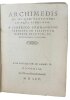
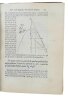
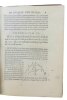
First edition of Commandino's translation, and accompanying mathematical additions, of Archimedes' work on floating bodies, being the foundational work of hydrostatics. Commandino's own mathematical additions include the very first attempt to fill the gap in the incomplete proof of propositions 2 in book II of the Latin translation made by the Flemish Willem Moerbeke in 1269. ""This edition of Commandino remained the reference until the early twentieth century and the work of Heiberg after the discovery of the Archimedes palimpsest"". (D.B.I).""In hydrostatics [Archimedes] described the equilibrium of floating bodies and stated the famous proposition - known by his name - that, if a solid floats in a fluid, the weight of the solid is equal to that of the fluid displaced and, if a solid heavier than a fluid is weighed in it, it will be lighter than its true weight by the weight of the fluid displaced. We owe to Archimedes the full exposition of the doctrine of levers and pulleys."" (PMM, p. 44)The work consists of two parts: The first is to the effect that the pressure excerted by any part of a fluid on the fluid is downward. The second postulate states that the pressure of the fluid on a body placed in it is exerted upward along the perpendicular through the center of the body.However, Book II contained many sophisticated ideas and complex geometric constructions and did not have the appeal of Book I. Only after Greek geometry was combined with algebra, trigonometry, and analytical geometry, the present work being one of the earliest attempts to do this, and the field of mechanics reached the maturity to handle the concepts of equilibrium and stability that Archimedes introduced was Book II seriously studied. It then became the standard starting point for scientists and naval architects examining the stability of ships and other floating bodies.""Archimedes left to posterity his famous treatise ""On Floating Bodies"", which establishes the physical foundations for the floatability and stability of ships and other maritime objects. Yet since this treatise was long lost and also simply ignored by practitioners, it took many centuries before Archimedes' brilliant insights were actually applied in ship design and ship safety assessment."" (Nowacki, The Heritage of Archimedes in Ship Hydrostatics: 2000 Years from Theories to Applications).A Greek manuscript dating from about the ninth century and containing both books of On Floating Bodies was translated into Latin by the Flemish Dominican William of Moerbeke in 1269, along with other works of Archimedes from other manuscripts. The tracks of the Greek manuscript were lost in the fourteenth century, but Moerbeke's holograph remains intact in the Vatican library (Codex Ottobonianus Latinus 1850) [5, 8]. Moerbeke's Latin translation was the source of all versions of On Floating Bodies from his time until the twentieth century.""In 1543 Tartaglia [...] the Moerbeke translations of On the Equilibrium of Planes and Book I of On Floating Bodies (leaving the erroneous impression that he had made these translations from a Greek manuscript, which he had not since he merely repeated the texts of the Madrid manuscript with virtually all their errors). Incidentally, Curtius Trioianus published from the legacy of Tartaglia both books of On Floating Bodies in Moerbeke's translation (Venice, 1565). The key event, however, in the further spread of Archimedes was the aforementioned editio princeps of the Greek text with the accompanying Latin translation of James of Cremona at Basel in 1544. Since the Greek text rested ultimately on manuscript A,On Floating Bodies was not included. A further Latin translation of the Archimedean texts was published by the perceptive mathematician Federigo Commandino [...], which the translator supplemented with a skillful mathematical emendation of Moerbeke's translation of On Floating Bodies (Bologna,1565) but without any knowledge of the long lost Greek text."" (DSB)Adams, 1533 Riccardi, I, 42- 5Honeyman 131" Macclesfield 183D.B.I., XXVII, p. 604.Bibliotheca Mechanica 78Graesse I, 180.BM 000105842

Des Unvergleichlichen Archimedis Kunst=Bücher Oder Heutigs Tags befindliche Schrifften, Aus dem Griechischen in das Hoch-Deutsche übersetzt, und mit nothwendigen Anmerkungen durch und durch erläutert von Johanne Christophoro Sturmio. + Des Unvergle... - [FIRST GERMAN ARCHIMEDES]
Nürnberg, Paulus Fürsten, 1670 + (Sand=Rechnung) 1667. Folio. Contemporary full calf, rebacked in old style with 5 raised bands. Corners neatly restored. Extremities slightly rubbed. Engraved frontispiece with globes, world-systems, and Archimedean figures. Title in red and black. (18), 427, (1) pp. + (8), 32 pp. Numerous diagrams in the text. Occasional light browning, a few brownspots. Some leaves in the ""Sand-Rechnung"" with a dampstain. Ovcerall fine and clean, printed on good paper.
The highly important first edition of the first German translation of Archimedes' main mathematical works, marking a milestone in the reception of the science of Antiquity. The translation was based on David Rivault's Latin-Greek edition of 1615 and has the famous commentaries by the editor Johann Christoph Sturm (1635-1703), professor of mathematics and Physics at the university of Altdorf from 1669. This seminal work contains the first German translations of the following main works by Archimedes: Sphere & Cylinder (2 Books) Measurement of the Circle. Equilibrium of planes. Quadrature of the parabola. Conoids & spheroids. Spirals. As well as The Sand Reckoner (Psammites, Arenarius), which was separately published, in 1667, and is sometimes withbound as an appendix, as here, but which is often missing. This seminal work, the Sand Reckoner, introduced an extremely large number in arithmetics, (""How many grains of sand could the whole universe hold?"") and also contained the first printed statement of the heliostatic world-picture, a theory first put forward by ARISTARCHUS in a lost work and here referred by Archimedes: ""Dann er fetzet (Aristarchus) die Fix-oder Haft-Sterne, samt der Sonne als unbeweglich in einem Kreiss umb die Sonne, welche das Mittel solches Kreises besitze. Der Fix-oder Haft-Sternen aber ihren umb der Sonnen Mittelpunct ausgespannten, Himmel beschreibet er in solcher Grösse, dass der Erden Lauffkreiss, auf welchem sie umb die Sonne bewegt werden solle, gegen derer Haft-Sternen fernen Entlegenheit, sich nicht anderst verhalte, als einer Kugel Mittel-punct gegen deroselben Umbkreiss."" (pp. 2 -3 in Sand=Rechnung""). Called ""the God of Mathematics"" by Plinius, Archimedes is arguably the greatest mathematician, physicist, and engineer of ancient times. Without the background of the works of Archimedes the development of mathematics in Europe during the 16th end 17th centuries is inconceivable. ""There is no one individual whose work epitomizes the character of the Alexandrian age so well as Archimedes (287-212 B.C.), the greatest mathematician in antiquity."" (Morris Kline). ""He gave birth to the calculus of the infinite conceived and brought to perfection successively by Kepler, Cavalieri, Fermat, Leibnitz and Newton."" (Chasles) The first German edition of the works of Archimedes was foundational in the spreading of the Aristotelian teachings in Northern Europe, making them accessible to a much wider, learned audience. Sturm was a highly important German mathematician, whose fame was not only national. He was closely connected with the Royal Society in London, where his portrait was presumably the first of a German scientist. In 1672, he gained wide acknowledgement for his “Collegium Experimentale” and became a pioneer in the introduction of experiments in scientific teaching in Germany. He is responsible for several important inventions, like the differential thermometer, and his many mathematical works greatly improved the teachings of mathematics in German schools. His magnum opus is no doubt his monumental first German edition of Archimedes’ works. Poggendorff II:1043.
Archimedous ta sozomena meta ton Eutokiou Askaloniton hypomnematon (Greek). Archimedis quae supersunt Omnia cum Eutocii Ascalonitae Commentariis. Ex Josephi Torelli, Veronensis, cum nova Versione Latina. Accedunt Lextiones variantes ex Codd. Mediceo e...
Oxford, Clarendoniano, 1792. Folio. Bound to style in a nice recent full brown morocco, gilt title on spine. Kept in a matching protective slipcase. Engraved frontispiece. Engraved title-vignette (Archimedes). (2),V,XXIX,471,(1) pp. One engraved plate. Many textdiagrams. Mild browning to upper part of title-page. Greek and Latin text. The last 20 leaves with browning in upper right corner. A few corners repaired (no loss). A few scattered brownspots, otherwise clean and fine, wide-margined.


First edition of Torelli's remarkable edition of Archimedes' Opera Omnia. ""Of the many editions prior to the modern edition of Heiberg, the most important was that of Joseph Torelli (Oxford, 1792). By this time, of course, Archimedes’ works had been almost completely absorbed into European mathematics and had exerted their substantial and enduring influence on early modern science.""(DSB).Archimedes was called ""the God of mathematics"" by Plinius, and he is without doubt the greatest mathematician, physicist and engineer of ancient times and one of the greatest geniuses of all times. ""There is no one individual whose work epitomizes the character of the Alexandrian age so well as Archimedes (287-212 B.C.), the greatest mathematician in antiquity"" (Morris Kline). ""He gave birth to the calculus of the infinite conceived and brought to perfection successively by Kepler, Cavalieri, Fermat, Leibnitz and Newton."" (Chasles). Lowndes I,61-62: ""The most complete and magnificent edition of this authors works."" - Brunet I,384.
ARCHIMEDES WERKE
Wissenschaftliche Buchgesellschaft. 1963. In-8. Relié. Bon état, Couv. légèrement passée, Dos satisfaisant, Intérieur frais. 423 pages. Illustré de nombreuses figures en noir et blanc dans le texte. Tranche de tête grise. Jaquette manquante.. . . . Classification Dewey : 430-Langues germaniques. Allemand
Übersetzt und mit Anmerkungen versehen von Arthur Czwalina. Kreismessung Übers. von F. Rudio. Des Archimedes Methodenlehre von den Mechanischen Lehrsätzen, Übers. von J.L. HEIBERG, und Kommentiert von H.G. ZEUTHEN. Classification Dewey : 430-Langues germaniques. Allemand

Über einander berührende Kreise. Aus dem Arabischen übers. und mit Anmerk. versehen von Y. DOLD-SAMPLONIUS, H. HERMELINK & M. SCHRAMM.
Stuttgart, Tbn., 1975.
68 p., 7 fold. tables with facsimile of the Arabic text. Cl. 20 cm (BT, Archimedis opera omnia, IV)

