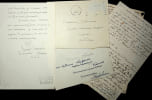
Paris, Revue Hebdomadaire, 1922. (Numero Special). 4to. With orig. frontwrapper in cont. hcloth. Back faded. 306 pp, Portrait and many textillustr.
A memorial volume issued by ""Revue Generalé de L'Electricité"" with many contributors.
Paris, Crochard, 1821. Without wrappers. In: Annales de Chimie et de Physique, Par MM. Gay-Lussac et Arago."", Tome 18., Cahier 1 a. 3. Titlepage a. htitle to vol. 18. Pp. (4), 1-112 a. pp. 225-336 a. 2 folded engraved plates. (Entire issues offered).. Ampère's papers: pp. 88-106 + pp. 313-333 The plates depicts experimental arrangements and Ampère's initial Rotation Apparatus.
Fisrt edition and first printings of the demonstrations of Ampere's new Equilibrium technique. When Faraday had completed his importent paper on Electro-magnetic motions he send it to Ampere.. Ampere invented the Rotation Apparatus in order to repeat Faraday's experiment on the electro-magnetic rotation. He produced an uninterrupted rotation, either of magnetic pole around a wire or of a wire around a magnetic pole. From these experiments originated a new theory of electricity and magnetism. .
Paris, Crochard, 1820. 8vo. In 'Annales de Chimie et de Physique', Volume 15, pp.59-76170-218. The entire volme 15 offered here in contemporary fine half calf with gilt spine. Five engraved plates accompanying the memoires. A fine copy.
First edition of the first announcement of Ampère's discoveries on electromagnetism. Ampère first heard of Ørsted's discovery of electromagnetism on the 4th of September when Arago announced Ørsted's results to the Paris Academy of Sciences. In Ørsted's experiment a current-carrying wire is held over, and under, a compass needle - the result being that the needle is positioned at 45 degrees in respect to the wire. Ampére immediately saw that this result made no physical sense and realized that the true nature of the effect could not be observed until the force of terrestrial magnetism was somehow neutralized what Ørsted had observed and reported on was the resultant of the force from the wire and that from the earth's magnetic field. Ampère discovered that the compass needle sets at 90 degrees to the current-carrying wire when the effect of terrestial magnetism is eliminated. He also observed that current-carrying wires which are formed as spirals act as permanent magnets, and this lead him to his theory that electricity in motion produces magnetism and that permanent magnets must contain electrical currents. And thus Ampère laid the foundation of the new field of electrodynamics.Ampère announced his theory and experimental results, for the first time, in a series of memoires read before the Paris Academy of Sciences in September and October 1820. These memoires were first published in the September and October issues of Arago's 'Annales de Chimie et de Physique' (the offered items). In November Ampère had a seperate printing of his findings published under the title 'Mémoires sur I'action mutuelle de deux courans électriques, sur celle qui existe entre un courant électrique et un aimant ou le globe terrestre, et celle de deux aimans I'un sur I'autre.' (Dibner 62, Norman 43). On the title-page of this publication it is stated 'Extrait des Annales de Chimie et de Physique' and therefore this publication is often identified as an offprint of the two offered papers (see the Norman sales catalogue for an example). This is, however untrue, since it contains considerable changes and additions in comparison with text of the journal issues (see Williams: What were Ampère's Earliest Discoveries in Electrodynamics? ISIS, volume 74, p.492).Honeyman 82, Barchas 51, Wheeler 762.
"AMPÈRE, ANDRÉ-MARIE & MICHAEL FARADAY - DESCRIBING AMPERE'S ROTATION APPARATUS.
Reference : 41248
(1821)
Paris, Crochard, 1821. Contemp. full cloth. Light wear to spine ends. Gilt lettering to spine. In: Annales de Chimie et de Physique, Par MM. Gay-Lussac et Arago."", Tome 18. 448 pp. and 6 folded engraved plates (4 of these belonging to the described papers). Ampère: pp. 88-106 + pp. 313-333 and 4 plates. Faraday: pp. 337-379. Savary: pp. 370-379. The plates depicts experimental arrangements and Ampère's initial Rotation Apparatus. The whole volume present.
Fisrt edition and first printings of the demonstrations of Ampere's new Equilibrium technique. When Faraday had completed his importent paper on Electro-magnetic motions (the paper offered here in the first French edition) he send it to Ampere.. Ampere invented the Rotation Apparatus in order to repeat Faraday's experiment on the electro-magnetic rotation. He produced an uninterrupted rotation, either of magnetic pole around a wire or of a wire around a magnetic pole. From these experiments originated a new theory of electricity and magnetism. - The third memoir is the First French edition of Faraday's famous paper ""On some New Electro-Magnetical Motions, and on the Theory of Magnetism"" (Quaterly Journal of Science, October 1821), in which is recorded for the first time the conversion of electrical into mechanical energy. It also contains the first notion of the ""Line of Force"". He employed a magnet and a wire with a flowing current, which causd each separately to rotate round the other. He concluded that a current-carrying wire is sorraunded by a circular ""line of force"". Oersted had spoken of the ""electrical conflict"" surrounding the wire and had noted that ""this conflict performs circles"".
Paris, Crochard, 1820. 8vo. Without wrappers, as extracted from ""Annales de Chimie et de Physique"", Volume 15, pp. 59-76 and pp.170-218. Five engraved plates accompanying the memoires showing the experimental equipments. Half-title and title-page to volume 15 present.
First edition of the first announcement of Ampère's discoveries on electromagnetism. Ampère first heard of Ørsted's discovery of electromagnetism on the 4th of September when Arago announced Ørsted's results to the Paris Academy of Sciences. In Ørsted's experiment a current-carrying wire is held over, and under, a compass needle - the result being that the needle is positioned at 45 degrees in respect to the wire. Ampére immediately saw that this result made no physical sense and realized that the true nature of the effect could not be observed until the force of terrestrial magnetism was somehow neutralized"" what Ørsted had observed and reported on was the resultant of the force from the wire and that from the earth's magnetic field. Ampère discovered that the compass needle sets at 90 degrees to the current-carrying wire when the effect of terrestrial magnetism is eliminated. He also observed that current-carrying wires which are formed as spirals act as permanent magnets, and this lead him to his theory that electricity in motion produces magnetism and that permanent magnets must contain electrical currents. And thus, Ampère laid the foundation of the new field of electrodynamics.Ampère announced his theory and experimental results, for the first time, in a series of memoires read before the Paris Academy of Sciences in September and October 1820. These memoires were first published in the September and October issues of Arago's ""Annales de Chimie et de Physique"" (the offered items). In November, Ampère had a separate printing of his findings published under the title 'Mémoires sur I'action mutuelle de deux courans électriques, sur celle qui existe entre un courant électrique et un aimant ou le globe terrestre, et celle de deux aimans I'un sur I'autre.' (Dibner 62, Norman 43). On the title-page of this publication it is stated 'Extrait des Annales de Chimie et de Physique' and therefore this publication is often identified as an offprint of the two offered papers (see the Norman sales catalogue for an example). This is, however untrue, since it contains considerable changes and additions in comparison with text of the journal issues (see Williams: What were Ampère's Earliest Discoveries in Electrodynamics? ISIS, volume 74, p.492).Honeyman 82, Barchas 51, Wheeler 762. Sparrow, Milestones No 8.
"AMPÈRE, ANDRÉ-MARIE. - THE CLASSIFICATORY SYSTEM OF AMPERE.
Reference : 43465
(1816)
(Paris, Crochard, 1816) No wrappers as extracted fron 'Annales de Chimie et de Physique', Volume 1 and 2 (2e Series). Pp. 295-308 a. pp. 373-394 (Vol. 1), pp. 5-32 a. pp. 105-125 (Vol. 2). With both halftitles to vols. 1 a. 2. Htitles shaved in inner margins, no loss of letters. All 4 papers having some scattered brownspots.
First appearance of Ampere's notable memoir (issued in 4 parts) in which he tries to set up a classification system for the elementary entities in chemistry tieing the elements together in a natural classification, a dim foreshadowing of the periodic table.""Here (in the paper offered) he drew attention to the similarities between Lavoisier's and his fellowers classification of elements in terms of their reactions with oxygen and Linnaeus' classification of plants in terms of their sexual organs. Bernard de Jussieu had successfully challenged Linnaeus with a natural system that took the whole plant into account and sought affinities between all parts of the plant, not just the flowers, as the basic classification. Ampère now wished to do the same thing for chemistry. By discovering a natural classification, i.e., one that tied the elements together by real and rather than artificial relations, Ampère hoped to prove a new insight into chemical reactions. His classificatory scheme, therefore, was not merely an ordering ofthe elements but, like the later periodic table of Dimitri Mendeleev, a true instrument of chemical research. Ampères system was as artificial as Lavoisier's...Thepapermay be noted, however, as an early attempt to find relationships between elements that would bring some order into the constantly growing number of elementary bodies.""(DSB I, p. 143).
Paris, Crochard, 1820. 8vo. In 'Annales de Chimie et de Physique', Volume 15, pp. 59-76 170-218. The entire volme 15 offered in a nice contemporary half calf with gilt spine. A bit of wear to extremities. Five engraved plates accompanying the memoires. A very fine copy.
First edition of the first announcement of Ampère's discoveries on electromagnetism. Ampère first heard of Ørsted's discovery of electromagnetism on the 4th of September, when Arago announced Ørsted's results to the Paris Academy of Sciences. In Ørsted's experiment, a current-carrying wire is held over and under a compass needle - the result being that the needle is positioned at 45 degrees in respect to the wire. Ampére immediately saw that this result made no physical sense and realized that the true nature of the effect could not be observed until the force of terrestrial magnetism was somehow neutralized what Ørsted had observed and reported on was the resultant of the force from the wire and that from the earth's magnetic field. Ampère discovered that the compass needle sets at 90 degrees to the current-carrying wire, when the effect of terrestial magnetism is eliminated. He also observed that current-carrying wires which are formed as spirals act as permanent magnets, and this lead him to his theory that electricity in motion produces magnetism and that permanent magnets must contain electrical currents. And thus Ampère laid the foundation of the new field of electrodynamics.Ampère announced his theory and experimental results, for the first time, in a series of memoires read before the Paris Academy of Sciences in September and October 1820. These memoires were first published in the September and October issues of Arago's 'Annales de Chimie et de Physique' (i.e. the offered item). In November Ampère had a seperate printing of his findings published under the title 'Mémoires sur I'action mutuelle de deux courans électriques, sur celle qui existe entre un courant électrique et un aimant ou le globe terrestre, et celle de deux aimans I'un sur I'autre.' (Dibner 62, Norman 43). On the title-page of this publication it is stated 'Extrait des Annales de Chimie et de Physique' and therefore this publication is often identified as an offprint of the two offered papers (see the Norman sales catalogue for an example). This is, however untrue, since it contains considerable changes and additions in comparison with text of the journal issues (see Williams: What were Ampère's Earliest Discoveries in Electrodynamics? ISIS, volume 74, p.492).Honeyman 82, Barchas 51, Wheeler 762.
(Paris, Crochard, 1828). No wrappers. In: ""Annales de Chimie et de Physique, Par MM. Gay-Lussac et Arago."", tome 37 (sec. cahier), Titlepage to vol. 37, pp. 113-223. (Entire issue offered). Ampere's paper: pp. 113-139 a. 1 large folded engraved plate.
First appearance of Ampere's last major paper on magnetism and electricity. As in his most importent paper from 1827, he shows the unification of the electric and the magnetic fields and treats the relations mathematically.
Paris, Crochard, 1825. 8vo. 2 contemporary half calfs w. richly gilt spines. Light wear at top of spines. Minor scratches to upper compartments of spines. Small stamps on verso of title-pages and verso of plates. In: ""Annales de Chimie et de Physique, Par MM. Gay-Lussac et Arago."", tome 29 a. 30. - 448 pp. and 3 folded engraved plates + 448 pp. and 2 folded engraved plates. (The entire volumes offered). Ampère's papers: pp. 381-404 (tome 29) + Suite pp. 29-41 (tome 30) + ""Lettre à Gerhardi"": pp. 373-381 (tome 29). Clean and fine throughout.
First appearance of this famous memoir, in which Ampère presented his collected results on electrodynamics to the French Academy, creating the foundation of 19th century developments in electricity and magnetism. In the words of James Clark Maxwell, ""We can scarcely believe that Ampère really discovered the law of action by means of the experiments which he describes. We are led to suspect, what, indeed, he tells us himself, that he discovered the law by some process which he has not shown us, and that when he had afterwards built up a pefect demonstration he removed all traces of the scaffolding by which he raised it.""The offered memoir was published BEFORE the famous ""Theorie mathématique des phénomènes électro-dynamiques uniquement déduite de L'expérience"", which did not appear until 1827. That 1827-Memoire incorporates, together with a new presentation of Ampère's results from 1820, 1822, 1823, the offered memoir (1825). (Horblit: 100 - Dibner: 62).""From 1814 until 1820 Ampére did not perform the kind of research that would have made it into the annals of the histrory of science, but on September 11, 1820 when he heard Francois Arago speak about Oersted's work, he got fresh inspiration and started the work that made him famous. Arago related how Oersted had found that a steady electric current influences the orientation of a compass needle. After a weak Ampère had determined experimentally that that two straight, parallel, and current-carrying, wires execute a force on each other. The magnitude of the force is inversely proportional to the distance between the wires and proportional to the strenghts of the current..... During the following years he continued his researches, both experimentally and theoretically. he built an instrument for measuring electricity that later was developed into the galvanometer. Finally in 1825 he presented his collected results to the Academy IN ONE OF THE MOST CELEBRATED MEMOIRS IN THE HISTORY OF NATURAL PHILOSOPHY (The paper offered)."" (Citizen's Compendium, p. 2). - Norman No 47.The volumes contain many other notable papers by: Wöhler, Fresnel, Marcet, Berzelius, Felix Savart, De la Rive, Braconnet, Boussingault, Magnus, Poncelet, Vaugelin, Poisson, Gay-Lussac, Faraday, Laplace etc.
"AMPÈRE, ANDRÉ-MARIE. - INCORPORATED IN THE ""PRINCIPIA"" OF ELECTRODYNAMICS.
Reference : 44786
(1824)
Paris, Crochard, 1824. 8vo. Without wrappers. In 'Annales de Chimie et de Physique', Series 2 - Volume 26, issue 2 and 3. With titlepage to vol. 26. Pp. 113-224 a. pp. 225-336, 1 folded engraved plate (entire issues offered). Ampere's papers: pp. 134-162 a. pp. 246-258.
First appearance of one of Ampere's importent contributions to electrodynamic. This memoir was later incorporated in his great memoir of 1827 ""Mémoire sur la théorie mathématique des phénomenes electro-dynamiques...."", published 1827, the ""Principia"" of electrodynamics.
"AMPÈRE, ANDRÉ-MARIE. - DEMONSTRATING THE BOYLE-MARIOTTE LAW OR AMPÈRES GAS LAW.
Reference : 45113
(1815)
Paris, Crochard, 1815. Contemp. hcalf. Spine gilt. Slightly rubbed. A few scratches to binding. Wear to top of spine. Small stamps on verso of titlepage.In: ""Annales de Chimie, ou Recueil de Mémoires concernant la Chemie"" Tome 94. 336 pp. a. 1 plate (the plate in facs., not belonging to Ampere's paper). Ampere's paper: pp. Some scattered brownspots.
First appearance of Amperes second paper on molecular physics.""The noumenal aspect of chemistry fascinated Ampère. Although his derivation of Avogadro’s law came three years after Avogadro had enunciated it, the law is known today in France as the Avogadro-Ampère law. This was Ampère’s first excursion into molecular physics, and was followed almost immediately by a second. In 1815 he published a paper demonstrating the relation between Mariotte’s (Boyle’s) law and volumes and pressures of gases at the same temperature. The paper is of some interest as a pioneer effort, along with Laplac’s great papers on capillarity, in the application of Mathematical analysis to the molecular realm.""(DSB).The volume contains 3 importent papers by Jean-Baptiste Biot on polarisation of light and Berzelius ""Experiences pour déterminer les proportions définies, dans lequelles les élémens de la nature organique sont combinés"" + ""Suite..."" 1-2, pp. 5-33, pp. 170-190 a. pp. 296-232
(Paris, Crochard, 1824). 8vo. Without wrappers. In 'Annales de Chimie et de Physique', Series 2 - Volume 26, Cahier 4. Pp. 337-448 (entire issue offered). With htitle to volume 26. Amperes' paper: pp. 390-411 and 2 folded engraved plates.
First appearence of the paper in which Ampere describes his invention of the SOLENOID, the electro-magnetic device he used in his early electrodynamical experiments.""A solenoid is a coil wound into a tightly packed helix. In physics, the term solenoid refers to a long, thin loop of wire, often wrapped around a metallic core, which produces a magnetic field when an electric current is passed through it. Solenoids are important because they can create controlled magnetic fields and can be used as electromagnets. The term solenoid refers specifically to a magnet designed to produce a uniform magnetic field in a volume of space (where some experiment might be carried out).""Poggendorff I, p. 29. - Ronalds, p. 10.
(Paris, Crochard, 1828). No wrappers. In: ""Annales de Chimie et de Physique, Par MM. Gay-Lussac et Arago."", tome 39 (Sec. Cahier), With halftitle to vol. 39. pp. 113-224. (Entire issue offered). Ampere's paper: pp. 113-145 a. 1 folded engrave plate. The plate with a few, mostly marginal brownspots.
First appearance of Ampere's mathematical treatment of Fresnel's ondulatory theory of light, agreeing with Fresnel and opposed to Biot and Laplace who advocated a corpuscular theory.
"AMPÈRE, ANDRÉ-MARIE. - THE CARDINAL FORMULAS OF ELECTRO-DYNAMICS.
Reference : 47420
(1825)
(Paris, Crochard, 1825). Extracted from ""Annales de Chimie et de Physique, Par MM. Gay-Lussac et Arago."", tome 29 a. 30. Ampère's papers: pp. 381-404 a. 1 folded engraved plate (tome 29) + Suite pp. 29-41 (tome 30) + ""Lettre à Gerhardi"": pp. 373-381 (tome 29). With both halftitlepages to vol. 29 a. 30. Scattered brownspots.
First appearance of this famous memoir, in which Ampère presented his collected results on electrodynamics to the French Academy, creating the foundation of 19th century developments in electricity and magnetism. In the words of James Clark Maxwell, ""We can scarcely believe that Ampère really discovered the law of action by means of the experiments which he describes. We are led to suspect, what, indeed, he tells us himself, that he discovered the law by some process which he has not shown us, and that when he had afterwards built up a pefect demonstration he removed all traces of the scaffolding by which he raised it.""The offered memoir was published BEFORE the famous ""Theorie mathématique des phénomènes électro-dynamiques uniquement déduite de L'expérience"", which did not appear until 1827. That 1827-Memoire incorporates, together with a new presentation of Ampère's results from 1820, 1822, 1823, the offered memoir (1825). (Horblit: 100 - Dibner: 62).""From 1814 until 1820 Ampére did not perform the kind of research that would have made it into the annals of the histrory of science, but on September 11, 1820 when he heard Francois Arago speak about Oersted's work, he got fresh inspiration and started the work that made him famous. Arago related how Oersted had found that a steady electric current influences the orientation of a compass needle. After a weak Ampère had determined experimentally that that two straight, parallel, and current-carrying, wires execute a force on each other. The magnitude of the force is inversely proportional to the distance between the wires and proportional to the strenghts of the current..... During the following years he continued his researches, both experimentally and theoretically. he built an instrument for measuring electricity that later was developed into the galvanometer. Finally in 1825 he presented his collected results to the Academy IN ONE OF THE MOST CELEBRATED MEMOIRS IN THE HISTORY OF NATURAL PHILOSOPHY (The paper offered)."" (Citizen's Compendium, p. 2). - Norman No 47.
"AMPÈRE, ANDRÉ-MARIE. - ""ONE OF THE MOST CELEBRATED MEMOIRS IN THE HISTORY OF NATURAL PHILOSOPHY""
Reference : 48082
(1825)
Paris, Crochard, 1825. 8vo. Bound in 2 uniform later hcloth. Gilt lettering to spines. In: ""Annales de Chimie et de Physique, Par MM. Gay-Lussac et Arago."", tome 29 a. 30. - 448 pp. and 3 folded engraved plates + 448 pp. and 2 folded engraved plates. (The entire volumes offered). Ampère's papers: pp. 381-404 (tome 29) + Suite pp. 29-41 (tome 30) + ""Lettre à Gerhardi"": pp. 373-381 (tome 29). Some scattered brownspots.
First appearance of this famous memoir, in which Ampère presented his collected results on electrodynamics to the French Academy, creating the foundation of 19th century developments in electricity and magnetism. In the words of James Clark Maxwell, ""We can scarcely believe that Ampère really discovered the law of action by means of the experiments which he describes. We are led to suspect, what, indeed, he tells us himself, that he discovered the law by some process which he has not shown us, and that when he had afterwards built up a pefect demonstration he removed all traces of the scaffolding by which he raised it.""The offered memoir was published BEFORE the famous ""Theorie mathématique des phénomènes électro-dynamiques uniquement déduite de L'expérience"", which did not appear until 1827. That 1827-Memoire incorporates, together with a new presentation of Ampère's results from 1820, 1822, 1823, the offered memoir (1825). (Horblit: 100 - Dibner: 62).""From 1814 until 1820 Ampére did not perform the kind of research that would have made it into the annals of the histrory of science, but on September 11, 1820 when he heard Francois Arago speak about Oersted's work, he got fresh inspiration and started the work that made him famous. Arago related how Oersted had found that a steady electric current influences the orientation of a compass needle. After a weak Ampère had determined experimentally that that two straight, parallel, and current-carrying, wires execute a force on each other. The magnitude of the force is inversely proportional to the distance between the wires and proportional to the strenghts of the current..... During the following years he continued his researches, both experimentally and theoretically. he built an instrument for measuring electricity that later was developed into the galvanometer. Finally in 1825 he presented his collected results to the Academy IN ONE OF THE MOST CELEBRATED MEMOIRS IN THE HISTORY OF NATURAL PHILOSOPHY (The paper offered)."" (Citizen's Compendium, p. 2). - Norman No 47.The volumes contain many other notable papers by: Wöhler, Fresnel, Marcet, Berzelius, Felix Savart, De la Rive, Braconnet, Boussingault, Magnus, Poncelet, Vaugelin, Poisson, Gay-Lussac, Faraday, Laplace etc.
"AMPÈRE, ANDRÉ-MARIE. - THE NEW ELECTRIC MOTOR AND AMPÉRE'S ""FORCE LAW""
Reference : 48224
(1822)
(Paris, Crochard, 1822). No wrappers. In: ""Annales de Chimie et de Physique, Par MM. Gay-Lussac et Arago."", Tome 20 (Premier Cahier) Pp. (5-) 112 a. 1 engraved plate. (Entire issue offered). Ampère's paper: pp. 60-74 a. 1 engraved folded plate depicting apparatus. Some brownspots to the plate.
First apperance of this importent paper in which Ampère his creation of a new kind of electric motor where he succeeded in spinning a cylindrical magnet around its axis by connecting it to a battery generating a steady current.With the invention of the battery (Allessandro Volta, 1800), the generation of a magnetic field from electric current (Hans Christian Oersted, 1820) the foundation for building electric motors was laid.Togetner with this paper comes the importent paper in which Ampère introduced his ""LAW OF FORCE"", the force which exists between two current elements. - Extract from the same volume of ""Annalen"", pp. 398-421. The text refers to the plate attached to the first paper offered here.
"(ARAGO, DOMINIQUE- FRANCOIS & AMPERE, ANDRE-MARIE AMPÈRE) + FRESNEL, AUGUSTIN
Reference : 48806
(1821)
Paris, Crochard, 1821. 8vo. Uncut and unopened in orig. printed wrappers. In: ""Annales de Chimie et de Physique, Redigées par MM. Gay-Lussac et Arago"", Tome XVII - Mai Issue. Pp. 1-112 including titlepage to vol. 17. - The rapport: pp. 80-102. Fresnel's paper: pp. 102-111. Clean and fine.
First appearance of the joint report. This investigation of Fresnel's paper by Arago (mainly written by Arago as a polemic directed at Biot) and Ampère is a central document in the rather bitter confrontation between Arago and Biot on the wave theory of light put forward by Fresnel.Fresnel's paper is the first part of three of his ""Calcul des teintes"".
"AMPÈRE, ANDRÉ-MARIE. - INCORPORATED IN THE ""PRINCIPIA"" OF ELECTRODYNAMICS AND THE INVENTION OF THE SOLENOID.
Reference : 48831
(1824)
Paris, Crochard, 1824. 8vo. Contemp. hcloth with gilt lettering to spine. In 'Annales de Chimie et de Physique', Series 2 - Volume 26. 448 pp. a. 5 large folded engraved plates. (Entire volume offered). Ampere's papers: pp. 134-162, 246-258 a. 390-411. A bit of browning to halftitle and verso of last plate. A few scattered brownspots.
The first paper is the first appearance of one of Ampere's importent contributions to electrodynamic. This memoir was later incorporated in his great memoir of 1827 ""Mémoire sur la théorie mathématique des phénomenes electro-dynamiques...."", published 1827, the ""Principia"" of electrodynamics.The second paper is the first appearence of the paper in which Ampere describes his invention of the SOLENOID, the electro-magnetic device he used in his early electrodynamical experiments.""A solenoid is a coil wound into a tightly packed helix. In physics, the term solenoid refers to a long, thin loop of wire, often wrapped around a metallic core, which produces a magnetic field when an electric current is passed through it. Solenoids are important because they can create controlled magnetic fields and can be used as electromagnets. The term solenoid refers specifically to a magnet designed to produce a uniform magnetic field in a volume of space (where some experiment might be carried out).""The volume contains further importent papers by Poisson ""Sur la Chaleur rayonnante"", pp. 225-246 + Note.. pp. 442-44, Gay-Lussac, Savart, Pelletier et Caventou, Becquerel etc.
Leipzig, Johann Ambrosius Barth, 1821. 8vo. Contemp. hcalf. Gilt spine and with gilt lettering. Some scratches to spine. In: ""Annalen der Physik und der Physikalischen Chemie. Hrsg. Ludwig Wilhelm Gilbert"", Bd. 7 (= Bd. 67 der Reihe). (8),444 pp., 2 folded tables and 8 engraved plates. Small stamp to verso of titlepages. Ampére's paper: pp. 113-167 a. 225-258 with 4 engraved plates. Internally clean and fine.
First German versions of Ampére's famous papers, the first announcements of Ampère's discoveries on electromagnetism, being the German version of Ampére's ""Mémoires sur I'action mutuelle de deux courans électriques, sur celle qui existe entre un courant électrique et un aimant ou le globe terrestre, et celle de deux aimans I'un sur I'autre.""Ampère first heard of Ørsted's discovery of electromagnetism on the 4th of September when Arago announced Ørsted's results to the Paris Academy of Sciences. In Ørsted's experiment a current-carrying wire is held over, and under, a compass needle - the result being that the needle is positioned at 45 degrees in respect to the wire. Ampére immediately saw that this result made no physical sense and realized that the true nature of the effect could not be observed until the force of terrestrial magnetism was somehow neutralized" what Ørsted had observed and reported on was the resultant of the force from the wire and that from the earth's magnetic field. Ampère discovered that the compass needle sets at 90 degrees to the current-carrying wire when the effect of terrestial magnetism is eliminated. He also observed that current-carrying wires which are formed as spirals act as permanent magnets, and this lead him to his theory that electricity in motion produces magnetism and that permanent magnets must contain electrical currents. And thus Ampère laid the foundation of the new field of electrodynamics.Ampère announced his theory and experimental results, for the first time, in a series of memoires read before the Paris Academy of Sciences in September and October 1820. These memoires were first published in the September and October issues of Arago's 'Annales de Chimie et de Physique'. In November Ampère had a seperate printing of his findings published under the title 'Mémoires sur I'action mutuelle de deux courans électriques, sur celle qui existe entre un courant électrique et un aimant ou le globe terrestre, et celle de deux aimans I'un sur I'autre.' (Dibner 62, Norman 43). Honeyman 82, Barchas 51, Wheeler 762. (The French versions).The volume contains other importent papers of historical importence, relating to the discovery of electro-magnetism by Oersted in 1820. (Raschig, Bechstein, Georg von Buquoy, Prechtl, Boisgiraud).
FARADAY, MICHAEL & AMPÈRE, ANDRÉ-MARIE. - ESTABLISHING ELECTRO-MAGNETIC ROTATION.
Reference : 49581
(1822)
Leipzig, Johann Ambrosius Barth, 1822. 8vo. Contemp. hcalf. Gilt spine and with gilt lettering. Some scratches to spine. In: ""Annalen der Physik und der Physikalischen Chemie. Hrsg. Ludwig Wilhelm Gilbert"", Bd. 12 (= Bd. 72 der Reihe). (12),436 pp., 2 folded tables and 4 engraved plates. Small stamp to verso of titlepages. Internally clean and fine, except for browning to upper right corners on the last 75 leaves. Faraday's paper: pp. 113-129. Ampere's appers: pp. 257-276 a. 32-36.
First German versions, in Gilbert's preparations, of these fundamental papers by Faraday and Ampére, the papers that established electro-magnetic rotation, the first electromotors. - Apparatus depicted on the plates.The volumes contains further notable papers by Döbereiner, Berzelius, Sertürner etc. etc.
(Paris, 1820). Small 8vo. Contemporary (original?) blank blue paper wrappers. Annulated stamp to title-page, otherwise a nice, clean, and fresh copy. 68 pp. + 5 engraved plates.
First edition, in the extremely scarce off-print, of the first announcement of Ampère's seminal discoveries on electromagnetism, which laid the foundation for electrodynamics. Ampère first heard of Ørsted's discovery of electromagnetism on the 4th of September, when Arago announced Ørsted's results to the Paris Academy of Sciences. In Ørsted's experiment, a current-carrying wire is held over and under a compass needle - the result being that the needle is positioned at 45 degrees in respect to the wire. Ampére immediately saw that this result made no physical sense and realized that the true nature of the effect could not be observed until the force of terrestrial magnetism was somehow neutralized"" what Ørsted had observed and reported on was the resultant of the force from the wire and that from the earth's magnetic field. Ampère discovered that the compass needle sets at 90 degrees to the current-carrying wire, when the effect of terrestial magnetism is eliminated. He also observed that current-carrying wires which are formed as spirals act as permanent magnets, and this lead him to his theory that electricity in motion produces magnetism and that permanent magnets must contain electrical currents. And thus Ampère laid the foundation of the new field of electrodynamics.""Ampère, professor of mathematics at the Polytechnique, heard of Oersted's discovery and immediately set up a series of experiments to determine the exact relationships of current-flow and magnetism. In a week Ampère presented the first of a series of papers establishing the laws of forces acting between conductors carrying current."" (Dibner). Ampère's seminal results were announced in a series of memoires read before the Paris Academy of Sciences in September and October 1820. These memoires were first published in the September and October issues of Arago's ""Annales de Chimie et de Physique"", and in November Ampère had the scarce seperate printing of his findings published under the title ""Mémoires sur I'action mutuelle de deux courans électriques, sur celle qui existe entre un courant électrique et un aimant ou le globe terrestre, et celle de deux aimans I'un sur I'autre"". It is this publication that is considered ""his first great memoir on electrodynamics"" (DSB).Sparrow: 8" Dibner: 62 Honeyman: 83 Barchas 51 (only the periodical-issue) Wheeler 762 (only the periodical-issue).
Paris, Crochard, 1820. 8vo. In 'Annales de Chimie et de Physique', Volume 15, pp.59-76170-218. The entire volme 15 offered here. 448 pp., 5 engraved plates. Bound in contemporary half calf with gilt spine, Raised bands. Minor scratches to spine. Corners a bit bumped. Five engraved plates accompanying the memoires. Clean and fine.
First edition of the first announcement of Ampère's discoveries on electromagnetism. Ampère first heard of Ørsted's discovery of electromagnetism on the 4th of September when Arago announced Ørsted's results to the Paris Academy of Sciences. In Ørsted's experiment a current-carrying wire is held over, and under, a compass needle - the result being that the needle is positioned at 45 degrees in respect to the wire. Ampére immediately saw that this result made no physical sense and realized that the true nature of the effect could not be observed until the force of terrestrial magnetism was somehow neutralized what Ørsted had observed and reported on was the resultant of the force from the wire and that from the earth's magnetic field. Ampère discovered that the compass needle sets at 90 degrees to the current-carrying wire when the effect of terrestial magnetism is eliminated. He also observed that current-carrying wires which are formed as spirals act as permanent magnets, and this lead him to his theory that electricity in motion produces magnetism and that permanent magnets must contain electrical currents. And thus Ampère laid the foundation of the new field of electrodynamics. Ampère announced his theory and experimental results, for the first time, in a series of memoires read before the Paris Academy of Sciences in September and October 1820. These memoires were first published in the September and October issues of Arago's 'Annales de Chimie et de Physique' (the offered items). In November Ampère had a seperate printing of his findings published under the title 'Mémoires sur I'action mutuelle de deux courans électriques, sur celle qui existe entre un courant électrique et un aimant ou le globe terrestre, et celle de deux aimans I'un sur I'autre.' (Dibner 62, Norman 43). On the title-page of this publication it is stated 'Extrait des Annales de Chimie et de Physique' and therefore this publication is often identified as an offprint of the two offered papers (see the Norman sales catalogue for an example). This is, however untrue, since it contains considerable changes and additions in comparison with text of the journal issues (see Williams: What were Ampère's Earliest Discoveries in Electrodynamics? ISIS, volume 74, p.492). Honeyman 82, Barchas 51, Wheeler 762.
Paris, Crochard, 1825. 8vo. Bound in contemporary half calf with gilt lettering to spine. In: ""Annales de Chimie et de Physique, Par MM. Gay-Lussac et Arago."", tome 29. Entire volume offered. Very light occassional foxing, otherwise a fine and clean copy with no institutional stamps. Pp. 381-404"" 373-381. [Entire volume: 448 pp. + folded plate].
First appearance of this famous memoir, in which Ampère presented his collected results on electrodynamics to the French Academy, creating the foundation of 19th century developments in electricity and magnetism. In the words of James Clark Maxwell, ""We can scarcely believe that Ampère really discovered the law of action by means of the experiments which he describes. We are led to suspect, what, indeed, he tells us himself, that he discovered the law by some process which he has not shown us, and that when he had afterwards built up a pefect demonstration he removed all traces of the scaffolding by which he raised it."" The offered memoir was published BEFORE the famous ""Theorie mathématique des phénomènes électro-dynamiques uniquement déduite de L'expérience"", which did not appear until 1827. That 1827-Memoire incorporates, together with a new presentation of Ampère's results from 1820, 1822, 1823, the offered memoir (1825). (Horblit: 100 - Dibner: 62). ""From 1814 until 1820 Ampére did not perform the kind of research that would have made it into the annals of the histrory of science, but on September 11, 1820 when he heard Francois Arago speak about Oersted's work, he got fresh inspiration and started the work that made him famous. Arago related how Oersted had found that a steady electric current influences the orientation of a compass needle. After a weak Ampère had determined experimentally that that two straight, parallel, and current-carrying, wires execute a force on each other. The magnitude of the force is inversely proportional to the distance between the wires and proportional to the strenghts of the current..... During the following years he continued his researches, both experimentally and theoretically. he built an instrument for measuring electricity that later was developed into the galvanometer. Finally in 1825 he presented his collected results to the Academy IN ONE OF THE MOST CELEBRATED MEMOIRS IN THE HISTORY OF NATURAL PHILOSOPHY (The paper offered)."" (Citizen's Compendium, p. 2). - Norman No 47. The volumes contain many other notable papers by: Wöhler, Fresnel, Marcet, Berzelius, Felix Savart, De la Rive, Braconnet, Boussingault, Magnus, Poncelet, Vaugelin, Poisson, Gay-Lussac, Faraday, Laplace etc.
Paris Edititions de la Nouvelle Revue Française N.R.F. 1922 in 12 (18,5x13) 1 volume broché, 49 pages [1], avec un portrait par Marie Laurencin en frontispice. Collection "Une oeuvre, un portrait". Tirage limité à 540 exemplaires (achevé d' imprimer à la date du 18 mars 1922), celui-ci un des 500 exemplaires numérotés sur papier vergé à la forme des Manufactures d''Arches (N°1 à 500). Bel exemplaire ( Photographies sur demande / We can send pictures of this book on simple request )
Très bon Ed. numérotée
Chez Bachelier A Paris, chez Bachelier, Imprimeur-Libraire pour les Sciences, 1834. In-8 relié demi-basane brune, dos lisse à filets dorés, Gardes de papier marbré, étiquette de référence en dos. LXX + 272 pages + Deux tableaux dépliants réunis en une seule planche, très légèrement déchirée en bas de jointure : "Optimo et carissimo filio - carmen mnemonicum" et "Classification des connaissances humaines, Tableaux synoptiques des sciences et des arts.". Les pages 159-160 sont harmonieusement complétées de manière manuscrite. Belle édition originale de la première partie du magnum opus du mathématicien, chimiste et physicien français André-Marie Ampère (1775-1836), qui n'est autre qu'une magistrale réflexion philosophique et méthodique sur la connaissance, qui synthétise toute la pensée de ce grand savant. Cette édition de 1834 constitue la seule édition qu'Ampère put mener à bien de son vivant, chez le prestigieux imprimeur et libraire des sciences, Charles-Louis-Étienne Bachelier (1776-1852), qui fut un éditeur de référence dans le domaine scientifique, notamment pour des institutions comme le Bureau des longitudes et l'École polytechnique, au début et milieu du XIXe. La mort d'Ampère, en 1836, l'empêcha d'accompagner la publication de la seconde partie que prit en charge son fils, Jean-Jacques Ampère, en 1843, pour qui le poème scientifique "Optimo et Carissimo Filio - Carmen Mnenonicum." (Au meilleur et très cher fils - poème mnémotechnique), dans la lignée de Lucrèce, que vous retrouverez sur la planche en fin d'ouvrage de cette édition, est dédié. Sources : Interfaces - fonds anciens BU Lyon, "André-Marie Ampère, philosophe des sciences", Interfaces, Déc. 2024. Norbert Verdier, "Théodore Bailleul (1797-1875) ou le prote devenu directeur de l'Imprimerie Mathématique de (Mallet)-Bachelier (1812-1864). Quelques rousseurs éparses en début et fin d'ouvrage. Très bel exemplaire complet et non annoté.
Toutes les expéditions sont faites en suivi au-dessus de 25 euros. Expédition quotidienne pour les envois simples, suivis, recommandés ou Colissimo.