 Write to the booksellers
4335 books for « adam ch »Edit
-
Type
Art print (1)
Autograph (13)
Book (4267)
Drawings (2)
Engraving (16)
Magazine (3)
Manuscript (1)
Maps (2)
Music sheets (27)
New book (2)
Photographs (1)
-
Latest
Last 3 days (6)
Last month (189)
Last week (3)
-
Language
Dutch (1)
English (4)
French (4250)
German (3)
Russian (77)
-
Century
16th (3)
17th (29)
18th (60)
19th (482)
20th (1532)
21st (414)
-
Countries
Belgium (189)
Brazil (1)
Canada (20)
China (1)
Côte d'Ivoire (6)
Denmark (100)
France (3578)
Germany (5)
Greece (3)
Netherlands (1)
Switzerland (351)
United Kingdom (3)
United States of America (77)
-
Syndicate
ALAC (18)
CLAM (14)
CLAQ (4)
CNE (2)
ILAB (2109)
NVVA (54)
SLACES (54)
SLAM (1873)
SNCAO (55)
Topics
- Adam (3465)
- Adam antoine (39)
- Adam jean pierre (16)
- Adam juliette (38)
- Adam michel (11)
- Africa (9)
- Alsace (27)
- Archaeology (13)
- Architecture (24)
- Autographs (72)
- Bibliophilism (12)
- Biography (21)
- Buffon (14)
- Caricature (11)
- Children’s books (35)
- Comic strip (42)
- Cooking (10)
- Dedication (13)
- Detective novels (140)
- Dictionaries (10)
- Drawings (15)
- Early printed books (11)
- Economics (12)
- Economics (54)
- Education (23)
- Education - morals (13)
- English (17)
- Engraving (books about) (15)
- Fantastic (21)
- Fine arts (16)
- First edition (97)
- Flora (9)
- French literature (14)
- Geography (9)
- Germanic languages (21)
- Germany (16)
- Hainaut (19)
- Helvética (25)
- History (135)
- Humour anecdotes (11)
- Illustrated books (20)
- Industrial arts & crafts - fine arts (18)
- Italy (12)
- Journalism (28)
- Latin (11)
- Law (20)
- Literature (653)
- Lorrain (13)
- Magazine (10)
- Malacology (10)
- Manuscripts (31)
- Maps (10)
- Mathematics (74)
- Medicine (13)
- Military arts (12)
- Music (18)
- Newspapers press (18)
- Opera ballet (10)
- Paris (47)
- Philosophy (61)
- Photography (29)
- Poetry (33)
- Poland (17)
- Police (20)
- Policy (18)
- Portraits (15)
- Psychology (15)
- Raphael (16)
- Regionalism (13)
- Reliure (19)
- Review (26)
- Reviews (20)
- Rops félicien (12)
- Russia (14)
- Scandinavian literature (54)
- Science fiction (19)
- Sciences (17)
- Scores (137)
- Smith adam (23)
- Songs (33)
- Spying (37)
- Stendhal (10)
- Switzerland (18)
- Symbolism (14)
- Tales (45)
- Tea (10)
- Theatre (51)
- Travel (10)
- Ussr (9)
- Various (20)
- War (56)
- Williams tennessee (9)
- Women (the) (25)
- Youth (14)
Untersuchung der Natur und Ursachen von Nationalreichthümern, Aus dem Englischen. 2 Bände. - [THE SEMINAL FIRST TRANSLATION OF 'WEALTH OF NATIONS']
Leipzig, Weidmann, 1776-78. 8vo. Bound in two nice uniform contemporary half calf bindings with five raised bands and gilt lettering to spine. Ex-libris pasted on to pasted down front free end-papers and a small embossed stamp to front free end paper on volume 1 (""Buchhändler u. Antiquar Carl Helf""). Stamp to p. 1 of both volumes. Spines with light soiling and capital on volume 1 lacking a small part of the leather. A few light brown spots throught. A fine set. VIII, 632 pp"" XII, 740 pp.
First German edition, also being the very first overall translation, of Adam Smith's ground-breaking main work, the ""Inquiry into the Nature and Causes of the Wealth of Nations"". This seminal first translation of the work was undertaken by J.F. Schiller, who finished the first part of the translation in time for it to appear as soon as 1776, the same year as the original English edition. The second part appeared in 1778, the same year as the exceedingly scarce first French translation. This first German translation has been of the utmost importance to the spreading of Smith's ideas throughout Europe, and, after the true first, this must count as the most important edition of the work.""The influence of the Wealth of Nations [...] in Germany [...] was so great that 'the whole of political economy might be divided into two parts - before and since Adam Smith"" the first part being a prelude, and the second a sequel."" (Backhouse, Roger E., The Methodology of Economics: Nineteenth-Century British Contributions, Routledge, 1997.)""The first review of the translation, which appeared in the Göttingische gelehrte Anzeigen for March 10, 1777, by J. G. H. Feder, professor of Philosophy at the University of Göttingen, was very favorable. In the words of the reviewer: ""It is a classic"" very estimable both for its thorough, not too limited, often far-sighted political philosophy, and for the numerous, frequently discursive historical notes,"" but the exposition suffers from too much repetition."" (Lai, Cheng-chung. Adam Smith Across Nations: Translations and Receptions of The Wealth of Nations, Clarendon Press, UK, 2000).Until 1797, [...], the work of Adam Smith received scant attention in Germany. While Frederick II was living, Cameralism held undisputed sway in Prussia, and the economic change which began with the outbreak of the French Revolution had still not gained sufficient momentum to awake the economic theorists from their dogmatic slumber."" (Lai, Cheng-chung. Adam Smith Across Nations: Translations and Receptions of The Wealth of Nations, Clarendon Press, UK, 2000).Various German economist read the german translations and was inspired by it.""Christian Garve, [...], must be considered as among the important contributors to the spread of Smith's views. Himself a popularizer of philosophical doctrines, he was early attracted by the Scotch writers and became one of their foremost exponents in Germany."" In 1791 Garve began a second translation of the Smith's work and in the introduction to the the translation he wrote: ""It (Smith's work) attracted me as only few books have in the course of my studies through the number of new views which it gave me not only concerning the actual abject of his investigations, but concerning all related material from the philosophy of civil and social life"". Georg Sartorius, August Ferdinand Lueder and, perhaps the most important economist of the period, Christian Jacob Kraus, were all important figures in the spread of Smith's thought. ""The most significant of Kraus' works and that also which shows his conception of economic science most clearly is the five-volume work entitled State Economy. The first four volumes of this work are little more than a free paraphrase of the Wealth of Nations"". Kraus was: ""to a large extent responsible for the economic changes which took place in Prussia after 1807, in so far as they can be ascribed to Smithan influence."" (Lai, Cheng-chung. Adam Smith Across Nations: Translations and Receptions of The Wealth of Nations, Clarendon Press, UK, 2000).Kraus wrote of the present volume: ""[T]he world has seen no more important book than that of Adam Smith.... [C]ertainly since the times of the New Testament no writing has had more beneficial results than this will have.... [Smith's doctrines form] the only true, great, beautiful, just and beneficial system."" (Fleischacker, Samuel , A Third Concept of Liberty, Princeton University Press, 1999.)_____________Hailed as the ""first and greatest classic of modern thought"" (PMM 221), Adam Smith's tremendously influential main work has had a profound impact on thought and politics, and is considered the main foundation of the era of liberal free trade that dominated the nineteenth century. Adam Smith (1723-1790) is considered the founder of Political Economy in Britain, mainly due to his groundbreaking work, the ""Wealth of Nations"" from 1776. The work took him 12 years to write and was probably in contemplation 12 years before that. It was originally published in two volumes in 4to, and was published later the same year in Dublin in three volumes in 8vo. The book sold well, and the first edition, the number of which is unknown, sold out within six months, which came as a surprise to the publisher, and probably also to Smith himself, partly because the work ""requires much thought and reflection (qualities that do not abound among modern readers) to peruse to any purpose."" (Letter from David Hume, In: Rae, Life of Adam Smith, 1895, p. 286), partly because it was hardly reviewed or noticed by magazines or annuals. In spite of this, it did evoke immense interest in the learned and the political world, and Buckle's words that the work is ""in its ultimate results probably the most important book that has ever been written"", and that it has ""done more towards the happiness of man than has been effected by the united abilities of all the statesmen and legislators of whom history has preserved an authentic account"" (History of Civilisation, 1869, I:214) well describes the opinion of a great part of important thinkers then as well as now. Kress S. 2567Goldsmith 11394Menger 521Not in Einaudi
Untersuchung der Natur und Ursachen von Nationalreichthümern, Aus dem Englischen. 2 Bände. - [THE SEMINAL FIRST TRANSLATION OF 'WEALTH OF NATIONS']
Leipzig, Weidmann, 1776-78. 8vo. Bound in two nice uniform contemporary half calf bindings with five raised bands, black title-label and gilt lettering to spine. Small paper-label to upper compartment (Catalogue-number from an estate-library). Light wear to extremities, otherwise a very nice set. VIII, 632 pp" XII, 740 pp.
First German edition, also being the very first overall translation, of Adam Smith's ground-breaking main work, the ""Inquiry into the Nature and Causes of the Wealth of Nations"". This seminal first translation of the work was undertaken by J.F. Schiller, who finished the first part of the translation in time for it to appear as soon as 1776, the same year as the original English edition. The second part appeared in 1778, the same year as the exceedingly scarce first French translation. This first German translation has been of the utmost importance to the spreading of Smith's ideas throughout Europe, and, after the true first, this must count as the most important edition of the work.""The influence of the Wealth of Nations [...] in Germany [...] was so great that 'the whole of political economy might be divided into two parts - before and since Adam Smith"" the first part being a prelude, and the second a sequel."" (Backhouse, Roger E., The Methodology of Economics: Nineteenth-Century British Contributions, Routledge, 1997.)""The first review of the translation, which appeared in the Göttingische gelehrte Anzeigen for March 10, 1777, by J. G. H. Feder, professor of Philosophy at the University of Göttingen, was very favorable. In the words of the reviewer: ""It is a classic"" very estimable both for its thorough, not too limited, often far-sighted political philosophy, and for the numerous, frequently discursive historical notes,"" but the exposition suffers from too much repetition."" (Lai, Cheng-chung. Adam Smith Across Nations: Translations and Receptions of The Wealth of Nations, Clarendon Press, UK, 2000).Until 1797, [...], the work of Adam Smith received scant attention in Germany. While Frederick II was living, Cameralism held undisputed sway in Prussia, and the economic change which began with the outbreak of the French Revolution had still not gained sufficient momentum to awake the economic theorists from their dogmatic slumber."" (Lai, Cheng-chung. Adam Smith Across Nations: Translations and Receptions of The Wealth of Nations, Clarendon Press, UK, 2000).Various German economist read the german translations and was inspired by it.""Christian Garve, [...], must be considered as among the important contributors to the spread of Smith's views. Himself a popularizer of philosophical doctrines, he was early attracted by the Scotch writers and became one of their foremost exponents in Germany."" In 1791 Garve began a second translation of the Smith's work and in the introduction to the the translation he wrote: ""It (Smith's work) attracted me as only few books have in the course of my studies through the number of new views which it gave me not only concerning the actual abject of his investigations, but concerning all related material from the philosophy of civil and social life"". Georg Sartorius, August Ferdinand Lueder and, perhaps the most important economist of the period, Christian Jacob Kraus, were all important figures in the spread of Smith's thought. ""The most significant of Kraus' works and that also which shows his conception of economic science most clearly is the five-volume work entitled State Economy. The first four volumes of this work are little more than a free paraphrase of the Wealth of Nations"". Kraus was: ""to a large extent responsible for the economic changes which took place in Prussia after 1807, in so far as they can be ascribed to Smithan influence."" (Lai, Cheng-chung. Adam Smith Across Nations: Translations and Receptions of The Wealth of Nations, Clarendon Press, UK, 2000).Kraus wrote of the present volume: ""[T]he world has seen no more important book than that of Adam Smith.... [C]ertainly since the times of the New Testament no writing has had more beneficial results than this will have.... [Smith's doctrines form] the only true, great, beautiful, just and beneficial system."" (Fleischacker, Samuel , A Third Concept of Liberty, Princeton University Press, 1999.)_____________Hailed as the ""first and greatest classic of modern thought"" (PMM 221), Adam Smith's tremendously influential main work has had a profound impact on thought and politics, and is considered the main foundation of the era of liberal free trade that dominated the nineteenth century. Adam Smith (1723-1790) is considered the founder of Political Economy in Britain, mainly due to his groundbreaking work, the ""Wealth of Nations"" from 1776. The work took him 12 years to write and was probably in contemplation 12 years before that. It was originally published in two volumes in 4to, and was published later the same year in Dublin in three volumes in 8vo. The book sold well, and the first edition, the number of which is unknown, sold out within six months, which came as a surprise to the publisher, and probably also to Smith himself, partly because the work ""requires much thought and reflection (qualities that do not abound among modern readers) to peruse to any purpose."" (Letter from David Hume, In: Rae, Life of Adam Smith, 1895, p. 286), partly because it was hardly reviewed or noticed by magazines or annuals. In spite of this, it did evoke immense interest in the learned and the political world, and Buckle's words that the work is ""in its ultimate results probably the most important book that has ever been written"", and that it has ""done more towards the happiness of man than has been effected by the united abilities of all the statesmen and legislators of whom history has preserved an authentic account"" (History of Civilisation, 1869, I:214) well describes the opinion of a great part of important thinkers then as well as now. Kress S. 2567Goldsmith 11394Menger 521Not in Einaudi
Undersøgelse om National-Velstands Natur og Aarsag. Af det Engelske oversat og med nogle Anmærkninger oplyst af Dræbye. 2 Deele. [Anden Deel:] Hertil er føiet Gourvenør Pownals Brev til Forfatteren i hvilket nogle af de i dette Værk fremsatte Læresætn... - [FIRST DANISH EDITION OF ""THE WEALTH OF NATIONS""]
Kiøbenhavn [Copenhagen], 1779-80. 8vo. Two very nice contemporary brown half calf bindings with raised bands, gilt ornamentations and gilt leather title- and tome-labels. Volume two with a bit of wear to upper capital. Corners slightly bumped. Pencil annotations to verso of title-page in volume one" title-page in volume two mounted to cover up a small hole caused by the removal of an old owner's name. Internally very clean and bright. All in all a very nice, clean, fresh, and tight copy. Engraved (by Weise, 1784) armorial book plate to inside of front boards (Gregorius Christianus Comes ab Haxthausen). (12), 575" (8), 775, (3, - errata) pp.
The extremely scarce first Danish edition of Adam Smith's seminal main work, ""the first and greatest classic of modern economic thought"" (PMM 221), the main foundational work of the era of liberal free trade. This publication constitutes the first Danish work worth mentioning in the history of economic thought - in spite of the great interest in political economy that dominated Danish political thought in the last quarter of the 18th century. The value of Smith's work was not immediately recognized in Denmark at the time of its appearance and a quarter of a century had to go by for its importance to be acknowledged and for Danish political economy to adapt the revolutionizing theories of Adam Smith. Few copies of the translation were published and sold, and the book is now a great scarcity. As opposed to for instance the German translation of the work, Smith concerned himself a great deal with this Danish translation. As is evident from preserved correspondence about it, he reacted passionately to it and was deeply concerned with the reaction to his work in Scandinavia (see ""Correspondence of Adam Smith"", Oxford University Press, 1977).- As an example, Smith writes in a letter to Andreas Holt on Oct. 26th, 1780: ""It gives me the greatest pleasure to hear that Mr. Dreby has done me the distinguished honour of translating my Book into the Danish language. I beg you will present to him my most sincere thanks and most respectful Compliments. I am much concerned that I cannot have the pleasure of reading it in his translation, as I am so unfortunate as not to understand the Danish language."" The translation was made by Frants Dræby (1740-1814), the son a whiskey distiller in Copenhagen, who mastered as a theologian and was then hired by the great Norwegian merchant James Collett as tutor to his son. There can be no doubt that Dræbye's relation to the Collett house had a great impact upon his interest in economics. In the middle of the 1770'ies, Dræbye accompanied Collett's son on travels throughout Europe, which took them to England in the year 1776, the same year that the ""Wealth of Nations"" was published for the first time. Through the Colletts, Dræbye was introduced to the mercantile environment in England and here became thoroughly acquainted with English economics and politics at the time. It is presumably here that he gets acquainted with Adam Smith's freshly published revolutionary work. When Dræbye returned to Denmark at the end of 1776, he was appointed chief of the Norwegian secretariat of the Board of Economics and Trade. He began the translation of the ""Wealth of Nations"" that he brought back with him from England immediately after his return.""WN [i.e. Wealth of Nations] was translated into Danish by Frants Dræbye and published in 1779 (three years after the first English edition). The translation was initiated by Andreas Holt and Peter Anker, who were acquainted with Smith. Dræbye was a Dane who lived mainly in Norway, reflecting the fact that Norway was much more British-oriented than Denmark proper (Denmark and Norway were united until 1814, when Sweden took Norway away from the Danes"" in 1905 Norway became an independent state). Norwegian merchants lived from exporting timber to Britain and tended on the whole to be adherents of a liberal economic policy, whereas the absolutist government in Copenhagen was more German-oriented and had economic views similar to those in contemporary Prussia."" (Cheng-chung Lai (edt.): ""Adam Smith Across Nations"", p. (37)). The last quarter of the eighteenth century in Denmark was dominated by a lively discussion of monetary policy and the institutional framework best suited to realize that policy. There was a vital interest in questions of economic concern, and contemporary Danish sources refer to the period as ""this economic age"" and state things such as ""never was the world more economically minded"" (both from ""Denmark and Norway's Economic Magazine""). During this period, Smith's revolutionary ideas did not play a major role, however, and only at the beginning of the 19th century did Danish politicians and economists come to realize the meaning of Smith's views. ""Without exaggeration it can essentially be said that a quarter of a century was to pass from the time of the publication of the book in Denmark before Danish political economy fully made Adam Smith's theories and points of view its own. It took so long a time because the economic conditions as a whole in the years from 1780-1800 did not make desirable or necessary the changing of their concepts. That glorious commercial period had to pass before it was understood that we had altogether too little help in our own natural resources and that a different course was, therefore, necessary. Only when one had come so far could the new thinking find a nourishing soil so that it could develop strength with which to push aside the old ideas.""(Hans Degen: ""On the Danish Translation of Adam Smith and Contemporary Opinion Concerning It."" Translated by Henrietta M. Larson. In: Adam Smith Across Nations, p. 51). This first Danish translation is one of the very earliest translations of ""Wealth of Nations"""" it is only preceded by the German (1776-78) and the extremely scarce French (1778-79). As a comparison, the Italian translation does not appear until 1790-91, the Spanish 1792, the Swedish 1800-1804, the Russian 1802, etc.Adam Smith Across Nations: A4 - nr. 1. ""All five books were translated"" appears to be a complete translation. The long letter from Governor Pownall to Adam Smith (25 Sept. 1776) is added as the Appendix (vol. 2, pp. 683 ff.).""(PMM 221 - first edition)
Undersøgelse om National-Velstands Natur og Aarsag. Af det Engelske oversat og med nogle Anmærkninger oplyst af Dræbye. 2 Deele. [Anden Deel:] Hertil er føiet Gourvenør Pownals Brev til Forfatteren i hvilket nogle af de i dette Værk fremsatte Læresætn... - [FIRST DANISH EDITION OF ""THE WEALTH OF NATIONS""]
Kiøbenhavn [Copenhagen], 1779-80. 8vo. Two nice contemporary half calf bindings with four raised bands and gilt leather title label to spines. Volume one lacking one cm of upper part of spine. Volume two with a small tear to lower part of spine. Both volumes with light brown spotting throughout, however, mainly affecting first and last five leaves of both volumes. A fine set. (12), 575"" (8), 775, (3, - errata) pp.
![Undersøgelse om National-Velstands Natur og Aarsag. Af det Engelske oversat og med nogle Anmærkninger oplyst af Dræbye. 2 Deele. [Anden Deel:] Hertil ...](https://static.livre-rare-book.com/pictures/LLX/50523_1_thumb.jpg)
![Undersøgelse om National-Velstands Natur og Aarsag. Af det Engelske oversat og med nogle Anmærkninger oplyst af Dræbye. 2 Deele. [Anden Deel:] Hertil ...](https://static.livre-rare-book.com/pictures/LLX/50523_2_thumb.jpg)
![Undersøgelse om National-Velstands Natur og Aarsag. Af det Engelske oversat og med nogle Anmærkninger oplyst af Dræbye. 2 Deele. [Anden Deel:] Hertil ...](https://static.livre-rare-book.com/pictures/LLX/50523_3_thumb.jpg)
The extremely scarce first Danish edition of Adam Smith's seminal main work, ""the first and greatest classic of modern economic thought"" (PMM 221), the main foundational work of the era of liberal free trade. This publication constitutes the first Danish work worth mentioning in the history of economic thought - in spite of the great interest in political economy that dominated Danish political thought in the last quarter of the 18th century. The value of Smith's work was not immediately recognized in Denmark at the time of its appearance and a quarter of a century had to go by for its importance to be acknowledged and for Danish political economy to adapt the revolutionizing theories of Adam Smith. Few copies of the translation were published and sold, and the book is now a great scarcity. As opposed to for instance the German translation of the work, Smith concerned himself a great deal with this Danish translation. As is evident from preserved correspondence about it, he reacted passionately to it and was deeply concerned with the reaction to his work in Scandinavia (see ""Correspondence of Adam Smith"", Oxford University Press, 1977).- As an example, Smith writes in a letter to Andreas Holt on Oct. 26th, 1780: ""It gives me the greatest pleasure to hear that Mr. Dreby has done me the distinguished honour of translating my Book into the Danish language. I beg you will present to him my most sincere thanks and most respectful Compliments. I am much concerned that I cannot have the pleasure of reading it in his translation, as I am so unfortunate as not to understand the Danish language."" The translation was made by Frants Dræby (1740-1814), the son a whiskey distiller in Copenhagen, who mastered as a theologian and was then hired by the great Norwegian merchant James Collett as tutor to his son. There can be no doubt that Dræbye's relation to the Collett house had a great impact upon his interest in economics. In the middle of the 1770'ies, Dræbye accompanied Collett's son on travels throughout Europe, which took them to England in the year 1776, the same year that the ""Wealth of Nations"" was published for the first time. Through the Colletts, Dræbye was introduced to the mercantile environment in England and here became thoroughly acquainted with English economics and politics at the time. It is presumably here that he gets acquainted with Adam Smith's freshly published revolutionary work. When Dræbye returned to Denmark at the end of 1776, he was appointed chief of the Norwegian secretariat of the Board of Economics and Trade. He began the translation of the ""Wealth of Nations"" that he brought back with him from England immediately after his return.""WN [i.e. Wealth of Nations] was translated into Danish by Frants Dræbye and published in 1779 (three years after the first English edition). The translation was initiated by Andreas Holt and Peter Anker, who were acquainted with Smith. Dræbye was a Dane who lived mainly in Norway, reflecting the fact that Norway was much more British-oriented than Denmark proper (Denmark and Norway were united until 1814, when Sweden took Norway away from the Danes"" in 1905 Norway became an independent state). Norwegian merchants lived from exporting timber to Britain and tended on the whole to be adherents of a liberal economic policy, whereas the absolutist government in Copenhagen was more German-oriented and had economic views similar to those in contemporary Prussia."" (Cheng-chung Lai (edt.): ""Adam Smith Across Nations"", p. (37)). The last quarter of the eighteenth century in Denmark was dominated by a lively discussion of monetary policy and the institutional framework best suited to realize that policy. There was a vital interest in questions of economic concern, and contemporary Danish sources refer to the period as ""this economic age"" and state things such as ""never was the world more economically minded"" (both from ""Denmark and Norway's Economic Magazine""). During this period, Smith's revolutionary ideas did not play a major role, however, and only at the beginning of the 19th century did Danish politicians and economists come to realize the meaning of Smith's views. ""Without exaggeration it can essentially be said that a quarter of a century was to pass from the time of the publication of the book in Denmark before Danish political economy fully made Adam Smith's theories and points of view its own. It took so long a time because the economic conditions as a whole in the years from 1780-1800 did not make desirable or necessary the changing of their concepts. That glorious commercial period had to pass before it was understood that we had altogether too little help in our own natural resources and that a different course was, therefore, necessary. Only when one had come so far could the new thinking find a nourishing soil so that it could develop strength with which to push aside the old ideas.""(Hans Degen: ""On the Danish Translation of Adam Smith and Contemporary Opinion Concerning It."" Translated by Henrietta M. Larson. In: Adam Smith Across Nations, p. 51). This first Danish translation is one of the very earliest translations of ""Wealth of Nations"""" it is only preceded by the German (1776-78) and the extremely scarce French (1778-79). As a comparison, the Italian translation does not appear until 1790-91, the Spanish 1792, the Swedish 1800-1804, the Russian 1802, etc.Adam Smith Across Nations: A4 - nr. 1. ""All five books were translated"" appears to be a complete translation. The long letter from Governor Pownall to Adam Smith (25 Sept. 1776) is added as the Appendix (vol. 2, pp. 683 ff.).""
""Om Beskatning"" (+) ""Om Jordbrukets förfall i Europa, efter Romerska Väldets undergäng"" (+) ""Om Handelsbalancen"" (+) ""Om Jordbruks-systemet I en Rikshushållning, samt om Economisterne I Frankrike"" (+) ""Om Pappers-myntet I Norr-Amerika Kolonierne, före... - [""THE EARLIEST APPEARANCE IN SWEDISH OF A NUMBER OF TRANSLATIONS FROM ADAM SMITH""]
Stockholm, Henrik A. Nordström, 1797-1801. 8vo. Uncut, partly unopened in the original wrappers. In 22 volumes as issued. Last volume name written on title-page, otherwise an exceptionally fine, clean and untouched set rarely seen in this condition. (4),102 pp." (2),182 pp. (2),107 pp. (2),157,(1) pp. (2),176,(4) pp. (4),138,(2) pp. (2),205,(1) pp. + 1 folded table (2),188 pp (2),190 pp. (2),89,(4) pp. (4),135,(1) pp. (2),116,(1) pp. (2),157 pp. (2),120 pp. (2),151,(1 blank,10) pp. + 1 folded map (2),215 pp. + 1 folded table (2),131,(5) pp. (4),207 pp. (2),183,(1) pp. + 1 folded table (2),218 pp. (2),144,(4) pp." (6),449,(1) pp. + 5 folded plates.""Om Beskatning"", Part: 36, 37, 38:Pp. 145-177""Om Jordbrukets förfall i Europa, efter Romerska Väldets undergäng"", Part: 27, 28. Pp. 93-120""Om Handelsbalancen"", Part: 25,26. Pp. 92-114""Om Jordbruks-systemet I en Rikshushållning, samt om Economisterne I Frankrike"", Part: 25-26. Pp. 43-92""Om Pappers-myntet I Norr-Amerika Kolonierne, före Revolutionen"". Part: 27-28. Pp.57-62""Om Krono-jord"". Part: 29,30,31. Pp 139-146.""Theorien för statsskulder"". Part: 44, 45, 46, 47, 48, 49 & 50. Pp. 151-161.
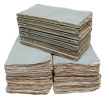
First, however partial, translation of Adam Smith's Wealth of Nations in Swedish rarely seen in this condition, thus making it the very first opportunity for Swedish speakers to study Adam Smith. A more lengthy translation was made in 1909 - 1911 but to this day a full Swedish translation has not been made.""Von Schulzenheim [nobleman, physician, country squire and politician] also published shorter articles in the review 'Läsning I blandade ämnen', an organ of the opposition to the absolutist and obscurantist regime of Gustavus IV Adolphus. The editor of the review was count Georg Adlersparre, an army officer and a political writer who in 1809 was to become one of the prime-movers behind the dethronement of the king. Adlersparre to was an admirer of Adam Smith. In 1799-1800 he published in the 'Läsning' his own Swedish translation of several selections from Wealth of Nations. In some cases Adlersparre added footnotes, making it easier for the readers to apply Smith's ideas to Swedish conditions. Those translations, to the best of my knowledge, were the first ones of Wealth of Nations in Sweden. They were followed by translations of other parts of Wealth of Nations, published in 1800 amd 1808. This time the translator was Erik Erland Bodell, an official of the Swedish Customs and thus, if you like, a colleague of Adam Smith."" ( Cheng-chung, Adam Smith Across Nations). Despite the comparatively late translation into Swedish, it still had a profound influence, not on economists since they were well aware of the original work in English, but upon politics and public opinion in general: ""There are few things more striking to the modem student of the history of ideas in Sweden than the negative phenomenon that Sweden was almost entirely uninfluenced by this fact and thus remained almost unaffected by English economic thought during a period when its superiority was most evident. As far as I am acquainted with the Swedish economic discussion and our popular economic literature of the 1860's and 1870's, there is almost no trace of any influence from English writers. [...]Of Adam Smith we have still only one abbreviated translation of his famous work and that was published as late as during this century"" and, as far as I know, nothing of Ricardo's or Malthus' exists in Swedish, nor do any of the major economic works of J.S. Mill."" (Heckscher, A survey of economic thought in Sweden, 1875-1950).The journal was preceded by Adlersparre's ""Läsning för landtmän"" 1795-96. The content is a mixture of literature, agriculture, law, philosophy and politics. Apart from the many contributions by Swedish authors, ""Läsning i blandade ämnen"" also contains texts by Kant, Gibbon and De Lolme OCLC lists copies at Yale, Minnesota, and Texas.
Recherches sur la Nature et les Causes de la Richesse des Nations. Traduit de l'Anglois de M. Smith [by Blavet]. 2 Tomes.
Londres, Pierre J. Duplain, 1788. 8vo, Two nice uniform contemporary full calf bindings with gilt spines. Some loss of leather to back hinge and lower capital of volume one and minor loos of leather to spine of volume two, all due to worming. Worming is not bad and does not affect anything but outer layer of small parts of the bindings. Apart from the worming a very nice, fresh and clean copy indeed. (8), IV, 503" (4), 496 pp. With both half-titles, the advertisment, both prefaces and the table of contents.
Rare early French translation of Adam Smith's political and economic classic, the ""Wealth of Nations"". Translated by Blavet. The present edition constitutes the third reprint of the second French translation. The second French translation was done by Blavet and is the first translation into French of which the translator and publisher are known. ""The reprint of Blavet's version appeared at Yverdon in 1781 in 6 volumes 12mo, and at Paris in the same year in 3 volumes 12mo, and again at London and Paris in 1788 in 2 volumes 8vo [the present edition], and revised and corrected, with Blavet's name as translator, at Paris An, ix (1800-01) in 4 volumes 8vo.He [Blavet] had no intention of publishing it until his friend M. Ameilhon happened to complain of scarcity of interesting articles for his Journal de l'Agriculture, du Commerce, des Arts et des Finances, which had just come under the control of the Mercantilist. It struck him that he might offer it to him which he did, with the explanation that it was far from perfect. It was accepted, and appeared in the issues of the Journal between January, 1779, and December 1780. He did not anticipate that it would go further. The edition of 1788 likewise appeared without his knowledge or consent, and was still more marred by errors than that of Yverdon"". (Lai, Cheng-chung. Adam Smith Across Nations: Translations and Receptions of The Wealth of Nations, Clarendon Press, UK, 2000). Hailed as the ""first and greatest classic of modern thought"" (PMM 221), Adam Smith's tremendously influential main work has had a profound impact on thought and politics, and is considered the main foundation of the era of liberal free trade that dominated the nineteenth century. Adam Smith (1723-1790) is considered the founder of Political Economy in Britain, mainly due to his groundbreaking work, the ""Wealth of Nations"" from 1776. The work took him 12 years to write and was probably in contemplation 12 years before that. It was originally published in two volumes in 4to, and was published later the same year in Dublin in three volumes in 8vo. The book sold well, and the first edition, the number of which is unknown, sold out within six months, which came as a surprise to the publisher, and probably also to Smith himself, partly because the work ""requires much thought and reflection (qualities that do not abound among modern readers) to peruse to any purpose."" (Letter from David Hume, In: Rae, Life of Adam Smith, 1895, p. 286), partly because it was hardly reviewed or noticed by magazines or annuals. In spite of this, it did evoke immense interest in the learned and the political world, and Buckle's words that the work is ""in its ultimate results probably the most important book that has ever been written"", and that it has ""done more towards the happiness of man than has been effected by the united abilities of all the statesmen and legislators of whom history has preserved an authentic account"" (History of Civilisation, 1869, I:214) well describes the opinion of a great part of important thinkers then as well as now. Considering the groundbreaking views presented in ""Wealth of Nations"", it comes as no surprise that the work was considered part of the revolutionary cultural development in France. As Adam Smith's friend, the Marquis of Lansdowne, said after quoting Smith's work: ""With respect to French principles, as they had been denominated, those principles had been exported from us to France, and could not be said to have originated among the population of the latter country."" (Quoted in: Rae, p. 291). The ideas of Adam Smith were often considered so dangerously closely connected with French ideas at the time that the term ""political economy"" almost became synonymous with questions concerning the constitution of governments. ""The French Revolution seems to have checked for a time the growing vogue of Smith's book and the advance of his principles in this country, just as it checked the progress of parliamentary and social reform, because it filled men's mind with a fear of change, with a suspicion of all novelty, with an unreasoning dislike of anything in the nature of general principle."" (Rae, p. 293). There can be no question that this seminal work greatly influenced French opinion at the time.
Adam-Fitx-Adam ou Fitz-Adam - [Edward Moore dit] - [1712 - 1757] - Journaliste et écrivain anglais
Reference : 34436
(1761)
Tableau critique des Moeurs angloises - Traduction de la Feuille périodique intitulée The World by Adam-Fitx-Adam -
1761 La Haye - Cuissard - 1761 - 1 volume in12 de 12 - 216 pages - Reliure pleine basane d'époque - dos cinq nerfs ornés de fleurons - tranches rouges - petits accrocs à la coiffe supérieure - coins un peu émoussés - Bon exemplaire -
Rare ouvrage -
Les Chevilles de Me Adam menuisier de Nevers. Rare édition originale de ce célèbre recueil composé par le premier poète-ouvrier français.
Précieux exemplaire conservé dans son authentique reliure en vélin souple de l’époque. Paris, chez Toussaint Quinet, 1644. In-4 de (28) pp. dont 1 portrait frontispice, (8) pp. de préface, 100 pp., (8) pp., 315 pp., (1) f.bl. Des rousseurs, qq. ff. brunis. Relié en plein vélin souple de l’époque, titre manuscrit au dos. Reliure de l’époque. 226 x 168 mm.
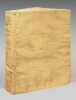
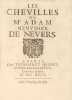
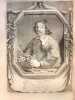
[video width="1920" height="1080" mp4="https://www.camillesourget.com/wp-content/uploads/2025/04/IMG_5332.mp4"][/video] Rare édition originale de ce célèbre recueil composé par le premier poète-ouvrier français. Cioranescu 12191; Graesse I, 18; Brunet, I, 46 («le portrait de Me Adam manque souvent»); De Backer, 755; Lachèvre, pp. 119 et 153. C'est le premier recueil donné par Billaut, qui jusqu'alors n'avait laissé imprimer que des plaquettes de circonstance. Les 28 premières pages sont une longue épitre en vers adressée au vicomte d'Arpajon. Les 100 pages qui suivent la préface de l'abbé de Marolles renferment 62 poésies françaises par 53 auteurs et 7 pièces grecques, latines, italiennes et espagnoles à la louange de l’auteur. Sous le titre Approbation du Parnasse, Saint-Amant, Scudéry, Scarron, Corneille, Colletet, Benserade, Boisrobert, Beys, Ragueneau, Desfontaines, Tristan l'Hermitte, Melle de Gournay témoignent du succès considérable des Chevilles. La seconde partie contient les épîtres, stances, rondeaux, sonnets, épigrammes, chansons et élégies de maître Adam. L'ouvrage constitue, avec Le Vilebrequin (1663, imprimé à titre posthume), et Le Rabot (jamais publié) l'un des trois titres composés par le simple menuisier de Nevers que demeura toute sa vie Adam Billaut (1602-1662), en dépit de ses attaches parisiennes et des protections qu'il trouva dans la capitale, auprès des milieux littéraires et les grands (Marie-Louise de Gonzague, Condé, Richelieu). Il est considéré aujourd’hui comme le premier poète prolétaire français. Adam Billaut voit le jour à Nevers en 1602. Sa jeunesse est mal connue. Il est menuisier et poète. Il est même le premier d’une grande tradition de poètes ouvriers qui se développera surtout au XIXe siècle. Il commence par des vers "d’atelier", une Muse des copeaux qui séduisit princesses et académiciens et deviendra la coqueluche des salons parisiens. Introduit par l’abbé Marolles dans la Bohème des Lettres ce "Virgile au rabot" fut surtout un poète courtisan. Il résista aux instances de ses amis qui voulaient l’attirer à Paris avec une pièce fameuse : Au loin l’ambition et ses folles chimères ! / Qu’un autre aille, orgueilleux, dans le palais des rois / Avec pompe étaler ses hautaines misères / Moi, j’aime mieux Nevers et l’ombre de ses bois ! Billaut meurt en 1662. Les chevilles de Maître Adam parurent en 1644 et eurent un grand succès critique. Si sa poésie brille peu par l'élégance, dans un siècle qui en fut plein, sa langue est pleine de verve et d'originalité et ses recueils font de lui un des tous premiers poètes du XVIIe, l'un de ceux dont la langue est toujours appréciée, dénuée d'afféteries et d'ornements inutiles.Celui qu'on surnomma "le Virgile du rabot" et que Voltaire tint pour l'un des grands écrivains du XVIIe, fut un poète et un chansonnier. Cette édition contient la préfacepar Michel de Marolles, qui l'avait rencontré par hasard dans les rues de Nevers, qui avait lu ses vers et considérait ce menuisier «comme une des plus rares choses du siècle». Dès lors, il fut introduit auprès des grands et, objet de curiosité, fut recherché de toute la bonne société.Billaut devint le protégé du prince de Condé, fut pensionné par Richelieu et admiré par ses pairs ; les 96 premières pages correspondent à des éloges en vers de poètes contemporains de celui qui fut un événement littéraire. Corneille le met dans un sonnet, Rotrou lui consacre une épigramme, Scarron et Scudéry lui dédient des odes. Le recueil contient une ode au cardinal de Richelieu qui l'avait pris sous sa protection. Impression en caractères italiques et romains, parfois grecs, avec ornements typographiques. Exemplaire bien complet du beau portrait de l'auteur dans son atelier de menuiserie en frontispice. Il manque à beaucoup d'exemplaires. Précieux exemplaire conservé dans son authentique reliure en vélin souple de l’époque.

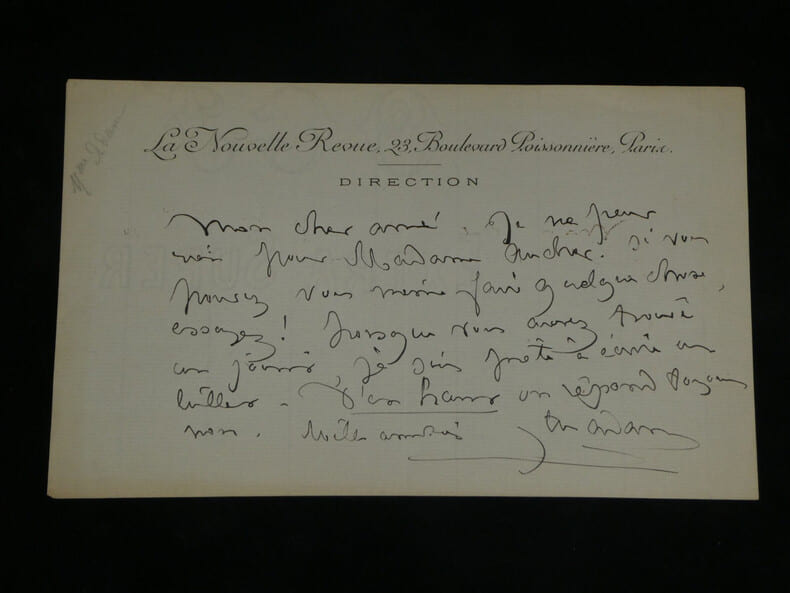
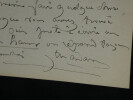
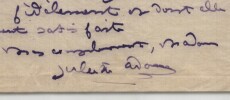
Juliette Adam - Lettre autographe signée - "La Nouvelle Revue" - 1885
Juliette Adam. Lettre autographe signée, "La Nouvelle Revue", 1885 Écrivaine française Lettre autographe signée de Juliette Adam, non datée, écrite à l'encre noire sur un feuillet de papier vergé avec entête "La Nouvelle Revue", revue qu'elle a fondé en 1879 et qu'elle anime jusqu'en 1899. "Mon cher ami, Je ne peux voir pour Madame Aucher. Si vous pouvez vous-même faire quelques chose, essayez ! [...] je suis prête à écrire un billet. [...]" Dimensions : 21 x 13,1 cm État : Voir photos pour plus de détails. Nombre de pages : 1 page Juliette ADAM Juliette Lambert, épouse La Messine, puis Adam, née le 4 octobre 1836 à Verberie et morte dans sa centième année, le 23 août 1936 à Callian, est une écrivaine, polémiste, salonnière féministe, femme de lettres et républicaine française. Wikipédia Contactez-nous Lettres autographes, vieux papiers, livres anciens, photographies, gravures, timbres... Nous expertisons et/ou rachetons dans toute la France vos lettres, collections de lettres et livres anciens. Paiement Sont acceptés les paiements par eBay, par PayPal, par virement ou par chèque. Envoi Envoi soigné dans un emballage rigide et étanche sous trois jours. Prévoir les délais postaux habituels en plus. Retour Satisfait ou remboursé. Si vous n'êtes pas entièrement satisfait, retour à la charge du vendeur pour l'Europe. À la charge de l'acheteur pour le reste du monde.

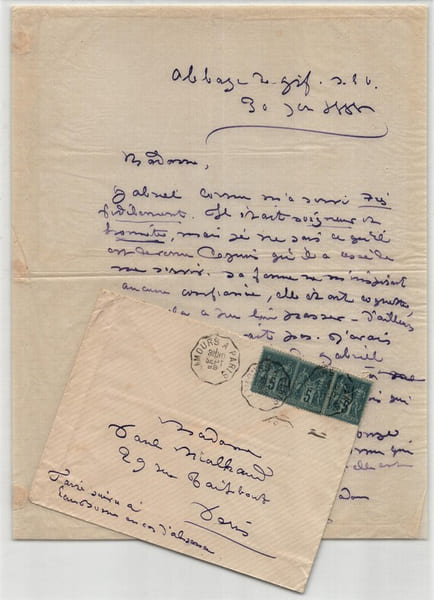
Juliette Adam - Lettre autographe signée - Abbaye de Gif, 1888
Juliette Adam. Lettre autographe signée, Abbaye de Gif, 1888 Femme de lettres française Lettre autographe signée de Juliette Adam, datée du 30 septembre 1888. Rédigée à l'encre bleue. Avec son enveloppe timbrée et cachetée. Dimensions : 20,7 x 26,6 cm État : Voir photos pour plus de détails. Nombre de pages : 1 page Juliette Adam Juliette Lambert, épouse La Messine, puis Adam, née le 4 octobre 1836 à Verberie et morte dans sa centième année, le 23 août 1936 à Callian, est une écrivaine, polémiste, salonnière féministe, femme de lettres et républicaine française.
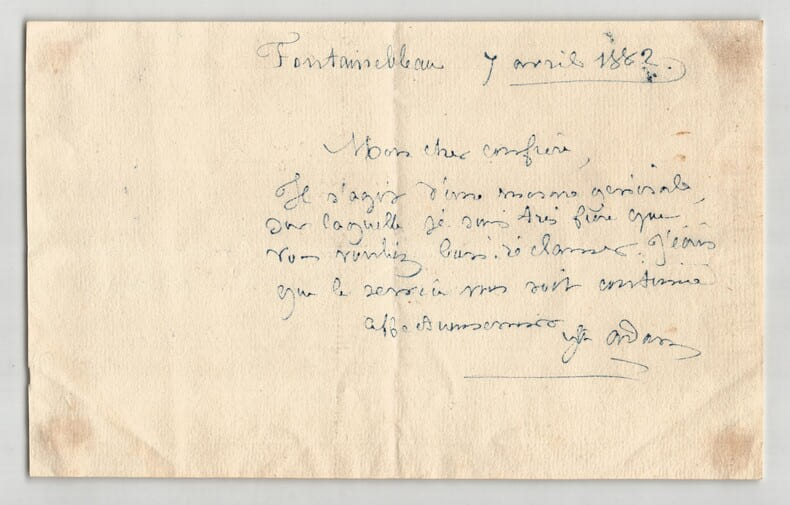
Juliette Adam - Billet autographe signé - Fontainebleau 1882
Juliette Adam - Billet autographe signé - Fontainebleau 1882 Billet autographe signé de Juliette Adam, daté du 7 avril 1882 à Fontainebleau. Rédigé à l'encre bleue sur un feuillet de papier vergé filigrané. Dimensions : 20,7 x 12,9 cm Nombre de pages : 1 page Juliette Adam Juliette Lambert, épouse La Messine, puis Adam, née le 4 octobre 1836 à Verberie et morte dans sa centième année, le 23 août 1936 à Callian, est une écrivaine, polémiste, salonnière féministe, femme de lettres et républicaine française.
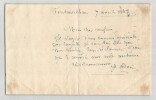
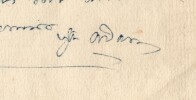
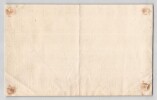
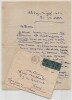
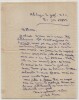
Paul ADAM Lettre autographe signée et enveloppe à Philippe GILLE 1899 2 pages
Paul ADAM Lettre autographe signée et enveloppe à Philippe GILLE 1899 2 pages Écrivain, Critique d'art Lettre autographe signée et son enveloppe de Paul ADAM à Philippe GILLE qu'il qualifie de "Mon cher Maître" 1899 2 pages "Je vous dois un peu de modestes gloires, et ma gratitude" Dimensions : 18x 13,7 cm État : Voir photos pour plus de détails. Nombre de pages : 2 Paul ADAM Paul Auguste Marie Adam, né le 7 décembre 1862 à Paris où il est mort le 1ᵉʳ janvier 1920, est un écrivain français et critique d'art.
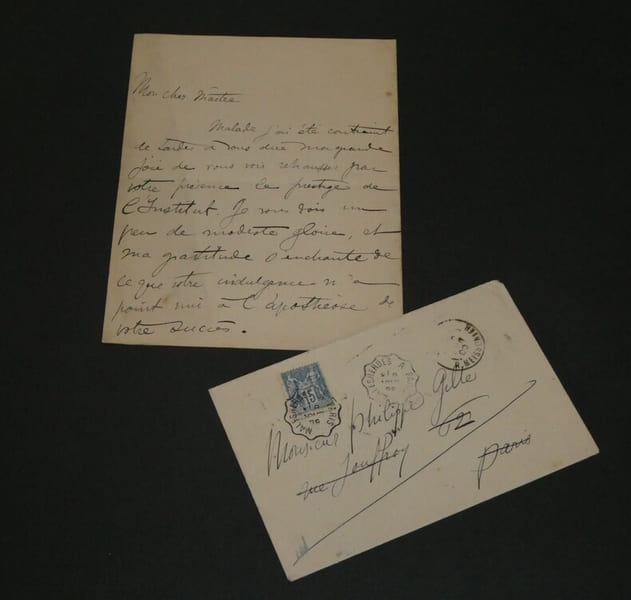

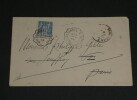
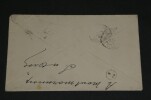
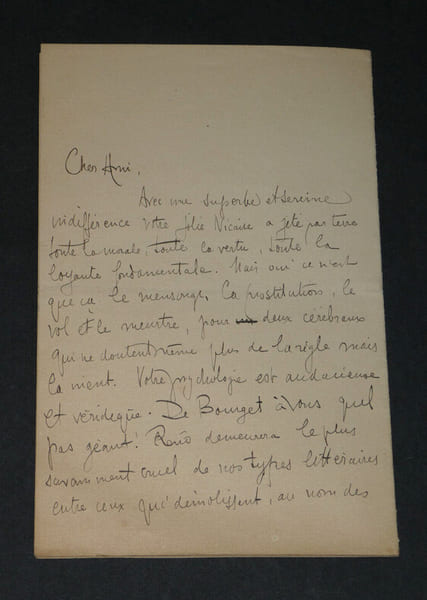
Paul ADAM — Lettre autographe signée, juillet 1902 — "La prostitution, le vol & le meurtre" — 6 pages — À Pierre Valdagne
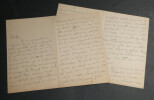
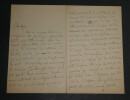
Paul ADAM. Lettre autographe signée, 1902 Écrivain français Lettre autographe signée de Paul ADAM, adressée à Pierre Valdagne, datée de juillet 1902, de 6 pages sur deux feuillets doubles. Il parle du livre de son correspondant "La confession de Nicaise" publié en 1902. "Avec une superbe et sereine indifférence votre jolie Nicaise a jeté par terre toute la morale, toute la vertu, toute la loyauté fondamentale. Mais oui ce n'est que ça le mensonge, la prostitution, le vol et le meurtre" Dimensions : 11 x 17,5 cm État : Voir photos pour plus de détails. Nombre de pages : 6 pages Paul ADAM Paul Auguste Marie Adam, né le 7 décembre 1862 à Paris où il est mort le 1ᵉʳ janvier 1920, est un écrivain français et critique d'art. Wikipédia Pierre VALDAGNE Lucien Louis, connu sous le nom de plume de Pierre Valdagne né Charles-Lucien Louis à Paris le 3 mai 1854 et mort le 31 janvier 1937 à Paris 17ᵉ, est un romancier et auteur dramatique français. Wikipédia
Adam le bossu trouvère artésien du XIIIe siècle. Le jeu de Robin et Marion jeu du pèlerin
Librairie Honoré Champion Éditeur 1976 in12. 1976. Broché. Adam de la Halle dit Adam le Bossu ou le Bossu d'Arras est un trouvère picard du XIIIe siècle. Il est l'auteur du Jeu de la Feuillée et du Jeu de Robin et de Marion œuvres fondatrices du théâtre profane médiéval. Son œuvre mêle satire sociale chansons populaires et critique de la société arrageoise corrompue par l'argent
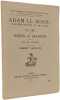
Bon état pages non coupées intérieur propre
1836-1936. Femme de lettres. 2 L.A.S. Jte Adam et Juliette Adam a Mon cher Lollie [Frdric Lolli (1854-1945) crivain et journaliste]. Chteau de Costre par Cavaillon, 23 octobre 1884 et Paris, lundi (s.d.). 4 pp. in-8 oblong. En-tte de La Nouvelle Revue.
Dans la 1re lettre, elle juge son ...article inte?ressant. Les rapprochements entre le?tat ancien des lettres et lactuel e?taient ne?cessaires [...]. Le second article pourra venir tre?s vite apre?s celui-ci... elle lassure de les faire parai?tre au plus to?t dans la Nouvelle Revue... et dans la seconde, elle annonce : ...Je?cris au Pre?sident du Conseil afin dessayer de mon influence sur son esprit. Au ministe?re de lInstruction publique tout est bien pre?pare?, mais si M. Brisson a une ide?e pour Bourges jai bien peur de ne pouvoir rien dans ce cas. Votre Gens de lettres est encore retarde?...Juliette Adam a ve?cu presque centenaire. Grande dame des lettres franc?aises, elle fre?quenta Hugo et Flaubert, ainsi que des personnalite?s politiques, parmi lesquelles Gambetta. Elle e?pousa en secondes noces Edmond Adam, se?nateur, conseiller de Thiers. Juliette Adam publia une cinquantaine d'ouvrages, des romans, des me?moires et des re?flexions politiques, ainsi que des centaines d'articles. En 1879, elle fonde et dirige la Nouvelle Revue, consacre?e a? la litte?rature et a? la politique. Cette publication re?ve?la des e?crivains comme Guy de Maupassant ou Paul Bourget.
VALENCIENNES PRISE D'ASSAUT, ET SAUVEE DU PILLAGE PAR LA CLEMENCE DU ROY, LE 16 MARS 1677 [Paris, ca. 1680]
Paris 1680 Une gravure à l'eau-forte sur cuivre , Format : 56 centimètres de haut par 97 centimètres de large (cuvette : 53.0 x 96.5 cm ), sur papier verger crème, inscription au bas de la gravure : R. Bonnart Sculp. + puis inscrit dans la moitié gauche : "Valenciennes prise d'assaut, et sauvee du pillage par la clemence du Roy, le 10 Mars 1677 - Dessigne sur le lieux, pour le Roy tres-chrestien, par F. Vander Meulen. Se distribue a Paris par l'Auteur, en l'Hostel des Manufactures Royales des Gobelins, Et en la rue St Jacques, Avec privilege du Roy." + puis inscrit en latin dans la moitié droite : "Valencenae vi captae et clementia Victoris ab excidio servatae XVI Martii 1677 - Ad Verum delineatus pro Rege Christianissimo per F. Vander Meulen. Prostat Parisiis apud Authorem in Regia Artium officina Vulgo dicta des Gobelins Et in via Jacobea, Cum privilegio Regis.", Fait à Paris, sans date (1680),
Vue représentant la prise de Valenciennes par les Français pendant la "Guerre de Hollande". Gravée par R. Bonnart d'après F. Van der Meulen. "Peintre baroque flamand", Adam Frans van der Meulen (1632-1690) se spécialisa dans les paysages et les scènes de bataille. Baptisé le 11 janvier 1632 à Bruxelles, dans les Pays-Bas espagnols, Adam Frans van der Meulen se forme dès 1648 auprès du peintre de batailles Pieter Snayers, issu de l'école flamande. Vers 1664, le ministre des Finances Colbert le fait venir à Paris, à la demande de Charles Le Brun, pour l'employer en tant que paysagiste aux Gobelins, avant de lui confier la charge de « peintre des conquêtes du Roi » Louis XIV. Les toiles d'une exactitude minutieuse que réalise van der Meulen lors des campagnes de Flandre, en Franche-Comté et en Hollande durant la guerre de Dévolution de 1667-1668, plaisent tant au Roi-Soleil que ce dernier lui ordonne à partir de cette date de l'accompagner dans toutes ses opérations militaires. Il exécute de nombreux croquis, vues de villes et paysages. [Showing the town of Valenciennes. Etching by R. Bonnart after Adam Frans van der Meulen (1632-1690) who was a Flemish Baroque painter specialising in battle scenes. He was active first in Brussels, where he was a pupil of Pieter Snayers, and from the 1660s onwards in Paris.His paintings during the campaigns of Flanders in 1667 so delighted Louis that from that date van der Meulen was ordered to accompany him in all his expeditions. In 1673 he was received into the Académie royale de peinture et de sculpture, attained the grade of councillor in 1681, and died full of honors in Paris in 1690. ]- Hollstein XIV ................... SUPERBE ................. en parfait état (very good condition). parfait état
ETUDES D'ANIMAUX DANS LE PAYSAGE
Pont-à-Mousson Haguenthal éditeur 0 in 8 oblong (13,5x26) 1 volume reliure cartonnée verte de l'éditeur, plat supérieur illustré d'une grande composition lithographiée. Album renfermant 12 planches lithographiées par Victor Adam. Victor-Vincent Adam, 1801-1867, lithographe français. Bon exemplaire
Bon Couverture rigide
[Chez Aubert gal-Véro-Dodat, Imp. d'Aubert et de Junca] - ADAM, Victor
Reference : 64583
(1837)
Passe-Tems (180 planches en 2 Tomes : Complet) [ Passe-Temps ]
2 vol. in-folio (36 x 27,7 à la reliure, 34,9 x 26,5 cm en marges) reliure de l'époque demi-chagrin brun, dos lisse orné en long, plats richement ornés avec initiales A. J. au centre, Chez Aubert gal-Véro-Dodat, Imp. d'Aubert et de Junca, Paris, s.d. [ circa 1836 - 1840 ], Tome 1 : Planches 1 à 89 ; Tome II : Planches 90 à 180 (les planches 151 à 162 sont dessinées dans le format à l'italienne),
![Passe-Tems (180 planches en 2 Tomes : Complet) [ Passe-Temps ]. ADAM, Victor](https://static.livre-rare-book.com/pictures/CDL/64583_thumb.jpg)
![Passe-Tems (180 planches en 2 Tomes : Complet) [ Passe-Temps ]. ADAM, Victor](https://static.livre-rare-book.com/pictures/CDL/64583_2_thumb.jpg)
![Passe-Tems (180 planches en 2 Tomes : Complet) [ Passe-Temps ]. ADAM, Victor](https://static.livre-rare-book.com/pictures/CDL/64583_3_thumb.jpg)
Très rare exemplaire dont nous n'avons pas trouvé l'équivalent, contenant 180 planches. Parmi les autres exemplaires les plus complets que nous ayons pu repérer, on peut noter celui du Musée Carnavalet (don Visme de Wegmann), contenant 120 planches et édité par Aumont et Tessari, et un autre exemplaire du même éditeur contenant 124 planches (les éléments disponibles ne permettant pas que l'on puisse conclure avec certitude quant à l'antériorité d'une édition sur l'autre). Comme l'écrit Mennessier de la Lance à propos de Victor Adam (1801-1867), "parmi les milliers de dessins lithographiés dont il est l'auteur, la plupart représentent des chevaux et des scènes hippiques. Il fut donc un spécialiste dans ce genre et son nom mérite de figurer dans une bibliographie hippique. Les chevaux de Victor Adam, qui a représenté toutes les races, du Boulonnais au Pur sang, sont souvent élégants et gracieux et ont parfois un mouvement endiablé [... ]". Dans ce rare recueil de "passe-temps", Victor Adam est fidèle à lui-même et les scènes hippiques abondent (il est rare de trouver une planche sans cheval). On y découvrira également de nombreuses scènes militaires ou de chasse, mais aussi des dessins pittoresques, et parfois exotiques (le recueil s'ouvre d'ailleurs sur des scènes asiatiques). "Tous ses dessins sont exécutés avec une facilité inouïe, "de chic"" explique Béraldi, et ils témoignent de la profonde passion de Victor Adam pour la chose équestre. Bon état (des rouss. parfois importantes, reliures un peu frottées, surtout en coupes, 2 petits accrocs marginaux n'affectant pas le dessin, bon exemplaire par ailleurs) pour ce remarquable recueil des "Passe-Tems" rassemblant 180 planches. Mennessier, I, 6 ; Béraldi, Graveurs, I, 15 (à propos de Victor Adam, mais Béralid ne semble pas avoir connu ce recueil).
Bildliche Erinnerungen vom eidgenössischen Truppenzusammenzug im August 1861. / Souvenirs pittoresques de la concentration des troupes fédérales suisses en août 1861. Nach der Natur gezeichnet und hrsg. von Eugen Adam. Text von Abraham Roth.
Bern, Dalp, gedruckt bei Julius Adam in München, 1861, gr. in-Folio, 1 Bl. (Vorwort) + lith. Titel mit Vignette + 9 (von 15) getönte lith. Tafeln mit je 1 Bl. Begleittext. Textbl. vereinzelt leicht stockfleckig. Tafeln am Rand bestossen, AUCH VERKAUF Pro Tafel möglich frs 50.- pro Tafel mit Textbl. Hlwd. Titel Aufgezogen, stellenweise beschabt.
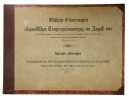
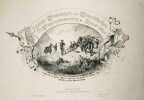

Deutsch-französische Parallelausgabe dieser visuell aufschlussreichen Darstellung über die schweizer. Wehrbereitschaft nach der politischen Niederlage von 1860 (Savoyerhandel). - Die vom Zeichner Bruder Franz Adam lithographierten Tafeln zeigen: Die Einschiffung der Truppen zu Luzern. / Der Abmarsch von Amsteg. / Das Gefecht bei der Meidschlinger-Brücke / Der Brückenschlag am Pfaffensprung. / Der Aufbruch vom Lager bei Wasen. / Position bei Göschenen. / Die Batterie Nr. 27 bei der ersten Schutzgalerie auf der Gotthardstrasse. / Die Feldpredigt beim Berner Bataillon zu Andermatt. / Der Abendrapport im Lager von Realp.FEHLEN 6 Tafeln: Marsch der 1. Brigade nach der Furka. (nur Beschreibung vorhanden) / Halt der 1. Brigade am Rhônegletscher. (nur Beschreibung) / Die 2. Brigade am Nufenenpass. (nur Beschreibung) / Gefecht am Pfyner-Wald. (nur Beschreibung) / Beiwachtfeuer im Stockalper’schen Palais zu Brig. (nur Beschreibung) / Der Einzug in Sitten. (entre des troupes à Sion (nur Beschreibung)Der Künstler E. Adam ist einer von 4 Brüdern des Albrecht Adam, der Stammvater einer in 4 Generationen tätigen bayerischen Künstlerfamilie war. (hauptsächlich Pferde- und Schlachtenmaler). Die Kommentare zu den einzelnen Bildern wurden vom bedeutenden schweizerischen Journalisten und Schriftsteller A. Roth verfasst. Thieme-B. I/60 f.; Barth 25801; HBLS V/718.// AUCH VERKAUF Pro Tafel möglich frs 60.- pro Tafel mit Textbl. Image disp.

(SLACES, NVVA)
Phone number : 41 (0)26 3223808
En Undersökning av Folkens Välstånd dess Natur och Orsaker. Översättning av D:r Emil Sommarin. 2 volumes. - [FIRST SWEDISH EDITION OF ""THE WEALTH OF NATIONS""]
Lund, C. W. K. Gleerups förlag, 1909 & 1911. 8vo. Bound with the original wrappers of volume 1 in one contemporary half blue cloth binding with red leather titel label with gilt lettering to spine. A fine and clean copy. XVI,191, (4), 179 pp.
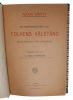
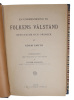

First edition of the first Swedish translation of Adam Smith's ground-breaking main work, the ""Inquiry into the Nature and Causes of the Wealth of Nations"". Smaller parts of the book had previously been translated into Swedish (in 1800, 1804 and 1869), but the present translation is considered the first actual translation of the work (even though some parts have been excluded by translator Emil Sommarin, who based his translation the 5th English edition, the last edition to be supervised by Adam Smith himself). It is to this date the only Swedish translation of the work, which tells us a lot about the history of Swedish economics. Despite the comparatively late translation into Swedish, it still had a profound influence, not on economists since they were well aware of the original work in English, but upon politics and public opinion in general: ""There are few things more striking to the modem student of the history of ideas in Sweden than the negative phenomenon that Sweden was almost entirely uninfluenced by this fact and thus remained almost unaffected by English economic thought during a period when its superiority was most evident. As far as I am acquainted with the Swedish economic discussion and our popular economic literature of the 1860's and 1870's, there is almost no trace of any influence from English writers. [...]Of Adam Smith we have still only one abbreviated translation of his famous work and that was published as late as during this century"" and, as far as I know, nothing of Ricardo's or Malthus' exists in Swedish, nor do any of the major economic works of J.S. Mill."" (Heckscher, A survey of economic thought in Sweden, 1875-1950).Translator Emil Sommarin (1874-1955) was a student of Knut Wicksell, arguably the most influential Swedish economist, and Sommarin succeeded Wicksell's professorship in national economics. Wicksell ""came to know his classics very well and became and remained an admirer of Adam Smith. Around 1910 he also assisted his former student and successor as economics professor in Lund, Emil Sommarin, with the translation of WN, still the most complete we have in Sweden. In this connection he wrote to a friend in Uppsala, ""It is almost unbelievable that we have been denied this masterpiece for 125 years and our economic policy is a result of the omission"" (Cheng-Chung Lai, Adam Smith Across Nations, p. 384).
En Undersökning av Folkens Välstånd dess Natur och Orsaker. Översättning av D:r Emil Sommarin. [i.e. Swedish ""Wealth of Nations""]. 2 volumes. - [FIRST SWEDISH EDITION OF ""THE WEALTH OF NATIONS""]
Lund, C. W. K. Gleerups förlag, 1909 & 1911. 8vo. Both volumes in the original printed wrappers. Light wear to spines, otherwise a very fine and clean set. XVI,191, (4), 179 pp.
![En Undersökning av Folkens Välstånd dess Natur och Orsaker. Översättning av D:r Emil Sommarin. [i.e. Swedish ""Wealth of Nations""]. 2 volumes. - ...](https://static.livre-rare-book.com/pictures/LLX/58833_1_thumb.jpg)
First edition of the first Swedish translation of Adam Smith's ground-breaking main work, the ""Inquiry into the Nature and Causes of the Wealth of Nations"". Smaller parts of the book had previously been translated into Swedish (in 1800, 1804 and 1869), but the present translation is considered the first actual translation of the work (even though some parts have been excluded by translator Emil Sommarin, who based his translation the 5th English edition, the last edition to be supervised by Adam Smith himself). It is to this date the only Swedish translation of the work, which tells us a lot about the history of Swedish economics. Despite the comparatively late translation into Swedish, it still had a profound influence, not on economists since they were well aware of the original work in English, but upon politics and public opinion in general: ""There are few things more striking to the modem student of the history of ideas in Sweden than the negative phenomenon that Sweden was almost entirely uninfluenced by this fact and thus remained almost unaffected by English economic thought during a period when its superiority was most evident. As far as I am acquainted with the Swedish economic discussion and our popular economic literature of the 1860's and 1870's, there is almost no trace of any influence from English writers. [...]Of Adam Smith we have still only one abbreviated translation of his famous work and that was published as late as during this century"" and, as far as I know, nothing of Ricardo's or Malthus' exists in Swedish, nor do any of the major economic works of J.S. Mill."" (Heckscher, A survey of economic thought in Sweden, 1875-1950).Translator Emil Sommarin (1874-1955) was a student of Knut Wicksell, arguably the most influential Swedish economist, and Sommarin succeeded Wicksell's professorship in national economics. Wicksell ""came to know his classics very well and became and remained an admirer of Adam Smith. Around 1910 he also assisted his former student and successor as economics professor in Lund, Emil Sommarin, with the translation of WN, still the most complete we have in Sweden. In this connection he wrote to a friend in Uppsala, ""It is almost unbelievable that we have been denied this masterpiece for 125 years and our economic policy is a result of the omission"" (Cheng-Chung Lai, Adam Smith Across Nations, p. 384).
Métaphysique de l'Ame, ou Théorie des sentimens moraux, traduit de l'anglais de M. Adam Smith, Professeur de Philosophie Morale, dans l'Université de Glasgow, par M.*** (Marc Antoine Eidous).
Paris, Briasson, 1764 ; 2 tomes in-12, veau marbré, dos lisse décoré «à la grotesque» de croisillons étoilés, pièce de titre et de tomaison havane (reliure de l'époque) ; VIII (le premier feuillet est blanc), 302 pp. , (1) f. blanc ; (4), 370, (2) pp. (privilège).


Edition originale rare de ce premier texte d'Adam Smith en Français, traduit par Marc-Antoine Eidous, né à Marseille (1724-1790), collaborateur de l'Encyclopédie (450 articles dont l'héraldique et l'art de monter), traducteur de nombreux ouvrages dont le célèbre Dictionnaire universel de médecine de Robert James, en collaboration avec son ami Denis Diderot, Julien Busson, Eidous et François-Vincent Toussaint. Philosophe, économiste et même fondateur de l'économie politique, Adam Smith, Ecossais, va mener une carrière universitaire ; d'abord professeur de logique à l'université de Glasgow, puis de philosophie morale, il va se faire connaitre en Grande-Bretagne et en Europe grâce au présent ouvrage où il développe l'idée d'immédiateté et d'universalité de jugements moraux en affirmant que les individus partagent les sentiments les uns envers les autres par un mécanisme de sympathie. Les convictions religieuses d'Adam Smith sont relativement floues et font référence au «Grand Architecte de l'Univers» cher aux Francs-Maçons. On peut lire sur sa pierre tombale : Ci-gît Adam Smith, auteur de «Les sentiments moraux» et «La Richesse des Nations». Minuscule accroc à la coiffe supérieure et usure à l'inférieure du tome 1er avec petite fente au mors, sans gravité. Table des matières manuscrite en fin de chaque tome, bon exemplaire dans l'ensemble.
Oeuvres de Maitre Adam Billaut, menuisier de Nevers; [...] edition par N.-L. Pissot.Le titre complet de l’ouvrage est le suivant: Oeuvres de Maitre Adam Billaut, menuisier de Nevers; edition soigneusement revue d’apres celle originale de 1644, augmentee de quelques notes; et precedee d’une notice historique sur cet homme extraordinaire par N.-L. Pissot.
1832 1vol. pet. in-8, XLI-324pp, reliure demi veau,dos lisse orné. ep. Paris 1806 Le titre complet de l’ouvrage est le suivant: Oeuvres de Maitre Adam Billaut, menuisier de Nevers; edition soigneusement revue d’apres celle originale de 1644, augmentee de quelques notes; et precedee d’une notice historique sur cet homme extraordinaire par N.-L. Pissot. - Excellente edition dans laquelle "Les Chevilles" sont suivies de "L"approbation du Parnasse", recueil de vers des meilleurs poetes du temps de Louis XIII a la louange de maitre Adam. Bien complet du portrait grave. dos un peu frotté,texte bon
![Oeuvres de Maitre Adam Billaut, menuisier de Nevers; [...] edition par N.-L. Pissot.Le titre complet de l’ouvrage est le suivant: Oeuvres de Maitre ...](https://static.livre-rare-book.com/pictures/BRK/22165_1_thumb.jpg)
![Oeuvres de Maitre Adam Billaut, menuisier de Nevers; [...] edition par N.-L. Pissot.Le titre complet de l’ouvrage est le suivant: Oeuvres de Maitre ...](https://static.livre-rare-book.com/pictures/BRK/22165_2_thumb.jpg)
Remise de 20% pour toutes commandes supérieures à 200 €
Le Vilebrequin de Me. Adam, Menuisier de Nevers. Contenant toutes sortes de Poësies gallantes, tant en Sonnets, Epistres, Epigrammes, Elégies, Madrigaux, que Stances, & autres Pièces autant curieuses, que divertissantes, sur toutes sortes de sujets. Dedié à Monsieur le Prince. A Paris, chez Guillaume de Luyne, 1663. In-12 de 295pp. (1)f.
P., Guillaume de Luyne, 1663 ; petit in-12. 23ff.-528pp.-3ff. (erreur de pagniation). Veau brun de l'époque, dos à nerfs, filets dorés, pièces de titre en papier manuscrite (XIXe s. ?). Coiffes arassées, coins frottés, cuir craquelé, page de titre montée sur onglet. Note manuscrite ancienne sur le contreplat inf. vantant les mérites de la poésie de Me Adam.
Edition originale précédant celle en 295pp. publiée la même année. Elle présente la particularité d'avoir une numérotation erronnée après la page 240, la pagination reprend au numéro 351. Le texte est cependant parfaitement complet comme viennent le confirmer l'enchainement des vers, les signatures des cahiers (qui se suivent) et la réclame de fin de page qui renvoie bien au premier mot de la page suivante. Cette édition du second recueil de poésies d'Adam Billaut (après Les Chevilles, en 1644) a été établie par son ami Augustin François Berthier, prieur de Saincaize (Nièvre) qui aprend la mort du poète en 1662 au moment ou il rédige la préface du volume. Il préparait aussi la publication du "Rabot" qui ne sera finalement pas imprimée. Berthier a également laissé une oeuvre inédite qui ne sera publiée qu'au XIXe siècle. Celui qu'on surnoma ironiquement le "Virgile du rabot" était né à Nevers en 1602. De modeste extraction, il eut à lutter contre les préjuger de sa condition, même s'il fut loué de son vivant par de nombreux auteurs (Ménard, Scudéry, De Thou... et même Corneille), et parfois aidé financièrement par le Prince de Gonzague, Richelieu, ou l'abbé de Marolles, il dut retourner à son état de menuisier à Nevers après avoir tenté sa chance à Paris. Ce n'était pas, en effet, un poète de cour, et ses vers sont emprunt de simplicité, d'humour et d'une modernité qui les rendent si agréablement lisibles aujourd'hui.
Récompenses artistiques.
Paris H. GACHE 1850 1 Paris, H. Gache éditeur, in-16 oblong, (1850), illustré par Victor Adam, couverture rempliée verte décorée de six anges jouant des instruments, titre en noir.
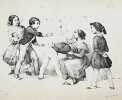
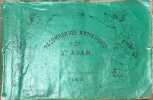
Victor Adam, célèbre pour son imagination extraordinaire et son étonnante facilité de plume, a illustré à plusieurs reprises les plaisirs et les jeux enfantins. Ce charmant album de 24 lithographies en noir et blanc comme "colin-maillard", "le cheval fondu", "l'escarpolette", montre avec beaucoup de vivacité des enfants qui s'amusent ou jouent aux adultes. manques et déchirures à la couverture, rousseurs éparses sur les pages.

