Write to the booksellers
23040 books for « abbe e b »Edit
-
Type
Art print (1)
Autograph (5)
Book (22993)
Engraving (2)
Magazine (14)
Manuscript (1)
Maps (13)
Music sheets (4)
Old papers (4)
Photographs (2)
Reprint (1)
-
Latest
Last 24h (94)
Last 3 days (10)
Last month (132)
Last week (16)
-
Language
English (3)
French (23036)
Latin (1)
-
Century
16th (3)
17th (100)
18th (1606)
19th (7256)
20th (6145)
21st (183)
-
Countries
Belgium (1233)
Canada (77)
China (23)
Côte d'Ivoire (38)
Denmark (68)
France (20768)
Germany (111)
Greece (23)
Italy (9)
Netherlands (3)
Switzerland (687)
-
Syndicate
ALAC (67)
CLAM (62)
CLAQ (17)
CNE (31)
ILAB (11978)
NVVA (165)
SLACES (163)
SLAM (11558)
SNCAO (29)
Topics
- Age (78)
- Alsace (88)
- Aquitaine (106)
- Archaeology (225)
- Architecture (184)
- Astronomy (123)
- Auvergne (105)
- Bible (298)
- Biography (431)
- Books from the xviiith (130)
- Bourbonnais (94)
- Brittany (270)
- Burgundy (135)
- Catechism (206)
- Catholicism (638)
- Champagne (90)
- Christ (the) (266)
- Christianity (1034)
- Churches (303)
- Cult (102)
- Dauphiné (137)
- Dedication (219)
- Dictionaries (125)
- Drioux (99)
- Early printed books (407)
- Education (232)
- Education - morals (172)
- Esotericism (110)
- Ethic (249)
- Faith (76)
- Fine arts (99)
- First edition (277)
- Fleury (138)
- Forez (153)
- Franche comte (69)
- From lyons (133)
- Genealogy (165)
- Geography (636)
- Greece (71)
- Hagiography (88)
- Helvética (72)
- History (2366)
- Italy (98)
- Languedoc (96)
- Latin (104)
- Law (96)
- Linnean society of lyons (81)
- Literature (1311)
- Lorrain (109)
- Lyons and area (81)
- Lyons college (81)
- Lyons college pc (81)
- Lyons revue (81)
- Middle ages (99)
- Newspapers press (130)
- Normandy (220)
- Paris (188)
- Philosophy (519)
- Poetry (176)
- Policy (127)
- Prayers (77)
- Prevost abbot (145)
- Provence (159)
- Psychology (99)
- Regionalism (597)
- Religions (2366)
- Reliure (102)
- Reverend (128)
- Reviews (84)
- Rome (75)
- Savoy (70)
- Sciences (194)
- Switzerland (81)
- Teaching (77)
- Theatre (85)
- Theology (1199)
- Translation (87)
- Travel (141)
- Various (172)
- Vertot (115)
- Virgin mary (135)
- War (135)
- Xviii th century (111)
Neue Reise durch Nordamerika, in dem Jahr 1781, nebst dem Feldzüge der Armee des Herrn Grafen von Rochambeau, vom Abbe Robin. Aus dem Französischen übersetzt.
Nürnberg, Grattenauer, 1783. Contemp. hcalf, gilt. Wear to titlelabel. A paperlabel pasted on lower part of spine. Lower right corner of front free endpaper gone. Stamp on titlepage. (4),176 pp. Internally fine and clean.
First German edition of this first-hand account of the campaign of the allied armies under command of general Washington. It also contains reflexions and observations on the customs of the Americans, together with an account of the capture of general Burgoyne and Cornwallis with their armies. - Sabin: 72037.

Des principes des négociations, pour servir d'introduction au droit public de l'Europe, fondé sur les traités.
A La Haie, 1757. 12mo. Very nice marbled full calf with richly gilt spine. Gilt title-label to spine. All edges of boards gilt (gilding a bit worn). Marbled edges. Front and back end-papers with a few later annotations. Otherwise a very nice and clean copy. VIII, 278 pp.
Rare first edition of one of Mably's most important works. ""His principes des negociations, which was to serve as an introduction to the Droit publique [...] was a courageous attack on the foreign policies of the European powers, and a plea for more rational and honest methods, not only for the sake of justice and humanity, but because they are actually profitable."" (Whitfield, Ernest A., Gabriel Bonnot De Mably, New York, 1969).Gabriel Bonnot de Mably ( 1709 - 1785), was a French philosopher and politician. He was one of the 18th century's most popular writers but largely passed into obscurity in the 20th century. His works contributed to the later concepts of both communism and republicanism. Some have enrolled him in the French School of Utopianism: ""Here also is the beginning of the French School of Utopian Communism properly so called. The Abbé de Mably (1709-1785) merits attention for his singularly clear exposition of the fundamental doctrine of equality: ""The sentiment of equality if nothing else than sentiment of our dignity"" men have become slaves by letting it grow feeble, and only by revivifying it will they become free""."" (Catlin, George. A History of Political Philosophers, London, 1950).More recent research suggests another approach to Mably's thinking: ""Mably should be seen as neither a proto-socialist nor a reactionary thinker, but as a republican - a classical republican, in fact, whose writing represents a later Gallic contribution to the political tradition founded by Machiavelli and Harrington. He is not only interesting as the personification of the revolutionary spirit and as a level-headed reformer, but because he formulated principles which have since been either accepted or re-discovered."" (Wright J. History of Political Thought, Volume 13, Number 3, 1992 , pp. 391-415).
"OUTHIER, ABBÉ R. ET (PIERRE-CHARLES) LE MONNIER. - MAP OF THE PLEIADES.
Reference : 45938
(1755)
Carte des Pléyades, dont la position de trente-cinq principales étoiles est déterminée par les observations de M. le Monnier, faites en 1744, 1745, 1746 & 1748. Les autres étoiles qui suivent, ont été placées par estime des distances & par des alignem...
(Paris, Imprimerie Royale, 1755). 4to. Extract from ""Mémoires fe Mathematique et de Physique, Présentés à l'Academie des Sciences par divers Savans"", Tome II. Pp. 607-608 and 1 folded engraved map ""Carte dee Etoiles des Pleiades ajoutées a celles qui ont etes observées par Mr. le Monnier, suivant divers Alignements &c. par Mr. l'abbé Outhier"" (ca. 25x19 cm.).
First printing of Le Monnier's famous star map of the Pleiades.
Histoire des revolutions de Pologne. Depuis le commencement de cette monarchie jusqu' a la mort d'Auguste II. 2 vols. - [RARE WORK ON THE HISTORY OF POLAND]
Amsterdam (Paris), F. l'Honore 1735. 8vo. Uniformly bound in two contemporary full calf bindings with four raised bands and richly gilt spines. Small paper-label pasted on to top of spine. Front hinge on vol. II partly split. Ex-libris pasted on to pasted down front end-paper. Internally nice and clean. XXIV, 243 pp. + 1 folded map (2), 206, (38) pp. + 2 folded maps.


Uncommon first edition of this history of Poland spanning from the beginning of the 11th century to the advent of Stanislas Leszczynski (1677 – 1766). Complete with all three maps. Barbier II, 766.
Histoire des révolutions des Pais-Bas depuis l'an 1559 jusques à l'an 1584. 2 vols. - [THE DUTCH REVOLT]
Paris, Briasson, 1727. 8vo. Uniformly bound in two nice contemporary Cambridge-style mirror binding with four raised bands and richly gilt spines. Small paper-label pasted on to top of spines. Wear to extremities, boards with scratches with some loss of leather. Internally fine and clean, a nice set. XII, 307, (5) pp. (4), 271 pp.


First edition of Pagi’s work on The Dutch Revolt from 1559 to 1648, also known as the Eighty Years' War or the Dutch War of Independence.Joseph Albert Pagi (1690-1740) was a French clergyman, provost of the chapter of Cavaillon, born in Martigues.A second edition was published in 1769.
Histoire des Revolutions de Portugal.
Amsterdam, Etienne Roger, 1712. 12mo. In contemporary full calf with five raised bands and gilt lettering and ornamentation to spine. Small paper label to upper part of spine indicating the books placement in an estate library. A few leaves with repairs, otherwise a good copy. 165 pp. + frontispiece, folded map and 2 folded plates.
First illustrated edition, second overall, of this classic on the history of Portugal.
La Prusse et sa Neutralité.
A Londres, 1800. Cont. blue papercovers. XVI,348 pp. - First edition. Barbier III:1098.
Traité du choix et de la Methode des Études. Nouvelle édition.
Nimes, Paris, Pierre Beaume, 1784. Small 8vo. Cont. full calf. Richly gilt back. Top of spine gone. Some scratches on covers. XII,417 pp. On good paper.
This edition is supplemented with ""Memoire pour les Etudes des Missions Orientales"" etc.
Histoire de Manon Lescaut et du Chevalier des Grieux. Préface de Guy de Maupassant. Illustrations de Maurice Leloir.
Paris, Tallandier, (ca. 1920). Royal 8vo. Bound uncut w. orig. wrappers in orig. hcalf, back richly gilt. Clean copy, richly illustrated w. numerous woodcut illustr. in text, two engr. plates and 12 colour-plates.
Étude des Fleurs Botanique, élémentaire, descriptive et usuelle. troisieme edition entirement Revue et consid. augmentée. 3 vols.
Lyon, Girard et Josserand, 1860. Small8vo. 3 cont. hcalf. Backs lightly rubbed. XVIII,440III,752VIII,896 pp. and 13 engraved plates.
La Physique Occulte, ou Traite de la Baguette divinatoire. 2 vols.
A la Haye, Adrien Moetgens, 1747. Small 8vo. 2 cont. full mottled calf. Richly gilt backs. Gilt leather tome-and titlelabels. Spine ends lightly rubbed. Light cracking to leather along hinge on volume 2, but not loosening. Corners a bit bumped. Htitle, engraved frontispiece, (26),275(4),246 pp. and 24 engraved plates (all). Very light browning to lower margins of a few leaves. Otherwise a clean and fine copy, printed on good paper.
Interesting work dealing with all aspects of the divining-rod's functions in the search of minerals, water, hidden treasures, stolen goods, thieves, run-away murderers etc. etc. (Barbier III:885).
Memoires politiques et militaires, Pour Servir à l'Histoire de Louis XIV & de Louis XV, Composés sur les piéces originales recuillies por Adrien-Maurice duc de Noailles...1.-5. vol. (of 6).
Paris, Moutard, 1777. Bound in 5 cont. full mottled calf. Richly gilt backs, tome-and titlelabels in leather. Back lightly rubbed. Top of spines a bit worn.
Le Parfait Ingenieur Francois, ou la Fortification offensive et Défensive contenant la Construction, L'Attaque et la Défense des Places Régulieres & Irregulieres, selon les Méthodes de Monsieur de Vauban, & des plus Habiles Auteurs de l'Europe, qui...
Paris, C.-A. Jombert, 1742. 4to. Cont. full calf, raised bands and back richly gilt. Titlelabel in leather on back, gilt. Engraved frontispiece. XIV,(2),336,(4) pp. and 50 large folded engraved plates, 4 large engraved vignettes. Small stamp on title and verso. printed on good paper, clean and fine.
This third edition of the wellknown French mathematician, having 2 fine textengravings depicting the siege of Namur and Lille. - Klaus Jordan No 846.
Géographie Moderne avec Introduction. Ouvrage utile a tous ceux qui veulent se perfectionner dans cette Science, on y trouve jusqu'aux notions les plus simples...Chaque Carte sur les marges l'explication de celle qu'elle renferme, la méthode qu'o...
Paris, Mondhare et jean, 1793. Small folio. (36x31 cm.). Cont. hcalf. Back somewhat rubbed and with some cracking along first hinges but tight and not loose. Engraved titlepage and engraved Table of maps (bound at end - bottom a little shawed). With 64 double-page engraved maps (the first 7 are hemispheres, world-systems etc), all handcoloured in outline. All maps have engraved text in borders. On good paper with only minor scattred brownspots in margins. (Plates numb. 1-64).
Scarce last edition of Clouet's fine general atlas, first issued 1767. Phillips records 2 other editions form 1787 (Phillips No. 661) and 1791 (Phillips No. 673), but not this. - Not in Shirley: Maps and Atlases in The British Library.
La Vierge. Histoire de la Mère de Dieu et de son Culte. Complété par les Traditions D'Orient, Les Écrits de Saints Pères et L'Histoire privée des Hébreux. Nouvelle Édition illustrée par Laroche, Bréviere, E. Courbe, J. Gagniet etc. 2 vols.
Paris, Mercier, 1844-45. Royal8vo. 2 orig. hcalf, raised bands, gilt. 2 chromolithographed frontispieces. 450,(1)490 pp., 16 steel-engraved plates and numerous textillustr. in woodcut.
La langue des calculs, ouvrage posthume et élémentaire, imprimé sur les manuscrits autographes de l'auteur" Dans lequel des observations, faites sur les commencemens et les progrès de cette langue, démontrent les vices des langues vulgaires, et font... - [THE LANGUAGE OF ALGEBRA]
Paris, Charles Houel, an VI de la République (=1798). 8vo. Recent simple brown half cloth w. gilt title to spine. Uncut. Title-page w. large damp-stain, next few leaves w. a bit of soiling to upper corner. Occasinal brownspotting. Every gathering extended and re-inforced at hinge, probably in order to make the book open to its full extent. (2), 484, (1, -errata) pp.
The true first edition of this posthumously published major treatise, Condillac's final main work, which proved to be one of his most important and influential ones. The work was originally published both separately, as it is here, with its own errata-leaf and title-page without mentioning of volume number for the Oeuvres, and as the final volume of his ""Oeuvres philosophiques"".Having realized that other philosophers' accounts of knowledge had failed because they focused on the essences instead of the origins, Condillac, in all of his major treatises, set out to define moral and metaphysical problems as precisely as one can define the problems of geometry, and the approach that would enable this would be analytic. In the same stroke he would correct Locke's mistake of ""Internal sense"", the distinction between the process of sensation and of reflection. ""His instrument was a highly original theory of language as the analyst of experience. It is by the mind's capacity to invent and manipulate symbols of uniform and determinate significance that it passes from sensation to reflection and communication and hence to effective knowledge... By identifying the operations of language as the cause of intellectual functions, Condillac intended to be making the kind of statement Newton had made when he identified gravity as the cause of planetary motion - an exact and verifiable generalization of phenomenal effects. "" (D.S.B. III:381). It is in his last major work that Condillac deals most thoroughly with the analysis of language and the language of algebra. Algebra is the language of mathematics, and it is the only language that is well done (""bien faite""), nothing in this language is arbitrary" the analogies of this language are always precise and lead on to new sensible expressions" in this language the purpose is not to learn to speak like others, the purpose is to speak in the greater analogy in order to reach a greater precision. Algebra, the language of mathematics, is a language of analogies. Analogy, which constitute this language, also constitutes the methods. ""L'analogie: viola donc à quoi se réduit tout l'art de raisonner, comme tout l'art de parler"" et dans ce seul mot, nous voyons comment nous pouvons nous instruire des découvertes des autres, et comment nous en pouvons faire nous-mêmes.""(= ""The analogy: now, this is what the entire art of reasoning as well as the entire art of talking can be reduced to"" and with this single word we see how we can guide the discoveries of others, and how we can do them ourselves. [own translation]"" (p. 7). And thus, the objective of this work is to see how it will be possible to give to other sciences the same exactness as that which we otherwise believe exclusively to be a part of mathematics, namely the exactness of the language of algebra.""It was through his last works -""La logique"" and, especially, ""La langue des calculs""- that Condillac exercised the most decisive influence on the philosophical taste of the generation of scientists immediately following his own. Therein, like his predecessors in the rationalist tradition, he looked to mathematics as the exemplar of knowledge. He parted company with them, however, in developing the preference he had expressed in his early work for the analytic over the synthetic mode of reasoning."" (D.S.B."" III:382). Algebra, seen as both a language and as the method of analysis, in comparison to the inaccurate instrument that is ordinary language would reveal to Condillac what is the difference between the problems of science and those of society, the moral and metaphysical ones. ""And in that comparison Condillac's philosophy entered into the reforming mission of the Enlightenment, the central imperative of the rationalism then having been to reduce the imperfections of human arrangements by approximating them to the natural and to educate the human understanding in the grammar of nature. In Franceat least, the congruence of Condillac's philosophy of science with the broader commitments of progressive culture recommended it so scientists themselves as the most authoritative reading of Newtonian methodology... The terminology and symbolism of the modern science of chemistry are examples still alive in science of the practicality of this program."" (D.S.B., III:382). Condillac's philosophy of science was considered the most authoritative reading of Newtonian methodology. Among many others Lavoicier and other protagonists of the chemical revolution were influenced by his reform of nomenclature, as were and are botanists, zoologists and geometrics by his scientific explanations. His psychological empiricism is now considered the first positivist account of science.Condillac was one of the greatest French philosophers of the Enlightenment. He was friends with Rousseau and Diderot and was a forerunner in the junction between epistemology and philosophy, which was inspired by Locke and Newton, as the two sciences almost merged into one in this period. ""Condillac contibuted to the synthesis more decisively than did any other writer."" (D.S.B. III:380).
La Philosophie de L'Histoire. - [THE FIGHT AGAINST INTOLERANCE]
Utrecht, Aux dépens de la Compagnie, 1765. Fine contemp. full mottled calf. Spine richly gilt. (8),275 pp. Internally clean and fine. Last leaf with a small loss of paper in outher margin. One leaf with a small hole in text.
The work was first published in Russia in 1763, and in 1765 published in three different places in Europe. This fundamental work was written at the height of Voltaire's famous fight to ""écraser l'Infame"", which denoted fanatism, superstition and intolerance" it also symbolized Christianity, which he considered the most barbaric and cruel of all religions.
Traité élémentaire de Physique. Troisieme edition, Revue et considerablement augmentée. 2 vols.
Paris, Bachelier, 1821. Bound in 2 fine contemp. full calf, spines richly gilt and with tome-and titlelabels with gilt lettering. Edges gilt and gilt borders on covers. A stamp on htitles. (4),510"(4),452,(2) pp. and 19 large folded engraved plates. A fain dampstain to marghins of the last 25 leaves and plates in volume 2.(more to the last 4 plates just reaching image).
Haüy is well known for his importent works in mineralogy. Napoleon had nominated Haüy an honorary canon of Notre Dame, in 1803 he ordered him to write a textbook of physics for the newly instituted lycées. This book was outstanding for its clear, methodological expositionof physics, although mathemaical treatment of problems was lacking. His ""Traite de Physique"" brought him appointment to the Legion of Hoor in 1803.
Élémens de L'Histoire de France, depuis Clovis jusqu'a Louis XV. Dixieme Edition. 4 Vols.
Paris, Verdiere, 1817. Small 8vo. Bound in 4 contemp. full calf., spines richly gilt, tome-and titlelabels with gilt lettering. A paperlabel pated to upper compertment. Wear to top of spines. Spines bit rubbed. Ca. 2000 pp. 4 engraved frontsipieces and 1 plate.
Lettres sur LÉlectricité. Dans lesquelles on examine les dernieres Découvertes qui ont été faites sur cette Matiere, & les conséquences que l'on en peut tirer. (+) Lettre sur L'electricité" Dans laquelle en soutient le principe des Effluences & Affl...
Paris, Hippolyte Louis Guerin, et L. F. Delatour, 1753 et 1760. Small 8vo. 2 uniform cont. full mottled calf. Raised band and richly gilt back. Corners a bit bumped. Top of spines with wear, small tears in hinges at upper compartment (but not loosening) Titlelabels on the first volume slightly worn. A small loss of leather at lower compartment on the first volume. Corners bumped. A small losss of leatner at lower right corner on volume one. XII,264 pp. + XII,284 pp. and 4 double-page folded engraved plates showing electrical experiments. + 3 (of 4) engraved plates. Internally clean, printed on good paper. From the library of le Comte de Caumia Baillenx, ""en son Chateau d'Andrain"" and with his mongram, blindtooled on both covers.
First edition of Nollet's ""Lettres..."", the first two parts, which he continued up to 1767. In his first book on electricity 1747 he explained the electrical phenemena in accordence with Cartesian concepts as 'attraction' and 'repulsions'. By this publication he immedeately became the chief of European electricians. After serious criticism from a group lead by Buffon, Nollet published his amusing set of Lettres (1753), containing a wealth of experimental counterexamples to contradict the opposing theories, which drew their strenght from Franklin's occasional obscurities.Wheeler Gift Nos 379 + 379a.
Traité des Caractères physiques des Pierres Précieuses, pour servir a leur determination lorsqu'elles ont été taillées.
Paris, Courcier, 1817. Contemp. hcalf. Richly gilt spine. Tome-and titlelabels with gilt lettering. An old repair to spine at upper compartment. Some small cracks to leather at spine. Spine a bit rubbed. XVI,XXII,253 pp. and 3 large folded engraved plates with many figs. showing crystal forms and Nicholson's hydrometer. Some scattered brownspots, mainly at margins. A wide-margined copy.
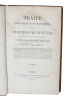
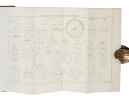
Scarce first edition of Haüys landmark work on the crystallography of gemstones. Haüy had already in 1784 demonstrated the constancy of aspects of the geometric form of the individual crystals and hereby he laid the foundation stones of the science of Crystallography in general. In the offered work he applies his crystal-discoveries of the constancy of angles to the cutting of gems, thus providing us with the first handbook to show how to determine different kinds of gemstones, and he thereby also founded the science of Gemology. ""He hypothesized that each crystal was built up of successive additions of what we now call a ""unit cell"" to form - in the absence of external inteference - a simple geometric shape with constant angles and with sides trhat could be related by simple integral ratios. he maintained that an identity of difference in crystalline form implied an identity or difference in chemical composition. This was the beginning of the science of crystallograpy, which was to attain maturity over a century later with the development of X-ray techniques by Laue and Bragg.""(Asimov).
Observations sur des Tubulaires a Tube élastique et cartilagineux. (+) Observations sur les Charactéres spécifiques qui distinguent le Tubulaire de L'Ocean à tube élastique & cartilagneux, de son analogue dans la Méditerranée, d´rcrit par M. Ellis. (2...
(Paris, Moutard, Panckoucke, 1780). 4to. Extracts from ""Mémoires fe Mathematique et de Physique, Présentés à l'Academie des Sciences par divers Savans"", Tome IX. Pp. 299-308 a. 3 fine folded engraved plates. + pp. 309-328 a. 2 folded engraved plates.
Two papers on tubular, pibe-shaped, animals of the sea with fine engravings.
Description d'un Sablier de 30 heures, propre à servir sur mer, marquant distinctement les heures & les minutes une à une, & qui ne s'arréte pas dans le temps même qu'on le tourne.
(Paris, L'Imprimerie Royale, 1750). 4to. Extract from ""Mémoires fe Mathematique et de Physique, Présentés à l'Academie des Sciences par divers Savans"", Tome I. Pp. 80-94 a. 3 engraved plates showing the machinery of the sand-timer.
Describing the construction of his advanced sand-timer to measure both minutes and hours mainly to be used at see.
Origène. Cours d'Éloquence sacrée fait a la Sorbonne pendent les Années 1866 et 1867. 2 Vols.
Paris, Ambroise Bray, 1868. 8vo. 2 fine contemp. hcalf. Raised bands, richly gilt spines. (6),446(4),454 pp. Iternally clean and fine.