 Write to the booksellers
[60's/Cuba] ROSTGAARD (Alfredo)
Jésus
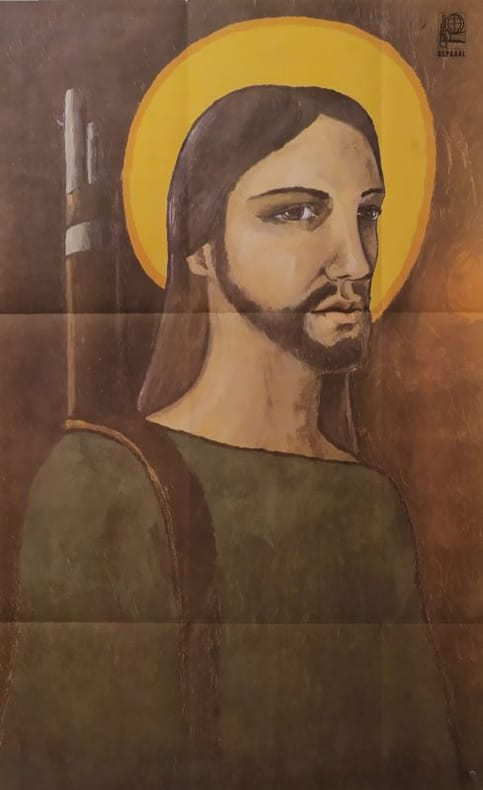
OSPAAAL. 1969. Impression en offset. Dim: 532 x 328 mm.
Reference : 3332
Fondée à Cuba en 1966 "L'Organización de Solidaridad de los Pueblos de África, Asia y América" (OSPAAAL) a réalisé de nombreux posters. Sans ligne esthétique du Parti, les artistes affichistes cubains s'inspirèrent librement du Pop art et de l'Art Cinétique.
Bookseller's contact details
Librairie Michaël Seksik
M. Michaël Seksik
16 rue du Cardinal Lemoine
75005 Paris
France
09 53 64 12 15
Payment mode

Sale conditions
NOS CONDITIONS DE VENTE Conforme aux usages de la librairie ancienne et moderne, tous les ouvrages présentés sont complets et en bon état, sauf indication contraire. L'exécution des commandes téléphonées est garantie mais sans règle absolue, la disponibilité des livres n'étant pas toujours vérifiable lors de l'appel. Au-delà de huit jours les livres réservés seront remis en vente. Les frais de port sont à la charge du destinataire. Les livres sont payables à la commande. Aucun livre ne sera expédié sans être réglé en totalité. Suite aux modifications des tarifs de la Poste, tout colis supérieur à 3cm d'épaisseur sera désormais expédié en colissimo. Vos règlements par chèque en Euros hors France ou chèque en devise doivent être majorés de 15 Euros. Nous acceptons les règlements par chèque bancaire ou postal, mandat postal ou international, Paypal et virement bancaires. Conditions of sale: All of our books are complete and in good antiquarian condition unless stated otherwise. Orders by telephone are accepted with the understanding that availability of the requested book may not always be confirmed at the time of the call. Reserved books will be held for a period of eight days before being put back on sale. Delivery charges and postal fees are the responsibility of the buyer. Books must be paid for at the time of the order; no book will be sent without being paid first.
5 book(s) with the same title
Explication du mystère de la passion de Notre-Seigneur Jesus-Christ, suivant la Concorde
Paris, Jacques Estienne, et François Babuty, 1728. 395 g Deux parties en un volume in-12, pleine basane, dos orné, frontispice et [3] ff., 256-344 pp., [3] ff., [1] f. de catalogue de Jacques Estienne.. Illustré d'un frontispice gravé sur bois. Première édition à réunir sous un même titre deux textes publiés en 1727 et séparément : ''La Croix de Notre-Seigneur Jesus-Christ'' et ''Le Mystère de Jesus-Christ crucifié, devoilé par S. Paul''. Ces précédentes éditions ne comportaient pas de frontispice. Une des publications de l'abbé Jacques-Joseph Duguet (Montbrison, 1649 - Paris, 1733) qui fut un proche des jansénistes. Barbier, II, 380. Usures aux coins. . (Catégories : Religion, )
Ordonnance et instruction pastorale de monseigneur l'évesque d'Auxerre, portant condamnation d'un livre intitulé : L'esprit de Jésus-Christ et de l'église sur la fréquente communion, par le P. Jean Pichon, de la compagnie de Jésus à Paris chez Hippolite-Louis Guérin, 1745
(S. l.), (s. n.), 1747. 360 g In-12, plein veau, 498 pp., [3] ff.. Fentes aux mors, usures aux coins. . (Catégories : Religion, Censure, )
Le saint évangile ou la vie de N.-S. Jésus-Christ selon les quatre évangélistes, harmonisée en un seul récit avec notes explicatives par P. M. Labatut, chanonie honoraire, curé-archiprêtre de Penne avec approbation de monseigneur l'évêque d'Agen
Paris, P. Lethielleux, 1883. 875 g In-8, demi maroquin brun à la bradel, tête dorée, [1] ff., ix-395 pp., illustré de gravures hors-texte.. Exemplaire bien relié. Quelques petites rousseurs. . (Catégories : Religion, )
Many Lives of Jesus. Scholarship, Religion, and the Nineteenth Century Imagination
, Brepols, 2024 Paperback, 300 pages, Size:156 x 234 mm, Language: English. ISBN 9782503602561.
Summary This collection of essays aims to offer a multi-disciplinary approach to nineteenth and early twentieth century scholarship on Jesus and early Christianity, which illustrates the width and depth of the questions that critical reflections on the historical Jesus raised in and beyond the field of liberal theology. More precisely, it focuses on Jesus scholarship as practiced in various disciplines and fields that engaged with the academic study of religion. On the other hand, this volume aims for a comprehensive, multi-perspectivist historicization of this scholarship, considering the full range of religious, cultural, racial, political, and national dynamics that hosted the many controversies over the historical Jesus. Divided into five sections, the eleven essays in this book are organized according to guiding themes and a loose chronological structure. The first section revisits the roots of the Forschung in Liberal-Protestant Germany, and especially focuses on the maturation of historical-critical consciousness in the work of Reimarus (and his predecessors), Schleiermacher and Strauss. The second section is concerned with the rise of the ?oriental Jesus? against the background of the making of the academic, non-theological study of religion as a scientific discipline. The third section explores how themes related to the historical Jesus and the rise of Christianity were treated among different academic disciplines from the early second half of the nineteenth century onwards. The fourth section explores how the historical Jesus was at the same time further explored by the biblical scholars and theologians who integrated new comparative methods in their research. The fifth section, finally, highlights the cultural-political appropriations that were made of scholarly writings on Jesus, which not rarely constituted the bricks with which radical political movements built their houses. TABLE OF CONTENTS Introduction (Cristiana Facchini & Annelies Lannoy) Section 1: Disentangling the Jesus of History from the Christ of Faith 1. Reimarus' Dangerous Idea: Launching a Historical Research of Christian Origins in the German Enlightenment (Fernando Bermejo-Rubio) 2. Betwixt and Between: Fr. Schleiermacher's and D. Fr. Strauss's Contributions to the Paradigm of the 'Historical Jesus' in Early Nineteenth Century Theology as Prototypes of Post-Enlightenment Christology and Jesus Research (Eckart David Schmidt) Section 2: The Historical Jesus between Academic Scholarship and Public Debate 3. 'One Cannot Be a Good Historian and a Good Controversialist at the Same Time': The Politics of Historiography in Renan's Histoire des Origines du Christianisme from Jesus to Paul, 1863-1869 (Robert D. Priest) 4. An Eastern Story: Claude Reignier Conder and the Oriental Jesus (Michael Ledger-Lomas) Section 3: Jesus at the Crossroads of Disciplines 5. Early Christianity in the Framework of Roman Religion: Georg Wissowa (Elisabeth Begemann & J rg R pke) 6. The Passion as Purim Sacrifice: Jesus and Comparative Religion in the Dialogue between James G. Frazer and Salomon Reinach (Annelies Lannoy) 7. The Sociological Gospel of Shailer Mathews (1863-1941) (C. J. T. Talar) Section 4: The Comparative Jesus in Liberal Theology 8. 'Religionizing' History, or 'Historicizing' Religion? Johann G. Droysen's Hellenismus in Wilhelm Bousset's Works on Jesus and Early Christianity (Luca Arcari) 9. Danish Contributions to the Life of Jesus Literature (Mogens M ller) Section 5: Cultural Mythmaking on Jesus 10. Enlisting Religion: Franz Overbeck's Criticism of the Socialist and Nationalist Mythmaking on Jesus and Early Christianity (Emiliano Rubens Urciuoli) 11. The Historical Jesus at the Battlefield: Scholarship and Politics in Italy, 1900s-1920s (Cristiana Facchini) Names Index
Conférences de Notre-Dame de Paris et Retraites Pascales à Notre-Dame (1929-1937 : 9 Tomes - Complet) 1929 : Jésus et l'Histoire - La Dévotion du Devoir ; 1930 : Jésus Messie - La Bonté de Dieu ; 1931 : Le Thaumaturge et les Prophètes - Jésus Chef-d'Oeuvre de Dieu ; 1932 : Jésus Fils de Dieu - Les Joies du Mal ; 1933 : La Personne de Jésus - La Vie divine dans l'Ame du Chrétien ; 1934 : Jésus Lumière du monde - Notre intimité avec Dieu ; 1935 : L'Héritage de Jésus - Aimez-Vous ! ; 1936 : Jésus Rédempteur - La Montée des Ames ; 1937 : Jésus vivant dans l'Eglise - Tables - L'Autre Vie
9 vol. in-8 reliure demi-basane marron, Spes, 1929-1937. Liste des titres : 1929 : Jésus et l'Histoire - La Dévotion du Devoir ; 1930 : Jésus Messie - La Bonté de Dieu ; 1931 : Le Thaumaturge et les Prophètes - Jésus Chef-d'Oeuvre de Dieu ; 1932 : Jésus Fils de Dieu - Les Joies du Mal ; 1933 : La Personne de Jésus - La Vie divine dans l'Ame du Chrétien ; 1934 : Jésus Lumière du monde - Notre intimité avec Dieu ; 1935 : L'Héritage de Jésus - Aimez-Vous ! ; 1936 : Jésus Rédempteur - La Montée des Ames ; 1937 : Jésus vivant dans l'Eglise - Tables - L'Autre Vie
Rare réunion complète des Conférences ainsi que des Retraites pascales à Notre-Dame de Paris, données par le père jésuite Pinard de la Boullaye, de 1929-1937. Bon état (anciens cachets d'institution religieuse, étiquettes de cote en mors)

