 Write to the booksellers
Michel BAKOUNINE
Confession
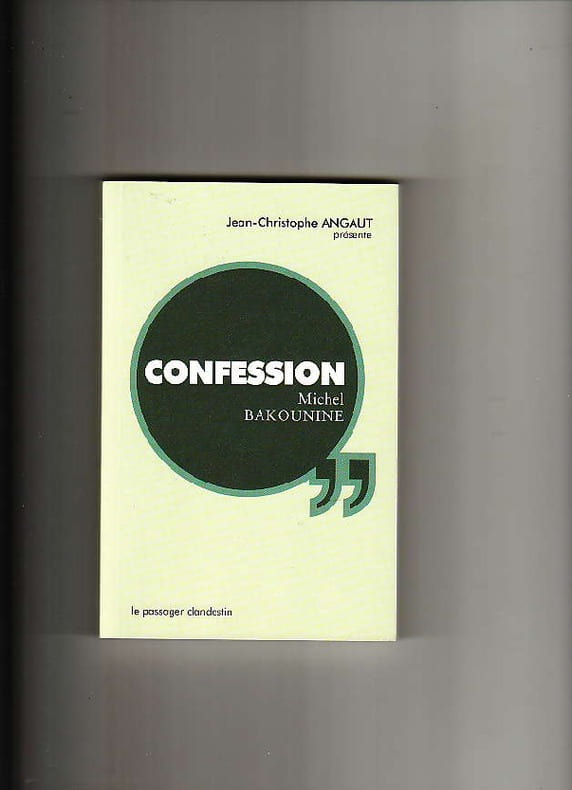
Editions Le Passager clandestin, 2013, 11 x 17, 211 pages sous couverture imprimée. Présenté par Jean-Christophe Angaut.
Reference : PHILO77777414
Bookseller's contact details
Le Plaisir du Texte
M. Fabrice Sivignon
1 rue Violi
69001 Lyon
France
04 78 58 44 04
Payment mode
Sale conditions
Règlement par chèque, mandat, virement bancaire ou Paypal. Prix en euros, auxquels il convient d'ajouter le coût du port. Les livres voyagent aux frais et risques de l'acheteur. Expédition dès réception du règlement.
5 book(s) with the same title
Histoire de La Confession d’Auxpourg, Contenante Les principauls Traittez et Ordonnances, faittes pour la Religion, quand l'Electeur Jehan, Duc de Saxe avec les Citez et autres Princes Protestants présentèrent leur Confession de Foy (icy inserée) à l'Empereur Charles V. es Estats générauls de l'Empire tenus à Auxpourg, 1530. Recueullie Par le D. David Chytreus, Professeur des S. lettres, en l’Université de Rostoch, & nouvellement mise en François, par Luc le Cop.
Anvers, Arnould Coninx, 1582. In-4 de (8)-835-(5) pp. (sign. *4, A-Nnnnn4), vélin ivoire rigide à rabats, lacets (reliure de l'époque).
Deuxième édition française de la Confession d’Augsbourg établie sur l’édition latine de 1531 traduite par Luc Le Cop (ou Le Coq) et "insérée" dans le recueil du théologien luthérien et historien allemand David Chytraeus (1530-1600) publié une première fois en latin (1578) puis traduit en allemand (1580) enfin en français (1582).La première édition française de la Confession parut en 1561 sous le titre Confession de Foy présentée à l’Empereur Charles cinquième a la convocation d’Augsbourg (Brunet, II, 219).Confession de foi luthérienne, rédigée en grande partie par Melanchton, avec la collaboration de Luther, la Confession d’Augsbourg fut présentée par ce dernier à l’empereur Charles Quint lors de la diète d’Augsbourg le 25 juin 1530. Sur un ton modéré, elle exposait les dogmes nouveaux de la Réforme de manière à la rendre acceptable aux catholiques. Portée par l’appui de sept princes et de deux villes d’Empire, elle fut rejetée après six semaines d’examen par les théologiens catholiques, dont Jean Eck. Luther se raidit alors, déconseillant toute concession à Melanchton, ce qui provoqua la formation de la ligue protestante de Smalkalde. Atténuée par Melanchton en 1540 (Confessio variata) puis rétablie dans son texte et sa rigueur originels en 1580 (Confessio invariata), la Confession d’Augsbourg demeure le plus important formulaire de foi des églises luthériennes. Très bel exemplaire en vélin d’époque.Brunet I, 1897 : « Ce volume rare renferme un grand nombre de documents relatifs à l’histoire de la Réforme ».


Yesenin S. Confession of a bully. Confession dun voyou. In French (ask us if in
Yesenin S. Confession of a bully. Confession dun voyou. In French (ask us if in doubt)/Esenin S. Ispoved khuligana. Confession dun voyou. Short description: In French (ask us if in doubt).Confession dun voyou. In French: Paris. J. Povolozky Cie 1923. 83 p.. We have thousands of titles and often several copies of each title may be available. Please feel free to contact us for a detailed description of the copies available. SKUalbac35deef24cd3f1b
Ispoved [Russian, i.e. The Confession/A Confession]. Die Beichte. Roman. - [ENRAGING LENIN]
Berlin, J. Ladyschnikow, 1908. Contemporary half calf with gilding to spine. Spine with a bit of wear. A bit of light occasional brownspotting, and a marginal marking in red crayon on one page, but overall very nice.
First separate edition - appearing almost simultaneously with the version in the ""Znaniye""-compilation - of Gorki's highly influential novel ""The Confession""/""A Confession"", which created quite a stir when it appeared and caused great distress to both the Russian Orthodox Church, to Leo Tolstoy and to Vladimir Lenin, who mentioned the work specifically on the many occasions when he criticized the attempts to unite Socialism and Christianity. ""The Confession"" tells the story of Matvei - based upon the real life story of a religious sectarian in Nizhny Novgorod - who becomes a wanderer through Russia seeking a philosophy to live by. The work is of great historical importance, as it embodies the philosophy of the ""God-building"" movement that arose in the Russian Empire in the late 19th century. The novel expresses Gorky's belief in humanity, when strong individuals are connected to each other, and it reflects Gorky's disgust with injustice, hypocrisy, and conditions that degrade human dignity as well as his faith in human potential. Of the work, Gorki himself said: ""I am an atheist. In ""A Confession"" the idea was to show the means by which man could progress from individualism to the collectivist understanding of the world. The main character sees 'God-building' as an attempt to reconstruct social life according to the spirit of collectivism, the spirit of uniting the people on their way to one common goal: liberating man from slavery, within and without.""
La confession d'Augsbourg.
Paris Strasbourg, Editions luthériennes, 1948 ; in-12, 96 pp., broché. Confession de foi de quelques princes et villes remise à sa majesté impériale à Augsbourg en 1530 - traduction nouvelle de la confession accompagnée de notes.
Confession de foi de quelques princes et villes remise à sa majesté impériale à Augsbourg en 1530 - traduction nouvelle de la confession accompagnée de notes.
Confession de minuit.
Par Georges Duhamel (1884-1966).1 frontispice. Lithographies de Berthold Mahn (1881-1975).Edition tirée à 540 exemplaires. Celui-ci, N°79, un des 500 sur vélin de Montgolfier.Paris, Henri Jonquières, éditeurs - 1926 - 189 pages.Ouvrage broché. Nombreuses signatures d'inconnus sur la page de garde. Recouvert par un papier cristal de protection. Pas de rousseur. Très bon état. Format in-4°(25x20).
BERTHOLD MAHN

