 Write to the booksellers
BOURGIN Georges
La commune.
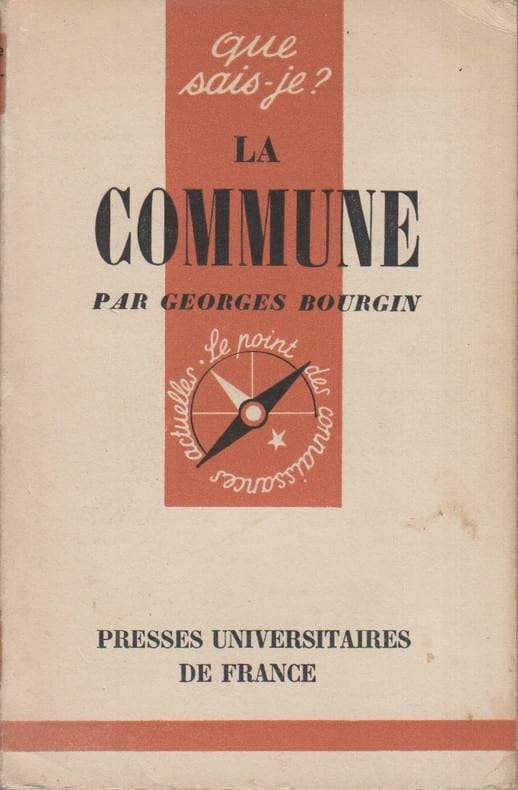
Couverture souple. Broché. 128 pages.
Reference : 115634
Livre. Editions P.U.F (Collection : Que sais-je? N° 581), 1953.
Bookseller's contact details
Librairie et Cætera
Mme Sophie ROSIERE
sophie@librairie-et-caetera.com
+33 (0) 5 56 88 08 45
Payment mode
Sale conditions
Envoi par la Poste à réception du paiement. Paiement par virement, chèque ou CB (Stripe) PAS DE PAIEMENT SUR LE SITE. Je vous enverrai les informations de paiement en validant votre commande. EXPEDITIONS du lundi au vendredi en courrier ordinaire ou suivi, sous étuis recyclables et/ou réutilisés. Les livres sont nettoyés, réparés si besoin, et couverts de papier cristal. FRAIS D'EXPEDITION : Pour un livre standard (moins de 500g): FRANCE : de 5 à 7,50 € en courrier suivi. EUROPE : de 14 € en colissimo de 6 à 10 € pour le spays desservis par Mondial Relay PAYS HORS UE : 35 € en colissimo Pas d'envoi aux Etats-Unis RETOUR : Conformément à la législation sur la vente à distance, vous disposez d'un droit de retour des ouvrages pendant 14 jours. Les frais de port restent à votre charge lorsqu'il s'agit d'une erreur de commande de votre part et à notre charge si le livre n'est pas conforme à notre description.
5 book(s) with the same title
Raising Claims. Justice and Commune in Late Medieval Italy
, Brepols, 2022 Hardback, 255 pages, Size:178 x 254 mm, Illustrations:7 b/w, 18 tables b/w., 3 maps b/w, Language: English. ISBN 9782503590066.
Summary Ceccholo, making a claim against Nello for the payment of unpaid land rent. Jacopo, Giovanni and Turi, appealing for an exemption from tax. The long queue of claimants that formed in front of the communal palace was an everyday scene in fourteenth century Lucca. What is remarkable is the enormous ubiquity of such claims. In this Tuscan city of only twenty thousand people, an average of ten thousand claims were filed at the civil court each year. Why did local residents submit claims to the commune in such numbers? And what effect did this daily accumulation have on the development of the commune? In the fourteenth century, Italian communes, the established public authorities that governed the populace, underwent a shift toward becoming oligarchic regimes. The communes' character as a form of government in which power was held 'in common' by 'the public' seemed be on the verge of disappearing. At this time, political leaders and judicial magistrates began to rely on their own discretion when rendering their decisions, a practice that was recognized as legitimate even when such decisions deviated from positive law. By the beginning of the fifteenth century, this shift in the underlying logic of the legitimacy of rulings became entrenched in the jural and political character of the commune, portending the advent of the modern era. Based on the archival records from law courts and councils, this book elucidates the process of the emergence and shaping of a new form of justice and the transformation of the commune by focusing on everyday practices that unfolded in the spheres of civil and criminal justice by inhabitants who raised claims and the governors who heard them. TABLE OF CONTENTS Introduction Part I: Civil Justice and the Commune Chapter 1: Why did people go to the courts? 1. The high volume of claims heard by civil courts 2. Civil trials 3. Conflict resolution extra iudicium 4. The significance of judicial orders 5. The commune within society Chapter 2: Realisation of the Commune through Claims 1. Interaction between the Commune and Its Inhabitants 2. Exceptio in the courts 3. Speaking out to the Anziani 4. The creativity of claims Chapter 3: A shift in the modality of justice in the civil courts: From formalism to arbitrium 1. Changes to civil trials over the fourteenth century 2. A qualitative shift in the identity of decision makers 3. A shift in judicial principle in the realm of procedural law 4. The decline of local jurists 5. Exceptio among litigants and arbitrium procedendi among judges 6. The Doge and 'proper' summary justice 7. The commune's appropriation of the realm of civil law Part II: Criminal Justice and the Commune Chapter 4: Criminal Justice in fourteenth-century Lucca 1. The rise of criminal justice 2. Volume of maleficia brought before the criminal court 3. Maleficia 4. Procedures 5. Sentences 6. After sentencing 7. Validity of gratia Chapter 5: Gratia, the Commune, and Justice 1. Gratia and the commune 2. Amnesty under foreign masters 3. Individual gratia under Pisan rule 4. Prohibition of gratia in the republican period 5. Gratia in communal Lucca Chapter 6: The Commune and Politics in the Practice of Extraordinary Justice 1. The commune and extraordinary justice 2. Captain ser Scherlatto's lawsuit for the restitution of property 3. Maintenance of territorial security by the bargello 4. The podest and the Anziani in the republican period 5. The 1392 regime and the Capitano del Popolo 6. Extraordinary justice and the extension of politics Conclusion
Commune, Paris - Parijs 1871 / De Parijse Commune van 1871.
, ludion, 2021 Hardcover, 224 pp. 24,5 x 32,5 cm Text in NL / FR / . . ISBN 9789493039.
De Parijse Commune van 1871 is een scharniermoment in de geschiedenis van Frankrijk en de internationale arbeidersbeweging. Ofschoon de fotografie toen nog in haar kinderschoenen stond werd de revolutionaire opstand in Parijs uitgebreid gedocumenteerd. De beelden van het vernietigde Parijs werden in de burgerlijke pers vaak gebruikt om de zogenaamde barbaarsheid van de Commune te onderstrepen. De portretten van de mannen en vrouwen van de Commune, veelal getrokken in gevangenschap, gaven de onbekende Parijzenaars dan weer een gezicht. Dit rijkge llustreerde boek, gepubliceerd naar aanleiding van de 150e verjaardag van de Parijse Commune, biedt een unieke blik op de revolutie aan de hand van talrijke foto's en documenten. Samengesteld door Ronny Van de Velde, met een inleiding van Xavier Canonne. La Commune de Paris de 1871 est un moment charni re de l'histoire de la France et du mouvement ouvrier international. Si la photographie en tait encore ses balbutiements l' poque, le soul vement r volutionnaire Paris tait bien document . Les images de Paris d truites taient souvent utilis es dans la presse bourgeoise pour souligner la soi-disant barbarie de la Commune. Les portraits d'hommes et de femmes de la Commune, souvent pris en captivit , donnaient un visage aux Parisiens inconnus. Ce livre richement illustr , publi l'occasion du 150 me anniversaire de la Commune de Paris, offre un regard unique sur la r volution travers de nombreuses photos et documents. Compil par Ronny Van de Velde, avec une introduction de Xavier Canonne. The Paris Commune of 1871 is a pivotal moment in the history of France and the international labor movement. Although photography was in its infancy at that time, the revolutionary uprising in Paris was extensively documented. Images of the destroyed Paris were often used in the bourgeois press to underscore the alleged barbarity of the Commune. In turn, the portraits of the men and women of the Commune, many drawn in captivity, gave a face to the unknown Parisians. This richly illustrated book, published on the occasion of the 150th anniversary of the Paris Commune, offers a unique look at the revolution through numerous photographs and documents. Compiled by Ronny Van de Velde, with an introduction by Xavier Canonne.
EUROPE REVUE MENSUELLE N° 64-65 - Pierre ABRAHAM :Pourquoi ?..Albert SOBOUL :De VEmpire à la Commune.Robert BOUDRY / Lucien SCHELER : Paris l'insurgé..Marcel BLOCH :En lisant le Journal Officiel de laCommune..Janine BOUISSOUNOUSE
LES EDITEURS FRANCAIS REUNIS. AVRIL-MAI 1951. In-12. Broché. Bon état, Couv. convenable, Dos satisfaisant, Intérieur frais. 236 pages. Deuxième plat désolidarisé.. . . . Classification Dewey : 70.49-Presse illustrée, magazines, revues
Sommaire : Pierre ABRAHAM :Pourquoi ?..Albert SOBOUL :De VEmpire à la Commune.Robert BOUDRY / Lucien SCHELER : Paris l'insurgé..Marcel BLOCH :En lisant le Journal Officiel de laCommune..Janine BOUISSOUNOUSE / Louis de VILLEFOSSE : La presse parisienne pendant la commune.Jean FHÉVILLE :La Commune et la littérature..Guy TREAL :La Musique et la Commune.Robert BOUDRY :Courbet et la Fédération des Artistes.. .Gaston COHEN :Les Finances et la CommuneHélène PARMELIN :Les Femmes et la Commune.Hélène GOSSET :Les Polonais dans la Commune de Paris.Émile TERSEN :Léo Frankel..Alexander ABUSCH :Le Retentissement de la Commune deParis en Allemagne..Tibor ERENY :La Commune de Paris et le MouvementOuvrier Hongrois..Lucien SCHELER :Bibliographie de la Commune..VERCORS :La Puissance du jour (Roman II).Jean-Paul MARAT :Les Aventures du Jeune Comte Potowski(Roman V).CHRONIQUESJean BAUMIER, Jean DAUTRY, Pierre GAMARRA, Josette MELEZE, ROUBEN MELIK, Lucien SCHELER, Gilette ZIEGLER, sur : J. DUCROUX : Roumanie, un des chantiers de la vie nouvelle. — De VEnfant au Proscrit, notes sur Jules Vallès. — Antoine OLIVESI : La Commune de 1871 à Marseille et ses origines. — Jean FRÉVILLE : Plein Vent. — Florimond BONTE : Certitude de Victoire. — Jorge AMADO : Les chemins de la faim. — Zaharia STANCU : Les Nu-Pieds. — Pages de gloire des vingt-trois. —Les Médailles de la Commune. —Les poètes de la Commune..TUne Lettre.Correspondance du Comité d'Europe Classification Dewey : 70.49-Presse illustrée, magazines, revues


The Civil War in France. Address of the General Council of the International Working-Men's Association. - [MARX' SEMINAL DEFENSE OF THE PARIS COMMUNE]
High Holborn, for the Council by Edward Truelove, 1871. Small 8vo. Near contemporary quarter cloth with silver lettering to front board. Binding with signs of use, but overall good. One closed marginal tear and title-page with a few brownspots, otherwise very nice and clean. 35 pp.
Exceedingly rare first edition (with the names of Lucraft and Odger still present under ""The General Council"") of one of Marx' most important works, his seminal defense of the Paris Commune and exposition of the struggle of the Communards, written for all proletarians of the world. While living in London, Marx had joined the International Working Men's Association in 1864 - ""a society founded largely by members of Britain's growing trade unions and designed to foster international working class solidarity and mutual assistance. Marx accepted the International's invitation to represent Germany and became the most active member of its governing General Council, which met every Tuesday evening, first at 18 Greek Street in Soho and later in Holborn. In this role, Marx had his first sustained contact with the British working class and wrote some of his most memorable works, notably ""The Civil War in France"". A polemical response to the destruction of the Paris Commune by the French government in 1871, it brought Marx notoriety in London as 'the red terror doctor', a reputation that helped ensure the rejection of his application for British citizenship several years later. Despite his considerable influence within the International, it was never ideologically homogenous... (homas C. Jones: ""Karl Marx' London"").The work was highly controversial, but extremely influential. Even though most of the Council members of the International sanctioned the Address, it caused a rift internally, and some of the English members of the General Council were enraged to be seen to endorse it. Thus, for the second printing of the work, the names of Lucraft and Odger, who had now withdrawn from the Council, were removed from the list of members of ""The General Council"" at the end of the pamphlet. ""[Marx] defended the Commune in a bitterly eloquent pamphlet, ""The Civil War in France"", whose immediate effect was further to identify the International with the Commune, by then in such wide disrepute that some of the English members of the General Council refused to endorse it."" (Saul K. Padover, preface to Vol. II of the Karl Marx Library, pp. XLVII-XLVIII).""Written by Karl Marx as an address to the General Council of the International, with the aim of distributing to workers of all countries a clear understanding of the character and world-wide significance of the heroic struggle of the Communards and their historical experience to learn from. The book was widely circulated by 1872 it was translated into several languages and published throughout Europe and the United States."" (The Karl Marx Archive)Marx concluded ""The Civil War in France"" with these impassioned words, which were to resound with workers all over the world: ""Working men's Paris, with its Commune, will be forever celebrated as the glorious harbinger of a new society. Its martyrs are enshrined in the great heart of the working class. Its exterminators history has already nailed to that eternal pillory from which all the prayers of their priests will not avail to redeem them.""The address, which was delivered on May 30, 1871, two days after the defeat of the Paris Commune, was to have an astounding effect on working men all over the world and on the organization of power of the proletarians. It appeared in three editions in 1871, was almost immediately translated into numerous languages and is now considered one of the most important works that Marx ever wrote. "" ""The Civil War in France"", one of Marx's most important works, was written as an address by the General Council of the International to all Association members in Europe and the United States.From the earliest days of the Paris Commune Marx made a point of collecting and studying all available information about its activities. He made clippings from all available French, English and German newspapers of the time. Newspapers from Paris reached London with great difficulty. Marx had at his disposal only individual issues of Paris newspapers that supported the Commune. He had to use English and French bourgeois newspapers published in London, including ones of Bonapartist leanings, but succeeded in giving an objective picture of the developments in Paris. ...Marx also drew valuable information from the letters of active participants and prominent figures of the Paris Commune, such as Leo Frankel, Eugene Varlin, Auguste Serraillier, Yelisaveta Tornanovskaya, as well as from the letters of Paul Lafargue, Pyotr Lavrov and others.Originally he intended to write an address to the workers of Paris, as he declared at the meeting of the General Council on March 28, 1871. His motion was unanimously approved. The further developments in Paris led him, however, to the conclusion that an appeal should be addressed to proletarians of the world. At the General Council meeting on April 18, Marx suggested to issue ""an address to the International generally about the general tendency of the struggle."" Marx was entrusted with drafting the address. He started his work after April 18 and continued throughout May. Originally he wrote the First and Second drafts of ""The Civil War in France"" as preparatory variants for the work, and then set about making up the final text of the address.He did most of the work on the First and Second drafts and the final version roughly between May 6 and 30. On May 30, 1871, two days after the last barricade had fallen in Paris, the General Council unanimously approved the text of ""The Civil War in France"", which Marx had read out.""The Civil War in France"" was first published in London on about June 13, 1871 in English, as a pamphlet of 35 pages in 1,000 copies. Since the first edition quickly sold out, the second English edition of 2,000 copies was published at a lower price, for sale to workers. In this edition [i.e., MECW], Marx corrected some of the misprints occurring in the first edition, and the section ""Notes"" was supplemented with another document. Changes were made in the list of General Council members who signed the Address: the names of Lucraft and Odger were deleted, as they had expressed disagreement with the Address in the bourgeois press and had withdrawn from the General Council, and the names of the new members of the General Council were added. In August 1871, the third English edition of ""The Civil War in France"" came out, in which Marx eliminated the inaccuracies of the previous editions.In 1871-72, ""The Civil War"" in France was translated into French, German, Russian, Italian, Spanish, Dutch, Flemish, Serbo-Croat, Danish and Polish, and published in the periodical press and as separate pamphlets in various European countries and the USA. It was repeatedly published in subsequent years....In 1891, when preparing a jubilee German edition of ""The Civil War in France"" to mark the 20th anniversary of the Paris Commune, Engels once again edited the text of his translation. He also wrote an introduction to this edition, emphasising the historical significance of the experience of the Paris Commune, and its theoretical generalisation by Marx in ""The Civil War in France"", and also giving additional information on the activities of the Communards from among the Blanquists and Proudhonists. Engels included in this edition the First and Second addresses of the General Council of the International Working Men's Association on the Franco-Prussian war, which were published in subsequent editions in different languages also together with ""The Civil War France"". (Notes on the Publication of ""The Civil War in France"" from MECW Volume 22). Only very few copies of the book from 1871 on OCLC are not explicitly stated to be 2nd or 3rd editions, and we have not been able to find a single copy for sale at auctions within the last 50 years.
LES CONVULSIONS DE PARIS. 1. Les prisons pendant la Commune. 2. Episodes de la Commune. 3. Les Sauvetages pendant la Commune. 4. La Commune à lHôtel de Ville.
Paris, Hachette, 1878-1880. Quatre volumes forts in-8 (23 cm x 15 cm), IV]-543 pp - [III]-506 pp - [III]-515 pp - [III]-542 pp. Reliés en demi-chagrin vert, plats en percaline, dos à 4 nerfs, filets dorés, auteur titre et nom du propriétaire (E. Tournié) en lettres dorées. Petit choc sans gravité sur la reliure du tome 3.
ÉDITION ORIGINALE. Bons exemplaires. Au tome 4 page 486 document en fac-similé, feuille repliée, pièce du Comité de salut public qui donne l'ordre de conduire à Mazas le sieur Maxime du Camp...Lhistoire de la Commune est intrigante. Une relative prospérité économique sous le second Empire bascule dans une défaite militaire imprévue. Les travaux dHaussmann accentuent une misère ouvrière qui mobilise des bataillons révolutionnaires. Le refus dune défaite trop facilement acceptée par les Versaillais alors que Paris veut encore se battre, les bombardements de la capitale, la Commune révolutionnaire installée à lHôtel de Ville, les incendies allumés par les irréductibles, les représailles sanglanteslaissent la capitale dévastée. Maxime Du Camp donne sa vision des événements, lavantage est quelle est proche et quil y a participé mais nous sommes probablement loin des vérités historiques et équilibrées. Linclinaison de lauteur le porte plus facilement vers Versailles que vers Paris. Quoiquil en soit, il sagit dun intéressant témoignage sur lenchaînement des circonstances jusquaux catastrophes finales avant que la troisième République efface rapidement les traces de cette guerre civile. La table des matières que nous reproduisons fidèlement, donne un premier aperçu de sa présentation des situations.VOLUME I : Les prisons pendant la Commune. Chapitre I. Les forces de lInsurrection. I. La Garde Nationale. II. Le Comité central. III. Les Hébertistes. Chapitre III. Le dépot près la Préfecture de police. I. Le Président Bonjean. II. Les arrestations. III. Les premières exécutions. IV. Le sous-brigadier Braquond. Chapitre III. La maison de justice. Chapitre IV. Saint-Lazare. Chapitre V. Sainte-Pélagie. Chapitre VI. La Santé. I. Le général Chanzy. II. Les détenus. III. Lordre dexécution. IV. Les Dominicains dArcueil. Chapitre VII .Mazas. Chapitre VIII. I. Larrivée des otages. II. La mort des otages. III. Jean-Baptiste Jucker. IV. La mort de Delescluze. V. La justice du peuple. VI. La révolte des otages. VII. La délivrance.VOLUME II : Episodes de la Commune. Chapitre I. Les Maires de Paris et le Comité central. I. Les premières concessions. II. Les prétentions du Comité. III. La mauvaise foi du Comité. IV. La capitulation des Maires. V. Les élections de la Commune. IV. Les prétendues représailles. Chapitre II. Le Palais de la légion dhonneur. I. Les bataillons fédérés. II. Le général Eudes. III. La générale Eudes. IV. Lincendie. V. La rue de Lille. Chapitre III. Le Palais des Tuileries. I. Le gouverneur militaire. II. Préparatif de départ. III. Bergeret lui-même. IV. Le bouvier Victor Bénot. Chapitre IV. Les musées du Louvre. I. La délégation aux musées. II. Le marquis Benrardy de Sigoyer. Chapitre V. La colonne de la Grande Armée. I. Gustave Courbet. II. Les préparatifs. La chute. Chapitre VI. Les barricades. I. Les Champs-Elysées II. La suspension darmes. III. Recrutement. Chapitre VII. Le combat dans les rues. I. Le Huitième arrondissement. II. Lincident Ducatel. III. La porte de Saint-Cloud. IV. Larmée française. V. Le pétrole. VI. Sauve qui peut. VII. Les pertes de linsurrection.VOLUME III : Les sauvetages pendant la Commune. Chapitre I. Le Ministère de la marine. I. La retraite sur Versailles. II. Les souterrains. III. La délégation. IV. La flottille de la Seine. V. Les marins communards. VI. Les avanie. VII. La batterie de Montretout. VIII. Le 21 mai. IX. La rue Royale. X. Nos canonnières. Chapitre II. I. Pendant la guerre. II. Les moyens de défense. III. Les premières réquisitions. IV. Le départ du gouverneur. V. Labandon de Paris. VI. Jacobins et socialistes. VII. Charles Beslay. VIII. Les diamants de la couronne. IX. Conseil des Régents. X. Le monayage des lingots. XI. La journée du 12 mai. XII. Lensablement. XIII. Les dernières réquisitions. XIV. Lincendie du Palais-Royal. XV. Le double du grand-Livre. XVI. Epilogue.Volume IV : La Commune à lHôtel de Ville. Chapitre I. Les législateurs. I. La prise de possession. II. Le huit clos des séances. III. Les élections complémentaires. IV. Les compétitions. V. La manifestation des francs-maçons. VII. Les usurpateurs. VII. Les dernières séances. VIII. La délégation à la guerre. Chapitre II. Les administrateurs. I. La réaction. II. La direction des domaines. III. La propriété. IV. La liberté individuelle. Chapitre III. I. La liberté de la presse. II. La liberté de conscience. III. Les congrégations religieuses. IV. Les mystères de Picpus. Chapitre IV. Les soldats. I. La délégation scientifique. II. Les incendiaires. III. Larmée fédérée. IV. Le patriotisme. Chapitre V. La revendication. I. Les accusés. II. Les coutumax. III. Les programmes. IV. Le Quart-Etat. Photos sur demande.

