 Write to the booksellers
-
Type
Book (761)
Magazine (8)
Music sheets (1)
-
Latest
Last 24h (1)
Last 3 days (1)
Last month (10)
Last week (3)
-
Language
English (2)
French (768)
-
Century
18th (19)
19th (31)
20th (304)
21st (154)
-
Countries
Belgium (178)
Canada (5)
Côte d'Ivoire (2)
Denmark (39)
France (498)
Netherlands (17)
Switzerland (31)
-
Syndicate
ALAC (5)
ILAB (102)
NVVA (24)
SLACES (7)
SLAM (41)
D'Eugène Delacroix au Néo-Impressionnisme
Librairie Floury, collection "Ecrits d'artistes", Paris, 1939. In-12, broché sous couverture illustrée, 129 pp. Dédicace - Note préliminaire - I. Documents. - II. Apport de Delacroix. - III. Apport des impressionnistes. - IV. Apport des néo-impressionnistes. - V. La touche divisée. - VII. Résumé des trois apports. - VIII. Témoignages. - IX. L'éducation de ...
Mention de quatrième édition illustrée de 25 reproductions en noir et blanc. --- Plus d'informations sur le site archivesdunord.com
Homo Legens Styles et pratiques de lecture: Analyses comparees des traditions orales et ecrites au Moyen Age / Styles and Practices of Reading: Comparative Analyses of Oral and Written Traditions in the Middle Ages
, Brepols - Harvey Miller, 2010 Hardcover. VI 230 p., 4 b/w tables, 156 x 234 mm, Languages: English, French, Fine copy. Including an index. ISBN 9782503534091.
This volume presents research, carried out as part of the international, interdisciplinary project Homo Legens, into the contacts between oral and written communication in medieval Europe.<br>Ce volume presente les resultats d?une recherche internationale sur les contacts entre la communication orale et la communication ecrite menee dans le cadre du projet interdisciplinaire ? Homo legens? .<br>How can we uncover the traces of oral culture in medieval sources when the oral matter we possess survives only in written form? Is it the case that only the written persists while the oral is lost? What was the status of orality in medieval society? The studies in this volume (five chapters in French and two in English) examine the links between the oral and the written traditions in medieval literature. They do this by means of the analysis of literary sources from very diverse backgrounds, both geographically and linguistically speaking: the investigation ranges from medieval Spain, through the Byzantine Empire and the Crusader states, to late medieval and early modern Turkey. This interdisciplinary enquiry by an international group of scholars enables us to define the modes of transmission of medieval texts and how they were memorized as well as to decipher how they were read and appropriated. In addition, the book suggests a methodological basis for research into indices of orality and for analysis of the intertextual links between literary works. This enquiry, undertaken within the framework of the international Homo Legens project, provides an efficacious tool for the study of the practices of reading and writing.<br>Comment deceler les traces de la culture orale dans les sources medievales si nous ne possedons les materiaux oraux que sous forme ecrite? Est-ce seulement l?ecrit qui reste tandis que l?oral ne se maintient pas? Quel est le statut de l?oralite dans la societe medievale? A partir des monuments litteraires appartenant a des aires tres variees du point de vue de la geographie et des langues 3/4 l'Espagne medievale, l?Empire byzantin, les Etats croises et la Turquie des XVe-XVIe siecles 3/4 ce volume etudie les liens entre tradition orale et tradition ecrite dans la litterature medievale. L?enquete interdisciplinaire menee par une equipe internationale de chercheurs venus d?horizons divers permet de definir les modes de transmission des textes medievaux, les formes de leur memorisation et de dechiffrer les modes de leur lecture et de leur appropriation. L?ouvrage propose aussi une methodologie pour la recherche des indices de l?oralite et pour l?analyse des liens intertextuels entre les oeuvres litteraires. Ce travail realise dans le cadre du projet international ? Homo legens ? constitue un outil efficace pour l?etude des pratiques de lecture et d?ecriture.
Narratives on Translation across Eurasia and Africa. From Babylonia to Colonial India
, Brepols, 2022 Hardback, 406 pages, Size:156 x 234 mm, Illustrations:2 b/w, 5 tables b/w., Language: English. ISBN 9782503594897.
Summary What has driven acts of translation in the past, and what were the conditions that shaped the results? In this volume, scholars from across the humanities interrogate narratives on the process of translation: by historical translators ranging from ancient Babylonia to early modern Japan and the British Empire, and by academics from the nineteenth to the twentieth centuries who interpreted these translators' practices. In Part 1 the volume authors reflect on the history of the approaches to the phenomenon of translation in their specific fields of competence in order to learn what shaped the academic questions asked, what theoretical and practical tools were deployed, which arguments were privileged, and why certain kinds of evidence (but not others) were thought to be the basis for understanding the function and purpose of all translation performed in a given culture. Part II explores how translators and authors from antiquity to modern times described their own motivations and the circumstances in which they chose to translate. In both parts, the contributors disentangle histories of translation from the specialized intellectual fields (such as science, religion, law, or literature) with which they have been bound in order to make the case that we understand translation best when we take into account all cultural practices and translation activities cutting synchronically and diachronically through the entire societal fabric. TABLE OF CONTENTS Introduction ? Sonja Brentjes, in cooperation with Jens H yrup and Bruce O'Brien Part 1: Observer Narratives Scholarly Translation in the Ancient Middle East: Ancient and Modern Perspectives ? C. Jay Crisostomo Interdisciplinary Interactions: Septuagint Studies, Classics, and Translation Studies ? Benjamin G. Wright III A Plurality of Voices: Fragmented Narratives on Syriac Translations ? Matteo Martelli Re-visiting the Translation Narratives: The Multiple Contexts of the Arabic Translation Projects ? Miriam Shefer-Mossensohn Philosophical Pahlavi Literature of the Ninth Century ? G tz K nig Changing Perceptions in Modern Scholarship on Tangut Translations of Chinese Texts ? Imre Galambos Biblical Theology, Scholarly Approaches, and the Bible in Arabic ? Miriam Lindgren Hj lm Translating inside al-Andalus: From Ibn Rushd to Ibn Juljul ? Maribel Fierro Part 2: Participant Narratives From Opheleia to Precision: Dionysius the Areopagite and the Evolution of Syriac Translation Techniques ? Emiliano Fiori Wisdom in Disguise: Translation Narratives and Pseudotranslations in Arabic Alchemy ? Christopher Braun Philology and Polemics?in the Prologues to the Latin Talmud Dossier ? Alexander Fidora Faraj ben Sal?m of Agrigento: Translation, Politics and Jewish Identity in Medieval Sicily ? Lucia Finotto Practices of Translation in Medieval Kannada Sciences: 'Removing the Conflict between Textual Authority and the Worldly' ? Eric Gurevitch The Trope of Sanskrit Origin in Pre-Modern Tamil Literature ? Eva Wilden Ibn al Quff the Translator, Ibn al-Quff the Physician: Translation and Authority in a Medieval Commentary on the Hippocratic Aphorisms ? Nicolas Carpentieri Isaac Aboab da Fonseca's Preface to his Hebrew Translation of Abraham Cohen De Herrera's Puerta del Cielo ? Federico Dal Bo Mahometism in Translation: Joseph Morgan's Version of Mohamad Rabad n's Discurso de la Luz (1723-1725) ? Teresa de Soto The Possibility of Translation: A Comparison of the Translation Theories of Ogy? Sorai and ?tsuki Gentaku ? Rebekah Clements The Hermeneutics of Mathematical Reconciliation: Two Pandits and the Benares Sanskrit College ? Dhruv Raina Index
Poetic Rewritings in Late Latin Antiquity and Beyond
, Brepols, 2024 Paperback, 520 pages, Size:156 x 234 mm, Illustrations:2 b/w, 11 tables b/w., Language(s):English, French, Italian. ISBN 9782503610245.
Summary 'Rewriting' as the reworking of narrative material based on conscious strategies of composition plays a significant role in much of the Latin poetry of Late Antiquity. This book, resulting from the conference Riscritture poetiche nell'Occidente latino tra tarda antichit e medioevo, which was held on 9-11 May 2022 at the Department of Human Sciences (DSU) of the University of L'Aquila, looks at the range of practices and purposes that inform this procedure, with particular regard to the processes of transcodification enacted - in different historical and cultural contexts - by the recasting of authoritative prose texts into a classicising poetic idiom. The contributions present a multifaceted approach to rewriting, cover a variety of authors, genres, and texts, and cast a glance also at medieval Latin literature. In short, the essays in this collection, by reflecting on the interpretative contribution of the critical category of 'rewriting', not only add further tesserae to the mosaic of literary studies on Late Latinity, they also invite to grasp the difference between secular and Christian rewritings. TABLE OF CONTENTS Introduction (Stefania Filosini) Late Latin Antiquity: Secular Rewritings Poetic Rewriting of Hylas: Dracontius, Romul. 2 (Salvatore Costanza) La r criture d'Ausone par Luxorius : enjeux et po tique (Florence Garambois-Vasquez) Forms of Martial's Reception in the Aenigmata Symposii (Marco Onorato) Late Latin Antiquity: Christian Rewritings 1. The Biblical Poetry Poetic Rewritings between Literature and Doctrine: Prudentius, Cathemerinon 5 (Fabio Gasti) La r criture vis e argumentative de la Bible. Le cas des m daillons bibliques du po me d'Orientius et du Carmen adversus Marcionitas (Ps.-Tert.) (Lucie Martin) Rewriting the Miracles: The Healing of the Man Blind from Birth in Sedulius (carm. pasch. IV. 251-270) (Stefania Filosini) The Parable of the Rich Man and Lazarus in Avitus of Vienne, carm. III. 220-310 (Franca Ela Consolino) R criture des discours des Actes des Ap tres chez Arator. Technique de la r criture et vis e pragmatique du texte (Bruno Bureau) 2. A Case Study on Biblical Poetry: The Heptateuchos Poem The Heptateuch Poet as a Battalist: Strategies of Epicisation in Battles Scenes and Military Speeches (Donato De Gianni) Per grandia tempora: Time and Temporal References in the Poem of the Heptateuchos (Francesco Lubian) Structure of the Narrative Sequences and Intratextual Links in the Heptateuchos Poem (Luciana Furbetta) Costruzione di una formularit epica interna nel poema dell'Heptateuchos. Studio di casi dell'Exodus: la teofania sul monte Horeb (Michele Cutino) 3. The Hagiographic Poetry La r criture po tique de la Vie de saint Martin par Paulin de P rigueux au miroir des genres litt raires (Sylvie Labarre) R flexions sur un exemple de r criture po tique : Paulin de P rigueux, Vie de saint Martin, V. 398-487 (Vincent Zarini) Poetic Rewriting with an Audience: Venantius Fortunatus' Life of St Martin and the Ladies of the Abbey Sainte-Croix in Poitiers (Lorenzo Livorsi) Beyond Late Antiquity Un siriaco tardo antico in riscrittura carolingia. L'attualizzazione dell'armonia evangelica di Taziano nel Heliand anticosassone (Wolfgang Haubrichs) Riscrivere i vangeli in volgare: il Liber evangeliorum e la tentazione di Cristo (Chiara Staiti) Isidore and the Wisdom of Gildas in the Vita Merlini (Francesco Marzella) Index The Authors
Steiner d'Allonnes Myriam Revault Ehrenberg Mottu Garapon Meirieu Ebadi Pomian
Reference : 100122170
(2006)
LE FUTUR DE L'AUTORITE / XLes rencontres internationales de Genève 2005 - textes des conférences et des débats
AGE D HOMME 2006 128 pages 15 6x2x22cm. 2006. Broché. 128 pages.
très bon état de conservation intérieur propre bonne tenue
Racine et Shakespeare
GARNIER-FLAMMARION 1970 in12. 1970. Broché.
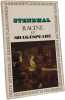
Bon état bords et revêtement frottés intérieur propre
Racine et Shakspeare - étude sur le romantisme
Calmann-Lévy Editeurs 1935 in12. 1935. Broché. Racine et Shakespeare est un pamphlet de Stendhal (1823-1825) où il prend parti pour le romantisme contre le classicisme. Il défend l'idée d'une littérature moderne rejette la règle des trois unités et fait l'apologie du théâtre en prose pour offrir plus de plaisir au spectateur
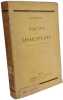
couverture ternie accrocs sur les bords intérieurs propres
"Le message d'Igor Strawinsky; précédé d'une lettre d'Igor Strwinsky (édition définitive)."
Lausanne, Editions de l'Aire, 1980. 13 x 21, 127 pp., broché, bon état.
En frontispice portrait de Igor Strawinsky.
Du Hasard dans la Production Artistique
ECHOPPE 1990 39 pages 10 8x0 8x18 2cm. 1990. Broché. 39 pages.


couverture légèrement usagée intérieur propre
Théorie de l'art et des Genres littéraires - Classes du second degré et propédeutique.
Editions de l'Ecole In-8,reliure orangée forte et sobre de l'éditeur,486 pages,remarquable état de l'ensemble par ailleurs frais.
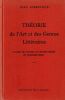
Très Bon Etat Mise à jour du Samedi 27 Juin 2026. Paiement PayPal immédiat, Mondial Relay pour : France, Allemagne, Autriche, Belgique, Espagne, Italie, Portugal, Luxembourg, Pays-Bas, Pologne (Communiquer votre point ou locker si connu). Une participation supplémentaire peut être demandée pour les colis lourds hors France où les envois compris entre 5 et 25 kg sont dégressifs : 2 à 4 kilogrammes - 7.99 / 5 à 10 kg - 15.99 / 15 -25 kg - 25.99. Certaines de nos collections ( Vian, Céline, Camus (...) peuvent être expédiées en Franco de port. Pour linternational hors Europe (Suisse, Canada, Japon, Etats-Unis, les frais dexpéditions peuvent varier selon le poids (mise à jour : 1 juin 2026).
Le voile du nom. Essai sur le nom propre arabe
PUF 1991 208 pages 13 4x2x21 2cm. 1991. Broché. 208 pages. Dans cet essai Jacqueline Sublet explore le système onomastique arabe médiéval en analysant la structure et la signification des noms propres arabes des surnoms et des titres honorifiques. L'ouvrage vise à familiariser un large public avec les sources et l'esprit de ce système au-delà du cercle des spécialistes
Bon Etat couverture un peu défraîchie intérieur propre bonne tenue
Haïti terre cassée. quinze ans dans la campagne haïtienne
L'Harmattan / histoire d vie 1996 302 pages in8. 1996. broché. 302 pages.
couverture tachée intérieur propre
The Reader in the Text: Essays on Audience and Interpretation (Princeton Legacy Library)
PRINCETON UNIV PR 1980 456 pages 13 97x2 794x21 336cm. 1980. Broché. 456 pages.
Bon Etat bonne tenue intérieur propre
Understanding Monastic Practices of Oral Communication (Western Europe, tenth-thirteenth centuries) <br>
, Brepols - Harvey Miller, 2011 Hardcover. XII 390 p., 7 b/w ill., 3 b/w tables, 156 x 234 mm, Languages: English, French, German, Fine copy. Including an index. ISBN 9782503534824.
This collection of papers delves into the fascinating methods with which monastic groups of the central Middle Ages practised modes of oral communication.<br>Although traditionally defined as a literate environment, Western monastic culture depended on a range of communicative practices which was just as large, and in some ways more sophisticated in its diversity, than that of other groups of society. Monks and nuns exchanged considerable amounts of information for which no written media were deemed necessary or which did not make a complete or immediate transition into written sources. Grouped in five thematic chapters, the papers in this volume aim to provide inroads into a useable interpretation of the various contexts in which monks and nuns in the central Middle Ages considered the spoken word as a vital complementary medium to other forms of communication.
Ecrire les expositions
Bruxelles, La Lettre volée, "Le Couloir parallèle", 1996, 15 x 21, 106 pages cousues sous couverture souple imprimée. Préface de Michel Baudson. ""Écrire les expositions" propose un choix de textes de 1969 à aujourd'hui, pour la plupart inédits en français, situant la pensée de l'organisateur de ces expositions qui ont marqué les dernières décennies : " Quand les attitudes deviennent forme ", " Les Mythologies individuelles " et " Le Musée des obsessions " (DOCUMENTA 5, 1972), " Les Machines célibataires ", " L'Œuvre d'art totale ", " Le Monte Verità ", " La Suisse visionnaire ", etc. Traversée à la fois critique, prospective et poétique de l'art contemporain et de son développement muséographique, les textes publiés ici sont chargés de sa quête des " énergies artistiques primordiales " et de sa profonde conviction en ces possibilités objectives qu'ouvre l'intensité de l'art, que le lecteur retrouvera dans la suite des chapitres. Ceux-ci en effet forment un hymne à l'exposition : " Ma vie est au service d'un médium, et ce médium n'est pas l'image qui est elle-même réalité, mais l'exposition qui présente la réalité ". Au long de son parcours de quelque trente années d'expositions thématiques, Harald Szeemann aura œuvré à dégager les résonances subtiles qui peuvent naître entre les œuvres, les artistes, les lieux, suivant une compréhension de l'art qu'il a définie en ces termes : " je ne m'intéresse qu'à la conscience divergente, parce que c'est là seulement que se trouvent les énergies utopiques ", précisant ainsi une véritable éthique de l'exposition."
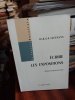
Bon état.
Thèses présentées à la faculté des sciences de Paris pour obtenir le grade de docteur ès sciences mathématiques
Paris, Gauthier-Villars et fils, 1894. In-8, XII-339 pp., demi-basane aubergine de l'époque, dos long orné de filets dorés (reliure un peu défraîchie mais solide, rousseurs).
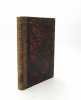
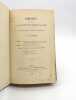
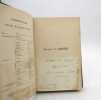
Réunion des deux thèses présentées par Séguier pour le grade de docteur en mathématiques. La première est intitulée "Sur deux formules fondamentales dans la théorie des formes quadratiques et de la multiplication complexe, d'après Kronecker", la seconde "Application combinée des deux formules de Kronecker". L'ouvrage est dédié à Charles Hermite, mathématicien français connu pour avoir été un des premiers à utiliser le concept de matrices. À la page de dédicace, il a été collé un autographe d'Hermite qui envoie cet ouvrage à Léonce Laugel, mathématicien et traducteur de Gauss. Voir photographie(s) / See picture(s) * Membre du SLAM et de la LILA / ILAB Member. La librairie est ouverte du lundi au vendredi de 14h à 19h. Merci de nous prévenir avant de passer,certains de nos livres étant entreposés dans une réserve.
DurantyEtude biographique et critique
Société d'Edition "Les Belles Lettres", Paris, 1954. In-12, broché, imprimé sur velin teinté, 224 pp. Préface, par Maurice Parturier - Introduction - Chapitre I. Introduction biographique. - II. L'homme de lettres : 1. La doctrine littéraire. - 2. La critique littéraire. - 3. Le théâtre des marionnettes. - 4. Les romans. - 5. Les contes ...
Avec un portrait de Duranty en frontispice. --- Plus d'informations sur le site archivesdunord.com
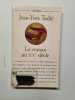
La pratique de l'art. Collection : Idées, N° 314.
Paris, Gallimard, 1974. 11 x 16, 284 pp., broché, bon état.
Bréviaire des Echecs
Librairie Stock Broché 1947 In-12 (12 x 19 cm), broché, couverture illustrée, 328 pages, schémas et figures en noir in-texte ; pliures au dos, coifes et bords frottés, mors supérieur fendu en queue, rousseurs aux plats défraîchis, nom manuscrit et date à la fausse page de titre, par ailleurs intérieur frais, état correct. Livraison a domicile (La Poste) ou en Mondial Relay sur simple demande.


Moeurs et Histoire des Peuls
Paris Payot 1937 une tache en couverture . Ouvrage documenté puisant et critiquant aussi de nombreuses sources
Assez bon Couverture souple
Esquisse d'une Théorie des Phénomènes Magnétiques, par le Docteur J.A. TEDINNGAROV, Membre correspondant de la Société Royale Académique de Savoie, de la Société Médicale du Canton de Genève, etc. etc., publié par les soins de M. le Chevalier BRICE, Comte de Beauregard, membre de la Société de Magnétisme, fondée à Paris, en 1814, par le Marquis de Puysigue, etc.
Paris, Dentu, Libraire, 1843, 1 fascicule in-8 de 225x145 mm environ, 32 pages, broché, feuillets non rognés. Couverture brunie avec bordures fendillées, des rousseurs.
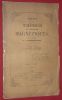

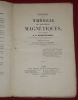
Publication dédiée au Pr Lordat, chef de file du mouvement magnétiste de Montpellier. Merci de nous contacter à l'avance si vous souhaitez consulter une référence au sein de notre librairie.
Roger de Piles etLe débat sur le colorisau siècle de Louis XIV
La Bibliothèque des Arts, Paris, 1957. Fort in-8, cartonnage éditeur illustré, 683 pp. Introduction : Le projet, la méthode, prologue : I. La famille de Piles. - II. L'établissement de l'Académie royale de Peinture et de Sculpture. - III. Roger de Piles à l'université. - IV. L'Académie de la "jonction" au "parfait établissement". ...
Avec un frontispice et 40 planches en noir en hors texte.Rare. --- Plus d'informations sur le site archivesdunord.com
Théorie et politique N° 3-4.
Couverture souple. Revue brochée, 148 pages. Quelques passages soulignés.
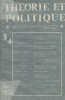
Périodique. Editions Servir le Peuple, Février 1975.
Verdun : le Coup de Force Allemand
Histoire et Collections 2002 16 4x0 4x22 2cm. 2002. Relié.
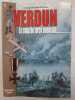

Bon état

