 Write to the booksellers
Mémoires sur la Révolution française. extraits de sa correspondance et de celle de ses amis
Paris, Ponthieu, 1824 2 vol. in-8, XII-363 pp. et 390 pp., broché. Rousseurs.
Fierro, 347. "Il s'agit de réflexions de Condorcet sur la Révolution tirées de sa correspondance et réunies par F. G. de La Rochefoucauld-Liancourt". - - VENTE PAR CORRESPONDANCE UNIQUEMENT - LIEN DE PAIEMENT, NOUS CONSULTER.


Éloge de M. de Fourcroy. lu à la séance publique de l'Académie royale des sciences, le 4 mai 1791
Paris, Imprimerie des sourds et muets, s.d. (1791) in-8, 22 pp., dérelié.
Édition originale. L'éminent chimiste vivait encore au moment de cet éloge académique (il ne mourut qu'en 1809). En novembre de cette année 1791, il fut seulement élu adjoint au secrétaire perpétuel de l'Académie des sciences, Nicolas de Condorcet. - - VENTE PAR CORRESPONDANCE UNIQUEMENT - LIEN DE PAIEMENT, NOUS CONSULTER.
CONDORCET (Jean-Antoine-Nicolas Caritat de), TURGOT (Anne-Robert-Jacques)
Reference : 240044
Correspondance inédite. (1770-1779). Publiée avec des notes et une introduction d'après les autographes de la collection Minoret et les manuscrits de l'institut par M. Charles Henry
Paris, Charavay, 1883 in-8, XXX-326 pp., portr. en front., index, broché. Rousseurs.
Première édition. - - VENTE PAR CORRESPONDANCE UNIQUEMENT - LIEN DE PAIEMENT, NOUS CONSULTER.
Vie de Monsieur Turgot. (EXEMPLAIRE SUR GRAND PAPIER).
1786 In-8 (219 x 144 mm), demi-veau blond, dos lisse orné de doubles filets dorés en place des nerfs, titre doré, (reliure Laurenchet), (4), 299 p. et (1) p. d'errata (exemplaire imprimé sur grand papier). Londres, 1786.
![Vie de Monsieur Turgot. (EXEMPLAIRE SUR GRAND PAPIER).. [CONDORCET (Jean Antoine Nicolas de Caritat, marquis de)]](https://static.livre-rare-book.com/pictures/HAT/38306_1_thumb.jpg)
![Vie de Monsieur Turgot. (EXEMPLAIRE SUR GRAND PAPIER).. [CONDORCET (Jean Antoine Nicolas de Caritat, marquis de)]](https://static.livre-rare-book.com/pictures/HAT/38306_2_thumb.jpg)
Véritable édition originale comportant l'errata au verso de la page 299 et l'avertissement, suivi de "l'avis de l'éditeur" qui informe le lecteur de la place des notes renvoyées en fin de volume. Condorcet fait l'éloge de Turgot et se pose en défenseur de la doctrine physiocratique et des idées économiques des Lumières qu'il contribua à mettre en uvre en tant que ministre des Finances de 1774 à 1776.Selon Spengler ('Économie et population', INED, 1954, p. 242), "la théorie fiscale de Turgot y est exprimée en termes mathématiques", faisant de Condorcet l'un des précurseurs de l'École mathématique. "Contrairement à ce que suggère le titre, ce livre n'est pas une biographie, mais plutôt un exposé des idées éducatives, politiques et économiques de Turgot. En fait, Stanley Jevons l'a qualifié de l'un des premiers ouvrages sur l'économie pure" (Gerits).(Einaudi, 1217. Gerits, 'Vie de Turgot', édition A. Goldsmiths, 13128. Kress, B.1032).Petite tache marginale aux deux derniers feuillets.Exceptionnel exemplaire, lun des rares imprimés sur grand papier (vergé de Hollande), entièrement non rogné, témoins conservés.
Réflexions de M. le Mis. de Condorcet sur l'usufruit des bénéficiers.
In-8 (193 x 125 mm), broché, couverture de papier marbré moderne, 8 pages. S.l.n.d. [Paris, 1789].
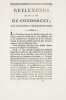
Édition originale. Titre courant. Si Condorcet approuve la nationalisation des biens ecclésiastiques et la neutralisation du pouvoir politique de l'Église, il rejette toute mesure portant atteinte au droit de propriété, qu'il considère comme un principe fondamental et inaliénable des droits de l'homme."Les titulaires actuels des bénéfices sont de véritables propriétaires usufruitiers, leur possession leur a été conférée sous l'autorité de la loi existante, d'après des formes établies par cette loi, et reconnues par tous les tribunaux civils" (p.1).(Martin & Walter, 8098). Très bon exemplaire, très frais, bien conservé.
RÉFLEXIONS D'UN CITOYEN SUR LA RÉVOLUTION DE 1788
londres sans editeur 1788 -in-12 broché un volume, broché (dérelié) in-douze (paperback in-12) (18,7 x 11,8 cm), sans couverture (A RELIER), toutes tranches lisses rouges, sans illustration (no illustration) excepté un Bandeau (front de chapitre) gravé sur bois en noir, 37 pages, 1788 Sans Lieu (LONDRES) sans Nom d'Editeur,
Note : Par Condorcet, d'après Barbier ...... ÉDITION ORIGINALE ....... TRÉS RARE ... et en bon état (good condition) ... à relier. en trés bon état
VIE DE MONSIEUR TURGOT
1786 un volume, reliure demi-basane havane in-octavo (half binding sheepskin in-8), (23 x 15 cm), reliure tardive (19ème), dos à nerfs (spine with raised bands), décoration or (gilt decoration) à filets or (gilt lines) et mates, filet mate de chaque côté des nerfs, pièce de titre sur fond rouge avec filet or (label of title with gilt line), titre frappé or, papier peigné aux plats (cover with painting paper), toutes tranches non rognées, sans illustrations (no illustration), dos légèrement frotté, [IV]-299-[1] pages, 1786 Londres (sans nom d'Editeur),
Edition Originale........Note(s) : Par Condorcet, d'après Barbier. - Fausse adresse. Probablement imprimé aux Pays-Bas d'après le matériel typogr. Réf. bibl. : CG, XXXI, 516. - CG, CXCVI, 26. - Barbier........Condorcet dans son ouvrage défend la pensée physiocratique et le personnage du ministre Turgot. il exposera et démontrera le bien fondé des théories économiques de Turgot. ....D'après Stourm, la Vie de Turgot de Condorcet est éloquente et utile à consulter......Rare....en bon état malgré le léger défaut signalé (good condition in pite of the small defect indicated).
Esquisse d'un tableau historique des progrès de l'esprit humain. Ouvrage posthume de Condorcet.
A Paris, chez Agasse, l'an III de la République, [1795]. In-8 de [8]-385 pages, demi-basane brune, dos lisse orné de filets et fleurons dorés.
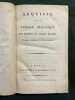
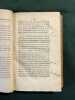
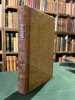
Édition originale. Cet ouvrage de philosophie de l'histoire retrace les grandes étapes du progrès général de l’esprit humain à travers l’histoire, les sciences, la morale et la politique. Condorcet rédige cet ouvrage dans les derniers mois de sa vie, alors qu'il est contraint de se cacher chez Mme Vernet à Paris, à la suite de l'émission d'un décret d'arrestation à son encontre. Il manque la table des matières (p. 387 à 389). Marginalia au crayon sur une quarantaine de pages (au début). Dos refait avec réemploi de l'ancien, quelques mouillures. En Français dans le texte, 196; Martin & Walter, 1, 8083; Printing and the Mind of Man 246; Quérard, II, p. 269.
Condorcet ; Jean-Pierre Schandelier, Pierre Crépel (édité sous la direction de) ; Groupe Condorcet
Reference : 1733217338833
(2004)
Tableau historique des progrès de l'esprit humain : projets, esquisse, fragments et notes (1772-1794),
Légères piqûres sur jaquette ; GLN-544, Institut National d'Etudes Démographiques, Paris 2004
Assez bon
Vie de Monsieur Turgot
1786 Londres (Paris), 1786, in-8 de (2) ff- 299 pp.-(1)p. (errata), reliure de l'époque de plein veau havane raciné, dos lisse orné de fers dorés, pièce de titre de maroquin rouge, charnières fendues, 1er plat détaché, reliure à restaurer, sinon bel état intérieur.
Edition A selon le classement de Gerit's, et la première des quatre éditions publiées à l'adresse de Londres avec la date de 1786. Ce tirage correspond à la collation d'Einaudi [(2) ff., 299 pp., (1) p. d'errata], qui est présentée comme l'édition originale. Dans cette biographie, Condorcet développe les idées politiques de Turgot et sa théorie mathématique de l'impôt.
Nouvelles littéraires. De la République, ou un Roi est-il nécessaire à la conservation de la Liberté ? par M. Condorcet
Paris, Boulard, s.d. (1791) in-8, 12 pp., dérelié.
L'auteur s'élève vigoureusement contre les vues exposées par Condorcet.Martin et Walter, 18982.Extrait du Journal de Physique, par M. l'abbé Rozier. Mois de juillet. - - VENTE PAR CORRESPONDANCE UNIQUEMENT - LIEN DE PAIEMENT, NOUS CONSULTER.
MOYEN D'APPRENDRE A COMPTER SUREMENT ET AVEC FACILITE.
PARIS. 1800. In-12. Broché. Etat passable, Plats abîmés, Dos abîmé, Déchirures. 132 pages. Manque en tête sur les 10 premières pages ayant des conséquences sur la lecture. Manque dos.. . . . Classification Dewey : 372.7-Livre scolaire : mathématiques
Classification Dewey : 372.7-Livre scolaire : mathématiques
REFLEXIONS SUR L'ESCLAVAGE DES NEGRES
LE MONDE/FLAMMARION. 2009. In-8. Broché. Bon état, Couv. convenable, Dos satisfaisant, Intérieur frais. 247 pages - annotations à l'encre sur la page de titre.. . . . Classification Dewey : 300-SCIENCES SOCIALES
Classification Dewey : 300-SCIENCES SOCIALES
CORRESPONDANCE INEDITE DE CONDORCET & MADAME SUARD 1771-1791
Paris, Fayard, 1988, in-8 broché, 262 pp, index. Coupure de presse. Couverture en bon état, intérieur en très bon état.
Esquisse d'un tableau historique des progrès de l'esprit humain suivi de "Fragment sur l'Atlantide"
Flammarion 1988 352 pages poche. 1988. broché. 352 pages.
Bon état
"CONDORCET, (MARIE JEAN ANTOINE NICOLAS CARITAT MARQUIS de).
Reference : 42119
(1795)
Esquisse d'un tableau historique des progrès de l'esprit humain. - [PMM 246 - CAN MAN BECOME PERFECT?]
Paris, Agasse, l'an III de la République, une et indivisible (1795). 8vo. Bound in a very nice newer pastiche-binding in full mottled calf. Five raised bands and gilt title-label to spine. A very nice, clean, fresh, and attractive copy. VIII, 389 pp.
![Esquisse d'un tableau historique des progrès de l'esprit humain. - [PMM 246 - CAN MAN BECOME PERFECT?]. "CONDORCET, (MARIE JEAN ANTOINE NICOLAS ...](https://static.livre-rare-book.com/pictures/LLX/42119_1_thumb.jpg)
![Esquisse d'un tableau historique des progrès de l'esprit humain. - [PMM 246 - CAN MAN BECOME PERFECT?]. "CONDORCET, (MARIE JEAN ANTOINE NICOLAS ...](https://static.livre-rare-book.com/pictures/LLX/42119_2_thumb.jpg)
The rare first edition of Condorcet's main work, ""the most fully developed exposition of the progress of man"" (Printing and the Mind of Man, p. 149) and a main work of the Enlightenment as well as of historical thought in general. The author was the creator of what came to found the basis for the modern French system. The great French philosopher, political thinker and mathematician, M.J.A. Condorcet (1743 - 1794), played a seminal role in 18th century France. He was friends with the likes of d'Alembert, Voltaire, Turgot etc., and he greatly contributed to the social and political debates of politically turbulent France. As one of the few, he advocated a liberal economy, equality in public education as well as in gender and race etc. He preached constitutionalism, and his thoughts that are still influential today embody those of the Enlightenment and rationalism.""A belief in the ultimate perfectibility of man lies at the root of all progressive thinking about the human condition. The ""philosophes"" and Godwin had familiarized the reading public with this notion" it was left to Condorcet to give it its finest and most durable expression. It was the gospel of nineteenth century that mankind is destined for indefinite future progress. Condorcet, looking back and then forward, saw proof of this in the growing equality between classes and nations, the intellectual, physical and moral improvement of man" and he prophesied that popular education on correct principles would strengthen and assure this progress."" (PMM 246).During the French Revolution Condorcet came to play a dominating role, advocating a rationalist reconstruction of society, and he championed many liberal causes. In 1791 he became secretary of the Legislation Assembly, and the institution adopted his scheme for comprehensive state education, which later became the basis of the modern French system. In the struggle between the two political parties, the Girondists and the Montagnards, Condorcet occupied an independent role, but when he opposed the death penalty under the trial of King Louis XVI (still supporting the actual trial), and the radical Montagnards gained more power, Condorcet was branded a traitor, and in October 1793 a warrant was issued for his arrest. He now went into hiding for several months (almost a year), and it is during these months that he writes the work that was to become his most important, the main work ""Esquisse..."" (""Sketch for a Historical Picture of the Progress of the Human Mind""), which was published posthumously, the year after his death. In 1794 Condorcet was arrested, and two days later he was found dead in his cell, -it is unknown whether he committed suicide or was murdered because of fear of fierce reactions that would definitely have occurred had the beloved man been officially sentenced to the death penalty.""In the Esquisse"", published after his death, Condorcet traces the history of man through epochs, the first three covering his progress from savagery to pastoral community and thence to the agricultural state. The next five span the growth of civilizations and knowledge down to Descartes, and the ninth describes the revolution of Condorcet's own lifetime, from Newton to Rousseau. The prophetic view of the tenth epoch shows Condorcet at his most original. He forecasts the destruction of inequality between nation and classes, and the improvement, intellectual, moral and physical, of human nature..., it exercised considerable influence on Comte. But it is as the most fully developed exposition of the progress of man that Condorcet's work is now remembered, and it is this which has given it its lasting appeal."" (PMM 246).
"CONDORCET, (MARIE JEAN ANTOINE NICOLAS CARITAT MARQUIS de).
Reference : 61971
(1797)
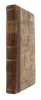
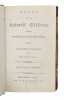
Udkast til et Historisk Skilderie af den menneskelige Aands Fremskridt. I Haandskrivt efterladt. Oversat af K.H. seidelin. - [CAN MAN BECOME PERFECT?]
København, Tikiøbs Forlag, 1797. 8vo. Bound in a contemporary half calf binding with gilt spine and gilt title label. Minor cracks to spine. Insignificant wear to capitals. Edges of boards worn. Corners bumped. Bibliographical notes to front free endpaper. Small ownership stamp to verso of title page. Evenly browned. XII,(2),368,(1: errata) pp.
The extremely rare first Danish edition of Condorcet's main work ""Esquisse d'un tableau historique des progrès de l'esprit humain.1795"", ""the most fully developed exposition of the progress of man"" (Printing and the Mind of Man, p. 149) and a main work of the Enlightenment as well as of historical thought in general. The author was the creator of what came to found the basis for the modern French system. The great French philosopher, political thinker and mathematician, M.J.A. Condorcet (1743 - 1794), played a seminal role in 18th century France. He was friends with the likes of d'Alembert, Voltaire, Turgot etc., and he greatly contributed to the social and political debates of politically turbulent France. As one of the few, he advocated a liberal economy, equality in public education as well as in gender and race etc. He preached constitutionalism, and his thoughts that are still influential today embody those of the Enlightenment and rationalism.""A belief in the ultimate perfectibility of man lies at the root of all progressive thinking about the human condition. The ""philosophes"" and Godwin had familiarized the reading public with this notion" it was left to Condorcet to give it its finest and most durable expression. It was the gospel of nineteenth century that mankind is destined for indefinite future progress. Condorcet, looking back and then forward, saw proof of this in the growing equality between classes and nations, the intellectual, physical and moral improvement of man" and he prophesied that popular education on correct principles would strengthen and assure this progress."" (PMM 246).During the French Revolution Condorcet came to play a dominating role, advocating a rationalist reconstruction of society, and he championed many liberal causes. In 1791 he became secretary of the Legislation Assembly, and the institution adopted his scheme for comprehensive state education, which later became the basis of the modern French system. In the struggle between the two political parties, the Girondists and the Montagnards, Condorcet occupied an independent role, but when he opposed the death penalty under the trial of King Louis XVI (still supporting the actual trial), and the radical Montagnards gained more power, Condorcet was branded a traitor, and in October 1793 a warrant was issued for his arrest. He now went into hiding for several months (almost a year), and it is during these months that he writes the work that was to become his most important, the main work ""Esquisse..."" (""Sketch for a Historical Picture of the Progress of the Human Mind""), which was published posthumously, the year after his death. In 1794 Condorcet was arrested, and two days later he was found dead in his cell, -it is unknown whether he committed suicide or was murdered because of fear of fierce reactions that would definitely have occurred had the beloved man been officially sentenced to the death penalty.""In the Esquisse"", published after his death, Condorcet traces the history of man through epochs, the first three covering his progress from savagery to pastoral community and thence to the agricultural state. The next five span the growth of civilizations and knowledge down to Descartes, and the ninth describes the revolution of Condorcet's own lifetime, from Newton to Rousseau. The prophetic view of the tenth epoch shows Condorcet at his most original. He forecasts the destruction of inequality between nation and classes, and the improvement, intellectual, moral and physical, of human nature..., it exercised considerable influence on Comte. But it is as the most fully developed exposition of the progress of man that Condorcet's work is now remembered, and it is this which has given it its lasting appeal."" (PMM 246).
Condorcet (Marie Jean Antoine Nicolas Caritat, Marquis de):
Reference : 59131BB
(1795)
Esquisse d'un tableau historique des progrès de l'esprit humain. Ouvrage posthume de Condorcet.
Paris, Chez Agasse. L'an III. (i.e. 1795). 8°. VIII S., 389 S. Halblederband der Zeit mit rotem goldgeprägtem Rückenschild und wenig Rückenvergoldung.
En Français dans le texte 196. - Erste Ausgabe von Condorcets philosophischem Hauptwerk, die umfassendste und beste Darstellung des menschlichen Fortschritts, posthum erschienen. Es ist die Zusammenfassung der Philosophie der Aufklärung mit ihrem Glauben an die Vernunft als Voraussetzung des Fortschrittes. Ein Text der auf der historischen Darstellung aufbauend in seiner Aussage gerade wieder von höchster Aktualität ist. Condorcet sprach sich in seinen Schriften für die Emanzipation aller Geschlechter, Rassen und Religionen aus. - Exemplar in einem schlichten Halblederband der Zeit mit kleiner Fehlstelle am oberen Kapital. Deckel fleckig, Stehkanten beschabt. Der fliegende Vorsatz gelockert. Vereinzelt fleckig. - En Français dans le texte 196. - Première édition. Première édition de l'œuvre philosophique majeure de Condorcet, la description la plus complète et la meilleure du progrès humain, publiée à titre posthume, elle résume la philosophie des Lumières avec sa croyance en la raison comme condition préalable au progrès. Un texte qui, s'appuyant sur la description historique, est à nouveau d'une actualité brûlante. Dans ses écrits, Condorcet s'est prononcé en faveur de l'émancipation de tous les sexes, races et religions. - Exemplaire dans une reliure sobre en demi-cuir d'époque avec une petite imperfection sur la tranche supérieure. Couverture tachée, bords abîmés. Page de garde détachée. Quelques taches éparses.
Voltaires Levnet, tilligemed hans Domme over Religion og Bibel. Oversat ved O. Horrebow.
Kiøbenhavn: A. Soldin, 1802. 8vo. Indbundet i et samtidigt hldrbd. med rygforgyldning. Titeletiket i skind med forgyldt titel. Kantslid. Øvre kapitæl slidt. Hjørner stødte. Et brændemærke på forpermermen har afgivet en brunplet på de første 6 blade. Enkelte brunpletter, ellers ren og pæn. Trykt på godt papir. Ex libris Nicolai Bøgh.
Titeloplag, idet indholdet er identisk med førstetrykket fra 1798.
Mémoires de Condorcet sur la Révolution Française. Extraits de Sa Correspondance et de Celles de Ses Amis.
Paris,Ponthieu en 1824.2 vols.in-8 en demi-reliure de l'époque.362 et 390 pages avec les Tables des Matières. Mémoires apocryphes tirés de la correspondance de Condorcet avec Suard,Morellet,Rousseau,D'Alembert,Diderot etc.. Bon état avec qques rousseurs.
CONDORCET [Marie Jean Antoine Nicolas de Caritat] Marquis de; PEYSONEL [Claude-Charles] de; LE CHAPELIER [Isaac-René-Guy]:
Reference : 9307
(1790)
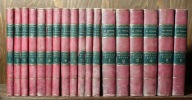
Bibliothèque de l'homme public; ou analyse raisonnée des principaux ouvrages françois et étrangers, Sur la Politique en général, la Législation, les Finances, la Police, l'Agriculture, & le Commerce en particulier, & sur le Droit naturel & public [avec] Bibliothèque de l'homme public [...] Seconde année.
A Paris, chez Buisson, 1790-1791. 24 tomes en 18 volumes petit in-8, demi-vélin teinté rouge à coins, dos lisses ornés de roulettes et filets dorés, étiquettes de titre et tomaison vertes. Reliures un peu frottées, dos légèrement passés, minimes manques à quelques étiquettes, quelques taches au papier des plats, très rares rousseurs, quelques auréoles. A noter que les étiquettes de titre orthographient "public" avec la terminaison -que. Les 12 numéros de la première années sont reliés indépendamment, les 12 de la seconde sont reliés à raison de 2 numéros par volume, sous la même reliure toutefois.
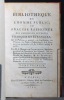
Cette revue "avait pour but de mettre autant que possible la science du gouvernement et de l'administration à la portée de tout le monde." Hatin, Bibliographie historique et critique de la presse française, p. 162. Figurent ici de nombreux textes et articles de Condorcet, dont les fameux Cinq Mémoires sur l'instruction publique, mais également des études sur les physiocrates, Adam Smith, Locke, Hume, Rousseau, Voltaire, and so on! Le Siècle des Lumières, amputé toutefois ici des dernières livraisons (soit 4 tomes, la parution continuera l'année suivante). Malgré tout, terriblement rare. INED, 1166.
CONDORCET, Marie Louise Sophie de Grouchy, marquise de (1764-1822)
Reference : 19514
(1993)
Lettres sur la sympathie ; suivies des Lettres d'amour à Maillia Garat ; textes revus, présentés et annotés par Jean-Paul de Lagrave
Montréal Presses de l'Université du Québec 1993
in-8, 196p. Couverture illustrée couleurs. :: Publication du département de Philosophie, Collection symbolique et idéologie, Cahiers Recherches et théorie, no S23. Première édition collective des ces lettres, et première séparée de celles sur la sympathie publiées pour la première fois en 1798 à la suite de l'ouvrage d'Adam Smith : Théorie des sentimens moraux, qu'elle avait traduit en français. :: broché. Bel état.
Vie de Voltaire suivie des mémoires de Voltaire écrits par lui-même.
Londres Editions Cazin M.DCCXCI (1791) +303p+279p 2 tomes en 2 volumes IN18. Reliures d'époque en plein veau blondDos lisses ornés avec pièces de titres et de tomaisons. Plats ornés d'un file doré. Coins émoussés. Coiffe du tome II arrachée.
CONDORCET (Marquis de)], TURGOT, BRUNY (Chevalier de)] COLBERT (Jean-Baptiste)
Reference : 023262
I. VIE de MONSIEUR TURGOT. Londres, sans nom, 1786. [2] ff. (titre, avertissement) 299 pp. errata. II. EXAMEN du MINISTERE de M. COLBERT. Paris, De l'Imprimerie de D'HOURY, 1784, XVI 295 pp.
0 Deux ouvrages en un volume in-8° (205 x 128mm). Reliure ancienne en demi-veau caramel, dos lisse orné d'une pièce de titre et de palette dorés, tranches jaunes, signet. (exemplaire un peu rogné, deux légères salissures sur le titre du premier texte, présences de rousseurs sur le second texte). Édition originale où Condorcet fait l'éloge de Turgot et se pose en défenseur de la doctrine physiocratique qu'il contribua à vulgariser. Jean-Baptiste Colbert fut l' un des principaux ministres de Louis XIV. Contrôleur général des finances de 1665 à 1683, secrétaire d'État de la maison du roi et secrétaire d'État de la Marine de 1669 à 1683. Bel exemplaire.
Elémens du calcul des probabilités et son application aux jeux de hasard, à la loterie et aux jugemens des hommes par Feu M. DE CONDORCET avec un discours sur les avantages des mathématiques SOCIALES et une notice sur M. DE CONDORCET -- EDITION ORIGINALE -- RARE -- BON EXEMPLAIRE
P., Royez, 1805, un volume in 8 relié en demi-basane, dos orné de filets dorés (reliure de la deuxième moitié du XIXe siècle), (étiquettes de titre légèrement frottées), 12pp., 210pp.
---- EDITION ORIGINALE de cet ouvrage posthume publié un an après la mort de CONDORCET par F.J.M. FAYOLLE ---- RARE ---- BON EXEMPLAIRE ---- "Les travaux de CONDORCET sur le calcul des probabilités l'amènent à concevoir l'application des mathématiques à l'étude des décisions humaines (le vote politique), et plus généralement à la fondation d'une authentique science sociale". (EN FRANCAIS DANS LE TEXTE N° 196)**8759/ARM1D

