 Write to the booksellers
45285 books for « l homme »Edit
-
Latest
Last 24h (13)
Last 3 days (100)
Last month (158)
Last week (12)
-
Language
Danish (1)
Dutch (1)
English (4)
French (45270)
German (1)
Greek (1)
Romanian (1)
Russian (6)
-
Century
16th (22)
17th (75)
18th (450)
19th (3236)
20th (23049)
21st (3097)
-
Countries
Belgium (1697)
Brazil (1)
Canada (206)
China (24)
Côte d'Ivoire (82)
Denmark (74)
France (41323)
Germany (75)
Greece (11)
Netherlands (11)
Switzerland (1772)
United Kingdom (2)
United States of America (7)
-
Syndicate
ALAC (168)
CLAM (73)
CLAQ (55)
CNE (33)
ILAB (24221)
NVVA (230)
SLACES (222)
SLAM (23539)
SNCAO (544)
Type
- Any type (3)
- Art print (1)
- Artists book (2)
- Autograph (65)
- Book (43923)
- Disk (1)
- Drawings (26)
- Engraving (19)
- Magazine (353)
- Manuscript (12)
- Maps (1)
- Music sheets (283)
- New book (4)
- Old papers (9)
- Photographs (579)
- Posters (4)
Topics
- Anatomy (86)
- Anthropology (210)
- Aquitaine (89)
- Archaeology (326)
- Autographs (261)
- Balzac honoré de (101)
- Biography (753)
- Biology (106)
- Carco francis (96)
- Catholicism (102)
- Children’s books (273)
- Christianity (380)
- Cinema (328)
- Civilisation (80)
- Comic strip (459)
- Dedication (269)
- Detective novels (308)
- Drawings (143)
- Early printed books (176)
- Earth (108)
- Economics (136)
- Education (161)
- Education - morals (109)
- English (269)
- Engraving (books about) (262)
- Epistemology (86)
- Esotericism (164)
- Essays (136)
- Ethic (269)
- Ethnology (158)
- Fantastic (80)
- Fine arts (160)
- First edition (470)
- French literature (89)
- Genealogy (220)
- Geography (337)
- God (95)
- Hackney (141)
- Helvética (138)
- History (1361)
- Hugo victor (138)
- Humour anecdotes (109)
- Industrial arts & crafts - fine arts (110)
- Journalism (564)
- Law (262)
- Literature (4803)
- Magazine (2426)
- Mathematics (188)
- Mauriac françois (87)
- Medicine (654)
- Metallurgy (85)
- Military arts (109)
- Music (103)
- Napoleon i (92)
- Navy (106)
- Newspaper (218)
- Newspapers press (3265)
- Painters (82)
- Palaeontology (136)
- Palaeozoology (85)
- Paris (162)
- Periodicals (130)
- Philosophy (1354)
- Photography (878)
- Poetry (342)
- Policy (459)
- Portraits (274)
- Prehistory (201)
- Psychiatry neurology (96)
- Psychoanalysis (104)
- Psychology (678)
- Regionalism (84)
- Religions (969)
- Review (173)
- Reviews (2583)
- Science fiction (107)
- Sciences (639)
- Scores (338)
- Sexuality (138)
- Simenon georges (206)
- Social sciences (212)
- Sociology (295)
- Songs (285)
- Sports (142)
- Spying (92)
- Switzerland (193)
- Telephone - telegraph (90)
- Testimonies / stories (110)
- Theatre (480)
- Theology (621)
- Travel (239)
- Various (315)
- War (249)
- Youth (98)
Déclaration des droits de l'Homme, et articles de Constitution présentés au roi, avec sa réponse du 5 Octobre soir. [Extrait des procês-verbaux de l'Assemblée Nationale, Des 20, 21, 22, 23, 24, 26 Aout & premier Octobre 1789. Déclaration des droit... - [""MEN ARE BORN AND REMAIN FREE AND EQUAL IN RIGHTS""]
Paris, Chez Baudouin, Imprimeur de l'Assamblée Nationale, 1789. 8vo. Bound in an exquisite later red half morocco with gilt spine. Top edge gilt. (1) f. (title-page), 8 pp. (""Déclaration des droits de l'Homme en société""), 6 pp. (""Articles de Constitution""), (1) f. (""Réponse du Roi""), (1) f. (blank). Woodcut head-pieces. Title-page slightly bowned, otherwise in excellent condition. A truly excellent copy.
The exceedingly scarce true first printing, in an incredibly rare form of off-print/separate printing, of one of the most important and influential documents in the history of mankind, namely the French Human Rights Declaration, containing also the articles for the first French Constitution. This groundbreaking publication constitutes a monumental change in the structure of the human world, providing all citizens with individual rights that we now take for granted. This monument of humanist thought appeared in the ""Procès verbal de l'Assemblée Nationale"", copies of which are also very difficult to obtain. There, however, the two parts appeared without a title-page and without the final blank, which together constitute a form of wrappers for this off-print/separate printing, of which only five or six other copies are known and which is present in merely one or two libraries world-wide. As far as we now, only one other copy has been on the private market, and that did not have the blank back wrapper. This exceedingly rare separate printing of the Human Rights Declaration, with the Constitution, was intended for the inner circle of those participating in its creation and was limited to a very restricted number of copies - all of which will have been owned by the creators of the Declaration. This epochal document is just as important today as it was when it was formulated during the French Revolution in 1789, and since 2003, the Declaration has been listed in the UNESCO Memory of World Register - ""This fundamental legacy of the French Revolution formed the basis of the United Nations Declaration of 1948 and is of universal value"". Few other documents in the history of mankind has done as much to determine the way we live and think, the way Western societies are structured and governed, and few other documents have had such a direct impact upon our constitutional rights and the way we view ourselves and others in society. It is here that we find the formulation of liberty and equality upon which so much of Western political and moral thought is based - that all ""men are born and remain free and equal in rights"" (Article 1), which were specified as the rights of liberty, private property, the inviolability of the person, and resistance to oppression (Article 2)" that all citizens were equal before the law and were to have the right to participate in legislation directly or indirectly (Article 6) no one was to be arrested without a judicial order (Article 7)" Freedom of religion (Article 10) and freedom of speech (Article 11) were safeguarded within the bounds of public ""order"" and ""law"", etc., etc.The content of the document that were to change the Western world for good emerged largely from the ideals of the Enlightenment. ""The sources of the Declaration included the major thinkers of the French Enlightenment, such as Montesquieu, who had urged the separation of powers, and Jean-Jacques Rousseau, who wrote of general will-the concept that the state represents the general will of the citizens. The idea that the individual must be safeguarded against arbitrary police or judicial action was anticipated by the 18th-century parlements, as well as by writers such as Voltaire. French jurists and economists such as the physiocrats had insisted on the inviolability of private property."" (Encycl. Britt.).The key drafts were prepared by Lafayette, working at times with Thomas Jefferson. In August 1789, Honoré Mirabeau played a central role in conceptualizing and drafting the Declaration. On August 26, 1789, in the midst of The French Revolution, the last article of the Declaration was adopted by the National Constituent Assembly, as the first step towards a constitution for France. ""In 1789 the people of France brought about the abolishment of the absolute monarchy and set the stage for the establishment of the first French Republic. Just six weeks after the storming of the Bastille, and barely three weeks after the abolition of feudalism, the Declaration of the Rights of Man and of the Citizen (French: La Déclaration des Droits de l'Homme et du Citoyen) was adopted by the National Constituent Assembly as the first step toward writing a constitution for the Republic of France.The Declaration proclaims that all citizens are to be guaranteed the rights of ""liberty, property, security, and resistance to oppression."" It argues that the need for law derives from the fact that ""...the exercise of the natural rights of each man has only those borders which assure other members of the society the enjoyment of these same rights."" Thus, the Declaration sees law as an ""expression of the general will,"" intended to promote this equality of rights and to forbid ""only actions harmful to the society."" (www.humanrights.com). This sensational document became the crowning achievement of the French Revolution"" it came to accelerate the overthrow of the ""Ancien Régime"" and sowed the seed of an extremely radical re-ordering of society. The Declaration interchanged the pre-revolutionary division of society -in the clergy, the aristocracy, and the common people- with a general equality - ""All the citizens, being equal in [the eyes of the law], are equally admissible to all public dignities, places, and employments, according to their capacity and without distinction other than that of their virtues and of their talents"" (From Article VI), upon which today's society is still based. It is hard to imagine a work that is more important to the foundation of the society that we live in today.

Rapports du physique et du moral de l'homme. 2 vols.
Paris, Au bureau de la Bibliothèque Choisie, 1830. 8vo. Uniformly bound in two nice contemporary half calf bindings with four raised bands and gilt lettering and ornamentation to spine. Boards with scratches and loss of the marbled paper. Ex-libris pasted on to pasted down front end-papers. Internally with occassional light marginal brownspotting. 405, (2) pp. 430, (2) pp.
Later edition of this work, which in the 19th century was considered as one of the finest works dedicated to the science of man. “As a philosopher, Cabanis sought in medicine an instrument for the analysis of ideas, that is to say, for the reconstruction of their genesis. His fundamental philosophical work, Rapports du physique et du moral de l’homme, is presented as “simple physiological researches.”1 It is composed of twelve Mémoires (the first six of which were first read in the sessions of the Institute) collected in one volume in 1802. In this work Cabanis sets forth a psychology and an ethical system based on the necessary effects of an animal’s organization upon its relationships with its environment. Even the unlimited perfectibility of the human species, which renders it “capable of all things,” derives from the fact that “man is undoubtedly the most subject to the influence of exterior causes.”(DSB)
SAINCTONGE (+) REMOND, DES COURS, NICOLAS (+) (LASAVILE, GEORGE)
Reference : 61580
(1696)
Histoire de Dom Antoine, roy de Portugal tiree des memoires de Dom Gomes Vasconcellos de Figueredo (+) Les véritables devoirs de l'Homme d'épée, particulièrement d'un Gentilhomme (+) Conseils D'Un Homme De Qualite A Sa Fille.
Amsterdam, Lorme & Roger, 1696 (+) Amsterdam, Braakman, 1697 (+) A La Haye, Van Dole, 1698. 12mo. In contemporary full vellum with title in contemporary hand to spine. Small paper-label pasted on to top of spine. Light wear to extremities, other wise nice and clean. (Frontispiece), 5-178, (Blank), (Frontispiece), (14), 244, (4), (Frontispiece), (6), 152 pp.
Interesting sammelband containing three works all sharing a focus on the values, virtues, and social roles of nobility and the upper classes in European society.
L'Homme qui a perdu son ombre avec 15 eaux-fortes de Bernard Naudin.
Paris, Peignot, 1913. 4to. Uncut and unopened in the original wrappers. With tissue-guards. Apart from minor tear to hinge at bottom, near mint condition.
Nr. 17 of 100 copies, one of only 15 copies on Japan-paper. ""Le present Exemplaire, qui porte le no 17, est un des quinze exemplaires sur Japon Imperial, renfermant, autre les gravures terminées une Suite d'Etats."" Comprising 15 original signed engravings, each with a suite, all in all 30 original engravings by the famous French painter and printmaker Bernard Naudin. Bernard Naudin (1876-1946) was the pupil of Léon Bonnat at the Beaux-Arts, Paris. He was successful as a painter, but he gave it up in1904 in order to concentrate on printmaking, for which he is now famous. His engravings for ""L'Homme qui a perdu son ombre"" are considered some of his finest works, and the book one of his scarcest.In all 100 copies were made, nr. 1 being a unique copy on ""vieux Japon"" (priced at 10.000 fr. at the time of appearance), Nr. 2-10 on ""vieux Japon"" (priced at 600 fr.), nr. 11-25 on ""Japon"" (priced at 500 fr.), and nr. 26-100 on Holland, with no extra suite (priced at 300 fr.).
Les devoirs de l'homme, et du citoien, tels qu'ils lui sont prescrits par la loi naturelle. 2 vols.
Amsterdam, Coup, 1748. 8vo. In contemporary full calf with five raised bands, richly gilt spine and gilt super ex-libris to front board. Wear and soiling to extremities, two large scratches with loss of leather to front board. Leather on spine cracked and spine-ends chipped. Internally nice and clean. XLIX, 252, (3), 256, 523 pp.

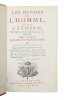
Sixth French translation of Pufendorf's second main work, his seminal ""On the Duty of Man and Citizen "", which became extremely influential during the Enlightenment of the 18th century and had a great impact on legal, moral, constitutional, and political thinking, not only in Europe, but also in America. It was perhaps more influential than the work which is usually considered Pufendorf's main work, namely his ""De jure naturae et gentium"" from 1672, which is longer and more elaborate, though, or perhaps exactly therefore, the present work must be said to be the one that came to exercise the greatest impact and came to spread Pufendorf's thought, not least his concept of ""natural law"" and his analysis of just war theory (which he gives in the present work), throughout Europe and America. It is the present work ""that guaranteed him a place in university curricula for a century."" (SEP).
Les devoirs de l'homme, et du citoien, tels qu'ils lui sont prescrits par la loi naturelle. 2 parts. (+) Du pouvoir des souverains, et de la liberte de conscience. - [A MILESTONE IN THE HISTORY OF NATURAL LAW]
Amsterdam, de Coup, 1722 - 1723 (+) Amsterdam, Pierre Humbert, 1714. 8vo. In contemporary full calf with five raised bands and richly gilt spine. Small paper-label pasted on to top of spine. Boards with scratches and leather on spine cracked. Ex-libris pasted on to pasted down front-end paper. Internally very fine and clean. LXI, (3), 597, XLVII, 407 pp. + 2 frontispieces.
Later French translation of Pufendorf's second main work, his seminal ""On the Duty of Man and Citizen "", which became extremely influential during the Enlightenment of the 18th century and had a great impact on legal, moral, constitutional, and political thinking, not only in Europe, but also in America. It was perhaps more influential than the work which is usually considered Pufendorf's main work, namely his ""De jure naturae et gentium"" from 1672, which is longer and more elaborate, though, or perhaps exactly therefore, the present work must be said to be the one that came to exercise the greatest impact and came to spread Pufendorf's thought, not least his concept of ""natural law"" and his analysis of just war theory (which he gives in the present work), throughout Europe and America. It is the present work ""that guaranteed him a place in university curricula for a century."" (SEP).
Essais de Theodicée sur la Bonté de Dieu, la Liberté de L'Homme, et L'Origine du Mal + Appendices sux Essais de Theodicee sur la Bonté ...2 Vols. - [A NEW PHILOSOPHY]
Amsterdam, D. Mortier, 1720. Bound in one contemporary full calf. Spine richly blindtooled. XLI,(3),520 pp. + 1 fold. table. A fine clean copy.
The scarce third edition of Leibnitz' importent treatise on the goodnes of God, the free will of man and the causes of evil in the world, The principal subject of the work being the problem of liberty and free will. It is the only larger philosophical work published by Leibnitz himself.Ravier No 67 (the first ed. from 1710) - PMM: 177 (1710-edition).
L'Homme de Cour.
Rotterdam, Jean Hofhout, 1728. 8vo. Bound in a nice contemporary Cambridge-style mirror binding with five raised bands and richly gilt spine. Gilt super ex-libris to front board. All edges marbled. Traces after a small paper-label to upper part of spine. Boards with a few holes in the leather. Otherwise a nice and clean copy. (58), 372 pp. + frontispiece.
A nice copy of this eighth revised and corrected edition of this famous collection of sayings translated from Spanish from the original edition of 1647 by Amelot de la Houssaie, secretary of the French Embassy in Venice.
L'homme detrompe, ou Le criticon de Baltazar Gracian. Traduit de l'espagnol. - [FIRST COMPLETE FRENCH TRANSLATIO OF 'EL CRITICON']
A La Haye, Jaccob van Ellinckhuysen, 1705. 8vo. In contemporary full calf with five raised bands and richly gilt spine. Small paper-label pasted on to spine. Gilt super ex-libris to front board. Wear to extremities, corner bumped and boards with scratches. Internally nice and clean. (12), 282, (17) pp.
![L'homme detrompe, ou Le criticon de Baltazar Gracian. Traduit de l'espagnol. - [FIRST COMPLETE FRENCH TRANSLATIO OF 'EL CRITICON']. GRACIAN Y MORALES, ...](https://static.livre-rare-book.com/pictures/LLX/60916_4_thumb.jpg)
![L'homme detrompe, ou Le criticon de Baltazar Gracian. Traduit de l'espagnol. - [FIRST COMPLETE FRENCH TRANSLATIO OF 'EL CRITICON']. GRACIAN Y MORALES, ...](https://static.livre-rare-book.com/pictures/LLX/60916_5_thumb.jpg)
![L'homme detrompe, ou Le criticon de Baltazar Gracian. Traduit de l'espagnol. - [FIRST COMPLETE FRENCH TRANSLATIO OF 'EL CRITICON']. GRACIAN Y MORALES, ...](https://static.livre-rare-book.com/pictures/LLX/60916_6_thumb.jpg)
Rare first complete French translation of Gracián’s vol. 1 of El Criticon first published in 1651. Various French editions were published in the end of the 17th century (París, Colombat, 1696 París, Colombat, 1697 Brussels, T’Sertstevens, 1696 Brussels, François Serstevens, Brussels, François Foppens, 1697), all incomplete. This present 1705 translation is considered the best and also serves as basis for the modern reissue by Alfred Coster (1931). El Criticon is considered one of the masterpieces of Spanish Baroque literature and is regarded, along with Don Quixote and La Celestina, to be one of the most influential works in Spanish literature,
Histoire florentine de Nicolas Machiavel citoien et Secretaire de Florence. Nouvellement traduicte d'Italien en Francois, Par le Seigneur de Brinon Gentil-homme ordinaire de la chambre du Roy. - [FIRST FRENCH TRANSLATION OF MACHIAVELLI'S 'FLORENTINE HISTORIES']
Paris, Guillaume de la Noue, 1577. 8vo. In recent full limp vellum with yapp edges. Woodcut printer's device on title, woodcut headpieces and initials. Small closed tear to upper inner margin of title-page. First 33 ff. with small worm tract in inner margin, with minor loss of text. Light dampstaining to first and last leaves. A good copy. (36), 294, (6) pp.
The exceedingly rare first French, and presumably very first overall, translation, of Machiavelli's Florentine Histories" his famous account of the political events and power struggles in Florence during the Renaissance. Essentially being a panegyric to the house of Medici, Machiavelli's work offers valuable insights into the rise and fall of political factions, the challenges faced by republican governments, and the dynamics of power in a city-state. Although often overshadowed by his more famous 'The Prince', the present work is important in understanding Machiavelli's broader political philosophy and is an indispensable document in understanding renaissance politics in general. The Histories constitute an essential work for understanding the political development of the late Machiavelli, and is “also an important item in modern historiography because for the first time the issue of conflict, and more precisely of urban conflict, finds itself at the heart of historical narrative (…).Infact, the Histories constitute the first attempt in modern historiography to analyze the totality of individual and collective agents and factors that allow a community to sustain itself or to founder. This analytical quality was certainly at the basis of the interest in the work outside Florence and the fact of its being translated. As Yves de Brinon explains in dedicating his ‘Histoire Florentine [the present work] to Cathrine de Medici, the case of Florence is a model for the dangers that threaten the integrity of every state and the Kingdom of France in Particular.” (Landi, A re-reading of Machiavelli). Machiavelli visited France, representing the Republic of Florence, where he - and later his writings - exercised great influence. The Huguenot, Innocent Gentillet, whose work commonly referred to as 'Discourse against Machiavelli' or 'Anti Machiavel', accused Machiavelli of being an atheist and accused politicians of his time by saying that his works were the ""Koran of the courtiers"", that ""he is of no reputation in the court of France which hath not Machiavel's writings at the fingers ends"" (Birely, The Counter Reformation, 1990). “Although Machiavelli became the embodiment of a real ""devil theory of history,"" there was nothing supernatural or even suspicious about his journey across the Alps. As the French translator remarked to his customers in 1544, ""This Florentine merchant has voluntarily left his own country to be received into yours.... Do not be so ungracious as to refuse him citizenship. From all appearances he was welcomed with open arms, or at least open minds. Within a few years, one of his admirers declared that he was a prophet honored more in France than in his own country."" (Kelley, Murd'rous Machiavel in France: A Post Mortem). Following the crisis of 1513, which involved arrests for conspiracy and torture, Machiavelli's relationship with the Medici family gradually improved. Despite the dedication of his book ""Il Principe"" to Lorenzo II de' Medici having little effect, Machiavelli found favor with a faction in Florence that was not opposed to him and was granted an appointment. In a letter Machiavelli expressed his dissatisfaction with his idle state and offered his valuable political experience to the new ruler. To further solidify his position, Machiavelli, adopting a somewhat courtier-like attitude, arranged for the staging of his play ""Mandragola"" at the wedding of Lorenzino de' Medici in 1518. In 1520, he received an invitation to Lucca for a semi-private mission, indicating that his ostracism was coming to an end. Later that year, Giulio Cardinal de Medici commissioned him to write a history of Florence. Although this was not exactly the role he desired, Machiavelli accepted it as the only way to regain the favor of the Medicis. The purpose of the work, although unofficial, was to restore the city's official historical standing. The salary for this appointment was not substantial, starting at 57 florins per year and later increased to 100. In May 1526, Machiavelli formally presented the finished work to Giulio de' Medici, who had become Pope Clement VII. The Pope appreciated the work and rewarded Machiavelli, though only moderately, and sought his support in creating a national army based on his theoretical work ""The Art of War,"" in preparation for the War of the League of Cognac. However, Machiavelli's hopes were shattered following the Sack of Rome in 1527 and the fall of the Medici government in Florence. Soon after, Machiavelli passed away. This exceedingly scarce first French edition was issued with two variant title-pages, the present referred to as variant-b. (see Gerber, Niccolo Machiavelli). Bibliopgraphia Machiavelliana, p. 60, no. 160. Gerber, dritter teil, p. 37, D-b. Brunet 1279.
L'Homme révolté. - [PRESENTATION-COPY]
(Paris), Gallimard, (1951). 8vo. Bound uncut and with the original printed wrappers, also the spine, in a wonderful grey full morocco binding with splendid line-gilding and gilt lettering to spine and onlays of coloured morocco (eight different colours) in a weve-like pattern with gilt outline to boards. top-edge gilt. Binding by Henning Jensen, gilding by Leif Hagel Olsen and design by Jens Bork. Gilt super ex-libris to inside of front board. A very nice and clean copy. 382, (2) pp.
![L'Homme révolté. - [PRESENTATION-COPY]. "CAMUS, ALBERT.](https://static.livre-rare-book.com/pictures/LLX/58821_1_thumb.jpg)
![L'Homme révolté. - [PRESENTATION-COPY]. "CAMUS, ALBERT.](https://static.livre-rare-book.com/pictures/LLX/58821_2_thumb.jpg)
![L'Homme révolté. - [PRESENTATION-COPY]. "CAMUS, ALBERT.](https://static.livre-rare-book.com/pictures/LLX/58821_4_thumb.jpg)
First edition, review-copy (Service de Presse-copy - ""S. P."" to bottom of title-page and on back wrapper) of ""The Rebel"", one of Camus' greatest works, with signed presentation-inscription to front free end-paper to the famous critic of literature and drama, the writer Guy Dumur (1921-1991).The younger Guy Dumur was a close friend of Camus, who hired him to work on ""Combat"" with him. It is reported that he had a great talent for discovering new talent. Since childhood, he was extremely passionate about the theatre and came to work with all the great dramatic figures in Paris at the time. He is also famous for a number of well respected novels.Famous for it's opening lines ""What is a rebel? A man who says no: but whose refusal does not imply a renunciation. He is also a man who says yes as soon as he begins to think for himself. A slave who has taken orders all his life, suddenly decides that he cannot obey some new command. What does he mean by saying 'no'?"", the novel addresses themes that have never lost their relevance, like terrorism, rebellion, art, etc., and counts as one of the great literary productions of the 20th century.
Nanine, eller Manden uden Fordomme. Komedie i tre Akter, oversat af Fransk (ved Falck) efter Nanine, ou l'homme sans prejugé.
(Kbh., 1783). Samt. slidt hldrbd.
First Danish edition. Første danske oversættelse. Fra 8. bind af ""Skuespil til Brug for den danske Skueplads. Bibl.Dan. IV:291.
L'Homme des Champs, ou les Géorgiques Francoises.
A Basle, Decker, l'imprimerie de Levrault Strassbourg, 1800. 8vo. Cont. full mottled calf. Richly gilt back. Engraved frontisp. XXIX,265 pp. Printed on good paper.
Vaincre. Esquisse d'une Doctrine de la Guerre basée sur la Connaissance de l'Homme et sur la Morale. 3 vols.
Paris, Nancy, Berger-Levrault, 1913. Royal8vo. 3 contemporary hcalf. Stamp on titlepage. XIII,253253187 pp.
Mémoires tires des Papiers d'un Homme D'État, sur les Causes secretes qui ont déterminé la Politique des Cabinets dans la Guerre de la Revolution depuis 1792 jusqu'en 1815. Tome 1-2 (of 13).
Paris, Ponthieu et Comp., 1828 Bound in 2 modest hcloth. 516,581 pp. Scattered brownspots.
Congrès pour L'Étude de la Tuberculose chez L'Homme et chez les Animaux. 1re Session.- 1888. President: M. le Professeur Chauveau. Avec Figures dans le Texte.
Paris, G. Masson, 1889. Recent boards. Uncut. Htitle and last leaves a bit soiled. (2),760 pp.
L' Homme pendant les Ages de la Pierre dans les environs de Dinant-sur-Meuse. Deuxième édition avec 41 gravures, 4 planches & 1 tableau synoptique.
Bruxelles, Muquardt, 1872. Contemp. hcalf. Spine gilt and somewhat rubbed. Top of spine worn. Stamps on titlepage and htitle. (2),250 pp., textillustr., 4 tinted lithographed plates and 1 large table ""Table Synoptique"" With presentation inscription on halftitle ""A Monsieur Engelhardt, honneur de l'Auteur, E. Dupont"". Engelhardt was a well-known Danish archaeologist.
"CALMETTE, (LÉON CHARLES ALBERT). - THE REACTION TEST FOR TUBERCULOSIS.
Reference : 47219
(1907)
Sur un nouveau procédé de diagnostic de la tuberculose chez l'homme par l'ophtalmo-réaction à la tuberculine.
(Paris, Gauthier-Villars et Cie), 1907. 4to. Without wrappers. In: ""Comptes Rendus Hebdomadaires des Séances de L'Academie des Sciences"", Tome 144, No 24. Pp.(1309-) 1396. (Entire issue offered). Calmette's paper: pp. 1324-1326.
First printing of calmette's paper in which he introduced his conjunctival reaction test for tuberculosis.Garrison & Morton: 2337.
Description de l'uréthre de l'homme, démontrée à l'Academie le troisiéme Juillet 1700.
(Paris, Jean Boudot, 1703). 4to. No wrappers. Extracted from ""Histoire de L'Academie Royale des Sciences"", Année 1700. Pp. 305-310.
First appearance of the paper in which Littre described for the first time the urethral gland which was later named ""Littre's gland"". Garrison & Morton No 1215.
"ORÉ, (PIERRE CYPRIEN). - PIONEERING INTRAVENOUS ANASTHESIA.
Reference : 49096
(1874)
De l'anesthésie produite chez l'homme par les injections de chloral dans les veines. (+) (Suite). Tétanos traumatique traité par les injections. Guérison.
(Paris, Gauthier-Villars), 1874. 4to. No wrappers. In: ""Comptes Rendus Hebdomadaires des Séances de L'Academie des Sciences"", Tome 78, No 7 a. 9. Pp. (453-) 520 a. (577-) 664 (2 entire issues offered). Oré's papers: pp. 515-517 a. 651-654.
First printing of 2 importent papers in surgical anaesthesia as they records ""The first successfull human anaesthesia. Oré, professor of physiology at Bordeaux, reported the successfull use of this method in animals... 1872."" (Garrison & Morton No. 5672).
De la Recherche de la Verité, ou l'on Traite de la Nature de l'Esprit de l'homme, & de l'usage qu'il en droit faire pour éviter l'erreur dans les Sciences. Sixiéme édition, revué & augmentée de plusieurs Eclairissemens. 4 Vols.
Paris, Michel David, 1712. Small8vo. Bound in 4 contemp. full calf. Raised bands, richly gilt spines. Spineends worn. Titlelabels partly gone. Internally clean.
L'Anatomie de L'Homme, suivant la Circulation du Sang, & les dernieres découvertes, démosnstrée au Jardin Royal.
Paris, Laurent d'Houry, 1690. Contemp. full mottled calf. Richly gilt spine in 6 compartments, raised bands. Titlelabel with gilt lettering. Wear to top of spine. A small nick in leather in middle of front hinge. Fronthinge weakening, but still holding. Engraved portrait. (24),550,(14) pp. and 19 engraved anatomical plates. A few brownspots. Some scattered inkspots. A faint dampstain on foot of portrait. A dampstain to lower right corners of the last 5 leaves. Last leaf and errata-leaf repaired in right margin, no loss of letters.
Scarce first edition of this surgical textbook that opened a new era in which French surgical teaching dominated Europe.""A native of Paris, Dionis studied surgery at the Confraternity of St. Côme and was first surgeon to Queen Maria Theresa until her death in 1684. When Louis XIV established a demonstratorship in operative surgery at the Jardin Royal in the early 1670s, he appointed Dionis to the position. Dionis remained there until 1680 when he returned to serve as surgeon to the entire royal house. The present work was first published in French in 1690 and soon became a standard work and popular textbook on the subject. It remained in print for over half a century and was even translated into Chinese. The illustrations, limited in number, are rather unimpressive copperplates."" (Heirs of Hippocrates, 649 (Latin edition of 1696)). - Wellcome II, 471.
DONNÉ, A. (ALFRED). - FIRST DESCRIPTION OF INFECTION BY TRICHOMONAS VAGINALIS.
Reference : 51497
(1836)
Animalcules observés dans les matières purulentes et le produit des sécretions des organes génitaux de l'homme et de la femme" extrait d'une lettre de M.A. Donné.
(Paris, Bachelier), 1836. 4to. No wrappers. In: ""Comptes Rendus Hebdomadaires des Séances de L'Academie des Sciences"", Tome 3, Séance Lundi 19 sept. Pp. (375-) 392. (Entire issue offered). Donné's paper: pp. 385-386.
First printing of the paper, being the first to describe living organisms in pathological conditions.""First description of Trichomonas vaginalis, which Donné at first believed to be the pernicious gonorrhoea. He later admitted the organism to be a normal inhabitant of the female genital tract. Donné was, by this work, the first to describe livig organisms in pathological conditions, as observed by modern methods."" (Garrison & Morton No. 5207).
Les lettres sincères d'un gentil-homme françois, eller en Fransk Herremands oprigtige Breve, af det Franske oversatte i Dansken, og til Oplysning af det tiende Brev hosføiet en kort Efterretning om de Borgerlige Krige i Frankerige, udgivet Aar 1757 af...
Kiøbenhavn, Glasings Efterleverske, ved Nicolaus Møller, (1757). Samtidigt helldrbd. med rygforgyldning og rygtitel. Lidt kantslid. 256 pp. Lettere brunplettet.
Bibl. Danica II, 537.
Dictionnaire Universel des Sciences Morale, Économique, Politique et Diplomatique". ou Bibliothèque de l'homme d'état et du Citoyen. 30 vols. - [ROBINET'S ""DICTIONNAIRE UNIVERSEL""]
London, chez les Libraires associés, 1777 - 1783 [Presumably printed in Liège by Clément Plomteux in association with Elmsly in London, van Harrevelt in Amsterdam, Rosset in Lyon and Panckoucke in Paris]. 4to. Uniformly bound in 30 contemporary half calf binding with leather title-label with gilt lettering to spines. Wear to extremities and small paper-label paper on to top of spines. First few leaves in most volumes with light soiling, otherwise internally very fine and clean. Complet.
First edition of Robinet monumental encyclopedia, still regarded as being the first main encyclopedia on European social sciences. Robinet, in collaboration with Charles-Joseph Panckoucke were exponents of Diderot's Encyclopédie, and published a supplement to it in four volumes (1776-1777), the present work published as a direct extension to the Encyclopédie.Robinet is one of the precursors in the history of evolutionary thought who contributed to the process which later crystallized in the work of Charles Darwin.

