 Write to the booksellers
290 books for « epistolae »Edit
-
Type
Book (289)
Old papers (1)
-
Latest
Last 3 days (1)
Last month (4)
-
Language
French (280)
Greek (1)
Latin (9)
-
Century
15th (1)
16th (8)
17th (29)
18th (31)
19th (58)
20th (41)
21st (3)
-
Countries
Belgium (90)
Canada (1)
Denmark (14)
France (120)
Greece (3)
Italy (2)
Netherlands (25)
Switzerland (35)
-
Syndicate
ILAB (97)
NVVA (5)
SLACES (5)
SLAM (66)
Topics
- Academy (8)
- Antwerp (8)
- Arles (1)
- Belgium (15)
- Bible (5)
- Bibliography (8)
- Books from the xviiith (2)
- Byzantium, (3)
- China (1)
- China (1)
- Christianity (4)
- Church book (1)
- Classic literature (1)
- Cult (1)
- Dance & ballet (1)
- Dancing (1)
- Descartes rené (3)
- Early printed books (3)
- Elzevier (1)
- England (1)
- English (1)
- Erasmus (1)
- Ethic (1)
- First edition (2)
- Geography (1)
- Greece (1)
- Greek (16)
- Hackney (2)
- Head edition (1)
- Helvética (1)
- History (48)
- Holland (3)
- Humanism (11)
- Incunabulum (1)
- Isaac (5)
- Japan (1)
- Jesuits (10)
- Latin (72)
- Latin greek (3)
- Law (2)
- Linnean society of lyons (2)
- Literature (16)
- Liturgy (1)
- London (1)
- Lyons and area (2)
- Lyons college (2)
- Lyons college pc (2)
- Lyons revue (2)
- Magazine (1)
- Marseilles (1)
- Medicine (6)
- Middle ages (2)
- Monfalcon (1)
- Morin edgar (2)
- Neurology (1)
- Newspapers press (1)
- Part dieu (1)
- Patrology (2)
- pharmacy (1)
- Philology (4)
- Philosophy (9)
- Phonetics (1)
- Poland (1)
- Printing (1)
- Psychiatry neurology (1)
- Psychology (4)
- Regionalism (1)
- Reims (1)
- Religions (24)
- Reliure (5)
- Reviews (1)
- Rome (2)
- Saint jerome (2)
- Saint john (1)
- Saint paul (1)
- Sciences (3)
- Socrates (1)
- Sue eugène (3)
- Switzerland (2)
- Tea (1)
- Theology (28)
- Trappists (1)
- United kingdom (1)
- Various (3)
- Vatican city (1)
- Xviii th century (2)
Iusti Lipsi Epistolae, Volume XIV: 1601, Iusti Lipsi Epistolae
, Brussel, KVAB, , Gebonden in linnen band, 2006, 591 p.
In 1978 werd het eerste deel van de Iusti Lipsi Epistolae gepubliceerd. Exact 400 jaar na het overlijden van Iustus Lipsius verscheen nu volume XIV van de reeks. Bij het begin van elk deel worden de voornaamste interessepunten van de correspondentie van dat jaar opgeroepen. Naast een literatuurlijst is er ook een concordantietabel tussen de Inventaire (een ander werk uit 1968) en het betreffende deel, en een lijst van de gepubliceerde brieven opgenomen. Elke brief wordt voorafgegaan door een inleidend gedeelte met een samenvatting en een overzicht van bestaande versies. Het wordt eventueel aangevuld met biografische informatie van de correspondent, bijzonderheden over de overlevingsgeschiedenis en informatie van de correspondent. De brieven zelf, voor zowat 95 procent in het Latijn geschreven, worden eventueel voorzien van een kritisch apparaat en daarna toegelicht in een veelzijdig commentaar dat zich qua periode uitstrekt van de Oudheid tot Lipsius' eigen tijd. Citaten en anekdotes worden geidentificeerd of toegelicht. Vermelde personen krijgen een korte biografische notitie. Occasioneel komen epigrafische of numismatische bronnen aan bod. Ook Lipsius' (her-)uitgaven en plannen komen, net als de publicaties en projecten van collega's geregeld ter sprake. Ten slotte vindt men in de brieven ook verslagen van en reflecties op contemporaine gebeurtenissen of geruchten hierover. Ieder deel wordt afgesloten door een uitvoerige Index nominum. Bij het verschijnen van het laatste deel van de reeks, met de correspondentie van 1606, zullen ook de brieven worden opgenomen die na het verschijnen van het betreffende deel aan het licht kwamen. Er wordt ook een overkoepelende index voorzien, evenals een volledige concordantietabel, waarin alle verschillen tussen de Inventaire en Iusti Lipsi Epistolae worden aangegeven.
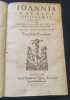
Epistolae et responsa. Quibus Interiectae sunt infignium in Ecclesia Dei virorum aliquot etiam Epistolae. Indice rerum insigniorum. Tomi Sexti : Pars altera
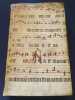
Genève Vignon & Chouet 1617 CALVINI IOANNIS (Jean CALVIN) - Epistolae et responsa. Quibus Interiectae sunt infignium in Ecclesia Dei virorum aliquot etiam Epistolae. Indice rerum insigniorum. Tomi Sexti : Pars altera - Il s'agit du Tome 6 des 7 volumes composant l'"Opéra omnia théologica" paru chez Vignon & Choué en 1617 -Genève, Vignon & Chouet, 1617 - Grand in4, plein vélin en parchemin de réemploi d'une partition ancienne, avec notes et lettres calligraphiées et peintes - 3ff + 598 colonnes + 5ff - Interfolié d'un grand nombre de pages vierges, certaines comportant des inscriptions manuscrites d'époque. Menus défauts à la reliure, mouillures claires sur la quasi totalité des pages. 3e édition de cette correspondance de Calvin qui fut compilée par Théodore de Bèze en 1575 dès la mort de Calvin. Dans une reliure d'époque ou antérieure.
Satisfaisant


IVSTI LIPSI EPISTOLAE I. Vol 6 : 1593. Iusti Lipsi Epistolae, Pars IV: 1591 Iusti Lipsi Epistolae
, Brussel, Paleis der Academien, 1994., Gebonden in groen linnen, goudopdruk op platen en rug, 18x26,5cm, 380pp.
Koninklijke Academie voor Wetenschappen, Letteren en schone Kunsten van Belgie.De brieven van Iustus Lipsius worden door de leden van de commissie sinds 1978 chronologisch vertaald. De werken die hieruit resulteerden, zijn ondertussen een standaard referentiewerk geworden voor al wie met Iustus Lipsius en humanisme bezig is
Ivsti Lipsi Epistolae, I, 5 : 1592. Iusti Lipsi Epistolae
, Brussel, Paleis der Academien, 1991., Gebonden, groen linnen, vergulde stempel en titel op de voorplat, rug versierd vergulde titel, 18,5x26,5cm, 493pp, index nominum.
Koninklijke Academie voor Wetenschappen, Letteren en Schone Kunsten van Belgie. Iusti Lipsi Epistolae I, 5.De brieven van Iustus Lipsius worden door de leden van de commissie sinds 1978 chronologisch vertaald. De werken die hieruit resulteerden, zijn ondertussen een standaard referentiewerk geworden voor al wie met Iustus Lipsius en humanisme bezig is
Ivsti Lipsi Epistolae, I, 7 : 1594. Iusti Lipsi Epistolae
, Brussel, Paleis der Academien, 1997., Gebonden, groen linnen, vergulde stempel en titel op de voorplat, rug versierd vergulde titel, 18,5x26,5cm, 418pp, index nominum.
Koninklijke Academie voor Wetenschappen, Letteren en Schone Kunsten van Belgie. Iusti Lipsi Epistolae I, 7.De brieven van Iustus Lipsius worden door de leden van de commissie sinds 1978 chronologisch vertaald. De werken die hieruit resulteerden, zijn ondertussen een standaard referentiewerk geworden voor al wie met Iustus Lipsius en humanisme bezig is
Ivsti Lipsi Epistolae, I, 8: 1595, Iusti Lipsi Epistolae
, Brussel, Paleis der Academien, 2004., Gebonden, groen linnen, vergulde stempel en titel op de voorplat, rug versierd vergulde titel, 18,5x26,5cm, 664pp, index nominum.
Koninklijke Academie voor Wetenschappen, Letteren en Schone Kunsten van Belgie. Iusti Lipsi Epistolae I, 8.De brieven van Iustus Lipsius worden door de leden van de commissie sinds 1978 chronologisch vertaald. De werken die hieruit resulteerden, zijn ondertussen een standaard referentiewerk geworden voor al wie met Iustus Lipsius en humanisme bezig is
Ivsti Lipsi Epistolae, I, 6 : 1593. Iusti Lipsi Epistolae
, Brussel, Paleis der Academien, 2004., Gebonden, groen linnen, vergulde stempel en titel op de voorplat, rug versierd vergulde titel, 18,5x26,5cm, 380pp, index nominum.
Koninklijke Academie voor Wetenschappen, Letteren en Schone Kunsten van Belgie. Iusti Lipsi Epistolae I, 6.De brieven van Iustus Lipsius worden door de leden van de commissie sinds 1978 chronologisch vertaald. De werken die hieruit resulteerden, zijn ondertussen een standaard referentiewerk geworden voor al wie met Iustus Lipsius en humanisme bezig is
Iusti Lipsi Epistolae, Iusti Lipsi Epistolae, deel IV. (vol.4)
, Brussel, KVAB, , 2012 bound in hardcocer, cloth Gebonden in linnen band, 752pp. pars IV 1591. ISBN 9789065691002.
In 1978 werd het eerste deel van de Iusti Lipsi Epistolae gepubliceerd. Exact 400 jaar na het overlijden van Iustus Lipsius verscheen nu volume XIV van de reeks. Bij het begin van elk deel worden de voornaamste interessepunten van de correspondentie van dat jaar opgeroepen. Naast een literatuurlijst is er ook een concordantietabel tussen de Inventaire (een ander werk uit 1968) en het betreffende deel, en een lijst van de gepubliceerde brieven opgenomen. alle anderen delen uit deze reeks ook beschikbaar !
GUIBERTUS GEMBLACENSIS [GUIBERT DE GEMBLOUX] (DEROLEZ A. e.a., eds.)
Reference : R118872
(1988)
Guiberti Gemblacensis Epistolae quae in codice B.R. Brux. 5527-5534 inveniuntur [2 volumes] Pars I: Epistolae I-XXIV, Pars II: Epistolae XXV-LVI (Corpus Christianorum, Continuatio Mediaevalis, 66-66A)
Turnhout, Brepols 1988-1989 Complet en 2 tomes, xl + 628pp. (pagination continuée) + 3 planches hors-texte, 25cm., dans la série "Corpus Christianorum Continuatio Mediaevalis" volumes LXVI-LXVIA (66-66A), reliures toile d'éditeur avec titre doré, ISBN 2-503-03661-8 & 2-503-03663-2, (introduction en français, texte en latin), texte frais, très bon état, poids: 1.5kg., R118872
Epistolae Karolini aevi (VI). Hincmari archiepiscopi Remensis epistolae. (Die Briefe des Erzbischofs Hinkmar von Reims). Teil 2. Nach Vorarbeiten von Ernst Perels und Nelly Ertl. Monumenta Germaniae Historica - Epistolae, Tomus VIII.
Wiesbaden, Harrassowitz Verlag 2019, 295x210mm, broschiert. Neues Exemplar.
lateinischer Text, Pour un paiement via PayPal, veuillez nous en faire la demande et nous vous enverrons une facture PayPal
“C. PLINII SECUNDI NOVOCOMENSIS EPISTOLARU LIBRI DECEM, IN QUIBUS MULTAE HABENTUR EPISTOLAE NON ANTE IMPRESSAE…”.
(L'édition originale des Lettres de Pline le Jeune imprimée par Alde Manuce. Un séduisant exemplaire en maroquin du XVIII siècle) PLINIUS CAECILIUS SECUNDUS. (61-113 ap. J.-C.) “C. PLINII SECUNDI NOVOCOMENSIS EPISTOLARU LIBI DECEM, IN QUIBUS MULTAE HABENTUR EPISTOLAE NON ANTE IMPRESSAE…”. 1508, Venetiis, in aedib. Aldi et Andreae Asulani soceri. 1 volume in-8° (159x102 mm) (dimensions pages 154x91 mm) (12) ff. (titre, préface à Aloisio Mocenigo, index et 1 f. b.), 525, (1) pp., (1) f. avec ancre aldine au verso. (*8, **4, a-z8, aa-kk8) Reliure anglaise en maroquin vert du XVIII siècle. Petit encadrement décoré sur les plats. Dos à cinq nerfs avec fleurons et décorations dorés et pièce de titre en maroquin rouge. Roulette dorées sur les coupes. Tranches décorées de rouge. Gardes de papier décoré. Edition Originale, en partie Editio Princeps et première imprimée par Alde Manuce, très rare. Dos insolé et habiles restaurations aux mors et à la coiffe supérieure. Très bel exemplaire frais et propre. “Cette édition, devenue d’une excessive rareté, est des plus précieuses sous plusieurs rapports, puisqu’elle contient 375 lettres divisées en dix livres, tandis que la précedente édition de Rome 1490 n’en contenait que 236 divisés en neuf livres, et que les éditions sans date de Venise (vers 1471), celle de Naples de 1476 et celle de Milan de 1478 n’en renfermaient que 122 en huit livres” (Firmin-Didot, S. 304). Premier livre qui indique l’association entre Alde et son beau-père Andrea (Torresani) Asulani (soceri). Dans la préface Alde remercie le sénateur vénitien Aloisio Mocenigo, ambassadeur en France, qui lui a fourni, pour cette édition de Pline le jeune, un précieux manuscrit sur vélin, ancien et très correct, provenant de Paris. “L’écriture du manuscrit original sur vélin était si ancienne, qu’on aurait pu, au dire d’Alde, la faire remonter au temps même où vivait Pline. Etait-elle en lettres onciales ou gothiques? Alde ne nous dit rien sur ce sujet, et l’on ignore si ce manuscrit a été conservé”. Le manuscrit de Paris, découvert par Fra’ Giocondo de Vérone au début du XVI siècle et porté à Venise par Mocenigo, était déjà consideré perdu peu de temps après avoir été utilisé par Alde Manuce pour son édition complète de 1508. Les Lettres (Epistolae) sont le recueil de la correspondance de l’écrivain latin. Les lettres pliniennes sont une source précieuse de rensignement sur le Haut-Empire romain. Dans chacune de ses lettres, Pline, tout en respectant la forme épistolaire, traite un thème en particulier. C’est pratiquement l’ensemble des domaines de la vie des classes supérieures romaines qui s’y trouve abordé. On peut trouver des réflexions sur la politique, le droit, la justice, la littérature, la culture, l’éducation, ainsi que la descriptions de paysages et des villas de Pline. Parmi les passages les plus connus figurent la description de l’éruption du Vésuve en 79 à Tacite et l’échange avec Trajan sur l’attitude à adopter face aux chrétiens. Provenance : Ex libris XIX Charles Bathurst (dernier Viscount Bledisloe) à Lydney Park. (Renouard, p. 53 n° 3 ; Adams, P 1538 ; Brunet, III, 773)
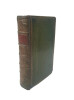
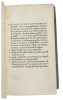
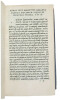
(L'édition originale des Lettres de Pline le Jeune imprimée par Alde Manuce. Un séduisant exemplaire en maroquin du XVIII siècle)
IVSTI LIPSI EPISTOLAE I. Vol 5 : 1592. Iusti Lipsi Epistolae
, Brussel, Paleis der Academien, 1991., Gebonden in groen linnen, goudopdruk op platen en rug, 18x26,5cm, 493 pp.
Koninklijke Academie voor Wetenschappen, Letteren en schone Kunsten van Belgie.De brieven van Iustus Lipsius worden door de leden van de commissie sinds 1978 chronologisch vertaald. De werken die hieruit resulteerden, zijn ondertussen een standaard referentiewerk geworden voor al wie met Iustus Lipsius en humanisme bezig is
IVSTI LIPSI EPISTOLAE I. Vol 7 : 1594. Iusti Lipsi Epistolae
, Brussel, Paleis der Academien, 1997., Gebonden in groen linnen, goudopdruk op platen en rug, 18x26,5cm, 418pp.
Koninklijke Academie voor Wetenschappen, Letteren en schone Kunsten van Belgie.De brieven van Iustus Lipsius worden door de leden van de commissie sinds 1978 chronologisch vertaald. De werken die hieruit resulteerden, zijn ondertussen een standaard referentiewerk geworden voor al wie met Iustus Lipsius en humanisme bezig is
Ivsti Lipsi Epistolae, I, 1 : 1564-1583.
, Brussel, Paleis der Academien, 1978., Gebonden, groen linnen, vergulde stempel en titel op de voorplat, rug versierd vergulde titel, 18,5x26,5cm, 491pp, index nominum.
Koninklijke Academie voor Wetenschappen, Letteren en Schone Kunsten van Belgie. Iusti Lipsi Epistolae I, 1.De brieven van Iustus Lipsius worden door de leden van de commissie sinds 1978 chronologisch vertaald. De werken die hieruit resulteerden, zijn ondertussen een standaard referentiewerk geworden voor al wie met Iustus Lipsius en humanisme bezig is
Ivsti Lipsi Epistolae, I, 2 : 1584-1587.
, Brussel, Paleis der Academien, 1983., Gebonden, groen linnen, vergulde stempel en titel op de voorplat, rug versierd vergulde titel, 18,5x26,5cm, 461pp, index nominum.
Koninklijke Academie voor Wetenschappen, Letteren en Schone Kunsten van Belgie. Iusti Lipsi Epistolae I, 2.De brieven van Iustus Lipsius worden door de leden van de commissie sinds 1978 chronologisch vertaald. De werken die hieruit resulteerden, zijn ondertussen een standaard referentiewerk geworden voor al wie met Iustus Lipsius en humanisme bezig is
Ivsti Lipsi Epistolae, I, 3 : 1588-1590.
, Brussel, Paleis der Academien, 1987., Gebonden, groen linnen, vergulde stempel en titel op de voorplat, rug versierd vergulde titel, 18,5x26,5cm, 376pp, index nominum.
Koninklijke Academie voor Wetenschappen, Letteren en Schone Kunsten van Belgie. Iusti Lipsi Epistolae I, 3.De brieven van Iustus Lipsius worden door de leden van de commissie sinds 1978 chronologisch vertaald. De werken die hieruit resulteerden, zijn ondertussen een standaard referentiewerk geworden voor al wie met Iustus Lipsius en humanisme bezig is
Ivsti Lipsi Epistolae, I, 13: 1600.
, Brussel, Paleis der Academien, 2004., Gebonden, groen linnen, vergulde stempel en titel op de voorplat, rug versierd vergulde titel, 18,5x26,5cm, 386pp, index nominum.
Koninklijke Academie voor Wetenschappen, Letteren en Schone Kunsten van Belgie. Iusti Lipsi Epistolae I, 13.De brieven van Iustus Lipsius worden door de leden van de commissie sinds 1978 chronologisch vertaald. De werken die hieruit resulteerden, zijn ondertussen een standaard referentiewerk geworden voor al wie met Iustus Lipsius en humanisme bezig is
S. Ignatii Martyris epistolae genuinae ex Bibliotheca Florentina. Addentur S. Ignatii Epistolae quales vulgo circumferatur ad haec S. Ignatii Epistolae accessit universis Translatio vetus. Edidit & Notas addidit IAACUS VOSSIUS. Editio Secunda.
1680 veau brun très usagé, ancienne mouillure dans la marge supérieure. pet. in-4, (3ff.), 316pp. chiffrée 318, (le cahier F est en double) Londini Joannis Gellierand & Roberti Sollers 1680
Edition en grec donnée par Vossius comme pour la première en 1646, texte latin en regard. Les sept lettres d'Ignatios sont adressées aux fidèles d'Ephèse, de Magnésie, Tralles, Philadelphie, Rome, Smyrne et à Polycarpe évêque de cette ville. Les neuf autres lettres sont considérées comme apocryphes.Isaac Vossius fut un temps, libraire de Christine de Suède.
ORATIONES EPISTOLAE & POEMATA. ( 2 tomes dans 1 volume).
, Lipsae,(Lyon) Joh. Grossii, 1714.**, Relie, plein parchemin, tranches rouge, frontispice gravee n/b, 11x17,5cm, 798pp + 112pp.
Cum praesatione & insignibus augmentis M. Jacobi Thomasii. Sub calcem adjectae sunt nuptiae parisinae.
1572. Marci Antonii Mureti. Orationes Epistolae & Poemata.
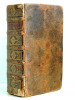
Marci Antonii Mureti, presbytei, Jcti & Civis Romani Orationes Epistolae & Poemata" se traduit approximativement par "Discours, Lettres et Poèmes de Marc Antoine Muret, prêtre, Jurisconsulte et Citoyen Romain." Marc Antoine (de) Muret (Muretus en latin), né le 12 avril 1526 à Muret commune d'Ambazac près de Limoges et mort le 4 juin 1585 à Rome, est un professeur de lettres et un humaniste français. Il donna, avant 1552, une série de conférences à Paris, au collège de Boncourt. Il y attira un public important, y compris le roi Henri II de France et la reine. Il a pour élèves Rémy Belleau, Jean de La Taille, Étienne Jodelle ou encore Vauquelin de la Fresnaye, qui formeront bien vite la Brigade (future Pléiade), avec qui il prend part à la Pompe du bouc. Il se lie également d’amitié avec Dorat et certains de ses jeunes élèves comme Du Bellay et Baïf. Il est très proche de Ronsard, qui lui demande de rédiger un commentaire de ses poèmes, dont les obscures allusions mythologiques ou les néologismes tirés du grec et du latin ont dérouté nombre de lecteurs; ce commentaire, lui-même très érudit, est imprimé dans le recueil des Amours de 1553. Cette même année 1553, il est emprisonné au Châtelet pour sodomie et hérésie. Il décide de se laisser mourir de faim puis est libéré grâce à l’intervention d’amis puissants. Une fois libre, il se rend à Toulouse où il étudie et enseigne le droit jusqu’à ce que les mêmes accusations qu’en 1553 soient portées contre lui l’année suivante. Il ne sauve sa vie qu’en s’enfuyant avec Ludovicus Memmius Frémiot, son amant du moment. fort volume relié in 18, 170x100, relié pleine basane époque, accrocs, bon état intérieur, ss la pge de titre et 2 pages de préface, démarre page 3, début du texte. 786pp + suppléments M. Antonii Mureti, Poémata Varia duobus libris diftincta, 226pp. Lipsiae, Sumptibus Heredum Joh. Grossii, 1572
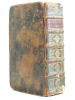
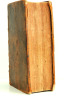
Libaniou Sophistou Epistolai. Libanii Sophistae epistolae. Quas nunc primum maximam partem e variis codicibus, manu exaratis, edidit, latine convertit & notis illustravit Joannes Christophorus Wolfius. Accedunt in calce ejusdem Libanii epistolae a Francisco Zambicario olim Latine conversae & Cracoviae primum editae, heic autem integra propemodum centuria ex MS auctae.
Amsterdam (Amstelaedami), Apud Janssonio-Waesbergios, 1738.
Folio: (XX),865,(1 blank) p. Vellum 42x27 cm 'The first comprehensive edition of the letters of Libanius, accompanied by a Latin translation' (Ref: STCN ppn 183220943; Brunet 3,1050; Hoffmann 2,522; Graesse 4,195; Ebert 11937) (Details: Back with 7 raised band. Boards blind tooled. Broad margins. Title in red and black. Engraved printer's mark on the title, depicting a mole, flanked by a seating Hermes and Athena; the motto is: 'vulgo caeca vocor, video sed acutius ipso', 'By the crowd I am called blind; but I see better than itself'. Printed in 2 columns, Greek text with parallel Latin translation. Notes at the bottom of the page. A good copy, inside fine) (Condition: Binding soiled and scuffed. Front hinge splitting, but still tight. Small tear in the vellum on the back. Both pastedowns worn. Turn-in of the lower board loosening. Paper yellowing) (Note: The German christian Hebraist and classical scholar Johannes Christoph Wolf, 1683-1739, is best known for his path-breaking 'Bibliotheca Hebraea' (Hamburg, 1715-1733), which remained long the most cited source for bibliographic information on Hebrew books and the background of their authors, and which bore witness to christian interest in Jewish literature and realia. Wolf especially occupied himself with the study of Oriental languages and literature, of which he became professor at the Hamburg gymnasium in 1712. There he compiled the 'Bibliotheca Hebraea'. Among classicists Wolf is known for the edition of his 'Anecdota Graeca, sacra et profana' (Hamburg 1722-1724), and this edition of 1738 of the letters of the Greek rhetorician and philosopher Libanius, ca. 314-392/93 A.D., who was one of the most influential authors of late antiquity. It is the first comprehensive edition of the letters of Libanius, accompanied by a Latin translation. Libanius 'embodied in his work many of the ideals and aspirations of the pagan Greek urban upper classes of late antiquity'. (OCD, 2nd ed. p. 605) In 354 he was appointed to the official chair of rhetoric at Antioch. His pupils include pagans and christians, e.g. Johannes Chrysostomos, Basilius Magnus, Gregorius Nazianzenus. As a literary figure of renown he corresponded with many leading figures in the Greek world, among whom the Emperor and philosopher/scholar Julian (Julianus Apostata), who was much admired by him. In this edition of Wolf 1605 letters have been collected (p. 1/728). At the end of these genuine letters Wolf added a reissue of a collection of 476 letters in Latin translation of Libanius which was first published in the Polish city Cracow in 1504 by one Johann Sommerfeldt, who had got a mutilated manuscript (depravatissimum exemplar) with these translated letters from a local 'bibliopola'. (p. 729) Well into the 19th century these Cracovian Latin letters were considered authentic works of Libanius. Now we know that they are forgeries by the Italian humanist Francesco Zambeccari, ca. 1443 - after 1475, (Hoffmann 2,528). Zambeccari was unmasked in 1878 by R. Foerster in his 'Francesco Zambeccari und die Briefe des Libanios'. (Stuttgart 1878)) (Collation: pi2, 2, *-3*2, A-5L4, 5M-5Y2 (last leaf 5Y2 blank)) (Photographs on request)
TA TÔN PHILOSTRATÔN LEIPOMENA HAPANTA. Philostratorum quae supersunt omnia. Vita Apollonii libris VIII; Vitae Sophistarum libris II, Heroica, Imagines priores atque posteriores et Epistolae. Accessere Apollonii Tyanensis epistolae, Eusebii liber adversus Hieroclem, Callistrati descript. statuarum, omnia ex MSS. Codd. recensuit, notis perpetuis illustravit, versionem totam fere novam fecit Gottfridus Olearius.
Leipzig (Lipsiae), Apud Thomam Fritsch, 1709. (Colophon at the end: 'Typis Christophori Fleischeri, an. MDCCIX')
Folio. (VIII),XLIII, (I);987 p. Vellum 37 cm (Ref: Hoffman 3,77/78; Ebert 16744a; Brunet 4,619; Graesse 5,273; not yet in VD18) (Details: Back with 6 raised bands. Boards with blindstamped borders. Blindstamped floral ornament in the center of the boards. Title in red and black. Woodcut printer's mark on the title: a pegasus flying among the clouds. Text in 2 columns, Greek with parallel Latin translation. The commentary is printed on the lower part of the pages. Occasional text engravings) (Condition: Vellum age-toned, spotted and scuffed. Front joint split, but strong. Rear joint starting to split. Endpapers worn and waterstained. Small blind stamp near the lower edge of the title. Paper browning, occasionally severe foxing) (Note: The Suda, a 10th century Byzantine encyclopedia, knows three Greek sophists called Philostratus, three generations living between 160 and 250 A.D. The first one is thought to have written most works, the 'Vita Apollonii' (Life of Apollonius), the 'Vitae Sophistarum' (Biographies of Sophists), the 'Gymnastikos', the 'Heroikos', the 'Eikones', and 'Dialexeis', and a collection of 73 letters, mostly love letters. (Neue Pauly 9, Philostratos 5-8) In the first years of the third century Philostratus moved to Rome, where he entered the court of the emperor Septimius Severius. There he wrote ca. 307 A.D. at the behest of the empress Julia Domna Augusta, whose favour he enjoyed, a biography of the neopythagorean ascetic and wandering philosopher, and also miracle-monger, Apollonius of Tyana. Few books have over a long period of time aroused so much upheaval among Christians as this biography. Apollonius was born in the year when Jesus Christ is supposed to be born. It is almost impossible to reveal Apollonius' true identity, or to decide whether this is a biography of a real or fictionalized hero, or just an Heliodoran romance or a romantic hagiography, or even a documentary romance. The question can be dealt from so many angles, that the Philostratean studies constitute a separate branch in the research of the culture of the Early Roman Empire. The problem is 'that Philostratus, as a man of letters and sophist full of passion for Greek romance and for the studies in rhetoric, was hardly interested in the historical Apollonius'. (Dzielska,M., 'Apollonius of Tyana in legend and history', Rome 1986, p. 14) A fact is that contemporary sources reveal next to nothing about Apollonius. 'To satisfy the empress's demand, who asked him (Philostratus) to narrate the life and achievements of Apollonius, he had to invent this figure as it were anew. Thus using his literary imagination, this moderately gifted writer turned a modest Cappadocian mystic into an impressive figure, full of life, politically outstanding, and yet also preposterous'. (Op. cit. p. 14) Nothing proves that the 'Vita Apollonii Tyanensis' was widely read in the 3rd century. It would probably not have survived, were it not for the gouvernor of Bithynia, Sossianus Hierocles, one of the inspirators of the persecution of the Christians at the beginning of the third century in his province under the emperor Diocletian. At the beginning of the 4th century he published his 'Philaletes', a treatise against Christianity, in which he ridiculed the divine attributes of Christ, and praised Apollonius' virtues and thaumaturgic abilities. In the 'Philaletes' Hierocles propagated his pagan Christ Apollonius. The Christians were furiously enraged, because Hierocles dared to contrast Apollonius with their Saviour. The Christians won under Constantine, and the 'Philaletes' vanished soon from the face of earth. It is only known through the 'Against Hierocles' a treatise of the Churchfather Eusebius. The 'Vita Apollonii Tyanensis', in which it was believed that Apollonius was presented as the equal, if not the superior of Christ, survived however the burning of pagan literature by Christian mobs in early christianity. The 'Vitae Sophistarum', is a collection of biographies of 59 Greek sophists of the so-called Second or New Sophistic. Philostratus consulted their works, but used also the oral tradition. This work is a valuable source for the history of philosophy from Nero to the beginning of the third century. The 'Gymnastikos' is a treatise on Greek athletics. In the 'Heroikos' the ghosts of Heroes, especially Protesilaos, tell remarkable particulars about themselves. The 'Imagines', the description of paintings, of Philostratus and the 'Descriptio statuarum' , the description of statues, written by Callistratus, belong to the rhetorical genre of 'ecphrasis', in which the relation of the verbal and visual was explored. Ancient Greek rhetoricians defined it as a 'speech that brings the thing shown vividly before the eyes', for instance the famous description of the Shield of Achilles by Homer in the 18th book of the Iliad, vs. 478/608. 'In modern criticism ecphrasis has come to be defined as the 'description of a work of art, a category that may be restricted to the visual arts (painting and sculpture) or expanded to include architecture and other arts'. (The Classical Tradition, Cambr. Mass., 2010, p. 291, s.v. Ecphrasis) The German theologian and classical scholar Gottfried Olearius, 1672 - 1715, was appointed professor of Greek and Latin at the University of Leipzig in 1699. In 1693 he started a journey which brought him to Oxford and Cambridge, where he stayed for more than a year to study Greek manuscripts. (ADB 24, 277/78; he has also a lemma in Wikipedia) (Provenance: At the lower edge of the title a blind imprint of a small oval stamp, in the center of which an imperial eagle. The legend reads: 'empire francais zuiderzée, decret du .. vrier, 181?'. Napoleon annexed in 1810 the Netherlands into the French empire. The provinces North Holland and Utrecht were transformed into the 'Département Zuiderzée'. The legend probably refers to the 'decret du 5 février 1810' (decree of the 5th february 1810) in which Napoleon regulated the booktrade. On the front pastedown has been pasted a small paper label reading: 'Henry Bousquet') (Collation: pi4, a-e4, f2 (leaf f2 verso blank); A-6H4, 6I2 (leaf 6I2 verso blank)) (Photographs on request) (Heavy book, may require extra shipping costs)
Caius Plinius Caecilius Secundus (Pline l'ancien)
Reference : caius-plinius-secundus
(1632)
C. Plinii Caecilii Secundi Epistolarum Libri IX. Eiusdem et Traiani Imperatoris Epistolae Amoebaeae. Item Claudiani Panegyrici adiunctae sunt Isaaci Casauboni. Notae in Epistolis varia lectiones ultra praecedentes, in hac postrima editione margini accesserunt.
In-24, plein vélin à rabat de l'époque, dos lisse, toutes tranches rouges, 860 pp., petite mouillure en fin d'ouvrage, bandeau, cul de lampe. Dernière édition revue avec variantes et annotations d’Isaac Casaubon Apud Jacobum Chouët - Genève.
Dernière édition de référence, Genève 1632, in‑24 : Pline le Jeune, lettres complètes avec correspondance à Trajan, Claudien et notes critiques de Casaubon, enrichies de variantes marginales, bandeaux et culs-de-lampe décoratifs, exemplaire complet et rare, idéal pour collectionneur de classiques latins ou éditions humanistes genevoises. Compact, élégant, avec ornements et annotations intactes, il représente un exemple typique de l’imprimerie savante du XVIIᵉ siècle. Chronologie : Guerre César-Pompée → Pline le Jeune → lettres et correspondances La culture littéraire romaine de l’époque de Pline connaissait La Pharsale, donc l’influence morale et rhétorique de Lucain peut transparaître dans les références à la guerre et aux vertus civiques.
Epistolae et Epistolae ad eum Datae. Quas cum Prooemio ac Notis Germanice Scriptis. Edidit Gustav Scherz adjuvante Joanne Ræder. 2 vols (+) Opera Theologica. Cum Prooemiis ac Notis Germanice Scriptas ediderunt Knud Larsen et Gustav Scherz. 2 vols.
Hafniae, 1952. Large4to. Four volumes, all uncut and unopened in the original printed wrappers. Very light wear to extremities, otherwise a very nice and clean set. XXXII, 480 pp. + 1 portrait (8), 481-1027, (1) pp. + 1 portrait IX, (3), 508, (1) pp. (6), 574 pp.
First and only edition of Gustav Scherz's monumental work with Steno's collected works. No. 14 out of 500 copies.
ORDERICUS VITALIS, ANASTASIUS IV, ADRIANUS IV e.a. (MIGNE J.-P., ed.)
Reference : R118319
(1890)
Saeculum XII: Orderici Vitalis Angligenae coenobii Uticensis monachi: Historia ecclesiastica. Accedunt Anastasii IV, Adriani IV Romanorum pontificum Epistolae et privilegia necnon [in: Patrologia Latina, 188 (tomus unicus)]
Parisiis [Paris], Garnier-Migne 1890 [Continuation of the title: "Theobaldi Cantuariensis archiepiscopi ; Attonis Pistoriensis, B. Amedei Lausannensis, Anselmi Havelbergensis ; Gisleberti Porretani Pictaviensis, episcoporum ; Guerrici Igniacensis, Odonis Morimundensis, Fastredi Claraevallensis, Joannis Ciritae Tharaucani in Hispania, Gaufridi Claraevallensis, abbatum; Hugonis Metelli, canonici regularis, Gilbert de Hoilandia : Opuscula, Diplomata, Epistolae], [850] pp. (i.e. 1700 numbered columns), 28cm., original 1890-edition, in the series "Patrologiae cursus completus. Series secunda" tomus CLXXXVIII (188) (tomus unicus), bound in a solid hardcover, some occasional foxing (text always well readable), good condition, text in Latin, [contains among others works of Ordericus Vitalis (1075-c.1142, English chronicler, who wrote the "Historia Ecclesiastica"), pope Anastasius IV (c.1073-1154) and pope Adrianus IV (c.1100-1159)], weight: 1.6kg., R118319

