 Write to the booksellers
2663 books for « television »Edit
-
Type
Book (2579)
Disk (1)
Magazine (77)
Music sheets (6)
-
Latest
Last 24h (1)
Last 3 days (4)
Last month (71)
Last week (23)
-
Language
English (8)
Finnish (1)
French (2265)
Russian (389)
-
Century
19th (2)
20th (1628)
21st (156)
-
Countries
Belgium (58)
Canada (3)
Côte d'Ivoire (1)
Denmark (10)
France (2146)
Switzerland (51)
United States of America (394)
-
Syndicate
ALAC (2)
CLAM (4)
ILAB (1474)
NVVA (5)
SLACES (5)
SLAM (1452)
Topics
- Advertisement (9)
- Almanac (5)
- Anonymous (4)
- Autographs (4)
- Aviation (4)
- Beckett samuel (5)
- Boll marcel (7)
- Bourdieu pierre (7)
- Brittany (4)
- Bumble-bee (9)
- Caricature (4)
- Cazeneuve jean (10)
- Chancel (12)
- Children’s books (29)
- Christianity (10)
- Cinema (173)
- Coluche (4)
- Comic strip (17)
- Communication (15)
- Cooking (6)
- Crapouillot (11)
- Daily (9)
- Dedication (9)
- Dictionaries (6)
- Early printed books (19)
- Education (28)
- Education - morals (22)
- Electricity (14)
- Electronics (28)
- Ethic (20)
- Figaro (4)
- Film-maker (14)
- Fine arts (13)
- Geography (9)
- Guide books (4)
- History (35)
- Industrial arts & crafts - fine arts (19)
- Iran - persia (8)
- Journalism (45)
- Judith (4)
- L'illustration (newspaper) (5)
- Leisure (13)
- Literature (76)
- Magazine (278)
- Mathematics (39)
- Mauriac françois (5)
- Media (12)
- Medicine (6)
- Music (11)
- News (11)
- Newspaper (15)
- Newspapers press (324)
- Opera (9)
- Opera ballet (9)
- Paris (5)
- Periodicals (11)
- Philosophy (6)
- Photography (21)
- Physics (12)
- Policy (29)
- Psychology (12)
- Reading vocabulary (5)
- Religions (39)
- Review (21)
- Reviews (309)
- Science fiction (4)
- Sciences (41)
- Sciences & technique (23)
- Scores (9)
- Social sciences (17)
- Sociology (13)
- Songs (8)
- Sports (5)
- Sports (8)
- Switzerland (5)
- Talec pierre (4)
- Tea (4)
- Technology (9)
- Telecommunications (66)
- Telephone - telegraph (512)
- Television and radio (8)
- Theatre (24)
- Theology (38)
- Theory (4)
- Trade (5)
- Travel (4)
- United states (6)
- Various (20)
- War (5)
- Wolton dominique (6)
- Youth (7)
- Zitrone léon (8)
Television. A Monthly Magazine. Vol. 1, No.1, 1928. The World's first Television Journal. The Official Organ of the Television Society. - [THE WORLD'S FIRST TELEVISION JOURNAL]
(London, The Television Press), 1928. 8vo. Original illustrated coloured wrappers depicting a distinguished couple enjoying the opera transmitted on television, with the actual opera in the background. Richly illustrated throughout. A bit of minor spotting to front wrapper" all in all a very nice, fully intact, copy. 52 pp + one loose leaf: ""Supplement to Television, No. 1 - March, 1928"" (containing the article ""Seeing Across the Atlantic!"").
The first printing of the uncommon (especially in wrappers) first volume, first number of the world's first television journal, which contains many very important articles in the history of the development of television and which came to highly influence the use and spreading of the television as a broadcast medium.The journal ""Television"", ""The first periodical publication devoted to television, began publication in 1928, the year that marked the beginning of television's transformation from scientific curiosity to commercially viable broadcast medium."" (Hook & Norman, p. 205).The most important year for television as we know it today must be said to be 1928, the year in which it became certain that television could be more than a scientific curiosity, the same year that the ""Television"" journal, aimed at both amateurs and professionals and filled with commercials connected to television, appeared. ""In 1927 television was belived to be just around the corner. This imminence became a fact in 1928..."" (Shiers, p. 132).""Television"" served as the official journal of the Television Society, ""a combination which met the needs and interests of amateurs as well as professionals."" (Shiers, p. 132). ""Of all scientific subjects, perhaps the one which is creating the most interest in the public mind at the present time is television. It is, howevera subject upon which almost no literature or authentic information has been available, either to the interested amateur or to the scientist. It is the object of this, the first journal of its kind in the world, to fill this want, and to supply an organ the sole object of which will be to keep interested members of the public supplied with up-to-date and authentic information upon this new branch of science, which bids fair in time to rival wireless broadcasting in importance and popularity."" (beginning of the Editorial, by Dinsdale).Hook and Norman, Originas of Cyberspace, nr. 203, (1) (""A monthly magazine devoted to the interests and progress of the science of seeing by wire and wireless"" - the front wrapper of vol. 1, no. 1 depicted). Shiers, Early Television, a Bibliographic Guide, nr. 1152 (""Greetings to the World's first Television Journal""), 1153 (""The Bith of the Television Society""), 1154 (""Technical Notes""), 1155 (""Technical Notes""), 1156 (""Commercial Televsion. When may we expect it?""), 1157 (""Join the Television Society""), 1158 (""How to make a Simple Televisor""), 1159 (""Television on the Continent""), 1160 (""Noctovision. Seeing in total Darkness by Television""), 1161 (""Seeing Across the Atlantic"", being the account of Baird's transmission from London to New York).

Symposium on Television. A Group of Five Papers Describing the Apparatus and Methods Used in the Experimental Demonstration of Television over Communication Channels of the Bell System, April, 1927. - [BELL SYSTEM'S FAMOUS TELEVISION-ISSUE.]
(USA, American Telephone and Telegraph Company, 1927). 8vo. Original printed blue wrappers. Punched for 3-ring binder. Spine worn, a bit of soiling to wrappers, inner hinges a bit weak. Internally fine and clean. (2), 9 + (3), 44 + 12 + 17, (3) + 20 pp. Illustrated.
Separate reprint of 5 articles published a month before in ""The Bell System Technical Journal. Four of the present articles on the early development of television were exceedingly influential, among these the paper by Frank Gray, who conducted groundbreaking research on the development of television, and Edward Nelson's important ""Radio transmission for television"". All four articles listed in ""Early Television, A Bibliographic Guide to 1940"". ""The chief problems presented in the accomplishment of television are discussed. These are: the resolution of the scene into a series of electrical signals of adequate intensity for transmission" the provision of a transmission channel capable of transmitting a wide band of frequencies without distortion means for utilizing the transmitted signals to re-create the image in a form suitable for viewing by one or more observers" arrangement for the accurate synchronization of the apparatus at the two ends of the transmission channel."" (From the introduction to the present volume).The papers contained in the present volume are:1. Ives, Herbert E. Television, pp. 1-9.2. Gray, Frank, & J. W. Horton & R. C. Mathes. The production and utilization of television signals, pp. 1-44. (ET)3. Stoller, H. M. & E. R. Morton. Synchronization of television, pp. 1-12. 4. Gannett, D. K. & E. I. Green. Wire transmission system of television, pp. 1-17. 5. Nelson, Edward L. Radio transmission for television, pp.1-20. Early Television:1068.
Télévision Francaise n° 28 - août 1947 - Electronique n° 12 - août 1947
Télévision Francaise et Electronique Malicorne sur Sarthe, 72, Pays de la Loire, France 1947 Book condition, Etat : Bon broché, sous couverture illustrée In-4 1 vol. - 37 pages
quelques figures Contents, Chapitres : 1. Télévision : Maurice Lorach : La télévision américaine - Robert Aschen : La projection des images sur écran - La télévision à Bikini - Construction d'un récepteur de télévision - Pierre Greuet : Réalisation de notre correspondant - J. Barthon : Etude des étages de détection et d'amplification vidéo-fréquence pour récepteurs de télévision à 455 lignes - Possibilités nouvelles de la télévision - Société des radioélectriciens - 2. Electronique : A la conquête des couches ionisées de la haute atmosphère - Application médicale de l'électrolyse - L. Liot : Amplificateur pour T.H.F. de 15 watts - Alimentation totale pour récepteur portatif - Le label - Oscilloscope simple
The Quarterly of Film, Radio and Television - Burton Paulu - Robert Swezey - Dallas Smythe - Curtis Harrington - Richard Rowland - Herbert Luft - Charles Brackett - Jack Howard - Franklin Fearing - Gerald Pratley
Reference : 83551
(1952)
The Quarterly of Film, Radio and Television - Volume VII - Fall 1952 - Number 1 , (1. Problems in communication : The challenge of the 242 channels, part I - Give the television code a chance - What television programming is like - 2. The film abroad : Film Festival at Cannes, 1952 - Films from overseas - 3. Two view of a director, Billy Wilder : A matter of decadence - A matter of humor - 4. Several views of motion picture advertising, letters from readers : There's still no business like it - 5. The experimenting film : The film gains a dimension - 6. Books and bibliography : A bibliography for the Quarter - Additions to a bibliography of film music on records)
University of California , The Quarterly of Film, Radio and Television Malicorne sur Sarthe, 72, Pays de la Loire, France 1952 Book condition, Etat : Bon paperback, editor's brown and cream wrappers illustrated by 3 figures on the left part of the front part grand In-8 1 vol. - 107 pages
1st edition, 1952 Contents, Chapitres : 1. Problems in communication : Burton Paulu : The challenge of the 242 channels, part I - Robert Swezey : Give the television code a chance - Dallas Smythe : What television programming is like - 2. The film abroad : Curtis Harrington : Film Festival at Cannes, 1952 - Richard Rowland : Films from overseas - 3. Two view of a director, Billy Wilder : Herbert Luft : A matter of decadence - Charles Brackett : A matter of humor - 4. Several views of motion picture advertising, letters from readers : There's still no business like it - 5. The experimenting film : Jack Howard : The film gains a dimension - 6. Books and bibliography : Franklin Fearing : A bibliography for the Quarter - Gerald Pratley : Additions to a bibliography of film music on records minor folding track on the bottom right corner of the pages, quite nothing, else, near fine copy, no markings, inside is clean - The Quarterly of Film, Radio and Television - Volume VII - Fall 1952 - Number 1
The Quarterly of Film, Radio and Television - Dallas W. Smythe - Franklin Fearing - May W. Seagoe - Walter Krulevitch Kingson and Rome Cowgill - Jay E. Gordon - Coleman O. Parsons - Lawrence Morton
Reference : 83550
(1951)
The Quarterly of Film, Radio and Television - Volume VI - Winter 1951 - Number 2 , (1. Problems in communication : The consumer's stake in radio and television - A word of caution for the intelligent consumer of motion pictures - Children's television habits and preferences - 2. Radio : Radio in Puerto Rico - 3. Films : There's really no business like show business - Cyrano's nose since Rostand - 4. Music : Composing, orchestra and criticizing - 5. A bibliography for the Quarter)
University of California , The Quarterly of Film, Radio and Television Malicorne sur Sarthe, 72, Pays de la Loire, France 1951 Book condition, Etat : Bon paperback, editor's red and cream wrappers illustrated by 3 figures on the left part of the front part grand In-8 1 vol. - 107 pages
1st edition, 1951 Contents, Chapitres : 1. Problems in communication : Dallas W. Smythe : The consumer's stake in radio and television - Franklin Fearing : A word of caution for the intelligent consumer of motion pictures - May W. Seagoe : Children's television habits and preferences - 2. Radio : Walter Krulevitch Kingson and Rome Cowgill : Radio in Puerto Rico - 3. Films : Jay E. Gordon : There's really no business like show business - Coleman O. Parsons : Cyrano's nose since Rostand - 4. Music : Lawrence Morton : Composing, orchestra and criticizing - 5. Franklin Fearing : A bibliography for the Quarter minor folding track on the bottom corner of the bottom side of the wrappers, else, near fine copy, no markings, inside is clean - The Quarterly of Film, Radio and Television - Volume VI - Winter 1951 - Number 2 (pages 109 to 215)
Télévision Francaise n° 20 - décembre 1946 - Electronique n° 4 - décembre 1946
Télévision Francaise et Electronique Malicorne sur Sarthe, 72, Pays de la Loire, France 1946 Book condition, Etat : Moyen broché, sous couverture illustrée In-4 1 vol. - 37 pages
quelques figures Contents, Chapitres : 1. Télévision : Maurice Lorach : Bilan - Yves Angel : Le problème des studios de télévision - Trois phases de la télévision - Le succès de la télévision aux Etats-Unis - Michel Désir : Un système de transmission de télévision pour amateurs - Alimentation des tubes cathodiques - A la Société des Radioélectriciens - Les plus de 40 - 2. Electronique : Oleg Yadoff : Recherche sur la vraie signification des lois d'établissement et de suppression du courant - B. Roger : Comment mesurer l'intensité des rayons X - Liot : Un nouveau Q-mètre - Appareil simple pour test et adaptation des bobines d'accord - Roland Cosmond : La pratique de la modulation de fréquence - R. David : Etude d'une récepteur O.C. type IVI - Le récepteur type C. 63 dos repare, avec un petit manque de papier sur la couverture, tache d'encre sur les premieres pages (sur les publicités) sinon bon etat
Télévision Francaise n° 29 - septembre 1947 - Electronique n° 13 - septembre 1947
Télévision Francaise et Electronique Malicorne sur Sarthe, 72, Pays de la Loire, France 1947 Book condition, Etat : Bon broché, sous couverture illustrée In-4 1 vol. - 44 pages
quelques figures Contents, Chapitres : 1. Télévision : Maurice Lorach : La télévision américaine - Un premier reportage théâtral de la télévision française - Robert Aschen : La projection des images sur écran - Commentaires sur les systèmes de télévision - Roland Gosmand : La pratique de la modulation de fréquence - Dr. V.-K. Zworykin : Progrès dans la télévision - 2. Electronique : A la conquête des couches ionisées de la haute atmosphère - Circuits et tubes électroniques - L. Liot : Un générateur d'impulsions de 5 kilowatts - Emetteur portatif de 1 kw de crête modulée en impulsions - M. Chamagne et Gaston Guyot : Mesure du bruit de fond dans les lampes à T.S.F. - M. Pinot : Réception et liaisons dans la bande des 54 Mc/s - Récepteur PR6-47 - Récepteur Le Lion type M
[79 papers on various aspects of the Telstar satellites]. - [THE TELSTAR-SATELLITE - THE FIRST TO TRANSMIT TELEVISION.]
New York, American Telephone and Telegraph Company, 1963. 8vo. 3 original full green cloth. Volume 42, 1963-1,2,3 of ""The Bell System Technical Journal"". Library stamp to free front end-paper. Minor bumping to extremities. A nice, clean, uniform set. 20, 738 pp.+ (2), 739-1940 pp. + 1941-2974 pp.
First publication of the first description of the world's first television satellite. Telstar I made a tremendous impact on the world by transmitting transatlantic live television. ""Telstar captured the popular imagination in a way that it is hard to believe any satellite, especially a communication satellite, could do today. According to AT&T, more than half the population of the UK watched its first transatlantic transmission, a remarkable percentage given that far fewer people than today owned television sets."" (Gavaghan, Something New under the Sun, p. 188)According to the US Space Objects Registry, Telstar 1 and 2 were still in orbit as of May 2010. The Telstar-satellites represent the true beginning of satellite communication.Telstar 1 was launched on July 10th 1962 and was the world's first active repeater satellite, the primary function of which was transmission of voice, black/white and colour television, fascimilie, and high- and low-speed data. The Telstar-project had five overall objectives"" to demonstrate broadband transmission, test operational communication satellite reliability, obtain operational experience with ground terminals and provide space radiation measurement.Telstar 1 was a medium-altitude satellite with an elliptic orbit which was completed once every 2 hours and 37 minutes. Due to Telstar's non-geosynchronous orbit, its availability for transatlantic signals was limited to 20 minutes in each orbit that passed over the Atlantic Ocean. The Telstar 2 was almost identical with Telstar 1 but had a higher orbit to reduce exposure to the damaging effect of the radiation belt. The Chief of NASA's Communications Satellite Programs wrote in 1966: ""Although not the first communications satellite, Telstar is the best known of all and is probably considered by most observers to have ushered in the era of satellite communications. This impression was a result of the tremendous impact upon the public by the first transmission of live television across the Atlantic Ocean. Telstar I was launched on July 10, 1962, and on that same day live television pictures originating in the United States were received in France."" (Jaffe, pg. 107)""On the whole, Telstar made a tremendous impact in the nation by transmitting transatlantic live television, which demonstrated the possibilities for commercial satellite television and other services."" (Delbert. Communication via satellite, 83 p). The Telstar-satellites were not the first launched satellites, but they were the first to demonstrate the possibilities of satellites and to present them to a broader audience. The three volumes offered contain a wide variety of articles related to the Telstar satellites from the technical design of the satellite to transmission test and evaluation to spacecraft test.Issue 1:1. Beach, C.D." Trecker, J.M.. A Method for Predicting Interchannel Modulation due to Multipath Propagation in FM and PM Tropospheric Radio Systems. Pp. 1-36.2. Bodtmann, W.F. Ruthroff, C.L. A Wideband Transistor IF Amplifier for Space and Terrestrial Repeaters Using Grounded-Base Transformer-Coupled Stages. Pp. 37-54.3. Coyne, J.C. Monitoring the Percussive Welding Process for Attaching Wires to Terminals. Pp. 55-78.4. MacWilliams, Jessie. A Theorem on the Distribution of Weights in a Systematic Code. Pp. 79-94.5. Peck, D.S. Blair, R.R. Brown, W.L. Smits, F.M. Surface Effects of Radiation on Transistors. Pp. 95-129.6. Graff, H.J. Peacock, J.M. Zalmans, J.J. Development of Solderless Wire Connector for Splicing Multipair Cable. Pp. 131-153.7. Gordon, E.I. Rigden, J.D. The Fabry-Perot Electrooptic Modulator. Pp. 155-179.8. Pfahnl, Arnold. Properties of Fast-Decay Cathode-Ray Tube Phosphors. Pp. 181-201.Issue 2:9. Hallenbeck, F.J. Mahoney, J.J. Jr. The New L Multiplex - System Description and Design Objectives. Pp. 207-221.10. Graham, R.S. Adams, W.E. Powers, R.E. Bies, F.R. New Group and Supergroup Terminals for L Multiplex. Pp. 223-278.11. Albert, W.G. Evans, J.B. Jr Ginty, J.J. Harley, J.B. Carrier Supplies for L-Type Multiplex. Pp. 279-317.12. Clark, O.P. Drazy, E.J. Weller, D.C. A Phase-Locked Primary Frequency Supply for the L Multiplex. Pp. 319-340.13. Andrews, E.G. Pp. Telephone Switching and the Early Bell Laboratories Computers. Pp. 341-353.14. Sandberg, I.W. On the Theory of Linear Multi-Loop Feedback Systems. Pp. 355-382.15. Descloux, A. On Overflow Processes of Trunk Groups with Poisson Inputs and Exponential Service Times. Pp. 383-397.16. Rosenzweig, W. Gummel, H.K. Smits, F.M. Solar Cell Degradation under 1-Mev Electron Bombardment. Pp. 399-414.17. Marcuse, Dietrich. A Further Discussion of Stimulated Emission of Bremsstrahlung. Pp. 415-430.18. Cravis, H. Crater, T.V. Pp. Engineering of T1 Carrier System Repeatered Lines. Pp. 431-486.19. Takacs, L. Delay Distributions for One Line with Poisson Input, General Holding Times, and Various Orders of Service. Pp. 487-503.20. Takacs, L. A Single-Server Queue with Feedback. Pp. 505-519.Issue 3:21. Lindner, R. Semiconductor Surface Varactor. Pp. 803-831.22. Paull, M.C. Reswitching of Connection Networks. Pp. 833-855.23. Sandberg, I.W. The Realizability of Multiport Structures Obtained by Imbedding a Tunnel Diode in a Lossless Reciprocal Network. Pp. 857-876.24. Rado, T. On Non-Computable Functions. Pp. 877-884.25. Schepis, A.J. On the Theory of Shrink Fits with Application to Waveguide Pressure Seals. Pp. 885-907.26. Frisch, H.L. Gordon, S.B. Vyssotsky, V.A. Hammersley, J.M. Monte Carlo Solution of Bond Percolation Processes in Various Crystal Lattices. Pp. 909-920.27. Curtis, Harold E. Interference between Satellite Communication Systems and Common Carrier Surface Systems. Pp. 921-943.28. Gucker, George B. Long-Term Frequency Stability for a Reflex Klystron without the Use of External Cavities. Pp. 945-958.29. Flanagan, James L.Models for Approximating Basilar Membrane Displacement - Part II. Effects of Middle-Ear Transmission and Some Relations between Subjective and Physiological Behavior. Pp. 959-1009.30. Rowe, H.E. Approximate Solutions for the Coupled Line Equations. Pp. 1011-1029.31. Rowe, H.E. Warters, W.D. Transmission in Multimode Waveguide with Random Imperfections. Pp. 1031-1170.Issue 4:32. Tsiang, S.H. Ulrich, W. Automatic Trouble Diagnosis of Complex Logic Circuits. Pp. 1177-1200.33. Benes, V.E. Heuristic Remarks and Mathematical Problems Regarding the Theory of Connecting Systems. Pp. 1201-1247.34. Benes, V.E. Algebraic And Topological Properties of Connecting Networks. Pp. 1249-1274.35. Meadows, H.E.Solution of Systems of Linear Ordinary Differential Equations with Periodic Coefficients. Pp. 1275-1294.36. Landau, H.J. Pollak, H.O. Prolate Spheroidal Wave Functions, Fourier Analysis and Uncertainty -- III: The Dimension of the Space of Essentially Time- and Band-Limited Signals. Pp. 1295-1336.37. Scheinman, A.H. A Method for Simplifying Boolean Functions. Pp. 1337-1346.38. Boyd, G.D. Kogelnik, H. Generalized Confocal Resonator Theory. Pp. 1347-1369.39. Geusic, J.E." Scovil, H.E.D. A Unidirectional Traveling-Wave Optical Maser. Pp. 1371-1397. 40. Morris, Robert. Further Analysis of Errors Reported in ""Capabilities of the Telephone Network for Data Transmission"". Pp. 1399-1414.41. Otterman, Joseph. Grade of Service of Direct Traffic Mixed with Store-and-Forward Traffic. Pp. 1415-1437.42. Fraser, J.M." Bullock, D.B. Long, N.G. Over-All Characteristics of a TASI System. Pp. 1439-1454.43. Miedema, H. Schachtman, M.G. TASI Quality - Effect of Speech Detectors and Interpolation. Pp. 1455-1473.Issue 5:44. Nelson, W.L. Phase-Lock Loop Design for Coherent Angle-Error Detection in the Telstar Satellite Tracking System. Pp. 1941-1975.45. Elliott, E.O. Estimates of Error Rates for Codes on Burst-Noise Channels. Pp. 1977-1997.46. Mc Adoo, Kathryn L. Speech Volumes on Bell System Message Circuits -- 1960 Survey. Pp. 1999-2012.47. Cutler, C.C. Kompfner, R. Tillotson, L.C. A Self-Steering Array Repeater. Pp. 2013-2032.48. Sandberg, I.W. On the Properties of Some Systems that Distort Signals -- I. Pp. 2033-2046.49. Ohm, E.A. Snell, W.W. A Radiometer for a Space Communications Receiver. Pp. 2047-2080.50. Brown, W.S. The ALPAK System for Nonnumerical Algebra on a Digital Computer --- I: Polynomials in Several Variables and Truncated Power Series with Polynomial Coefficients. Pp. 2081-2119.51. Musa, J.D.Discrete Smoothing Filters for Correlated Noise. Pp. 2121-2151.52. Evens, M.J. Myers, G.H. Timko, J.W. Command Guidance of Telstar Launch Vehicle. Pp. 2153-2168. 53. Yu, E.Y. Spin Decay, Spin-Precession Damping, and Spin-Axis Drift of the Telstar Satellite. Pp. 2169-2193.54. Paul, B. West, J.W. Yu, E.Y. A Passive Gravitational Attitude Control System for Satellites. Pp. 2195-2238.55. Fletcher, H.J. Rongved, L. Yu, E.Y. Pp. Dynamics Analysis of a Two-Body Gravitationally Oriented Satellite. Pp. 2239-2266.56. Rice, S.O.Innage and Outage Intervals in Transmission Systems Composed of Links. Pp. 2267-2283.57. Dragone, C. Hogg, D.C.Wide-Angle Radiation Due to Rough Phase Fronts. Pp. 2285-2296.58. Bennett, W.R. Rice, S.O.Spectral Density and Autocorrelation Functions Associated with Binary Frequency-Shift Keying. Pp. 2355-2385.59. Bennett, W.R. Salz, J.Binary Data Transmission by FM over a Real Channel. Pp. 2387-2426.60. Lucky, R.W.A Functional Analysis Relating Delay Variation and Intersymbol Interference in Data Transmission. Pp. 2427-2483.Issue 6:61. Haynie, G.D. Rosenfeld, P.E. An Automated 20-20,000-cps Transmission Measuring Set for Laboratory Use. Pp. 2501-2531.62. Sandberg, I.W.Signal Distortion in Nonlinear Feedback Systems. Pp. 2533-2550.63. Manley, J.M. A Three-Conductor Elementary Clogston Coaxial Transmission Line --- Calculation, Fabrication and Experiment. Pp. 2551-2574.64. Darlington, Sidney. Linear Time-Varying Circuits --- Matrix Manipulations, Power Relations, and Some Bounds on Stability. Pp. 2575-2608. 65. Li, Tingye. Mode Selection in an Aperture-Limited Concentric Maser Interferometer. Pp. 2609-2620.66. DiDomenico, M. Jr. Anderson, L.K. Broadband Electro-Optic Traveling-Wave Light Modulators. Pp. 2621-2678.67. Byrne, C.J. Karafin, B.J. Robinson, D.B. Jr. Systematic Jitter in a Chain of Digital Regenerators. Pp. 2679-2714.68. Curtis, Harold E. Satellite System Interference Tests at Andover, Maine. Pp. 2715-2739.69. Miller, S.E.The Nature of and System Inferences of Delay Distortion Due to Mode Conversion in Multimode Transmission Systems. Pp. 2741-2760.70. Young, D.T.Model for Relating Coupled Power Equations to Coupled Amplitude Equations. Pp. 2761-2764. 71. Enloe, L.H.Interchannel Interference in FM Systems Produced by Continuous Random Mode Conversion in Circular Electric Waveguide. Pp. 2765-2786.72. Young, D.T.Effect of Differential Loss on Approximate Solutions to the Coupled Line Equations. Pp. 2787-2793. 73. Benes, V.E.Markov Processes Representing Traffic in Connecting Networks. Pp. 2795-2837.74. Borenstein, D.P. Spectral Characteristics of Digit-Stimulating Speech Sounds. Pp. 2839-2847.75. Bullington, K.. Reflections from an Exponential Atmosphere. Pp. 2849-2867. 76. Emling, J.W. Mitchell, D.The Effects of Time Delay and Echoes on Telephone Conversations. Pp. 2869-2891.77. Brady, P.T. Helder, G.K.. Pp. Echo Suppressor Design in Telepone Communications. Pp. 2893-2917.78. Riesz, R.R. Klemmer, E.T. Subjective Evaluation of Delay and Echo Suppressors in Telephone Communicaions. Pp. 2919-2941.79. Hill, D.W. Calculation of the Spin-Axis Orientation of the TELSTAR Satellites from Optical Data. Pp. 2943-2960.
Les ecrits de l'Image N°1, automne 1993- la television doit etre enseignee a l'ecole de francois bayrou, la television du futur de herve bourges, television & culture, la television en mots & en maux, des francais dans le poste, la memoire d'alain decaux
AU BUREAU DE LA REVUE. 1993. In-4. Broché. Etat d'usage, Tâchée, Dos satisfaisant, Quelques rousseurs. 210 PAGES - Nombreuses illustrations noir/blanc, dans et hors texte. . . . Classification Dewey : 70.49-Presse illustrée, magazines, revues
Les ecrits de l'Image N°1, automne 1993 - la television doit etre enseignee a l'ecole de francois bayrou, la television du futur de herve bourges, television et culture de jean denis bredin / dider decoin / jean claude carriere/ hubert nyssen/ jacques drillon/ luc ferry -la television en mots & en maux, des francais dans le poste, la memoire d'alain decaux, instruire en amusant, guillaume durand: l'homme des reves impossibles ... Classification Dewey : 70.49-Presse illustrée, magazines, revues

Télévision Francaise n° 30 - octobre 1947 - Electronique n° 14 - octobre 1947
Télévision Francaise et Electronique Malicorne sur Sarthe, 72, Pays de la Loire, France 1947 Book condition, Etat : Moyen broché, sous couverture illustrée In-4 1 vol. - 44 pages
quelques figures Contents, Chapitres : 1. Télévision : Maurice Lorach : Un mot - La télévision américaine - Robert Aschen : La projection des images sur écran - J. Barthon : Etude des étages de détection et d'amplification vidéo-fréquence pour récepteurs de télévision à 455 lignes - Mon premier récepteur d'images - Récepteur à projection Medalyr - Une mission de la télévision française à Bruxelles - R. Charbonnier et S. Royer : Correction basse fréquence des amplificateurs video - 2. Electronique : René Lemas : Un nouveau débouché pour l'électronique, les ultra-sons - Mesure des tensions de crête en régime d'impulsions - Emploi de la modulation de fréquence sur les chemins de fer - plusieurs pages de publicité illustrée couverture réparée sur le dos, avec de petits manques de papier, un feuillet central mobile
Communications n° 7 - Radio-télévisions, réflexions et recherches - La radio-télévision au service de la promotion socio-culturelle par Abraham A. Moles, Télévision et développement culturel par Michel Crozier, La télévision en regard du cinéma par Jules
Le seuil. 1966. In-12. Broché. Bon état, Couv. convenable, Dos satisfaisant, Intérieur frais. 175 pages.. . . . Classification Dewey : 300-SCIENCES SOCIALES
Sommaire : Radio-télévisions, réflexions et recherches - La radio-télévision au service de la promotion socio-culturelle par Abraham A. Moles, Télévision et développement culturel par Michel Crozier, La télévision en regard du cinéma par Jules Gritti, Sur la critique de télévision par Michel Tardy, L'interview télévisuelle par Pierre Dumayet, L'interview dans les sciences sociales et a la radio-télévision par Edgar Morin Classification Dewey : 300-SCIENCES SOCIALES
Reference : bd-a04d4f4c2643bbe4
Anfisa Chekhov is a Russian television and radio presenter, actress, and until
Anfisa Chekhov is a Russian television and radio presenter, actress, and until 2014 hosted the show Lets Get Married on Inter and the television show How to Marry on the Ukrainian channel STB. She previously hosted the erotic television show Sex with Anfisa Chekhov on TNT and the TV show Good Night, Men on DTV./Anfisa Chekhova Rossiyskaya tele- i radiovedushchaya, aktrisa. Vela do 2014 goda peredachu «Davay poenimsya na kanale «Inter i televizionnoe shou «Kak vyyti zamu na ukrainskom kanale STB. Ranee vela televizionnoe eroticheskoe shou «Seks s Anfisoy Chekhovoy na TNT i televizionnoe shou «Spokoynoy nochi, muiki na DTV. S 17 fevralya po 2 iyunya 2018 goda-vedushchaya realiti-shou «Vzveshennye i schastlivye lyudi. Anfisa Chekhov is a Russian television and radio presenter, actress, and until 2014 hosted the show Lets Get Married on Inter and the television show How to Marry on the Ukrainian channel STB. She previously hosted the erotic television show Sex with Anfisa Chekhov on TNT and the TV show Good Night, Men on DTV. We have thousands of titles and often several copies of each title may be available. Please feel free to contact us for a detailed description of the copies available. The delivery of this book might be delayed beyond the usual timeframe due to extended processing and preparation before shipment, and faster shipping options are not offered. Please inform us if you need the order by a certain date or have a deadline.SKUbd-a04d4f4c2643bbe4

La télévision est-elle au point ? , n° 4 de la collection Problèmes
Editions Elzévir , Problèmes Malicorne sur Sarthe, 72, Pays de la Loire, France 1946 Book condition, Etat : Bon broché, sous couverture imprimée éditeur petit In-8 1 vol. - 61 pages
quelques figures dans le texte en noir et blanc, et 4 planches hors-texte 1ere édition Contents, Chapitres : Préface - Principes fondamentaux de la tranmission des images - Les dispositifs de réception - La luminescence - Le studio de télévision - Le télécinéma - L'émetteur de télévision - La télévision ambulante - La télévision en couleurs - La télévision en France - La condition de la réception - Problème des programmes - Viste au centre de télévision - Conclusion et bibliographie infime dechirure au bas du mors du plat supérieur de la couverture, papier tres legerement jauni, sinon bon état - format de poche
La télévision cette inconnue
1956 Paris Ribet-Desjardins 1956 In12 broché 17 pages
ON JOINT - Télévision scolaire 1957-1958 Ministère de l'éducation nationale institut pédagogique national 1958 plaquette In8 broché non paginé- RAD revue mensuelle de radiotelephone radiotélégraphie radiotélévision radiocinéma Dunod 1933 In8 broché 60 pages illustrations dans le texte.- Duvivier (andré) Tabard (Raymond) la télévision pour tous tous les principes toutes les méthodes réalisation complete et détaillée d un récepteur de télévision In4 broché 47 pages illustrations dans le texte.- La télévision revue mensuelle de phototélégraphie et de télévision Numéro 23 de mars 1932 In4 broché - Point de bonnes soirées sans téléviseur radio point bleu radio en tous points le mieux dépliant in8 2 pages photographies dans le texte et tarifLES 6 Plaquettes
Télé 7 jours n° 467 - Miss U.N.C.L.E. : fait aussi du charme, Alerte spatiale a la télévision : les Berlurons débarquent, Raymond Devos : étonnons les Champs Elysées, Les amoureux de Dolorès devienennt vedettes a la télévision, Bernardette Robert
Télé 7 jours. 5 avril 1969. In-12. Broché. Bon état, Couv. convenable, Dos satisfaisant, Intérieur frais. 142 pages. Nombreuses illustrations en couleurs et noir et blanc dans et hors texte.. . . . Classification Dewey : 791.45-Télévision

Sommaire : Miss U.N.C.L.E. : fait aussi du charme, Alerte spatiale a la télévision : les Berlurons débarquent, Raymond Devos : étonnons les Champs Elysées, Les amoureux de Dolorès devienennt vedettes a la télévision, Bernardette Robert est gonflée a bloc Classification Dewey : 791.45-Télévision
Télérama n° 1373 - La télévision des autres : le Brésil, Au bonheur du jour par Claude Manceron, La télévision ce n'est pas de la confiture, Onze Verts, l'espoir tricolore, Avril au Portugal, Messieurs les jurés, L'Amérique de Bob Dylan, Olof Palme
Télérama. 5 mai 1976. In-12. Broché. Bon état, Couv. convenable, Dos satisfaisant, Intérieur frais. 122 pages. Nombreuses illustrations en noir et blanc dans et hors texte.. . . . Classification Dewey : 791.45-Télévision

Sommaire : La télévision des autres : le Brésil, Au bonheur du jour par Claude Manceron, La télévision ce n'est pas de la confiture, Onze Verts, l'espoir tricolore, Avril au Portugal, Messieurs les jurés, L'Amérique de Bob Dylan, Olof Palme, jamais abattu, jamais satisfait Classification Dewey : 791.45-Télévision
TELEVISION - N°63
NON PRECISE. Mai 1956. In-4. Broché. Etat d'usage, 2ème plat abîmé, Agraffes rouillées, Intérieur frais. Paginé de 97 à 128. Quelques illustrations en noir et blanc dans le texte.. . . . Classification Dewey : 791.45-Télévision
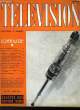
Sommaire effets secondaires, la télévision en couleurs en France, Contrôleur électronique, compte rendu du Salon de la Pièce détachées, récepteur de hautes performances, échangez votre vieux 441 lignes, du nouveau chez les lampistes, télévision simultanée, télévision en couleurs. Classification Dewey : 791.45-Télévision
Reference : alb3c02bc9254a532ea
Fielding Raymond. A Technological History of Motion Pictures and Television: An
Fielding Raymond. A Technological History of Motion Pictures and Television: An Anthology from the Pages of the Journal of the Society of Motion Picture and Television Engineers History of Film and Television. In English /Fielding Raymond. A Technological History of Motion Pictures and Television: An Anthology from the Pages of the Journal of the Society of Motion Picture and Television Engineers Istoriya kino i televideniya. University of California Press 1983 book in English. We have thousands of titles and often several copies of each title may be available. Please feel free to contact us for a detailed description of the copies available. SKUalb3c02bc9254a532ea.
L'image dans la société contemporaine - Publicité, Bande dessinée, Cinéma, Télévision , dans la collection Le Point de la Question
Editions Denoel , Le Point de la Question Malicorne sur Sarthe, 72, Pays de la Loire, France 1971 Book condition, Etat : Bon broché, sous couverture imprimée à rabats éditeur violet, illustrée d'une composition de Serre en noir et blanc, avec un il In-8 1 vol. - 317 pages
nombreuses illustrations dans le texte en noir et blanc 1ere édition, 1971 Contents, Chapitres : Introduction - 1. L'image imprimée : Quelques problèmes de photo journalisme - L'image publicitaire - La bande dessinée, un multi-média - L'image imprimée, détente ou éducation - 2. L'image cinématographique : Cinéma et onirisme - La production cinématographique - La consommation cinématographique - 3. L'image électronique : La télévision dans le monde - La télévision en France - Relations qualitatives avec la télévision - Spectacle ou information - La télévision industrie culturelle - Propositions pour une télévision culturelle - Conclusion : L'avenir de l'image : L'image et la transmission du savoir - Image et signe - Image et ordinateur - Appendice : Chiffres et documents - Bibliographie - Revues bords des coiffes de la couverture à peine frottés (extrémités du dos), la couverture est sinon propre, l'intérieur également, quelques rousseurs sur la page de gardes, texte propre, quelques coins de pages cornés, cela reste un bon exemplaire
Acta Electronica - Geneve (R.) - Billard (P.) - Oliffson (M.) - Audebert (M.) - Enselme (L.) - Borne (J.) - Fournol (J.-M.) - Maillard (J.) -
Reference : 43687
(1960)
Acta Electronica - Volume 4 - Avril 1960 - Numéro 2 - Appareillages de prises de vue de télévision - Caméras à images multiples et équipements transistorisés , Revue d'Electronique et de Physique Appliquée
Acta Electronica Malicorne sur Sarthe, 72, Pays de la Loire, France 1960 Book condition, Etat : Très Bon broché In-4 1 vol. - 193 pages
nombreuses figures Contents, Chapitres : paginé 127 à 320 - R. Geneve : Appareillages de prises de vue de télévision, caméras à images multiples et équipements transistorisés - P. Billard : Les caméras de prises de vues à images multiples, principaux problèmes rencontrés - P. Billard et M. Oliffson : Les combinaisons optiques à tirage constant, applications à la réalisation de caméras à images multiples - M. Audebert : Calcul des amplificateurs vidéo à transistors - L. Enselme : Préamplificateur à transistors pour caméra de télévision - J. Borne : Générateur transistorisé de signaux de base pour la télévision - J.-M. Fournol et L. Enselme : Caméra portative à transistors pour reportages de télévision - P. Billard et J. Maillard : Un viseur électronique pour caméra de prises de vue cinématographiques - Collectif : Une caméra de télévision à double standard
Sciences Humaines - N°13 Janvier 1992 -Un auteur : Bronislaw Malinowski - A propos de Les français sont-ils encore catholiques ? - La télévision dans nos tête : L'impact des médias - La télévision hybride - Le temps du public-roi - Vive la télévision géné
Sciences Humaines. 1992. In-4. Broché. Bon état, Couv. convenable, Dos satisfaisant, Intérieur frais. 50 pages - nombreuses photos et illustrations en noir et blanc dans le texte. Texte sur plusieurs colonnes.. . . . Classification Dewey : 70.49-Presse illustrée, magazines, revues
Sommaire : Un auteur : Bronislaw Malinowski - A propos de Les français sont-ils encore catholiques ? - La télévision dans nos tête : L'impact des médias - La télévision hybride - Le temps du public-roi - Vive la télévision généraliste - Entretien avec Henri Mandras - SH & leurs partiques : l'éthologie appliquée.. Classification Dewey : 70.49-Presse illustrée, magazines, revues
L'ENFANT DEVANT LA TELEVISION.
CASTERMAN. 1979. In-8. Broché. Etat d'usage, Coins frottés, Dos satisfaisant, Intérieur frais. 184 pages .. . . . Classification Dewey : 300-SCIENCES SOCIALES
Analyse de bonne qualité des rapports entre la télévision et l'enfant / Données d'enquêtes sur la place et la fonction de la télévision dans la vie des enfants - Ce que la télévision propose aux enfants - Dans la famille - Voie d'accès au monde des adultes - L'apprentissage des signes sociaux - Télévision et information - Télévision, langage et lecture - Evasion, refuge - Inquiétude des adultes - Former un téléspectateur actif. Classification Dewey : 300-SCIENCES SOCIALES
EDUCATION PHYSIQUE ET SPORT N°271 / MAI-JUIN 1998 - SPORT EL TELEVISION NUMERIQUE TELEVISION PAYANTE Message de Madame la Ministre de la Jeunesse et des sports (p. 9)Sport et télévision quelles relations ?R. Faure(p. 10)Quel sport pour auel public ? ETC.
COMITE D'ETUDES ET D'INFORMATIONS PEDAGOGIQUES DE L'EDUCATION PHYSIQUE ET DU SPORT. 1998. In-4. Broché. Bon état, Couv. convenable, Dos satisfaisant, Intérieur frais. 87 pages. Nombreuses illustrations en noir et blanc et en couleurs dans et hors texte.. . . . Classification Dewey : 796.1-Sports divers
SOMMAIRE : SPORT EL TELEVISION NUMERIQUE TELEVISION PAYANTE Message de Madame la Ministre de la Jeunesse et des sports (p. 9)Sport et télévision quelles relations ?R. Faure(p. 10)Quel sport pour auel public ? H. Bourges(p. 1 il Premier salon du livre sportif J. Marchand (p. 12)Le numérique évolution ou révolution ? J. Ferran (p. 13)GRS : SURDITE ET EXPRESSIONF. Péchillon, M.-L. HamardRUGBYDQSSIER TECHNIQUE ET PEDAGOGIQUE F.F.R.Le mot du présidentB. Lapasset (p. 22)Le mot du DTN R. Antonin (p. 22)Le ruaby : tradition-évolutiondéveloppementP. Lautier, M. Lazerges (p. 23)Le meilleur niveau actuel P. Agostini, M. Godemet(p. 25)Le rugby comment ça marche ?P. Agostini, P. Briat, M. Jeandroz(p. 26) Les niveaux de jeuP. Briat, F. Doublier, D. Rétière(p. 31 ) L'apprentissageF.Doublier, M. Jeandroz, P. Lautier,D. Rétière(p. 36)La politique d'animation fédéraleM. Jeandroz, M. Lazerges (p. 40)France ton rugby scolaire tout le camp !J. Dury(p. 42)LE CORPS EN MOUVEMENTSTRESS PRATIQUES SPORTIVES ET MONDE DU TRAVAIL Association nationale pour la promotion des activités physiques et sportives dans le pionde du travail ANALYSE DES TACHES ET LUDOMOTRICITE P. Bordes (p. 47)ÎECHNIQUES ET PÉDAGOGIQUESNATATION SYNCHRONISÉE : POSITIONS DE BASE EN FLOTTAISON DORSALEG.JoieLUTTE : CHUTER A PARTIR D'UN DECALAGE EN CONTROLE BRAS SUR JAMBED. RayBOOMERANG : DÉCOUVRIR LE BOOMERANGF. Le Mercier BASKET-BALL : JOUER VITE SANS OPPOSITIONL. LegrandGYMNASTIQUE : DE LA ROULADE AVANT AU SALTO AVANTE. PedroCANOË-KAYAK : REPÉRER LES CONDUITES ET EVALUERJ. -G. Caumeil, P. Lamarzelle,A. Nelias-Campestrini, A4. VergerVIOLENCE À L'ÉCOLE : LE SPORT SCOLAIRE EST-IL EN DANGER ?O. Rascle, G. Coulomb, C. SabotierBADMINTON : EVOLUTION DU CONCEPT CONTENUS D'ENSEIGNEMENTD.Moulin, W. FouassierCOLLOQUE : ÊTRE EN FORME LE JOUR JE.RoquesLA VITESSE : OBJET D'APPRENTISSAGE VARIABLE D'ENSEIGNEMENTO. JalabertMÉDECINE DU SPORT : LA TENDINITE DE L'ENFANT EXISTE-T-ELLE ?Ch. BénèzisTHESE DE M. GARCIN : PRESCRIPTION DE L'INTENSITE D'EXERCICE ET PERCEPTION DE L'EFFORTH. VandewalleINFORMATIONSPUBLICATIONS Classification Dewey : 796.1-Sports divers
L'AUDIOVISUEL - COMMUNICATION & SOCIETE - N°4 - DECEMBRE 1998 - LE SPORT, L'ARGENT ET LA TELEVISION - LES NOUVEAUX DEFIS DE LA TELEVISION PUBLIQUE - TELEVISION LOCALE - LE MIPCOM - LE NATPE - TVFI 1ER MARCHE MONDIAL - INTERNET AU SERVICE DU DROIT D'AUTEUR
IMPREMERIE FRANCE QUERCY. 1998. In-8. Broché. Bon état, Couv. légèrement passée, Dos satisfaisant, Intérieur frais. 129 pages augmentées de quelques illustrations en noir et blanc dans et hors texte.. . . . Classification Dewey : 70.49-Presse illustrée, magazines, revues
SOMMAIRE : LE SPORT, L'ARGENT ET LA TELEVISION - LES NOUVEAUX DEFIS DE LA TELEVISION PUBLIQUE - TELEVISION LOCALE - LE MIPCOM - LE NATPE - TVFI 1ER MARCHE MONDIAL - INTERNET AU SERVICE DU DROIT D'AUTEUR - Classification Dewey : 70.49-Presse illustrée, magazines, revues
Précis de télévision
Éditions de la Radio 1949 in8. 1949. Cartonné. Le livre 'Précis télévision' de Paul Berché publié par les Éditions Radio est un ouvrage technique de référence sur la télévision et la TSF. Il s'inscrit dans la lignée des travaux de l'auteur notamment 'Pratique et théorie de la TSF' et s'adresse aux radioamateurs et techniciens
Bon état pages jaunies intérieur propre

