 Write to the booksellers
723 books for « nunc »Edit
-
Type
Book (721)
Magazine (1)
Maps (1)
-
Latest
Last 24h (1)
Last month (10)
Last week (1)
-
Language
French (701)
Greek (4)
Latin (16)
Russian (2)
-
Century
16th (61)
17th (105)
18th (63)
19th (39)
20th (71)
21st (12)
-
Countries
Belgium (126)
Canada (3)
Denmark (38)
France (373)
Germany (3)
Greece (10)
Netherlands (55)
Poland (1)
Switzerland (111)
United Kingdom (1)
United States of America (2)
-
Syndicate
ALAC (3)
CLAM (7)
CLAQ (3)
CNE (4)
ILAB (296)
NVVA (24)
SLACES (24)
SLAM (184)
Topics
- Aesop (2)
- Anacreon (3)
- Anatomy (4)
- Archaeology (4)
- Astrology (2)
- Athenaeus (3)
- Belgium (8)
- Bible (13)
- Bibliography (5)
- Binding w/arms (3)
- Biography (6)
- Books from the xviith (4)
- Books from the xvith (2)
- Byzantium, (4)
- Canon law (4)
- Cap (3)
- Catechism (2)
- Catholicism (12)
- Cayrol jean (4)
- Christianity (14)
- Church book (4)
- Churches (8)
- Dictionaries (5)
- Early printed books (14)
- Education (2)
- Education - morals (2)
- Engraving (books about) (3)
- Engravings (4)
- Erasmus (9)
- Ethic (2)
- Family (3)
- First edition (11)
- Gallimard (2)
- Germany (5)
- Gide andré (20)
- Greece (5)
- Greek (23)
- Hagiography (6)
- Helvética (8)
- History (54)
- History of art (6)
- Holland (2)
- Humanism (5)
- Isaac (2)
- Italian (3)
- Italy (6)
- Jacob (7)
- Jansenism (3)
- Jesuits (6)
- Jouhandeau marcel (3)
- Judaism (judaica) (3)
- Latin (92)
- Law (39)
- Linguistics (3)
- Linnean society of lyons (6)
- Literature (25)
- Liturgy (8)
- Lyons and area (6)
- Lyons college (6)
- Lyons college pc (6)
- Lyons revue (6)
- Manuscripts (3)
- Medicine (16)
- Middle ages (3)
- Morin edgar (3)
- Mythology (2)
- Newspaper (3)
- Newspapers press (4)
- Palaeography (2)
- Paris (3)
- Philology (8)
- Philosophy (20)
- Poetry (8)
- Printing (3)
- Protestantism (4)
- Psychology (4)
- Regionalism (5)
- Religions (46)
- Religions & spirituality (6)
- Reliure (8)
- Reverend (2)
- Review (6)
- Rhetoric (3)
- Rome (6)
- Sciences (2)
- Surgery (3)
- Switzerland (10)
- Theology (40)
- Viticulture (3)
- Wallonia (3)
- War (3)
- Wine (3)
Gide (André) Et nunc manet in te. Suivi de: Journal intime Ides et Calendes, Neuchâtel et Paris, 1947. In-8° de 120 pp., Première édition dans le commerce Première Édition originale mise dans le commerce après la rarissime édition privée tirée à 13 exemplaires la même année réservés à l'auteur. Un des 600 exemplaires sur vélin nominatif Réf AB237
Reference : GUZ-8
Gide (André) Et nunc manet in te. Suivi de: Journal intime Ides et Calendes, Neuchâtel et Paris, 1947. In-8° de 120 pp., Première édition dans le commerce Première Édition originale mise dans le commerce après la rarissime édition privée tirée à 13 exemplaires la même année réservés à l'auteur. Un des 600 exemplaires sur vélin nominatif Réf AB237
Gide (André) Et nunc manet in te. Suivi de: Journal intime Ides et Calendes, Neuchâtel et Paris, 1947. In-8° de 120 pp., Première édition dans le commerce Première Édition originale mise dans le commerce après la rarissime édition privée tirée à 13 exemplaires la même année réservés à l'auteur. Un des 600 exemplaires sur vélin nominatif Réf AB237
Gide (André) Et nunc manet in te. Suivi de: Journal intime Ides et Calendes, Neuchâtel et Paris, 1947. In-8° de 120 pp., Première édition dans le commerce Première Édition originale mise dans le commerce après la rarissime édition privée tirée à 13 exemplaires la même année réservés à l'auteur. Un des 600 exemplaires sur vélin nominatif Réf AB237
Reference : alb27763e06c3891f76
PRO NUNC: Modern Political Processes. In Russian /PRO NUNC: sovremennye politic
PRO NUNC: Modern Political Processes. In Russian /PRO NUNC: sovremennye politicheskie protsessy. Issue 11 Tambov of the Derzhavin TSU, 2012, 174 p. We have thousands of titles and often several copies of each title may be available. Please feel free to contact us for a detailed description of the copies available. SKUalb27763e06c3891f76.

AUGUSTINUS HIPPONENSIS, S. ; [ AUGUSTIN, Saint ; AUGUSTINE, S. ]
Reference : 62099
(1586)
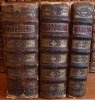
Tomus VI Operum D. Aurelii Augustini Hipponensis Episcopi, continens [ ta polemika ] Hoc est, Decertationes adversus haereses, praecipue Iudaeorum, Manichaeorum, Priscillianistarum, Origenistarum, Arrianorum, & Ioviniani ; nunc multis in locis summo stidop emendatus, per Theologos Lovanienses [ Suivi de : ] Tomus VII Operum D. Aurelii Augustini Hipponensis Episcopi, continens Reliquam Partem [ Ton polemikon ] in alias duas divisam, quarum priore adversus Donatistas, posteriore contra Pelagiano dimicat. Una cum appendice pseudepigraphorum. Nunc demum post varias editiones ad complurium MS. fidem à non paucis mendarum milibus incredibili labore expurgatus: id quod ex subiectis ad calcem Castigationibus & Scholiis facile cognosci poterit [ Suivi de : ] Annotationes in Tomum VIII B. Augustinii Hipponensis Episcopi Quibus castigationum ratio varietasque lectionum indicatur, res memoratu dignae observantur, obscuriora difficilioraque loca explicantur & illustrantur
1 vol. fort in-folio reliure pleine basane marbrée, dos à 5 nerfs, s.n. [ Compagnie des Libraires ], Ludguni [ Lyon ], 1586, 381-621-315 pp. ; Titre complet : Tomus VI Operum D. Aurelii Augustini Hipponensis Episcopi, continens [ ta polemika ] Hoc est, Decertationes adversus haereses, praecipue Iudaeorum, Manichaeorum, Priscillianistarum, Origenistarum, Arrianorum, & Ioviniani ; nunc multis in locis summo stidop emendatus, per Theologos Lovanienses [ Suivi de : ] Tomus VII Operum D. Aurelii Augustini Hipponensis Episcopi, continens Reliquam Partem [ Ton polemikon ] in alias duas divisam, quarum priore adversus Donatistas, posteriore contra Pelagiano dimicat. Una cum appendice pseudepigraphorum. Nunc demum post varias editiones ad complurium MS. fidem à non paucis mendarum milibus incredibili labore expurgatus: id quod ex subiectis ad calcem Castigationibus & Scholiis facile cognosci poterit [ Suivi de : ] Annotationes in Tomum VIII B. Augustinii Hipponensis Episcopi Quibus castigationum ratio varietasque lectionum indicatur, res memoratu dignae observantur, obscuriora difficilioraque loca explicantur & illustrantur
![Tomus VI Operum D. Aurelii Augustini Hipponensis Episcopi, continens [ ta polemika ] Hoc est, Decertationes adversus haereses, praecipue Iudaeorum, ...](https://static.livre-rare-book.com/pictures/CDL/62099_thumb.jpg)
![Tomus VI Operum D. Aurelii Augustini Hipponensis Episcopi, continens [ ta polemika ] Hoc est, Decertationes adversus haereses, praecipue Iudaeorum, ...](https://static.livre-rare-book.com/pictures/CDL/62099_2_thumb.jpg)
![Tomus VI Operum D. Aurelii Augustini Hipponensis Episcopi, continens [ ta polemika ] Hoc est, Decertationes adversus haereses, praecipue Iudaeorum, ...](https://static.livre-rare-book.com/pictures/CDL/62099_3_thumb.jpg)
Ce volume réunit les tomes 6 et 7 et les annotations aux tomes 7, de l'édition établie par Thomas Gozaeus et Jean Molanus à partir de l'édition publiée à Anvers par Christophe Plantin en 1576-1577. On reconnaît publié la marque au Lion et aux Abeilles de la "Compagnie des libraires" de la Ville de Lyon avec leur devise "De forti dulcedo" (Baudrier, VI, 284). Etat satisfaisant (forts accrocs en coiffe, reliure frottée avec mq. de cuir au second plat, qq. mouill., travail de vers sur 40 ff. affectant le texte sur 20 ff., petite piqûre de vers sur affectant parfois qq. lettres sur la dernière partie du volume, ex-libris "Collegii Societatis Jesu Aginnensis Catal. Inscriptus" et ex-libris "Salvatoris"). Le collège des Jésuites d'Agen fut fondé en 1591 (4 ans après l'impression de cet ouvrage) ; il sera évacué le 1er août 1762.
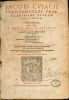
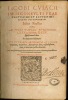
JURISCONSULTI PRÆCLARISSIMI, OPERUM POSTUMORUM: - Papinianus, hoc est in omnia æmilii papiniani iureconsulorumcoryphæi opera, recitationes accuratissimæ a multis multum expatitæ, Sunt autem in Questionum libros XXXVII, Responsorum libros XIX, Definitionum libros II, De adulteriis libros II, A [...] librum singularem. Omnia exManuscriptis codicibus. Qua potuit optima side & diligentia, ex recensione magni nominis I. C. nunc primum in lucem edita. Cum indicegemino, legum scilicet explicatarum, rerum & verborum, quæ potissimum in his Commentariis contnentur. Cum gratis & privilegio Casar. Maiest. ad decenn. - Julius Paullus sive, Ad Julii Pauli Juriscons. LXXX. ad Edictum. Et XXV. Quæstionum Libros, Recitationes solemnes. OPUS UT PRÆCLARISSIMUM AC LONGE utilissimum, ita & bono Antecessorum Iuris, ac studiosorum, nunc primum iure publico donatum. Cumindice gemino, legum scilicet explicatarum, rerum & verborum, quæ potissimum in his Commentariis continentur. Cum gratis & privilegio Cesar. Maiest. addecenn. Libros Quæstionum XXV. Recitationes solemnes. OPUS UT PRÆCLARISSIMUM AC LONGE utilissimum, ita & bono Antecessorum Iuris, ac studiosorum, nunc primum iure publico donatum. Cum indice gemino, legumscilicet explicatarum, rerum & verborum, quæ potissimum in his Commentariis continentur. Cum gratia & privilegio Cæsar Maiest. ad decenn. - Opus Paralipomenon, QUO COMPREHENDUNTUR EA OMNIA, QUÆ ULTRA RECITATIONES IN PAPINIANUM, Jul. Paulum, Codicem Justiniani, & Pandectas, Operi Posthumo adhuc deerant. Ex manuscriptis codicibus, qua potuit optimaside & diligentia, ex recensione magni nominis IC. nunc primum in lucemeditum; Cum Indice Rerum & Verborum satis largo. Et Gratia Cæsar. Majestat. ad Decennium.
, Francofurti (Francfort), Ex Officiana Paltheniana Sumtibus Hæredum Petri Fischeri 1595/ 1596/ 1598, 3 vol. in-4, demi-basane brune, plats en daim retourné, tit. doré sur pc. brune, dos à 5 nerfs orné de dentelles et fers dorés, impression en double colonne, (coiffes absentes, tranchefiles cassés, dos fendu pour le t. I., ors passés, cuir très frotté avec de fortes épidermures et des accrocs, coins émoussés, plat sup. presque détaché au t. I, des trous de vers marginaux, une forte acidification du papier sur l’ensemble du texte), [3ff.]-618-220-[25ff.]-[4ff.]-685p.-[20ff.]/ [7ff.]-420-360-194- [2ff.]-310p.-[70ff.]/ [1f.]-72p.-[30ff.].


Phone number : 01 43 29 46 77
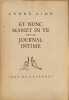
Et nunc manet in te suivi de Journal intime
Ides et Calendes 1951 119 pages in12. 1951. broché. 119 pages. Ce volume rassemble deux textes autobiographiques d'André Gide : 'Nunc manet in te' un récit poignant sur sa relation conjugale difficile et la découverte posthume du journal de sa femme Madeleine suivi d'extraits de son propre 'Journal intime' offrant un regard complémentaire sur sa vie et sa pensée
Bon état
Et nunc Manet in te suivi de Journal intime.
Ides et calendes, 1947. In/8 (19 x 13 cm) broché, couverture illustrée d'une vignette, 119 pages.
"Gide André – Et nunc manet in te suivi de Journal intime : André Gide a tenu un journal intime pendant près de 60 ans. «Et nunc manet in te» et «Journal intime» sont une tranche de son journal, celle écrite après la mort de sa femme Madeleine. Rédigeant sans aucun artifice littéraire, il raconte certains faits marquants de sa vie conjugale, complexe et torturée. La mort de Madeleine a été une grande douleur pour Gide, qu’il tente certainement de conjurer avec ce plaidoyer qui fait revivre ses souvenirs."
Et nunc Manet in te suivi de Journal intime.
Ides et calendes, 1947. In/8 (19 x 13 cm) broché, couverture illustrée d'une vignette, 119 pages. Couverture avec un petit un petit manque.
"Gide André – Et nunc manet in te suivi de Journal intime : André Gide a tenu un journal intime pendant près de 60 ans. «Et nunc manet in te» et «Journal intime» sont une tranche de son journal, celle écrite après la mort de sa femme Madeleine. Rédigeant sans aucun artifice littéraire, il raconte certains faits marquants de sa vie conjugale, complexe et torturée. La mort de Madeleine a été une grande douleur pour Gide, qu’il tente certainement de conjurer avec ce plaidoyer qui fait revivre ses souvenirs."
Reference : albfe3066f25f58f7a2
Herberstein C. Rerum Moscovicarum auctores varii: unum in corpus nunc primum co
Herberstein C. Rerum Moscovicarum auctores varii: unum in corpus nunc primum congesti. In Russian /Gerbershteyn S. Rerum Moscoviticarum auctores varii: unum in corpus nunc primum congesti. Notes on Moscovia Frankfurt Andreaes Wechelius Claudius Marnius loan Aubrius 1600. 445 p. We have thousands of titles and often several copies of each title may be available. Please feel free to contact us for a detailed description of the copies available. SKUalbfe3066f25f58f7a2.
Nunc. Revue verticale 16
Editions Corlevour Editions Corlevour 2008. n° de septembre. In-8 carré broché, couverture illustrée de 128 pages. Franck Damour : L'art et le sacré, une mauvaise querelle. Jean Luc Marion. Dieu la charité le don. ... Illustrations en noir. Petite éraflure en couverture, rares passages soulignés au crayon de papier, sinon bon état
![Nunc. Revue verticale 16. NUNC ] Revue littéraire](https://static.livre-rare-book.com/pictures/MAS/131627_1_thumb.jpg)
Toutes les expéditions sont faites en suivi au-dessus de 25 euros. Expédition quotidienne pour les envois simples, suivis, recommandés ou Colissimo.
Nunc. Revue passagère 15. Numéro spécial Salah Stétié
Editions Corlevour Editions Corlevour 2008. N° de mars. In-8 carré broché, couverture illustrée de 190 pages. Numéro Spécial Salah Stétié. Quelques passages soulignés au crayon de papier, mouillure marginale à quelques feuillets, sinon Bon état
![Nunc. Revue passagère 15. Numéro spécial Salah Stétié . NUNC ] Revue littéraire](https://static.livre-rare-book.com/pictures/MAS/131634_1_thumb.jpg)
Toutes les expéditions sont faites en suivi au-dessus de 25 euros. Expédition quotidienne pour les envois simples, suivis, recommandés ou Colissimo.
Nunc. Revue vulnérable 19
Editions Corlevour Editions Corlevour 2009. N° de septembre. In-8 carré broché, couverture illustrée de 126 pages. Dossier Déconstruction et Christianisme. Quelques passages soulignés au crayon de papier sinon Bon état
![Nunc. Revue vulnérable 19. NUNC ] Revue littéraire](https://static.livre-rare-book.com/pictures/MAS/131636_1_thumb.jpg)
Toutes les expéditions sont faites en suivi au-dessus de 25 euros. Expédition quotidienne pour les envois simples, suivis, recommandés ou Colissimo.
Nunc. Revue agonale 36
Editions Corlevour Editions Corlevour 2015. N° de juin. In-8 carré broché, couverture illustrée de 143 pages. Dossier Jean-Pierre Lemaire. Bon état
![Nunc. Revue agonale 36. NUNC ] Revue littéraire](https://static.livre-rare-book.com/pictures/MAS/131639_1_thumb.jpg)
Toutes les expéditions sont faites en suivi au-dessus de 25 euros. Expédition quotidienne pour les envois simples, suivis, recommandés ou Colissimo.
Nunc. Revue patiente 14
Editions Corlevour Editions Corlevour 2007. N° de novembre. In-8 carré broché, couverture illustrée de 142 pages. Musique contemporaine. Etat des lieux/perspectives. Bon état
![Nunc. Revue patiente 14. NUNC ] Revue littéraire](https://static.livre-rare-book.com/pictures/MAS/131641_1_thumb.jpg)
Toutes les expéditions sont faites en suivi au-dessus de 25 euros. Expédition quotidienne pour les envois simples, suivis, recommandés ou Colissimo.
Nunc. Revue pauvre 38
Editions Corlevour Editions Corlevour 2016. N° de février. In-8 carré broché, couverture illustrée de 127 pages. Dossier Jacques Maritain. Couverture aimée en bord de dos, sinon Bon état
![Nunc. Revue pauvre 38. NUNC ] Revue littéraire](https://static.livre-rare-book.com/pictures/MAS/131642_1_thumb.jpg)
Toutes les expéditions sont faites en suivi au-dessus de 25 euros. Expédition quotidienne pour les envois simples, suivis, recommandés ou Colissimo.
Nunc, stans, épokhê, cycle de l'Hourloupe. Dubuffet
Paris Galerie Jeanne Bucher 1966 9,8 x 21 cm En feuilles Ed. originale
Carton d'invitation au vernissage le 7 avril 1966 de l'exposition de Jean Dubuffet "Nunc, stans, épokhê, cycle de l'Hourloupe" à la Galerie Jeanne Bucher. Texte calligraphié par l'artiste sérigraphié en blanc sur noir. Verso couché blanc vierge. Parfait état 0
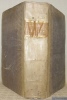
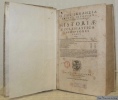
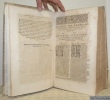
Historiae ecclesiasticae scriptores graeci. Graecolatine nunc primum editi, ex interpretatione Iannis Christophorsoni Angli Cicestrensis quondam Episcopi, & recognitione Suffridi Petri I clarissimi, una cum variis lectionibus & additionibus codicum, quibus hic interpres usus est, suis locis insertis: aliis item variis lectionibus ex doctissimorum nostrae aetatis virorum exemplaribus, ad oram cuiusque pagine fideliter relatis, adeo ut quicquid siue in dictionibus, sine in sententiis universae historiae Graecae obscurum, deprauatum, mancum atque imperfectum hactenus suit, nunc illustratum, restitutum,& omnibus suis numeris ac partibus abselutum, adiecto rerum memorabilium Indice locupletissimo, prodeat. Relié avec: Theodoriti episcopi Cyri ecclesiasticae historiae Libri Quinque.
Coloniae Allobrogum (Genève), Excudebat Petrus de la Rouiere 1612, 355x235mm, Scriptores graeci, Nempe, Eusebii, cognomento Pamphili, Caesareae Palaestinae Episcopi, historiae Ecclesisticae, libri X. Eiusdem de vita Constantini Magne, lib. IIII. Constantini Magni oratio ad fanctorum coetum, Eiusdem Eusebii oratio in laudem Constantini Magni, ad trigesimum illius Imperii annum, ex Bibliotheca Palatina nunc primum Graece in lucem missa. Socratis Scholastici Constantinopolitani historiae Eccles., lib. VII. Theodori ti Cyrensis Episcopi, lib. V. Theodori Lectoris collectaneorum, lib. II. Hermiae Sozomeni Salaminii, lib. IX. Euagrii Scholastici Epiphanensis, lib. VI. Edition bilingue: grec ancien et latin, bandeaux, lettrines, 6ff. + 768 pages + 629 pages + 13 ff., reliure demi-parchemin à coins. Pièce de titre doré au dos. Plats papier marbré. Quelques très petits trous au dos. Quelques pages brunis.
Pour un paiement via PayPal, veuillez nous en faire la demande et nous vous enverrons une facture PayPal
Institutiones iuris canonici, quibus ius pontificum singulari methodo libris quatuor comprehenditur. Nunc primum annotatis in margine locis, unde sumptae sunt. Suivi de : Rubricae summae capitulorom iuris canonici, Thomae Noageorgi Straubingentis opera in
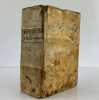
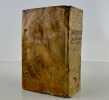
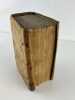
Lugduni, Apud Haeredes Gulielmi Rouillij sub scuto veneto, 1614, 8 x 12 cm, plein parchemin d'époqu, titre maunscrit au dos, 500, index np, 286p. Institutiones iuris canonici, quibus ius pontificum singulari methodo libris quatuor comprehenditur. Nunc primum annotatis in margine locis, unde sumptae sunt. Suivi de : Rubricae sive summae capitulorom iuris canonici, Thomae Noageorgi Straubingentis opera in lucem editae.Bon exemplaire. Solide.
NOTA BENE : Les questions et commandes seront traitées dans les 48h, toutes les expéditions reprendront début juillet. Merci !
Summa doctrinae christianae. cum appendice de hominis lapsu et justificatione secundum sententiam et doctrinam Concilii Tridentini, ex postrema recognitione doctoris Petri Canisii (..), secundum editionem : Antverpiae, ex officina Christophori Plantini (..) MDLXXXVII. Novissime, iterumque nunc tertio edita et adaucta
Landshut, Joseph Thomann, 1839 in-8, [5] ff. n. ch., pp. XI-XLII, 259 pp., [5] ff. n. ch. d'index, cartonnage de papier raciné, dos lisse muet, tranches mouchetées de bleu (reliure de l'époque). Coiffes, coupes et coins très frottés.
Une des très nombreuses éditions du Grand Catéchisme du Jésuite Pierre Canisius (1521-1597), inspiré par les deux catéchismes de Luther et dont le titre exact est Summa doctrinae christianae, per quaestiones tradita et in usum Christianae pueritiae nunc primum edita, dont la première édition parut en 1555 à l'adresse de Vienne. Il ne connut pas moins de 400 éditions en toutes langues jusqu'au début du XIXe siècle.Seulement deux exemplaires de cette édition bavaroise au CCF (BnF et Abbeville).Cachets de la bibliothèque des Carmélites de Bamberg. - - VENTE PAR CORRESPONDANCE UNIQUEMENT - LIEN DE PAIEMENT, NOUS CONSULTER.
[Impensis Societatis Typographicae Librorum Officij Ecclesiastici] - Collectif
Reference : 27714
(1666)
Breviarium Romanum ex decreto sacro-sancti Concilii Tridentini restitutum. Pars Aestivalis. Pii V. Pont. Max. jussu editum, et Clementis VIII primum, nunc denuo Urbani PP. VIII auctoritate recognitum. Una cum Officiis novorum Sanctorum ab Innocentio X & Alexandro VII VII concessis. In quo Psalmi, Lectiones, Responsoria, tam de Tempore, quàm de Sanctis, & alia quae requirebantur ad longum, suis locis posita sunt.
1 vol. in-8 relié plein maroquin rouge orné à la Duseuil, dos à 5 nerfs orné, ill., roulettes sur coupes, chasses ornées, tranches dorées, Impensis Societatis Typographicae Librorum Officij Ecclesiastici, Paris, 1666, 29 ff. n. ch., 760-cxcij pp. et 2 ff. n. ch. Titre complet : Breviarium Romanum ex decreto sacro-sancti Concilii Tridentini restitutum. Pars Aestivalis. Pii V. Pont. Max. jussu editum, et Clementis VIII primum, nunc denuo Urbani PP. VIII auctoritate recognitum. Una cum Officiis novorum Sanctorum ab Innocentio X & Alexandro VII VII concessis. In quo Psalmi, Lectiones, Responsoria, tam de Tempore, quàm de Sanctis, & alia quae requirebantur ad longum, suis locis posita sunt.
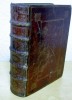
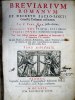
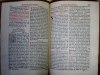
Exemplaire entièrement réglé en maroquin du temps (petits frott. en coupes et qq. taches en plat, petit trou en page de titre, des rouss.).
[ Apud Firmin Didot] - BABRIUS ; [ BABRIOS ; BABRIAS ] ; VILLEMAIN, Abel ; BOISSONADE, J. Fr.
Reference : 37125
(1844)
Babrii Fabulae Iambicae CXXIII iussu Summi Educationis Publicae administratoris Abeli Villemain viri excell. nunc primum editae Ioh. Fr. Boissonade Litt. Gr. Pr. recensuit latine convertit annotavit.
1 vol. in-8 reliure demi-chagrin bordeaux, dos à 4 nerfs dorés, Apud Firmin Didot, Parisiis [ Paris ], 1844, xii-269 pp. Rappel du titre : Babrii Fabulae Iambicae CXXIII iussu Summi Educationis Publicae administratoris Abeli Villemain viri excell. nunc primum editae Ioh. Fr. Boissonade Litt. Gr. Pr. recensuit latine convertit annotavit.
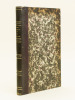
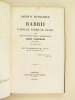
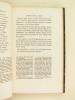
Bon état (coupes noircies en plat, dos passé, qq. rouss.) pour cette rare édition princeps publiée par Boissonade sur le manuscrit découvert par Mynas au Mont Athos en 1843, et dédiée à Villemain. Texte grec avec traduction latine en regard, notes en latin
Sacrorum Bibliorum Vulgatae Editionis Concordantiae, ad recognitionem Ivssv Sixti V. Pont. Max. Bibliis Adhibitam Recensitae atqve Emendatae. Primùm à Francisco Lvca Theologo & Decano Audomaropolitano, Nunc denuo variis locis expurgatae ac locupletatae cura & studio V.D. Hvberti Phalesii, Coenobij Affligeniensis Ordinis S. Benedicti Subprioris.
Fort in-8,reliure d'époque Maroquin rouge, dos à nerfs, tranches dorées, titre doré, fleurons dorés, dentelle dorée bornant les plats, double filet aux coupes. Texte sur six colonnes.Intérieur frais. Dorure des tranches estompée en petites zones, petit manque sur 3 coins. Trés bon état général. coloniae agrippinae. apud balthasarum ab egmond.
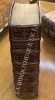

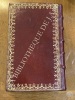
Pour trouver tous les mots de la bible selon les versions et traductions. En l'état..Hors frais d'envoi.
Rationale Divinorum Officiorum ; Nunc recens utilissimis Adnotationibus illustratum. Adjectum suit prætera aliud Diuinorum Officiorum Rationale ab Ioanne Beletho Theologo Parisiensi, Abhinc fere quadringentis annis conscriptum, ac nunc demum in lucern editum, cum duplici, uno prioris, alter posterioris, Rationalis Indice locupltissimo
Lugduni, Antoinii Cellier, Libraire, 1672 Reliure de l’époque veau havane marbré, dos à nerfs encadrés de fers dorés, [6]-[38]-568 pp., texte à 2 colonnes, index. Accrocs en pied et en tête de dos, coins émoussés et fottés, intérieur correct. Manque pages de garde, de faux-titre et de titre.
Texte en latin. Les ouvrages de Guillaume Durand (1230-1296) eurent une vogue extraordinaire au Moyen Âge. Le “Rationale divinorum officiorum” (1286), était l’un des premiers livres qui aient été imprimés (Mayence, 1459). Etat correct d’occasion
PAROIMIAI HELLÊNIKAI. Adagia, sive proverbia Graecorum ex Zenobio seu Zenodoto, Diogeniano & Suidae collectaneis. Partim edita nunc primum, partim latine reddita, scholiisque parallelis illustrata ab Andrea Schotto Antverpiano, Soc. Iesu presbytero.
Antwerpen (Antverpiae), Ex officina Plantiniana, apud viduam & filios Ioannis Moreti. 1612.
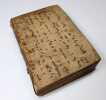
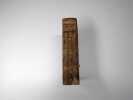
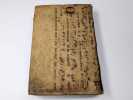
4to. (XX),702,(1 printers' device),(1 blank) p. Vellum. 25 cm (Ref: stcv: 6633561; Brunet 1,45; Graesse 1,17: 'Édition excellente des anciens parémiographes, avec des notes très utiles'; Ebert 87; Smitskamp, 'The Scaliger Collection', 172) (Details: The vellum the binder used, was once a manuscript leaf with 10 lines black text in Latin from different Psalms, and with black quadratic musical notation on red staves of five lines, for the Gregorian chant. The leaf must have measured ca. 30x40 cm. The neums look rather cursive. The height of the letters is between 0.5 and 0.7 cm; it has 4 capitals surrounded and filled with penwork, they measure ca. 2 cm. The texts seems to contain 4 antiphons, 43/2, 53/26, 39/2-4. The last one is an antiphon, 'Cum sanctificatus fuero in vobis etc.', to be sung on the wednesday (feria iiii) after the 4th sunday in Lent. The letters are too small for a choir. So it is not an antiphonarium leaf. Perhaps it was used for mass. The letter is the gothic 'textura', used for liturgical texts in the 14th & 15th century. It was written probably in Central Europe. This kind of letter was the example for the first printer's typeface. See for the origin of this vellum leaf the provenance below. Plantin's engraved printer's device on title: 'constantia et labore'; on the last but one page is another bigger version of that printer's mark.) (Condition: Binding soiled. Vellum on the back blackening, cracked and partly damaged, a small piece of vellum at the foot of the back has gone. Front hinge cracking, but strong. The front flyleaf has gone. Old ownership entry in ink on the title. Paper yellowing, some gatherings are browning; 2 leaves of the introduction are loosening) (Note: This title consists of 5 parts, 'Proverbia Zenobii ex Tarrhaeo ac Didymo' (p. 1/168), followed by the 'editio princeps' of 'Diogeniani vulgaria proverbia, graece nunc primum eruta, latine reddita ac scholiis illustrata ab Andreae Schotto' (p. 169/257), then 'Proverbiorum graecorum e Vaticana Bibliotheca Appendix', (p. 258/324), and 'Proverbia ex Suidae collectaneis, Andreae Schotti Societatis Iesu scholiis explicata' (p. 325/579), and finally J.J. Scaliger's 'Stromateus proverbialium versuum', with Schottus' Latin translation and notes (p.581/644). The first to write about proverbs, in Greek 'paroimiai', was the Greek philosopher Aristotle in his 'Paroimiai'. He considered them remnants of ancient wisdom, early forms of philosophical statements, that were concise and easy to remember. In Alexandrian times proverbs were no longer exclusively subject to philosophical exegesis, and became a literary genre. The Alexandrian philologist Didymus amassed a collection of proverbs in 13 books, from which Lucillus of Tarrha made a compilation of 3 books in the first century A.D. During the reign of the Roman emperor Hadrian the Greek sophist Zenobius excerpted from the collections of Didymus and Lucillus of Tarrha 3 books of proverbs. Ca. 900 a new corpus of proverbs was formed, consisting of an excerpt from the collection of Zenobius, together with a collection ascribed to Plutarchus, and a collection of proverbs that went under the name of the Greek grammarian Diogenianus, who lived in the second century A.D. (N.P. 9,351/52) The collections of Zenobius and Diogenianus were edited, translated into Latin and annotated by the Dutch Jesuit scholar Andreas Schott, latinized as Andreas Schottus, 1552-1629, who was professor of Latin in Louvain, Toledo and Saragossa. He edited also Aurelius Victor, Pomponius Mela and Seneca Rhetor. His thorough knowledge of Greek is attested by the edition of the 'Bibliotheca' of Photius (1606), and the Chresomathy of Proclus (1615). He was the first to edit the Proverbs of Diogenianus in 1612. Nowadays it is doubted whether Diogenianus really was the author of this Byzantine collection of proverbs. (Sandys 2,305; NP 3, 605/6) Schottus added also proverbs he excerpted from the Suda, a Byzantine encyclopedic lexicon dating from the 10th century. Schottus adopted also a collection of proverbs, called 'Stromateus', which had been compiled and translated into classical Greek verse by the French classical scholar J.J. Scaliger, 1540-1609. This collection was first published in Paris in 1594). Collections of proverbs and commonplaces formed during the Renaissance and later part of the intellectual initiation of every schoolboy. They were of prime importance for the humanistic education. Aristotle was right, the rôle of proverbs as the vehicle of classic learning and wisdom of generations is evident, up to this day) (Provenance: Prague, two times. On title in ink: 'Conventus S. Michaelis Ordinis Servorum B. V., Vetero Pragae'. (B.V. means Beatae Virginis) The convent of the archangel Michael of the Servite Order of the Holy Virgin Mary belonged to the church of Saint Michael in the Old City of Prague. The Order was founded in 1233 and had in the 14th century already more than a hundred convents in Central Europe. The music and the Gregorian Chant of this convent were well known. In the 'Historia et Origo Ecclesiae et Conventus s. Michaelis Archangelis, Servorum Mariae, Vetero Pragae' it is stated: 'Musica semper nobis celebris erat', and told that there were big choirs. The convent had also a school. In 1786 the church and monastery of Saint Michael were dissolved by degree of the government, and its belongings sold. (svatymichael.cz/historie.php) The vellum used for the binding probably comes from this convent, or its church On the verso of the title and on p. 645, the last page before the index, a small oval armorial stamp of the Lobkowicz family, one of the oldest Bohemian noble families, with 'an infant of Prague' crown on top; the oval escutcheon is divided in 4, 2 of which show an eagle; the legend reads 'Bibliotheca P.D.L.; (See Wikipedia 'Lobkowicz'); this family owned one of the most famous humanist collections of Europe; their library is since 1928 part of the National Library of Czechia; the name of a branch of this noble family is 'Popel de Lobkowicz'; so the legend very likely means 'Bibliotheca Popel De Lobkowicz'; (See 'Slavica saeculi XVI Bibliothecae Universitatis Bratislavensis', 1981, p. 169)) (Collation: *4, 2*6, A-Z4, Aa-Zz4; aa-tt4) (Photographs on request)
Commentationes diversorum partim antea, partim nunc primum editae in Epist. M.T. Ciceronis, quae olim Familiares dictae, nunc rectius Ad Familiares appellantur.
N.pl. (Geneva), Excudebat Henr. Stephanus, 1577.
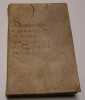
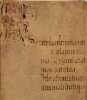
8vo. 2 parts in 1: VIII,231,(1 blank);205,(1 blank) p. Vellum 16.5 cm (Ref: GLN-6033; Renouard, Estienne, 144; Schreiber, Estiennes, no. 15; Dibdin 1,423) (Details: The vellum that the binder used comes from a once sumptuously calligraphed manuscript leaf with Psalm 118 vss 17/21 written in six lines: 'Retribue servo tuo vivifica me et custodiam sermones tuos./ Revela oculos meos et considerabo mirabilia de lege tua./ Incola ego sum de (sic!) terra, non abscondas a me mandata tua./ Concupivit anima mea desiderare iustificationes tuas in omni tempore./ Increpasti superbos maledicti qui declinant a mandatis tuis'. The letter is the gothic 'textura', used for liturgical texts in the 14th & 15th century, and the example for the first typeface. The margins are ample. The first R is a huge capital; several smaller capitals have traces of gilt; the text is partly faded by wear, but readable. Printer's Olive tree device of the Stephanus family on the title page, motto: 'Noli altum sapere', short for 'Noli altum sapere, sed time', in English 'Donot be high-minded, but fear'. (Epistola Beati Pauli ad Romanos 11,20) (Condition: Vellum worn & soiled. Front hinge cracking. Ownership entry on the title page. On the title also in old ink: 'Liber non adeo frequens'. Small name cut out of the title, leaving a tiny hole of 2 mm x 23 mm. Printer's mark on the title skillfully handcoloured. Some old ink underlinings and annotations in the text. No flyleaves) (Note: For centuries the Roman orator, author and politician Cicero retained a central position as a school author and a model for good writing, on protestant schools and in Jesuit colleges. The period of his greatest glory was the Renaissance, when he became the object of a literary cult called Ciceronianism. Many humanists took him as an absolute model for pure Latin, and an elegant style. Petrarch modeled his own 'Epistolae Familiares' in part on Cicero's 'Epistulae ad Familiares'. Petrarch created, like Cicero, in his letters 'a kind of autobiography and a partial history of his own life and time.' Petrarca 'helped establish Cicero as a uniquely powerful stylistic model and intellectual resource'. (The Classical tradition, N.Y., 2010, p. 196) . This 1577 book on offer contains a choice of the commentaries on the 'Epistulae ad Familiares' of diverse leading scholars. It is, Stephanus tells in the preface, an accompanying volume to the edition of the 'Epistulae ad Familiares', which he published in the same year. This supplementary volume contains the commentary (scholia) on the letters by Paulus Manutius, 'locorum aliquot explicationes & emendationes' of Willem Canter, the 'emendationum rationes' of Dionysius Lambinus, an excerpt of the 'adversaria' of Adrianus Turnebus, a 'commentariolus' of Stephanus himself. The second part, 205 pages, contains the according to Stephanus very useful 'commentarius' of the Italian bishop Gerolamo Ragazzoni, or Hieronymus Ragazzonius, 1537-1592. (Part 1, p.5)) (Provenance: 'Sum Jan. Herman(ni) Demmingeri, Nor(nb)'. This might be the cleric Johann Hermann Demminger, from 1597 till 1605 'Pfarrer' at Feucht, a walk of 3 hours from Nurnberg. He moved to Nurnberg, for from 1505-1623 he was curate and deacon of the local 'Spital-Kirche') (Collation: a4; a-b8, c4, d-p8 (leaf h8 blank, p8 verso blank); a-f8, g4, h-n8, o4 (min blank leaf o4) (Photographs on request)
Cyrilli, Philoxeni aliorumque veterum Glossaria latino-graeca, & graeco-latina, a Carolo Labbaeo collecta & in duplicem alphabeticum ordinem redacta. Cum variis emendationibus ex MSS. Codd. petitis, virorumque doctorum castigationibus ac conjectaneis, his accedunt Glossae aliquot aliae latino-graecae ex iisdem Codd. MSS. quae nunc primum prodeunt. Praeterea veteres glossae verborum juris, quae passim in Basilicis reperiuntur, ex variis perinde Codd. MSS. Bibliothecae Regiae erutae, digestae, & notis illustratae ab eodem Carolo Labbaeo. (Edidit et praefationem adjecit Car. Du Fresne du Cange) (Bound with:) (Aegidius Bucherius) Aegidii Bucherii Atrebatis e Societate Iesu De doctrina temporum commentarius in Victorium Aquitanum, nunc primum post 1177 annos in lucem editum, aliosque antiquos Canonum Paschalium Scriptores, chronologiae Ecclesiasticae illustrandae ac stabiliendae utilissimos.
Ad 1: Paris (Lutetiae Parisiorum), Cura & impensis Ludovici Billaine, 1679. Ad 2: Antwerp (Antverpiae), Ex officina Plantiniana Balthasaris Moreti, 1634. (Colophon at the end: 'Antverpiae, Ex officina Plantiniana Balthasaris Moreti, 1633')

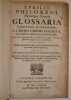
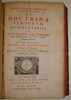
Folio. 2 volumes in 1: (II),208,(2),246 (recte 244);40 p.; (XXXII),500,(2 colophon & printer's mark) p. Contemporary calf. 33 cm (Ref: Ad 1: Hoffmann 1,497; Brunet 2,464; Ebert 5608; Graesse 2,317. Ad 2: STCV:6667622; Beledimar 1921: Ebert 2098b, who gives as date 1633; Backer-Sommervogel I, 1867, 2, who mentions the date 1636) (Details: Back with 6 raised bands. Ad 1: This collection of 'glossaria' consists of 3 parts, the first two of which have their own title page, each showing a woodcut ornament. The first part contains the Greek-Latin 'glossaria', the second part the Latin-Greek 'glossaria'. The third part, the last 40 p., contain the 'Veteres Glossae verborum juris'. Ad 2: Title in red & black. An engraving of angels around the Jesuit IHS-device on the title. Plantin's printers' mark on the verso of the last leaf) (Condition: Binding very worn & very shabby. Leather on the boards abraded. Head & tail of the back chafed. Shield on the back half gone. Corners bumped. Front hinge cracking, but strong. Fold in the front flyleaf. Margins of the first title are thumbed and browning. A few not objectional wormholes in the upper & lower margin, keeping far away from any text) (Note: Ad 1: Philoxenus Alexandrinus was a grammarian who lived in the first century BC. Traces of his work are to be found in later grammarians and lexicographers. (Neue Pauly, Philoxenus 8) Cyrillus, 5th century AD. His Glosses were used by Hesychius, Photius and in the Suda. (Neue Pauly, Kyrillos 5 and 6). Charles Labbé, 1582-1657, was a parliamentary barrister at Paris, who published, with the help of J.J. Scaliger Glosses on Greek law (1607), and prepared an edition, this edition, of the Glossaries of Cyril and Philoxenus, which was published after his death by the French philologist, lexicographer and historian of the Middle Ages and Byzantium, Charles du Fresne, sieur du Cange, in short Du Cange (1679). (Sandys 2,287) The first part of this work contains Greek-Latin glosses, the second Latin-Greek glosses, followed by emendations. This work was reprinted in London, 1817, etc. as an appendage to the new edition of Stephanus' Greek Thesaurus. Ad 2: Aegidius Bucherius (Gilles Boucher), 1576-1665, was a French Jesuit and chronological scholar. His 'De Doctrina Temporum commentarius in Victorium Aquitanum' of 1633/34 published for the first time a number of important medieval chronological documents, and other works on the computation of the date of Easter (the so-called cycle of Victorius of Aquitaine). First comes the 'Canon Paschalis' of Victorius Aquitanus himself, followed by Bucherius' commentary (p. 1-288), then comes bishop Hippolytus Portuensis' (of Portus, also known as Hippolytus of Rome) 'Canon Paschalis priscorum Latinorum rationibus confirmis', also with the commentary of Bucherius (p. 289-312), then Bucherius' treatise 'Tractatus de antiquo Paschali Iudaeorum cyclo latinorum item conformi, maxime ex Epiphanio' (p.313-432), and the 'editio princeps' of Anatolius Alexandrinus' 'Canon Paschalis' (433-466), and finally the 'Epistolae patrum antiquorum de festi Paschalis ratione' (p. 467-493). Victorius Aquitanus had written ca. 450 the 'Cursus Paschalis', called 'Canon Paschalis' in this edition, in which he introduced a more precise computation of Easter. During the Synode of Orléans of 541 Victorius' computations were accepted by the church. (LMA 8,1629/30). Bucherius tells us in the 'praefatio' that he got the MS with the 'Cursus Paschalis' from his fellow Jesuit Jacobus Sirmundus during a visit to Paris in 1615. The 'editio princeps' of and the commentary on the 'Cursus Paschalis' and of the other late antique and early medieval computistical texts laid, together with the work of Joseph Justus Scaliger (1579 and 1606) and that of Dionysius Petavius (1627), the foundations of the science of 'Computus', the science of time-reckoning, and of 'Computus ecclesiasticus', the method to regulate the calender of the church, especially the date of Easter) (Collation: Ad 1: pi1; A-2C4; chi1, A-2A4, 2B2, 2C-2H4; a-e4. Ad 2: *- 4*4, A-3R4 (minus blank leaf 3R4)) (Photographs on request) (Heavy book, may require extra shipping costs)

