Write to the booksellers
2552 books for « marx »Edit
-
Type
Autograph (2)
Book (2522)
Magazine (22)
Music sheets (6)
-
Latest
Last 3 days (2)
Last month (66)
Last week (15)
-
Language
Dutch (1)
English (10)
French (1965)
German (5)
Japanese (2)
Russian (569)
-
Century
18th (1)
19th (37)
20th (1105)
21st (150)
-
Countries
Belgium (111)
Canada (8)
China (2)
Côte d'Ivoire (1)
Denmark (20)
France (1743)
Switzerland (66)
United States of America (601)
-
Syndicate
ALAC (8)
CLAM (2)
ILAB (1042)
NVVA (17)
SLACES (17)
SLAM (993)
SNCAO (2)
Topics
- Althusser louis (9)
- Anarchy (7)
- Attali jacques (8)
- Autographs (6)
- Berlin (8)
- Biography (32)
- Calvez jean-yves (18)
- Chambre henri (7)
- Christen yves (5)
- Christianity (5)
- Cinema (24)
- Collections (6)
- Communism (113)
- Communism (180)
- Conte arthur (7)
- Cooking (7)
- Decoration (6)
- Dedication (17)
- Drawings (7)
- Duclos jacques (6)
- Early printed books (23)
- Economics (73)
- Engels friedrich (11)
- Essays (5)
- Ethic (16)
- Fine arts (24)
- First edition (12)
- Frossard andré (6)
- Garaudy roger (5)
- Genealogy (11)
- Geography (9)
- Germanic languages (43)
- Germany (12)
- Giroud françoise (11)
- Hegel (5)
- Helvética (5)
- History (47)
- Humour anecdotes (5)
- Industrial arts & crafts - fine arts (13)
- Isaiah (4)
- Italian (5)
- Journalism (16)
- Lefebvre henri (13)
- Lénine (35)
- Leninism (6)
- Literature (63)
- Magazine (115)
- Marx karl (535)
- Museums (5)
- News (11)
- Newspaper (5)
- Newspapers press (137)
- Paillet marc (5)
- Painters (6)
- Painting (7)
- Papaioannou kostas (5)
- Paris (6)
- Philosophy (227)
- Photography (5)
- Piettre andré (8)
- Poetry (5)
- Policy (150)
- Political economy (6)
- Political sciences (8)
- Proletariat (9)
- Psychology (45)
- Regionalism (7)
- Religions (22)
- Revel jean-françois (7)
- Review (29)
- Reviews (129)
- Russia (5)
- Sauvy alfred (6)
- Scores (6)
- Social sciences (13)
- Socialism (55)
- Sociology (12)
- Songs (5)
- Switzerland (5)
- Tales (8)
- Testimonies / stories (5)
- Theatre (5)
- Theology (12)
- Trade unionism (7)
- Travel (6)
- Ussr (12)
- Various (6)
Le nouveau léviathan : De l'aliénation à la jouissance, la genese de la sociologie du travail chez Marx et Engels - Le salaire socialiste (les rapports de production, sur l'histoire moderne des théories de la valeur et de la plus-value) - Les échanges socialistes - La bureaucratie et la révolution (5 volumes).
Anthropos Sociologie et Travail 1970 Editions Anthropos, 1970-1974, broché, environ 22x14cm. Des pliures sur un plat, haut et bas d'un dos émoussés, un petit accroc sur le haut d'un dos quelques frottements d'usage sur les couvertures. Bon état pour le reste et intérieurs bien propres.


Merci de nous contacter à l'avance si vous souhaitez consulter une référence au sein de notre librairie.
Convoiter l'impossible : l'utopie avec Marx, malgré Marx.
Albin Michel 1995 Bibliothèque Albin Michel, Idées, 1995, 438 p., broché, coins des plats un peu cornés, quelques frottements en bordure de couverture, bon état pour le reste et intérieur bien propre.
Merci de nous contacter à l'avance si vous souhaitez consulter une référence au sein de notre librairie.
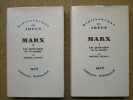
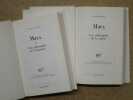
MARX : une philosophie de la réalité, une philosophie de l'économie (2 volumes).
Gallimard 1976 Gallimard, 2 volumes, 1976, 479- 486 pp, cartonnages éditeur sous jaquette, environ 23x15cm. Bords des jaquettes froissés dont l'un avec des déchirures sans manque. Bon état pour le reste et intérieurs bien propres.
Merci de nous contacter à l'avance si vous souhaitez consulter une référence au sein de notre librairie.
Georges Ribemont-Dessaigne, Marx Ernst (Galerie Alphonse Chave, Vence).
Galerie Alphonse Chave 1972 Galerie Alponse Chave, Vence, 1972, broché, plaquette de 42 p. non numérotées, bon état.
Merci de nous contacter à l'avance si vous souhaitez consulter une référence au sein de notre librairie.
The Civil War in France. Address of the General Council of the International Working-Men's Association. - [MARX' SEMINAL DEFENSE OF THE PARIS COMMUNE]
High Holborn, for the Council by Edward Truelove, 1871. Small 8vo. Near contemporary quarter cloth with silver lettering to front board. Binding with signs of use, but overall good. One closed marginal tear and title-page with a few brownspots, otherwise very nice and clean. 35 pp.
Exceedingly rare first edition (with the names of Lucraft and Odger still present under ""The General Council"") of one of Marx' most important works, his seminal defense of the Paris Commune and exposition of the struggle of the Communards, written for all proletarians of the world. While living in London, Marx had joined the International Working Men's Association in 1864 - ""a society founded largely by members of Britain's growing trade unions and designed to foster international working class solidarity and mutual assistance. Marx accepted the International's invitation to represent Germany and became the most active member of its governing General Council, which met every Tuesday evening, first at 18 Greek Street in Soho and later in Holborn. In this role, Marx had his first sustained contact with the British working class and wrote some of his most memorable works, notably ""The Civil War in France"". A polemical response to the destruction of the Paris Commune by the French government in 1871, it brought Marx notoriety in London as 'the red terror doctor', a reputation that helped ensure the rejection of his application for British citizenship several years later. Despite his considerable influence within the International, it was never ideologically homogenous... (homas C. Jones: ""Karl Marx' London"").The work was highly controversial, but extremely influential. Even though most of the Council members of the International sanctioned the Address, it caused a rift internally, and some of the English members of the General Council were enraged to be seen to endorse it. Thus, for the second printing of the work, the names of Lucraft and Odger, who had now withdrawn from the Council, were removed from the list of members of ""The General Council"" at the end of the pamphlet. ""[Marx] defended the Commune in a bitterly eloquent pamphlet, ""The Civil War in France"", whose immediate effect was further to identify the International with the Commune, by then in such wide disrepute that some of the English members of the General Council refused to endorse it."" (Saul K. Padover, preface to Vol. II of the Karl Marx Library, pp. XLVII-XLVIII).""Written by Karl Marx as an address to the General Council of the International, with the aim of distributing to workers of all countries a clear understanding of the character and world-wide significance of the heroic struggle of the Communards and their historical experience to learn from. The book was widely circulated by 1872 it was translated into several languages and published throughout Europe and the United States."" (The Karl Marx Archive)Marx concluded ""The Civil War in France"" with these impassioned words, which were to resound with workers all over the world: ""Working men's Paris, with its Commune, will be forever celebrated as the glorious harbinger of a new society. Its martyrs are enshrined in the great heart of the working class. Its exterminators history has already nailed to that eternal pillory from which all the prayers of their priests will not avail to redeem them.""The address, which was delivered on May 30, 1871, two days after the defeat of the Paris Commune, was to have an astounding effect on working men all over the world and on the organization of power of the proletarians. It appeared in three editions in 1871, was almost immediately translated into numerous languages and is now considered one of the most important works that Marx ever wrote. "" ""The Civil War in France"", one of Marx's most important works, was written as an address by the General Council of the International to all Association members in Europe and the United States.From the earliest days of the Paris Commune Marx made a point of collecting and studying all available information about its activities. He made clippings from all available French, English and German newspapers of the time. Newspapers from Paris reached London with great difficulty. Marx had at his disposal only individual issues of Paris newspapers that supported the Commune. He had to use English and French bourgeois newspapers published in London, including ones of Bonapartist leanings, but succeeded in giving an objective picture of the developments in Paris. ...Marx also drew valuable information from the letters of active participants and prominent figures of the Paris Commune, such as Leo Frankel, Eugene Varlin, Auguste Serraillier, Yelisaveta Tornanovskaya, as well as from the letters of Paul Lafargue, Pyotr Lavrov and others.Originally he intended to write an address to the workers of Paris, as he declared at the meeting of the General Council on March 28, 1871. His motion was unanimously approved. The further developments in Paris led him, however, to the conclusion that an appeal should be addressed to proletarians of the world. At the General Council meeting on April 18, Marx suggested to issue ""an address to the International generally about the general tendency of the struggle."" Marx was entrusted with drafting the address. He started his work after April 18 and continued throughout May. Originally he wrote the First and Second drafts of ""The Civil War in France"" as preparatory variants for the work, and then set about making up the final text of the address.He did most of the work on the First and Second drafts and the final version roughly between May 6 and 30. On May 30, 1871, two days after the last barricade had fallen in Paris, the General Council unanimously approved the text of ""The Civil War in France"", which Marx had read out.""The Civil War in France"" was first published in London on about June 13, 1871 in English, as a pamphlet of 35 pages in 1,000 copies. Since the first edition quickly sold out, the second English edition of 2,000 copies was published at a lower price, for sale to workers. In this edition [i.e., MECW], Marx corrected some of the misprints occurring in the first edition, and the section ""Notes"" was supplemented with another document. Changes were made in the list of General Council members who signed the Address: the names of Lucraft and Odger were deleted, as they had expressed disagreement with the Address in the bourgeois press and had withdrawn from the General Council, and the names of the new members of the General Council were added. In August 1871, the third English edition of ""The Civil War in France"" came out, in which Marx eliminated the inaccuracies of the previous editions.In 1871-72, ""The Civil War"" in France was translated into French, German, Russian, Italian, Spanish, Dutch, Flemish, Serbo-Croat, Danish and Polish, and published in the periodical press and as separate pamphlets in various European countries and the USA. It was repeatedly published in subsequent years....In 1891, when preparing a jubilee German edition of ""The Civil War in France"" to mark the 20th anniversary of the Paris Commune, Engels once again edited the text of his translation. He also wrote an introduction to this edition, emphasising the historical significance of the experience of the Paris Commune, and its theoretical generalisation by Marx in ""The Civil War in France"", and also giving additional information on the activities of the Communards from among the Blanquists and Proudhonists. Engels included in this edition the First and Second addresses of the General Council of the International Working Men's Association on the Franco-Prussian war, which were published in subsequent editions in different languages also together with ""The Civil War France"". (Notes on the Publication of ""The Civil War in France"" from MECW Volume 22). Only very few copies of the book from 1871 on OCLC are not explicitly stated to be 2nd or 3rd editions, and we have not been able to find a single copy for sale at auctions within the last 50 years.
Herr Vogt. - [MARX' STRUGGLE AGAINST DEFAMATION ]
London, 1860. 8vo. Bound partly uncut with the original wrappers in a nice recent half calf pastiche binding with four rasied bands and gilt lettering to spine. Front wrapper with marginal repairs and back wrappers with repairs with minor loss of text. Light brownspotting to first and last leaves. A fine copy. VI, (2), (1)-191, (1, -errata) pp.
![Herr Vogt. - [MARX' STRUGGLE AGAINST DEFAMATION ]. "MARX, KARL.](https://static.livre-rare-book.com/pictures/LLX/56420_1_thumb.jpg)
![Herr Vogt. - [MARX' STRUGGLE AGAINST DEFAMATION ]. "MARX, KARL.](https://static.livre-rare-book.com/pictures/LLX/56420_2_thumb.jpg)
![Herr Vogt. - [MARX' STRUGGLE AGAINST DEFAMATION ]. "MARX, KARL.](https://static.livre-rare-book.com/pictures/LLX/56420_3_thumb.jpg)
The rare first edition of Marx' landmark defense against defamation, a seminal work in his struggle for a new human society. Written in the midst of his writing of ""The Capital"", ""Herr Vogt"" constitutes the work that took precedence over this most important critique of political economy and the work that gives us one of the most profound insights into the mind of the great Marx. ""Herr Vogt"" is furthermore the work that we have to thank for the influence that ""The Capital"" and Marxist socialism did come to have upon our society. ""In 1857, Karl Marx resumed work on his critique of political economy, a process that culminated in the publication of ""Capital"" a decade later. He wrote a rough draft (the ""Grundrisse"") in 1857 and 1858, parts of which he then reworked into the ""Contribution to the Critique of Political Economy"", which was published in June 1859. Then, in 1861 through 1863, he wrote a revised draft of the whole of ""Capital"", which was followed by a more polished draft written during 1864 and 1865. Finally, he revised the first volume yet again, during 1866 and 1867. It appeared in September, 1867.The careful reader will have noticed a rather lengthy gap in this chronology. From the second half of 1859 through 1860, Marx was not working on his critique of political economy. What was he doing instead? What was so important, so much more of an urgent priority than his theoretical work?The answer is that Marx was fighting back against Carl Vogt's defamatory attack. He fought back in order to defend his reputation and that of his ""party."" ... "" Herr Vogt"", the book Marx wrote in order to set the record straight."" (Klimann, Marx' Struggle Against Defamation).Vogt was a prominent radical German politician and materialist philosopher who had immigrated to Switzerland, where he served in parliament and was also a professor of geology. His position on the 1859 war over Italian unification had a pro-French tilt, which resulted in the publication of a newspaper article and an anonymous pamphlet that alleged (correctly) that Vogt was being paid by the French government. Vogt believed Marx to be the source of the allegation and the author of the pamphlet.Vogt fought back by attacking Marx. He published a short book that described Marx as the leader of a band of blackmailers who demanded payment in return for keeping quiet about their victims' revolutionary histories. The book also contained a number of false and harmful allegations against Marx, and Vogt did everything in his power to destroy Marx' reputation. Not only did he attack Marx personally, he also falsified facts and made up untrue allegations to libel the Communist League, portraying its members as conspirators in secret contact with the police and accusing Marx of personal motives.There is no doubt that this work of slander put both Marx' own future as well as that of the Communist League at stake. ""Ferdinand Lassalle warned Marx that Vogt's book ""will do great harm to yourself and to the whole party, for it relies in a deceptive way upon half-truths,"" and said that ""something must be done"" in response (quoted in Rubel 1980, p. 53). Frederick Engels also urged Marx to respond quickly, and he provided a good deal of assistance when Marx wrote ""Herr Vogt""....Carl Vogt and the circumstances that gave rise to his defamatory attack against Marx and his ""party"" are dead and gone. But ""Herr Vogt"" and Marx's battle against defamation remain living exemplars of how one responds in a genuinely Marx-ian way-i.e., the way of Marx. Do not separate theory from practice, or philosophy from organization. Do not retreat to the ivory tower or suffer attacks in silence"" set the record straight. Use the bourgeois courts if necessary. Enlist the assistance of others."" (Klimann).""Marx's Herr Vogt, almost entirely unknown in the English-speaking world. It is nevertheless one of the most brilliant of his writings. Engels considered it better than the Eighteenth Brumaire"" Lassalle spoke of it as ""a masterpiece in every respect"""" Ryazanov thought that ""in all literature there is no equal to this book"""" Mehring rightly wrote of its ""being highly instructive even today""."" (Karl Marx on Herr Vogt - from The New International, Vol. X No. 8, August 1944, pp. 257-260. Transcribed & marked up by Einde O'Callaghan for ETOL).
Anekdota zur neuesten deutschen Philosophie und Publicistik von Bruno Bauer, Ludwig Feuerbach, Friedrich Köppen, Karl Nauwerk, Arnold Ruge und einigen Ungenannten. 2 bde. [(Marx): Bemerkungen über die neueste preußische Censurinstruction. Von einem Rh... - [DEFINING THE ESSENCE OF REASON AS FREEDOM - MARX' DEBUT ARTICLE]
Zürich & Winterthur, Literarischen Comptoirs, 1843. 8vo. Bound in one nice later half calf binding in contemporary style with gilt title and blindstamped ornamentation to spine. Faded inscription of ""Eigenthus des Literar. Museum"" to both title-pages and last leaf of bot volumes. Stamps of the same Litarary Museum to volume 1, at both title-page, last leaf and a few leaves inbetween. Neat pencil annotations to a few leaves of volume 1. Neatly washed and with a few tiny closed tears to second gathering. A small spot to lower blank margin of pp. 195-8 of vol. 1. Contents generally clean and crisp. All in all a evry nice copy. IV, 320 + IV, 288 pp. [Marx' paper: Vol. I, pp. 56-88].
Extremely scarce first edition of this two-volume periodical, which contains the first printing of Marx' first newspaper article, being the first political article written by Marx for publication, namely his ""Comments on the Latest Prussian Censorship Instruction"". This important debut work, which constitutes the foundation of Marxian dialectic and his formulation of Critical Hegelianism, was written between January 15 and February 10, 1842, but due to censorship restrictions, it first appeared here, in Ruge's ""Anekdota"", in Switzerland in 1843, to avoid German censorship. ""The young Marx and the young Engels ridiculed the Prussian Censorship Law of 1841. The attack of the young Mark, ""Comments on the Latest Prussian Censorship Instruction,"" was written in 1842 but published a year later in Ruge's ""Anekdota"".""Comments on the Latest Prussian Censorship Instruction"" is an early exercise by the young Marx in the application of the categories of Hegelian critique. In this essay, the young Marx employed the Hegelian modalities of substance and essence to demonstrate the authoritarian nature of the Prussian Censorship Instruction. The young Marx utilized the concepts of substance and essence in the defence of free press. ""Comments on the Latest Prussian Censorship Instruction"" defines the essence of a free press as free mind, or the essence of reason as freedom. The young Marx argues that it was impossible for reason to act in accordance with its essence unless it was totally free, because without absolute freedom, reason cannot follow its own insights to their logical conclusion. Consequently, when the Prussian Censorship Instruction limits the freedom of reason, when it sets boundaries beyond which reason cannot go, the Prussian Government annihilates the essence of reason. The strategy of the young Marx is his essay is to adopt Hegelian logic in the cause of liberalism. He wished to show how Hegelian categories could be adjusted, could be transformed into weapons in the cause of political reform. In this essay, the young Marx proved two things, that he interpreted Hegel as a critical Hegelian and that he himself continued this Critical Hegelian tradition. In 1842, the young Marx explored, experimented with the use of Hegelian categories, essence, and appearance as devices by which to advance the cause of political progressivism, and this was the meaning of Critical Hegelianism in the generation of Gans."" (Norman Levine: Divergent Paths: Hegel in Marxism and Engelsism, pp. 142-43).""Karl's [i.e. Marx] politics had closely followed those of Ruge ever since the end of the 1830s. In 1842 and 1843, their responses to immediate events, not least the ""frivolous diatribes of the ""Free"", had remained very close. An established author, and in the possession of independent means, ""Papa Ruge"" - as Jenny called him - was clearly the senior partner in this collaboration. The banning of the ""Deutsche Jahrbücher"" in January 1843 as the result of Prussian pressure, together with the suppression of the ""Rheinische Zeitung"", meant the effective silencing of Young Hegelianism within Germany. The aim of the criticism, as it was applied among Young Hegelians, was to highlight the gap between the demands of reason and the behavior of the government, but its failure to make any significant headway against the Prussia of Friedrich Wilhelm IV had also pushed them both towards an open criticism of Hegel's political philosophy. (Gareth Steadman Jones: Karl Marx, Greatness and Illusion, p. 142).Although another anonymous essay ""Luther als Schiedsrichter zwischen Strauß und Feuerbach"" (Vol. II, pp. 206-208) has long been attributed to Marx, the preface to MECW I now states that ""recent research has proved that it was not written by Marx (Draper, register, p. 58). The piece might be by Feuerbach himself.
El Capital. Resumido y acompanado de un estudio sobre el socialismo científico por Gabriel Deville. Primera edición [Marx / Deville] (+) Socialismo Utopico y Socialismo Cientifico [Engels] (+) La Ley de Los Salarios y Sus Consecuencias [Guesde]. - [FIRST SPANISH EDITION OF THE MOST IMPORTANT ABRIDGED VERSION OF ""THE CAPITAL""]
Madrid, Ricardo Fé, 1887. 8vo. Contemporary brown half calf with gilt lettering and ornamentation to spine and red paper covered boards. Most leaves evenly browned (due to the quality of the paper) and some brownspotting to last few leaves. Overall a very good copy indeed of this otherwise fragile book. [Socialismo Utopico... :] pp. (1)-91, (1) + frontispiece of Engels" [La Ley de Los Salarios... :] pp. (1)-44 + frontiespiece of Guesde" [El Capital:] pp. (I)-LVI, 263 pp.
![El Capital. Resumido y acompanado de un estudio sobre el socialismo científico por Gabriel Deville. Primera edición [Marx / Deville] (+) Socialismo ...](https://static.livre-rare-book.com/pictures/LLX/58427_1_thumb.jpg)
![El Capital. Resumido y acompanado de un estudio sobre el socialismo científico por Gabriel Deville. Primera edición [Marx / Deville] (+) Socialismo ...](https://static.livre-rare-book.com/pictures/LLX/58427_2_thumb.jpg)
![El Capital. Resumido y acompanado de un estudio sobre el socialismo científico por Gabriel Deville. Primera edición [Marx / Deville] (+) Socialismo ...](https://static.livre-rare-book.com/pictures/LLX/58427_3_thumb.jpg)
The exceedingly scarce first Spanish edition of the most important abridged version of Marx's Capital ever to have appeared, published in the same year as what is generally accepted as the first Spanish edition of ""Das Kapital"" (Zafrilla's abridged version - defectively translated from Roy's French version - which was published in newspaper installments 1886-87).This Spanish translation was made from the French of Gabriel Deville (1854 -1940), the great French socialist theoretician, politician and diplomat, who did more than almost anyone else to raise awareness of Karl Marx's theories of the weaknesses of capitalism - most effectively through the present work, which came to have a profound influence upon the spreading of Marxist thought throughout the Spanish speaking part of the world. ""The epitome, here translated, was published in Paris, in 1883, by Gabriel Deville, possibly the most brilliant writer among the French Marxians. It is the most successful attempt yet made to popularize Marx's scientific economics. It is by no means free from difficulties, for the subject is essentially a complex and difficult subject, but there are no difficulties that reasonable attention and patience will not enable the average reader to overcome. There is no attempt at originality. The very words in most cases are Marx's own words, and Capital is followed so closely that the first twenty-five chapters correspond in subject and treatment with the first twenty-five chapters of Capital. Chapter XXVI corresponds in the main with Chapter XXVI of Capital, but also contains portions of chapter XXX. The last three chapters-XXVII, XXVIII, and XXIX-correspond to the last three chapters-XXXI, XXXII, and XXXIII-of Capital."" (ROBERT RIVES LA MONTE, Intruductory Note to the 1899 English translation).The Spanish translator of the work is Antonio Atienza, a typographer and translator at the press of Ricardo Fé, who in 1886 volunteered his work at the newly founded ""El Socialista"", the Spanish flagship publication of Marxist socialism. It was also in 1886 that Atienza translated the present work, with the publication following in 1887. This translation happened almost simultaneously with the ""translation"" by Zafrilla, which appeared in weekly installments in the rival newspaper ""La Républica"", and the two first versions of ""Das Kapital"" to appear in Spanish tell the story of more than just the desire to spread Marx's ideas in Spain. Both versions were part of an ongoing struggle between political parties vying for the loyalty of Spain's workers (see more below). THE WORK IS OF THE UTMOST SCARCITY, WITH MERELY THREE COPIES LISTED ON OCLC (two in Bristish Library and one in Bibliothèque Nationale) and none at auction over the last 40 years at least.Backgrund for the publication:Among the numerous nascent political organizations that sprouted in the last half of 19th century Spain, many of them as a result to the tumultuous years after the so-called ""Glorious Revolution"" of 1868, was the Partido Socialista Obrero Español (PSOE). The party was founded by Pablo Iglesias in 1879, and it was the second socialist party in Europe, preceded only by the Sozialdemokratische Partei Deutschlands (SPD). Notably, of the original twenty-five founding members sixteen were typographers. March of 1886 was a turning point for the PSOE, as they began to publish a weekly newspaper, ""El Socialista"", in order to reach a wider audience throughout Spain and thus advance the Marxist socialist agenda, of which the paper became the flagship. (To this day, it is the official paper of the PSOE, the present ruling party in Spain, although it was suppressed during the years of Franco's dictatorial regime and published sporadically in exile, in France, or clandestinely in Spain. It was again published regularly since 1978. The PSOE gave up Marxism in 1979 in favor of Democratic Socialism.)In 1886 the translator of the present work, Antonio Atienza, was a typographer and translator at the press of Ricardo Fé. At the same time, he volunteered his work at the newly founded El Socialista, as the PSOE funds were quite limited-he wouldn't have a paid position in the paper until 1913. He translated articles by Engels, Guesde, and Buechner, among others.""Das Kapital"" had been published twenty years earlier. That it took so long to reach Spain in book form reveals, among other things, that up to that moment most of Marx's thoughts had filtered through to the workers' unions and parties by way of the writings of his followers as they were interpreted and explained by the intellectuals in charge of these organizations. It is also evident that the complexity of the book wouldn't be of much use to the average worker, factory and otherwise. Enter Deville's abridged version, which was more accessible in that some of the most basic ideas of Marx were digested and re-explained. The point was not to publish a book that could only be only be understood by economists and philosophers, but one that could be given to the workers. A rival party leftist party, considered by the PSOE as bourgeois, was the Partido Republicano Federal. One of its members, Pablo Correa y Zafrilla, undertook the task of translating the first volume of Das ""Kapital"". Quite usual for Spain at the time, the translation was published in weekly instalments to subscribers of their newspaper, ""La República"", starting in 1886 and ending in 1887. The paper then sold the cloth binding to its subscribers and offered to collect the installments to have the book bound for its customers. According to the ad in ""La República"" (22/1/1886), the translation is purportedly from the German original, but it has been clearly demonstrated that it is a defective translation from the French translation of Roy (Ribas). It seems very plausible that when the PSOE found out that someone else in Spain was beginning to publish a translation of the first volume of ""Das Kapital"", El Socialista decided to publish Deville's translation. In fact, the publication of El Capital by ""La República"" was briefly mentioned once in ""El Socialista"", and not in flattering terms (7/10/1887). That a Marxist newspaper disparaged against the first Spanish publication of ""Das Kapital"" reveals, among other things, that they were not terribly excited about some other party's publication producing a defective rendering of their guiding principles. On the other hand, that ""La República"" had decided to publish the book was probably brought about by the foundation of ""El Socialista"", as they saw that the PSOE now had the means to spread their ideas throughout the country. It is in no small way possible that the haste to publish the book brought about the many defects in the translation from the French of Roy as Correa hurried to finish it.José Mesa y Leompart, a typographer, translator, and Marxist ideologue and activist, had experienced the upheavals of the Commune of Paris during his exile after the 1868 revolution. He developed a friendship with Marx's son in law, Paul Lafargue, and his wife, Laura Marx-who themselves had been in exile in Spain during 1871-72-, as well as with Engels, with whom he shared much correspondence, and many other figures of the Marxist movement. He also met both Marx and Engels during their exile in London. His friendship with Pablo Iglesias was a major driving force behind the formation of the PSOE, and he collaborated with El Socialista both as a writer and as a financial supporter. Mesa writes to Engels in April of 1887 lamenting that some Spanish thinkers were using Marx's theories and the policies of the German Socialist Party to deny the concept of class struggle, despite the fact that ""we have […] proven to them that you and Marx have always said the opposite, and having quoted to them the very clear statements of the German Socialist Party"" [but] they remain unmovable, and at some point they even wanted to publish the abridged Capital by Deville, without the preface, and with notes interpreting the meaning in their own way-which we have impeded-(the Resumen [abridgement] of Deville will soon be published, faithfully translated into Spanish.""Therefore, as early as April of 1887 the present translation was already in progress, and in fact, according to Mesa, soon to be published, so it was apparently very advanced. It is then quite possible that Antonio Atienza was commissioned to translate the Deville's abridgement a few months earlier, and not unlikely as far as 1886, when ""La República"" was still publishing installments of the Correa translation. The PSOE is obviously trying to obscure and minimize Correa's translation by publishing the Deville book, as the task of translating ""Das Kapital"" from the original would be lengthy and costly, and it would have come out too late to ascertain their political hold on Marx's ideas. This translation of Deville, then, sees the light is in the very midst of the bickering between leftist parties, and is in fact a product of the confrontations between leftist ideologies. It was finally published about nine months after Mesa's letter to Engels. The first announcement in ""El Socialista"" appears in their November 11th, 1887 issue. The price is four pesetas, or about the cost of an entire year's subscription to the paper, although subscribers could purchase it at half price. Still, given that many subscribers were workers of scarce means, less than three hundred copies were sent out to the main Spanish cities, and that the total edition was probably about a thousand copies at most.The scarcity of this book can be underlined if one considers the virulent war that was waged against all socialist and Marxist literature during and after the Spanish Civil War by the dictatorial regime of Francisco Franco. Book purges and burnings were considerable throughout Spain since the onset of the war, in 1936. It is not that books were burnt sporadically and occasionally, but rather they were destroyed in a systematic and terrifyingly efficient manner. As early as September of 1936 official orders were given to all civil governors, mayors, school inspectors in the nationalist areas to purge all ""harmful"" books, such as pornography and books of a communist or Marxist content. Teachers, librarians, and private citizens, often purged their own libraries, public or personal, of such works in order to comply with the official orders. Countless people were summarily executed for owning certain books that revealed their political tendencies. Obviously, owning actual edition of a book by Marx was reason enough to be deemed guilty and likely executed. As the war advanced, many other such official orders were issued, and unfathomable numbers of books were burnt. To this is added that many libraries were burnt down during the bombardments that took place throughout the country, and that all the libraries of the leftist parties were systematically destroyed. The end of the war, in 1939, only made it official throughout the entire country that communist and socialist literature was banned. So even the few copies that might have survived the fires and the purges were surely disposed of by their owners. It is no small wonder that this particular copy did manage to survive.Withbound in the present volume is the first Spanish translation of Engels' ""Socialism: Utopian and Scientific"" and Jules Guesde's work on the Law of Wages. See:Ribas, Pedro. ""La primera traducción castellana de El capital, 1886 - 1887"", in Cuadernos Hispanoamericanos, Madrid, junio de 1985, pp. 201-210.Castillo, Santiago. ""Marxismo y socialismo en el siglo XIX español"", in, Movimiento sociales y estado en la España contemporánea, Manuel Ortiz et al (coord.), Universidad de Castila-La Mancha, 2001Boza Puerta, Mariano, and Sánchez Herrador, Miguel Ángel. ""El martirio de los libros: una aproximación a la destrucción bibliográfica durante la Guerra Civil."" In Boletín de la Asociación Andaluza de Bibliotecarios. Año nº 22, Nº 86-87, 2007, págs. 79-96Tur, Francesc. https://serhistorico.net/2018/04/04/el-bibliocausto-en-la-espana-de-franco-1936-1939/
J. St. Mill’s Ansichten über die soziale Frage und die angebliche Umwälzung der Sozialwissenschaft durch Carey. - [A MAIN SOURCE OF INSPIRATION FOR MARX]
Duisburg, Falk & Lange, 1866. 8vo. Original publisher's black cloth with gilt lettering to spine and blindstamped borders to boards. Small tears to top capital and a small tear to the top of hinges. Otherwise very clean and fresh, aslo internally. VIII, 256 pp.

Scarce first edition of Lange's highly influential work, which came to serve as a great source of inspiration to Karl Marx, who read it extensively. Especially Lange's theories on rent theory and soil exhaustion (chapter 4 in the present work) influenced Marx profoundly.Apart from his influence through Marx, Lange was seminal in the spreading of Darwinism in Germany. Nietzsche was introduced to Darwin via Lange, which became pivotal in his construction of his theory of the Übermensch. ""[Lange], elucidates his critique against the Leibig school in the 1866 book [the present], the title which ironically mocks Dühring's book. Marx made some excerpts from this book in the beginning of 1868 and possessed a copy in his library. These excerpts are important because Marx focused on chapter 4 in which lange criticizes Carey's and Dühring's view on agriculture. Marx documented a passage in which Lange rejects Carey's idea of the harmonious development"" especially the latter's treatment of a ""protective tariff"" as ""panacea"" which should automatically lead to the establishment of an autarchic. "" (Karl Marx's Ecosocialism).""Thus in 1868 Marx began reading the work of authors who took a more critical stance toward Liebig's Agricultural Chemistry. He was already familiar with arguments such as Roscher's, which held that the robbery system should be criticized from the point of view of ""natural science"" but could be justified from an ""economic"" standpoint insofar as it was more profitable. According to Roscher, it was only necessary to stop the robbery just before it became too expensive to recover the original fertility of the soil-but market prices would take care of that. Adopting Roscher's arguments, Friedrich Albert Lange, a German philosopher, argued against Dühring's reception of Liebig and Carey in his J. St. Mill's Views of the Social Question [J. St. Mills Ansichten über die sociale Frage] published in 1866. Marx read Lange's book at the beginning of 1868, and it is no coincidence that his notebook focuses on its fourth chapter, where Lange discusses the problems of rent theory and soil exhaustion. Specifically, Marx noted Lange's observation that Carey and Dühring denounced ""trade"" with England as a cause of all evils and regarded a ""protective tariff"" as the ultimate ""panacea,"" without Lange's recognizing that ""industry"" possesses a ""centralizing tendency,"" which creates not only the division of town and country but also economic inequality. Similar to Roscher, Lange argued that ""despite the natural scientific correctness of Liebig's theory,"" robbery cultivation can be justified from a ""national economic"" perspective.""( Saito, Marx's Ecological Notebooks)Lange is a significant figure among the mid nineteenth century German intellectuals who were concerned to think through the impact of developments in natural science for philosophy, pedagogy, and politics.""Lange was one of the originators of ""physiological neo-Kantianism"" and an important figure in the founding of the Marburg school of neo-Kantianism. He played a significant role in the German labour movement and in the development of social democratic thought. He articulated a socialist Darwinism that was an alternative to early social Darwinism."" (SEP)Die Bibliotheken von Marx und Engels (MEGA IV.32).
Vie et doctrine de Karl Marx
Editions de la Nouvelle France , Les Grands Courants Malicorne sur Sarthe, 72, Pays de la Loire, France 1946 Book condition, Etat : Bon broché, sous couverture imprimée éditeur grand In-8 1 vol. - 412 pages
1ere édition Contents, Chapitres : 1. La vie de Karl Marx : L'enfance et les études - Les années de jeunesse - Les débuts de l'exil à Londres - De la crise de 1857 à la fondation de l'Internationale - Les années de maturité - Vieillesse et mort de Karl Marx - 2. La philosophie et la méthode de Karl Marx : Hegel et la formation de Karl Marx - La méthode de Karl Marx - Le matérialisme historique - L'évolution des sociétés - 3. Les doctrines économiques de Karl Marx : La théorie de la valeur - La théorie de la plus-value - Moyens de production morts et travail vivant - L'armée industrielle de réserve et la théorie des salaires - La misère croissante du prolétariat - La loi de concentration et l'éviction des petits producteurs - La théorie des crises - 4. La politique de Karl Marx : La lutte révolutionnaire dans la société capitaliste - La révolution sociale - L'Etat communiste selon Karl Marx - La société idéale - 5. Vue d'ensemble du système de Karl Marx legere petite déchirure sur le haut du plat inférieur de la couverture, sinon bon état, papier un peu jauni, mais propre
Marx K., Engels F. Manifest Kommunisticheskoj partii.Podgotovitel' Rubinshtej
In Russian. Short description: Marx K., Engels F. Manifesto of the Communist Party. Prepared by Rubinstein E. Hood. Pismannik G. Portraits of K. Marx and F. Engels by the artist Avvakumov N. Bas-relief of the authors by the sculptor Vasilik N. Institute. Moscow, 1938. Managing editor V.V. Adoratsky. Portraits of K. Marx and F. Engels by the artist N. Avakumov. Bas-relief by sculptor N. Vasilyk. Text in Russian and German M. Partizdat of the Central Committee of the All-Union Communist Party of Bolsheviks, 1938. Vladimir Viktorovich Adoratsky (August 7 (19), 1878, Kazan - June 5, 1945, Moscow) - a member of the Russian revolutionary movement, Soviet historian, Marxist philosopher. Academician of the Academy of Sciences of the USSR (1932), professor (1926), doctor of historical sciences (1934) [3]. In 19311939 Director of the Marx-Engels-Lenin Institute, in 19361939 also headed the Institute of Philosophy of the Academy of Sciences of the USSR. Adoratsky was one of the first philosophers to praise Stalin as the theoretician of Leninism and the leader of the world proletariat. In December 1929, in connection with the 50th anniversary of Joseph Vissarionovich, leading Marxist philosophers were approached with a proposal to glorify Stalin as a great philosopher - a classic of Marxism. The director of the Institute of Marx and Engels, academician Ryazanov, and the director of the Institute of Philosophy, academician Deborin, refused, but Adoratsky accepted the proposal and appeared in Izvestia with a corresponding article. This step predetermined his subsequent rise and status as the formal head of Soviet philosophy. In 1936, he headed the commission for the acquisition of the archive of Marx and Engels. The Manifesto of the Communist Party (German Manifest der Kommunistischen Partei) is the work of Karl Marx and Friedrich Engels, in which the authors declare and justify the goals, objectives and methods of struggle of the emerging communist organizations and parties. This important Marxist work states that the entire previous history of mankind is the history of class struggle. The authors proclaim the inevitability of the death of capitalism at the hands of the proletariat, which will have to build a classless communist society with public ownership of the means of production. Please feel free to contact us for a detailed description of the copies available. SKUMS002165
Sweet Marx. Cent et huit desserts.
Rodez, éd. du Rouergue, 2010, EDITION ORIGINALE, gd. in-4, cartonnage couv. photo coul. éd., 253 pp., papier glacé, très nb. photos en coul. de Mathilde de L'Ecotais, sommaire, index, bel ENVOI de Thiérry Marx au feutre noir sur la deuxième de couverture, "Pour ce livre, Thierry Marx a créé 108 recettes de dessert, entièrement originales. Photographiés comme des pierres précieuses, ces biscuits, soufflés, gâteaux, vacherins et autres glaces font la synthèse de la beauté et du goût. Finesse des sens, raffinement de l'expression, on reconnaît là le talent d'un chef qui ne sait pas répéter mais réinvente constamment. Du plus baroque au plus épuré, ces desserts égrènent les bases d'une pâtisserie du XXIe siècle, riche d'un savoir-faire exemplaire et d'une audace unique. Star des fourneaux, deux étoiles pour son établissement Cordeillan-Bages à Pauillac depuis 1999, Thierry Marx incarne une génération de cuisiniers échappés des carcans de l'académisme culinaire. L'inventeur de la tarte au citron déstructurée s'est donné le droit de tout oser. Conjuguant la cuisine avec la science (il participe notamment à l'expérience du Laboratoire, lieu innovant au coeur de Paris), Thierry Marx est aussi l'auteur à grand succès d'un livre de haut vol, Planète Marx (Éditions Minerva, 2004) et d'une bible culinaire pour tous, Easy Marx (Éditions Minerva, 2005). Photographe et réalisatrice talentueuse spécialisée dans la nature morte, Mathilde de L'Ecotais a illustré de nombreux ouvrages de cuisine, parmi lesquels Avec un nuage de lait s'il vous plait. Ses images pour Planète Marx ont révolutionné la photographie culinaire à l'instar de ce qu'avait pu faire Jean-Louis Bloch-Lainé. Dans ce nouveau livre, elle photographie les desserts comme les stars glamours d'un grand film hollywoodien". Bel ENVOI du chef Très bon état, comme neuf
[Marx – Engels] Paul Lafargue ; Wilhelm Liebknecht ; Friedrich Lessner ; Eleanor Marx-Aveling ; George Julian Harney ; Georg Weerth ; Friedrich Albert Sorge ; Guerman Lopatine ; Theodore Cuno ; August Bebel ; Jenny Marx ; Docteur Edgar Longuet ; P. Annenkov ; Franziska Kugelmann ; Anselmo Lorenzo ; Kovalevski ; Morozov ; Ernest Belfort Bax ; Edward Aveling ; Roussanov ; Voden ; Kravtchinskaïa ; Franz Mahring :
Reference : 6185
(1950)
Souvenirs sur Marx et Engels. Traduit du russe par A. Roudnikov et R. Rodov.
Moscou, Editions en Langues Etrangères, sans date (circa années 1950) ; in-8, pleine percaline havane, titre doré au dos ; 381 pp. , 36 pp. , (2) pp. , 24 planches de portraits en noir et blanc à pleine page hors-texte, 15 illustrations in-texte.
Toile légèrement frottée , sinon exemplaire en bon état.


Phone number : 06 60 22 21 35
Harpo Marx par Harpo Marx. (Harpo speaks !).
Editions Charles Mandel, 1963, in-8°, 474 pp, écrit en collaboration avec Rowland Barber, traduit de l'américain par Jean Paradis, broché, couv. illustrée à rabats, bon état
"... Sur les Marx Brothers toute une littérature a fleuri, dont l’intérêt semble à peu près nul depuis qu’ont été publiés le “Groucho and Me” de Groucho Marx (éd. Arthaud) et surtout le “Harpo Marx”, de Harpo (éd. Charles Mandel). Ce sont, par la drôlerie des anecdotes, la précision des portraits, la façon de concevoir l’existence, les trouvailles de toutes sortes, en somme le talent, des ouvrages bien supérieurs à ceux que la famille Marx a inspirés aux biographes et essayistes professionnels. Chez les Marx, c’est Groucho qui était considéré comme l’écrivain du groupe ; pourtant, il y a chez Harpo un reporter de classe, un observateur d’une grande finesse. Aucun des deux n’a eu la prétention d’écrire sur l’art comique." (Fernand Pouey) — "... Voilà, le moment est venu maintenant pour moi, d’enlever mes chaussures, de m’étirer et de dire quelques mots. Les jours de lutte sont terminés. Pourtant, je voudrai pouvoir dire en jetant un regard sur mon passé : « je n’ai pas un seul regret. » Malheureusement, j’en ai un. Il y a déjà plusieurs années de cela, un homme très sage du nom de Bernard Baruch me prit à part et me dit en me tapotant l’épaule : « Harpo, mon garçon, il faut que je te donne trois conseils, trois choses dont tu devras toujours te souvenir. » A ces mots, mon cœur bondit, je brûlais d’impatience : j’allais enfin connaître le mot magique, le sésame qui vous ouvre une vie fortunée et heureuse, et cela, de la bouche même du maître. « Oui, monsieur, lui dis-je. » Il me dit ces trois choses. Mon seul regret est d’avoir complètement oublié ce que c’était." (pp. 8-9) Désormais les frais d'envoi sont de 6 € seulement pour les livres jusqu'à 1 kg (colissimo suivi), pour la France métropolitaine.
Il Capitale. Critica dell'economia politica. - [FIRST ITALIAN TRANSLATION OF MARX' ""DAS KAPITAL""]
Torino, Unione Tipografico-Editrice, 1886. Royal8vo. Bound in a contemporary half vellum binding with red and green title label to spine with gilt lettering and ornamentation to spine, forming six compartments. In ""Biblioteca dell'Economista"", Third Series, volume 9. wear to extremities and light brownspotting throughout, especially to first and least leaves. e copy. Il Capitale: 685 pp. [Entire volume: (4), 903, (1) pp.].
![Il Capitale. Critica dell'economia politica. - [FIRST ITALIAN TRANSLATION OF MARX' ""DAS KAPITAL""]. "MARX, CARLO. [KARL].](https://static.livre-rare-book.com/pictures/LLX/55015_1_thumb.jpg)
![Il Capitale. Critica dell'economia politica. - [FIRST ITALIAN TRANSLATION OF MARX' ""DAS KAPITAL""]. "MARX, CARLO. [KARL].](https://static.livre-rare-book.com/pictures/LLX/55015_2_thumb.jpg)
![Il Capitale. Critica dell'economia politica. - [FIRST ITALIAN TRANSLATION OF MARX' ""DAS KAPITAL""]. "MARX, CARLO. [KARL].](https://static.livre-rare-book.com/pictures/LLX/55015_3_thumb.jpg)
First full Italian translation of Marx' landmark work, constituting what is arguably the greatest revolutionary work of the nineteenth century. The work proved immensely influential in both communist and fascist circles. Antonio Gramsci, founding member and one-time leader of the Communist Party of Italy (PCI), based much of his theoretical and practical work on the present translation of Marx' work and Ezra Pound read this Italian translation (which is among the most heavily marked annotated volumes in his personal library) and was horrified by the accounts of the exploitation of labor given by Marx which eventually grew into his sympathy for fascism and Mussolini's socialist roots. (Rainey, Textual Studies in the Cantos).The translation was done in nine installments beginning in 1882 but was not published until 1886. The translation, however, remained relatively unknown: ""It was difficult in Italy during that period [late 19th century] to obtain Marx's works. With the exception of Cafiero's hard to find summary and some other summarizing pamphlets published by another Southern scholar, Pasquale Martiguetti of Benevent, those Italians who sought to consult Marx were forced (unless they could read the original German) to have recourse to the French translation of the first volume of 'Capital', published in 1875. True, in 1886 Boccardo had published in Biblioteca dell'Economista, an Italian translation of 'Capital', but this was inaccessible to those of modest means."" (Piccone, Italian Marxism).The first edition of the work originally appeared in German in 1867, and only the first part of the work appeared in Marx' lifetime.Bert Andréas 154Einaudi (not numbered, between no. 3769 and 3770)Mattioli 2287 (a reprint from 1916).
Il Capitale. Critica dell'economia politica. - [FIRST COMPLETE ITALIAN TRANSLATION OF MARX' ""DAS KAPITAL""]
Torino, Unione Tipografico-Editrice, 1886. Royal8vo. Bound uncut and largely unopened with the original printed wrappers in a very nice recent red half calf binding with marbled paper covered boards. Half-title and title-page browned. Published as ""Biblioteca dell'Economista"", Third Series, volume 9. An unusually fine copy. Il Capitale: 685 pp. [Entire volume: (4), 903, (1) pp.].
![Il Capitale. Critica dell'economia politica. - [FIRST COMPLETE ITALIAN TRANSLATION OF MARX' ""DAS KAPITAL""]. "MARX, CARLO. [KARL].](https://static.livre-rare-book.com/pictures/LLX/55866_1_thumb.jpg)
![Il Capitale. Critica dell'economia politica. - [FIRST COMPLETE ITALIAN TRANSLATION OF MARX' ""DAS KAPITAL""]. "MARX, CARLO. [KARL].](https://static.livre-rare-book.com/pictures/LLX/55866_2_thumb.jpg)
![Il Capitale. Critica dell'economia politica. - [FIRST COMPLETE ITALIAN TRANSLATION OF MARX' ""DAS KAPITAL""]. "MARX, CARLO. [KARL].](https://static.livre-rare-book.com/pictures/LLX/55866_3_thumb.jpg)
First full Italian translation of Marx' landmark work, constituting what is arguably the greatest revolutionary work of the nineteenth century. The work proved immensely influential in both communist and fascist circles. Antonio Gramsci, founding member and one-time leader of the Communist Party of Italy (PCI), based much of his theoretical and practical work on the present translation of Marx' work and Ezra Pound read this Italian translation (which is among the most heavily marked annotated volumes in his personal library) and was horrified by the accounts of the exploitation of labor given by Marx which eventually grew into his sympathy for fascism and Mussolini's socialist roots. (Rainey, Textual Studies in the Cantos).The translation was done in nine installments beginning in 1882 but was not published until 1886. The translation, however, remained relatively unknown: ""It was difficult in Italy during that period [late 19th century] to obtain Marx's works. With the exception of Cafiero's hard to find summary and some other summarizing pamphlets published by another Southern scholar, Pasquale Martiguetti of Benevent, those Italians who sought to consult Marx were forced (unless they could read the original German) to have recourse to the French translation of the first volume of 'Capital', published in 1875. True, in 1886 Boccardo had published in Biblioteca dell'Economista, an Italian translation of 'Capital', but this was inaccessible to those of modest means."" (Piccone, Italian Marxism).The first edition of the work originally appeared in German in 1867, and only the first part of the work appeared in Marx' lifetime.Bert Andréas 154Einaudi (not numbered, between no. 3769 and 3770)Mattioli 2287 (a reprint from 1916).
Marx Karl Karl Karl Das Kapital. Kritik der politisehen oekonomie von Karl Marx
Marx Karl Karl Karl Das Kapital. Kritik der politisehen oekonomie von Karl Marx (Criticizing Karl Marxs Political Economy) In two volumes. In Russian /Marx Karl. Marks Karl Das Kapital. Kritik der politisehen oekonomie von Karl Marx (Kritika politicheskoy ekonomii Karla Marksa) V 2-kh tomakh. Hamburg Otto Meissners 1919. 790c. We have thousands of titles and often several copies of each title may be available. Please feel free to contact us for a detailed description of the copies available. SKUalbb02bf544fde30699.
L'oeuvre de Marx un siècle après 1883-1983 - Actes du Colloque international du 17-20 mars 1983 publié sous la direction de Georges Labica
Presses Universitaires de France - P.U.F. Malicorne sur Sarthe, 72, Pays de la Loire, France 1985 Book condition, Etat : Bon broché, sous couverture imprimée éditeur gris foncé, illustrée d'un fac-similé d'un manuscrit de Marx, titre en blanc et rouge fort et grand In-8 1 vol. - 414 pages
1ere édition, 1985 Contents, Chapitres : Note de présentation - Maurice Caveing : Ouverture - Georges Labica : Sur l'objet du colloque - 1. Histoires et problèmes de l'édition des oeuvres originales de Marx : Problèmes d'éditions -Problèmes de lectures - Questions de lecture, autour du jeune Marx - Problèmes de méthode - Problèmes de réception - 2. Traduction et réception de l'oeuvre de Marx en Europe et dans quelques langues européennes : Le Capital et la France, la réception en France - Exemples de traductions et réceptions (Allemagne - Amérique latine - Angleterre - Australie - Belgique - Bulgarie - Espagne - Grèce - Italie - Union soviétique) - 2. L'oeuvre de Marx hors d'Europe : Afrique - Monde arabe - Asie - Cloture du colloque - Lettre de Pierre Vilar - Quelques remarques de conclusion de Georges Labica - Georges Labica (27 décembre 1930, Toulon 12 février 2009), est un philosophe français, professeur émérite des Universités (Paris-X Nanterre), directeur de recherche honoraire au Centre national de la recherche scientifique (CNRS) et professeur honoraire de l'Université du Peuple à Pékin. Spécialiste de philosophie politique, en particulier de l'histoire du marxisme, il codirige avec Gérard Bensussan le Dictionnaire critique du marxisme (PUF). Intellectuel engagé, Labica est également militant anti-colonialiste et anti-impérialiste. (source : Wikipedia) infime déchirure sans manque sur le haut du mors du plat supérieur, très légères traces de pliures aux coins des plats, sinon bon état, intérieur frais et propre, papier à peine jauni
Marxisme et humanisme - Une introduction à l'uvre économique de Karl Marx , préface de Jean Marchal
Presses Universitaires de France - P.U.F. , Bibliothèque de la Science Economique Malicorne sur Sarthe, 72, Pays de la Loire, France 1953 Book condition, Etat : Bon relié, demi-toile ordinaire grand In-8 1 vol. - 301 pages
1ere édition Contents, Chapitres : Préface de Jean Marchal, xxxii, texte, 269 pages - 1. Lecture de Marx : 1.1. Marx et ses maitres : Marx et les économistes classiques - Marx et les philosophes - 1.2. Les thèmes majeurs de l'économie marxiste : La valeur - La monnaie - Le capital - 2. Valeur de Marx : 2.1. Signification humaine du marxisme : Apport de Marx - Ambivalence de Marx - 2.2. Signification historique du marxisme : La valeur marchande - La valeur-travail - Capitalisme et collectivisme - La question cruciale de la propriété - Appendice : L'économie politique selon Staline exemplaire ex-bibliotheque, plusieurs cachets et tampons, sinon tres bon etat, reliure ordinaire
Marxisme et humanisme - Une introduction à l'uvre économique de Karl Marx , préface de Jean Marchal
Presses Universitaires de France - P.U.F. , Bibliothèque de la Science Economique Malicorne sur Sarthe, 72, Pays de la Loire, France 1954 Book condition, Etat : Moyen broché grand In-8 1 vol. - 301 pages
1ere édition Contents, Chapitres : Préface de Jean Marchal, xxxii, texte, 269 pages - 1. Lecture de Marx : 1.1. Marx et ses maitres : Marx et les économistes classiques - Marx et les philosophes - 1.2. Les thèmes majeurs de l'économie marxiste : La valeur - La monnaie - Le capital - 2. Valeur de Marx : 2.1. Signification humaine du marxisme : Apport de Marx - Ambivalence de Marx - 2.2. Signification historique du marxisme : La valeur marchande - La valeur-travail - Capitalisme et collectivisme - La question cruciale de la propriété - Appendice : L'économie politique selon Staline tres nombreux passages soulignés à l'encre, de nombreuses notes manuscrites a l'encre, sinon bon exemplaire
Kapitalut. Kritika na politicheskata ekonomiia. [i.e. Bulgarian ""Das Kapital""]. [Translated by Dimitar Blagoev] (+) Kapitalut. [Translated by Georgi Bakalov] (+) Karlu Marksu i Negovoto Vreme [i.e. Bulgarian: ""Karl Marx and his Time""]. - [THE FIRST BULGARIAN TRANSLATIONS OF MARX'S 'DAS KAPITAL']
[Blagoev-translation:] Sofia, [presumably 1910 but august 1909 stated on last leaf of preface] & [Ba [Blagoev-translation:] 8vo. In a contemporary full cloth binding with red leather title-label with gilt lettering to spine. Spine with wear and light soiling to extremities. Hindges a bit weak First 10 leaves with stain in margin, otherwise a good copy. (6), XXXI, (1), 675, (1) pp.{Bakalov-translation:] 8vo. In contemporary half calf with five raised bands and gilt lettering to spine. Wear to extremities and hindges a bit weak Repair to inner margin of title-page. Internally fine and clean. XXX, (2), 598, (2) pp. + frontiespiece of Marx. Withbound is ""Karl Marx and His Time"": (1)-180 pp.
![Kapitalut. Kritika na politicheskata ekonomiia. [i.e. Bulgarian ""Das Kapital""]. [Translated by Dimitar Blagoev] (+) Kapitalut. [Translated by Georgi ...](https://static.livre-rare-book.com/pictures/LLX/57297_1_thumb.jpg)
![Kapitalut. Kritika na politicheskata ekonomiia. [i.e. Bulgarian ""Das Kapital""]. [Translated by Dimitar Blagoev] (+) Kapitalut. [Translated by Georgi ...](https://static.livre-rare-book.com/pictures/LLX/57297_2_thumb.jpg)
![Kapitalut. Kritika na politicheskata ekonomiia. [i.e. Bulgarian ""Das Kapital""]. [Translated by Dimitar Blagoev] (+) Kapitalut. [Translated by Georgi ...](https://static.livre-rare-book.com/pictures/LLX/57297_3_thumb.jpg)
A most interesting set consisting of the two first Bulgarian translations of Marx' 'Das Kapital'. Quite extraordinary in the history of translations of 'Das Kapital' two Bulgarian translation appeared, presumably, simultaneously and both translations seems to have been actively used though the 20ies and 30ies and they were reprinted simultaneously in 1930-31, both edited by Todor Pavlov. To our best knowledge Bulgarian is the only language which have had two complete translation published at the same time.The Bakalov-translation is certainly published in 1910. The Blagoew-translation, printed in Sofia, has often been referred to as being printed in 1909 and has occasionally been referred to as the first translation of the two, solely because his foreword was proceeded by ""August, 1909"". That the book was actually printed in 1909 has, however, recently been disputed. Both translators were well aware of each other and perhaps Blagoew simply wrote ""August 1909"" to gain primacy in being the first to have a complete translation published: ""I was not able to prove this, but this is either a typo (unlikely) or was Blagoev's way to acquire primacy over the other translation from 1910, that of Georgi Bakalov"" (Panayotov, Capital without Value: The Soviet-Bulgarian Synthesis). Translator Dimitar Blagoev, the founder and leader of the Bulgarian Worker's Social Democratic Party became (or Narrow Socialists, or Tesniaki), became the the first Marxist propangandist in Bulgaria. About the present translation Blagoev said: ""The translation was made from Russian, but we can rightly say that it came from Russian as well as from Russian German and French. We all had four Russian issuesbut the basis for this was the last Russian translation, which was edited by G. P. Struwe, as it came closest to the original. In all this, however, we had to compare, almost line by line, with the original of the last, fourth German edition of Friedrich Engels and the French translation, which was specially reviewed by Marx himself.""Blagoev was also a prominent proponent of ideas for the establishment of a Balkan Federation, leading the Narrow Socialists into the Communist International in 1919, where the party changed its name to the Bulgarian Communist Party. However, during this period Blagoev and the party as a whole did not completely adopt Bolshevik's positions on the basic questions. This determined the party's policies during the Vladaya Soldiers' Rebellion of 1918 and the military coup of 9 June 1923 when the party adopted a position of neutrality. He was also an opponent of the failed September Uprising and thought that there were no ripe conditions for a revolution in Bulgaria yet.A partial translation by Blagoev (only 122 pp) was published in 1905 and is of the utmost scarcity. Georgi Bakalov published his translation from the German, in his hometown Stara Zagora. The publisher was The Liberal Club, which was a printshop rather than a proper publisher. He was also a member of Bulgarian Social Democratic Party as of 1891 and, likely much similar to many of the early Bulgarian socialists, was active in education and socalled 'uchitelsko delo' (teachers' affairs). In 1891-93 he studied in Geneva and quickly befriended Plekhanov, whom he translated in the 1890s.OCLC only list no copies of either translation. We know, however, that a copy of both translations are held in the SS. Cyril and Methodius National Library (Bulgaria).
"Actuel Marx- n°9 1991 Le monde est-il un marché - Sommaire: Colloque ""Actuel Marx"": Le socialisme a-t-il un avenir?, Le Système mondial peut-il être réduit à un marché mondial? par Samir Amin, Penser le marché par Christian Barrère, etc."
Presses universitaires de France. 1991. In-8. Broché. Bon état, Couv. convenable, Dos satisfaisant, Intérieur frais. 222 pages.. . . . Classification Dewey : 70.4-Journalisme, chronique
"Sommaire: Colloque ""Actuel Marx"": Le socialisme a-t-il un avenir?, Le Système mondial peut-il être réduit à un marché mondial? par Samir Amin, Penser le marché par Christian Barrère, Ordres, classes, Etat chez Marx par Maurice Godelier, La logique de l'Etat chez Marx par Bernard Bourgeois, Quo vadis Europe de l'Est par Agnes et Gabor Kapitany, La question de l'égalité chez Marx par François Furet et Jacques Texier, etc. Classification Dewey : 70.4-Journalisme, chronique"
"Philosophie- N°31- Sommaire: Marx: Sur le ""Savoir absolu""- Rodrigo Pierre: Le philosophe, le trésor et la source, Marx, l'économie et le De Anima d'Aristore- Jean-Pierre Lefebvre: La langue de Marx, Catherine Colliot-Thélène, etc"
Les Editions de Minuit. 1991. In-8. Broché. Bon état, Couv. convenable, Dos satisfaisant, Intérieur frais. 92 pages.. . . . Classification Dewey : 100-PHILOSOPHIE ET DISCIPLINES CONNEXES
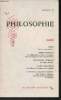
"Sommaire: Marx: Sur le ""Savoir absolu""- Rodrigo Pierre: Le philosophe, le trésor et la source, Marx, l'économie et le De Anima d'Aristore- Jean-Pierre Lefebvre: La langue de Marx, Catherine Colliot-Thélène: Max Waber et l'héritage de la conception matérialiste de l'histoire, etc. Classification Dewey : 100-PHILOSOPHIE ET DISCIPLINES CONNEXES"
[Marx Engels] - Paul Lafargue ; Wilhelm Liebknecht ; Friedrich Lessner ; Eleanor Marx-Aveling ; George Julian Harney ; Georg Weerth ; Friedrich Albert Sorge ; Guerman Lopatine ; Theodore Cuno ; August Bebel ; Jenny Marx ; Docteur Edgar Longuet ; P. Annenkov ; Franziska Kugelmann ; Anselmo Lorenzo ; Kovalevski ; Morozov ; Ernest Belfort Bax ; Edward Aveling ; Roussanov ; Voden ; Kravtchinskaïa ; Franz Mahring :
Reference : 10990
(1950)
Souvenirs sur Marx et Engels. Traduit du russe par A. Roudnikov et R. Rodov.
1950 Moscou, Editions en Langues Etrangères, sans date (circa années 1950) ; in-8, pleine percaline havane, titre doré au dos et sur plat ; 381 pp. , 36 pp. , (2) pp. , 24 planches de portraits en noir et blanc à pleine page hors-texte, 15 illustrations in-texte. exemplaire en bon état.
Reference : bd-bb37082ecebd9c18
Marx K. Capital Per M. J. Roy, totally revamped by Marx K. Le Capital Traduatio
Marx K. Capital Per M. J. Roy, totally revamped by Marx K. Le Capital Traduation de M.J. Roy, entierement revision par Lauteur. Paris: Maurice Lachatre et Cie, 1872-1875./Marks K. Kapital Per. M. D. Roya, polnostyu pererab. avt. Marx K. Le Capital Traduction de M.J. Roy, entierement revisee par Lauteur. Paris: Maurice Lachatre et Cie, 1872 1875. First French Edition. Marx K. Capital Per M. J. Roy, by Marx K. Le Capital Traduation de M.J. Roy, entierement revisee par Lauteur. Paris: Maurice Lachatre et Cie, 1872-1875. 3. We have thousands of titles and often several copies of each title may be available. Please feel free to contact us for a detailed description of the copies available. The delivery of this book might be delayed beyond the usual timeframe due to extended processing and preparation before shipment, and faster shipping options are not offered. Please inform us if you need the order by a certain date or have a deadline.SKUbd-bb37082ecebd9c18