 Write to the booksellers
677 books for « le siecle de la renais... »Edit
-
Type
Book (676)
Magazine (3)
-
Latest
Last 3 days (2)
Last month (3)
Last week (1)
-
Language
French (678)
German (1)
-
Century
19th (65)
20th (297)
21st (33)
-
Countries
Belgium (62)
Canada (5)
Côte d'Ivoire (7)
Denmark (1)
France (570)
Germany (2)
Greece (1)
Netherlands (1)
Switzerland (30)
-
Syndicate
ALAC (5)
CLAM (2)
CLAQ (1)
ILAB (311)
NVVA (4)
SLACES (4)
SLAM (297)
Topics
- Anatomy (3)
- Archaeology (3)
- Architecture (11)
- Batiffol louis (18)
- Belgium (21)
- Bernoville gaëtan (3)
- Berry (5)
- Berry andré (3)
- Bibliography (5)
- Biography (5)
- Carpenter (3)
- Catholicism (9)
- Chevrillon andré (3)
- Christianity (7)
- Dedication (3)
- Economics (4)
- Education (4)
- England (8)
- Essays (6)
- Fine arts (36)
- First edition (8)
- Flanders (13)
- Furniture (5)
- Furniture (4)
- Genealogy (4)
- Geography (17)
- Gidel charles (4)
- Hachette (3)
- Hackney (13)
- Helvética (4)
- Historical general points (3)
- History (143)
- Ile de france (3)
- Industrial arts & crafts - fine arts (28)
- Italy (20)
- Lacroix paul jacob (4)
- Larivaille paul (5)
- Literature (27)
- Lucas - dubreton (14)
- Magazine (22)
- Martini alberto (6)
- Medicine (7)
- Michelet jules (3)
- Middle ages (6)
- Modern times (9)
- Music (4)
- Newspapers press (22)
- Painters (7)
- Painting (6)
- Paris (6)
- Philosophy (11)
- Poetry (6)
- Provence (10)
- Public sale (11)
- Reform (3)
- Regionalism (6)
- Religions (8)
- Reviews (29)
- Sciences (3)
- Sculpture (8)
- Simone (3)
- Sports (12)
- Switzerland (7)
- Teaching (5)
- The book (3)
- Theatre (11)
- Thureau-dangin paul (4)
- Travel (3)
- United kingdom (7)
- Various (18)
- Velay (3)
- War (4)
- Weber eugen (3)
Renaissance. Histoire de France au seizième siècle. - [INVENTING THE ""RENAISSANCE""]
Paris, 1855. 8vo. Very nice contemporary diced half calf with gilt spine. Cracks to upper and lower hinges, and inner front hinge weak, but overall a very nice copy. A bit of brwning and soiling to first and last leaves and dampstaining to inner margin of first ab. 20 leaves. (10), CLX, 334 pp
First edition of this seminal work - the third in Michelet's series of ""The History of France"" - in which he coins the term ""Renaissance"" and uses it for the period of the sixteenth century as an historical period in its own right.The humanists of the period that we now call the Renaissance had a strong sense of being and doing something that was very different from that of the centuries before them"" they clearly thought of themselves as living in and creating a new epoch, re-inventing and re-using the classical Greek and Roman values. Once again they gave birth to the humanistic arts, literature, philosophy, painting, sculpting, etc. It is not a new invention of later times to view this historical epoch as something new and still something different, something worthy of the term ""Re-birth"", acknowledging both the source from which inspiration was drawn as well as the achievements of the new era.Thus, Michelet is not the first to understand what went on in this period, but still he changed our concept of it for ever - he invented the term which has not only determined this perioed ever since, but which has also been used to explain and understand all that went on in this most crucial period for modern man. It is in the present work by Michelet that he uses for the first time the noun ""Renaissance"" for this epoch and lets it refer to the discovery of world and of man in the 16th century. He not only lets the term refer to the artistic or scholarly part of the period, he lets it refer to the entire complex of changes that were taking place in this period, and he thus gives birth to the period as that of the mind and spirit of man, instead of just that of painting and learning. Michelet's work appeared at a time that allowed for it to exercise the greatest of influence. From the end of the 16th century until the middle of the 18th century, the history of the Renaissance was a field that barely existed. Only with Voltaire was some focus put on this period that we ever since Michelet have called the ""Renaissance"". Only with Michelet are we given the vocabulary to sum up this period and to describe it properly and in detail. When he publishes his work in 1855, historians and thinkers are ready to view this period as something in itself and as something worth noticing. That which Michelet thus began is that which Burchardt takes up in his ""Cultur der Renaissance in Italien"" (1860), in which ""Renaissance"" is finally characterized as the birth of modern humanity. Both Michelet and Burckhardt believed that modern, secular man is a product of the ""Renaissance"".""The terms ""restauratio"" or ""resttitutio"" had been applied by fourteenth-century Italian humanists to the revival of ancient languages and literatures, that of ""rinascita"" by Ghiberti and Vasari to the new blossoming art and architecture. In the eighteenth century Voltaire and Gibbon first saw the Italian civilization of the fourteenth to sixteenth centuries as an entity and as a determining factor in the whole course of European history. Michelet (324) in 1855 first used the term ""renaissance"" for this period as an historical epoch in its own right. Burckhardt, an admirer of both Voltaire and Gibbon, supplied the final synthesis."" (Printing and the Mind of Man, p. 211)
Le crépuscule de la chevalerie. Noblesse et guerre au siècle de la Renaissance
Seyssel, Champ Vallon, "Epoques", 2015, 15,5 x 24, 409 pages cousues sous couverture souple illustrée. Ouvrage enrichi de quelques illustrations noir & blanc. "Charles VIII, Louis XII et François Ier ont rêvé de l'Italie. Ils ont entraîné derrière eux des armées toujours plus nombreuses, dont le noyau était constitué de cavaliers bardés de fer, à l'esprit habité d'aventures et d'exploits comparables à ceux des héros des «vieux romans». L'imaginaire chevaleresque se nourrissait alors d'une force mobilisatrice puissante. Les rois eux-mêmes ne craignaient pas de porter les armes, au péril de leur vie, ou de leur liberté, au cours d'un combat singulier dans la fureur d'un champ de bataille. Les guerres d'Italie (1494-1559) constituent ce moment paradoxal d'apogée de l'imaginaire chevaleresque et du déclin de la cavalerie lourde. Car les armes à feu ont transformé la pratique et la culture militaires : avec son arquebuse, un fantassin sans nom pouvait sans peine tuer un grand seigneur. Victorieuse à Fornoue (1495) et Marignan (1515), la chevalerie française fut décimée à Pavie (1525). Pourtant, la mémoire des chevaliers ne s'est pas éteinte à la fin du «rêve italien». Le preux Bayard a été célébré comme le modèle de l'homme de guerre vertueux ; réels ou imaginaires, ses exploits ont été chantés pour faire oublier les malheurs et misères de la guerre. Et quelques figures exemplaires ont traversé les siècles, pour ressusciter, parfois, à l'époque contemporaine, afin d'exprimer les valeurs patriotiques et «nationales». En croisant de multiples sources (mémoires, correspondances, chroniques, oeuvres de fiction, images), en combinant approches culturelles, sociales et politiques, ce livre propose une analyse neuve de la culture militaire et une approche inédite du monde des gens de guerre au siècle de la Renaissance."

Très bon état.
TOME I - FASC I-4 - / BIBLIOTHEQUE D'HUMANISME ET RENAISSANCE : Le vrai siècle de la Renaissance, par J. Boulenger - La fille d'Ange Vergèce, par A. Dain - Un poème inconnu de Geoffroy Tory,par Jean Porcher -etc.
E.DROZ. NON DATE. In-8. Broché. Bon état, Couv. convenable, Dos satisfaisant, Intérieur frais. 166 pages. 1 carte postale de la librairie Droz.. . . . Classification Dewey : 70.49-Presse illustrée, magazines, revues
SOMMAIRE : Le vrai siècle de la Renaissance, par J. Boulenger - La fille d'Ange Vergèce, par A. Dain - Un poème inconnu de Geoffroy Tory,par Jean Porcher -etc. Classification Dewey : 70.49-Presse illustrée, magazines, revues
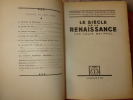
LE SIECLE DE LA RENAISSANCE par Louis Batiffol Librairie Hachette
1913 1913. LE SIECLE DE LA RENAISSANCE par Louis Batiffol 1913 Librairie Hachette
REVUE DES DEUX MONDES XXXVIe ANNEE N°2 - I.— L’ITALIE ET LA VIE ITALIENNE. — VII. — FLORENCE, LE MOYEN AGE,LE XVe SIÈCLE ET LA RENAISSANCE, par M. Henri Taine.II.- PROUDHON ET SES OEUVRES COMPLÈTES, par M. Eugène Pelletan.
AU BUREAU DE LA REVUE DES DEUX MONDES. 15 JANVIER 1866. In-12. Broché. Bon état, Couv. convenable, Dos satisfaisant, Intérieur frais. Paginé de 273 à 544.. . . . Classification Dewey : 70.49-Presse illustrée, magazines, revues
Sommaire : I.— L’ITALIE ET LA VIE ITALIENNE. — VII. — FLORENCE, LE MOYEN AGE,LE XVe SIÈCLE ET LA RENAISSANCE, par M. Henri Taine.II.- PROUDHON ET SES OEUVRES COMPLÈTES, par M. Eugène Pelletan.III.- MADAME DE NAILHAC, UN SPHINX DE LA VIE MONDAINE.IV.- EXPÉDITIONS PROJETÉES AU POLE NORD. — DE LA POSSIBILITÉ D’AT-TEINDRE LE POLE NORD, NOUVEAUX PLANS DE CAMPAGNE PROPOSÉS EN ANGLETERRE ET EN ALLEMAGNE, par M. Charles Martins.V. — ÉTUDES SUR LES TRAVAUX PUBLICS. — LES CHEMINS DE FER VICINAUX, par M. H. Blerzy.VI. - HUIT MOIS EN AMÉRIQUE A LA FIN DE LA GUERRE, LETTRES ET NOTES DE VOYAGE, 1864-1865. — IX. — LA VIE POLITIQUE A WASHINGTON, LE CAPITOL: ET LA MAISON-BLANCHE, par M. Ernest Duvergier de Hauranne.VII.- L’HISTOIRE DE LA PHILOSOPHIE ET L’ÉCLECTISME, par M. PaulJanet, de l’Institut.VIII.— CHRONIQUE DE LA QUINZAINE, HISTOIRE POLITIQUE ET LITTÉRAIRE.IX.— ESSAIS ET NOTICES. — LE GÉNÉRAL PRIM, par M. Charles deMazade.X.— BULLETIN BIBLIOGRAPHIQUE. Classification Dewey : 70.49-Presse illustrée, magazines, revues
Demeure historique n° 96 - Questions par Denis Picard, Le Marais de mains en mains par Anna de Bagneux, L'Etat et nous par Olivier Choppin de Janvry, Chateaux de France au siècle de la Renaissance par Jean Pierre Babelon, Entretenir un plan d'eau
Association des propriétaires de monuments historiques privés. 4e trimestre 1989. In-12. Broché. Bon état, Couv. convenable, Dos satisfaisant, Intérieur frais. 36 pages. Nombreuses illustrations en couleurs et noir et blanc dans et hors texte.. . . . Classification Dewey : 720-Architecture

Sommaire : Questions par Denis Picard, Le Marais de mains en mains par Anna de Bagneux, L'Etat et nous par Olivier Choppin de Janvry, Chateaux de France au siècle de la Renaissance par Jean Pierre Babelon, Entretenir un plan d'eau (suite) par Charles d'Ussel Classification Dewey : 720-Architecture
L'ART DES ORIGINES A NOS JOURS, FASC. 19, L'ART ITALIEN AU XVIe SIECLE (SUITE), LA RENAISSANCE EN FRANCE
Librairie Larousse. 1932. In-4. En feuillets. Etat d'usage, Couv. convenable, Coiffe en pied abîmée, Intérieur frais. Paginé de 289 à 304. Feuillets doubles non brochés. Illustré de nombreuses photos héliogravées en noir et blanc dans et hors texte. Texte sur 2 colonnes.. . . . Classification Dewey : 709-Histoire des arts
Sous la dir. de Léon Deshairs. L'Art italien au XVIe siècle (suite). La Renaissance en France. Classification Dewey : 709-Histoire des arts
Le siècle de la Renaissance. 5e édition.
P., Hachette, 1921, in 8, broché, II-419 pages
PHOTOS sur DEMANDE. Fermeture du 1er au 23 Août


Phone number : 04 77 32 63 69
LE SIÈCLE DE LA RENAISSANCE
LE SIÈCLE DE LA RENAISSANCE Louis Batiffol vol relié percaline à coins, 215x160, bel état intérieur, 419pp, Paris Hachette ss date vers 1940 rf/c61
Gothier Louis, FOUSS Madeleine, HAYT Franz, DURBECQ Léon, GODEFROID Jean, GEORGES Jean
Reference : 62975
"Illustration de notre passé (15 fascicules); 1. Des origines à l'Age du fer; 2. De la romanisation aux invasions normandes; 3. Le monde seigneurial; 4. Le milieu urbain; 5. L'Eglise médiévale; 6. Le siècle de Bourgogne; 7. Les techniques du XVe au XXe siècle; 9.La Renaissance, la Réforme et la restauration catholique; 10 Les régimes austro-espagnol et espagnol; 11. Le régime autrichien, Les révolutions brabançonne et liégeoise; 12. Les régimes français et hollandais 13. La Belgique indépendante, 1830-1914; 14 : La Belgique indépendante, 1830-1914 (suite); 15 : La Belgique contemporaine."
Bruxelles, La Renaissance du Livre, 1967. 23 x 31, sans pagination, 217 illustrations en N/B, 15 illustrations en couleurs, broché et en feuille sous chemises à rabats, bon état.
complet de toutes les pages et de toutes les planches.
SCHMIDT, Albert-Marie. BOYER, Frédéric. ROGER, Jacques. FORESTIER, Louis. ROBICHEZ, Jacques. DECAUDIN, Michel.
Reference : 19035
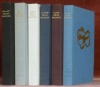
XIVè et XVè siècles français : Les sources de l’Humanisme. 250 p. XVIè siècle français : La Renaissance. 248 p. XVIIè siècle français : Le Grand Siècle. 236 p. XVIIIè siècle français : Le Siècle des Lumières. 239 p. XIXè siècle français : Le Siècle romantique. 253 p. XXè siècle français : Les Temps Modernes. 255 p. Collection “Connaissances/Les Grands Siècles Français” , 6 volumes.
Lausanne, La Guilde du Livre 1964, 165x130mm, reliure d'éditeur. Très bel exemplaire.
richement illustré, Pour un paiement via PayPal, veuillez nous en faire la demande et nous vous enverrons une facture PayPal
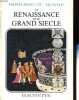
Histoire du monde - La Renaissance et le grand siècle : I: La Renaissance - II: Réformes et explorations - III: L'époque des grands souverains (1 volume).
Hachette. 1966. In-8. Relié. Etat d'usage, Coins frottés, Mors fendus, Papier jauni. 284 pages, nombreuses illustrations, cartes et photos en couleur et en noir et blanc dans et hors texte.. . . . Classification Dewey : 900-GEOGRAPHIE, HISTOIRE, SCIENCES AUXILIAIRES DE L'HISTOIRE
Classification Dewey : 900-GEOGRAPHIE, HISTOIRE, SCIENCES AUXILIAIRES DE L'HISTOIRE
Le siècle de la RENAISSANCE .
broché - 15,5x21 - 419 pp - 1955 - éditions HACHETTE, Paris.Collection " l'histoire de France racontée à tous ", publiée sous la direction de FR. FUNCK-BRENTANO.
ANTHROLOGIE HISTOIR PHILOSOPHIE LITTERATURE PARADES
Le livre en Franche-Comté.De la copie à l'imprimé: manuscrits et en Franche-Comté.Le papier en Franche -Comté du XVIe AU XIXe siècle.Humanisme et Renaissance.Le livre conquérant ( xviie siècle).Nouveaux publics, nouveaux marchés ( XVIIIe siècle).Aspects du livre comtois au XIXe et au XXe siècle.Petit journal de l'exposition.incunablesTable des illustration
broché - 16x24 - 176pp - 1984 - editions cahiers dolois n°7
ANTHROLOGIE HISTOIR PHILOSOPHIE LITTERATURE PARADES
CHATEAUX DE FRANCE AU SIECLE DE LA RENAISSANCE
Flammarion.1989.In-4 toilé bleu avec jaquette ill.en couleurs.Etui muet.838 p.Très bel exemplaire.
Le Siècle de la Renaissance.
Deuxième édition, 1 vol. grand in-8 carré reliure plein veau marbré, Librairie Hachette et Cie, Paris, 1911, 419 pp.
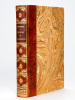
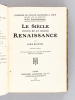
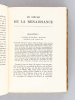
Bon exemplaire, très bien relié
LE SIÈCLE DE LA RENAISSANCE.
1911 Paris, librairie Louis Hachette et Cie, collection L'Histoire de France racontée à tous, 1911. Deuxième édition. In-8 de 419 pp. Reliure demi-chagrin brun bordée d'un filet doré, dos à nerfs orné de filets et de motifs dorés, lettres dorées, tranche supérieure dorée. Très bon état extérieur et intérieur, sans annotations ni soulignements.

La renaissance et le grand siecle. i. la renaissance.
Gnrique Broch D'occasion tat correct 01/01/1965 150 pages
LA RENAISSANCE ET LE GRAND SIECLE. I. LA RENAISSANCE.
HACHETTE. 1966. In-4. Cartonné. Etat d'usage, Couv. légèrement passée, Coiffe en tête abîmée, Intérieur frais. 284 pages. Premier plat illustré en couleurs. Nombreuses photos et illustrations en couleurs et noir et blanc dans et hors texte.. . . . Classification Dewey : 944-Histoire de France varia
Classification Dewey : 944-Histoire de France varia
N°285 - BORDURE - BORDER - EINFASSUNG - bordure de linge de table, style espagnole XVIe siecle, ruban style italien XVe siecle, musée de South-Kensington (Londres), bordure toile espagne XVIe siecle, bordure toile, renaissance italienne XVIe siecle
DUCHER E.. FEVRIER 1896. In-4. En feuillets. Etat d'usage, Couv. convenable, Dos satisfaisant, Intérieur frais. 8 pages - nombreuses illustrations en noir et blanc et monochromes dans et hors texte, accompagnées d'une legende.. . . . Classification Dewey : 720-Architecture
PUBLICATION MENSUELLE Classification Dewey : 720-Architecture
LA CONFESSION D'UN ENFANT DU SIECLE / COLLECTION LA RENAISSANCE DU LIVRE
MIGNOT. NON DATE. In-12. Relié. Etat d'usage, Couv. convenable, Dos satisfaisant, Quelques rousseurs. 227 pages - couverture conservée, partiellement désolidarisée. . . . Classification Dewey : 840.08-XIX ème siècle
Classification Dewey : 840.08-XIX ème siècle
"La Renaissance et le Grand siècle : I. La Renaissance - II. Réformes et explorations - III. L'époque des grands souverains (Collection : ""Histoire du Monde"")"
Hachette. 1966. In-4. Relié. Bon état, Couv. convenable, Dos satisfaisant, Intérieur frais. 284 pages augmentées de nombreuses illustrations en couleurs dans et hors texte. Texte sur deux colonnes.. . . . Classification Dewey : 944-Histoire de France varia
"Collection : ""Histoire du Monde"". Classification Dewey : 944-Histoire de France varia"
Le siècle de la Renaissance
P, Hachette , 1913 , gr in8br , 419pp , mouillures sur les dernières pages, couverture défraichie Langue: Français
Le siècle de la Renaissance.
P., Hachette (Collection "L'Histoire de France racontée à tous"), 1947, in 8, broché, 419 pages
Collection "L'Histoire de France racontée à tous". PHOTOS sur DEMANDE. Fermeture du 1er au 23 Août
Phone number : 04 77 32 63 69
XVIe siècle français : La Renaissance.
Lausanne, Guilde du Livre (Collection Les Grands Siècles Français), 1961, in 12 carré relié pleine toile grise décorée de léditeur, 250 pages ; importante iconographie ; index in-fine.
Tirage limité et numéroté. PHOTOS sur DEMANDE. Fermeture du 1er au 23 Août
Phone number : 04 77 32 63 69

