Write to the booksellers
901 books for « einstein »Edit
-
Type
Book (892)
Magazine (8)
Old papers (1)
-
Latest
Last month (11)
Last week (2)
-
Language
English (3)
French (793)
German (1)
Russian (104)
-
Century
19th (1)
20th (380)
21st (129)
-
Countries
Belgium (49)
Côte d'Ivoire (1)
Denmark (26)
France (648)
Germany (2)
Switzerland (66)
United States of America (109)
-
Syndicate
CLAM (1)
ILAB (370)
NVVA (12)
SLACES (12)
SLAM (330)
SNCAO (2)
Topics
- Ampere andré - marie (2)
- Aquitaine (2)
- Archaeology (2)
- Aristotle (2)
- Astronomy (6)
- Astrophysics (4)
- Atomic bombs (2)
- Barnett lincoln (6)
- Bergson henri (5)
- Biography (46)
- Biology (2)
- Carriere jean-claude (3)
- Chemistry (8)
- Children’s books (3)
- Cinema (2)
- Comic strip (3)
- Dukas paul (3)
- Einstein (141)
- English (4)
- Epistemology (5)
- Esotericism (2)
- Ethic (4)
- Fabre lucien (5)
- Figaro (5)
- Fine arts (2)
- First edition (9)
- Genealogy (3)
- Geometry (3)
- Germanic languages (3)
- Germany (2)
- Guittoneau ben (2)
- Hackney (2)
- Hebraic literature (3)
- Helvética (4)
- Historical general points (4)
- History (31)
- Hoffmann (12)
- Humour anecdotes (2)
- Jesuits (2)
- Journalism (7)
- L'illustration (newspaper) (8)
- Language (2)
- Lewis sinclair (6)
- Lincoln (6)
- Literature (22)
- Magazine (62)
- Mathematics (30)
- Mechanics (4)
- Medicine (7)
- Merleau ponty (3)
- Newspaper (4)
- Newspapers press (73)
- Newton (1)
- Nigger (2)
- Nordmann charles (10)
- Nuclear (5)
- Painting (2)
- Paris (2)
- Paris match (2)
- Periodicals (3)
- Philosophy (37)
- Physics (79)
- Poincaré raymond (3)
- Poitou (2)
- Psychology (6)
- Puech michel (2)
- Religions (4)
- Review (5)
- Reviews (69)
- River (3)
- Ruth (2)
- Saki (5)
- Sciences (78)
- Sciences & technique (22)
- Social sciences (2)
- Spiritualism (2)
- Switzerland (4)
- Tea (9)
- Technology (7)
- Telephone - telegraph (3)
- Testimonies / stories (2)
- Theory (3)
- Thuillier pierre (6)
- Travel (4)
- Universe (2)
- Various (6)
- Youth (6)
Über die Interferenzeigenschaften des durch Kanalstrahlen emittierten Lichtes [Einstein] (+) Über die Interferenzeigenschaften des Kanalstrahllichtes [Rupp]. Offprint from ""Sitzungsberichte der Preussischen Akademie der Wissenschaften"", XXV, 1926. - [THE GREATEST SCANDAL IN PHYSICS - AUTHOR'S PRESENTATION OFFPRINT ISSUE]
1926. Royal8vo. Author's presentation offprint with the printed presentation statement on top of frontwrapper ""Überreicht von den Verfassern"" [i.e. ""Given by the authors""]. Original printed wrappers. Front wrapper loose, but fully intact. ""Chilpp 202"" and ""Recdese 160"" written in hand to top of front wrapper. A very fine and clean copy. Pp. 334-351.
First edition, in the scarce author's presentation offprint issue, of this important paper, which contains Einstein's theories on wave-particle duality and German physicist Rupp's work on the same subject, seemingly to corroborating Einstein's theories. Rupp's experimental results later turned out to have been falsifications, and today he is mainly known as the protagonist in one of the biggest scandals in physics in the 20th century.Rupp published a number of papers on the interference properties of light emitted by canal ray sources. These articles, particularly the present that came into being in close collaboration with Albert Einstein, attracted quite a lot of attention, as they probed the wave versus particle nature of light. They also significantly propelled Rupp's career, even though they were considered highly controversial to begin with.In April 1926, Albert Einstein proposed to Emil Rupp to carry out two experiments that were to prove the wave nature of light versus the particle nature of light: the so-called 'Wire Grid Experiment' and the 'Rotated Mirror Experiment', experiments that Einstein had worked on theoretically and now would like to gain confirmation of through experiments. Rupp, at the time regarded as one of the most important and most competent experimental physicists, gladly took up the challenge. Rupp's observations - though highly controversial - confirmed Einstein's theory. Due to the surprising outcome of the experiments, Einstein was interested in exactly how it they were conducted, as Rupp's initial descriptions did not convince him that the results were feasible.""Rupp stood by his observations and suggested yet other circumstances that might explain them. Did Einstein now realize that there was something rather dubious about Rupp's work? He had seen him change his data repeatedly-and each time in better accordance with his own criticism, and on one occasion in no less than two days. He had had to accept that Rupp claimed to earlier have ""unknowingly"" or ""unconsciously"" rotated a mirror, and he will likely have seen that Rupp's work was highly controversial amongst experimentalists, leading to very public criticism in Die Naturwissenschaften. He himself was now also convinced that, in fact, Rupp's results were incomprehensible. So, did Einstein choose to suspend the publication of Rupp's piece, so that an additional round of checks and balances could take place? The answer is no: Rupp's paper was presented by Einstein to the Prussian Academy in a session on 21 October 1926, and it appeared in print in the Academy's proceedings in November of 1926-the articles by Einstein and Rupp came out back to back, and reprints circulated with both papers bound together, with a joint cover page that displayed both titles. Einstein referred in his article to Rupp's claims and he had even written the abstract of Rupp's paper"" (Dongen: ""Emil Rupp, Albert Einstein and the Canal Ray Experiments on Wave-Particle"").The first clear indication that Rupp's work was impossible to recreate came in 1930 in a paper published by Staub - nothing was wrong with Einstein's theory but Rupp's work was simply impossible: ""Rupp immediately set out to respond to Straub's publication. On 12 July 1930 he sent a first draft to Einstein, to whom he also announced his intention of redoing his canal ray experiments-Straub was dismissed as a clumsy graduate student with a lousy apparatus. Einstein suggested inviting Straub once Rupp had his experiment up and running again, but cautioned him not to engage the polemic in too sharp a tone"". Rupp managed to convince the physics society and continued to publish the new few years. In 1934 various different physicians pointed out that Rupp's work was impossible to recreate, and in 1935 the final blow to Rupp's career came about, when the German Physical Society's decided not to allow any citations of Rupp's work. This seems to have had very severe consequences, as today it is almost impossible to find any quotations - or even mentioning of Rupp in general, let alone his fraud - in any historical studies of either quantum theory or of Einstein.Despite the unquestionable fraud by Rupp, his experiments and collaboration with Einstein might have had a positive influence on the further progression to quantum mechanics. The two present papers became of seminal importance in the discussions between Bohr and Heisenberg, which eventually in 1927 resulted in Heisenberg publishing his landmark thesis on the uncertainty principle. When Max Born received the Nobel Prize in physics he stated that: ""An idea of Einstein gave me the lead [From the present paper]. He had tried to make the duality of particles-light quanta or photons-and waves comprehensible by interpreting the square of the optical wave amplitudes as probability density for the occurrence of photons.""Boni 160" Weil 153.
Hoffmann (Banesh) - Dukas (Helen) - Einstein (Albert), sur - Claude Manly, traduction
Reference : 86839
(1975)
Albert Einstein - Créateur et rebelle avec la collaboration de Helen Dukas, traduit de l'américain par Claude Manly (Relativité et Quanta)
Editions du Seuil Malicorne sur Sarthe, 72, Pays de la Loire, France 1975 Book condition, Etat : Bon broché, sous couverture imprimée éditeur, illustrée d'une photographie d'Albert Einstein à la fin de sa vie, pleine page en couleurs grand In-8 1 vol. - 304 pages
très nombreuses illustrations dans le texte en noir et blanc, certaines pleine page, photographies et figures, 2 planches hors-texte en fin d'ouvrage (complet) 1ere traduction en français, 1975 Contents, Chapitres : Préface - L'homme et l'enfant - L'enfant et le jeune homme - Prélude - Une nouvelle lumière point - L'agitation atomique - Des temps meilleurs - De Berne à Berlin - Des Principia à Principe - De Principe à Princeton - La Bataille et la bombe - A l'échelle de l'Univers - Tous les hommes sont mortels - Index et table des illustrations - Banesh Hoffmann (6 septembre 1906 à Richmond, Grande-Bretagne 5 août 1986) est un physicien théoricien anglais. Il semble avoir été le premier physicien à mentionner au grand public la possibilité de 11 dimensions dans l'univers, et cela dès 1967. - Doctorat en 1932 à l'université de Princeton sous la direction d'Oswald Veblen. Collaborateur d'Einstein à Princeton en 1935-1937. Publication conjointe d'un article sur le problème du mouvement en relativité générale. Nommé professeur de mathématiques au Queen's College de l'université de la ville de New York en 1952, où il restera jusqu'à la fin des années 1970, bien qu'il soit officiellement retraité dans les années 1960. - Helen Dukas (17 octobre 1896 10 février 1982) est la secrétaire et biographe d'Albert Einstein. Elle a coécrit Albert Einstein: Creator and Rebel et codirigé Albert Einstein: The Human Side, avec Banesh Hoffmann. - Son vrai prénom est Helene. Elle naît le 17 octobre 1896, d'un marchand juif allemand nommé Leopold Dukas et de Hannchen (née Liebmann). Née, élevée et éduquée à Freiburg-im-Breisgau, elle avait six frères et surs et un fils du nom de David. Hannchen Dukas était originaire de la ville de Hechingen, tout comme Elsa Einstein, la seconde épouse d'Albert Einstein. C'est par ce biais que Helen Dukas devient la secrétaire de celui-ci en 1928. Après la mort d'Elsa Einstein, en 1936, Helen Dukas s'occupera des tâches ménagères de la famille Einstein, qui vit à Princeton, dans le New Jersey, où elle restera jusqu'à sa mort, le 10 février 1982. Elle y avait suivi le physicien en 1933. Helen Dukas est l'une des deux personnes choisies par Einstein, selon son testament, pour détenir les droits à l'ensemble de ses manuscrits, droits d'auteur et droits de publication. L'autre fidéicommissaire était l'économiste Otto Nathan. Ils ont travaillé sur la compilation de documents nommée The Collected Papers of Albert Einstein, à l'aide de sources déposées à l'Université hébraïque de Jérusalem, dont elle était spécialiste. Fred Jerome a écrit un livre qui avance la thèse selon laquelle Albert Einstein et Helen Dukas ont été surveillés par le Federal Bureau of Investigation, pendant la direction de J. Edgar Hoover. (source : Wikipedia) couverture à peine jaunie avec d'infimes traces de pliures, notamment au dos, très légère tache sombre au bas du plat inférieur de la couverture, des deux côtés, l'intérieur est sinon frais et propre, quelques rousseurs sur la tranche centrale n'affectant pas l'intérieur, cela reste un bon exemplaire de cette bibliographie très documentée sur Albert Einstein par l'un de ses collègues à Princeton en 1935-1937, Banesh Hoffmann, 1906-1986, dans sa 1ere édition française de 1975 - NB : Il ne s'agit pas de l'édition en poche mais d'un volume en grand format de l'édition de 1975
Einstein Lived Here
Clarendon Press - Oxford University Press Malicorne sur Sarthe, 72, Pays de la Loire, France 1994 Book condition, Etat : Bon hardcover, editor's full black clothes, no dust-jacket grand In-8 1 vol. - 398 pages
few text-figures in black and white 1st edition Contents, Chapitres : To the Reader, References, Contents, List of illustrations, xvi, Text, 282 pages - In the shadow of Albert Einstein - Reflections on Bohr and Einstein - De Broglie, Einstein and the birth of the matter wave concept - Einstein, Newton and success - A mini-briefing on relativity, for the layman - How Einstein got the Nobel Prize - Helen Dukas, in memoriam - Samples from Die komische Mappe - The Indian connection : Tagore and Gandhi - Einstein on religion and philosophy - Einstein and the press - Onomasticon - Subject index no dust-jacket, else fine copy, no markings
The Advancement of Science, and its Burdens , The Jefferson Lecture and Other Essays (Albert Einstein)
Cambridge University Press Malicorne sur Sarthe, 72, Pays de la Loire, France 1986 Book condition, Etat : Bon paperback, editor's red wrappers grand In-8 1 vol. - 362 pages
1st edition, 1986 (paperback) "Contents, Chapitres : Contents, Preface, xi, Text, Notes, Acknowledgments, Index, 351 pages - 1. Einstein and the culture of science : Thematic presuppositions and the direction of scientific advance - Einstein's model for constructing a scientific theory - Einstein's scientific program : The formative years - Einstein's search for the Weltbild - Einstein and the shaping of your imagination - Physics in America, and Einstein's decision to immigrate - 2. On the history of twentieth-century physical science : "" Success sanctifies the means "" : Heisenberg, Oppenheimer, and the transition to modern physics - Do scientists need a philosophy ? - Science, technology, and the fourth discontinuity - 3. Science, education, and the public interest : The two maps - From the endless frontier to the ideology of limits - Metaphors in science and education - "" A natin at risk "" revised - "" The advancement of science, and its burdens "" : the Jefferson Lecture" near fine copy, the editor's wrappers is near fine, spine is lightly discoloured, inside is fine, no markings
Sugimoto (Kenji) - Einstein (Albert), sur - Bardos (Jean-Pierre), traduction
Reference : 100327
(1990)
Albert Einstein - Biographie illustrée - 500 photos et documents commentés , Traduction de Jean-Pierre Bardos
Belin Malicorne sur Sarthe, 72, Pays de la Loire, France 1990 Book condition, Etat : Bon relié, cartonnage éditeur illustré bleu, illustré d'un portrait d'Albert Einstein pleine page Petit In-4 carré 1 vol. - 223 pages
500 photographies et documents en noir et blanc 1ere traduction en français, 1990 Contents, Chapitres : Kenji Sugimoto : Préface - Biographie illustrée de tres nombreuses photographies et fac-similés de documents divers et variés - Avec quelques lettres en Annexe, une chronologie détaillée de 25 pages, la liste des publications scientifiques d'Einstein et autres, les biographies et un index - Kenji Sugimoto, né en 1947 et mort le 19 octobre 2006 à Osaka, fut un pédagogue des sciences naturelles japonais. Sugimoto était professeur à l'Université Kinki. De 1985 à 1987 il travailla à l'Université Louis-et-Maximilien de Munich. Son uvre la plus connue est Albert Einstein: A Photographic Biography. cartonnage à peine jauni, sinon bon exemplaire, intérieur frais et propre, quelques rousseurs sur les premières et dernières pages, de cet ouvrage de Kenji Sugimoto sur Albert Einstein. A notre connaissance, c'est l'iconographie la plus détaillée qui existe sur Einstein, une référence.
Einstein, History and Other Passions - The Rebellion against Science at the End of the Twentieth Century
Addison - Wesley Publishing Company Malicorne sur Sarthe, 72, Pays de la Loire, France 1996 Book condition, Etat : Bon paperback, editor's blue and black wrappers, illustrated by a portray of Einstein grand In-8 1 vol. - 242 pages
1st edition, 1996 "Contents, Chapitres : Contents, Preface, xii, Text, Notes, Ackowledgments, Index, 240 pages - 1. Science in history : What place for science at the "" end of the Modern Era "" ? - The public image of science - "" Doing one's damnedest "" : The evolution of trust in scientific findings - Imagination in science - Understanding the history of science - 2. Learning from Einstein : Enstein's influence on the culture of our time - Einstein and the goal of science - Of physics, love, and other passions : The letters of Albert and Mileva - "" What, precisely, is thinking ? "" ... Einstein's answer " near fine copy, no markings except a translation agency stamp and a letter enclosed, text remains clean and unmarked, a rather nice copy
Guye (Charles-Eugène), Ratnowsky (S.) et Lavanchy (Ch.) sur Albert Einstein et H.-A. Lorentz
Reference : 100484
(1921)
Vérifications expérimentales de de la formule de Lorentz-Einstein faite au Laboratoire de Physique de l'Université de Genève , dans les Mémoires de la Société de Physique et d'Histoire Naturelle de Genève, volume 39, fascicule 6 (Relativité restreinte)
Imprimerie Albert Kundig à Genève , Mémoires de la Société de Physique et d'Histoire Naturelle de Genève Malicorne sur Sarthe, 72, Pays de la Loire, France 1921 Book condition, Etat : Bon broché, sous couverture imprimée éditeur crème In-4 1 vol. - 82 pages
3 planches hors-texte (planches 3, 4 et 5, complet) et 11 figures dans le texte 1ere édition, édition originale, 1921 "Contents, Chapitres : Paginé 273 à 354 (82 pages) - Avant-propos - Dynamique des grandes vitesses - Aperçu historique - 1. Expérience de MM. Guye et Ratnovsky - Résultats - Conclusions de la 1ere partie - 2. Expériences de MM. Guye et Lavanchy : Méthode - Dispositif expérimental - Mesures préliminaires - Résultats et conclusions de la 2eme partie - Tableaux complets des résultats (Résultat - Théorie de Lorentz-Einstein et Théorie d'Abraham comparés) - 3 Planches commentées en regard - Appendice : Formule et tables - Charles-Eugène Guye, né le 15 octobre 1866 à Saint-Christophe, commune de Champvent dans le canton de Vaud, Suisse et mort le 15 juillet 1942 à Genève, est un physicien suisse. - Guye étudie la physique à l'Université de Genève où il reçoit son doctorat en 1889. De 1890 à 1892, il est privatdozent à Genève, et de 1893 à 1900, il est privatdozent au Polytechnicum de Zürich (aujourd'hui l'École polytechnique fédérale de Zurich). De 1900 à 1930, il est professeur ordinaire et directeur de l'institut de physique de l'Université de Genève. Il a comme doctorante Catherine Chamié qui soutient en 1913 une thèse intitulée Influence de la rapidité des variations du champ magnétisant sur l'hystérésis alternative et qui ira ensuite travailler à Paris avec Marie Curie. Il a principalement étudié les courants électriques, le magnétisme et les décharges électriques dans les gaz. Il a réalisé des expériences qui démontrent la dépendance de la masse de l'électron à sa vitesse dans le but de valider les prévisions de Lorentz et Einstein dans le cadre de la relativité restreinte. Il a participé aux 5e et 7e congrès Solvay. Il a écrit plusieurs ouvrages de vulgarisation et plus de 200 articles de physique (source : Wikipedia) - Comme l'indique C.-E. Guye dans l'avant-propos : ""Les travaux qui font l'objet de ce mémoire on été entrepris à la suite des discussions auxquelles avaient donné lieu les expériences bien connues de Kaufmann sur la variation d'inertie des corpuscules beta du radium. Ces expériences avaient démontré la variation d'inertie des corpuscules beta en fonction de la vitesse, mais elles étaient insufisamment précises pour permettre de trancher la question de savoir si cette variation était conforme à la théorie d'Abraham (Electron sphérique, indéformable) ou s'il fallait tenir compte dans cette variation de la contraction de Lorentz-Einstein, conformément au principe de relativité (...). Deux ans plus tard, M. Bucherer entreprit de nouvelles déterminations qui sans permettre de trancher définitivement la question étaient cependant plus favorable à la théorie de Lorentz-Einstein qu'à celle d'Abraham. L'idée me vient alors de chercher à attaquer le problème par l'étude des rayons cathodiques de grande vitesse. (...). mais la production de ces rayons, que l'on ne peut obtenir que dans des vides très poussés, présente au niveau expérimental de grandes difficultés. (...). Je me suis arrêté à la méthode que j'ai appelée ""Méthode des trajectoires identiques""." Bon exemplaire, couverture propre avec de légères traces de pliures, bas du dos un peu bruni avec un léger manque, également le bas du bord gauche du plat supérieur, dos à peine strié, coin supérieur gauche du volume à peine corné, infime petit manque de papier au coin inférieur droit du plat supérieur, la couverture originale reste en bon état, intérieur sinon très frais et propre, le papier n'est qu'à peine jauni sans aucune gravité, bien complet des 3 planches hors-texte présentant les installations du laboratoire et les résultats de la vérification, cela reste un bon exemplaire malgré ces petits défauts
Einstein (Albert) - Anna Beck and Peter Havas, eds. - Alfred Engel and Engelbert Schucking
Reference : 100209
(1998)
The Collected Papers of Albert Einstein - 7 First Volumes - English Translation by Anna Beck and Peter Havas - Volume 1. The Early Years, 1879-1902 - Volume 2. The Swiss Years : Writings, 1900-1909 - Volume 3. The Swiss Years : Writings, 1909-1911 - Volume 4. The Swiss Years : Writings, 1912-1914 - Volume 5. The Swiss Years : Correspondence, 1902-1914 - Volume 6. The Berlin Years : Writings, 1914-1917 - Volume 7. The Berlin Years : Writings, 1918-1921 - Volume 8. Berlin Years : Correspondence 1914-1918 (3 last volumes Edited by Alfred Engel and Engelbert Schucking) - (Physique, Physics, Relativité, Relativity - Oeuvres complètes)
Princeton University Press , The Collected Papers of Albert Einstein Malicorne sur Sarthe, 72, Pays de la Loire, France 1998 Book condition, Etat : Bon paperback, editor's printed wrappers, volume 1 is black, 7 other volumes are white In-4 8 vol. - 3408 pages
Contents, Chapitres : V.1. (1987), Contents, Publisher's Foreword (March 1987), Preface, Maja Winteler-Einstein, A Biographical Sketch, xxii, Text, 196 pages - V.2. (1989), Contents, Publisher's Foreword (September 1989), Preface, xiv, Text, 399 pages - V.3. (1993), Contents, Publisher's Foreword (August 1993), Preface, xi, Text, 437 pages - V.4. (1996), Contents, Publisher's Foreword (April 1996), Preface, xi, Text, 314 pages - V.5. (1995), Contents, Publisher's Foreword (October 1994), Preface, xxii, Text, 384 pages - V.6. (1997), Contents, Publisher's Foreword (May 1997), Preface, xii, Text, 449 pages - V.7. (2002), Contents, Publisher's Foreword (January 2002), xv, Text, 383 pages - V.8. (1998), Contents, Foreword, Acknowledgments, xxv, Text, 714 pages "8 first volumes of the Collected Papers of Albert Einstein published by Princeton, original paperback first edition, published from 1987 to 1997, homogeneous set but the first volume is black and the 6 following are white, very nice set, wrappers very lightly yellowing, quite nothing, else fine copy, inside is fine, no markings, few foxings on the right side of the volumes but not inside, a very important publications with all the papers from Einstein from 1879 to 1921, the most important period of his carreer with, for instance, the discovery of relativity, 1905 (""On the Electrodynamics of Moving Bodies"", volume 2, page 140) - The complete set should be in 15 volumes (volumes 9 to 15 are missing here) - NB : It may have additional shipping fees, according to the delivery address, the weight of the set is over 6,6 kilos, please contact us, should you need more informations"
Canguilhem (Georges) et Taton (René), eds. - J. Billard - J. Bromberg on Heisenberg - M. W. Burke-Gaffney - P. Forman - P.G. Hamamdjian sur Ampère - A. Hermann - T. Hirosige - D. Ivanenko - F. Herneck on Einstein und Schopenhauer - M. A. Hoskin on Edwin Hubble - B. Kouznetsov sur Galilée et Einstein - O.A. Lezehneva - S. Nisio - V. Parkazdé - E. Rybka - K.F. Schaffner on Lorentz - B.I. Spassky - B. J. Spencer on Bohr and Zeeman - R.H. Stuewer on Arthur Holly Compton - W.H. Venable on Samuel P. Langley - David Weiner - E. Yagi on Nagaoka - J.M. Zemplen on Eotvos
Reference : 101137
(1971)
Actes du XIIe Congrès International d'Histoire des Sciences - Tome V (5). Histoire de la physique, y compris l'astronomie , Paris, Conservatoire des Arts et Métiers, du 25 au 31 août 1968 (Etudes de la propagation des ondes lumineuses dans les milieux à la fois anisotropes et actifs - Heisenberg's paper on nuclear structure - Spectroscopic observations on Comet 1882, II - On the discovery of the diffraction of X-Rays by cristals - Genèse des idées d'Ampère en électromagnétisme - Zur Frühgeschichte der Quantentheorie - The decline of the Ether - Main periods of Soviet physics - Einstein und Schopenhauer - Edwin Hubble and the existence of external galaxies - Galilée et Einstein - Soviet scientific research in the history of physics - Chemical considerations and Bohr atom model - Développement de la physique en Géorgie au Xxe - Plan of a general history of astronomy - Theory and experiment in Lorentz's contraction hypothesis - Concept de modèle en physique - Bohr theory and Zeeman effect - Arthur Holly Compton and the reflexion of X-Rays - Samuel P. Langley's Bolometer and far Infra-Red - History of the 20th cy. Physics - Nagaoka's Saturnian Atomic model - Eotvos experiment and modern physics)
Librairie Scientifique et Technique Albert Blanchard , Congrès International d'Histoire des Sciences Malicorne sur Sarthe, 72, Pays de la Loire, France 1971 Book condition, Etat : Bon broché, sous couverture imprimée éditeur verte grand In-8 1 vol. - 127 pages
1ere édition, 1971 Contents, Chapitres : J. Billard : Etudes de la propagation des ondes lumineuses dans les milieux à la fois anisotropes et actifs - J. Bromberg : Heisenberg's paper on nuclear structure - M. W. Burke-Gaffney : Spectroscopic observations on Comet 1882, II - P. Forman : On the discovery of the diffraction of X-Rays by cristals - P.G. Hamamdjian : Genèse des idées d'Ampère en électromagnétisme - A. Hermann : Zur Frühgeschichte der Quantentheorie - T. Hirosige : The decline of the Ether - D. Ivanenko : Main periods of Soviet physics - F. Herneck : Einstein und Schopenhauer - M. A. Hoskin : Edwin Hubble and the existence of external galaxies - B. Kouznetsov : Galilée et Einstein - O.A. Lezehneva : Soviet scientific research in the history of physics - S. Nisio : Chemical considerations and Bohr atom model - V. Parkazdé : Développement de la physique en Géorgie au Xxe - E. Rybka : Plan of a general history of astronomy - K.F. Schaffner : Theory and experiment in Lorentz's contraction hypothesis - B.I. Spassky : Concept de modèle en physique - B. J. Spencer : Bohr theory and Zeeman effect - R.H. Stuewer : Arthur Holly Compton and the reflexion of X-Rays - W.H. Venable : Samuel P. Langley's Bolometer and far Infra-Red - C. Weiner : History of the 20th cy. Physics - E. Yagi : Nagaoka's Saturnian Atomic model - J.M. Zemplen : Eotvos experiment and modern physics bords des plats à peine jaunis, sinon bel exemplaire, intérieur frais et propre, coins à peine cornés, papier très légèrement jauni, cela reste un bon exemplaire - Actes du XIIeme Congrès International d'Histoire des Sciences - Tome 5 seul, complet en lui-même sur l'Histoire de la physique et l'astronomie
Einstein à Paris
Presses Universitaires de Vincennes , Histoires de Science Malicorne sur Sarthe, 72, Pays de la Loire, France 1992 Book condition, Etat : Bon broché, sous couverture imprimée éditeur blanche, illustrée de la une d'un journal français annonçant le passage d'Einstein au Collège de France In-8 1 vol. - 222 pages
quelques illustrations dans le texte en noir 1ere édition, 1992 Contents, Chapitres : Introduction - 1. Einstein à Paris, 1922 : Le séjour - Einstein incompréhensible - La présence du mythe - 2. Les deux physiques : La bataille de la relativité - L'introduction de la relativité dans l'enseignement - Conclusion - Sources : Journaux, journaux parus après la mort d'Henri Poincaré - Livres et articles parus sur la relativité entre 1905 et 1934 en français - Bibliographie indicative - Einstein, repères biographiques - Index couverture à peine jaunie avec d'infimes traces de pliures aux coins des plats, sinon bel exemplaire, intérieur frais et propre
Impact - n° 1 - volume 29 - janvier-mars 1979 - le siècle d'Einstein - 4 générations de pensée révolutionnaire
Unesco , Revue Impact Malicorne sur Sarthe, 72, Pays de la Loire, France 1979 Book condition, Etat : Bon broché revue 1 vol. - 100 pages
quelques figures Contents, Chapitres : excellence de la théorie de la gravitation d'Einstein, P.A.M. Dirac - Einstein, esprit ouvert, cur ouvert, A.M. M'Bow - logique, faculté d'abstraction et engagement, Einstein, physicien et humaniste, Y. Ne'eman - le cercle et la droite, M.A. Sinacoeur - siècle d'Einstein dans l'histoire de la physique, H.J. Treder - qui sera le mieux équipé pour enseigner la physique dans les années 1980, B. Robinson - du brevet d'Einstein et Szilard à la magnéto-dynamique moderne, I.L. Povh et A.D. Barinberg - antimatière et cosmologie, J.L. Demaret et J.E.H.L. Vandermeulen - une nouvelle mesure du temps, le système Einstein, M.R. Aragon - 2079, un siècle d'évolution technique et sociopolitique, D.A. Mathisen
Vérification expérimentale de la formule de Lorentz-Einstein par les rayons cathodiques de grande vitesse [19. July, 1915] (+) Vérification expérimentale de la formule de Lorentz-Einstein par les rayons cathodiques de grande vitesse [October 1915]. - [CONCLUSIVELY PROVING THE LORENTZ-EINSTEIN FORMULA]
Paris, Bachelier" Genève, Pélisserie, 1915. 4to and 8vo. Both in the original wrapper. Offprints from ""Comptes Rendus Hebdomadaires des Séances de L'Academie des Sciences"", tome 161, P. 52, 19 juillet 1915 [4to] and ""Archives des Sciences physiques et naturelles"", Tome XL, October 1915 [8vo]. Paper from ""Compte Rendu"" folded in half and ""Archives des Sciences physiques"" has a few nicks to extremities, otherwise to very fine and clean copies. [4to:] 4 pp."" [8vo:] 11 pp.
Two fine offprint issues of Guye and Lavanchy's famous experimental confirmation the Lorentz-Einstein formula which eventually led to a full understanding and acceptance of Einstein's theory of relativity. Einstein himself, though known as not taking much interest in the experimental support of his conceptions, wrote eulogistic letters to Guye after the present paper had been published. In February 1906 Walter Kaufmann made public his conclusion on the experiments he had been performing since 1901 on the electric and magnetic deflections of beta-rays. He claimed that Lorentz' theory of the electron, and thus ""the possibility of founding physics on the principle of relative motion"", had to be rejected. Ten years had to pass until Guye and Lavanchy confirmed the Lorentz theory and thereby proving Kaufmann's measuring equipment for imprecise. In 1915 Guye and Lavanchy measured the deflection of cathode rays at 0.25c-0.5c. They used a tube with a cathode and anode in order to accelerate the rays. A diaphragm at the anode produced a beam which was deflected. A screen was placed at the end of the apparatus, at which the impacts were photographed by a camera. They subsequently computated the ratio of transverse electromagnetic mass mT and rest mass m0 indicated by the red and blue curve, and obtained good agreement with the Lorentz-Einstein formula. Their experiments were considered by many as conclusively proving the Lorentz-Einstein formula. ""Charles Lavanchy [and] Guye was able to develop very precise techniques for measuring particle deflections within carefully controlled electric and magnetic fields. In 1916 and 1921 Guye published these methods and pronounced results in favor of the Lorentzian formulas and Einsteinian theory. Thereafter his reputation rose as a most able experimenter among the world's physicists"". (DSB).
EINSTEIN, sa vie et son temps -- EDITION ORIGINALE
P., A.Michel, 1950, un volume in 8, broché, couverture imprimée, 435pp.
---- EDTION ORIGINALE ---- Jeunesse et formation - Conception du monde physique avant Einstein - Naissance d'une ère nouvelle en physique (vie à Berne, influences philosophiques, les hypothèses fondamentales de la théorie de la relativité, relativité du temps...) - Einstein à Prague, à Berlin - La relativité généralisée - Einstein, figure publique - Voyages à travers l'Europe, l'Amérique et l'Asie - Développement de la physique atomique - Agitation politique en Allemagne - Utilisation politique des théories d'Einstein - Einstein au Etats-Unis**5925/CAV.E6
Vers le monde d'Einstein
Librairie Aristide Quillet , Encyclopédie Illustrée des Actualités Scientifiques Malicorne sur Sarthe, 72, Pays de la Loire, France 1925 Book condition, Etat : Bon relié, cartonnage éditeur, pleine toile bordeaux In-8 1 vol. - 187 pages
45 figures dans le texte et un portrait d'Einstein en frontispice 1ere édition Contents, Chapitres : Avant-propos, xv, Texte, 172 pages - 1. Avant la relativité : Espace - Matière - Temps - 2. La relativité restreinte : Vers la relativité restreinte - La relativité restreinte et la lumière - La lumière et l'ether - La relativité restreinte et l'hypothèse de la construction de Lorentz - La relativité restreinte dans l'espace temps - 3. La relativité généralisée : Vers la relativité généralisée - La relativité généralisée et les variations de la lumière - Les coordonnées de Descartes et les coordonnées de Gauss - De Newton à Einstein - Einstein - Appendice signature de l'ancien propriétaire sur la page de titres, papier un peu jauni, sinon tres bon etat
Why I Left Canada - Reflections on Science and Politics Translated by Helen Infeld, Edited with Introduction and Notes by Lewis Pyenson , (Wladyslaw Natanson - Bronia - Konin - Einstein - Niels Bohr and Einstein - Oppenheimer - The Centenary of Max Planck)
McGill - Queen's University Press, Montreal and London Malicorne sur Sarthe, 72, Pays de la Loire, France 1978 Book condition, Etat : Bon hardcover, editor's binding, under editor's red illustrated dust-jacket, a photograph of Leopold Infeld on phone grand In-8 1 vol. - 224 pages
15 illustrations in black and white (photographs, plates in text, complete) 1st edition, 1978 Contents, Chapitres : Contents, List of Illustrations, Acknowledgments, Foreword, xii, Text, 212 pages - 1. Canada and Poland - 2. Sketches from the Past : Wladyslaw Natanson - Bronia - Konin - Einstein - Niels Bohr and Einstein - Oppenheimer - The Centenary of Max Planck - Notes and index - Leopold Infeld (20 août 1898 à Cracovie, Pologne 15 janvier 1968 à Varsovie) est un physicien théoricien polonais. - Né à Cracovie où il fait ses études, Leopold Infeld étudie la physique à l'université jagellonne de Cracovie. Il obtint son doctorat en 1921 sous la direction de Ladislas Natanson. Juif, il quitte la Pologne pour l'Angleterre en 1933 avant de s'installer aux États-Unis en 1936 où il devient collaborateur d'Albert Einstein avec qui il correspond depuis 1927 à Princeton. Pour financer la suite de son séjour à Princeton, il écrit en 1938 L'Évolution des idées en physique avec Einstein, puis publie conjointement trois articles sur le problème du mouvement en relativité générale (le premier article avec Banesh Hoffmann). Nommé professeur à l'université de Toronto en 1938, il revient dans sa terre natale où il est nommé professeur à l'université de Varsovie en 1950. Il y reste jusqu'à sa mort en 1968. En 1955, il est l'un des onze signataires du manifeste Russell-Einstein qui met en lumière les dangers créés par les armes nucléaires et appelle les principaux dirigeants du monde à rechercher des solutions pacifiques aux conflits internationaux. (source : Wikipedia) near fine copy, the dust-jacket is near fine, lightly yellowing with few folding tracks on the top, a small missing of paper on the top left corner of the bottom part, inside is fine, no markings, a rather nice first English edition of Infeld's Memoirs
Application de la gravifique einsteinienne à l'électrodynamique des corps en mouvement , dans la série Mémorial des Sciences Mathématiques, fascicule LVIII (Relativité générale - Gravitation - Albert Einstein)
Gauthier-Villars , Mémorial des Sciences Mathématiques Malicorne sur Sarthe, 72, Pays de la Loire, France 1932 Book condition, Etat : Bon broché, sous couverture imprimée éditeur rose grand In-8 1 vol. - 57 pages
1ere édition, 1932 "Contents, Chapitres : Application à l'électromagnétostriction - Application à la thermodynamique - La relativité restreinte - Application à la mécanique ondulatoire de Dirac généralisée - Théophile de Donder (1872-1957) est un physicien, un mathématicien et un chimiste belge. Continuateur d'Henri Poincaré et d'Elie Cartan pour les invariants intégraux (des expressions mathématiques représentant très bien de nombreux phénomènes dans lesquels, à côté de plusieurs facteurs changeant de valeur, quelque chose reste constant, par exemple le volume dans un écoulement de liquide). De Donder va élargir et généraliser cette notion en introduisant celle de variant intégral. Séduit par les idées d'Albert Einstein, il sera, dès 1914, un des plus ardents défenseurs des thèses relativistes qu'il développera et enrichira. En 1922, il donne une autre définition de l'affinité chimique. Dès 1926, toujours à la pointe de l'actualité, il s'engage dans des recherches en mécanique ondulatoire - cette vision des choses associant des ondes aux corpuscules - mais il reste fidèle à l'esprit de la relativité générale. Par ses travaux sur la thermodynamique et l'affinité, De Donder a participé à la fondation de la chimie mathématique. Il était d'ailleurs convaincu de mathématiser l'Univers. « La mathématique est la langue scientifique par excellence », disait-il ; il ajoutait même la « langue divine ». Cet homme de vaste culture était aussi un musicien érudit et un excellent pianiste. Ses travaux ont également influencé ceux de Prigogine. (source : Wikipedia)" "bords des plats à peine jaunis, la couverture reste en bon état, infime petite déchirure de 1 mm sur le haut du plat supérieur, coins un peu émoussés sans gravité (ni gravitique), la couverture reste en bon état, intérieur frais et propre, papier à peine jauni, exemplaire en partie non coupé, cela reste un bon exemplaire - NB : Rappellons que le titre française du premier mémoire présentant la relativité d'Einstein est ""Sur l'électrodynamique des corps en mouvements"" (Gauthier-Villars, 1930, traduction des Annalen de Physique, 1905), il s'agit d'une étude de De Donder sur Einstein et non du texte original d'Einstein"
DE BROGLIE (L.) - RUSSO (F.) - LE LIONNAIS - NATAF - KAHAN - ARMAND - etc -- EINSTEIN (A.)
Reference : 5922
EINSTEIN
P., Hachette, 1966, un volume in 8 reliure souple de l'éditeur, 248pp., nombreuses gravures dans le texte
---- EDITION ORIGINALE ---- BEL EXEMPLAIRE ---- DE BROGLIE (L.). La physique contemporaine et l'oeuvre d'EINSTEIN - KAHAN (T.). Avant EINSTEIN - LE LIONNAIS (F.). La révolution relativiste - NATAF (R.). Après EINSTEIN, une science toujours en devenir - RUSSO (F.). Le philosophe-savant - ARMAND (L.). La grandeur d'EINSTEIN - etc**5922/P5DE-cav.G3-cav.G6(5)
Sammlung von 7 postkartengrösse Abbildungen und Sprüche von Albert Einstein + 1 Blatt: ‘Zeittafel unter besoderer Berücksichtigung der Berner Jahre (von 1879 bis 1955) / Verso: Stammbaum von Albert Einstein, / Albert Einstein in Bern
o.J., um 1970, kl. in-8vo, 219 S., ill., + 1 dépl. Albert Einstein Museum (2007) zus. im O.-Couvert v. ‘Einstein-Haus’, / Leinengebunden.

(SLACES, NVVA)
Phone number : 41 (0)26 3223808
Einstein - L'horloge dans la maison en feu (Relativité)
Hachette Littérature Malicorne sur Sarthe, 72, Pays de la Loire, France 1979 Book condition, Etat : Bon broché, sous couverture imprimée à rabats éditeur verte en deux tons, illustrée d'une photographie en noir et blanc d'Einstein, docteur honoris causa à Oxford, 1931 au centre du plat supérieur, avec le regard d'Einstein sur le haut du plat grand In-8 1 vol. - 265 pages
1ere édition, 1979 Contents, Chapitres : Avant-propos : Sous le signe d'Einstein - 1. Génie et indépendance, 1879-1905 : A la recherche des sources du génie, 1879-1895 - Les études en Suisse, 1896-1900 - Citoyen suisse, à la recherche d'une position, 1900-1903 - Un feu d'artifice mental, vers la Relativité restreinte, 1903-1905 - La relativité restreinte, le photon et les quanta - L'année miracle, 1905 - 2. Le batisseur d'univers, 1905-1915 : De la relativité restreinte à la relativité générale, 1906-1914, la Suisse, Prague, le retour en Allemagne - La relativité générale, la gravitation, les trous noirs - 3. L'humaniste, 1915-1955 : Vingt ans en Allemagne, 1914-1933 - Les cosmologies, l'anti-déterministe, les théories unitaires - Les dix premières années aux Etats-Unis, la bombe atomique, 1935-1945 - Les dix dernières années à Princeton, 1945-1954 - Le dernier souffle, de janvier au 9 avril 1955 - La fin - Index bas du plat inférieur de la couverture legerement insolé, la couverture est sinon propre et en bon état, intérieur propre, papier legerement jauni, tranche inférieure un peu brunie, cela reste un bon exemplaire de la première édition en grand format
Über die Krümmung des Raumes. + Über die Möglichkeit einer Welt mit konstanter negativer Krümmung des Raumes. + (Einstein's two remarks to the first paper): Bemerkung ... + Notiz ... - [THE CURVATURE OF SPACE]
(Berlin, Julius Springer, 1922-24). 8vo. In: ""Zeitschrift für Physik"", Vol. 10 (pp. 377 ff.),Vol.11 (pp.326), vol.16 (pp.228), vol.21 (pp.326-332). The entire four volumes offered here. Contemporary half cloth bindings.
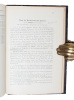
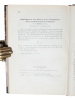
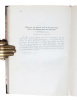
Two landmark papers in the history of cosmology: All first editions. In 'Über die Krümmung des Raumes' Friedman derived the non-stationary solutions to Einstein's field equations. Einstein quickly responded in a short comment ('Bemerkung'), in which he expressed his suspicion of such a model of the Universe and apparently pointed out an error in Friedman's calculations. However, Friedman now wrote a letter to Einstein, in which he enclosed his full calculations. Shortly after this, Einstein submitted a short notice (Notiz), in which he admitted that he himself had performed a calculation error and that Friedman's solutions, which shed new light on the matter, were valid. Friedman's expanding universe model was corroborated by Edwin Hubble's red-shift observations in 1929. In 'Über die Möglichkeit einer Welt mit konstanter negativer Krümmung des Raumes' Friedman derived the Friedman-equations and demonstrated that he had command of all three Friedman-models describing positive, zero and negative curvature respectively, nearly a decade before the independent discoveries of the same models by Lemaître, Robertson, and Walker.
Vérification expérimentale de la formule de Lorentz-Einstein par les rayons cathodiques de grande vitesse [19. July, 1915] (+) Errata. - [CONCLUSIVELY PROVING THE LORENTZ-EINSTEIN FORMULA]
(Paris, Bachelier" Genève, Pélisserie, 1915.) 4to. No wrappers. In: ""Comptes Rendus Hebdomadaires des Séances de L'Academie des Sciences"", Tome 161, No. 3 & No. 15 (Entires issues offered). Small stamp to top right corner of each issue. Pp. 45-60" Pp. 425-448. (Guye & Lavanchy's paper: Pp. 52-55" Pp. 447-8).
First appearance of Guye and Lavanchy's famous experimental confirmation the Lorentz-Einstein formula which eventually led to a full understanding and acceptance of Einstein's theory of relativity. Einstein himself, though known as not taking much interest in the experimental support of his conceptions, wrote eulogistic letters to Guye after the present paper had been published. In February 1906 Walter Kaufmann made public his conclusion on the experiments he had been performing since 1901 on the electric and magnetic deflections of beta-rays. He claimed that Lorentz' theory of the electron, and thus ""the possibility of founding physics on the principle of relative motion"", had to be rejected. Ten years had to pass until Guye and Lavanchy confirmed the Lorentz theory and thereby proving Kaufmann's measuring equipment for imprecise. In 1915 Guye and Lavanchy measured the deflection of cathode rays at 0.25c-0.5c. They used a tube with a cathode and anode in order to accelerate the rays. A diaphragm at the anode produced a beam which was deflected. A screen was placed at the end of the apparatus, at which the impacts were photographed by a camera. They subsequently computated the ratio of transverse electromagnetic mass mT and rest mass m0 indicated by the red and blue curve, and obtained good agreement with the Lorentz-Einstein formula. Their experiments were considered by many as conclusively proving the Lorentz-Einstein formula. ""Charles Lavanchy [and] Guye was able to develop very precise techniques for measuring particle deflections within carefully controlled electric and magnetic fields. In 1916 and 1921 Guye published these methods and pronounced results in favor of the Lorentzian formulas and Einsteinian theory. Thereafter his reputation rose as a most able experimenter among the world's physicists"". (DSB).
"CARTAN, ÉLIE. - THE EINSTEIN-CARTAN THEORY (ECT) OF GRAVITATION.
Reference : 48912
(1922)
Sur une définition géométrique du tenseur d'énergie d'Einstein. (+) Sur une généralisation de la notion de courbure de Riemann et les espaces à torsion. (+) Sur les espaces généralisés et la théorie de la Relativité. (+) Sur les espaces conformes...
Paris, Gauthier-Villars, 1922. 4to. Bound in 2 uniform full cloth, but of slightly different sizes. Paperlabels pasted to lower part of spines. A faint stamp to titlepage and some of the issues. In ""Comptes Rendus Hebdomadaires des Séances de L'Academie des Sciences"", Tome 174. 1815,(1) pp. (Entire volume offered). Cartan's papers: pp.437-439, 593-595, 734-737, 857-60, 1104-1107.
First edition of these papers, in which Cartan intruced the concept of ""Torsion"", the main inspiration for Einstein in his searce for a unified field theory. The ECT of gravity is a modification of the General relativity Theory""The Einstein-Cartan theory, also known as the Einstein-Cartan-Sciama-Kibble theory, is a classical theory of gravitation similar to general relativity but relaxing the assumption that the affine connection has vanishing antisymmetric part (torsion tensor), so that the torsion can be coupled to the intrinsic angular momentum (spin) of matter, much in the same way in which the curvature is coupled to the energy and momentum of matter. In fact, the spin of matter in curved spacetime requires that torsion is not constrained to be zero but is a variable in the principle of stationary action. Regarding the metric and torsion tensors as independent variables gives the correct generalization of the conservation law for the total (orbital plus intrinsic) angular momentum to the presence of the gravitational field. The theory was first proposed by Élie Cartan in 1922 and expounded in the following few years. Dennis Sciama and Tom Kibble independently revisited the theory in the 1960s, and an important review was published in 1976. Albert Einstein became affiliated with the theory in 1928 during his unsuccessful attempt to match torsion to the electromagnetic field tensor as part of a unified field theory. This line of thought led him to the related but different theory of teleparallelism."" (Wikipedia).
EINSTEIN. - BARNETT, Lincoln: - MARIANOFF, D. WAYNE, P.: - Clark(Ronald):
Reference : 45118aaf
(SLACES, NVVA)
Phone number : 41 (0)26 3223808
"EINSTEIN, A., L. INFELD, and B. HOFFMANN. - THE ROUND OFF OF GENERAL RELATIVITY - ASSOCIATION COPY.
Reference : 46475
(1938)
The gravitational Equations and the Problem of Motion. (Part I). (Received June 16, 1937). (+) II. (Received May 29, 1939). 2 Papers (Paper II only Einstein and Infeld).
(Princeton, NJ.), Annals of Mathematics, 1938 a. 1940. Both papers in orig. printed wrappers. Offprints from ""Annals of Mathematics"", Vol. 39, No. 1, january, 1938 and Vol. 41, No. 2, April, 1940. Pp. 65-100 and pp. 455-464. Both clean and fine. This copy has belonged to Abraham Pais (1918-2000) - the famous Einstein scholar, theoretical physicist and Einsteins collegue at Princeton - and having his name on top of both frontwrappers ""A Pais"".
First editions, in the scarce offprint versions, of Einstein's last and highly important contributions to General relativity, and in which is shown that the equation of motion follows directly from the field equation that defined the geometry.""Einstein's last importent contribution to general relativity deals again with the problem of motion. It is the work done with Leopold Infeld and Banash Hoffmann on the N-body problem of motion. In these papers, the gravitational field is no longer treated as external. Instead, it and the motion of its (singular) sources are treated simultaneously. Anew approximationscheme is introduced in which the fields are no longer necessarily weak but in which the source velocities are small compared with the light velocity .... The equations obtained have found use in situations where Newtonian interaction must be included. '(These equations) are widely used in analyses of planetary orbits in the solarsystem. For example, the Cal Tech Jet Propulsion Laboratory uses them, in modified form, to calculate ephmerides for high-precision tracking of planets and spacecraft.""(Pais ""Subtle is the Lord"", p. 290-91).""The problem of the equation of motion of bodies is the following. The 1916 theory had a classical structure in the sense that there were both field equations (the curvature of space-time is determined by the mass and motion of bodies in space-time) and equations of motion of bodies (the world line of small mass is a geodesic). Are these two statements really separate? If the field equations were linear, they indeed would be. They are not linear, however, and Einstein showed (in the papers offered) that if matter is represented by a point singularity of the metric field, these singularities are located on world lines that are geodesics of space-time, provided its metric satisfies the equation of general relativity.""(DSB).Weil: 202 a. 295 (both with an asterix denoting a major paper). - Boni: 236 a. 236.1.
Einstein A. Teoriya otnositelnosti. Berlin: Slovo, 1921. /Einstein A. Theory of
In Russian. Short description: Einstein A. Teoriya otnositelnosti. [Theory of Relativity]. Public presentation. Translated from German by G.B. Itelson. Berlin: Slovo, 1921. - 150, [2] p., 1 sheet portrait. Publisher's cover. Format 215x140 mm. Lifetime edition of one of the founders of modern physics, Nobel Prize winner Albert Einstein (1879-1955). First Russian edition. Please feel free to contact us for a detailed description of the copies available. SKUMS001965 kn_nat