 Write to the booksellers
23 books for « declaration des droits... »Edit
-
Type
Book (22)
Magazine (1)
-
Century
18th (4)
19th (2)
20th (8)
-
Countries
Denmark (1)
France (20)
Netherlands (1)
Switzerland (1)
-
Syndicate
ILAB (15)
NVVA (2)
SLACES (1)
SLAM (13)
Topics
- Champagne (1)
- Communism (1)
- Education (1)
- Education - morals (1)
- Faure christine (1)
- Geography (1)
- History (1)
- Law (3)
- Legislation (1)
- Magazine (2)
- Mirabeau (1)
- Mounier jean-joseph (1)
- Newspaper (1)
- Newspapers press (2)
- Philosophy (2)
- Photography (1)
- Policy (1)
- Rabaut jean-paul aka saint-etienne (1)
- Religions (1)
- Reviews (2)
- Revolution 1789 (1)
- Spain (1)
- Spanish war (1)
- Theology (1)
- United states (1)
La declaration des droits de l'homme de 1789 - 1789/1989
LIBRERIA ANTIQUARIA DELSTRE'S. 1989. In-8. Broché. Etat d'usage, Tâchée, Dos satisfaisant, Intérieur frais. Environ 15 pages , type fac simile (declaration des droits de l'homme) + un livret de 10 pages, en catalan (traduction de la declaration) + livret de 12 pages, en francais et catalan - le tout dans une pochette. . . . Classification Dewey : 320-Science politique
Classification Dewey : 320-Science politique
La déclaration des droits de l'homme de 1789 Textes présentés et annotés par Christine Fauré.
Bibliothèque Historique Payot Fort volume broché au format 14x20cm, couverture souple en papier fort jaune, titrage en noir, bel exemplaire , 387 pages.

Epuisé chez l'éditeur en 2013. Bon Etat Mise à jour du Samedi 27 Juin 2026. Paiement PayPal immédiat, Mondial Relay pour : France, Allemagne, Autriche, Belgique, Espagne, Italie, Portugal, Luxembourg, Pays-Bas, Pologne (Communiquer votre point ou locker si connu). Une participation supplémentaire peut être demandée pour les colis lourds hors France où les envois compris entre 5 et 25 kg sont dégressifs : 2 à 4 kilogrammes - 7.99 / 5 à 10 kg - 15.99 / 15 -25 kg - 25.99. Certaines de nos collections ( Vian, Céline, Camus (...) peuvent être expédiées en Franco de port. Pour linternational hors Europe (Suisse, Canada, Japon, Etats-Unis, les frais dexpéditions peuvent varier selon le poids (mise à jour : 1 juin 2026).
"Les origines de la déclaration des droits de l'homme de 1789 - ""Bibliothèque de l'histoire du droit et des institutions"" - 2e édition"
Fontemoing et Cie. 1912. In-8. Broché. Etat d'usage, Couv. légèrement passée, Dos abîmé, Papier jauni. VI + 251 pages. Dos cassé, livre quasiment désolidarisé. Manque en coiffe de pied.. . . . Classification Dewey : 944.04-Révolution de 1789
Classification Dewey : 944.04-Révolution de 1789
Déclaration des droits de l'Homme, et articles de Constitution présentés au roi, avec sa réponse du 5 Octobre soir. [Extrait des procês-verbaux de l'Assemblée Nationale, Des 20, 21, 22, 23, 24, 26 Aout & premier Octobre 1789. Déclaration des droit... - [""MEN ARE BORN AND REMAIN FREE AND EQUAL IN RIGHTS""]
Paris, Chez Baudouin, Imprimeur de l'Assamblée Nationale, 1789. 8vo. Bound in an exquisite later red half morocco with gilt spine. Top edge gilt. (1) f. (title-page), 8 pp. (""Déclaration des droits de l'Homme en société""), 6 pp. (""Articles de Constitution""), (1) f. (""Réponse du Roi""), (1) f. (blank). Woodcut head-pieces. Title-page slightly bowned, otherwise in excellent condition. A truly excellent copy.
The exceedingly scarce true first printing, in an incredibly rare form of off-print/separate printing, of one of the most important and influential documents in the history of mankind, namely the French Human Rights Declaration, containing also the articles for the first French Constitution. This groundbreaking publication constitutes a monumental change in the structure of the human world, providing all citizens with individual rights that we now take for granted. This monument of humanist thought appeared in the ""Procès verbal de l'Assemblée Nationale"", copies of which are also very difficult to obtain. There, however, the two parts appeared without a title-page and without the final blank, which together constitute a form of wrappers for this off-print/separate printing, of which only five or six other copies are known and which is present in merely one or two libraries world-wide. As far as we now, only one other copy has been on the private market, and that did not have the blank back wrapper. This exceedingly rare separate printing of the Human Rights Declaration, with the Constitution, was intended for the inner circle of those participating in its creation and was limited to a very restricted number of copies - all of which will have been owned by the creators of the Declaration. This epochal document is just as important today as it was when it was formulated during the French Revolution in 1789, and since 2003, the Declaration has been listed in the UNESCO Memory of World Register - ""This fundamental legacy of the French Revolution formed the basis of the United Nations Declaration of 1948 and is of universal value"". Few other documents in the history of mankind has done as much to determine the way we live and think, the way Western societies are structured and governed, and few other documents have had such a direct impact upon our constitutional rights and the way we view ourselves and others in society. It is here that we find the formulation of liberty and equality upon which so much of Western political and moral thought is based - that all ""men are born and remain free and equal in rights"" (Article 1), which were specified as the rights of liberty, private property, the inviolability of the person, and resistance to oppression (Article 2)" that all citizens were equal before the law and were to have the right to participate in legislation directly or indirectly (Article 6) no one was to be arrested without a judicial order (Article 7)" Freedom of religion (Article 10) and freedom of speech (Article 11) were safeguarded within the bounds of public ""order"" and ""law"", etc., etc.The content of the document that were to change the Western world for good emerged largely from the ideals of the Enlightenment. ""The sources of the Declaration included the major thinkers of the French Enlightenment, such as Montesquieu, who had urged the separation of powers, and Jean-Jacques Rousseau, who wrote of general will-the concept that the state represents the general will of the citizens. The idea that the individual must be safeguarded against arbitrary police or judicial action was anticipated by the 18th-century parlements, as well as by writers such as Voltaire. French jurists and economists such as the physiocrats had insisted on the inviolability of private property."" (Encycl. Britt.).The key drafts were prepared by Lafayette, working at times with Thomas Jefferson. In August 1789, Honoré Mirabeau played a central role in conceptualizing and drafting the Declaration. On August 26, 1789, in the midst of The French Revolution, the last article of the Declaration was adopted by the National Constituent Assembly, as the first step towards a constitution for France. ""In 1789 the people of France brought about the abolishment of the absolute monarchy and set the stage for the establishment of the first French Republic. Just six weeks after the storming of the Bastille, and barely three weeks after the abolition of feudalism, the Declaration of the Rights of Man and of the Citizen (French: La Déclaration des Droits de l'Homme et du Citoyen) was adopted by the National Constituent Assembly as the first step toward writing a constitution for the Republic of France.The Declaration proclaims that all citizens are to be guaranteed the rights of ""liberty, property, security, and resistance to oppression."" It argues that the need for law derives from the fact that ""...the exercise of the natural rights of each man has only those borders which assure other members of the society the enjoyment of these same rights."" Thus, the Declaration sees law as an ""expression of the general will,"" intended to promote this equality of rights and to forbid ""only actions harmful to the society."" (www.humanrights.com). This sensational document became the crowning achievement of the French Revolution"" it came to accelerate the overthrow of the ""Ancien Régime"" and sowed the seed of an extremely radical re-ordering of society. The Declaration interchanged the pre-revolutionary division of society -in the clergy, the aristocracy, and the common people- with a general equality - ""All the citizens, being equal in [the eyes of the law], are equally admissible to all public dignities, places, and employments, according to their capacity and without distinction other than that of their virtues and of their talents"" (From Article VI), upon which today's society is still based. It is hard to imagine a work that is more important to the foundation of the society that we live in today.
Concilium n° 228 - Déclaration des droits de l'homme et du citoyen de l'Assemblée nationale française (1789), Déclaration universelle des droits de l'homme des Nations unies (1948), Les droits de l'homme, panorama historique par Leonard Swidler, La Torah
Editions Beauchesne. Avril 1990. In-12. Broché. Bon état, Couv. convenable, Dos satisfaisant, Intérieur frais. 156 pages.. . . . Classification Dewey : 260-Théologie sociale chrétienne
Sommaire : Déclaration des droits de l'homme et du citoyen de l'Assemblée nationale française (1789), Déclaration universelle des droits de l'homme des Nations unies (1948), Les droits de l'homme, panorama historique par Leonard Swidler, La Torah écrite et orale, et les droits de l'homme, fondements et lacunes par Eugène Borowitz Classification Dewey : 260-Théologie sociale chrétienne
Déclaration des droits de l'homme. Proposée par M. de Ladebat, commissaire-député par des citoyens de Guienne (sic). 13 août 1789,
In-8, broché, couverture de papier marbré (rel. moderne), Iv, 14 p. S.l.n.d. [Paris, août 1789]
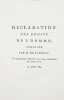
Edition originale de ce "modèle de 'Déclaration des droits de l'homme' à la fois libérale et modérée"."Le 13 août 1789, Laffon de Ladebat adresse à l'Assemblée constituante [ce] projet de déclaration des droits de l'homme, parmi les vingt-sept recensées (). En cinquante-huit articles, elle tente de concilier l'exigence de liberté et l'impératif d'ordre et de cohésion: primauté de la liberté, propriété garantie par la loi, fiscalité égalitaire, droit de suffrage démocratique et séparation des pouvoirs (). On notera la touche personnelle de son auteur que révèlent son souci des droits de la famille et de la solidarité nationale en faveur des citoyens malheureux, ainsi que son souci de la liberté de penser, influencé par son appartenance religieuse" (cf. Philippe P. Laffon de Ladebat, 'Laffon de Ladebat'; éd. EdiLivre, 2009).Daniel Laffon de Ladebat, dit Laffon-Ladébat (1746, Bordeaux - 1829, Paris), financier et homme politique de confession protestante, connu pour son engagement humaniste et philanthropique devint président de l'Assemblée législative en 1792, puis du Conseil des Anciens en 1797. Il s'illustra par sa défense infatigable de l'abolition de l'esclavage, des libertés fondamentales et des droits de l'homme. (Martin & Walter, 18391).Très bon exemplaire, bien conservé.
L'histoire n° 113 - 1789-1989 : deux cents ans de révolution française, Pourquoi célébrer 1789 par Maurice Agulhon, Les acteurs de la révolution par Jacques Solé, Les six jours des droits de l'homme par Jean Imbert, Déclaration des droits de l'homme
Société d'éditions scientifiques. Juillet-Aout 1888. In-12. Broché. Bon état, Couv. convenable, Dos satisfaisant, Intérieur frais. 131 pages. Nombreuses illustrations en couleurs et noir et blanc dans et hors texte.. . . . Classification Dewey : 900-GEOGRAPHIE, HISTOIRE, SCIENCES AUXILIAIRES DE L'HISTOIRE
Sommaire : 1789-1989 : deux cents ans de révolution française, Pourquoi célébrer 1789 par Maurice Agulhon, Les acteurs de la révolution par Jacques Solé, Les six jours des droits de l'homme par Jean Imbert, Déclaration des droits de l'homme et du citoyen Classification Dewey : 900-GEOGRAPHIE, HISTOIRE, SCIENCES AUXILIAIRES DE L'HISTOIRE
LAUZIERES DE THEMINES Alexandre, CERUTTI Joseph Antoine Joachim
Reference : 3867
(1788)
[Remontrances]: Remontrances du clergé, présentées au Roi le dimanche 15 juin 1788 (32 p.), suivi de: Observations sur les remontrances du clergé du 15 juin 1788 (29 p.); suivi de: Instructions et cahier du hameau de Madon [par Alexandre de Lauzières de Themines], Blois, chez J.P.J. Masson, 1789, 119 pages, suivi de: Cahier du Hameau de Madon, 60 pages; suivi de: Rapprochement de la déclaration des intentions du Roi du 23 juin 1789, et de la déclaration des Droits de l'homme, décrétée par l'Assemblée Constituante, avec leur développement mis à la portée de tout le monde. Paris, de l'imprimerie de J. Girouard, sans date (1789), 45 pages; suivi de: Nouvelle adresse aux provinces, s.l. ni date (1791), 61 pages; suivi de: Etrennes au public [ par Joseph Antoine Joachim Cérutti] (complet des quatre textes: consultation, dénonciation, prospectus, harangue miraculeuse) 56-24 pages, s.l. ni date (1789)
1788 Recueil factice dans une reliure in-8 pleine basane marbrée de l'époque, dos à 5 nerfs orné de caissons dorés à morif floral, pièces de titre rouge (remontr du clergé) et brune (pièces diverses), sans défaut notable, excellent état
Les Etats-Généraux convoqués par Louis XVI. (Drop-head title.) No place, (1789). - (Bound with:) TARGET, (G.J.B.) Suite de l'Écrit intitulé: Les Etats-Généraux convoqués par Louis XVI. (Drop-head title.) No place, (1789). - (Bound with:) TARGET, (G.J.B.) IIe Suite de l'Écrit intitulé: Les Etats-Généraux convoqués par Louis XVI. (Drop-head title.) No place, (1789). - (Bound with:) TARGET, (G.J.B.) Projet de déclaration des droits de l'homme en société. (Drop-head title). (Versailles, 1789). - (Bound with:) TARGET, (G.J.B.) Rapport fait au nom du Comité de constitution. (Drop-head title). Paris, Baudouin, 1789. - (Bound with:) TARGET, (G.J.B.) Rapport fait au nom du Comité de constitution à la séance du 31 mars 1790.
Paris, Imprimerie nationale, (1790). 6 volumes in 1. 75 pp.; 41 pp.; 62 pp.; 7 pp.; 8 pp.; 16 pp. 8vo. Modern boards. Martin & Walter 32253, 32259, 32260, 32263, 32264, 32265. All first or only editions. Among others against any right of veto in whatever form.Guy-Jean-Baptiste Target (1733-1806), lawyer and jurisconsult. Was received as avocat before the Parlement of Paris in 1752, and over the next thirty-five years earned a reputation as the foremost legal expert at the Parisian bar. Target was one of the prime movers in the Revolutionary national patriot party in 1788-1789. He contributed notably to the Constituent Assembly's legal, constitutional and administrative reforms. With the institution of the new judiciary in Revolutionary France, Target entered the magistracy, becoming judge and later president of one of the capital's civil tribunals. He helped prepare the Civil and Criminal Codes under Napoleon. Target's lifelong stature in legal affairs was reflected in his election to the Académie Française in 1785 and his later appointment to the Institut national (Historical Dictionary of the French Revolution, ii, 936).


(NVVA, )
Phone number : 31 20 698 13 75
MANDAR P., POIRET R.P., MOUNIER Jean-Joseph, CHABROUD Charles, CHAMPAGNE Abbé de, LE MINTIER Augustin R.L. Evèque de Tréguier, MOREL DE VINDE Charles Gilbert, FOUCHER D'OBSONVILLE, Comité des Pensions de la Constituante
Reference : 4175
(1789)
(Révolution Française) (Livre Rouge) - Panégyrique de S. Louis, roi de France, prononcé en l'église des Prêtres de l'Oratoire, devant MM. de l'Académie des Inscriptions et Belles-Lettres, & MM. de l'Académie des Sciences, le 25 aout 1774, par le P. Mandar, Paris, chez Lottin et Onfroy,1774, 88 pages; Suivi de: Discours prononcé par le R.P. Poiret, Superieur de l'Oratoire, Président du même District, le 30 aout 1789, jour de la bénédiction, par lui faite, du Drapeau de ce District dans l'Eglise de l'Oratoire, sans lieu ni éditeur, 1789, 18 pages; Suivi de: Exposé de la conduite de M. Mounier dans l'Assemblée Nationale, et des motifs de son retour en Dauphiné, Paris, Chez Buisson, 17 novembre 1789, 123 pages; Suivi de: Rapport de la propcédure du Chatelet, sur l'Affaire des 5 et 6 octobre, fait à l'Assemblée Nationale, par Charles Chabroud, Membre du Comité des Rapports. Paris, De l'Imprimerie Nationale, 1790, 118 pages; Suivi de: Compliment adréssé au Parlement, au nom du Chapitre de l'Eglise de Troyes, par M. l'Abbé de Champagne, Grand-Chantre & Chanoine de ladite Eglise. Troyes, chez André, sans date (vers 1790), 4 pages; Suivi de: Mandement de M. l'Evèque de Tréguier, avec sa lettre au Roi, & le décret de l'Assemblée Nationale, sans lieu ni éditeur, 1790, 32 pages; Suivi de: La Déclaration des Droits de l'Homme et du Citoyen, mise à la portée de tout le monde, & comparée avec les vrais principes de toute société, [par Morel de Vindé], Chez Baudoin, 1790, 82 pages, Suivi de: Le François philantrope, ou considérations patriotiques relatives à une ancienne & une nouvelle aristocratie [par Foucher d'Obsonville], sans lieu ni éditeur, 1789, 112 pages; Suivi de: Livre Rouge, (par le Comité des Pensions de la constituante), Paris, chez Baudoin, 1790, 39 pages.
1789 Recueil factice du XVIIIe siècle de plusieurs ouvrages, la plupart en édition originale, reliés à l'époque en 1 volume in-8 demi veau naturel, dos à nerfs orné de caissons et fleurons dorés, tranches rouges, pièce de titre bordeaux notée "recueil de pièces", très bon état
Education civique. Commentaire de la Déclaration des Droits de l' Homme et du Citoyen de 1789 et de 1793 à l' usage de l' Enseignement primaire, des Cours d' Adultes et d' Adolescents. Lettre-préface de M. Ferdinand Buisson.
Paris, Gedalge, sans date ( 1902) ; in-8°, pleine percaline rouge de lé'diteur,titre doré au dos, décor à froid sur les plats;168pp. illustré de portraits et repridductions de gravures anciennes hors texte.
Ors du dos passé, sinon très bon état.(GrF)
LES PETITES AFFICHES, Porte-Parole de la Déclaration des droits de l’homme et du citoyen de 1789, n°84, 14juillet 1989
, Paris, Bureau des Affiches 1989, in-4, plaquette représentant le Fac-similé du n°195 des Affiches, annonces et avis divers ou Journal Général de France du mardi 14 juillet 1789, nb. gravures, bon état, 114p.
Phone number : 01 43 29 46 77
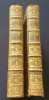
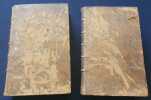
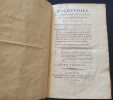
Les devoirs de la seconde législature ou des législateurs de France. Ouvrage qui a paru par cahiers, du 31 juillet 1790 au 23 juillet 1791, contenant des dissertations sur les maximes de la déclaration des droits de l'homme et du citoyen, publiée en 1789 par l'assemblée nationale, sur les principes de l'ancienne et de la nouvelle constitution de France, et sur les principes de la législation, de la politique et de la morale ; des réflexions sur l'état actuel des finances de France, et des extraits de quelques ouvrages nouveaux sur la révolution de 1789 - Tomes 1 & 2
Paris Mecquignon 1791 Tomes 1 & 2 en 2 volumes ( sur 4) - In8 - plein veau d'époque - dos à nerfs ornés - coiffes arasées - coins émoussés - nombreuses épidermures aux plats - 420 & 418 pages . Il semblerait que cet ouvrage soit de Achille nicolas Isnard qui fut économiste et Ingénieur.
Moyen
Précis de l'histoire de la Révolution française, avec les principaux décrets rendus pendant les années 1789, 1790 et 1791 par J. P. Rabaut de Sant-Etienne. Nouvelle édition, augmentée des réflexions du même auteur, et de la déclaration des droits de l'homme et du citoyen ; Suivi du Tableau de la Révolution française depuis son origine jusqu'en 1814, augmenté de la charte constitutionnelle ; Par M. de Norvins, seconde édition, revue et corrigée.
P., Librairie historique, 1820, 2 vol. in-12, iv-246 et 186 pp, 2 gravures en frontispices, les 2 tomes reliés ensemble en un volume demi-veau vert, dos lisse à quadruple filets et titres dorés (rel. de l'époque), un mors faible, qqs rousseurs, bon état
Ministre à Nîmes depuis 1785, il fut élu député aux Etats généraux de 1789. Il se fit remarquer par son hostilité contre le clergé, mais à la Convention, où il siégeait avec les Girondins, il combattit la mise en jugement de Louis XVI et vota pour l'appel au peuple et le sursis. Membre de la commission des Douze qui surveillait les actes du Tribunal révolutionnaire, il se vit envelopper dans la proscription des Girondins et périt sur l'échafaud en 1793. Désormais les frais d'envoi sont de 6 € seulement pour les livres jusqu'à 1 kg (colissimo suivi), pour la France métropolitaine.
COLLIARD, Claude-Albert / CONAC, G. / BEER-GABEL, J. / FROGE, S.:
Reference : 117140aaf
La déclaration des droits de l’homme et du citoyen de 1789. Ses origines, sa pérennité.
Paris, La documentation française, 1990, in-8vo, 316 p., frontispice, brochure originale.
(SLACES, NVVA)
Phone number : 41 (0)26 3223808
Les Petites Affiches - La Loi N° 84 : 1789 : Les Petites Affiches Porte-Parole De La Déclaration Des Droits De L'homme Et Du Citoyen [Unknown Binding]
BROCHE. 112 PAGES. EDITION POUR LE 14 JUILLET 1989. PHOTOS SUR DEMANDE
Merci de nous contacter à l'avance si vous souhaitez consulter une référence dans notre boutique à Authon-du-Perche.
Déclaration Des Droits De L'homme Et Du Citoyen De 1789
Broché comme neuf .Dédicace illustrée de l'auteur .2013. PHOTOS SUR DEMANDE
Merci de nous contacter à l'avance si vous souhaitez consulter une référence dans notre boutique à Authon-du-Perche.
Regards N° 287 : 1789-1939. Vive la Nation ! - La Révolution française. Les principes de 89 et le monde moderne (G. LEFEBVRE). Les gardes françaises furent aux côtés du peuple les soldats de la Révolution (Pierre VILAR) - La Révolution, fille des lumières, plaça la France à l'avant-garde des sciences. La déclaration des droits de l'homme et le racisme (Marcel PRENANT) - Dans les cachot de la Bastille (François DRUJON) - La prise de la Bastille - La Révolution fit de la France une terre d'asile (Alexandre ZEVAES) - L'Union Soviétique et la Révolution française - 14 juillet 1790, journée de la fédération (André RIBARD) - ...
1939 N° 287 - 13 juillet 1939 - Revue mensuelle illustrée - In-folio, broché couverture illustrée - 24 pages - Très nombreuses illustrations et reproductions photographiques en N&B in et hors texte

Bon état - Infimes frottements sur la couverture - Léger pli sur la couverture
FEUILLET ARTISTIQUE PHILATELIQUE - CEF - N° 965 - DECLARATION DES DROITS DE L'HOMME ET DU CITOYEN - VERSAILLES, 26 AOUT 1789
CEF. 26-08-1989. In-12. Broché. Bon état, Couv. convenable, Dos satisfaisant, Intérieur frais. Feuillet artistique philatélique de format paysage 31,1 x 21,6 cm tiré sur papier épais glacé, édité par les oeuvres sociales du personnel des PTT et le réseau commercial CEF et étranger au profit des oeuvres sociales des PTT. Il est composé d'un timbre original oblitéré du cachet premier jour, d'une illustration couleurs, d'une notice explicative.. . . . Classification : 20-Documents Philatéliques
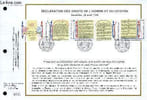
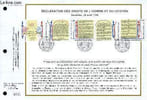
Ce feuillet artistique philatélique a été imprimé à tirage limité (33800 exemplaires). Ce document est une mine et un trésor d'informations sur le sujet traité, histoire, contenu artistique et biographie des personnages. Classification : 20-Documents Philatéliques
Concours J.E.E. 1977-1978 Fiche N°2 Rédaction Extrait de la déclaration des droits de l'Homme et du citoyen du 26 Août 1789.
Au bureau du journal. 1977. In-4. En feuillets. Bon état, Couv. convenable, Dos satisfaisant, Intérieur frais. 1 feuillet.. . . . Classification Dewey : 340-Droit
Classification Dewey : 340-Droit
Déclaration des Droits de l'Homme et du Citoyen 1789,
expliquée et accompagnée de lectures par Léon Bourgeois et Albert Métin. Paris. Cornelly Vers 1930. In-12 (15x10). 94 pages. Broché, couverture illutrée d'une composition de Thiriet.
< L'esprit en est franchement démocratique et laïque>. Trés bon état.
Le droit contre la Barbarie 5000 ans de lutte- Dossiers secrets de l'Histoire, Hors série n°2 oct/nov/dec 1998-Sommaire: Droits de l'Homme, Déclaration de 1789: le peuple prend la parole par Lucile Lanvin- Aux sources de l'histoire par Yves Lemoine- Vers
Didro. 1998. In-8. Broché. Bon état, Couv. convenable, Dos satisfaisant, Intérieur frais. 132 pages. Nombreuses illustrations et photos en noir et blanc, in texte. Texte sur 2 colonnes.. . . . Classification Dewey : 70.49-Presse illustrée, magazines, revues
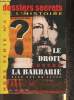
Sommaire: Droits de l'Homme, Déclaration de 1789: le peuple prend la parole par Lucile Lanvin- Aux sources de l'histoire par Yves Lemoine- Vers l'abolition de l'esclavage, chronologie du droit- Amnesty interrnational: Interviw de Denys Robillard par Philippe Aziz- Le droit contre la barbarie par Alix Maureau- etc. Classification Dewey : 70.49-Presse illustrée, magazines, revues
Le Pèlerin n° 5569 - Messe a Saint Germain de Gagny, D'ou viennent les paraboles ?, 26 aout 1789 : les droits de l'homme, 26 aout 1789 : ma France célèbre le 200e anniversaire de la Déclaration universelle des droits de l'hommes et du citoyen
Bayard-Presse. 25 aout 1989. In-12. Broché. Bon état, Couv. convenable, Dos satisfaisant, Intérieur frais. 72 pages. Quelques illustrations en couleurs et noir et blanc dans et hors texte.. . . . Classification Dewey : 200-RELIGION

Classification Dewey : 200-RELIGION

