 Write to the booksellers
733 books for « darwin »Edit
-
Type
Book (724)
Magazine (8)
Music sheets (1)
-
Latest
Last 3 days (1)
Last month (16)
-
Language
English (3)
French (580)
German (1)
Russian (149)
-
Century
19th (105)
20th (212)
21st (95)
-
Countries
Belgium (21)
Denmark (39)
France (468)
Germany (2)
Switzerland (42)
United States of America (161)
-
Syndicate
CLAM (1)
ILAB (320)
NVVA (6)
SLACES (6)
SLAM (266)
Topics
- Annals (2)
- Anonymous (1)
- Anthropology (5)
- Archaeology (2)
- Austria (2)
- Aviation (1)
- Barine arvède (2)
- Bible (1)
- Biography (5)
- Biology (58)
- Botany (6)
- Brunetiere ferdinand (1)
- Charton edouard (1)
- Children’s books (3)
- Christen yves (6)
- Christianity (1)
- Commune (2)
- Darwin (162)
- Despois eugéne (2)
- Detective novels (2)
- Drawings (2)
- Early printed books (2)
- Earth (1)
- Ecology (2)
- English (10)
- Entomology (1)
- Epistemology (12)
- Erasmus (3)
- Esotericism (3)
- Essays (4)
- Ethic (3)
- Ethnology (2)
- Fabre- luce alfred (3)
- Figaro (2)
- Flora (2)
- Fouillee alfred (1)
- Fundamentalism (1)
- Genealogy (1)
- Genetics (3)
- Geography (5)
- Geology (4)
- Germanic languages (3)
- Germany (2)
- History (61)
- Hugo victor (1)
- Huxley aldous (7)
- Journalism (4)
- L'illustration (newspaper) (2)
- Lecourt dominique (2)
- Legends (2)
- Leger louis (1)
- Literature (28)
- Magazine (44)
- Mathematics (20)
- Medicine (2)
- Miller (3)
- Motor vehicle (2)
- Mythology (2)
- Naturalist (2)
- Newspaper (2)
- Newspapers press (50)
- Palaeontology (3)
- Palaeozoology (1)
- Perrier edmond (4)
- Philosophy (28)
- Physics (2)
- Policy (2)
- Psychology (12)
- Rationalism (2)
- Reinach joseph (1)
- Religions (9)
- Review (6)
- Reviews (47)
- Rostand edmond (2)
- Science fiction (2)
- Sciences (49)
- Sciences & technique (2)
- Serres michel (3)
- Social sciences (3)
- Stone irving (4)
- Telephone - telegraph (2)
- Testimonies / stories (2)
- Theology (4)
- Theory (2)
- Thuillier pierre (3)
- Tort patrick (3)
- Travel (6)
- United states (2)
- Universe (1)
- Wildlife (4)
- Zoology (24)
Jinsoron (i.e. Japanese ""On the Ancestor(s) of Man"", Translated by Kozu Senzaburo, original title: ""Descent of Man""). 3 vols. - [FIRST TRANSLATION OF DARWIN INTO JAPANESE]
Tokyo, Ichibe Yamanaka., Meiji 14. (1881). 8vo. 3 volumes, all in the contemporary (original?) yellow wrappers (Traditional Fukuro Toji binding/wrappers). Extremities with wear and with light soiling, promarily affecting vol. 1. Title in brush and ink to text-block foot. A few ex-ownership stamps. Folding plate with repair. A fine set. 46 ff" 70 ff. + 9 plates of which 1 is folded" 72 ff. ""Vol. I contains prefaces to 1st and 2d editions of Descent of man Nos 936 & 944"" vol. II contains chapter 1 and vol. III chapter 2. All published, intended to form 9 vols containing chapters 1-7 and 21."" (Darwin-Online).
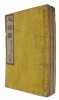
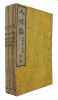
The exceedingly rare first translation of Darwin's Descent of Man and the first (partial) translation of Origin of Species, constituting the very first translation of any of Darwin's work into Japanese and, arguably, being the most influential - albeit in a different way than could be expected - of all Darwin-translations. ""The first translation of a book by Darwin was published in 1881: a translation of The Descent of Man, titled as Jinsoron (On the Ancestor(s) of Man"" Darwin 1881). The translator was a scholar of education, Kozu Senzaburo (...). In spite of its title, the book was actually a hybrid, which included a mixture of chapters of the Descent (namely, chapters 1-7 and 21) together with other texts: the Historical Sketch that Darwin appended to the third edition of the Origin (1861), and some sections taken from Thomas Huxley's Evidence as to Man's Place in Nature (Kaneko 2000). So this book can also be described as the first publication including a partial translation of a text from the Origin"" (Taizo, Translating ""natural selection"" in Japanese: from ""shizen tota"" to ""shizen sentaku"", and back?)Darwin's theories had a profound influence on Japan and Japanese culture but in a slightly different way than in the West: Darwinism was marked as social and political principles primarily embraced by social thinkers, philosophers and politicians to advocate the superiority of Japanese culture and society (and military) and not by biologist and zoologist. ""It was as if Darwin's famous oceanic journey and the meticulous research into the animal and plant kingdoms that he spent his life undertaking had all been staged as an elaborate excuse for composing a theory whose true object was Victorian society and the fate of the world's modern nations."" (Golley, Darwinism in Japan: The Birth of Ecology).The popularity of Darwin's works and theories became immensly popular in Japan: ""Curiously, there are more versions of ""The Origin"" in Japanese than in any other language. The earliest were literary, with subsequent translations becoming more scientific as the Japanese developed a technical language for biology."" (Glick, The Comparatice Reception of Darwinism, P. XXII)Darwin's work had in Japan - as in the rest of the world - profound influence on the academic disciplines of zoology and biology, however, in Japan the most immediate influence was not on these subjects but on social thinkers: ""[...] it exerted great influence on Japanese social thinkers and social activists. After learning of Darwin's theory, Hiroyuki Kato, the first president of Tokyo Imperial University, published his New Theory of Human Rights and advocated social evolution theory (social Darwinism), emphasizing the inevitable struggle for existence in human society. He criticized the burgeoning Freedom and People's right movement. Conversely Siusui Kautoku, a socialist and Japanese translator of the Communist Manifesto, wrote articles on Darwinism, such as ""Darwin and Marx"" (1904). In this and other articles, he criticized kato's theory on Social Darwinism, insisting that Darwinism does not contradict socialism. The well known anarchist, Sakae Osugi published the third translation of On the Origin of Species in 1914, and later his translation of peter Kropotokin's Mutial Aid: A Factor of Evolution. Osugi spread the idea of mutual aid as the philosophical base of Anarcho-syndicalism."" (Tsuyoshi, The Japanese Lysenkoism and its Historical Backgrounds, p. 9) ""Charles Darwin's theory of evolution was introduced to Japan in 1877 (Morse 1936/1877) during Japan's push to gain military modernity through study of western sciences and technologies and the culture from which they had arisen. In the ensuing decades the theory of evolution was applied as a kind of social scientific tool, i.e. social Spencerism (or social Darwinism) (Sakura 1998:341"" Unoura 1999). Sakura (1998) suggests that the theory of evolution did not have much biological application in Japan. Instead, Japanese applied the idea of 'the survival of the fittest' (which was a misreading of Darwin's natural selection theory) to society and to individuals in the struggle for existence in Japan's new international circumstances (see also Gluck 1985: 13, 265).However, at least by the second decade of the 1900s, and by the time that Imanishi Kinji entered the Kyoto Imperial University, the curricula in the natural and earth sciences were largely based on German language sources and later on English language texts. These exposed students to something very different from a social Darwinist approach in these sciences. New sources that allow us to follow"" (ASQUITH, Sources for Imanishi Kinji's views of sociality and evolutionary outcomes, p. 1).""After 1895, the year of China's defeat in the Sino-Japanese War, Spencer's slogan ""the survival of the fittest"" entered Chinese and Japanese writings as ""the superior win, the inferior lose."" Concerned with evolutionary theory in terms of the survival of China, rather than the origin of species, Chinese intellectuals saw the issue as a complex problem involving the evolution of institutions, ideas, and attitudes. Indeed, they concluded that the secret source of Western power and the rise of Japan was their mutual belief in modern science and the theory of evolutionary progress. According to Japanese scholars, traditional Japanese culture was not congenial to Weastern science because the Japanese view of the relationship between the human world and the divine world was totally different from that of Western philosophers. Japanese philosophers envisioned a harmonious relationship between heaven and earth, rather than conflict. Traditionally, nature was something to be seen through the eyes of a poet, rather than as the passive object of scientific investigations. The traditional Japanese vision of harmony in nature might have been uncongenial to a theory based on natural selection, but Darwinism was eagerly adopted by Japanese thinkers, who saw it as a scientific retionalization for Japan's intense efforts to become a modernized military and industial power. Whereas European and American scientists and theologians became embroiled in disputes about the evolutionary relationship between humans and other animals, Japanese debates about the meaning of Darwinism primarily dealt with the national and international implications of natural selection and the struggle for survival. Late nineteenth-century Japanese commentators were likely to refer to Darwinism as an ""eternal and unchangeable natural law"" that justified militaristic nationalism directed by supposedly superior elites"". (Magner, A History of the Life Sciences, Revised and Expanded, p. 349)""Between 1877 and 1888, only four works on the subject of biological evolution were published in Japan. During these same eleven years, by contrast, at least twenty Japanese translations of Herbert Spencer's loosely ""Darwinian"" social theories made their appearance. The social sciences dominated the subject, and when Darwin's original The Origin of Species (Seibutsu shigen) finally appeared in translation in 1896, it was published by a press specializing in economics. It is not surprising then that by the early 20th century, when Darwin's work began to make an impact as a biological rather than a ""social"" theory, the terms ""evolution"" (shinka), ""the struggle for existence"" (seizon kyôsô), and ""survival of the fittest"" (tekisha seizon) had been indelibly marked as social and political principles. It was as if Darwin's famous oceanic journey and the meticulous research into the animal and plant kingdoms that he spent his life undertaking had all been staged as an elaborate excuse for composing a theory whose true object was Victorian society and the fate of the world's modern nations."" (Golley, Darwinism in Japan: The Birth of Ecology).Freeman 1099c
Priruchennyie zhivotnyie i vozdelannyie rasteniya [i.e. Russian ""The Variation of Animals and Plants under Domestication"". Translated from English with the consent and assistance of the author by V. Kovalevsky. Edited by I. M. Sechenov, botanical sect... - [THE VERY FIRST PUBLICATION OF DARWIN'S 'VARIATION UNDER DOMESTICATION' IN ANY LANGUAGE. ]
St. Petersburg, 1868 [but in fact 1867-1869]. 8vo. In contemporary half calf with renewed spine. Inner hindges with repairs and boards with soiling and a few marks and holes to volume 1. Light foxing throughout, primarily affecting margins and plates. Overall a good copy. IV, 443, (1): ill"" V.2: 462, (I)-VI pp.


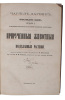
The very first publication of Darwin's 'Variation under Domestication' in any language. The title-page states 1868 but they two volumes were in fact published, respectively in November 1867 and 1869.""In August, 1867, Darwin wrote to Lyell that he was visited by a young Russian ""who is translating my new book into Russian."". The book was the 'Variation of Animals and Plants under Domestication', and the youngRussian was Vladimir Kovalevsky, who subsequently became a well-known evolutionary palaeontologist. At that time the 'Variation' was not yet published, and it seems most probably that the translation was made from a set of proofs given to Kovalevsky by Darwin. Thanks to Kovalevsky's rapid work, the first section of the Russian translation of the Variation was published several months prior to the publication of the English original."" (Glick, The Comparative Reception of Darwinism, p. 235)""The first Russian edition, which is dated 1868 on the volume title page, is of particular interest. It is the only work, in his lifetime, of which any part appeared in foreign translation before it appeared in English. Correspondence at Cambridge shows that the translator was sent copies of corrected proofs as they were ready. It was published in seven parts of which four, perhaps to the end of Chapter XV, appeared in 1867"" the next two appeared in 1868, and the last not until 1869, because he had been away in Russian Asia. The title is given in full, in English translation, under No. 925 and has been discussed above"" (Freeman).Vladimir Kovalevsky (1842-1883), the translator of this book, was a Russian biologist and the founder of evolutionary palaeontology. His own scientific works were printed between 1873 and 1877, and according to Henry Osborn (Osborn, H. The rise of Mammalia in North America // Proc. Amer. Assoc. Sci. 1894. vol. 42, pp. 189-227) they ''dare away'' all traditional and dry European paleontology. That was mainly because Kovalevsky was a devoted Darwinist and adapted Darwin's ideas to palaeontology. Luis Dollo, the Belgian palaeontologist, a contemporary of Kovalevsky's, described him thus: ''No palaeontologist embodies so perfectly our epoch, as the brilliant and miserable Vladimir Kovalevsky, friend and guest of the immortal Charles Darwin''. Indeed, Kovalevsky was a friend of Darwin's and they corresponded extensively. When visiting Darwin in 1877, the Russian botanist, Timiryazev, asked Darwin about his views on Russian science and Darwin surprised him with an answer that Vladimir Kovalevsky (little known at the time) was the bright hope of palaeontology.Kovalevsky was very eager to translate Darwin into Russian as soon as possible so he asked Darwin to send him the proofs of his book chapter by chapter as soon as Darwin finished them. Kovalevsky translated with great speed (the complete book contains 900 pages) and he began to print the chapters from July 1867 (the first English edition appeared on 30th January 1868). The chapters were printed one after another as the translation went on. It is unclear whether any part of it appeared before the English edition.Vladimir Kovalevsky translated another of Darwin's books, The Expression of the Emotions in Man and Animals [O vyrazhenii emotsyi u cheloveka I zhyvotnikh] that appeared the same year as the English edition (1872).Kovalevsky committed suicide at the age of forty after the breakdown of his marriage to the celebrated mathematician, Sophia Kovalevskaya who became the first female professor of mathematics in the world.OCLC finds only three complete copies worldwide (Cornell, American Philosophical Society (US) and Thomas Fisher Library, (Canada)). Freeman 925
Zoonomie, ou Lois de la vie organique, par Erasme Darwin, Docteur en Médecine, Membre de la Société royale de Londres, Auteur du Jardin botanique, etc. Traduit de l'anglais sur la troisième Édition, et augmenté d'Observations et de Notes, par Joseph-François Kluyskens, Professeur de Chirurgie à l'École élémentaire de Médecine, et Chirurgien en chef des Hôpitaux civils de Gand, Membre correspondant de la Société de l'École de Médecine de Paris, et de plusieurs Sociétés savantes.
A Gand, chez P. F. de Goesin-Verhaeghe; rue Haute-porte, n°229, 1810-1811. 1810 4 vol. in-8° (212 x 138 mm.) de: I. [3] ff. (faux-titre, titre, épigraphe); 20 pp. (préface du traducteur); [1] f. (titre de la première partie); 23 pp. (reprise de la pagination à 19, préface de l'auteur); [1] p. (table); 614 pp.; [1] p. (errata); 3 planches aquarellées ; II. [2] ff. (titre, table); 659 pp.; [2] pp. (errata, avis au relieur); 4 planches (3 aquarellées, 1 gravée); III. XIV pp. (titre, titre de la deuxième partie, préface de l'auteur); 586 pp.; 3 planches gravées; IV. [1] f. (titre); 570 pp. (dont table); 1 planche dépliante gravée. Un total de 11 planches (dont 1 dépliante et 6 à l'aquarelle). (Corps douvrage très frais). Demi-basane d'époque, plats recouverts de papier marbré, dos lisses ornés, titre et tomaison de maroquin noir, tranches jaspées. (Quelques petites rousseurs).


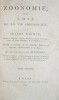
Première édition en français, traduite de l'anglais par Joseph-François Kluyskens et due à Erasmus Darwin (E.O. : 1795 et 1799). Le présent ouvrage est considéré comme son uvre principale pour ce qui touche aux sciences naturelles et à la médecine. Erasmus Darwin (1731-1802) est un poète, médecin, botaniste et inventeur britannique. 70 ans avant les travaux de son célèbre petit-fils et face au créationnisme alors dominant, il amorce de façon significative les réflexions sur l'origine de la vie et son évolution. Médecin, il exerce son art avec un grand succès à Lichfield. On a de lui un poème célèbre, le Jardin botanique (1781), divisé en deux parties, intitulées : l'Économie de la végétation et les Amours des plantes, et un ouvrage fort original, la Zoonomie ou Lois de la vie organique (1794) : il y classe les maladies de l'homme d'après une méthode analogue à celle adoptée par Carl von Linné (1707-1778, naturaliste suédois) pour les plantes, et les explique toutes par l'excitabilité, comme Thomas Brown (1785-1862, naturaliste et un malacologiste britannique). Dans cet ouvrage, de même que dans le poème posthume The Temple of Nature, il expose des idées évolutionnistes. Sa curiosité le conduit à s'interroger sur les raisons de la présence de coquillages fossilisés présents au fond des mines ainsi que sur le développement des bactéries qu'il observe au microscope. Il mène également des recherches sur les nuages. Dans ses travaux et sa réflexion, il en vient à remettre en cause la doctrine alors dominante du créationnisme. Il fait jouer un rôle à la sélection sexuelle dans l'évolution des espèces, idée que son petit-fils soutiendra lui aussi et qui intitulera Zoonomia le premier manuscrit de l'Origine des espèces. Également inventeur dans divers domaines, Erasmus Darwin laisse cependant d'autres s'attribuer certaines de ses inventions, craignant pour sa réputation en tant que médecin. On lui attribue ainsi :le moulin à vent horizontal de Josiah Wedgwood (grand-père d'Emma Wedgwood, épouse de Charles Darwin) ; un type de chariot qui ne se renverse pas (1766) ; une machine parlante (1771) ; l'ascenseur à caisson du canal à charbon du Somersetshire ; un dispositif géométrique de liaison dans la direction d'un véhicule (1758), préfigurant la géométrie directionnelle d'Ackermann ; un puits artésien ainsi que divers appareils de météorologie. Le traducteur, Joseph-François Kluyskens, décrit cette oeuvre de Darwin comme telle: Faire connaître les lois qui gouvernent tous les corps organisés ; réduire toutes ces lois qui ont rapport à la vie organique en classes, ordres, genres et espèces, et les faire servir enfin à l'explication des causes des maladies ; tel fut le but que se proposa le Docteur Darwin lorsqu'il composa la Zoonomie, ouvrage sublime qui lui a coûté plus de vingt années de travail, et les plus profondes méditations (Préface du traducteur, vol. 1). Louvrage est illustré de 11 planches, dont plusieurs rehaussées à laquarelle, représentant la rétine et le spectre oculaire. A noter l'impressionnante gravure du fauteuil pour corriger la distorsion de la colonne vertébrale. Rare exemplaire dont ne dénombre que 2 exemplaires passés en vente ces 50 dernières années. Bel exemplaire conservé dans sa reliure dépoque. 4 vol. 8vo (212 x 138 mm.) of : I. [3] ff. (faux-title, title, epigraph); 20 pp. (preface by the translator); [1] f. (title of the first part); 23 pp. (resumption of pagination at 19, preface by the author); [1] pp. (table) ; 614 pp. ; [1] p. (errata); 3 watercolor plates; II. [2] ff. (title, table) ; 659 pp. ; [2] pp. (errata, notice to the binder); 4 plates (3 watercolors, 1 engraved); III. XIV pp. (title, title of the second part, preface by the author) ; 586 pp. ; 3 engraved plates ; IV. [1] f. (title) ; 570 pp. (including table) ; 1 engraved folding plate. A total of 11 plates (including 1 folding and 6 in watercolor). (Body of the book very fresh). Contemporary half-basane, boards covered with marbled paper, spines decorated with smooth edges, title in black morocco, edges speckled. (A few small freckles). First edition in French, translated from English by Joseph-François Kluyskens and due to Erasmus Darwin (E.O.: 1795 and 1799). The present work is considered to be his main work on natural sciences and medicine. Erasmus Darwin (1731-1802) was a British poet, physician, botanist and inventor. Seventy years before the work of his famous grandson and in the face of the then dominant creationism, he significantly initiated reflections on the origin of life and its evolution. As a physician, he practiced his art with great success in Lichfield. He wrote a famous poem, the "Jardin botanique" (1781), divided into two parts, entitled "l'Économie de la végétation" and "Amours des plantes", and a very original work, the "Zoonomie ou Lois de la vie organique" (1794): he classifies the diseases of man according to a method similar to the one adopted by Carl von Linné (1707-1778, Swedish naturalist) for plants, and explains them all by excitability, like Thomas Brown (1785-1862, British naturalist and malacologist). In this work, as well as in the posthumous poem "The Temple of Nature", he exposes evolutionary ideas. His curiosity led him to question the reasons for the presence of fossilized shells at the bottom of mines as well as the development of bacteria, which he observed under a microscope. He also conducted research on clouds. In his work and his reflection, he came to question the then dominant doctrine of creationism. He gave a role to sexual selection in the evolution of species, an idea that his grandson would also support and even entitled "Zoonomia" the first manuscript of the Origin of Species. Also an inventor in various fields, Erasmus Darwin allowed others to take credit for some of his inventions, fearing for his reputation as a doctor. He is credited with: Josiah Wedgwood's horizontal windmill (grandfather of Charles Darwin's wife Emma Wedgwood); a type of carriage that does not tip over (1766); a talking machine (1771); the Somersetshire Coal Canal box elevator; a geometric device for linking the direction of a vehicle (1758), prefiguring Ackermann's directional geometry; an artesian well; and various meteorological devices. The translator, Joseph-François Kluyskens, describes Darwin's work as follows: "To make known the laws which govern all organized bodies; to reduce all these laws which relate to organic life into classes, orders, genera, and species, and finally to make them serve as an explanation of the causes of disease; such was the aim which Doctor Darwin proposed to himself when he composed Zoonomy, a sublime work which cost him more than twenty years of work, and the deepest meditations (translated from french). The work is illustrated with 11 plates, several of them enhanced with watercolors, representing the retina and the ocular spectrum. Note the impressive engraving of the chair "to correct the distortion of the spine" (translated from french). Rare and beautiful copy, preserved in its original binding, of which only 2 copies have been sold in the last 50 years.


Phone number : 06 81 35 73 35
Proiskhozhdenie chelovieska i polovoi podbor [i.e. English ""Descent of Man""]. - [FIRST TRANSLATION OF DARWIN'S 'DESCENT OF MAN' INTO ANY LANGUAGE]
S.-Peterburg, Izdanie redaktsii zhurnala ""Znanie, 1871. 8vo. In contemporary black half calf with four rasied bands and gilt lettering to spine. Corners of binding with repairs and a three cm long tear to lower front hindge. Light miscolouring throughout, especially to first 10 leaves. (2), VII, (6), 439 pp.
![Proiskhozhdenie chelovieska i polovoi podbor [i.e. English ""Descent of Man""]. - [FIRST TRANSLATION OF DARWIN'S 'DESCENT OF MAN' INTO ANY LANGUAGE]. ...](https://static.livre-rare-book.com/pictures/LLX/53279_1_thumb.jpg)
![Proiskhozhdenie chelovieska i polovoi podbor [i.e. English ""Descent of Man""]. - [FIRST TRANSLATION OF DARWIN'S 'DESCENT OF MAN' INTO ANY LANGUAGE]. ...](https://static.livre-rare-book.com/pictures/LLX/53279_2_thumb.jpg)
![Proiskhozhdenie chelovieska i polovoi podbor [i.e. English ""Descent of Man""]. - [FIRST TRANSLATION OF DARWIN'S 'DESCENT OF MAN' INTO ANY LANGUAGE]. ...](https://static.livre-rare-book.com/pictures/LLX/53279_3_thumb.jpg)
The exceedingly rare first Russian translation of Darwin's 'Descent of Man' published only four month after the original English. The Russian publisher was eager to have a translation published, hence this early abridged edition - two other Russian translations followed later the same year - The present translation being the very first into any language. ""The Descent of Man showed that the process of organic evolution, propelled by the struggle for existence and natural selection, applied to man no less than to the rest of the animal kingdom. It gave explicit recognition to the idea of the anthropoid origin of man. This claim surprised no one, for it was clearly hinted at in the great work of 1859 and was elaborated in Thomas Huxley's Man's Place in Nature and Vogt's Lectures on Man. Nor was it much of a surprise when three Russian translations of The Descent appeared within one year after the publication of the English original. Two general ideas represented the essence of The Descent: natural selection is not only behind the physical survival of man but also behind the evolution of cultural values"" and the differences between animal and human behavior are differences of degree rather than of kind."" (Darwin in Russian Thought) ""The Expression helped lay the foundations for a scientific study of the psychological aspect of the evolution of species. The book appeared in a Russian translation only a few months after the publication of the English original. The paleontologist Vladimir Kovalevskii was the translator, and the embryologist Aleksandr Kovalevskii was in charge of editorial tasks. In 1874 Vladimir wrote to Darwin that nearly two thousand copies of the Russian translation were sold."" "" The Expression deals much more extensively with selected aspects of human and animal behavior than with general problems of evolutionary biology. The Russian reviewers were generally impressed with Darwin's descriptions and categorizations of animal behavior. The Journal of the Ministry of Public Education was unusually profuse in praising the book's content and writing style. The reviewer commended Darwin's impartiality and avoidance of ""materialistic trappings."" Even the adherents of spiritualism could read the book, he wrote, without the least discomfort. The reviewer thought that psychologists would benefit from the information the book presented on the ""physiological"" basis of behavior. Indeed, he recommended the book to all readers interested in the scientific foundations of human behavior. The liberal journal Knowledgewas equally laudatory. It noted that the book was eminently successful on two counts: it offered a ""rational explanation"" of many expressions of human emotions, and it integrated the study of animal and human behavior into the universal process of organic evolution. In fact, no educated person could afford to ignore it.N. P. Vagner, professor of zoology and comparative anatomy at St. Petersburg University, called The Expression a book with ""great strengths and minor flaws."" The volume reminded him of Darwin's previous works, which marked ""turning points in the history of science."" The strength of the book lay much more in its suggestion of new topics for comparative-psychological research than in a presentation of a theoretically and logically integrated system of scientific thought. Insufficient exploration of the physiological underpinnings of mental activities represented the book's major shortcoming"" (Darwin in Russian Thought) In Russia Darwinism had a profound influence not only upon the different sciences, but also on philosophy, economic and political thought, and the great literature of the period. For instance, both Tolstoy and Dostoevsky referenced Darwin in their most important works, as did numerous other thinkers of the period.Like Strakhov, however, Dostoevsky, acknowledging the significance of the ""Origin of Species"", saw the dangers of the theory. In the same year as the publication of Rachinsky's translation, he lets the narrator in ""Notes from Underground"" (1864) launch his attack on Darwinism , beginning: ""As soon as they prove you, for instance, that you are descended from a monkey, then it's no use scowling, you just have to accept it.""In ""Crime and Punishment"" (two years later, 1866) the Darwinian overtones inherent in Raskolnikov's theory of the extraordinary man are unmistakable. He describes the mechanism of ""natural selection,"" where, according to the laws of nature, by the crossing of races and types, a ""genius"" would eventually emerge. In general, Darwinian themes and Darwin's name occur in many contexts in a large number of Dostoevsky's works.'Descent of Man' was transted into Danish, Dutch, French, German, Italian, Polish, Russian and Swedish in Darwin's lifetime. Freeman 1107.
Proiskhozhdenie chelovieska i polovoi podbor [i.e. English ""Descent of Man""]. - [FIRST TRANSLATION OF DARWIN'S 'DESCENT OF MAN' INTO ANY LANGUAGE]
S.-Peterburg, Izdanie redaktsii zhurnala ""Znanie, 1871. 8vo. In recent half calf with four rasied bands and gilt lettering to spine. Soiling and damp stain to title-page. Light brownspotting throughout. (2), VII, (5), 439, (7) pp.
![Proiskhozhdenie chelovieska i polovoi podbor [i.e. English ""Descent of Man""]. - [FIRST TRANSLATION OF DARWIN'S 'DESCENT OF MAN' INTO ANY LANGUAGE]. ...](https://static.livre-rare-book.com/pictures/LLX/56375_1_thumb.jpg)
![Proiskhozhdenie chelovieska i polovoi podbor [i.e. English ""Descent of Man""]. - [FIRST TRANSLATION OF DARWIN'S 'DESCENT OF MAN' INTO ANY LANGUAGE]. ...](https://static.livre-rare-book.com/pictures/LLX/56375_2_thumb.jpg)
![Proiskhozhdenie chelovieska i polovoi podbor [i.e. English ""Descent of Man""]. - [FIRST TRANSLATION OF DARWIN'S 'DESCENT OF MAN' INTO ANY LANGUAGE]. ...](https://static.livre-rare-book.com/pictures/LLX/56375_3_thumb.jpg)
The exceedingly rare first Russian translation of Darwin's 'Descent of Man' published only four months after the original English. The Russian publisher was eager to have a translation published, hence this early abridged edition - two other Russian translations followed later the same year - The present translation being the very first into any language. ""The Descent of Man showed that the process of organic evolution, propelled by the struggle for existence and natural selection, applied to man no less than to the rest of the animal kingdom. It gave explicit recognition to the idea of the anthropoid origin of man. This claim surprised no one, for it was clearly hinted at in the great work of 1859 and was elaborated in Thomas Huxley's Man's Place in Nature and Vogt's Lectures on Man. Nor was it much of a surprise when three Russian translations of The Descent appeared within one year after the publication of the English original. Two general ideas represented the essence of The Descent: natural selection is not only behind the physical survival of man but also behind the evolution of cultural values"" and the differences between animal and human behavior are differences of degree rather than of kind."" (Darwin in Russian Thought) ""The Expression helped lay the foundations for a scientific study of the psychological aspect of the evolution of species. The book appeared in a Russian translation only a few months after the publication of the English original. The paleontologist Vladimir Kovalevskii was the translator, and the embryologist Aleksandr Kovalevskii was in charge of editorial tasks. In 1874 Vladimir wrote to Darwin that nearly two thousand copies of the Russian translation were sold."" "" The Expression deals much more extensively with selected aspects of human and animal behavior than with general problems of evolutionary biology. The Russian reviewers were generally impressed with Darwin's descriptions and categorizations of animal behavior. The Journal of the Ministry of Public Education was unusually profuse in praising the book's content and writing style. The reviewer commended Darwin's impartiality and avoidance of ""materialistic trappings."" Even the adherents of spiritualism could read the book, he wrote, without the least discomfort. The reviewer thought that psychologists would benefit from the information the book presented on the ""physiological"" basis of behavior. Indeed, he recommended the book to all readers interested in the scientific foundations of human behavior. The liberal journal Knowledgewas equally laudatory. It noted that the book was eminently successful on two counts: it offered a ""rational explanation"" of many expressions of human emotions, and it integrated the study of animal and human behavior into the universal process of organic evolution. In fact, no educated person could afford to ignore it.N. P. Vagner, professor of zoology and comparative anatomy at St. Petersburg University, called The Expression a book with ""great strengths and minor flaws."" The volume reminded him of Darwin's previous works, which marked ""turning points in the history of science."" The strength of the book lay much more in its suggestion of new topics for comparative-psychological research than in a presentation of a theoretically and logically integrated system of scientific thought. Insufficient exploration of the physiological underpinnings of mental activities represented the book's major shortcoming"" (Darwin in Russian Thought) In Russia Darwinism had a profound influence not only upon the different sciences, but also on philosophy, economic and political thought, and the great literature of the period. For instance, both Tolstoy and Dostoevsky referenced Darwin in their most important works, as did numerous other thinkers of the period.Like Strakhov, however, Dostoevsky, acknowledging the significance of the ""Origin of Species"", saw the dangers of the theory. In the same year as the publication of Rachinsky's translation, he lets the narrator in ""Notes from Underground"" (1864) launch his attack on Darwinism , beginning: ""As soon as they prove you, for instance, that you are descended from a monkey, then it's no use scowling, you just have to accept it.""In ""Crime and Punishment"" (two years later, 1866) the Darwinian overtones inherent in Raskolnikov's theory of the extraordinary man are unmistakable. He describes the mechanism of ""natural selection,"" where, according to the laws of nature, by the crossing of races and types, a ""genius"" would eventually emerge. In general, Darwinian themes and Darwin's name occur in many contexts in a large number of Dostoevsky's works.'Descent of Man' was transted into Danish, Dutch, French, German, Italian, Polish, Russian and Swedish in Darwin's lifetime. Freeman 1107.
Sull'Origine delle Specie per Elezione Naturale ovvero Conservazione delle Razze perfezionate nella Lotto per L'Esistenza. Prima Traduzione Italiana col Consenso dell' Autore per Cura di G. Canestrini e L. Salimbeni. - [FIRST ITALIAN TRANSLATION OF DARWIN'S ""ORIGIN OF SPECIES""]
Modena, Nicola Zanichelli e. Soci, 1864. 8vo. In contemporary half calf with four raised bands and gilt lettering to spine. Reinforced in inner margins and plate with waterstains to lower margin. An unusually fine and well preserved copy, internally as well as externally. XV, 403 pp + 1 plate.


Rare first edition of the first Italian translation of Darwin's seminal ""Origin of Species"", quite unusually, authorized by Darwin himself. The work was very well received and - compared to France and Spain - Darwinism was quickly adopted by Italian biologist and zoologist and meet only little catholic opposition. ""The impact of Darwinism on Italian naturalists was powerful"" the logic and rigorous treatment of the problem of the origin of species as Darwin had presented it, forced zoologists and anthropologists to reconsider those passages of Lamarckisms that they had agreed to with excessive enthusiasm"". (Capanna, Darwinism and the Italian academies). The reception of Darwin's work in France (1862) and Spain (1877) were characterized by a strong chatolic opposition, which also had a strong suppressing effect on the spread of his ideas to academic institutions.Despite of Italy being a catholic stronghold the reception of Darwinism was very favourable and meet very limited criticism from the church:""In contrast to the power Catholicism was able to exert against Darwinism in Spain, it was practically impotent in Italy. Neither could the Italian Catholic intellectual establishment draw upon a repertory of anti-Darwinism arguments from the Italian scientific establishment, as was done in France. As in France under the Third Republic and as was the case sporadically in Spain, the advent of Darwinism in Italy provided a source of ideology for the anticlerical movement. Although Darwinism enjoyed a number of close connections with the English source, the peculiarities of the Italian situation set Darwinism in Italy apart from other situations. Italy was in the forefront in recognizing Darwin, electing him to various academies and societies and awarding him the famous Bressa Prize in 1875. In Italy the translation of the Origin ""1864"" was given an impeccable scientific presentation by Giocanni Canestrini and Leonardo Salimbeni, which avoided the type of situation that arose from the presentation of Darwinism in France by Clémence Royer as a new scientific basis for a secularistic Weltanschauung. As a general explanation, of course, it is reasonable to accept Cermenati's arguments that the favorable receptivity of the scientific community and the general indifference to ecclesiastical objections to Darwinism are the chief factors explaining the quick spread of Darwinism in Italy"". (Glick, The Comparative Reception of Darwinism).Emma Darwin, Darwin's wife, wrote publisher John Murry on the 17th of December: ""Mr Darwin desires me to say that as you have never hesitated to authorize a foreign translation he has taken upon himself to authorise a translation into Italian without consulting you."" When Darwin was informed that his work was being translated into Italian he wrote to his close friend J. D. Hooker: ""There is an Italian Edit. of Origin preparing!!! This makes fifth foreign Edit, ie in five foreign countries. Owen will not be right in telling Longmans that Book wd be utterly forgotten in ten years. Hurrah!"".Freeman no. 706
Pangenesis. - [DARWIN'S FERENSE OF HIS PANGENESIS-THEORY.]
London and New York, Macmillan and Co., 1871. Royal8vo. In publisher's original red embossed cloth. In ""Nature. A Weekly Illustrated Journal of Science"", Vol. 3, November 1870 - April 1871. Stamp to title-page and ex-libris pasted on to pasted down front end-paper. Binding with considerable wear"" spine partly disintegrated and front board bended vertically, but bookblock firmly attached. Internally fine and clean. Darwin's paper: Pp. 502-503. [Entire volume: XII, 520 pp].
![Pangenesis. - [DARWIN'S FERENSE OF HIS PANGENESIS-THEORY.]. "DARWIN, C. R.](https://static.livre-rare-book.com/pictures/LLX/60107_1_thumb.jpg)
![Pangenesis. - [DARWIN'S FERENSE OF HIS PANGENESIS-THEORY.]. "DARWIN, C. R.](https://static.livre-rare-book.com/pictures/LLX/60107_2_thumb.jpg)
![Pangenesis. - [DARWIN'S FERENSE OF HIS PANGENESIS-THEORY.]. "DARWIN, C. R.](https://static.livre-rare-book.com/pictures/LLX/60107_3_thumb.jpg)
First appearance of Darwin’s defense of his Pangenesis-theory. The Pangenesis theory was hypothetical mechanism for heredity, in which he proposed that each part of the body continually emitted its own type of small organic particles called gemmules that aggregated in the gonads, contributing heritable information to the gametes. He presented this 'provisional hypothesis' in his 1868 work The Variation of Animals and Plants Under Domestication, intending it to fill what he perceived as a major gap in evolutionary theory at the time. Darwin's half-cousin Francis Galton spent much time conducting wide-ranging inquiries into heredity which led him to refute Charles Darwin's hypothetical theory of pangenesis. In consultation with Darwin, he set out to see if gemmules were transported in the blood. Galton was troubled because he began the work in good faith, intending to prove Darwin right, and having praised pangenesis in Hereditary Genius in 1869. Cautiously, he criticized his cousin's theory, although qualifying his remarks by saying that Darwin's gemmules, which he called ""pangenes"", might be temporary inhabitants of the blood that his experiments had failed to pick up. In the present paper Darwin challenged the validity of Galton's experiment, giving his reasons in an article published in Nature where he wrote. “Now, in the chapter on Pangenesis in my Variation of Animals and Plants under Domestication, I have not said one word about the blood, or about any fluid proper to any circulating system. It is, indeed, obvious that the presence of gemmules in the blood can form no necessary part of my hypothesis" for I refer in illustration of it to the lowest animals, such as the Protozoa, which do not possess blood or any vessels" and I refer to plants in which the fluid, when present in the vessels, cannot be considered as true blood."" He goes on to admit: ""Nevertheless, when I first heard of Mr. Galton's experiments, I did not sufficiently reflect on the subject, and saw not the difficulty of believing in the presence of gemmules in the blood.” (From the present paper) The hypothesis was finally refuted in the 1900ies after Gregor Mendel's theory of the particulate nature of inheritance was accepted. The Pangenesis-theory, however, may be considered an eclectic mix of DNA, RNA, proteins and prions, and can be regarded as being one of the earliest steps toward the modern mechanism for heredity, namely DNA and RNA. Freeman 1751
De L'Origine des Espèces ou des Lois du Progrès chez les Étres organisés par Ch. Darwin. Traduit en francais sur le troisieme Édition avec l'autorisation de l'Auteur par Mlle Clémence-Auguste Royer. Avec une Preface et des Notes du Traducteur. - [FIRST FRENCH EDITION OF THE ""ORIGIN""]
Paris, Guillaumin et Cie, Victor Masson et Fils, 1862. 8vo. Bound partly uncut with the original wrappers in a very nice later full calf pastiche binding with four raised band and richly gilt spine. Gilt boarders to boards. Small repair to upper right corner of title-page, not affecting text. An exceptionally fine and clean copy. LXIV (incl. half-title), I-XXIII + (24-) 712. pp. and 1 folded plate (between pp.160 a. 161).

The scarce first edition of the controversial first French translation - bound partly uncut and with the original wrappers - of Darwin's masterpiece, one of the most important books ever printed. This famed translation - done by self-taught female scholar - ended up causing quite a stir and adding to the theory of evolution some for Darwin quite unforeseen interpretations. Because of this, the translator, Clémence Royer, gained notoriety as one of the leading eugenicists of the time. Darwin was very eager to have his work published in French. It is not known exactly how he happened on Royer as the translator, but as she was familiar with the works of Lamarck and Malthus, immediately realized the importance of Darwin's work and also had close connections to the French publisher Guillaumin, she must have seemed perfect for the job. She had a naturalist help her with the biologically technical parts and made an excellent job of the translation. There was one big problem, however - she went well beyond her role as a translator and added a 60-page preface and numerous explanatory footnotes that Darwin had not seen before publication. In the preface, she challenged the belief in religious revelation, she discussed the application of natural selection to the human race, and she presented a pure eugenic theory, explaining the negative consequences of protecting the weak and the infirm. She also promoted her concept of progressive evolution, which had more in common with the ideas of Lamarck than with those of Darwin. Right after having seen the translation, Darwin wrote in a letter to the American botanist, Asa Gray: ""I received 2 or 3 days ago a French translation of the Origin by a Madelle. Royer, who must be one of the cleverest & oddest women in Europe: is ardent deist & hates Christianity, & declares that natural selection & the struggle for life will explain all morality, nature of man, politicks &c &c!!!. She makes some very curious & good hits, & says she shall publish a book on these subjects, & a strange production it will be.""After some reflection, however, Darwin began having more serious doubts, and about a month later he wrote to the French zoologist Armand de Quatrefages: ""I wish the translator had known more of Natural History" she must be a clever, but singular lady" but I never heard of her, till she proposed to translate my book."" He had now also read the footnotes and wrote to Joseph Hooker: ""Almost everywhere in Origin, when I express great doubt, she appends a note explaining the difficulty or saying that there is none whatever!! It is really curious to know what conceited people there are in the world.""Freeman No 655 (Freeman does not mention the plate, which is present here).
Brief Descriptions of several Terrestrial Planariae, and of some remarkable Marine Species, with an Account of their Habits. - [DARWIN’S FIRST PUBLICATION ON TAXONOMY]
London, Taylor and Francis, 1844. 8vo. In a nice later half morocco binding with five raised bands and gilt lettering to spine. Blind stamped to upper outer corner of first leaf of table of contents. In ""The Annals and Magazine of Natural History"", volume 14. A very fine and clean copy. [Darwin's paper] pp. pp. 241-251.. [Entire volume:] vii, [1] - 472 + 12 plates.

First edition of Darwin's paper on flatworms collected by him during the Beagle voyage, one of the important early papers by Darwin on invertebrates originally intended for publication in The Zoology of the Voyage of HMS Beagle. This is Darwin's first publication on taxonomy: illustrated with a plate drawn by Darwin, it describes a new genus and 15 new species of flatworm. Extremely rare on the market.""The paper on flatworms [...] was Darwin's first venture into taxonomy. In it, he described a new genus and 15 new species"" most of the latter are still recognised as valid. He took a great deal of interest in these animals, making extensive notes on their morphology and behaviour"" (Porter, Darwin's Sciences).Previously familiar only with marine species, Darwin was astounded to discover two new species of flatworm living on dry land in Brazil. He was intrigued by their close resemblance to snails, and evolutionary questions may well lie behind his strong interest in them. PROVENANCE: From the collection William Pickett Harris, Jr. (1897 - 1972) (pencil note on p. iii). American investment banker and biologist. Following a career in banking, Harris was appointed Associate Curator of the Museum of Zoology at the University of Michigan in 1928. ""[Harris] played a highly important role in developing mammalogy and systematic collections of mammals at the University of Michigan"" (Hooper p. 923).Freeman 1669
Briefe von Darwin. Mit Erinnerungen und Erlaeuterungen. (i.e. English ""Letters on Geology""). - [RARE FIRST TRANSLATION OF DARWIN'S FIRST PUBLISHED WORK]
Berlin, Gebrüder Paetel, 1891. Large8vo. In a nice contemporary half calf binding with 5 raised bands and gilt lettering to spine. In ""Deutsche Rundschau"", Band 67, 1891. Green leather title-label and red leather tome-label to spine, Small paper label pasted on to top left corner of front board. Two stamps to first leaf and one stamp to P. 476. Light wear to extremities, internally very fine and clean. Pp. 357-390. [Entire volume: IV, 480 pp.]

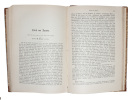
The Exceedingly rare first (and only 19th century) translation of Darwin's first published work ""Letters on Geology"" from 1835. The pamphlet was initially published without Darwin's consent and he was ""a good deal horrified"" when he learned about the publication, which explains the posthumous translation. The work contains extracts from ten letters written by Darwin to John Stevens Henslow (1796-1861) during his five-year voyage on the Beagle. Henslow, the charismatic and well-connected Regis Professor of Botany at Cambridge, was Darwin's close friend and first mentor in natural history and responsible for obtaining for Darwin his position as ship's naturalist aboard the Beagle. Henslow had this pamphlet printed without Darwin's knowledge for distribution amongst the members of the Cambridge Philosophical Society ""in consequence of the interest which has been excited by some of the Geological notices which they contain, and which were read at a Meeting of the Society on the 16th of November 1835"" an act which secured Darwin's reputation with the scientific community even before his return to England in October, 1836. ""It has always been assumed that it was issued, to members of the Cambridge Philosophical Society, in December 1835 and this is probably so , but I have not seen a copy with a dated ownership inscription, or accession stamp, for that year"" (Freeman).The original pamphlet was reprinted in facsimile in 1960, again for private circulation in the Cambridge Philosophical Society and for friends of that Society. Only two translations has been made: The present first and a Russian from 1959 (Freeman 7).Freeman No. 6.
Az Ember Származàsa és az Ivari Kiválás [i.e. Hungarian: ""The Descent of Man.""]. [Translated by:] Török Aurei és Entz Géza. 2 vols. - [FIRST HUNGARIAN TRANSLATION OF DARWIN'S ""THE DESCENT OF MAN""]
Budapest, Kiadja A. K. M., 1884. 8vo. In the publisher's original two embossed full red cloth bindings with gilt lettering to spine. Small vague stamp to both half-titles. Hindges loose on volume i. A fine fine and clean copy. LXXI, (1), 542 pp."" VII, 5, 436 pp.
![Az Ember Származàsa és az Ivari Kiválás [i.e. Hungarian: ""The Descent of Man.""]. [Translated by:] Török Aurei és Entz Géza. 2 vols. - [FIRST ...](https://static.livre-rare-book.com/pictures/LLX/53520_1_thumb.jpg)
The exceedingly rare first Hungarian translation of Darwin's The Descent of Man. ""Compared with the original and with a biography by Margó Tivador"" (Freeman). The Hungarian public was introduced to Darwinism early on when Ferenc Jánosi reviewed The Origin of Species in the Budapesti Szemle (Budapest Review) a half year after it first appeared in English. Darwin's principal works were first published in Hungarian translation by the Royal Hungarian Natural Science Society (Királyi Magyar Természettudományi Társulat). The Origin of Species, translated by László Dapsy, was published in 1873"" The present work in 1884 and a few years later, in 1897, the latter work was translated anew and published by László Seress. ""It is characteristic of the enlightened spirit of the country in this period that Darwin received academic recognition earlier in Hungary than in England. Although Cambridge did not honor Darwin until 1879, he was elected an honorary member of The Hungarian Academy of Sciences in 1872, the same year on this occasion the renowned Hungarian zoologist Tivadar Margó visited him at Down.Historical circumstances played a major role in this quick appearance of Darwinism and its popularity in Hungary. The failure of the 1848-49 revolution and war of independence seemingly put an end to progressive political discourse, signaling an ideological crisis among the intelligentsia. In this context, the natural sciences with their 'eternal truths' promised a way out, inasmuch as science's promised objectivity might well serve as a politically neutral expression of progressive values"" (Mund, The Reception of Charles Darwin in Nineteenth-Century Hungarian Society).""Darwin wrote, in the preface to the second edition, of 'the fiery ordeal through which this book has passed'. He had avoided the logical outcome of the general theory of evolution, bringing man into the scheme, for twelve years, and in fact it had, by that time, been so much accepted that the clamour of the opposition was not strident. He had also been preceded in 1863 by Huxley's Man's place in nature. The book, in its first edition, contains two parts, the descent of man itself, and selection in relation to sex. The word 'evolution' occurs, for the first time in any of Darwin's works, on page 2 of the first volume of the first edition, that is to say before its appearance in the sixth edition of The origin of species in the following year."" (Freeman).Freeman no. 1084.
Emma Darwin - The Inspirational Wife of a Genius (Charles Darwin)
Headline Malicorne sur Sarthe, 72, Pays de la Loire, France 2001 Book condition, Etat : Bon hardcover, editor's full blue printed clothes, no dust-jacket grand In-8 1 vol. - 382 pages
16 plates of photographies and figures in black and white 1st edition Contents, Chapitres : Picture credits, Contents, Acknowledgments, The Darwin Family, the Wedgwood family, the Allen family (3 trees), x, Text, 372 pages - La Britannique Emma Darwin (née Wedgwood, 2 mai 1808 7 octobre 1896) était la femme du naturaliste britannique Charles Darwin. Son père était Josiah Wedgwood II et son grand-père Josiah Wedgwood. Elle était également la cousine de son mari, Charles Darwin. (source : Wikipedia) no dust-jacket, else fine copy, no markings
Habits of ants (+) On the males and complemental males of certain cirripedes, and on rudimentary structures [C. R. Darwin] (+) Variations of organs [G. H. Darwin].
(London and New York, Macmillan and Co., 1873). Royal8vo. In contemporary cloth. In ""Nature. A Weekly Illustrated Journal of Science"", Vol. 8, July 1873 - October 1873. Extremities with wear and end papers brownspottet. Internally fine and clean. C. R. Darwin's papers: P. 244" Pp. 431-432. G. H. Darwin's paper: p. 505 . [Entire volume: Pp. 237-562].
![Habits of ants (+) On the males and complemental males of certain cirripedes, and on rudimentary structures [C. R. Darwin] (+) Variations of organs ...](https://static.livre-rare-book.com/pictures/LLX/60116_1_thumb.jpg)
![Habits of ants (+) On the males and complemental males of certain cirripedes, and on rudimentary structures [C. R. Darwin] (+) Variations of organs ...](https://static.livre-rare-book.com/pictures/LLX/60116_2_thumb.jpg)
First appearance of these three papes, two by Charles Darwin and one by his son. Freeman 1761, 1762 & 1763
Usonogie raki (i.e. 'Living Cirripedia') (+) Proishozhdenie vidov putem estestvennogo otbora... (i.e. 'On the tendency of species to form varieties') (+)Razlichnye formy tsvetov u rastenii odnogo i togo zhe vida (i.e. 'The Different Forms... - [SEVEN FIRST RUSSIAN TRANSLATIONS OF DARWIN'S SHORTER WORKS]
Moscow, Academy of Science, 1935-1959. Royal8vo. In 9 uniform full cloth bindings (albeit with slightly different colours, as published). All volumes with Darwin's signature ""Ch. Darwin"" embossed in gold to lower right corner of front board. All nine volumes with wear to spines. All nine volumes internally fine and clean (no stamps or brownspotting). XLVII, (1), 604, (4) pp. + 3 folded maps.: 682, (2) pp. + 3 folded maps: X, (2), 831, (1) pp. + 1 folded map.: 883, (1) pp.: 1040 pp. + 1 folded plate.: 696 pp.: 650 pp.: 543, (1) pp.: LVI, 734, (1) pp. The following being the collation of the papers which represent the first Russian translation of the given paper:[Geologija, Eskavajra, Tjlena Korolevskogo obschestva (i.e. 'Manual of Scientific Enquiry']: Vol. 2: Pp. 613-637[Usonogie raki (i.e. 'Living Cirripedia')]: Vol. 2: Pp. 37-87[Lectsii evolutsionnoi teorii (i.e. 'Studies in the theory of descent')]: Vol. 3: p. 755.[Proishozhdenie vidov putem estestvennogo otbora... (i.e. 'On the tendency of species to form varieties')]: Pp. 239-255.[Razlichnye formy tsvetov u rastenii odnogo i togo zhe vida (i.e. 'The Different Forms of Flowers on Plants of the Same Species')]: Vol. 7: Pp. 31-251.[Oplodotvorenie tsvetov (i.e. 'Fertilisation of flowers (Hermann Müller)']. Vol. 6: Pp. 652-654.[Zhizn Erazma Darvina (i.e. 'The Life of Erasmus Darwin')]. Vol. 9: Pp. 251-309.
A rare complete run of Moscow's Academy of Science Journal's publication of Darwin's 'Collected Works' containing seven first Russian translations of Darwin's shorter works. -Manual of Scientific Enquiry, Freeman 338, Translated by D. L. Weiss. Annotated by N. S. Shatskiï. 1935-Living Cirripedia, Freeman 341, Translated by N. I. Tarasov. 1936.-Studies in the theory of descent (August Weismann), Freeman 1415, Translated and with notes by S. L. Sobol'., 1939.-On the tendency of species to form varieties , Freeman 370, Translated by A. D. Nekrasov, S. L. Solol, 1939.-Different forms of flowers, Freeman 1302, Translated by A. P. Il'inskiï and E. D. D'yakov, 1948.-Fertilisation of flowers (Hermann Müller), Freeman 1433. Translated by V. A. Rybin., 1950.-Erasmus Darwin (Ernst Krause), Freeman 1324, Translated by V. N. Sukachev., 1959.Freeman 338, 341, 370, 1302, 1324, 1415, 1433,
[LYON, WILLIAM PENMAN]" [erroneously attributed to:] ASA GRAY (+) [translated by:] TSUTOMU INOUE. CHARLES DARWIN -
Reference : 57971
(1881)
Saru no Saiban: Yusho Reppai. - [THE FIRST REPUDIATION OF DARWIN'S THEORY OF EVOLUTION IN JAPANESE]
Tokyo, Nishimura Tomijiro, Fukuda Eizo, Meiji 21 [1881]. 8vo. In the original cloth binding with printed front board (depicting a monkey reading a newspaper). Light wear and soiling to extremities and end papers soiled, otherwise in fine condition. 285 pp. + 3 plates.
![Saru no Saiban: Yusho Reppai. - [THE FIRST REPUDIATION OF DARWIN'S THEORY OF EVOLUTION IN JAPANESE]. [LYON, WILLIAM PENMAN]" [erroneously attributed ...](https://static.livre-rare-book.com/pictures/LLX/57971_1_thumb.jpg)
![Saru no Saiban: Yusho Reppai. - [THE FIRST REPUDIATION OF DARWIN'S THEORY OF EVOLUTION IN JAPANESE]. [LYON, WILLIAM PENMAN]" [erroneously attributed ...](https://static.livre-rare-book.com/pictures/LLX/57971_2_thumb.jpg)
![Saru no Saiban: Yusho Reppai. - [THE FIRST REPUDIATION OF DARWIN'S THEORY OF EVOLUTION IN JAPANESE]. [LYON, WILLIAM PENMAN]" [erroneously attributed ...](https://static.livre-rare-book.com/pictures/LLX/57971_3_thumb.jpg)
The rare first Japanese translation of W. P. Lyon's anti-evolutionary text ' Homo versus Darwin'. It constitutes the very first publication in Japanese to reject Darwin's theory. A year after the publication, the book was banned for 'corrupting public morals'.The present work is Lyon's reply to the publication of Darwin's The Descent of Man. Here, he sees Darwin being charged by Homo of denying him from being a creature made by a God and declaring man to be merely some kind of animal. The author is recorded as being 'Eisa Gurei' [Asa Gray], but in 1986 a study confirmed the text to be a translation of Lyon's work.'Saru no Saiban' is an important work in the history of the reception of Darwinism in Japan. Darwin's theories had a profound influence on Japan and Japanese culture but in a slightly different way than in the West: Darwinism was marked as social and political principles primarily embraced by social thinkers, philosophers and politicians to advocate the superiority of Japanese culture and society (and military) and not by biologists and zoologists. ""It was as if Darwin's famous oceanic journey and the meticulous research into the animal and plant kingdoms that he spent his life undertaking had all been staged as an elaborate excuse for composing a theory whose true object was Victorian society and the fate of the world's modern nations."" (Golley, Darwinism in Japan: The Birth of Ecology).
Darwin Charles. Darwin Charles The Origin Of Species. In English /Darwin Charle
Darwin Charles. Darwin Charles The Origin Of Species. In English /Darwin Charles. Darvin Charlz The Origin Of Species. Book in English 416 c. You are welcome to reach out to us for a detailed description of the copies currently available. Delivery of this book may take longer than usual including extended processing and pre-shipping time, no expedited shipping is available. Please advise us if you have a set date or a deadline to receive your order.SKUalb6a02f881b2503616
La vie et la correspondance de Charles Darwin, avec un chapitre autobiographique, publiés par son fils M. Francis Darwin.
Paris C. Reinwald 1888 2 vol. relié 2 vol. in-8, cartonnages percaline verte de l'éditeur, titres dorés aux dos et ornements aux coiffes, IX + 701 + (3) et (4) + 794 pp., 1 figure gravée, 1 fac-similé et 3 portraits hors-texte, index. Edition originale française. Traduit de l'anglais par Henry C. de Varigny. Ex-libris contrecollés aux pages de garde : Edouard-André Naville. Titre et ornements dorés entièrement ternis au dos du tome 1. Tome 2 très frais. Quelques rousseurs, sinon en bonne condition. Peu courant.
![La vie et la correspondance de Charles Darwin, avec un chapitre autobiographique, publiés par son fils M. Francis Darwin.. DARWIN (Charles)]. DARWIN ...](https://static.livre-rare-book.com/pictures/VIG/124918_1_thumb.jpg)
![La vie et la correspondance de Charles Darwin, avec un chapitre autobiographique, publiés par son fils M. Francis Darwin.. DARWIN (Charles)]. DARWIN ...](https://static.livre-rare-book.com/pictures/VIG/124918_2_thumb.jpg)
![La vie et la correspondance de Charles Darwin, avec un chapitre autobiographique, publiés par son fils M. Francis Darwin.. DARWIN (Charles)]. DARWIN ...](https://static.livre-rare-book.com/pictures/VIG/124918_3_thumb.jpg)
La vie et la correspondance de Charles Darwin, avec un chapitre autobiographique, publiés par son fils M. Francis Darwin.
Paris C. Reinwald 1888 2 vol. relié 2 vol. in-8, cartonnages percaline verte de l'éditeur, titres dorés aux dos et ornements aux coiffes, IX + 701 + (3) et (4) + 794 pp., 1 figure gravée, 1 portrait hors-texte, index. Edition originale française. Traduit de l'anglais par Henry C. de Varigny. Manquent 2 portraits et le fac-similé. Plats du tome 1 frottés. Cartonnage du tome 2 différent, à l'adresse de "Schleicher Frères éditeurs". Des rousseurs, sinon en bonne condition. Peu courant.
![La vie et la correspondance de Charles Darwin, avec un chapitre autobiographique, publiés par son fils M. Francis Darwin.. DARWIN (Charles)]. DARWIN ...](https://static.livre-rare-book.com/pictures/VIG/124919_1_thumb.jpg)
![La vie et la correspondance de Charles Darwin, avec un chapitre autobiographique, publiés par son fils M. Francis Darwin.. DARWIN (Charles)]. DARWIN ...](https://static.livre-rare-book.com/pictures/VIG/124919_2_thumb.jpg)
![La vie et la correspondance de Charles Darwin, avec un chapitre autobiographique, publiés par son fils M. Francis Darwin.. DARWIN (Charles)]. DARWIN ...](https://static.livre-rare-book.com/pictures/VIG/124919_3_thumb.jpg)
Autobiography of Charles Darwin with Two Appendices, Comprising a Chapter of Reminiscences and a Statement of Charles Darwin's Religious View by his Son, Sir Francis Darwin
Icon Books (Watts and Co) , The Thinker's Library, n° 7 Malicorne sur Sarthe, 72, Pays de la Loire, France 2003 Book condition, Etat : Bon hardcover, editor's full black clothes, no dust-jacket In-8 1 vol. - 158 pages
Contents, Chapitres : Contents, Publisher's notes, iv, Text, 154 pages and catalogue no dust-jacket, else fine copy, no markings
Diario del Viaje de un Naturalista Alrededor del Mundo. 2 vols. - [FIRST COMPLETE SPANISH TRANSLATION OF DARWIN'S ""JOURNAL OF RESEARCHES""]
Madrid, Calpe, (1921 & 1922) 8vo. Bound in one half calf binding with four raised bands. Spine with wear, otherwise a fine copy. X, (6), 361, VIII, 359, (3) pp. + 1 folded map.
First complete Spanish translation of Darwin's ""Journal of Researches"": ""La única que completa e intacta, se ofrece en castellano"" (From the introduction to the present work). The work now, now known as Voyage of the Beagle, was Darwin's first published book. As Darwin later recalled in his autobiography 'The voyage of the Beagle has been by far the most important event in my life and has determined my whole career'. ""On its first appearance in its own right, also in 1839, it was called Journal of researches into the geology and natural history etc. The second edition, of 1845, transposes 'geology' and 'natural history' to read Journal of researches into the natural history and geology etc., and the spine title is Naturalist's voyage. The final definitive text of 1860 has the same wording on the title page, but the spine readsNaturalist's voyage round the world, and the fourteenth thousand of 1879 places A naturalist's voyage on the title page. The voyage of the Beagle first appears as a title in the Harmsworth Library edition of 1905. It is a bad title: she was only a floating home for Darwin, on which, in spite of good companionship, he was cramped and miserably sea-sick"" whilst the book is almost entirely about his expeditions on land."" (Freeman).Freeman 252.Blanco & Llorca: 5 (Blanco & Llorca: Bibliogrfía crítica illustrada de las obras de Darwin en españa, (1857-2005).
PORTRAIT DE CHARLES DARWIN - CABINET CARD PHOTOGRAPH OF CHARLES DARWIN
"55. Baker Street / Portman Square / London", [1870 ou1874], , , portrait format "cabinet" : tirage albuminé [60 x 90 mm] contrecollé sur carton [105 x 64 mm], Belle et rare épreuve dans ce format réalisée par le studio Elliot & Fry, fondé en 1863 (actif jusqu'en 1962) par Joseph John Elliot (1835-1903) et Clarence Edmund Fry (1840-1897) avec la mention imprimée de leur première adresse au 55 Baker Street (jusqu'en 1919). Signature fac-similé "C. Darwin" imprimée au bas du portrait sur le carton qui porte également le copyright imprimé du studio, au verso de la carte est imprimé le blason du studio, son nom et son adresse ainsi qu'un timbre à sec. Portrait daté de 1874 par la National Portrait Gallery de Londres qui possède un exemplaire similaire conservé sous le n° d'inventaire NPG x5934, avec un format moindre (83 x 50 mm) car une partie du tirage est masquée par un encadrement. Dès 1869, Charles Darwin semble disposer de ces portraits carte de visite et les évoque dans sa correspondance : "I like best the profile of Ernest Edwards, or a 3/4 face vignette which Messrs Elliot & Fry (Baker St) & which is a strong likeness & pleasing are now making some copies of for us,but I cannot send you one, or one of Mr Edwards'." (Darwin Correspondence Project, ?Letter no. 7020?. [En ligne]) ; Le 5 avril 1870 Charles Darwin effectua un paiement à Elliot & Fry (Darwin Correspondence Project, ?Letter no. 7687F?. [En ligne]) ; Le 2 août 1871 il adresse ses remerciements pour les photographies à Elliot & Fry : "Many thanks for the Photographs which are very good" (Darwin Correspondence Project, ?Letter no. 7893A,? [En ligne]). Tirage original en bon état, légères salissures et trace d'une indication manuscrite grattée en haut à gauche du tirage. Couverture rigide
Bon
La vie et la correspondance de Charles Darwin avec un chapitre autobiographique publiés par son fils M. Francis Darwin
Paris, C. Reinwald, 1888, in-8, 2 vol, front, IX-701-[2] pp, 1 pl. + front, [4]-794 pp, 1 pl, 20 pp. de cat. éd, Toile verte moderne, Première édition française, rare. Au total, elle comprend 3 portraits de Charles Darwin, dont 2 en frontispice, le fac-similé d'une page de notes manuscrites et 1 figure dans le texte représentant le navire "le Beagle" échoué dans la rivière Santa-Cruz. Vie et correspondance de Charles Darwin (1809-1882) par son fils Francis (1845-1925). Francis Darwin, botaniste spécialisé en physiologie végétale, collabora avec son père à partir de 1875, notamment pour la rédaction de The Power of Movement in Plants (1880). Il enseigna à Cambridge à partir de 1884 et y occupa la chaire de botanique de 1888 à 1904. In fine: catalogue de la librairie Reinwald pour mars 1888. Ex-libris manuscrit sur le faux-titre du t. I. Auréole en pied des feuillets du tome II. Couverture rigide
Bon 2 vol., front., IX-701-[2]
O Powstawaniu Gatunków. [i. e. Polish: ""Origin of Species""]. [Translated by Szymon Dickstein]. - [FIRST FULL POLISH TRANSLATION OF DARWIN'S ""ORIGIN OF SPECIES""]
Warszawa, Przegladu Tygodniowego, 1884. Large8vo. In contemporary half calf. Spine with wear, lacking the upper 1 cm. Small stamp to title-page. Hindges weak and back board detached from bookblock. Verso of title-page and first leaf on content. 437, (1), XVI [Including the plate] pp.
First edition of the first full Polish translation of Darwin's ""Origin of Species"". An attempt to publish a Polish translation was made as early as 1873. This was, however, never completed and only half of the work was published (Freeman 739), thus making the present copy the very first full Polish translation. As seen in several other countries (especially in Japan) the majority of Polish intellectuals adopted a Social Darwinism perspective at a very early stage, rather than appreciating the English naturalist's caution in applying his ideas to human society.""Before the first translations of Darwin's appeared [...], many Polish intellectuals, such as positivist writer Eliza Orzeszkowa (1841-1910) complained about the increasing confusion over the essence of the English naturalist's ideas, which had all too often been mixed up with all sorts of ideological debates. However, when Darwin's books were actually available in Polish translations, the novelty of his concepts gradually wore off, making room for more serious attempts to come to terms with evolutionary theory."" (Glick, The Reception of Charles Darwin in Europe). ""It appears that the struggle for or against Darwinism in partitioned Poland prefigured a pattern that is relevant for Polish thinking up to the present day: the conflict of striving for progress with the help of powerful allies abroad and of virulently rejecting all foreign advice for fear of losing one's cultural identity."" (Ibid.).Translation was begun by Szymon Dickstein who in the processe of the translation committed suicide. It was completed by Józef Nusbaum who also translated 'The Variation of Animals and Plants under Domestication' in 1888.Freeman 740
Darwin
Oxford, University Press , Past Masters Malicorne sur Sarthe, 72, Pays de la Loire, France 1982 Book condition, Etat : Bon paperback, illustrated by a portray of Darwin In-8 1 vol. - 111 pages
1st paperback Contents, Chapitres : Preface, Abbreviations, Contents, x, Text, 101 pages - Darwin's life - The foundations of Darwinism - Natural selection and the origin of species - The evidence for evolution by natural selection - Sex, variation and heredity - Man - Perfection and progress - Darwinism and ideology - Darwin as a scientist : An evaluation - Further readings and index working copy from Pierre Thuillier, very few annotations at ink, else fine copy - pocket edition
Naturwissenschaftliche Reisen nach den Inseln des grünen Vorgebirges, Sudamerika, dem Feuerlande, den Faltland-Inseln, Chiloe-Inseln, Galapagos-Inseln, Otaheiti, Neuholland, Neuseeland, Ban Diemen's Land, Keeling-Inseln, Mauritius, St. Helena, den Vz... - [FIRST TRANSLATION OF ANY OF DARWIN'S WORK]
Brunswick, F. Vieweg und Sohn, 1844. 8vo. 2 volumes bound in one contemporary half calf binding with gilt lettering to spine. Previous owner's stamp to front free end-paper. Light brownspotting throughout, especially to first and last leaves. XVI, 319, VIII, 301, (3) pp. + 1 folded map.
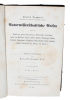

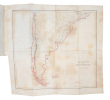
Rare first German translation of Darwin's Journal of researches, now known as Voyage of the Beagle, constituting the very first translation of any of Darwin's works into any language. As Darwin later recalled in his autobiography 'The voyage of the Beagle has been by far the most important event in my life and has determined my whole career'. ""On its first appearance in its own right, also in 1839, it was called Journal of researches into the geology and natural history etc. The second edition, of 1845, transposes 'geology' and 'natural history' to read Journal of researches into the natural history and geology etc., and the spine title is Naturalist's voyage. The final definitive text of 1860 has the same wording on the title page, but the spine readsNaturalist's voyage round the world, and the fourteenth thousand of 1879 places A naturalist's voyage on the title page. The voyage of the Beagle first appears as a title in the Harmsworth Library edition of 1905. It is a bad title: she was only a floating home for Darwin, on which, in spite of good companionship, he was cramped and miserably sea-sick"" whilst the book is almost entirely about his expeditions on land."" (Freeman)Freeman 176

