Write to the booksellers
264 books for « calculus »Edit
-
Type
Book (263)
Old papers (1)
-
Latest
Last 24h (3)
Last 3 days (3)
Last month (12)
Last week (3)
-
Language
English (8)
French (87)
Japanese (1)
Russian (168)
-
Century
17th (2)
18th (5)
19th (15)
20th (31)
21st (1)
-
Countries
Belgium (4)
China (1)
Denmark (37)
France (23)
Switzerland (18)
United States of America (181)
-
Syndicate
ILAB (43)
NVVA (1)
SLACES (1)
SLAM (4)
Topics
- Aristotle (1)
- Army (1)
- Calculation (4)
- Chemistry (2)
- Economics (1)
- Economics (1)
- Fisher max & alex (1)
- Geometry (1)
- Germanic languages (1)
- Hadamard (1)
- History (6)
- Isaac (1)
- Literature (1)
- Machines (1)
- Mathematics (37)
- Maxims (1)
- Medicine (1)
- Newton (1)
- Philosophy (2)
- Physics (1)
- Sciences (3)
- Sciences & technique (4)
- Sheep (1)
- Tea (4)
- Various (1)
Calcolo differenziale e principii di calcolo integrale, pubbicato con aggiunte dal Dr. Giuseppe Peano. - [A FOUNDATIONAL WORK OF THE SCIENCE OF INFINITESIMAL CALCULUS]
Torino, Fratelli Bocca, 1884. 8vo. Cont. full green cloth w. gilt title and ornamentation to spine. Minor occasional browning. A very nice and clean copy. XXXII, 333, (5, -index and errata) pp.
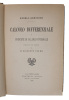
The scarce first edition of Peano's first major publication, his first book, the work that brought him international fame, and one of the most important calculus texts since the time of Euler and Cauchy.The present book, which has a somewhat strange history, contributing to its scarcity, is considered a constitutional work of the science of infinitesimal calculus. In 1899 it was translated into German, and in 1903 into Russian.The famous Italian mathematician, logical philosopher, pioneer of symbolic logic, and a founder of mathematical logic and set theory, Giuseppe Peano (1858 -1932), studied mathematics at the University of Turin, where he was employed just after graduating (1880), and where he stayed almost all of his life, devoting his life to mathematics. After having graduated with honours, he was employed to assist first Enrico D'Ovidio, and then the renowned Angelo Genocchi, who possessed the chair of Infinitesimal calculus. At this time, Genocchi's health was declining, and the teaching of the infinitesimal calculus course was handed over to Peano already in 1882. In 1880 Peano had published his first paper, and the following year he published another three" in 1884 he published his first book, the foundational ""Calculus and Principles of Integral Calculus"", which constitutes one of ""the most important works on the development of the general theory of functions since the work of the French mathematician Augustin-Louis Cauchy (1789-1857)"". (Encycl. Britt.)As is evident from the title-page, the work was based on Genocchi's lectures on calculus"" however, the book turned out to be much more than, and in fact something completely different from, that. Peano stands as the editor of the work, but in fact most of the book is written by Peano himself. Apparently, Genocchi had given his approval to the publication of an edited version of his lectures, but when he saw the final result, he regretted the fact that it had appeared under his name. Genocchi stated in a letter that ""... the volume contains important additions, some modifications, and various annotations, which are placed first. So that nothing will be attributed to me which is not mine, I must declare that I have had no part in the compilation of the aforementioned book and that everything is due to that outstanding young man Dr Giuseppe Peano ..."".Peano assumed full responsibility for the work and also recognised it as his own. He later saw the importance that this book has had on the development of the science of infinitesimal calculus. ""In 1915 he (Peano) printed a list of his writings, adding: ""My works refer especially to infinitesimal calculus, and they have not been entirely useless, seeing that, in the judgment of competent persons, they contributed to the constitution of this science as we have it today."" This ""judgment of competent persons"" refers in part to the ""Encyclopädie der mathematischen Wissenschaften"", in which Alfred Pringsheim lists two of Peano's books among nineteen important calculus texts since the time of Euler and Cauchy. The first of these books was Peano's first major publication and is something of an oddity in the history of mathematics, since the title page gives the author as Angelo Genocchi, not Peano: ""Angelo Genocchi, Calcolo differenziale e principia de calcolo integrale, publicato con aggiunte dal Dr. Guiseppe Peano."" The origin of the book is that Bocca Brothers wished to publish a calculus text based on Genocchi's lectures. Genocchi did not wish to write such a text but gave Peano permission to do so. After its publication Genocchi, thinking Peano lacked regard for him, publicly disclaimed all credit for the book, for which Peano then assumed full responsibility."" (D.S.B. X:441).Later the same year, after the publication of this his first major work, Peano became professor at the university of Turin. His first work now stands, not only as one of the founding texts of modern infinitesimal calculus, but also as a prime example of Peano's excellent style, which perfectly mixes simplicity and rigour. ""Beginning with a strict definition of real number, essentially that of Dedekind, he develops the calculus systematically, formulating every theorem with the greatest possible accuracy and precision, and strictly avoiding in the proofs any illegitimate appeal to intuitive properties of curves. When the customary enunciations of theorems are too loose, or conditions that need to be satisfied are not as a rule clearly stated, Peano often constructs counter-examples to show that assertions made in standard textbooks are incomplete or erroneous...."" (Kneebone, Mathematical Logic and Foundations of Mathematics, p. 142). Cellerino nr. 1. ""Prima edizione del primo libro di Peano che venne tradotto nel 1899 in tedesco e nel 1903 in russo. Pubblicato sotto il nome di Genocchi di cui Peano era assistente, il volume è in realtà interamente opera sua tanto che Genocchi lo disconobbe publicamente dando origine ad una breve polemice. Questa è l'opera che diede a Peano notorietà internazionale."" (Cellerino, Guiseppe Piano e la sua scuola. Catalogo monografico. Milano, 2004).

Applicazioni geometriche del calcolo infinitesimale. - [THE ""GEOMETRICAL CALCULUS""]
Torino, Bocca, 1887. Large 8vo. Cont. half vellum binding with gilt leather title-label to spine. Old library-mark rather crudely removed from back. Inner front hinge a bit weak. A bit of brownspotting. Library-stamp to title-page. XII, 334, (2) pp.
The rare first edition of the work in which Peano introduces the basic elements of geometric calculus and gives new definitions for the length of an arc and for the area of a curved surface.The famous Italian mathematician, logical philosopher, pioneer of symbolic logic, and a founder of mathematical logic and set theory, Giuseppe Peano (1858 -1932), studied mathematics at the University of Turin, where he was employed just after graduating (1880), and where he stayed almost all of his life, devoting his life to mathematics. After having graduated with honours, he was employed to assist first Enrico D'Ovidio, and then the renowned Angelo Genocchi, who possessed the chair of Infinitesimal calculus. In 1890 Peano became extraordinary professor, and in 1895 ordinary professor, of infinitesimal calculus at the Unversity of Turin. His important work ""Geometrical Applications of Infinitesimal Calculus"" is based on Peano's lectures on infinitesimal calculus and its application to geometry from 1885. In the important work he introduced his geometrical calculus and presented several new geometrical discoveries.""The treatise ""Applicazioni geometriche del calcolo infinitesimal"" (1887) was based on a course Peano began teaching at the University of Turin in 1885 and contains the beginnings of his ""geometrical calculus"" (here still influenced by Bellavitis' method of equipolences), new forms of remainders in quadrature formulas, new definitions of length of an arc of a curve and of area of a surface, the notion of a figure tangent to a curve, a determination of the error term in Simpson's formula, and the notion of the limit of a variable figure. There is also a discussion of the measure of a point set, of additive functions of sets, and of integration applied to sets. Peano here generalized the notion of measure that he had introduced in 1883."" (D.S.B. X:443).
Applicazioni geometriche del calcolo infinitesimale. + Calcolo Geometrico secondo l'Ausdehnungslehre di H. Grassmann. Preceduto dalle Operazioni della logica deduttiva. - [THE BEGINNING OF PEANO'S LOGIC AND THE ""GEOMETRICAL CALCULUS""]
Torino, Bocca, 1887 + 1888. Royal 8vo. Bound uncut w. the original wrappers of both works in one very nice a bit later (ab. 1920) red hcalf w. five raied bands to back. Single gilt lines to raised bands and gilt title on spine. A bit of soiling to wrappers, which have minor lacks to the inner hinges, where they are mounted onto hinge-strips. Front-wrappers w. stamp from ""Fratelli Bocca Editori"". A bit of brownspotting, mainly to first work. A very fine and attractive copy of these two works, very finely bound together. XII, 334, (2) + X, (2), 170, (2) pp.
Two rare and important first editions by the famous Italian mathematician, logical philosopher, pioneer of symbolic logic, and a founder of mathematical logic and set theory, Giuseppe Peano, uniting his first publication in logic with his introduction of the basic elements of geometric calculus. The present ""Calcolo geometrico secondo l'Ausdehningslehre de H. Grassmann"" contains a twenty-page long preliminary section on the operations of deductive logic, which constitutes Peano' s very first publication on the subject for which he is most famous, namely logic. This work appeared the year before his seminal ""Arithmetices Principia..."", in which he further improves his logical symbolism, which is introduced in the preliminary section of the present work. ""This section, which has almost no connection with the rest of the text, is a synthesis of, and improvement on, some of the work of Boole, Schröder, Peirce, and McColl."" (D.S.B. X:442).In the other present work, ""Applicazioni geometriche del calcolo infinitesimale"", Peano introduces the basic elements of geometric calculus and gives new definitions for the length of an arc and for the area of a curved surface. This important work (in which not only his geometrical calculus is introduced, but in which he also presented several new geometrical discoveries) is based on his lectures on infinitesimal calculus and its application to geometry from 1885. ""The treatise ""Applicazioni geometriche del calcolo infinitesimal"" (1887) was based on a course Peano began teaching at the University of Turin in 1885 and contains the beginnings of his ""geometrical calculus"" (here still influenced by Bellavitis' method of equipolences), new forms of remainders in quadrature formulas, new definitions of length of an arc of a curve and of area of a surface, the notion of a figure tangent to a curve, a determination of the error term in Simpson's formula, and the notion of the limit of a variable figure. There is also a discussion of the measure of a point set, of additive functions of sets, and of integration applied to sets. Peano here generalized the notion of measure that he had introduced in 1883."" (D.S.B. X:443). Peano (1858 -1932) studied mathematics at the University of Turin, where he was employed just after graduating (1880), and where he stayed almost all of his life, devoting this to mathematics. After having graduated with honours, he was employed to assist first Enrico D'Ovidio, and then the renowned Angelo Genocchi, who possessed the chair of Infinitesimal calculus. In 1890 Peano became extraordinary professor, and in 1895 ordinary professor, of infinitesimal calculus at the Unversity of Turin. Cellerino (Guiseppe Peano e la sua scuola. Catalogo monografico): Nr. 2 + 3. 2: ""Il più alto raggiunto dai matematici del XIX secolo nell'elaborazione della teoria delle funzioni di insiemi, è il V capitolo del libro di Peano..."" F.A. Medvedev.""
"BABBAGE, C. (CHARLES). - CREATING A NEW BRANCH OF MATHEMATICS.
Reference : 42184
(1815)
An Essay towards the calculus of functions. Communicated by W.H. Wollaston. Read June 15, 1815. (+) An essay towards the calculus of functions. Part II. Communicated by W.H.Wollaston. Read March 14, 1816. (2 Papers).
(London, W. Bulmer and Co., 1815 and 1816). 4to. No wrappers as extracted from ""Philosophical Transactions"" 1815 - Part I. and 1816 - Part II. Having both titlepages to the parts. Pp. (2),389-446 and (2),179-256. First titlepage with a stamp on verso. Otherwise fine and clean.
First printings of Babbage's main mathematical contributions.""Babbage's major Contribution to mathematics was his calculus of functions, which he became interested in as early as 1809 and continued to develop during his years at Cambridge. Babbage presents his major ideas on the subject in the above two papers, published in the ""Philosophical Transactions"" in 1815 and 1816. ""It can be said with some assurance that no mathematician prior to Babbage had treated the calculus of functions in such systematic way...Babbage must be given full credit as the inventor of a distinct and importent branch of mathematics"" (Dubbey 1978, 90). Elsewhere Dubby states that his new scheme would serve as a generalized calculus to include all problems capable of analytical formulation, and it is possible to see here a hint of the inspiration for his concept of THE ANALYTICAL ENGINE. While the work on the engines and his other scientific, social and political activities caused him virtually to abandon mathematical research at the age of thirty, the calculus of functions was the area he often yearned to continue. In fact the calculus of functions was not taken up by other workers, and it is the aspect of Babbage's mathematical work that modern mathematicians find most fascinating (Dubbey 1989, 18-19)."" (Hook a. Norman No. 19).Charles Babbage, William Herschel and George Peacock founded in 1810 in Cambridge the ""Analytical Society"", at Trinity College in order to reform the notation and the teaching of mathematics in England, introducing Leibniz' differential notation instead of Newton's fluxions. The continental texts and papers then became accessible to English students.
Observations on the Notation employed in the Calculus of Functions. (Read May 1. 1820).
London, Cambridge University Press, 1822. 4to. In recent paper wrappers. Extracted from the ""Transactions of the Cambridge Philosophical Society"", Volume 1, bound with the title-page of the volume. Fine and clean. (2), (63)-76
First appearance of Babbage paper on the notation employed in the Calculus of Functions.""Babbage's major Contribution to mathematics was his calculus of functions, which he became interested in as early as 1809 and continued to develop during his years at Cambridge. Babbage presents his major ideas on the subject in the above two papers, published in the ""Philosophical Transactions"" in 1815 and 1816. ""It can be said with some assurance that no mathematician prior to Babbage had treated the calculus of functions in such systematic way...Babbage must be given full credit as the inventor of a distinct and importent branch of mathematics"" (Dubbey 1978, 90). Elsewhere Dubby states that his new scheme would serve as a generalized calculus to include all problems capable of analytical formulation, and it is possible to see here a hint of the inspiration for his concept of THE ANALYTICAL ENGINE. While the work on the engines and his other scientific, social and political activities caused him virtually to abandon mathematical research at the age of thirty, the calculus of functions was the area he often yearned to continue. In fact the calculus of functions was not taken up by other workers, and it is the aspect of Babbage's mathematical work that modern mathematicians find most fascinating (Dubbey 1989, 18-19)."" (Hook a. Norman No. 19).
Observations on the Notation employed in the Calculus of Functions. (Read May 1. 1820).
London, Cambridge University Press, 1822. 4to. In plain white paper-wrappers with title-page of journal volume pasted on to front wrapper. In ""Transactions of the Cambridge Philosophical Society"", Volume 1. Fine and clean. Pp. (63)-76
First appearance of Babbage paper on the notation employed in the Calculus of Functions.""Babbage's major Contribution to mathematics was his calculus of functions, which he became interested in as early as 1809 and continued to develop during his years at Cambridge. Babbage presents his major ideas on the subject in the above two papers, published in the ""Philosophical Transactions"" in 1815 and 1816. ""It can be said with some assurance that no mathematician prior to Babbage had treated the calculus of functions in such systematic way...Babbage must be given full credit as the inventor of a distinct and importent branch of mathematics"" (Dubbey 1978, 90). Elsewhere Dubby states that his new scheme would serve as a generalized calculus to include all problems capable of analytical formulation, and it is possible to see here a hint of the inspiration for his concept of THE ANALYTICAL ENGINE. While the work on the engines and his other scientific, social and political activities caused him virtually to abandon mathematical research at the age of thirty, the calculus of functions was the area he often yearned to continue. In fact the calculus of functions was not taken up by other workers, and it is the aspect of Babbage's mathematical work that modern mathematicians find most fascinating (Dubbey 1989, 18-19)."" (Hook a. Norman No. 19).Erwin Tomash B47
Reference : alb9a6c3c492e20c601
Vector calculus and beginning of tensor calculus. In Russian /Vektornoe ischisl
Vector calculus and beginning of tensor calculus. In Russian /Vektornoe ischislenie i nachala tenzornogo ischisleniya. Publishing House of the Academy of Sciences of the USSR. 1951. We have thousands of titles and often several copies of each title may be available. Please feel free to contact us for a detailed description of the copies available. SKUalb9a6c3c492e20c601.

Reference : alb7abdf825d75e7c76
Cochin N. Vector calculus and the beginning of tensor calculus. In Russian (ask
Cochin N. Vector calculus and the beginning of tensor calculus. In Russian (ask us if in doubt)/Kochin N. Vektornoe ischislenie i nachala tenzornogo ischisleniya. Science 1965. 426 p. SKUalb7abdf825d75e7c76.
"BRODIE, B.C. - THE ATOMIC DEBATE IN CHEMISTRY. - ""BOOLEAN CHEMISTRY""
Reference : 43745
(1866)
The Calculus of Chemical Operations"" being a Method for the Investigation, by means of Symbols, of the Laws of the Distribution of Weight in Chemical Change. Received April 25, Read May 3, 1866. Part I-II. (I. On the Construction of Chemical Symbols. ...
(London, Taylor and Francis, 1866 a. 1877. 4to. No wrappers as extracted from ""Philosophical Transactions"", Vol. 156 - Part II a. vol. 167 - Part I. Pp. 781-859 a. pp. 35-116. Clean and fine.
First appearance of both papers, controversial as Brodie here tries to established a new chemical philosophy, refusing atomism and founding the calculation of chemical processes on Boolean Algebra, defining chemical symbols with mathematical terms and notations. The work is a remarkable attempt to set chemistry on a rational deductive basis. - The introduction in the second paper meets the main points raised by his critics.""In 1866 the Royal Society began to publish Brodie’s ""The Calculus of Chemical Operations"" (Philosophical Transactions, 156 [1866], 781-859"" 167 [1877], 35-116) which introduced Greek symbols for the chemical elements to replace the roman alphabet (Berzelian) symbols that contemporary chemists used to represent atomic weights. Brodie’s symbols, however, represented operations on space (volumes), not weights for, besides its revolutionary symbolism, the calculus also demanded an appreciation of George Boole’s algebraic logic, which Brodie had studied after the publication of Boole’s Investigation of the Laws of Thought in 1854. In this an equation such as y = xy is a symbolic statement that y is a subset of x in which the symbol x is an operator on y. Although professional mathematicians like William Donkin and Henry Smith later advised Brodie, it appears that he developed the system without professional help. The principal difficulty about the calculus for the present-day historian and philosopher of science is the need to explain it before going on to discuss it and the difficulty of giving any concise description of it. Boole had developed the concept of symbolic operators in algebraic analysis. These provided a code as to how the symbols were to be understood and manipulated. Brodie exploited this in the idea of a chemical operator, or chemical operations, that he symbolized by Greek letters. It is probably unwise, therefore, to interpret Brodie’s philosophy as analogous to Percy Bridgman’s later operationism. He proposed that if two substances with the empirically-derived weights, x and y combined to form a new compound with weight xy, then x + y = xy. From such weight equations he constructed a symbolic algebra that bypassed any atomistic interpretation.""(William H. Brock in ""Hyle Biography"").
"TSCHIRNHAUS, EHRENFRIED W. V. [FIRST PUBLICATION OF THE ""TSCHIRNHAUS TRANSFORMATION"".]
Reference : 46399
(1683)
Methodus datae figurae, rectis lineis & curva Geometrica terminate, aut Quadraturam, aut impossibilitatem ejusdem Quadraturae determinandi. (+) Nova Methodus determinandi Maxima & Minima (+) Aufrendi omnes terminos intermedios ex data aequatione. - [FORCED LEIBNIZ TO PUBLISH THE CALCULUS]
Leipzig, Grosse & Gleditsch, 1683. 4to. Contemporary full vellum. Handwritten title on spine. Library label to pasted down front free end-paper and a small stamps on titlepage. In: ""Acta Eruditorum Anno MDCLXXXIII"". As usual with various browning to leaves and plates. Tschirnhaus' paper: pp. 122-124" Pp. 204-207" Pp. 433-437. [Entire volume: (8), 561, (7) pp + 13 plates].
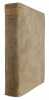
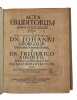
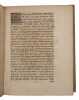
First appearance of Tschirnhaus's three exceedingly important papers which were to to initiate one of the most famous mathematical discoveries. In the papers he used infinitisimal methods which were very close to Leibniz's method and where he tried to lay down criteria for rational quadratures in the case of conic, cubic and quadratic curves, papers that led Leibniz to publish his first paper on the differential calculus, the ""Nova Methoda"" in the Acta for 1684 in order to secure his priority over Tschirnhaus concerning the calculus. Leibniz discovered, when he read Tschirnhaus' papers, that Tschirnhaus had here published results showing similarity with Leibniz's invention of the calculus as he had confided to Tschirnhaus earlier, during their Parisian stay, and this without references to Leibniz.The present volume of Acta also contain the first edition of Tschirnhaus' ""Tschirnhaus Tranformation"". Tschirnhaus work intensively on finding a general method for solving equations of higher of higher degree. ""His transformations constituted the most promising contribution to the solution of equations during the seventeenth century" but his elimination of the second and third coefficients by means of such transformation was far from adequate for the solution of the quintic.(Boyer. A History of Mathematics, 1968, 472 p.).Tschirnhaus (1651-1708) , a Saxon nobleman, had as wide interest as acquaintances: He studied in Leyden, served in the Dutch army, visited England and Paris several times. He set up a glassworks in Italy and is said to have introduced Porcelain to Europe. He wrote about philosophy and mathematics and was a close friend of Leibniz.
Reference : alb5ede08efbf4b87b4
N.S. Piskunov Differential and Integral Calculus. In Russian /Piskunov N.S. Dif
N.S. Piskunov Differential and Integral Calculus. In Russian /Piskunov N.S. Differentsialnoe i integralnoe ischisleniya. N.S. Piskunov Differential and Integral Calculus. You are welcome to reach out to us for a detailed description of the copies currently available. Delivery of this book may take longer than usual including extended processing and pre-shipping time, no expedited shipping is available. Please advise us if you have a set date or a deadline to receive your order.SKUalb5ede08efbf4b87b4
Reference : bd-ba7bdb3cfde797d9
Heinrich Burkhardt. Begins differential and integral calculus and its applicati
"Heinrich Burkhardt. Begins differential and integral calculus and its application to the description of natural phenomena, with 39 figures in the text./Genrikh Burkkhardt. Nachala differentsialnogo i integralnogo ischisleniy i ikh priloeniya k opisaniyu yavleniy prirody. s 39 figurami v tekste. Heinrich Burkhardt. Beginning of differential and integral calculus and their application to the description of natural phenomena, with 39 figures in the text. St. Petersburg: 1909, -232 p.; 24x16 sm. We have thousands of titles and often several copies of each title may be available. Please feel free to contact us for a detailed description of the copies available. The delivery of this book might be delayed beyond the usual timeframe due to extended processing and preparation before shipment, and faster shipping options are not offered. Please inform us if you need the order by a certain date or have a deadline.SKUbd-ba7bdb3cfde797d9"
Reference : alb44eb3942b8726ada
N.S. Piskunov Differential and Integral Calculus. Volume 2. In Russian /Piskuno
N.S. Piskunov Differential and Integral Calculus. Volume 2. In Russian /Piskunov N.S. Differentsialnoe i integralnoe ischisleniya.Tom 2. N.S. Piskunov Differential and Integral Calculus. Volume 2. You are welcome to reach out to us for a detailed description of the copies currently available. Delivery of this book may take longer than usual including extended processing and pre-shipping time, no expedited shipping is available. Please advise us if you have a set date or a deadline to receive your order.SKUalb44eb3942b8726ada
Reference : alb35b95cd52b0eb539
Granville W., Luzin N. Course of differential and integral calculus. Part 2. In
Granville W., Luzin N. Course of differential and integral calculus. Part 2. Integral calculus In Russian /Grenvil V., Luzin N. Kurs differentsialnogo i integralnogo ischisleniy. Chast 2. Integralnoe ischislenie M-L OGIZ. Gostekhizdat 1942. 300g. You are welcome to reach out to us for a detailed description of the copies currently available. Delivery of this book may take longer than usual including extended processing and pre-shipping time, no expedited shipping is available. Please advise us if you have a set date or a deadline to receive your order.SKUalb35b95cd52b0eb539
Reference : albf66d28c28a751ceb
Moser J. Selected Chapters in the Calculus of Variations. In English /Moser J.
Moser J. Selected Chapters in the Calculus of Variations. In English /Moser J. Selected Chapters in the Calculus of Variations. Basel, Birkhauser, 2003.Contact us for details or to request photos of available books. Delivery of this book could take longer than normal due to additional handling time before shipping, and no rush delivery options are available. Please let us know if you have a specific date by which you need to receive your order.SKUalbf66d28c28a751ceb
Reference : alb3ff85362ba2e81b0
Struwe M. Plateaus Problem and the Calculus of Variations. In English /Struwe M
Struwe M. Plateaus Problem and the Calculus of Variations. In English /Struwe M. Plateaus Problem and the Calculus of Variations. New Jersey, Princeton University Press, 1989.Contact us for details or to request photos of available books. Delivery of this book could take longer than normal due to additional handling time before shipping, and no rush delivery options are available. Please let us know if you have a specific date by which you need to receive your order.SKUalb3ff85362ba2e81b0
Reference : alb78a770fa3c64bc97
Morrey C.B. Multiple Integral Problems in the Calculus of Variations and Relate
Morrey C.B. Multiple Integral Problems in the Calculus of Variations and Related Topics. In English /Morrey C.B. Multiple Integral Problems in the Calculus of Variations and Related Topics. Berkeley, University of California Press. 1943. We have thousands of titles and often several copies of each title may be available. Please feel free to contact us for a detailed description of the copies available. The delivery of this book might be delayed beyond the usual timeframe due to extended processing and preparation before shipment, and faster shipping opSKUalb78a770fa3c64bc97
Problems and Theorems in Analysis: Series - TOMES 1 & 2· Integral Calculus · Theory Of Functions zeros polynomials determinants number theory geometry
Springer 1976 416 pages 15 24x2 286x22 606cm. 1976. Broché. 2 volume(s). 416 pages.

Bon état tranches un peu ternies intérieurs propres bonne tenue
Reference : albf65a65ef4346528c
Ambrosio L., Dancer N. Calculus of Variations and Partial Differential Equatio
Ambrosio L., Dancer N. Calculus of Variations and Partial Differential Equations. Topics on Geometrical Evolution Problems and Degree Theory. In English /Ambrosio L., Dancer N. Calculus of Variations and Partial Differential Equations. Topics on Geometrical Evolution Problems and Degree Theory. Berlin E. Springer, 2000, 347c. We have thousands of titles and often several copies of each title may be available. Please feel free to contact us for a detailed description of the copies available. SKUalbf65a65ef4346528c.
Reference : albd56ac74edd359500
Granville W., Luzin N. Course of differential and integral calculus. Part 1. D
Granville W., Luzin N. Course of differential and integral calculus. Part 1. Differential calculation.Part 2: Integral calculus. In Russian /Grenvil V., Luzin N. Kurs differentsialnogo i integralnogo ischisleniy. Chast 1. Differentsialnoe vychislenie.Chast 2: Integralnoe ischislenie. Supplements and revisions in relation to the programs of the material and physical departments of universities and higher education institutions. We have thousands of titles and often several copies of each title may be available. Please feel free to contact us for a detailed description of the copies available. SKUalbd56ac74edd359500.
Reference : albfc70a03ffca798c4
Emery Michel. Stochastic Calculus in Manifolds. In English /Emery Michel. Stoc
Emery Michel. Stochastic Calculus in Manifolds. In English /Emery Michel. Stochastic Calculus in Manifolds. With an Appendix by P.A. Meyer. Berlin E. Springer, 1989. 151c. We have thousands of titles and often several copies of each title may be available. Please feel free to contact us for a detailed description of the copies available. SKUalbfc70a03ffca798c4.
Reference : albbb612789c405f4d4
Giaquinta M. Multiple Integrals in the Calculus of Variations and Nonlinear Ell
Giaquinta M. Multiple Integrals in the Calculus of Variations and Nonlinear Elliptic Systems. In English /Giaquinta M. Multiple Integrals in the Calculus of Variations and Nonlinear Elliptic Systems. New Jersey, Princeton University Press, 1983. 296c. We have thousands of titles and often several copies of each title may be available. Please feel free to contact us for a detailed description of the copies available. SKUalbbb612789c405f4d4.
Reference : alb737593b5aa1afefe
Fichtenholz G.M. Course of differential and integral calculus. Course of differe
Short description: Fichtenholz G.M. Course of differential and integral calculus. Course of differential and integral calculus. Volume 3 In Russian /Fikhtengol'ts G.M. Kurs differentsial'nogo i integral'nogo ischisleniya. Kurs differentsial'nogo i integral'nogo ischisleniya. Tom 3In Russian.Edition 3. Textbook in three volumes. For students of mathematical departments of universities and postgraduate students. M. Gostekhizdat 1963. 656 p. We have thousands of titles and often several copies of each title may be available. Please feel free to contact us for a detailed description of the copies available. SKUalb737593b5aa1afefe
Reference : alb557d1e9f5961fedb
Urakawa H. Calculus of Variations and Harmonic Maps. In English /Urakawa H. Cal
Urakawa H. Calculus of Variations and Harmonic Maps. In English /Urakawa H. Calculus of Variations and Harmonic Maps. American Mathematical Society, 1993, 251c. We have thousands of titles and often several copies of each title may be available. Please feel free to contact us for a detailed description of the copies available. SKUalb557d1e9f5961fedb.
Reference : alb5cfdbdcd2ac08d18
Heinrichs G. Infinity-Small Calculus Task (bases for differential and integral
Heinrichs G. Infinity-Small Calculus Task (bases for differential and integral calculus) In Russian /Geynrikhs G. Zadachnik po ischisleniyu beskonechno-malykh. ( osnovaniya differentsialnogo i integralnogo ischisleniy) According to the syllabus of the 7th grade course at real schools in St. Petersburg, Typov v S. Suvorin, 1913,. We have thousands of titles and often several copies of each title may be available. Please feel free to contact us for a detailed description of the copies available. SKUalb5cfdbdcd2ac08d18.