 Write to the booksellers
1304 books for « allen j »Edit
-
Type
Book (1293)
Magazine (1)
Music sheets (18)
Object book (1)
-
Latest
Last month (9)
Last week (1)
-
Language
English (16)
French (1292)
Russian (5)
-
Century
17th (1)
18th (2)
19th (18)
20th (640)
21st (147)
-
Countries
Belgium (93)
Canada (16)
China (3)
Côte d'Ivoire (5)
Denmark (11)
France (1053)
Germany (1)
Netherlands (6)
Switzerland (117)
United Kingdom (2)
United States of America (6)
-
Syndicate
ALAC (8)
CLAM (2)
CNE (1)
ILAB (523)
NVVA (3)
SLACES (3)
SLAM (484)
Topics
- Allen oliver e. (11)
- Andrews allen (6)
- Archaeology (6)
- Architecture (11)
- Australia (6)
- Autographs (7)
- Aviation (5)
- Belgium (6)
- Bible (8)
- Biography (5)
- Byzantium, (4)
- Canada (4)
- Children’s books (27)
- Cinema (38)
- Comedy (8)
- Computer science (5)
- Detective novels (6)
- Drawings (4)
- Dulles allen (17)
- Ecology (3)
- Economics (10)
- Egypt (5)
- Egyptology (4)
- England (16)
- English (56)
- Entomology (9)
- Erasmus (4)
- Fine arts (8)
- First edition (5)
- Flora (4)
- Flowers (4)
- Flying saucers (ufo) (4)
- Fox (4)
- Games toys (8)
- Gardens (3)
- Gastronomy (4)
- Geography (11)
- Germanic languages (3)
- Great britain (8)
- Greece (4)
- Greek (10)
- Healthcare (3)
- Hervey (26)
- History (43)
- Humanism (5)
- Industrial arts & crafts - fine arts (4)
- Iron (11)
- Italy (5)
- Japan (6)
- Jazz (4)
- Jed (3)
- Language (10)
- Latin (6)
- Literature (97)
- Magazine (3)
- Miller (10)
- Navigation (3)
- Navy (7)
- Newspapers press (5)
- Ornithology (4)
- Painting (3)
- Paradise (4)
- Philology (3)
- Philosophy (16)
- Photography (11)
- Plato (3)
- Poe edgar (8)
- Poetry (13)
- Policy (4)
- Posters (11)
- Psychiatry neurology (6)
- Psychology (9)
- Railway (17)
- Religions (7)
- Review (14)
- Reviews (4)
- Ruth (4)
- Science fiction (4)
- Sciences (6)
- Scores (21)
- Sexuality (7)
- Simone (3)
- Sociology (5)
- Songs (16)
- Sports (3)
- Spying (7)
- Surgery (3)
- Tea (9)
- Theology (5)
- Translation (6)
- Turner (4)
- United kingdom (16)
- United states (15)
- Various (9)
- War (9)
- Warner (12)
- Williams tennessee (4)
- Zoology (3)
Encyclopédie visuelle des chemins de fer d'aujourd'hui
1981 Paris/Bruxelles Bordas/elsevier 1981 Un volumein°4 reliure cartonnée éditeur sous jaquette 256 pages. Très nombreuses photographies
![Encyclopédie visuelle des chemins de fer d'aujourd'hui. FREEMAN Allen G. - [Chemins de fer]](https://static.livre-rare-book.com/pictures/RLI/2344_1_thumb.jpg)
![Encyclopédie visuelle des chemins de fer d'aujourd'hui. FREEMAN Allen G. - [Chemins de fer]](https://static.livre-rare-book.com/pictures/RLI/2344_2_thumb.jpg)
![Encyclopédie visuelle des chemins de fer d'aujourd'hui. FREEMAN Allen G. - [Chemins de fer]](https://static.livre-rare-book.com/pictures/RLI/2344_3_thumb.jpg)
Très bon état N'hésitez pas à nous mettre dans vos favoris. Vous serez ainsi tenu au courant de nos nouveautés
Collectif. Textes de John Ashbery, Marcel Broodthaers, Manlio Brusatin, Michel Cassé, Paollo Fabbri, Mickael Jakob, Jacqueline Lichtenstein, Agnès Minazzoli, Angelika Overath, Michel Pastoureau, Denys Riout, Gilles A. Tiberghien, Paul Virilio, Allen S. Weiss.
Reference : 79711
(1993)
Azur. Fondation Cartier. Catalogue d'exposition.
Belgique, Fondation Cartier pour l'Art Contemporain/Martial et Snoeck, 1993, in-4, cartonnage éditeur, 272p. Très bon état.
Les années de mer de Joseph Conrad.
Paris, Denoël, 1968, in-8°, broché, 472 pages. Couverture à l'état d'usage. Intérieur en bon état. Sans annotations. Ex. du service de presse.
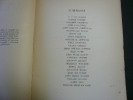
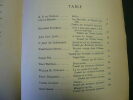
R. P. du Poisin, Cotton Mather, Benjamin Franklin, John Paul Jones, Saint John de Crèvecoeur, Washington Irvin, Edgar Poe, Walt Whitmann, William H. Herndon, Emily Dinkinson, Vachel Lindsay, James Weldon Johnson, Hart Crane, John Peale Bishop, Langston Hughes, Robinson Jeffers, Archibald Macleish, Henry Miller, Marianne Moore, John dos Passos, John Crowe Ransom, Wallace Stevens, Allen Tate, William Carlos Williams.
Reference : 78781
(1939)
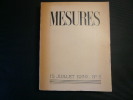
MESURES n°3 15 juillet 1939. Numéro spécial consacré aux LETTRES AMERICAINES.
Paris, José Corti, 1939, 185x23mm, broché, 382p. Bel exemplaire.
L'Allemagne souterraine
Genève, Trois collines, 1947, Broché, 366 pages. Couverture défraichie. Solide ex.
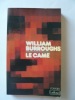
Le camé
Paris, Belfond, 1979, in-8, broché, 189 pages. Bon état. Collection littérature étrangère. Edition non expurgée.
Journaux indiens
Paris, Christian Bourgois, 1977, Broché, 266 pages. Photographie N/B. Jaquette légèrement défraîchie.
Viscosity of liquid Helium below the lambda-point [Kapitza] (+) Flow of liquid Helium II [J. F. Allen & A. D. Misener] [The volume also contain the following papers: New phenomena connected with heat flow in liquid Helium II [J. F. Allen & H. Jones] (... - [THE DISCOVERY OF SUPERFLUIDITY]
London, Macmillian and Co, 1938. Royal8vo. In contemporary half cloth with white paper title-label pasted on to spine. In: ""Nature"", January - June, 1939, Vol. 141, entire volume offered. Stamp to front free end-paper and title-page, otherwise fine and clean copy. P. 74"" P. 75. [Entire volume: LXIV, 1156 pp.].
![Viscosity of liquid Helium below the lambda-point [Kapitza] (+) Flow of liquid Helium II [J. F. Allen & A. D. Misener] [The volume also contain the ...](https://static.livre-rare-book.com/pictures/LLX/59910_1_thumb.jpg)
![Viscosity of liquid Helium below the lambda-point [Kapitza] (+) Flow of liquid Helium II [J. F. Allen & A. D. Misener] [The volume also contain the ...](https://static.livre-rare-book.com/pictures/LLX/59910_2_thumb.jpg)
![Viscosity of liquid Helium below the lambda-point [Kapitza] (+) Flow of liquid Helium II [J. F. Allen & A. D. Misener] [The volume also contain the ...](https://static.livre-rare-book.com/pictures/LLX/59910_3_thumb.jpg)
First publication of these two seminal papers which constitutes one of the most significant discoveries in 20th century physics. It ushered a golden period of low-temperature physics and created a new research field within physics which was later to be called quantum liquids. Both paper described a hitherto unknown state of matter: superfluidity of matter. The two discoveries were made independently, Kapitza's paper superseding Allen and Misener's by two weeks. Both studies reported that liquid helium flowed with almost no measurable viscosity below the transition temperature of 2.18 K.""Although the discovery of superfluidity stands as one of the most significant in physics in the 20th century, it was to be 40 years before the Royal Swedish Academy of Sciences honoured this seminal discovery with a Nobel prize - an exceptionally long interval. In 1978 Kapitza, by then 84, was given half of that year's Nobel Prize for Physics with a somewhat vague citation reading ""for his basic inventions and discoveries in the area of low-temperature physics"". The other half did not go to Allen and Misener. Today, science popularizers generally give sole credit for the discovery of superfluidity to Kapitza."" (Physics world, University of Toronto.). ""Kapitza observed that He II flowed between two closely spaced parallel plates extremely rapidly compared to He I, for the same pressure difference. This result, published in Nature on 8 January 1938, showed unambiguously that here was a new and mysterious kind of liquid - one with almost no viscosity. On the page facing Kapitza's one-page paper was another by the young Canadian physicists Jack Allen and Donald Misener, with essentially equivalent results on helium flow on long capillary tubes. It was submitted two weeks after Kapitza's, but both papers are the standard reference for the discovery of superfluidity"". (Griffin, A Century of Nature, 2003, p. 52).While investigating the thermal conductivity of liquid helium, Kapitsa measured the flow as the fluid flows through a gap between two discs into a surrounding bath. Above the lambda point, there was little flow, but below the lambda temperature, the liquid flowed with such great ease that Kapitsa drew an analogy with superconductors. It was a liquid of zero viscosity. He discovered the phenomenon in 1937 and published a paper about it in Nature in January 1938. He wrote: ""The helium below the lambda point enters a special state that might be called a ‘superfluid.’"" (DSB).Today the theory behind superfluidity is widely used within a broad variety of different subject such as spectroscopic and in high-precision devices as gyroscopes which allow the measurement of some theoretically predicted gravitational effects. In 1999, a type of superfluid was used to trap light and greatly reduce its speed. Light was passed through a Bose-Einstein condensed gas of sodium (superfluid) and found to be slowed to 17 m/s from its normal speed of 299,792,458 metres per second.Brandt, The Harvest of a Century, Pp. 254-7.

Viscosity of liquid Helium below the lambda-point [Kapitza] (+) Flow of liquid Helium II [J. F. Allen & A. D. Misener] [The volume also contain the following papers: New phenomena connected with heat flow in liquid Helium II [J. F. Allen & H. Jones] (... - [THE DISCOVERY OF SUPERFLUIDITY]
New York, Macmillian and Co, 1938. Royal8vo. In publisher's pictorial cloth with the original wrappers [in the back]. Gilt lettering and Nature's logo to spine and front board. Entire issue of ""Nature"", January - June, 1938, Vol. 141. ""Emmanuel College"" in gilt lettering to spine and two library stamps to title-page and first index page. Two small white paper labels pasted on to spine and a small tear to top of spine. Very slight wear to extremities, otherwise a very fine and clean copy. Rare in the publisher's binding. P. 74"" P. 75. [Entire volume: LXIV, 1156 + VIII, IV, VIII, VIII, XVI, VIII, VIII, XVI, VIII, XII, VIII, XII, XII, IV, IV, VIII, XII, VIII, VIII, VIII, VIII, XII, VIII, IV, XVI, CCLX (Advertisements).
First publication of these two seminal papers which constitutes one of the most significant discovery in 20th century physics. It ushered a golden period of low-temperature physics and created a new research field within physics which was later to be called quantum liquids. Both paper described a hitherto unknown state of matter: superfluidity of matter. The two discoveries were made independently, Kapitza's paper superseding Allen and Misener's by two weeks. Both studies reported that liquid helium flowed with almost no measurable viscosity below the transition temperature of 2.18 K.""Although the discovery of superfluidity stands as one of the most significant in physics in the 20th century, it was to be 40 years before the Royal Swedish Academy of Sciences honoured this seminal discovery with a Nobel prize - an exceptionally long interval. In 1978 Kapitza, by then 84, was given half of that year's Nobel Prize for Physics with a somewhat vague citation reading ""for his basic inventions and discoveries in the area of low-temperature physics"". The other half did not go to Allen and Misener. Today, science popularizers generally give sole credit for the discovery of superfluidity to Kapitza."" (Physics world, University of Toronto.). ""Kapitza observed that He II flowed between two closely spaced parallel plates extremely rapidly compared to He I, for the same pressure difference. This result, published in Nature on 8 January 1938, showed unambiguously that here was a new and mysterious kind of liquid - one with almost no viscosity. On the page facing Kapitza's one-page paper was another by the young Canadian physicists Jack Allen and Donald Misener, with essentially equivalent results on helium flow on long capillary tubes. It was submitted two weeks after Kapitza's, but both papers are the standard reference for the discovery of superfluidity"". (Griffin, A Century of Nature, 2003, p. 52).While investigating the thermal conductivity of liquid helium, Kapitsa measured the flow as the fluid flows through a gap between two discs into a surrounding bath. Above the lambda point, there was little flow, but below the lambda temperature, the liquid flowed with such great ease that Kapitsa drew an analogy with superconductors. It was a liquid of zero viscosity. He discovered the phenomenon in 1937 and published a paper about it in Nature in January 1938. He wrote: ""The helium below the lambda point enters a special state that might be called a ‘superfluid.’"" (DSB).Today the theory behind superfluidity is widely used within a broad variety of different subject such as spectroscopic and in high-precision devices as gyroscopes which allow the measurement of some theoretically predicted gravitational effects. In 1999, a type of superfluid was used to trap light and greatly reduce its speed. Light was passed through a Bose-Einstein condensed gas of sodium (superfluid) and found to be slowed to 17 m/s from its normal speed of 299,792,458 metres per second.Brandt, The Harvest of a Century, Pp. 254-7.
Allen G. Taylor. SQL for kettles. In Russian /Allen G. Teylor. SQL dlya chaynik
Allen G. Taylor. SQL for kettles. In Russian /Allen G. Teylor. SQL dlya chaynikov. 6th edition. M. Williams 2010 352s. You are welcome to reach out to us for a detailed description of the copies currently available. Delivery of this book may take longer than usual including extended processing and pre-shipping time, no expedited shipping is available. Please advise us if you have a set date or a deadline to receive your order.SKUalb4bedd2de20ed38cc
Allen Greg Poland: A Guide to Customs and Etiquette. In Russian /Allen Greg. Po
Allen Greg Poland: A Guide to Customs and Etiquette. In Russian /Allen Greg. Polsha: Putevoditel po obychayam i etiketu. M. AST: Astrel. 2008. We have thousands of titles and often several copies of each title may be available. Please feel free to contact us for a detailed description of the copies available. SKUalbdc6a741156f3a10a.
Taylor Allen G. SQL for teapots. In Russian /Teylor Allen G. SQL dlya chaynikov
Taylor Allen G. SQL for teapots. In Russian /Teylor Allen G. SQL dlya chaynikov. M. Dialectics 2007, 352p. We have thousands of titles and often several copies of each title may be available. Please feel free to contact us for a detailed description of the copies available. SKUalb2d365cf8513bed28.
Allen Cohen, Bruce Conner, Rick Griffin, Allen Ginsberg, Gary Snyder, Lawrence Ferlinghetti, Michael McClure
Reference : 104419
THE ORACLE OF THE CITY OF SAN FRANCISCO
n°1, septembre 1966 - n°12, février 1968; Format de 280x280mm à 445x929mm, 12 à 32 pages, en feuilles.Collection complète (104419)
Également connu sous le nom de San Francisco Oracle, the Oracle of the city of San Francisco était un journal clandestin publié en 12 numéros du 20 septembre 1966 à février 1968 dans le quartier Haight-Ashbury de cette ville. Allen Cohen (1940-2004), rédacteur en chef pendant la période la plus dynamique du journal, et Michael Bowen, directeur artistique, comptent parmi les fondateurs de la publication. L'Oracle a été l'un des premiers membres de l'Underground Press Syndicate. L'Oracle combinait poésie, spiritualité et intérêts multiculturels avec un design psychédélique, reflétant et façonnant la communauté contre-culturelle telle qu'elle se développait à Haight-Ashbury. Sans doute l'exemple exceptionnel de psychédélisme dans la presse « underground », la publication était connue pour son design multicolore expérimental. Les contributeurs d'Oracle comprenaient de nombreux artistes importants de la région de San Francisco de l'époque, notamment Bruce Conner et Rick Griffin. Il mettait en vedette des auteurs de beat tels qu'Allen Ginsberg, Gary Snyder, Lawrence Ferlinghetti et Michael McClure. Bel état dans un boîte de Pierre Mercier (1928-2014) signée et datée (19)89.
on inconversation with Stig Björkman Faber and Faber
Sans date. Woody Allen on Woody Allen inconversation with Stig Björkman/ Faber and Faber . Woody Allen on Woody Allen inconversation with Stig Björkman/ Faber and Faber
Très bon état
Viscosity of Liquid Helium below the l-Point [Kapitza] (+) Flow of Liquid Helium II [Allen & Misener]. - [THE DISCOVERY OF SUPERFLUIDITY]
New York, Macmillian and Co, 1938. Lex8vo. Entire volume 141 of Nature offered. Bound in a brown contemporary full cloth with gilt lettering to spine. Ex-library copy, paper label pasted on to top and bottom of spine. Library stamp to pasted down front free end-paper and title page. Paper labels pasted on the back free end-paper and pasted down back free end-paper. Internally fine and clean. P. 74" 75. [Entire volume: Pp. lxiv, 1156, v-xii, v-vii, v-iv, v-xii].
First publication of these two seminal papers which constitutes one of the most significant discovery in 20th century physics. It ushered a golden period of low-temperature physics and created a new research field within physics which was later to be called quantum liquids. Both paper described a hitherto unknown state of matter: superfluidity of matter. The two discoveries were made independently, Kapitza's paper superseding Allen and Misener's by two weeks. Both studies reported that liquid helium flowed with almost no measurable viscosity below the transition temperature of 2.18 K.""Although the discovery of superfluidity stands as one of the most significant in physics in the 20th century, it was to be 40 years before the Royal Swedish Academy of Sciences honoured this seminal discovery with a Nobel prize - an exceptionally long interval. In 1978 Kapitza, by then 84, was given half of that year's Nobel Prize for Physics with a somewhat vague citation reading ""for his basic inventions and discoveries in the area of low-temperature physics"". The other half did not go to Allen and Misener. Today, science popularizers generally give sole credit for the discovery of superfluidity to Kapitza."" (Physics world, University of Toronto.). ""Kapitza observed that He II flowed between two closely spaced parallel plates extremely rapidly compared to He I, for the same pressure difference. This result, published in Nature on 8 January 1938, showed unambiguously that here was a new and mysterious kind of liquid - one with almost no viscosity. On the page facing Kapitza's one-page paper was another by the young Canadian physicists Jack Allen and Donald Misener, with essentially equivalent results on helium flow on long capillary tubes. It was submitted two weeks after Kapitza's, but both papers are the standard reference for the discovery of superfluidity"". (Griffin, A Century of Nature, 2003, p. 52).Today the theory behind superfluidity is widely used within a broad variety of different subject such as spectroscopic and in high-precision devices as gyroscopes which allow the measurement of some theoretically predicted gravitational effects. In 1999, a type of superfluid was used to trap light and greatly reduce its speed. Light was passed through a Bose-Einstein condensed gas of sodium (superfluid) and found to be slowed to 17 m/s from its normal speed of 299,792,458 metres per second.Brandt, The Harvest of a Century, Pp. 254-7.
[The Studio] - HOLME, Charles (Ed.) ; James Craig Annan, Alvin Langdon Coburn, Frank Eugene, Baron Adolf de Meyer, Frances Stebbins Allen, Mary Electa Allen, Dwight Arthur Davis, Robert Demachy, Rudolf Dührkoop, David Octavius Hill, Gertrude Käsebier, Clarence H. White, Alexander Keighley, Joseph Turner Keiley, Guido Rey, Eva L. Watson-Schutze, George H. Seeley, Alfred Stieglitz, Heinrich Kühn, Malcolm Arbuthnot, Anne W. Brigman, J. Dudley Johnston
Reference : 54264
(1908)
Colour Photography and other recent developments of the Art of The Camera 1908. Special Summer number of The Studio
1 vol. in-4 reliure demi-maroquin brun, dos à 5 nerfs, couvertures d'origine contrecollées en plat, Offices of "The Studio", London, Paris & New York ("Bureau du Studio, à Paris" on cover, 1908, 10 pp. et 113 planches / 4to, half morroco leather binding, Offices of "The Studio", London, Paris & New York ("Bureau du Studio, à Paris" on cover, 10 pp. et 113 planches
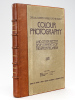
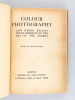
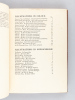
Nice copy with its great morocco binding (binding very slightly rubbed, slight foxing) ! With photographs by James Craig Annan, Alvin Langdon Coburn, Frank Eugene, Baron Adolf de Meyer, Frances Stebbins Allen, Mary Electa Allen, Dwight Arthur Davis, Robert Demachy, Rudolf Dührkoop, David Octavius Hill, Gertrude Käsebier, Clarence H. White, Alexander Keighley, Joseph Turner Keiley, Guido Rey, Eva L. Watson-Schutze, George H. Seeley, Alfred Stieglitz, Heinrich Kühn, Malcolm Arbuthnot, Anne W. Brigman, J. Dudley Johnston, or Charles Job. De la bibliothèque Henry Frugès avec son bel ex-libris arabisant signé "Abd En Nor". Passionné d'art, l'industriel sucrier Henry Frugès (1879-1974) tenait de sa grand-mère maternelle née Bentajou que sa famille descendait d’une certaine Zohra, fille de l’émir El Hadj Abd En Nor El Maimouny, général de Boadbil, le dernier roi de Grenade ; il restera profondément attiré par l'art musulman, comme le montre son amusant ex-libris avec sa devise "Je m'éclaire !".
Bragdon Allen, Damon D. Bodybuilding for the Mind. In Russian /Bregdon Allen, G
Bragdon Allen, Damon D. Bodybuilding for the Mind. In Russian /Bregdon Allen, Geymon D. Bodibilding dlya uma. M.: Eksmo 2005. Contact us for details or to request photos of available books. Delivery of this book could take longer than normal due to additional handling time before shipping, and no rush delivery options are available. Please let us know if you have a specific date by which you need to receive your order.SKUalb9a7d018d96f0df58
Allen Ginsberg : An Annotated Bibliography, 1969-1977.
Metuchen, N.J. & London. The Scarecrow Press, Inc. 1980. In-8 reliure éditeur. 330 pages. The Scarecrow Author Bibliographies, n° 46. E.O. de cette bibliographie d'Allen Ginsberg, consacrée aux publications entre 1969 et 1977. Photos.

Allen Greg Poland: A Guide to Customs and Etiquette. In Russian (ask us if in do
Allen Greg Poland: A Guide to Customs and Etiquette. In Russian (ask us if in doubt)/Allen Greg. Polsha: Putevoditel po obychayam i etiketu. ACT 2008 159 p. We have thousands of titles and often several copies of each title may be available. Please feel free to contact us for a detailed description of the copies available. SKUalbf6d0a7566f6aec3b
Les Ancêtres (The Fathers). Traduit de l'américain par Marie Canavaggia.
Paris, Gallimard, Collection Du Monde Entier, 1958. Un volume in-8, broché, non coupé, 282 pp.
Édition originale de la traduction française. Un des 210 exemplaires numérotés sur vélin pur fil Lafuma (seul tirage en grand papier). Bel ex. Allen Tate, né John Orley Allen Tate le 19 novembre 1899 à Winchester dans le Kentucky et mort le 9 février 1979 à Nashville dans le Tennessee, est un poète et critique littéraire américain. Après avoir fréquenté le conservatoire de musique de Cincinnati, il fait des études à l'université Vanderbilt où il rencontre son condisciple Robert Penn Warren, qui devient son un ami proche, et intègre le groupe de poètes sudistes mené par John Crowe Ransom. En 1924, il arrive à New York et travaille comme pigiste pour The Nation. Disciple de Thomas Ernest Hulme et très influencé par T.S. Eliot, il devient théoricien au sein du mouvement littéraire New criticism et fonde avec John Crowe Ranson la revue The Fugitive. En 1954, il reçoit le prix de Rome américain en littérature pour son uvre. Allen Tate épouse, en 1925, l'écrivaine américaine Caroline Gordon, dont il se sépare en 1945. Photos sur demande.
ALLEN Woody [ Pseudonyme de Allen Stewart Konigsberg ]
Reference : 36676
ISBN : 0394524438
FOUR FILMS OF WOODY ALLEN. Annie Hall - Interiors - Manhattan - Stardust Memories
New York Random House 1982 in 8 (23,5x15,5) 1 volume broché, 387 pages [1], avec des photographies en noir et blanc. Complete screenplays for "Annie Hall", "Interiors", "Manhattan", and "Stardust Memories". Texte en langue anglaise. Très bel exemplaire ( Photographies sur demande / We can send pictures of this book on simple request )
Très bon Broché
Partition de la chanson : So be it ! Steve Allen - Jayne Meadows - Walter Winchell - Mamie Van Doren College confidential
Rosemeadow 1960
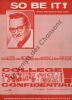
Bon état Format Américain Piano
Corpus Christianorum. Diversorum capitum seu difficultatum solutio.; Epistula de duabus naturis seu: Pamphilus theologus, Diversorum capitum seu difficultatum solutio (J.H. Declerck);Eustathius monachus, Epistula de duabus naturis (P. Allen).,
Turnhout, Brepols, 1989 Hardback, 476 p., 155 x 245 mm. ISBN 9782503401911.
Languages: Greek.

